




Abstract
This article offers an early assessment of the extent and scope of participation by higher education institutions (HEIs) in Degree Apprenticeship (DA) provision for meeting the broader workforce development objectives of the UK Government. While the take-up of DAs by HEIs and businesses has been undeniably lower than the publicly declared Government targets, the issues seem to be related to matters of institutional ‘stickiness’ in HEIs and implementation practicalities for businesses. The article reflects on the institutional dynamics involved in HEIs’ collective shifting of their practice in response to Government intervention to associate funding with HE–business collaboration. The authors’ observations are drawn from the experience of one HEI; they adopt an auto-ethnographic perspective to reflect on the role of the DA model as one way of stimulating how HEIs can work with businesses to co-design workforce development initiatives and offer ideas for future development.
Since 2015 the UK Government has been driving important policy changes to encourage higher education institutions (HEIs) and businesses to work together in delivering Degree Apprenticeships (DAs). While DAs are a government policy initiative, the intention is that apprenticeship standards should be designed largely by employer groups, so helping to ensure that key areas of workforce skills shortage can be addressed to help improve the international competitiveness of the UK economy. The UK Government has publicly committed to establishing 3 million apprenticeships by 2020, though this target is now regarded as optimistic in the light of other dynamics of the UK economy (see e.g. Moules, 2019). Behind the target is also the belief that DAs can widen participation in higher education and improve social mobility.
The Independent Panel Report to the Review of Post-18 Education and Funding (Augar Report, 2019) makes clear proposals to government on increasing flexibility and lifetime learning and improving the apprenticeship offer. The Augar Report states that 155,000 (41%) of the apprenticeships started in 2017/2018 were undertaken by people aged 25 or over and 113,700 (30%) by people aged 19–24 – thus over 70% were started by people aged over 19. Apprenticeship starts at level 6 (i.e. at degree level) grew from 1700 in 2016/2017 to 10,900 in 2017/2018. At level 6 in 2017/2018, Chartered Manager was the most popular choice, with 36% of all starts. Unsurprisingly, the Chartered Manager standards dominate, with 69 providers currently offering these programmes. The next most popular choice was Chartered Surveyor, accounting for just 17% of all starts.
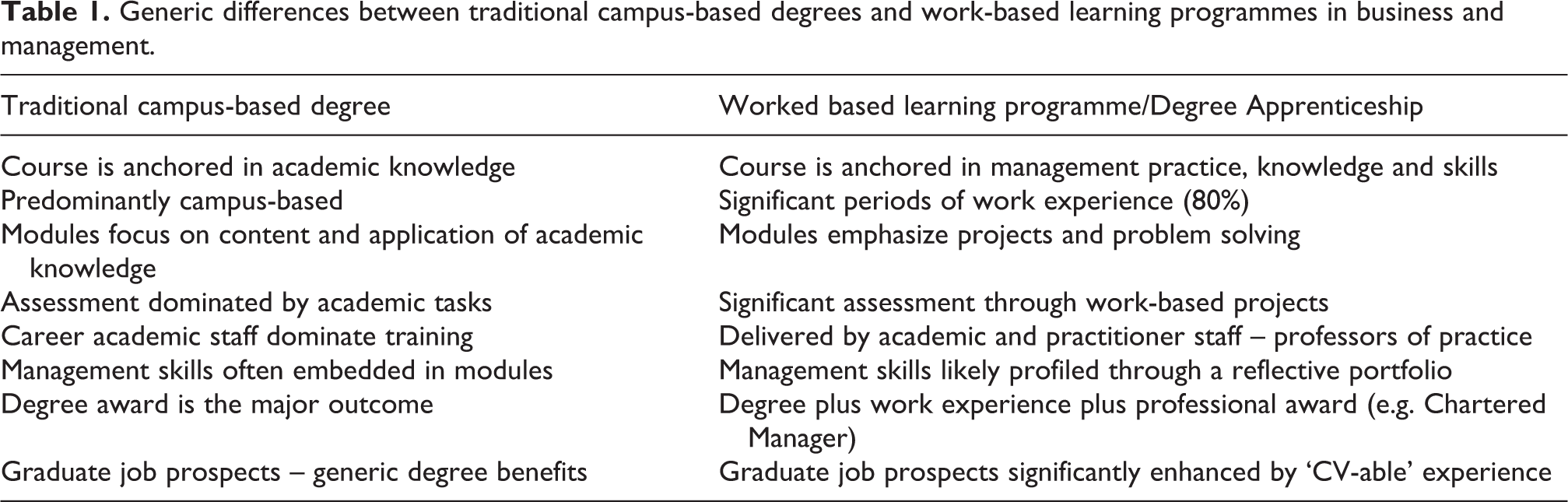
A fundamental aspect of the model for DAs is the bringing together of work-based learning and higher education study to achieve a university degree. Many UK universities have gained experience in developing work-based learning programmes in recent years and, while an increasing number of universities emphasize to potential students how their degree will prepare them for the ‘world of work’, none makes explicit a commitment to work-based learning as part of its core mission. In consequence, work-based learning programmes represent a marginal element of the typical HEI course portfolio. While DAs are new, higher-level study with a work-based learning focus is not. Table 1 lists broad features that were identified by comparing and contrasting curriculum descriptions from university prospectuses and websites for traditional 3-year business and management campus degrees with those for work-based degree programmes. While some of the boundaries between these two types of course may be blurred, in general, it is relatively easy to identify clear differences. Table 2 summarizes other forms of higher education provision in the United Kingdom that have similarities with DAs.
Generic differences between traditional campus-based degrees and work-based learning programmes in business and management.
Comparisons of DAs with other forms of HE provision.

DA: Degree Apprenticeship; HE: higher education.
An important element of the UK Government’s apprenticeship initiative is the associated funding mechanism, known as the Training Levy, which was introduced in 2017. While the Training Levy has the potential to encourage HEIs to see DA activity as a future source of mainstream funding, it has been controversial with regard to both the concept and the administrative burden, particularly for businesses. The Levy applies to businesses with an annual wage bill of over £3 million and so does not affect many small and medium-sized enterprises, for which an additional funding arrangement for apprenticeships is in place.
Writing at the start of 2019, we have not based this investigation on collecting detailed data and quantitative analysis across many HEIs. The National Audit Office report of 2019 provides detailed and recent data on UK apprenticeship activity (NAO, 2019). A number of UK HEIs have had the opportunity to initiate the development and delivery of DAs over the past 2 years in what we call the ‘start-up phase’. In this article, we critically reflect on our own experiences of introducing DAs in an English medium-sized, post-92 (i.e. a former polytechnic institution) and predominantly teaching university (specifically within a business school context). We have been working with a small number of large employers to establish the Chartered Manager Degree Apprenticeship and have completed cycles of delivery through to graduation.
We have addressed three isomorphic pressure dynamics as the focus for our critical reflections and we use the lens of an institutional perspective to understand the role of HEI structures and processes in shaping how one HEI has responded to the government’s DA initiative. First, we examine how HEIs and businesses have been encouraged by the government to collaborate through working on DAs. We see the Training Levy as a key ‘forcing’ mechanism for that collaboration. Second, HEIs are notoriously slow in changing their curriculum models; it is interesting to see how the DA initiative has engaged universities in shifting traditional degree designs towards ones anchored in work-based learning to support workforce development. Finally, we consider the extent to which HEIs in this ‘start-up phase’ of offering DAs have been approaching their design and delivery as an opportunity to be innovative and distinctive or whether they have tended to adopt a moderated institutional response that mirrors the actions of other HEIs.
Theoretical foundations
From an institutional perspective, universities can be seen as operating within a social framework of norms, values and taken-for-granted assumptions about what constitutes appropriate behaviour. Choices are informed not only by technological, informational and financial factors but also by socially constructed occurrences that are distinctly human in origin, like norms, habits and customs (Zukin and DiMaggio, 1990). Institutional theorists are especially interested in how organizational structures and processes become institutionalized over time (Burch, 2007). These structures and processes tend to be enduring, socially accepted and resistant to change. When people justify actions with the claim that ‘we’ve always done it this way’, ‘everybody does it this way’ or ‘that’s just the way things are done round here’, they are referring to the institutional structures and processes of an organization. Oliver (1997) notes that institutional theorists argue that many activities in an organization (e.g. approaches to managing the workforce, routines for assigning resources) are so taken for granted or so strongly endorsed by the organization’s prevailing culture or power structure that decision makers no longer question the appropriateness or rationality of those activities.
These institutional arguments have strong resonance when examining practice in UK HEIs. Indeed, the university sector is notoriously ‘sticky’ in terms of its practices in comparison to many business sectors and other parts of the public sector. The long-standing tradition of UK universities sustaining a model of academic freedom has led to many government reports and White Papers (e.g. Dearing Report, 1997; Robbins Report, 1963) that have recommended change and innovation in the higher education system, including, for example, in relation to teaching quality, research assessment and student satisfaction. A recurrent theme over the past 40 years has been the relevance of university courses with regard to preparing graduates for the workplace. This topic has also been regularly raised as a matter of concern by major graduate recruiters – see, for example, surveys by the Institute of Student Employers (2018) and High Fliers Research (2019). However, the ivory tower model of resistance in HEIs is remarkably resilient, particularly when it is upheld by common practice across the higher education sector.
Institutional theory suggests that activities are the result of processes at three levels: the individual, the organizational and inter-organizational. At the individual level, workforce norms and habits and unconscious conformity to traditions account for institutionalized action – or inaction. At the organizational level, culture, shared belief systems and political processes support given ways of working and perpetuate institutionalized structures and behaviours. At the inter-organizational level, pressures from government, business, peers and societal expectations define acceptable conduct. From an institutional perspective, these isomorphic pressures define what constitutes socially acceptable behaviour. Organizations embed themselves in various environments in which they may gain legitimacy from coercive, imitative or other institutional pressures (DiMaggio and Powell, 1983). These three isomorphic pressures inform three domains of research and practice on which we wish to focus in this article.
The first domain relates to the impact of formal and informal cultural and social pressures on universities to engage with wider workforce development. To obtain resources and social support, it is argued that organizations act in harmony with the state which is often seen as the main coercive force (Levy, 2006). Such pressures can be understood, depending on the perspective taken, as coercion or as an invitation to collaborate. The growth of DAs in the United Kingdom is an illustration of this process; the Training Levy introduced by the UK Government in 2017 has played a key role in shaping HEIs’ responses and encouraging higher education–industry links to deliver workforce development (Powell, 2019).
The second domain relates to the response of academics, support staff and university systems to the curriculum changes that are required to meet the broader workforce development objectives of the UK Government with regard to DAs. Universities are founded on the working patterns of members, methods and the environment, which provide definitions and rules for staff to follow to control output and build fundamental recognition and legitimacy. Systems and processes tend to develop gradually as members of an organization learn to identify which behaviours are necessary to function effectively. However, interaction with clients, regulators or other external stakeholders can challenge existing practice and require adaptation and change to systems, processes and the behaviours of university staff. Developments in the models for DAs can be seen as a disruptive force challenging traditional values and educational orientation in universities, which may be embraced or resisted to varying degrees.
The third domain stems primarily from the responses of organizations to uncertainty. This can be seen as a tendency for a university to model itself after other universities. Such mimetic reinforcement can be seen in aspects such as standard programme formats, one-size-fits-all approaches, common symbols or phrases and common organizational structures. External guidelines, such as those guiding DA development, may seek to reinforce similarities between institutions and may run counter to the aspiration of universities to differentiate themselves and stand out in an increasingly competitive market for higher-level skills.
Below we use these three domains to structure our reflective narrative around an interpretation of the nature of changes in HEI institutional dynamics that have been triggered by the UK Government’s DA initiative to foster greater HEI–business collaboration in relation to workforce development.
Research methodology
This article draws on a form of action research to develop an understanding of DAs in this institutional context. This approach follows such calls as that of Dover and Lawrence (2010) for research approaches to revitalize connections to individuals and organizations in situ both to foster greater relevance and to re-energize theoretical development. Dover and Lawrence suggest that a participatory form of action research begins from a position of close identification with the actors on which it focuses. The individuals who in other traditions might be viewed as ‘subjects’, a ‘population’ or a ‘sample’ are understood from this perspective as active, engaged and equal participants in the research process. The approach encourages the full and active involvement of participants with the expectation that critical reflection will lead to an increased self-awareness of their positions as well as their own resources (McIntyre, 2008). It draws on, and values, insider knowledge that stems from everyday experience and unique situations. Where successful, this form of action research supports the development of new practices that deliver some form of individual or organizational change.
Action research often occurs as an emergent and local process (Maguire, 1993), and this is indeed the case for the present study since two of the authors have been fully engaged with many others in the design, development and implementation of DAs at a UK university. We draw on the institutional setting in which we work and use our experiences, knowledge and access to empirical material for research purposes. We have more than 40 years of experience between us associated with the design and development of a variety of work-based learning programmes in university contexts. More recently, we have focused our activity on the development of DAs and have worked intensively with a variety of actors both in and outside the university to develop and deliver the Chartered Manager DA. We have drawn on these experiences and designed and used a semi-structured discussion guide to inform retrospective critical reflection (Boud et al., 1985) on the isomorphic pressures influencing DA developments. The approach in this article is not limited to reporting our experience but rather adopts a reflective auto-ethnographic perspective (see Minocha and Reynolds, 2013). As co-creators of the experience reported, we are writing in a reflective and auto-ethnographic style and we are implicit in our demonstration of ‘verisimilitude’ (Bochner and Ellis, 2003) and ‘naturalistic generalization’ (Stake, 1994) in evaluating the authenticity and impact of this research. Writing up practice is messy because there is rarely a distinct theoretical basis; we have retained this messiness in our reflection, although we draw on the institutional literature base outlined in the previous section. Our writing style for the narrative is deliberately intended to be authentic in relation to our auto-ethnographic and practice stance.
This method is replicable in other institutions where individuals with the necessary high levels of practical knowledge are willing to engage in a critically reflective process and work with others to collect data, discuss evidence and articulate their findings. A form of selective participation is not uncommon in organizational action research (Sense, 2006); however, there may be value to be realized from the full and active engagement in the research process of a wider group of practitioner-researchers directly representing different perspectives (e.g. registry, business, learner) than is used in this article. Potential researchers need to be aware of the strengths and limits of their pre-understanding so that they can use their experiential and theoretical knowledge to reframe consideration of situations to which they are close. They will need to attend to the demands that both organizational roles and researcher roles make on them and to consider the impact of organizational politics and resources on the process of inquiry and participant engagement (Brannick and Coghlan, 2007).
In summary, our approach is to draw critically on the collective reflections from two researcher-authors concerning recent changes to HEI institutional dynamics in relation to business collaboration. These reflections are calibrated against three isomorphic pressure domains to help understand how workforce development collaboration has developed in response to the UK Government’s DA initiative. It should be stressed that our reflections relate to what might be called ‘start-up phase’ of the DA initiative. We expect that these institutional dynamics may change over time and we make observations to this effect.
Reflections on DA activity in UK HEIs
Following the perspective articulated above, we focus our discussion on the three isomorphic pressure domains highlighted to reflect on the nature of the response of one university to the DA initiative and its approach to engaging with businesses in collaborative workforce development. In summary, our critical reflections provide insights into the dynamics of HEI–business collaboration with regard to workforce development focused on the current intervention episode, DAs. It will be evident that our reflective narrative emphasizes the often push–pull nature of the institutional dynamics at work within organizations and this is certainly our observation regarding HEI–business collaboration in relation to workforce development with DAs.
It is important to stress that apprenticeships are a devolved policy initiative in the United Kingdom. While all UK organizations are subject to the Training Levy if their annual wage bill is over £3 million, each nation manages its own apprenticeship programmes and how apprenticeship funding is used. The discussion that follows draws its reflections from experience in England. Similar action research on experience in Scotland, Wales and Northern Ireland would offer slightly differing reflections. Table 3 compares apprenticeship delivery in Scotland and England: while the two systems are not poles apart, the differences would need to be considered.
Apprenticeship delivery in Scotland and England.

Note: Levy is paid by all UK companies with an annual wage bill over £3 million (0.5% levy).
Critical reflection, Theme 1: DAs as an external pressure initiative on universities and businesses to collaborate
It is clear that successive governments in the United Kingdom have sought to encourage HEIs and businesses to collaborate in addressing workforce skills shortages. From Robbins Report (1963) through to Dearing Report (1997) and more recently Wilson (2012), there have been persistent calls for increased university–business partnership. Progress has been painfully slow. Currently, there is a strong expectation by government and businesses that UK universities should design and deliver degrees that better prepare graduates for the world of work in the 21st century. In this context, DA initiative, combined with the Training Levy, is another example of external pressure on universities to collaborate and engage with businesses. Arguably, it is the Training Levy that has driven a higher degree of responsiveness from both businesses and universities.
Our critical reflection on the recent experience of establishing DAs in our university context is that it highlights two particular external pressure dynamics at work that have brought about change in our institution’s behaviour with regard to collaborating with businesses. The first follows from the introduction of the Training Levy as a source of funding for DAs. This has impacted the behaviour of both businesses and universities. For businesses, the Levy represents a tax-based initiative to incentivize an investment in training. It is also a forcing mechanism by government to implement – even on a small scale – a change in the model for university funding. The idea of ‘learning while earning’ is appealing as a policy. It also implies that university courses would need to adapt to help prepare students for the world of work, which in turn addresses the view that businesses should contribute towards some aspects of the cost of going to university – presumably because businesses are seen as the primary beneficiaries of graduate talent.
The Training Levy has, then, brought HEIs and businesses together, though the underlying motivation perhaps arises from necessity rather than corresponding to the finer points of government policy thinking. Our behavioural insight comes from the initial response of businesses to the Training Levy. We have observed a simple motivation, which we label the ‘spend or lose the Training Levy’ strategy. Businesses with a wage bill of over £3 million a year are faced with a ‘tax’ that they can claim back only by investing in apprenticeship training.
Businesses that trigger it are therefore faced with a decision to change their training investment behaviour or forfeit the opportunity to recover any paid Training Levy. The ‘spend or lose the Training Levy’ strategy probably reflects the notion that paid Training Levy becomes the ‘default training budget’. One consequence of this attitude in our experience of working with employers is that they have been primarily using apprenticeships to draw down Training Levy funding to upskill and retrain their existing workforce (e.g. middle management) rather than to develop new or younger talent. This was not seen as the primary purpose behind the UK Government’s DA policy.
This first external pressure (coming from business) has driven the second. Any business deciding to invest its available Training Levy will seek a trusted university partner who can design and deliver DAs for it. Some HEIs have not been passive in this area – they have approached businesses about investing their Training Levy pot in DAs for their workforce. At our university, we have both engaged with long-standing business partners and developed new partnerships. This highlights our second external pressure dynamic on HEIs: they can access DA funding only if they partner with a major employer. We label this external pressure ‘building HEI–employer bridges’. This has ‘forced’ workforce development collaboration but with the important caveats we note below.
‘Building HEI-employer bridges’ is not a one-size-fits-all model. We are able to reflect directly only on the experiences of our own university in shifting its collaborative model with businesses in relation to the current DA initiative. However, intelligence sharing, conferences and workshop events about the ‘new DA activity’ all suggest that some common practices are emerging across HEIs in relation to collaboration with businesses for DAs. Of course, the UK Government, the Institute of Apprenticeships and the various standard-setting bodies seek a degree of uniformity in support of consistency and quality management.
In responding to the DA policy initiative, many HEIs are not starting with a blank sheet when it comes to collaboration with business. Various universities have established specific structures and processes for working closely with business, though these ‘commercial units’ are typically small and narrow in scope. The systems and processes in HEIs for delivering and managing traditional campus-based degrees generally do not fit well with the demands of more commercially orientated work. At our Business School, we have a long-standing (10-year) relationship with a national pub company and a new relationship with a consortium of companies that was established over a 4-month intensive DA tender process.
Our reflection on our own experience of university–business working is that employers have a preference to collaborate with university providers when they have built a strong, working and trusted relationship. We have also sensed that businesses have a level of comfort and reassurance when working with academic teams that ‘get it’ in terms of understanding the work-based approach to learning – where practice knowledge rather than academic knowledge is at the forefront of learning. In general, these relationships are not easily forged – though it might be argued that in the current DA/Training Levy initiative there is an element of government coercion to bring HEIs and businesses together.
However, universities have faced some early challenges from employers committed to investing in DAs, including demands for fast-track DA approvals; increased flexibility, adaptability and contextualization in content and delivery style; and evidence of a strong faculty base able to deliver work-based learning. We have also seen an interest in 2-year delivery models for the DA. Of course, businesses that pay the Training Levy in England face external pressures to spend it within a 2-year window. This in turn can put HEIs under pressure to design and develop programmes quickly in response to a particular business initiative.
Some of the dynamics of how HEIs and businesses work together have been shaped by the UK Government and the Institute for Apprenticeships – and this influence has not always been regarded as helpful, including, for example, the need for businesses to recruit, select and enrol apprentices inside the 2-year Training Levy window. Some timelines have been seen as unrealistic and information dissemination into organizations has been sporadic, ad hoc and inaccurate. On reflection, the mature working relationship that existed between our university and our main DA employer opened up an opportunity for a degree of manipulation and coercion, possibly on both sides. We had shared experiences, shared knowledge and shared risk – the lines can become blurred.
The core purpose of this section of the article has been to present our reflection on the interplay between two external pressure dynamics associated with the impact of the DA initiative. These dynamics provide the focus for our sense-making of how HEI–business collaboration for workforce development has changed in England over the past 2 years. While ours is just one case example, HEIs as a whole have had to engage with DAs in accordance with defined guidelines and policies. As noted earlier, the English apprenticeship system is different from that, for example, in Scotland. However, both English and Scottish universities are approaching the design and delivery of DA programmes in collaboration with business in a similar way, even if the funding mechanism is different. At the same time, this difference in funding mechanisms across nations is problematic for businesses. For example, it is imposing restrictions on employers who are looking to implement a fair and consistent ‘talent’ strategy across their UK-wide businesses.
Critical reflection, Theme 2: DAs and the dynamics of university responsiveness to new curriculum models for workforce development
Various internal factors have shaped our university’s response to the DA initiative in the ‘start-up phase’. We focus here on two key dynamics – curriculum and systems. We have seen the curriculum developments related to the delivery of DAs leading to a drive for system changes. This first dynamic we call ‘Stage 1 push–pull curriculum factors’. The DA initiative challenges the traditional 3-year campus-based degree which, in general, is anchored in specialist academic knowledge. The DA standards are specified in terms of knowledge, skills and behaviours but emphasize the blending of university study with workplace learning. It is clear that a DA provides more scope for workplace learning than it does for university study. Universities responding to the DA initiative are faced with a choice between mapping existing degree designs onto apprenticeship standards or taking the more radical option of redesigning degrees for work-based learning contexts, most likely in collaboration with business.
In our university, the curriculum response to the DA finely balanced these push–pull dynamics. We have adapted our existing curriculum to meet DA standards. This compromise reflects the ‘stickiness’ of traditional university curricula as well as the reality of a fixed academic staff base that will be expected to deliver similar courses to both traditional campus-based students and workplace delegates studying DAs. This balancing outcome has given some flexibility to the DA delivery team to work with business partners to manage a degree of contextualization – for example, in the use of specialist options and work-based project modules. This flexibility was crucial when responding to a large employer with whom we had a long-standing relationship which asked whether the university could develop a bespoke DA programme. Having a major employer approach, the university in this way helped to shift mindsets; a positive attitude towards DAs emerged even though neither the employer nor the university had a clear line of sight as to what the design and delivery of such a DA might involve.
It is noteworthy that other motivations were at work in encouraging work-based learning activity within the university through the launching of DAs. For example, DAs were seen as an opportunity for the university to regrow its part-time provision; similarly, as an ‘anchor institution’ in its region, the university was committed to working with employers on closing the higher-level skills gap, with clear goals to widen participation and increase social mobility. Apprenticeships can have a transforming influence through enabling greater social mobility and providing disadvantaged students with a pathway to university education without building up significant debt. The university had explicit ambitions in this area.
Our reflections also identified a knock-on systems impact of delivering work-based learning DAs. We label this the ‘Stage 2 internal infrastructure/systems impact’. Increasing levels of DA activity have disrupted the university’s existing systems and structures, challenging aspects of the way it operates. This disruptive effect of the DAs exposed weaknesses in the infrastructure that were inhibiting the rapid expansion for market share of regional DA activity. First, the complexity of the Education and Skills Funding Agency (ESFA) processes supporting DAs is onerous and resource-intensive – and so highlighted the university’s system constraints in areas such as registry and quality. Challenges relating to quality, regulations, progression and exam boards, as well as compliance with the ESFA, all pointed to blurred lines in the university that both tested our ability to understand the implications of DA delivery and limited any ambitions to push for rapid growth. The obvious consequence was missed market opportunities. In addition, the inevitable challenging of traditional norms and values led to extensive debate and reflection on how best the university should organize itself to deliver significant DA activity.
Conference and workshop events on the new DAs provided anecdotal evidence that our experience was mirrored in other universities. The general lack of understanding of DAs and how they were intended to operate created challenging engagement dynamics between the university and partner employers in particular. With regard to employers, for example, there was a lack of understanding of the funding rules, the value of the commitment statement and the requirement for the provision of trained mentors or any other learning support to their apprentices. University colleagues harboured a number of perceptions about the introduction of DAs – for example, they questioned the reputational value and were doubtful that there would be any return on investment. Our university faced a number of problems in allocating the necessary resources, human and physical, for the successful delivery of a DA at the point of start-up. These challenges, and the growing knowledge and expectations of employers about DAs, continue to test our capacity and capability to deliver a sustainable DA provision. Partner employers can sense the presence of these issues through feedback from their staff and this often leads to the need for careful and considered account management to sustain credibility and maintain trust in the university–employer relationship.
The dynamics highlighted above present challenges to existing roles and responsibilities in universities. Many ‘front runner’ institutions have established stand-alone units with responsibility for leading and managing the development of DAs with companies. In general, this practice has been well received by companies, which see it as offering flexibility, responsiveness and professionalism in the university’s DA provision. These units often include a combination of administration, management and delivery faculty. At our university, the management arrangements for DAs are evolving but more slowly than established ‘front runners’. In consequence, we have experienced predicable staffing issues associated with implementing a DA model that challenges traditions and norms. For example, some of our DA delivery faculty are also engaged in traditional programme delivery and find work-based learning and its dynamics a difficult adjustment. Similarly, providing administrative support for DAs in a system in which structures and processes are based on the traditional campus-based model tests the flexibility of the roles and responsibilities of professional support staff.
Perhaps the most obvious point of difference in the DA model is the distinction between a work-based learning curriculum and the traditional 3-year campus-based curriculum. Our experience suggests that DAs are more likely to be successful if they are aligned to employers’ specific strategic priorities: this is an obvious point, but it is not easily achieved against the background of traditional curriculum models. Our DA employers have been keen to be involved in co-creation and collaboration for their bespoke programmes: one looked to map its 5-year strategic plan onto the curriculum, giving rise to an interesting discussion about the co-creation of business risk, corporate governance and ethics modules. Another partner, an employer-led consortium, based the differentiation and ethos of its bespoke DA programme design on module content being shaped around extensive research on its industry sector.
Curriculum dynamics such as those noted above can result in programmes that are innovative and ‘unique’. One of our challenges has been the juxtaposition of these unique DAs with the delivery of our traditional course provision. In launching our DAs, we experienced teething problems in module scheduling to allow time for sufficient depth of understanding and meaningful refection on practice. Similarly, all exams were replaced by applied learning assessments. In short, there have been many adjustments to our modes and styles of delivery so that our DAs reflect the profile of our work-based learners.
Critical reflection, Theme 3: Distinctiveness in DAs – Balancing an HEI’s workforce development strategy and risk
Our third theme focuses on the opportunities for differentiation and innovation by HEIs in the workforce development market when offering DAs. More generically, we are reflecting on the capability and motivation of individual HEIs to engage in differentiation and innovation when faced with potentially sector-wide change. The UK’s HEI sector has a long-established system dynamic, with universities showing a tendency to move and change at the pace and direction of the ‘sector’. We focus our reflections on two related dynamics – integrating the workforce development curriculum and managing risk and innovation.
In the portfolios of many UK HEIs, the presence of workforce development curricula is limited to specialist corporate units or small and disparate teams located in core faculty structures. Indeed, a workforce development curriculum does not sit comfortably within the dominant academic curriculum models. There have been limited financial incentives for HEIs to offer such curricula – hence its marginal significance in individual institutions and overall in the sector. It is significant that the UK’s university sector has evolved over decades a range of sector-wide systems, regulations and guidelines that define ‘best practice’ in HEIs. For the core activities of teaching and research, the assessment and grading of HEIs through regular monitoring and national league tables (e.g. the National Student Satisfaction Survey) have tended to encourage similarity in core provision, operational management systems and educational outcomes. The narrative of differentiation between HEIs is often strongly expressed and aggressively marketed, but the reality is that the UK’s higher education sector is largely uniform in its provision. Course portfolios and models of delivery result in a student experience that is broadly similar across institutions.
There is a significant difference between conventional 3-year campus degrees, for which individual students apply to their preferred university, and DAs, for which business organizations effectively make the decision as to which university is to be their preferred supplier. In delivering DAs for business, HEIs are beginning to see a clear need for differentiation and innovation in provision. However, in a context of university systems and processes geared towards delivering a uniform quality of student experience on campus, the task of offering high-quality workforce development that meets the specific needs of an employer may well prove challenging to the HEI’s capacity and capability.
In 2019, we are seeing the DA initiative arguably coming to end of the ‘start-up phase’. A ‘second cycle’ phase is likely to force more intervention, structure and process change as universities are required to work more strategically with organizations – where, for instance, a DA is integrated into an organization’s workforce development strategy. As HEIs recognize that the DA initiative is ‘here to stay’, institutions will need to differentiate their offer whether they are to retain client partners and grow new business against the Training Levy funding that is available for investment by different organizations. The mainstreaming of system and process change in HEIs to support DA activity has started but, for the reasons noted above, progress is slow and is delaying ‘second cycle’ phase development and responsiveness in some universities.
Balancing risk and innovation has been, and continues to be, a notoriously challenging dynamic in HEIs. It remains an open question whether the UK Government will allow individual HEIs to fail, but this possibility arguably has limited the commitment of universities to engage in more radical futures in the way some other sectors have been forced to do (e.g. the challenges facing the retail sector and the high street). During the first cycle phase of the DA initiative, our experience was that risk factors were not explored or planned for in any depth. We observed the presence, at least in perception, of a ‘siege and herd mentality’. HEIs, faced with an opportunity to design innovative programmes and to differentiate themselves in the sector by working with organizations to support workforce development strategies, have tended towards a strategy of mapping already existing degrees onto the apprenticeship standards to enable early entry into the market.
It could be argued that this response by HEIs was in part driven by the process and outcomes associated with the DA standard setting process. Many apprenticeship standards offer statements of curriculum that do not explicitly account for the possibility of adaptation to an individual organization’s workforce development strategy. Universities have generally been mechanistic in their response to these DA standards and appear to have adopted many common practices in their design and provision. Many DA designs are anchored in semi-traditional undergraduate curricula rather than representing radically new and innovative workforce development curricula. Of course, the HEI narrative of partnership with business demands reference to adaptability and contextualization, but the reality of common HEI practice is pervasive. Herding practice in HEIs has been common for decades as particular government initiatives have come and gone. For the individual HEI, this approach provides a sense of comfort and reassurance (‘if they are doing it then it must be right’) and a sharing of risk across the sector.
The perception of equivalence between the workforce development curriculum and the traditional campus-based curriculum highlights the fact that change management in institutionally defined HEI environments can be slow and difficult. Some of our academic colleagues found it challenging to think differently about the patterns and mode of delivery and teaching styles; it was necessary to change delivery teams so that attitudes towards a workforce development curriculum and nontraditional student profile were improved. Our reflection on the emergence into the second cycle phase of the DA is that it will require an even higher level of alignment of the delivery team with the demands of successfully delivering a workforce development curriculum. We sense that our partner employers are becoming increasingly engaged with formulating ideas about the nature of our workforce development curriculum and its contextualization to the needs of the organization and its employees.
This last point identifies another important risk factor worthy of particular mention: the exposure of university DA delivery teams to working with an organization’s workforce. ‘Getting things wrong’ with a major employer brings high reputational damage to a university that will typically ripple through the sector and the well-networked marketplace of DA suppliers. Universities take the risk that, with DA provision, an organization can at any time withdraw without financial obligation. This dynamic is another factor that differentiates the DA from the conventional campus-based degree. Employers can decide to remove apprentices who may be underperforming in the business – a university has no control over the retention and progression of an organization’s employees – so putting at risk planned income streams associated with a DA contract.
Discussion and concluding reflections
It would be naive to believe that the UK Government’s recent reform of its apprenticeship scheme would instantly spark a major shift towards the adoption of DAs in universities. The breaking points in adopting work-based learning models in universities are many, but the two most obvious are the anchoring traditions of the academic staff base and the challenge of scaling up workplace learning opportunities. In the context of DAs, businesses wanting to invest in the programme are providing a supply of such opportunities. However, the dominant institutional dynamics of HEIs ensure that many face internal constraints in systems and academic staffing that prevent a major shift to DA provision and workplace learning.
We see the evolution of DA provision in universities going through a number of phases. In this article, we have reflected on the ‘start-up phase’ of the new framework for DAs in the United Kingdom. We have interpreted our university’s response to partnering with employers in workforce development as largely shaped by dominant institutionalized practices. This response reflects the reality that we are a traditional campus-based university. Indeed, it is likely that our business partners interpret and make sense of our behavioural responses in the light of the institutional stereotype of a traditional university. This has sharpened our sense of the importance of our university making changes in the second cycle phase of DAs. If workforce development using the DA model is to make a significant contribution to the social mobility agenda, partnership working between HEIs and employers will need to improve dramatically.
We anticipate that the second cycle phase will see our partner employer organizations developing more robust workforce development strategies with DAs playing a key role; this will drive more explicit objectives to which we, as the university partner, will need to respond. We see, for example, the recruitment and selection of apprentices becoming crucial, particularly as organizations shift their focus to the harnessing of new and emerging talent and not just developing existing middle management. We believe our business partners are becoming more ‘savvy’ and aware of the value of DAs to the business in terms of both return on investment and continuing professional development. ‘Moderated institutional responses’ by HEIs will not be a viable strategy as the market for DAs develops and matures. While DA activity may fall well short of traditional campus-based provision, HEIs will need to present DAs as well-developed and responsive products offered as part of an integrated portfolio. Long-standing institutional practices will not be an acceptable constraint as employers gear up their investment in DAs as part of their workforce development strategy.
A trend that we expect to develop during the second cycle phase is that of the business partners engaging more strategically in the process of aligning work-based learning on a DA programme with live initiatives and projects in the organization. This has two key advantages. First, it will support the apprentices in their learning process, making it less problematic for them to juggle a full-time demanding job with part-time education. Second, it will encourage a recognition that apprentices will be best placed to help execute the outcomes of the project investigations if they are enabled to progress within the organization. This combination of work-based learning with real activity in the business partner’s organization (in contrast to being primarily anchored in traditional academic knowledge) will of course present significant curriculum innovation challenges for many universities.
We also expect that there will be a number of operational innovations in the running of DAs during the second cycle phase. For example, we are expecting our partner organizations to want to make changes to curriculum design, particularly in relation to shortening the length of the programme and increasing the level of content relevant to the day to day running of the company. The second cycle phase will also likely see HEIs having to consider alternative progression routes with multiple ‘stopping off’ points, so that a continuous study programme from start to degree qualification becomes more staged to fit in with the other work and life pressures that many apprentices face. All these trends point to employers seeking out HEI partners who can provide an end to end solution to their qualifications, training and development plans and priorities. Finally, we recognise that if the DA model achieves wider acceptability from Training Levy paying employers, this will bring in more DA providers. We have noted that the traditional staffing base of most HEIs constitutes a barrier to large-scale DA provision. Increasing competition among DA suppliers will underline the necessity for an HEI to be able to demonstrate innovative pedagogy and so differentiate its offer as it seeks to attract the best business partners.
According to the report Shaping Higher Education – 50 Years After Robbins, ‘if UK higher education is going to prosper in the contemporary world, it is going to have to become messier, less precious, more flexible, and significantly more co-operative’ (Barr, 2013: 45). Few, if any, UK HEIs are motivated, designed and organized to meet this challenge. Specifically, in the context of this discussion, the workforce development curriculum needs to be characterized by diversity and innovation rather than standardization – this will be key to meeting the diverse needs of employers and their employees over the coming decades. There is need for an increasing speed of change and responsiveness in systems and practices in universities as the implementation of DAs evolves and expands. While this might not be a surprising necessity as a large national initiative ‘beds down’, it will not be without disruptive consequences for HEIs.
Footnotes
Declaration of conflicting interests
The author(s) declared no potential conflicts of interest with respect to the research, authorship, and/or publication of this article.
Funding
The author(s) received no financial support for the research, authorship, and/or publication of this article.
