




Abstract
This article explores the key challenges experienced by employers, employees and academics during work-based learning (WBL) programmes. Higher education institutes (HEIs) and external employer organizations are increasingly recognizing the benefits of engaging in WBL partnerships. These collaborations offer significant benefits to employers, employees and HEIs. The challenges associated with WBL place demands on the design of curriculum, pedagogy and accreditation. One of the major challenges facing the HEI and employer organization relates to organizational culture. The purpose of this article is to present an organizational culture web that recognizes the requirements of all stakeholders participating in a WBL partnership. An ethnographic methodology combining a number of different data-gathering methods was adopted. Johnson’s cultural web is used as a framework to present a series of recommendations for HEIs to review when considering WBL partnerships. The understanding of best practice in the design of WBL programmes is enriched.
Higher education policy is placing increasing importance on the need for higher education institutions (HEIs) to collaborate with external employers in the design and delivery of programmes of study (Buligina et al., 2016; Ferrández-Berrueco et al., 2016; Hurn, 2016). It is expected that in the coming years there will be a surge in demand internationally for work-based learning (WBL) partnerships between HEIs and external employer organizations. This expected increase in demand is influenced by a three factors: (1) the rise in non-standardized work for employees (Billett and Choy 2013, Baker et al., 2017), (2) the recognition by employers that knowledge is a source of competitive advantage (Basit et al., 2015; Etzkowitz and Zhou, 2018) and (3) HEIs seeking exposure to real-life business problems, as well as improving their reputation among external employers (Bureau et al., 2012; Stephens et al., 2014). Despite the recognition of the important role WBL can play in meeting the social and economic needs of society, few studies have investigated curriculum-related HEI–business cooperation (Plewa et al., 2015). Most studies that focus on collaborations between industry and higher education tend to concentrate on research and innovation, and the limited research available on WBL partnerships tends to focus on the associated challenges. Therefore, the aim of this article is to explore, through an ethnographic study in an HEI, how a deeper understanding of organizational culture can enhance WBL partnerships for the HEI by presenting a series of recommendations for it to review when considering WBL partnerships.
The HEI that was the site of inquiry (henceforth ‘HEI X’) is located in Ireland and has significant experience of engaging in WBL partnerships, having developed WBL programmes in cooperation with local, national and international employers. HEI X commenced operations in the early 1970s and is relatively small, with just over 3500 full-time learners and four academic faculties. It is one of the leading providers of WBL in Ireland, delivering a wide spectrum of WBL programmes in the Irish National Framework of Qualifications – from level 6 (Higher Certificate), through levels 7 and 8 (Ordinary and Honours degrees) to level 9 (Master’s). This research focuses on accredited programmes designed and delivered by an HEI in collaboration with an external organization, in which the learners are already in employment and where the learning is derived from the needs of the organization and its employees. What follows is a short discussion on WBL and the challenges and benefits it presents to the HEI. Organizational culture is then presented and, more specifically, how it affects WBL partnerships from the perspective of the HEI. The research methodology and methods are also presented. Finally, the impact of organizational culture is discussed and a series of recommendations for HEIs considering WBL partnerships is presented.
Work-based learning
Lester and Costley (2010: 562) define WBL as all and any learning that is situated in the workplace or that arises directly out of workplace concerns. According to Sobiechowska and Maisch (2006: 270), WBL involves programmes of study where ‘students are full-time employees whose programme of study is embedded in the workplace and is designed to meet the learning needs of the employees and the aims of the organisation’. The aim of WBL programmes is to simultaneously meet the learning needs of employees and the needs of their employer. Boud and Solomon (2001) explain that WBL programmes typically have six characteristics: (1) a partnership between an external organization and an HEI; (2) learners who are employed in an external organization: (3) a learning programme derived from the needs of the employers and their employees; (4) learners engaged in a process of recognition of their current knowledge, skills and competencies; (5) learning that takes place as an integrated part of tasks completed in the workplace; and (6) learning that is assessed by an HEI. Stephens et al. (2014: 159) explain that designing and delivering a curriculum for WBL is challenging for academic practitioners accustomed to the traditional mode of teaching and learning. The result is that academics who are involved in WBL typically advise, mentor, coach and supervise rather than teach. Major (2016) claims that academics acquire industry knowledge and exposure to real-life business problems when participating in WBL partnerships, and this knowledge can then be passed on to traditional full-time learners. Engaging in WBL programmes can broaden the contact base with industry partners, thus stimulating future opportunities for research and innovative collaborations (Wedekind and Mutereko, 2016). In WBL programmes, the majority of the learning occurs in the workplace. Therefore, the curriculum is derived from the needs of the employer and learner. However, some academics are reluctant to recognize learning that takes place outside the HEI (Major, 2016). However, Billett and Choy (2013) dispute this claim by describing workplaces as sites for the constitution of knowledge and learning. WBL programmes are often bespoke, as opposed to ‘off the shelf’ programmes, which means the learning programmes are negotiated, and this can challenge the HEI.
Reeve and Gallacher (2007) describe how HEIs have different cultures from private employers and emphasize the importance of understanding each other’s culture when engaging in WBL partnerships. Cultural differences between the two organizations in relation to goals, language, assumptions and time frames can make this form of engagement challenging (Collier et al., 2011; Schofield, 2013). However, it is not just cultural differences between the HEI and the external organization that create challenges in WBL partnerships. Often, cultural issues within the HEI or external employer can create difficulties when attempts are made to initiate or manage WBL. There are four challenges specific to the HEI. These relate to (1) systems within the HEI, (2) the organizational structure, (3) QA requirements and (4) a reluctance to share power (Major, 2016). Layer et al. (2010) suggest that organizational culture in an HEI is heavily influenced by how traditional full-time programmes of study are administered. As a result, the HEI can find it challenging to adapt its systems to suit non-traditional programmes such as WBL programmes. WBL programmes often run over 2 years, which can have implications in relation to registering learners on a programme, assessing learning and providing access to services.
Partnerships between universities and industry in general have been well-documented. Less well-documented has been industrial engagement in live collaborative projects specifically in relation to product design higher education (Hurn, 2016). According to Plewa et al. (2015), previous studies on industry–HE partnerships put too much emphasis on barriers and fail to highlight the drivers and benefits associated with such collaborations. For an HEI, ensuring a good relationship with the external employer organization is seen as extremely important. It is important that the HEI and the external organization take a collaborative approach to coordinating the WBL programme, with the employer involved in the design, delivery, monitoring and evaluation. The HEI needs to embrace a customer relationship management approach, and the HEI staff coordinating the WBL programme have an important role in ensuring that the partnership is successful (Schmidt and Gibbs, 2009). Basit et al. (2015) suggest that WBL collaborations work well only when they are managed by people who cross boundaries easily and have a deep understanding of the two cultures they need to bridge. HEIs should consider employing brokers to ‘build bridges’ between the HEIs and external employers.
Organizational culture
According to Alvesson (2013), culture is central to everything in organizational life, and the behaviour of the members is guided by values, ideas and beliefs that are accepted within their organization. Schein (2004: 17) defines culture as a pattern of shared basic assumptions that is learned by a group as it solves its problems and that is considered valid and is, therefore, taught to new members. However, this notion that culture is a shared phenomenon is questioned by Martin (2002), who suggests that different values may be displayed by people of the same culture. There are a number of influences on an organization’s culture. In certain industries, organizations share cultural characteristics that differ significantly from the characteristics found in other industries. Organizations operating in the public sector develop a different culture from those in the private sector due to differences in customer requirements, products and services offered, competition, technologies, funding sources and government influences. Public sector organizations such as HEIs are more influenced by the government than private organizations due to policies and legal frameworks imposed.
There is still debate in relation to whether or not culture can be changed. Lewis (1998) has concerns about changing something that is not unitary. However, if culture is composed of numerous subcultures, how/can managers change it? Changes to an organization’s culture can occur whether it is planned or not. An organization’s culture can change without altering deep underlying assumptions that have been widely accepted by its members. Such changes, Schein and Schein (2017) explain, may involve the identification of new stories, new heroes, people spending their time differently on a day-to-day basis and carrying out different rituals. There have been only a few studies of organizational culture in relation to HEIs, with most of the research gathered relating to industrial or commercial organizations (Kaufman, 2016). Interest in studying organizational culture from a higher education perspective appears warranted, as organizations operating in the HE sector are facing similar challenges to those in the private sector, including economic restructuring, internationalization, market forces and demographic shifts. However, understanding an HEI’s organizational culture can prove difficult, due to the absence of a unitary culture (Becher and Trowler, 2001). Subcultures relating to academic discipline and level in the organizational hierarchy tend to exist in most HEIs. Barnett (2000: 48) uses the term ‘multiversity’ when describing an HEI’s culture, suggesting that such institutions are composed of multiple factions, interests and activities, with notable differences between the academic and administrative subcultures.
Martin (2002) recommends that, when studying organizational culture, it is important to consider the broadest possible range of cultural manifestations and to incorporate both materialist aspects (e.g. physical arrangements, job descriptions, pay arrangements) and idealist aspects (e.g. beliefs and values) as part of the research. In recognition of the various cultural elements, writers have proposed a number of different frameworks for studying organizational culture (Hofstede et al., 1990, Manifestations of Culture; Schein, 1985, Three Levels of Culture and Johnson, 1988, Cultural Web). The cultural web was selected as the framework for this study: it has already been demonstrated to be a useful framework for performing organizational cultural analysis (Freemantle, 2013; Mossop et al., 2013). Johnson’s cultural web (1988) is therefore used to discuss the findings of this study. Its six factors, together with the paradigm, are shown in Figure 1.
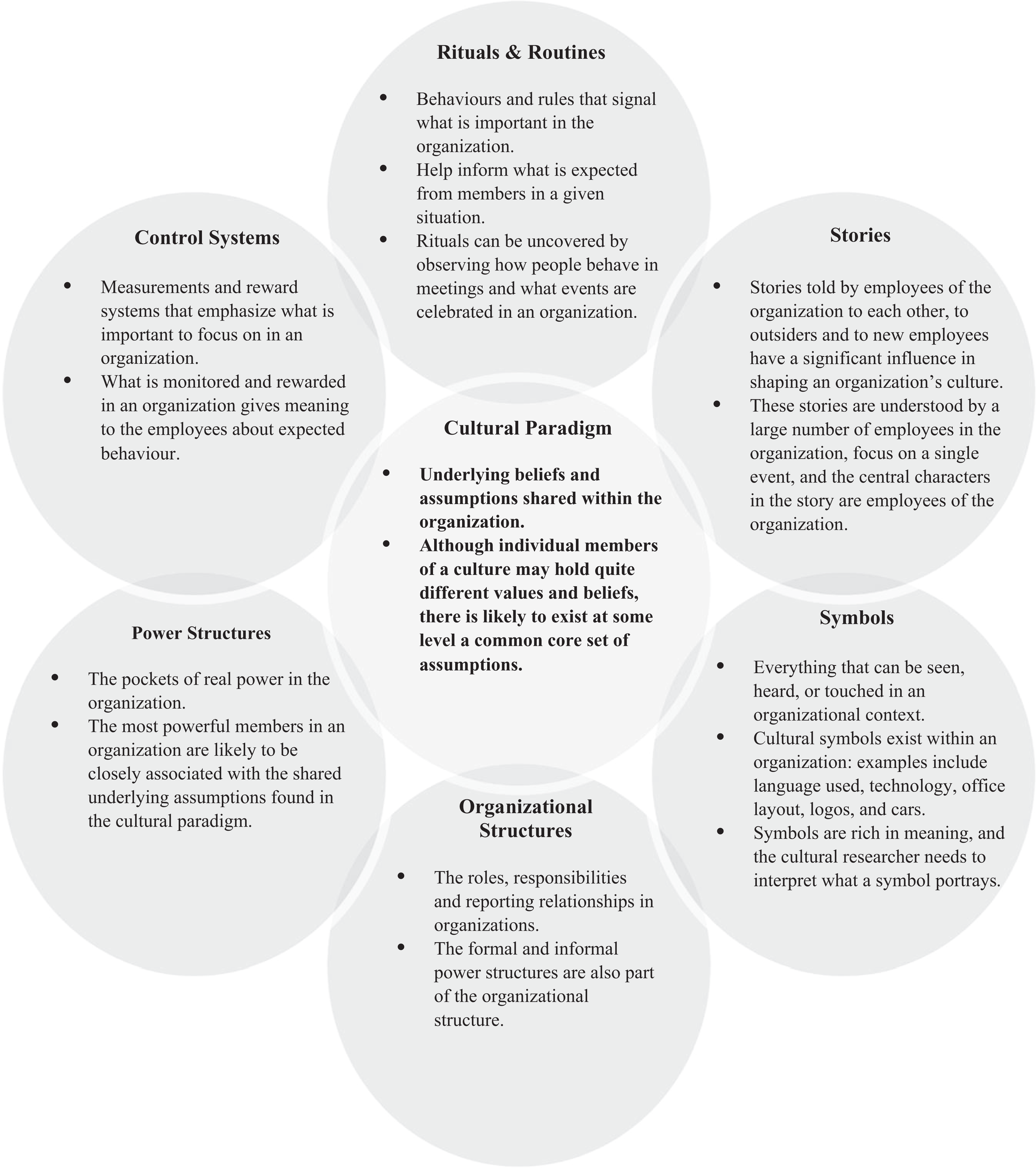
Johnson’s cultural web (Johnson, 1988).
The cultural web incorporates many of the ideas and opinions of other theorists into a single framework (McDonald and Foster, 2013). The artefacts identified by Schein (1985) are represented in the six outer layers of the web. The cultural web represents different elements: it shows the behavioural, physical and symbolic manifestations of an organization’s culture (Johnson et al., 2011). The web can be used for understanding the existing culture in an organization and for making recommendations in relation to certain aspects of that culture (Freemantle, 2013). This was an important consideration for this study, as it was anticipated that certain aspects of the cultures in HEI X might need to be reviewed in order to meet the requirements of all three stakeholders in the WBL partnership. It was important to recognize cultural issues that might affect the WBL partnership and to appreciate the role of underlying assumptions. The web also allows data collected from a range of different sources, such as interviews, observation and documents, to be represented (Losekoot et al., 2008). It is based on six interrelated and overlapping factors, which influence and are influenced by the central cultural paradigm (Johnson et al., 2013).
Methodology
Simply asking participants about their organizational culture would not provide sufficient information to explain the culture, because it consists of underlying assumptions that members of which members are often unaware (Schein, 2004). We believe that, to understand organizational culture, the researcher must focus on the underlying assumptions which are best understood through observation. Therefore, this study is conducted from a relativist ontological stance coupled with a social constructionist epistemology. The research question is: how can WBL partnerships be enhanced by a deeper understanding of organizational culture?
Both qualitative and quantitative approaches have been used in the past to study organizational culture (Martin, 2002). Researchers from different fields have studied culture by different means. Anthropologists have mainly used qualitative methods, while psychologists have preferred to use quantitative methods (Janićijević, 2011). A major benefit associated with ethnography is its ability to explore the hidden dimensions of organizational life through intense observation and direct involvement. This is particularly important when researching organizational culture, where many of the taken-for-granted aspects of life cannot be captured using methods like surveys. These taken-for-granted aspects or underlying assumptions are referred to in the paradigm in Johnson’s cultural web. They are rarely talked about, and may only be observed in people’s actions. Another reason for adopting ethnography was related to data collection. With ethnography, the researcher can supplement observation with interviews, and further supplement what can be learned first-hand with information gathered, or materials prepared by others. The data collection process is illustrated in Figure 2.
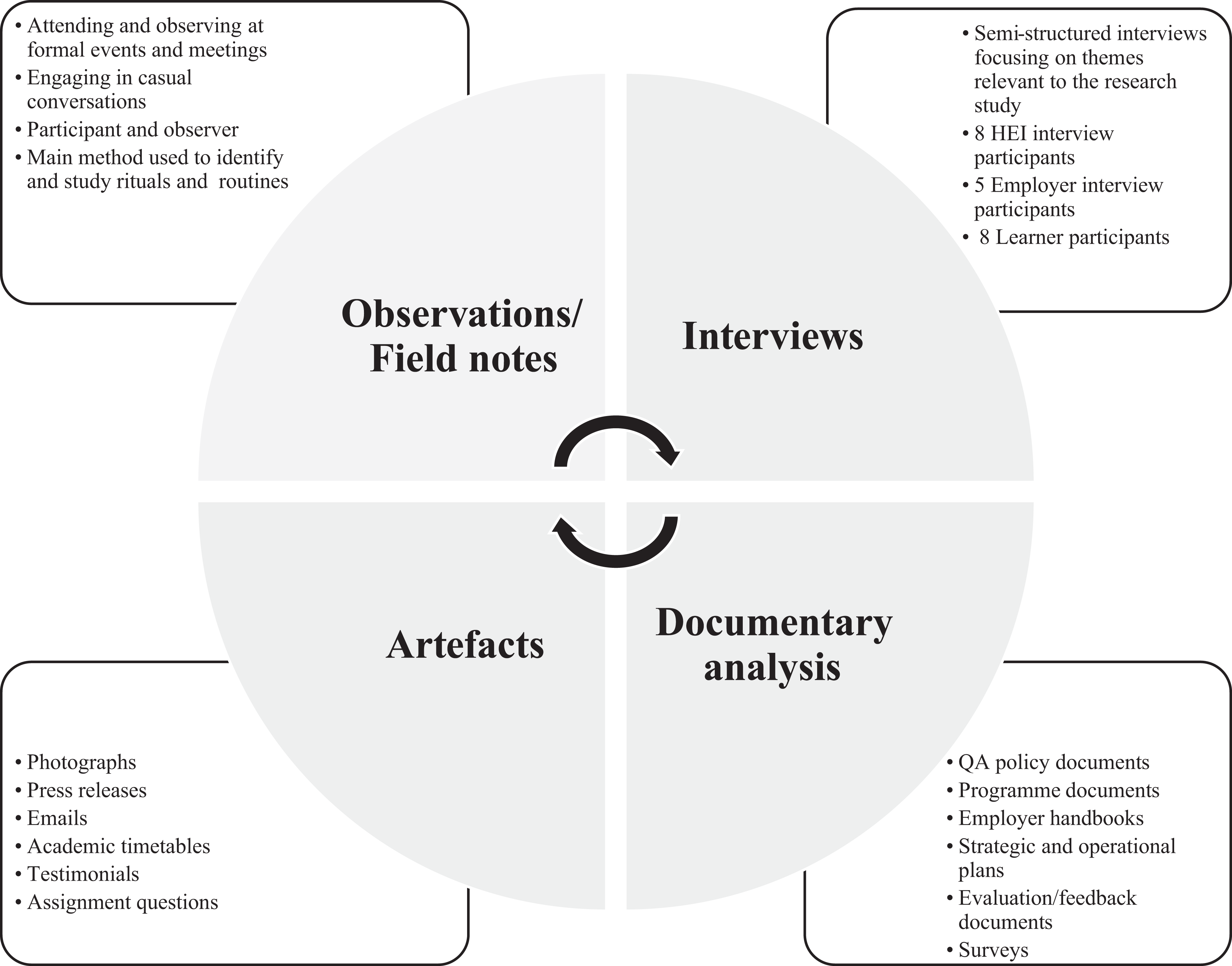
The data collection process.
The multiple data collection methods associated with ethnography proved useful in understanding the organizational cultures of the HEI and the employer organization (Wolcott, 2008). Field notes providing rich data on the experiences, assumptions and expectations of the three main stakeholders (the HEI, the external employer and the learner) were recorded over an 18-month period. Throughout the study, we observed and recorded field notes from a wide range of settings. Some of these settings were formal events, such as programme board meetings, exam board meetings and new programme development meetings. In other instances, the field notes were the result of causal, unplanned conversations in the canteen or corridor with learners, HEI X employees and employers. Interviews were conducted with eight HEI participants, eight WBL learners (from six different organizations) and five employer representatives (from five different organizations). In addition, documents and artefacts such as quality assurance (QA) policies, strategic plans, WBL programme documents, evaluation documents, emails and press releases contributed to the study.
The cultural web of WBL
Johnson’s cultural web (1988) is used to discuss the findings of the study. Each of the factors making up the web is presented separately.
Rituals and routines
The study found that some employers felt that the cultural rituals and routines associated with new programme development were bureaucratic and unnecessary: I think employers find the bureaucratic nature of the way we do things challenging. The idea that you finished the document and now it has to go to an internal committee and then an external report and panel is needed before the programme can be validated. The weeks and months pass. (HEI X participant H)
Issues in relation to the academic calendar were raised in the findings, with some participants suggesting that the HEI almost comes to a stop during the summer months. This issue with the academic calendar was also identified by Ball and Manwaring (2010). This research acknowledges the issues associated with the academic calendar and makes a valuable contribution by proposing an option that could be considered to address the challenge: In our programme, there are three semesters. The first two are delivered in class and the third is the placement which is delivered over the summer so the employees don’t have to go to class for that semester. They complete an assignment in the workplace so that is one way of getting over the academic calendar. (Employer participant E)
It was also uncovered in the findings that the style of delivery in WBL programmes is quite different from the routine used when dealing with full-time learners. One WBL lecturer described how he used a team-led approach to deliver the learning, treating the learners as members of his team. He said the learners could relate better to this style of delivery and contributed more in discussions. Indeed we would advocate that WBL learners be viewed as problem-solvers, bringing their knowledge and skills from the workplace into the learning situation. This style of delivery may challenge some HEIs, where a didactic culture can be evident in the way the lecturer delivers to traditional learners.
Stories
Stories are important because they convey the organization’s shared values or culture (Peters and Waterman, 1982). The literature does not appreciate the influence of internal stories in the promotion of WBL within the HEI. However, the findings from this study identify stories in circulation within HEI X that make the promotion of WBL challenging: I believe that one of the reasons why WBL is not more widespread within the college is due to stories that are being passed around by academics who do not support this type of an initiative. For example, one such story that I only learned of today relates to an incident involving a lecturer refusing to lecture on a WBL programme because he believed it lacked the same academic rigour as the full-time programmes and the delivery time is too intense. (Field notes)
Symbols
Some cultural web elements may be both symbolic and functional (Johnson et al., 2011) and the administrative system within HEI X appears to fall into this category. The administrative system not only performs a number of functions, but it is also a symbol of an important aspect of organizational culture within HEI X. It symbolizes what it is important to monitor (e.g. attendance and assessment grades), as well as the nature of the typical learner profile for whom the system was designed (full-time learner). Issues relating to the administrative system in HEI X catering for WBL programmes were raised during this study: Today an employer wanted to pay for each student in one bulk payment but the system could not facilitate this as it was designed for full-time learners who pay individually. It is not flexible enough to facilitate the employer paying one bulk payment for all their learners. (Field notes) be capable of handling bulk payments from employers (where the employer pays for all the learners in one payment as opposed to learners paying individually); register WBL learners for more than one academic year without the need to re-register each year (as some WBL programmes extend over a number of academic years); compensate WBL lecturers at a different rate from that for lecturers delivering traditional programmes (to reflect the additional effort required on WBL programmes); facilitate multidisciplinary programmes (e.g. a mixture of engineering and business) and allow WBL exams and exam boards (where exam results are approved) to be held outside dates identified for traditional programmes if required.
The language used by members can also symbolize what is important within the organization (Schein and Schein, 2017). This is evident in HEI X when new programmes are being developed, with so much emphasis put on credits, levels, academic rigour and learning outcomes. This issue concerning academic language is not surprising, as those employed outside higher education rarely come across these terms, which may mean very little to them. The email below illustrates how learners may struggle with unfamiliar language: Hi, Just a quick mail re: exam questions in general. I tend to be losing marks as I’m answering questions incorrectly. Is there a guide i can use to improve…? Just unsure how to go about questions such as Discuss, Evaluate etc. Regards, Anon.
Power structures
The findings reveal that the strategic importance of WBL in HEI X was questioned by some participants, who felt that WBL was not adequately resourced and did not receive sufficient attention in the HEI’s strategic plan: I feel within the college that work-based learning is not high in their agendas. They talk about it surely and say it is important but when you get into it, the full-time students get almost all the attention. (Employer participant D)
HEI X holds almost all the power when designing traditional full-time programmes of study. In other words, it decides the content, and how it is delivered and assessed. However, when designing and delivering WBL programmes, HEI X involves the employer in the decision-making process. There were mixed reviews among employers regarding their level of input in programme design: If the college wants employer engagement in work-based learning I think they need a more structured and serious approach. There needs to be a commitment from the college where they genuinely want the input from the employer. Often that relationship is not there. It is talked about but it is not there. (Employer participant B)
Organizational structures
A number of organizational structure issues were identified for HEI X. Participants called for the establishment of a dedicated WBL unit to coordinate WBL: I think when you consider the potential work-based learning offers an institute, you could very easily justify the creation of a dedicated learning office or department. (HEI X participant B) I would have a work-based learning department here in the college. That department would be the single point of contact with employers. (Employer participant D)
Another issue regarding organizational structure relates to how HEIs are set up. The findings show that employers sometimes require WBL programmes that cross academic disciplines, and that HEI X is not structured to facilitate this approach. It was reported that a culture of competition, rather than collaboration, could exist between academic departments in HEI X – perhaps stemming from the competition between departments when competing for full-time learners and resources. However, a culture of collaboration, not competition, is required to provide programmes that cross disciplines. Systems need to be put in place that will facilitate collaboration between the different departments in the design and delivery of WBL programmes. Issues such as which department coordinates the programme, invoices the employer and accredits the learning need to be considered. A policy regarding the design and delivery of cross-discipline programmes may also need to be developed to clarify how such programmes are managed.
The organizational structure in HEI X was set up primarily to deal with traditional full-time learners. This study found that many of the services available to full-time learners, such as a library, computer labs, career guidance and study skills, were not always accessible for WBL learners in HEI X. This concurs with research by Lemanski et al. (2011) who refer to the importance of making WBL learners feel part of the academic community. Some of the learners interviewed for this study highlighted the importance of the social aspects of completing a programme: We all work in different companies so we mightn’t see each other apart from coming to class once or twice a month so going for a few drinks now and again after class can help bring the class together. (Learner participant H)
Control systems
There are a number of issues relating to control systems that HEI X can consider when managing WBL programmes. The importance of maintaining rigour in all programmes, including WBL programmes, is evident from reading through the various HEI X QA documents. Employers, however, are sometimes less interested in academic rigour and more concerned with outputs. It is important that the HEIs promote, to the external employers, the significance of academic rigour in WBL programmes. They should stress that this rigour is required for accreditation, and that accreditation indicates high standards. One of the underlying assumptions identified in the cultural paradigm for HEI X (‘we are guardians of the academic standards’) highlights the importance of academic rigour in the institute, and any challenge to this will be resisted (Johnson, 1992). It is important that the HEIs maintain the same high standards of academic rigour when delivering WBL programmes, to ensure these programmes are not seen by some as inferior (Lester and Costley, 2010).
A further dimension of control systems relates to rewards. There remains a sense that HEIs do not sufficiently support, reward or incentivize collaboration with external organizations: until this occurs, WBL will not be widespread. Some HEI participants felt that WBL needed to be better rewarded and incentivized: There is no incentive for a HOD [Head of Department] to develop and deliver a WBL programme. I recently developed a WBL programme and spent some money advertising it. This came out of my department budget but when the money came in from the employer to pay for the programme, this money went into the large pot and not to me. (HEI X participant H)
The cultural paradigm
The paradigm of the organization encapsulates and reinforces the behaviours observed in the other elements of the cultural web. The paradigm closely corresponds to what Schein (1985) refers to as underlying assumptions. These assumptions are seldom discussed and are difficult to change (Elsmore, 2017). If we consider HEI X, this study has uncovered a set of core assumptions not uncommon within the HE sector: A quality product requires time for development. It has already been documented that designing quality programmes takes time in HEI X. The number of stages through which all new programmes must proceed before delivery can commence exemplifies this. This can prove problematic for both employers and academics. We believe in our procedures for administrating our academic programmes. HEI X has developed various procedures for administrating programmes of study in relation to design, delivery, assessment and evaluation. Some practices go back to when the HEI commenced operations over 45 years ago and have served the institute well since this time: attempts made to amend these practices will be resisted (Schein, 2004). We are guardians of the academic standards. Maintaining high academic standards remains at the core of what HEI X stands for. There is a preoccupation with ensuring that the standards associated with higher education are always addressed in HEI X. This has implications for how programmes are designed, delivered and assessed. Learner welfare is our main concern. Many of the academics involved in the delivery of WBL programmes also deliver full-time programmes. The majority of full-time learners are aged between 18 and 22, and sometimes the lecturers adopt a paternalistic style of delivery, demonstrating a concern not just for the academic delivery but also for the well-being of the individual. This concern for learners was observed throughout this study and from similar previous studies (Vasyakin et al., 2016).
Recommendations for the HEI with regard to collaborating in a WBL partnership are represented in Figure 3 using Johnson’s cultural web.

Cultural web for higher education.
Conclusion
The findings have revealed that WBL partnerships can be enhanced by considering the organizational cultures of the HEI and the external employer organization. The recommendations provide a useful framework for other HEIs considering WBL partnerships. In addition, the findings reveal that many of cultural rituals and routines, policies, procedures and systems in HEI X developed over time in response to the need to deliver full-time programmes and do not always address the needs of WBL programmes. Furthermore, the internal narrative questioning the academic rigour associated with WBL programmes can make the promotion of WBL difficult. An additional challenge relates to the organizational structure, with academic faculties operating as independent units. A culture of collaboration is required to respond to employers’ increasing need for multidisciplinary programmes. Other issues, in relation to language used, administrative systems, processes and procedures, rewards and incentives were also identified. Further research is needed to explore whether certain faculties, with different internal cultures, were better equipped than others to develop and support WBL partnerships.
It is worth considering the contribution of this study to the wider political and policy contexts. Although the study focuses on WBL partnerships, many of the recommendations may be useful when considering other forms of collaboration between HEIs and external employer organizations. Degree apprenticeships combine on-the-job training with study for a higher-level qualification. In the United Kingdom, degree apprenticeships remain central to the UK Government’s vision of improving skills and building sustainable growth for the economy: it plans to reform and improve the quality and quantity of degree apprenticeships by giving employers more control in relation to the content and assessment of the programmes. Policy makers in Ireland are also keen to promote apprenticeship partnerships between HEIs and employer organizations. Ireland’s first-degree apprenticeship programme commenced in 2016 and Irish authorities plan to grow WBL over the coming years using higher education apprenticeships. Many of the challenges and recommendations identified in this study provide insights which may be valuable to those considering research and apprenticeship partnerships between HEIs and external employer organizations.
Footnotes
Declaration of conflicting interests
The author(s) declared no potential conflicts of interest with respect to the research, authorship, and/or publication of this article.
Funding
The author(s) received no financial support for the research, authorship, and/or publication of this article.
