



Abstract
This article, through an empirical investigation, examines (a) the attitudes toward entrepreneurship among those of a productive age, and (b) the effect of the economic and political characteristics of a country on an individual’s tendency toward entrepreneurship. An anonymous questionnaire was designed and administered to a random sample of 180 people, ranging in age from 18 to 58, in the Athens area (Attica region) during the 2015–2016 academic year. Of those issued, 100 were completed sufficiently for analysis (response rate: 55.5%). The study supports the view that entrepreneurship is a vital asset for sustainable development and that integrating entrepreneurship into the formal education system (including higher education), together with greater flexibility, consistency, and continuity in public policy, will help improve its impact.
It is well known that entrepreneurship is closely linked to the economic development of a country. The creation of new businesses combined with their modernization leads to an increase in national wealth as it produces know-how and innovation, creates products and services, and reduces unemployment. Such an environment leads to business development and wider growth for the country, which in turn provide a better infrastructure for entrepreneurship to flourish further (Baumol, 1990, 2002; Boettke, 2001; Boettke and Coyne, 2003; Gartner, 1989; McClelland, 1967; Report of European Commission, 2012; Saiti and Provatari, 2014; Teixeira and Costa, 2006; Teixeira et al., 2003). For economic growth and entrepreneurship to flourish, there needs to be a favorable institutional and developmental framework, a stable tax system, an appropriate infrastructure, reduced bureaucracy, trained human resources, and a stable political and economic climate in the country (Karabegovic et al., 2002; Lee, 1991). With all the above components, entrepreneurship can contribute significantly to the modernization of society, to the quality of life of citizens, to increased productivity, and, of course, to a reduction in unemployment; and it can also help to increase workers’ incomes (Premand et al., 2016; Psaropoulou, 2012).
Indeed, entrepreneurship is an important means of enhancing an economy through innovation and entrepreneurship opportunities as well as societal development through social entrepreneurship (Kuratko et al., 2005; Robinson et al., 1991; Tubbs and Ekeberg, 1991). Entrepreneurial innovation focuses on business opportunities that require a high opportunity cost but at the same time carry substantial economic expectations. Such business opportunities derive not from people who simply see business as a livelihood, but from those who have knowledge and a business plan, and who know the market (Kakouris, 2010). Within this framework, the qualitative and sustainable improvement of an economy presupposes an entrepreneurial goal—namely the existence of planned actions that will contribute to the achievement of the objectives set. Innovative ideas need to be transformed into a viable business that responds to the needs of the market. This is accomplished through a business plan (a development strategy).
The factors that influence the efficient and effective development of an entrepreneurial idea are many and relate to the economic and social environment, individuals’ perceptions of entrepreneurship and their qualifications, motivations (internal and external) and skills as well as personal and psychological factors. For an investment plan to be successful, the individual needs to be strong-willed, innovative, and creative and must have a spirit of cooperation, especially during the first steps because they may need to establish various collaborations to help set up and operate their business (Ioannou, 2001).
Based on the above observations, entrepreneurship has not only an economic value but also a social and cultural value since it contributes to increased productivity and social development. Education (higher education in particular) has the same value since, apart from spreading knowledge, shaping the knowledge base, and developing the skills and competences in individuals, it contributes to the formation of the individual through socialization. Indeed, entrepreneurship and higher education have similar value for an economy as they provide leverage for sustainability. There is, therefore, a two-way relationship linking these two concepts whereby higher education contributes to the establishment of entrepreneurship and entrepreneurship helps to strengthen the relationship between the economy and education.
Entrepreneurship and higher education are closely linked to innovation and creativity—the main pillars of sustainable development. Indeed, entrepreneurship is inherent in all levels and in all forms of education and higher education has an important role to play in shaping an entrepreneurial culture by promoting competences at both personal and professional levels. Higher education is a key means of producing new ideas and of developing abilities and skills. It has a powerful integrating effect, helps restore respect for ethical values, and develops social interests, therefore contributing significantly to the development of a dynamic economy that is based on knowledge and competencies (Fassoulis, 2010: 23–25). Hence, the focus of this study is on the relationship between entrepreneurship and formal education, especially higher education.
Greece is facing developmental issues as it is going through a phase characterized by rapid change in the economic and societal contexts: although the European Union’s (EU) financial assistance program for Greece has ended, the country continues to strive for social and economic stability and sustainability. Indeed, the unfavorable economic climate and the uncertainty it brings have been among the main impediments to entrepreneurial endeavor. According to the European Commission, the Greek economy is primarily based on small businesses, unlike other EU economies. These small businesses account for about half of all jobs in Greece. In 2010–2011, 75% more early-stage entrepreneurs faced increased business start-up difficulties compared to 2009 due to the economic downturn, with the development of new businesses more difficult still (Ioannidis, 2013). The reduced liquidity, together with an unfavorable system of taxation and investment loans, has discouraged prospective entrepreneurs from exposing themselves to the Greek market (Sourlantzi, 2012). Given that an economic crisis is a phenomenon that has both negative and positive impacts on a country’s system, if a country such as Greece does not have the necessary infrastructure in place in the key areas of its economy to deal with any negative impacts effectively, then their consequences will become more pronounced—and this has happened in Greece. The main negative consequence of the crisis has been the recession, with high levels of uncertainty and instability at all levels of the economy, negative impacts on citizens’ quality of life and on the sustainability of the economy, with the main consequences being a decline in gross domestic product and a loss of jobs. Therefore, in this article, the economic crisis is taken into account as a cause of the economic recession.
The present study is motivated by previous relevant studies in Greece (Saiti and Provatari, 2014; Saiti et al., 2018). It was undertaken for the following reasons: (a) due to the overextended economic recession, Greece has been (and still is) experiencing a stagnation in creativity and innovation which has had a significant negative impact on individuals’ entrepreneurial efforts; (b) the Greek higher education system does not adequately prepare young people with the skills necessary for entrepreneurial activity (Saiti et al., 2018); (c) entrepreneurship and higher education contribute significantly to enhancing the sustainable development of a country; and (d) there are not many entrepreneurial opportunities in Greece for people to exploit while new businesses face a number of bureaucratic issues, which are a major obstacle for their development (Alexidis, 2014).
It is clear, therefore, that investigating the tendency of individuals to engage in business activities is important, as it can highlight areas where interventions can be made to motivate people, particularly those who are more concerned about the prospect of unemployment, to create their own businesses and to contribute to the country’s economic development.
The purpose of this article is, through an empirical investigation, to examine (a) the attitudes of those of a productive age toward entrepreneurship, and (b) whether or not the economic and political characteristics of a country affect an individual’s tendency toward entrepreneurship.
Theoretical background
Entrepreneurship is a rather complicated issue, because it is influenced by diverse factors that are constantly changing—factors that are economic, psychological, social, environmental, demographic, and cultural (Gaddam, 2007). An influential factor that directly links economic theory with entrepreneurship is the economic dynamic.
In the case of small businesses, entrepreneurship can face several difficulties, including bureaucratic procedures for the induction of a business into the labor market. It is important for a country to have a flexible and efficient system for setting up a new business. In addition, initial financial capital is needed to create a new business: in many cases, this takes the form of a business loan. The entrepreneur also needs to take into account other factors such as taxes, social security, and insurance charges. Hence, anyone who chooses to invest should be aware of the difficulties he or she faces due to the great competition that prevails. This is particularly true for small businesses since larger competitors have a larger market share and, in general, are in a more advantageous position (Barba-Sanchez and Atienza-Sahuquillo, 2018; Georgiadis, 2008; Premand et al., 2016).
According to the relevant literature (Barba-Sanchez and Atienza-Sahuquillo, 2018; Karagiannis, 1999), the motives that lead an individual to become an entrepreneur can be divided into two categories: (a) positive motives, which attract the individual to follow the business path, and (b) negative motives, which force the individual to engage in business activities. Moreover, there are the root causes that induce a person to become an entrepreneur, such as the continuing operation of a family business from generation to generation, the chosen field and level of education, and professional experience. These are considered neutral incentives, and their influence may be the same or even greater than that of the positive and negative incentives.
The decision to become an entrepreneur is a difficult one, since the individual is influenced by, among other things, cultural, personal, and psycho-emotional factors. In this context, two kinds of entrepreneurship can be distinguished: business opportunity and entrepreneurial need. Entrepreneurs in the first category focus on raising their income, while the second applies to people who cannot find another job or are not satisfied with their existing job. In general, when there is economic prosperity, there is a tendency for business opportunity to flourish and entrepreneurial needs to diminish. In Greece, however, many people say that the lack of relevant work (appropriate to their level of experience and qualification) leads them to become entrepreneurs. Greece has relatively few businesses derived from business opportunities: it seems that in Greece the crisis is forcing individuals to turn to entrepreneurship out of necessity rather than because they have identified a business opportunity that may generate a higher income (Ioannidis, 2013).
Ardagna and Lusardi (2008) examined Global Entrepreneurship Monitor surveys in 37 developed and developing countries and a sample of about 150,000 people. They identified two types of entrepreneurs: people engaged in pursuing a perceived business opportunity and people who were unemployed or could not find a better job and had turned to self-employment. In addition, countries whose citizens’ income is low have a negative link between entrepreneurship and economic growth. In contrast, in countries where income is high, for the most part, there is a positive relationship between economic growth and entrepreneurship (Acs, 1992; Barral et al., 2018; Premand et al., 2016).
Based on research conducted via the World Bank Atlas method, the average rate of entrepreneurship, as a percentage, is higher in middle- and low-income countries than in countries where citizens’ incomes are higher. However, it should be made clear that the type of business varies from country to country. For example, in poorer countries, more than two-thirds of residents are involved in business activities since they are self-employed.
Demographic factors fall within the context of variables such as population size, age, education, and experience. The main factors influencing entrepreneurship are the age, experience, and education of the individual who wishes to become an entrepreneur (Barba-Sanchez and Atienza-Sahuquillo, 2018; Gaddam, 2007; Premand et al., 2016). It is worth noting that one of the main factors influencing the decision to become an entrepreneur is the family environment. It seems that the profession of parents plays a decisive role as it greatly affects the attitudes and preferences of the child with regard to entrepreneurship (Shapero, 1984). The family’s financial situation may have a beneficial or an inhibiting effect on the decision of the individual to engage in business activities. Essentially, if a young person has affluent parents and lives in a comfortable family-friendly environment, then they are more likely to study and pursue the professional career they want. Also, if a young person growing up in a wealthy family wants to start a business venture then they will have the required financial capital to take such a step. On the other hand, if a young person lives in a family environment where the financial resources are more limited, it is extremely difficult for them to set up their own business without the necessary funds (Karagiannis, 1999).
According to Vasiliadis (2008), parents with businesses influence their children to follow the same path because entrepreneurial parents consider entrepreneurship to have more positive than negative aspects and so would like their children to follow entrepreneurial ways. It should be noted that, regardless of gender, almost all children are affected in the same way by their parents. Another parameter that affects parents’ attitude toward entrepreneurship is their educational level. It seems that parents who have completed secondary education largely encourage their children to engage in entrepreneurial activities, as they did themselves. On the other hand, parents in business who have completed tertiary education tend to be more negative (Immink and O’Kane, 2009).
Moreover, people who know someone who has recently created their own business are more likely to become entrepreneurs, as are those who believe they have the skills, the necessary knowledge, and the experience to be a successful entrepreneur—in contrast to people without business-related experience, whose fear of failure acts as an obstacle and may prevent them from trying. The greatest fear of new entrepreneurs derives from the investment risk they are contemplating: a business failure could have a long-term impact on their life. Also, a young entrepreneur needs to prepare a good business plan: otherwise, the company’s start-up phase will be threatened because the business plan will help the new business to develop and function effectively (Barral et al., 2018; Immink and O’Kane, 2009).
Gender seems to play a role, with men tending to engage more than women in investment activities. They seem to have more confidence in their skills and less fear of failure (Ardagna and Lusardi, 2008; Barral et al., 2018; Desai et al., 2003).
Within this framework, the term “entrepreneurship education” is embedded in a country’s education system and concerns both its large subsystems: formal and non-formal education. Entrepreneurship education is aimed at people of all ages because the main goal is to promote an entrepreneurial culture (Dutta et al., 2011; Raposo and Do Paco, 2011). The significant role of higher education in enhancing entrepreneurship is evident. However, some universities have study programs that lack an entrepreneurial culture because there is a view that being entrepreneurial “will drive out their other more fundamental university qualities such as intellectual integrity, critical inquiry and commitment to learning and understanding” (Williams, 2002: 19 cited by Kirby, 2006: 599). Higher education is a knowledge system that interacts with the economy of a country. Through higher education, people learn to collaborate, acquire, and develop new skills, to adapt to change successfully, and to think creatively. Higher education is thus a means by which people can overcome their adversity to risk and increase their self-confidence and skills.
Universities therefore need to understand the importance of entrepreneurship in order to recognize it as a mentality and an attitude (Gorman et al., 1997; Kirby, 2006). Jamieson (1984 cited by Raposo and Do Paco, 2011: 454–455) identified three stages of entrepreneurship education, all equally important for the development of entrepreneurship and, in fact, following an enterprise’s stages of development:
education about enterprise—this stage includes learning how an enterprise can be set up and run (instructions);
education for enterprise—this stage includes the acquisition of the necessary skills to set up a business as well as the establishment of self-confidence (training); and
education in enterprise—this stage includes the acquisition of knowledge and skills related to the expansion and development of an enterprise so that risks to the business can be recognized and addressed and its viability and successful performance can be maintained (entrepreneurship).
In this light, entrepreneurship is not just about setting expectations for a business but about realizing those expectations. Entrepreneurship education therefore needs to offer business know-how as well as other relevant knowledge and skills. Only then can creativity and innovation (the basic requirements for a healthy and sustainable economy) be achieved through higher education, by linking motivation with learning (Barral et al., 2018; Jorge-Moreno et al., 2012; Taatila, 2010).
At a societal level, Institutional Theory applies to social structures and culture—two elements that greatly determine the behavior of individuals. Indeed, according to Scott (2003, 2005), one of the basic pillars of institutions is the cultural–cognitive element. Education (at all levels) contributes to the formation of culture (and entrepreneurship) while the two elements of institutionalization, objectification and habitualization, both relate to social behavior (Tolbert and Zucker, 1996). Therefore culture and institutions are related or, as Scott (2003: 888) puts it, “the adoption and retention of new ideas is not a result of the characteristics of the adopting organization and its relation to the diffusion agent but of the structure of the broader field in which the organization is embedded.”
Indeed, the environment in which the institutions operate is what shapes the structures and balances within them, and this helps to ensure consistency in their performance. The financial crisis that gripped the world in 2008 created turbulence in business environments so that, if a country did not have a strong infrastructure, the negative effects would be exacerbated, as happened in Greece. The effective development of an entrepreneurial mind-set provides one means of dealing with environmental turbulence. Higher education thus has a role to play in the effort to safeguard the establishment of enabling structures and a constructive entrepreneurship culture.
Methodology
For this study, an anonymous questionnaire was administered to a random sample of 180 people ranging from 18 to 58 years old during the academic year 2015–2016. Of those issued, 100 were completed sufficiently for analysis (response rate: 55.5%). The sample was selected from the Athens area (Attica region) as it is the dominant region of economic activity in Greece. The research questions were:
To what extent do individuals intend to be entrepreneurs/create their own businesses?
To what extent do individuals feel they have the necessary characteristics to start up their own business?
What are factors do people think have a negative impact on the creation of a new business?
How do the characteristics of respondents differ (gender, educational level, professional situation, etc.) and to what extent does the general economic climate affect the creation of new businesses?
To what extent have respondents attended training programs on entrepreneurship and how has this affected their entrepreneurial intention? Are those who have attended training programs more likely to start their own business?
Do employment status and individual income affect the tendency toward entrepreneurship?
Does the family situation affect an individual’s decision to invest in a new business?
Does an individual’s educational level affect the decision to become an entrepreneur?
Does a knowledge of new technology contribute to the decision to start a new business?
The questionnaire used in the current research was developed with reference to studies by Dinis et al. (2013), Saiti et al. (2018), Liñán and Chen (2009) (cited by Dinis et al., 2013) and also of Koh (1996) (cited by Dinis et al., 2013), who examined entrepreneurial intentions and characteristics.
The questionnaire was divided into four main sections. The first section requested information on gender, age, family status, scientific subject, residency, parental educational level, family income, and so on, while the second section presented a group of questions concerning the employment profile of the respondents and their participation in training programs on entrepreneurship. The third section contained statements regarding the tendency of respondents toward entrepreneurship as well as their psychological characteristics and attitudes toward entrepreneurship. In particular, the degree of their actual or expected tendency toward entrepreneurship was measured by using the following scale: 1 = disagree very much, 2 = disagree moderately, 3 = average, 4 = agree moderately, and 5 = agree very much. Finally, the fourth section included statements regarding incentives or difficulties (such as the taxation system and political climate) and respondents were asked to rate their degree of agreement as to whether or not the economic and political environment had encouraged or discouraged their entrepreneurial intentions, using the same scale.
At this point, it should be noted that there is no specific variable that measures an economic crisis. With this in mind, statements relating to the environment of the crisis were used in the fourth section of the questionnaire. The effects of the economic crisis took hold in Greece in 2010, 2 years after the outbreak of the crisis in the United States in 2008. The country did not have the necessary infrastructure in place to deal with the crisis and minimize negative impacts. Greece therefore had to sign the first memorandum with its creditors in 2010, as it soon found itself running out of financial resources. For that reason, it had to take measures (mainly financial, such as tax increases) that have thwarted it from an entrepreneurial perspective while at the same time creating an entrepreneurial environment of uncertainty.
With regard to entrepreneurship in higher education, which is arguably the main pillar of entrepreneurial development, no specific variable was identified that directly measures it. The need to enhance entrepreneurship through formal education emerges from our analysis of the literature and empirical results.
The statistical and econometric analyses used for the questionnaire include:
descriptive statistics (percentages);
correlation tests (Spearman and ANOVA tests); and
OLS (ordinary least squares).
Results
Personal and psychological characteristics of respondents
With reference to individual/demographic characteristics, 52 participants were women and the remaining 48 were men. Respondents were between 18 and 58 years old, with an average age of 31.03 years (and a standard deviation of 12.5 years). With regard to family status, the majority of the sample (68%) were single; 70% had no children. Of the 30% who had children, 10% had one child, 16% had two children, and only 4% had more than two. The majority of respondents (52%) had completed post-compulsory secondary education, and 25% had completed higher education. Additionally, 6% held a postgraduate degree and just 3% a PhD.
Respondents were asked to indicate the subject of their studies, choosing from Humanities, Physical Sciences, Health Sciences, Technological Sciences, Economic Sciences, and Natural Sciences: 31% indicated none of the above; 15% indicated Humanities and 3% selected Natural Sciences. Health Sciences was not selected by any of the respondents. Eight people were studying Technological Sciences. Finally, a large proportion (43%) of respondents replied that their studies were related to the Economic Sciences. An overwhelming majority (94%) claimed that they knew a foreign language, while only 6% said they had no knowledge of a foreign language. Furthermore, 4% of the respondents claimed that they did not know how to use computers while the vast majority (96%) claimed a working knowledge of computers.
Accordingly, respondents were asked to indicate the extent to which they were familiar with new technologies: 4% were not at all familiar with them; 11% were a little familiar; while 43% knew sufficient to use new technologies. The remaining 42% were either familiar or very familiar with new technologies (22% and 20%, respectively).
Regarding employment status, 40% of the respondents were unemployed. Of the other 60%, 40% were employed on a full-time basis while 20% worked part-time. Less than half of the sample (40%) had a monthly income of €300 or less, while the income of 43% fell within the range €301–1200. The highest monthly incomes (€1200) were attained by 14% of the sample.
The majority of the respondents (60%) did not attend business seminars, while 21% had a higher education degree. Those who had attended training programs on entrepreneurship said that they had been professional training programs in public institutions and professional centers. Regarding hours of attendance, there was a great deal of diversity.
Table 1 shows the distribution of the sample with regard to the intention to engage in entrepreneurship. Respondents were asked to rate the degree of their actual or expected tendency toward entrepreneurship on the following scale: 1 = disagree very much, 2 = disagree moderately, 3 = average, 4 = agree moderately, and 5 = agree very much. As can be seen from Table 1, there was a great diversity in the responses. The only statement for which the respondents showed some agreement was “I am thinking of setting up my own business someday” (40% either agreed very much or agreed moderately with this statement). Forty-two percent of respondents were not interested in setting up their own business, and only 32% believed they were ready to start a business. Furthermore, 26% felt determined to become engaged in business activity, and 32% were thinking about this possibility seriously. Finally, 31% of the respondents were planning to start a family business.
Distribution of the sample in terms of individuals’ tendency to engage in entrepreneurship.
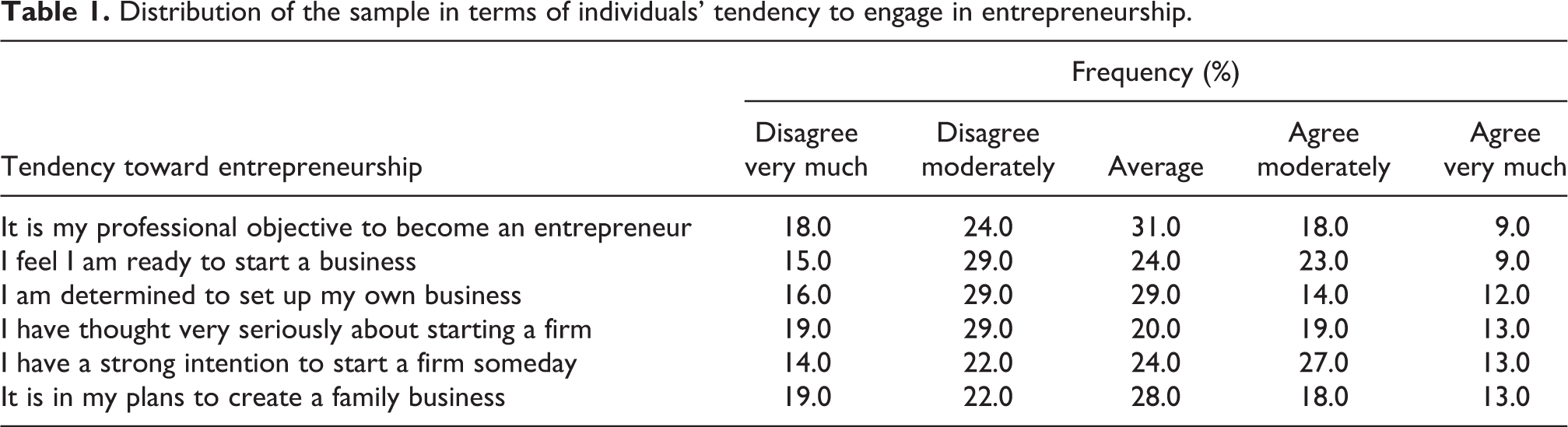
Table 2 addresses the question of whether psychological characteristics influence the decision of respondents to start their own business. They were asked to rate their psychological characteristics and attitudes to entrepreneurship using the same scale. There were reasonable levels of agreement among the respondents for the following statements: “I am a person who can take up responsibilities,” “I can easily adjust to circumstances,” “I am very good at organizing,” and “Job security is extremely important to me.” The last statement showed the highest level of agreement, with 92% agreeing very much or agreeing moderately with it, and this therefore seems to be a significant factor in an individual’s desire to become an entrepreneur.
Distribution of sample regarding whether psychological characteristics (e.g. self-confidence) influenced their decision to engage in entrepreneurship.

Almost half (48%) of the respondents thought they had the self-confidence necessary to set up their own business. Similarly, 47% believed they had original and innovative ideas with which to create a business. Eighty-three percent of respondents moderately agreed or very much agreed that they readily took on responsibility, while 78% could easily adapt to circumstances. Sixty-five percent of respondents felt they could easily cope with a challenge, with 51% believing they could take risks. The results also revealed that high percentages of respondents thought they were good at organizing (78%) and able to compete (56%). As noted above, 92% of respondents claimed that job security was of great importance. Seventy-eight percent thought it was very important to earn a high salary from their work (see Table 2).
Table 3 concerns the motives and difficulties an individual may consider before becoming an entrepreneur and starting up a business. Based on the results in Table 3, the statements “The Greek State provides the necessary incentives for an individual to become an entrepreneur” and “The political climate does not influence the creation of new businesses” seem to have a negative influence on the tendency toward entrepreneurship: the majority of respondents moderately disagreed or disagreed very much with these statements.
Distribution of sample regarding motives and difficulties an individual may consider before becoming an entrepreneur and starting a business.

In contrast, a large majority of the respondents moderately agreed or agreed very much with the following statements: “There are difficulties in financing a new business,” “The general economic climate influences an individual’s intention to create a new business,” “Reforms in the labor market (economy) are needed in order to start a business,” “The creation of a new business may improve the economic climate,” “The creation of a new business may help reduce unemployment,” and “The current taxation system in Greece discourages the creation of new businesses.” The last statement attracted a high level of agreement (91%).
In particular, 83% of respondents agreed with the statement that the Greek State provided no incentive to set up a business. The same proportion agreed that creating a business was a big risk. Eighty-two percent agreed that creating a business involved a lot of difficulty, while 89% agreed that the political climate affected the creation of businesses.
With particular reference to the section regarding the overall economic climate, a large majority (94%) of the respondents claimed that it had a negative effect on their intention to start a new business. Eighty percent shared the view that constructive reforms were necessary for the efficient performance of the economy in order to foster entrepreneurship, while 84% believed that the strengthening of entrepreneurship could boost the Greek economy and 85% indicated that enhancing entrepreneurship might reduce unemployment significantly.
Factors influencing an individual’s intention to become an entrepreneur
An OLS econometric model was run to investigate the tendencies of the respondents to engage in entrepreneurial activities (in terms of their personal characteristics) and to identify the personal characteristics that had an impact on their intention. The dependent variable expressing the intention to engage in entrepreneurship is derived from the sum of the respondents’ answers to Question 14 1 of the questionnaire. The larger the sum of responses to the group of statements that constitute the dependent variable of the model, the greater the intention to engage in entrepreneurship.
The empirical results revealed no statistically significant relationship between personal characteristics such as gender, age, educational attainment, computer literacy, employment status, salary, or family status, and the intention of individuals to start their own business. In contrast, it was found that there was a statistically significant positive correlation (at the 5% level of significance) between entrepreneurial intention and participation in a relevant training program. Thus, people who have attended training programs on entrepreneurship appear more positive in intention than those who have not done so.
The zero hypothesis was rejected for the variable “training programs” due to the fact that the zero hypothesis rejection level of significance was less than the statistical significance level of 5%. Therefore, we infer that respondents’ participation in a relevant training program affects their decision on whether or not to become an entrepreneur. Also, the sign of this explanatory variable (training programs) is positive. This means that the relationship between the explanatory variable “training programs” (B8) and the dependent variable “entrepreneurial intent” (Total_14) is positive. Hence, we may claim that when an individual has attended—or indeed has indicated a willingness to attend—a relevant training program on entrepreneurship, they are more likely to become an entrepreneur (see Table 4).
Results of a model examining the factors affecting entrepreneurial intention.
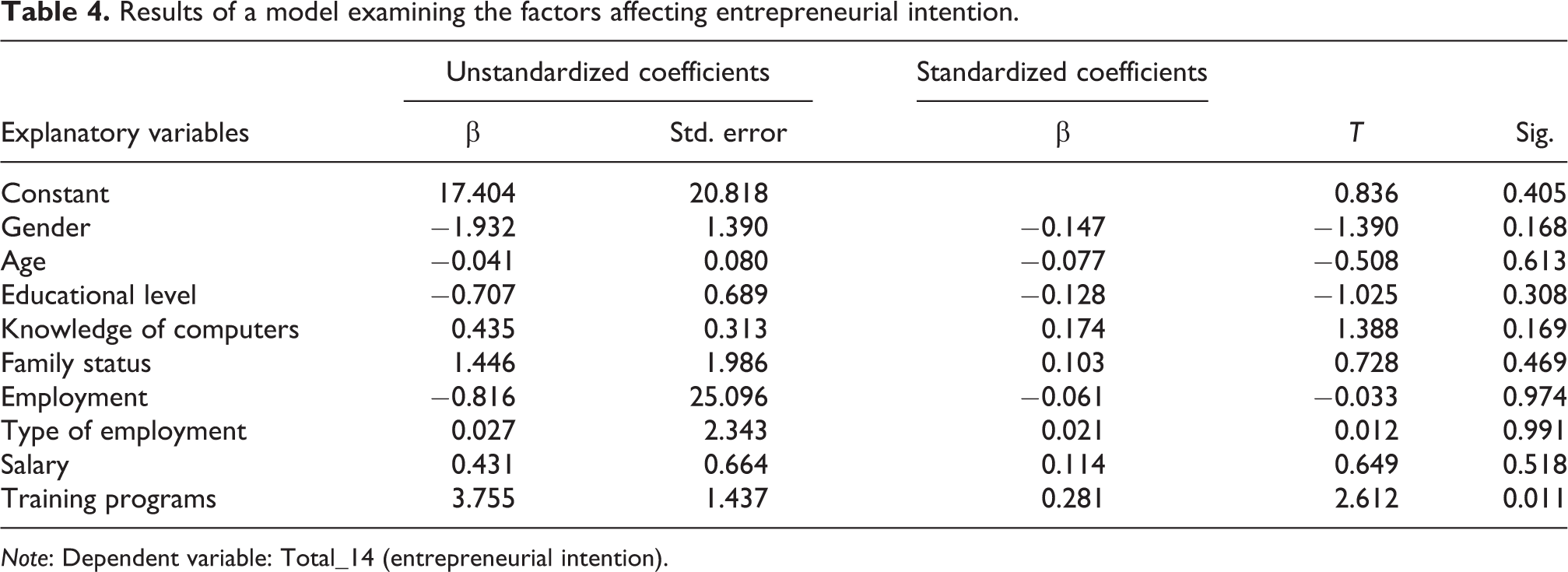
Note: Dependent variable: Total_14 (entrepreneurial intention).
Table 5 presents the results of the correlation tests between the tendency toward entrepreneurship and the statements related to respondents’ psychological characteristics. Of the 10 statements, only 3 appear to be statistically insignificant. These were: “I am very good at organizing,” “Job Security is extremely important to me,” and “High earnings from my job are very important to me.” The remaining seven statements were directly related with an individual’s intention to become an entrepreneur and appear to have a strong positive correlation. The statement “I have the confidence I need to create my own business” had the highest positive correlation at the 1% significance level. Thus there was a strong positive correlation between entrepreneurial intention and self-confidence, as well as a respondent’s perception that they had original and innovative ideas of the kind needed to create a business. Hence, when people’s self-confidence and sense of leadership are strengthened, their intention to set up their own business increases.
Correlation test between tendency toward entrepreneurship and psychological characteristics.
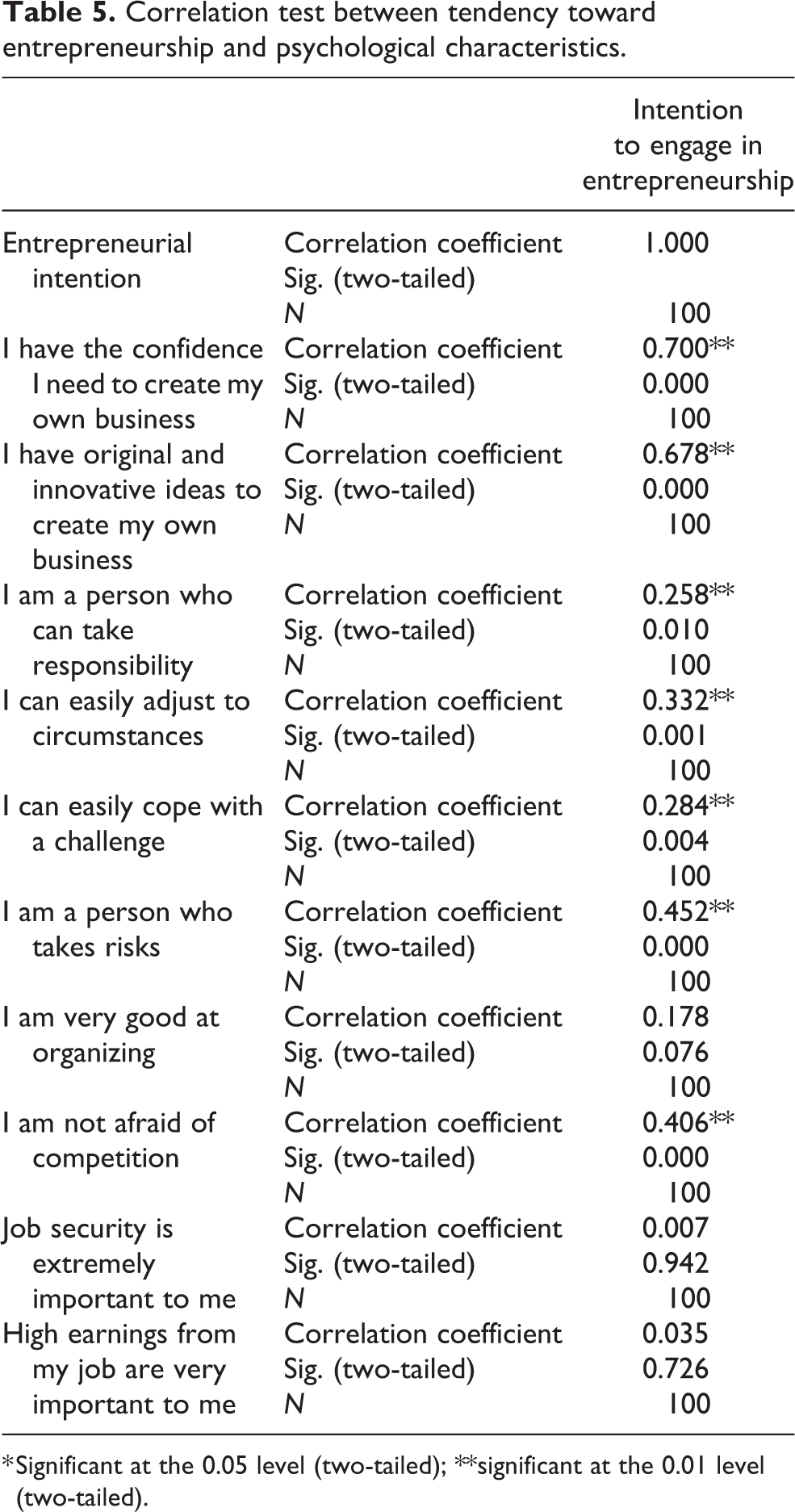
* Significant at the 0.05 level (two-tailed); **significant at the 0.01 level (two-tailed).
Regarding the perception of responsibility and adaptability, there was a moderate positive correlation with entrepreneurial intention that was statistically significant at the 5% and 1% levels, respectively. Thus when an individuals’ sense of responsibility and their perception of their adaptability are strengthened, the intention to set up their own business becomes more likely.
Finally, the results revealed a moderately positive and statistically significant correlation (at the 1% level) between people’s perception of risk and competition and their entrepreneurial intention (see Table 5).
Similarly, the correlation between perceived motivations and difficulties and the tendency of individuals toward entrepreneurship was tested. Table 6 reveals the values of the correlation coefficient and the level of statistical significance. It is evident that entrepreneurial intention is not strongly related to perceived difficulties or motivations. It seems that the only variable (statement) that influences the intention of individuals to become entrepreneurs is: “In order for an entrepreneur’s efforts to be successful, they should be determined to work more.” The correlation test revealed a positive statistically significant relationship at the 5% level.
Correlation tests regarding respondents’ tendency toward entrepreneurship and the difficulties and incentives related to becoming an entrepreneur.

* Significant at the 0.05 level (two-tailed); **significant at the 0.01 level (two-tailed).
Conclusions
This study examines factors affecting the intention of individuals to establish their own business. Given the current global economic situation, it is important to understand the difficulties, obstacles, and challenges that constrain entrepreneurship. Only then will the Greek economy be able to stand on its own feet and overcome the negative consequences of the economic crisis that has been hurting its people financially and psychologically. Through the investigation of entrepreneurship in Greece—a country still dealing with the deep and severe consequences of the economic crisis—obstacles and weaknesses that prevent entrepreneurship from flourishing have been identified.
This study provides only a basis for further exploration of the topic and does generate results for the whole of Greece. The final number of completed questionnaires used was small, so the empirical results cannot be generalized to determine the conditions for enhancing entrepreneurship in Greece. The study does, however, demonstrate the tendency for entrepreneurship to grow. It identifies key components for policies to empower and support entrepreneurship in Greece (and countries in a similar situation). It also identifies major obstacles in the way of entrepreneurship that need to be addressed. In addition, any country must have appropriate infrastructure to minimize the costs (social, economic, etc.) of tackling the various turbulences in a continuously changing environment. Moreover, the findings of this study provide an extension of other research in the entrepreneurship field and contribute to a better understanding of the value of entrepreneurial culture. It provides a framework to help countries such as Greece that have faced (or are still facing) many years of recession to recover through higher rates of performance that lead to positive growth and development. With regard to higher education, the findings should help in the identification of ways to improve the outputs of formal entrepreneurship education programs.
The results suggest that self-confidence and a sense of leadership are basic elements in strengthening peoples’ intention to set up their own business. Indeed, the Spearman correlation test revealed a positive significant relationship between self-confidence and the tendency toward entrepreneurship. This result is confirmed by the relevant literature, which indicates that self-confidence (among other characteristics) influences entrepreneurial behavior positively (Barba-Sanchez and Atienza-Sahuquillo, 2018; Chang and Rieple, 2013; Gartner, 1989; Krueger and Casrud, 1993; Linan, 2008; Premand et al., 2016).
Moreover, the regression results indicate that individuals’ participation in entrepreneurship training programs increases their intention to start their own business. This result is also confirmed in various previous studies (Barba-Sanchez and Atienza-Sahuquillo, 2018; Bird, 1988; Brown, 2005; Linan, 2008; Liñán and Chen, 2009; Premand et al., 2016; Quan, 2012; Robinson and Sexton, 1994), which conclude that entrepreneurship education, through the improvement of knowledge and the development of creativity and innovative skills, enhances peoples’ motivation to become entrepreneurs.
These results highlight the importance of entrepreneurship education. More specifically, they show that enhancing such education through the development and promotion of a higher education system that is more oriented toward innovation will change attitudes and behaviors positively with regard to entrepreneurial activity. It should be mentioned that this study recognizes the following limitation: causality between greater entrepreneurial intentions and training is not supported by the empirical results. However, it was not the aim of the article to investigate this significant aspect of entrepreneurship. The significance of the causality between these two variables could be investigated in a future study with more primary data.
What is important, however, is to note that the structure of a country’s educational system is the main pillar in the development of entrepreneurship—because everything starts with education. The growth rate of a country depends primarily on the continuous adaptation of the education system to new social and economic circumstances, and on the levels of investment in education. Entrepreneurship is linked to the sustainable development because it helps to increase income, create new jobs, and develop new products and services that will meet growing social needs. Empowering individuals to develop as entrepreneurs entrepreneurial actions can be achieved through effective education. Moreover, if a country wants to make improvements that will lead to social and economic development, it must recognize that it is through education that people shape their behavior, attitudes, ideology, and culture.
Of course, education is made up of different levels, but all these levels are interconnected. While a culture of entrepreneurship can start from basic education, the consolidation of the values acquired takes place in higher education. A higher education system must include the means of cultivating and promoting qualitative knowledge and important skills and attributes such as leadership, a cooperative spirit, self-confidence, adaptability, risk-taking, and resilience.
As has been argued elsewhere (Dutta et al., 2011; Gibb, 2002a, 2002b; Kirby, 2006; Rae, 2010; Raposo and Do Paco, 2011), entrepreneurship should be present at all levels of education: education can enhance the personal dynamics of individuals, prepare them to overcome barriers to entrepreneurship, and stimulate their enthusiasm for it.
It takes time and effort to demonstrate the results and, more generally, the effects of entrepreneurship education. Entrepreneurship education, particularly at the higher education level, needs to go beyond the traditional limits of learning and maintain a balance between theory and practice. Simply informing people about how to set up a business is not enough—people must be equipped with the resources and confidence to develop innovative ideas. Thus creativity, initiative, innovation, and cooperation should be granted much more than a passing reference in educational programs.
The empirical results also indicate a positive statistically significant relationship between peoples’ perceptions of risk and competition and their entrepreneurial intentions, while the majority of the respondents shared the view that job security was a vital element for them. Indeed, perceptions of and attitudes toward entrepreneurship are important elements that reveal the degree of readiness to engage in entrepreneurial activity.
In addition, a majority of the respondents agreed that the root cause preventing entrepreneurship from flourishing in Greece was related to corruption, political instability, the tax system, and restricted access to finance. Therefore, it is necessary for the Greek State (or any state) to develop a clear and sustainable strategy that will stimulate innovation and so encourage entrepreneurship. Higher education (and indeed the whole education sector) should be a facilitator in this effort. This is especially critical for a country like Greece, shaken by severe recession and financial crisis. Entrepreneurship is of catalytic importance in the economic development of a country. Through entrepreneurship, the state machinery will be able to function more effectively, revenues from state funds will increase, as will job creation.
While a country cannot guarantee a high level of involvement among its people in entrepreneurship, it can surely maximize the opportunities and incentives for its citizens to become entrepreneurs. More incentives from the Greek State would raise the desire of its people to pursue entrepreneurial activities.
As has been noted, this study provides a basis for further exploration of the topic, but has its limitations. Future studies could carry out a broader analysis: a larger sample would help to provide confirmation of the results. In addition, the sample of respondents in this study was from the Attica region and not from the whole of Greece. It would be particularly interesting to conduct similar research in different parts of the country, since people in urban and rural areas are likely to have different aspirations. It would help to clarify the different factors related to place of residence that affect the decision of individuals to engage in entrepreneurship. Moreover, models could be developed to assess the combined effect of the factors examined in this study regarding the intention to develop business activity.
This study supports the view that entrepreneurship is a vital asset for sustainable development and that education on entrepreneurship, flexibility, consistency, and continuity in public policy help to improve the impact of entrepreneurship. However, the effort to stimulate entrepreneurship through education is critical as this will help to determine the long-term performance of an economy and will influence the national development process. Thus, the aim must be to educate citizens to be entrepreneurial.
Footnotes
Declaration of conflicting interests
The author(s) declared no potential conflicts of interest with respect to the research, authorship, and/or publication of this article.
Funding
The author(s) received no financial support for the research, authorship, and/or publication of this article.
