



Abstract
Previous studies have attempted to examine and explain the integration of technology into the learning process. Most of these studies are related to the disciplines of pedagogy and informatics. The rest of the relevant literature cannot be definitively assigned to one discipline, but is often located at the intersection with the field of management. Taking a creative inquiry approach to analyzing this body of literature, the following key issues have been identified as of major relevance for future research. First, we must further explore what kind of influence the organizational culture of higher education institutions (HEIs) has on the strategy and implementation of integrating technology into the learning process. Second, we need to determine whether the integration of technology into the learning process at HEIs has the potential to support organizational development (mission, etc.) and/or adaptation, and whether an entrepreneurial culture could foster this potential.
Keywords
The e-learning 1 market globally continues to shift, grow, and evolve quickly and significantly. In 2018, the global market share for e-learning was USD190 billion and, according to the latest forecasts, it is likely to exceed USD300 billion by 2025. While North America (the United States and Canada) is still the market leader with a 40% share (Bhutani and Bhardwaj, 2019), followed by Europe, Asia and Africa have recently been catching up rapidly (Docebo, 2016). The strongest sector in the e-learning market is the academic sector, which accounts for over 50% of the total e-learning market share. With the globalization of the higher education (HE) industry, shrinking governmental support and cost increases (Bowen, 2012; Breneman, 2011; Gjerding et al., 2006; Sheets et al., 2012), higher education institutions (HEIs) like universities and business schools are challenged to sustain themselves in an ever-more competitive environment. Consequently, many HEIs today envisage alternative and differentiated modes of learning, focusing especially on new educational models that build on e-learning (Johnson et al., 2016). Indeed, almost every HEI makes use of technology in the learning process in one way or another (offering e-mail accounts for students, providing grades online, offering online courses, providing blended study programs or even massive open online courses (MOOCs)).
Given this background, and based on a look at the reported numbers, it is surprising that the “phenomenon” of integrating technology into the learning process has not attracted greater attention in HE from a research point of view. Although other disciplines, such as pedagogy and informatics, deal with the integration of technology into the learning process, a one-sided focus on success can often be found in the literature, as well as a dominant silo attitude. Studies adopting a broader view and a holistic perspective are still rare or not sufficiently elaborated. This is also the reason why theory in this field has developed slowly, if at all.
The present study seeks to contribute here by employing a systematic review of the literature. Instead of adopting a traditional, reproductive approach that conforms to preexisting frameworks, a creative inquiry approach has been chosen. This approach will provide more freedom for self-reflection and dialogue between the reviewer and the field in order to actively construct and co-construct knowledge with the aim of creating a holistic picture of the phenomenon under study. Adopting such an approach will also stimulate innovativeness and creativity in the application of newer or nontraditional research methods (Montuori and Donnelly, 2013). The next section explains creative inquiry as a methodology and then moves on to the individual steps undertaken in the review process. The subsequent section presents the results, drawing a map of the research terrain based on the three-level approach of the creative inquiry. A discussion of the findings follows, and implications for further research are presented. Finally, the study’s contribution and limitations are summarized in the conclusion.
Method
Creative inquiry
In a creative inquiry approach, the process of conducting a literature review becomes a creative process that involves the active construction of knowledge and interpretation of the field by the reviewer, entering into a dialogue with the research community (Montuori, 2005; Sawyer, 2011). Montuori (2005) proposes three levels that guide the literature review as a creative inquiry. The first level is disciplinary fragmentation, which recognizes a plurality of perspectives or disciplines and highlights the importance of cross-disciplinary and transdisciplinary research. This step should foster out-of-the-box thinking whereby established disciplinary lenses are challenged and questioned. The second level concerns cultural differences and claims that culture is a high-influence factor in research. It is assumed that different countries represent different perspectives, opinions, ideas, assumptions, and so on, and have thus established different bodies of knowledge over time that have an impact on how people think and how they address problems. The third level is the metaparadigmatic level, which aims at discovering new approaches to specific issues by exploring the nature of relationships, revealing the underlying principles. It is a reflective process on how we think and organize knowledge.
According to the steps proposed by Montuori (2005), the first step is the definition of certain inclusion and exclusion criteria. It is acknowledged that not only does the interpretation of the research field have an influence on the author’s perspective, but also vice versa. This means that, while the author is creating a map of the research terrain, she makes selective decisions based on her implicit and explicit assumption criteria (Montuori, 2005; Montuori and Donnelly, 2013). Inclusion and exclusion criteria are based on the selective decisions the author makes as inquirer, which depend on her personal and intellectual history as a researcher (Sawyer, 2011). The present author’s intellectual and personal history as a researcher is rooted in studies of international management. In recent years, the author has been intensively engaged with HE management. In particular, she began to realize that digitization was a pressing issue found in every industry. However, there are some major differences between digitization in a customary market and in HE. While digitization research does not typically focus on the learning process, integrating technology into the learning process does indeed bear real disruptive power capable of overturning the whole HE industry with major transformations in demand, student profiles, educational offers, delivery, and learning (Altmann et al., 2019). At the same time, the author wondered why this phenomenon, which is globally evolving and growing so rapidly, continues to receive little attention in research. Compared to digitization as studied in traditional firms, scholars appear less motivated to examine the integration of technology into the learning process of HE and prefer to investigate single aspects, taking a silo attitude.
With the aim of reviewing previous studies in this field, taking into consideration the author’s personal and intellectual background, and following the principles of the creative inquiry approach, the present literature review is guided by the following research questions: – Which disciplines are interested in and investigate the phenomenon of integrating technology into the learning process of HEIs? – Which cultural differences/perspectives exist? – To what extent is it possible to identify underlying relationships? And, if possible, how can further research address the identified relationships?
Search process
To answer these research questions, the author carried out an extensive search of relevant literature with the help of different electronic databases, including mainly EBSCO, JSTOR, and ScienceDirect. In order to carry out a systematic search process, various steps were undertaken.
A first step was the identification of thesaurus terms for “integration of technology” (thesaurus terms: technology, information and communications technology (ICT), computer, Internet, digitization, media, innovation, online education, e-learning, digital learning, distance education, blended learning, MOOCs, game-based learning). This was followed by a search tracking process in which the identified thesaurus terms were combined with the term “higher education.” All tracked searches were stored and tagged using the database and reference management software Mendeley. The intention was to identify, as far as possible, all the literature in the field, while keeping the focus on the literature of greatest relevance to the research aim.
In the second step, all sources identified (160) in the search tracking process were revised and filtered down, looking at title and abstract/introduction, discussion and/or conclusion, and references (to identify duplicates) for certain inclusion and exclusion criteria (Table 1).
Inclusion and exclusion criteria.
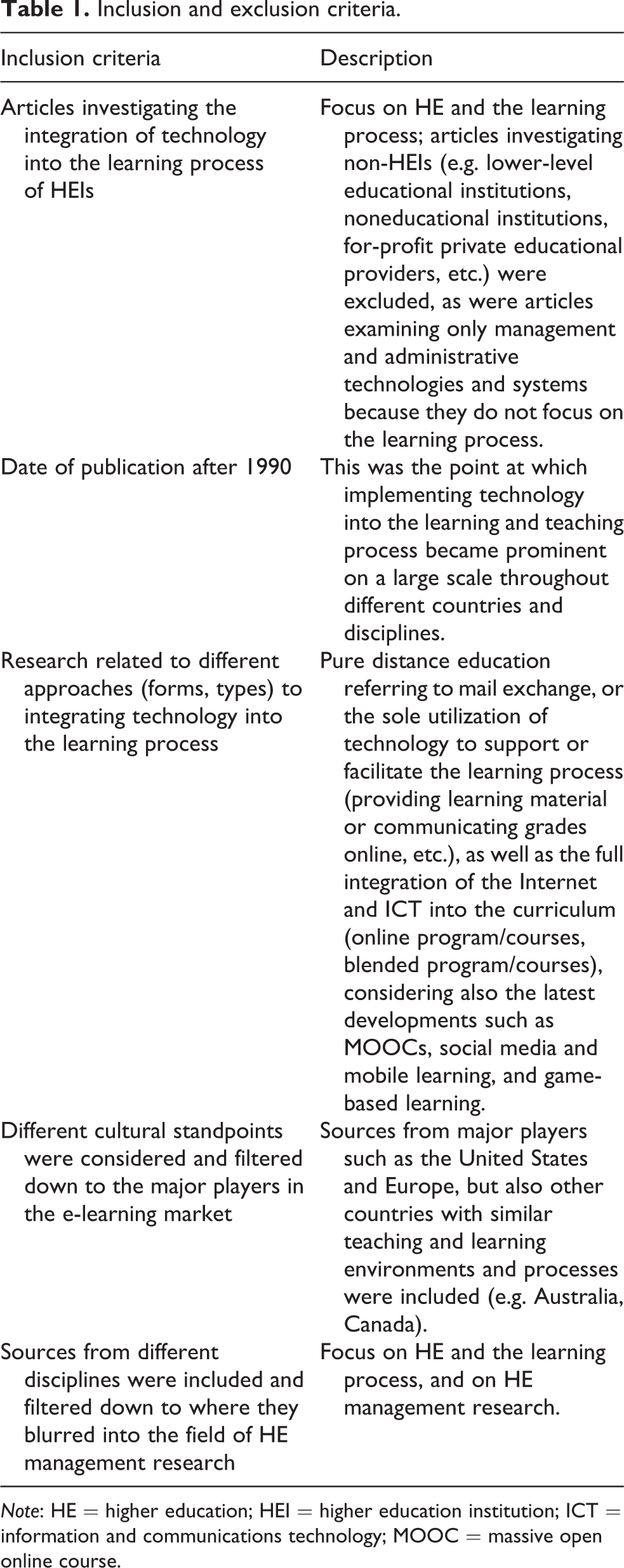
Note: HE = higher education; HEI = higher education institution; ICT = information and communications technology; MOOC = massive open online course.
By filtering down sources, a pool of 73 articles was identified. An in-depth screening followed, through which sources were organized in the form of a table according to author and year, type of study, journal and discipline (disciplinary fragmentation), country (cultural differences), and key issues that emerged from the literature, which were then grouped into a number of categories (metaparadigmatic level) (see Table 2). Categories were not dependent on quantifiable measures, but rather on whether they captured something important in relation to the overall research aim and research questions. Furthermore, categories assemble key issues that appear most often together and are connected through a contextual link in the literature.
Three-level creative inquiry analysis.
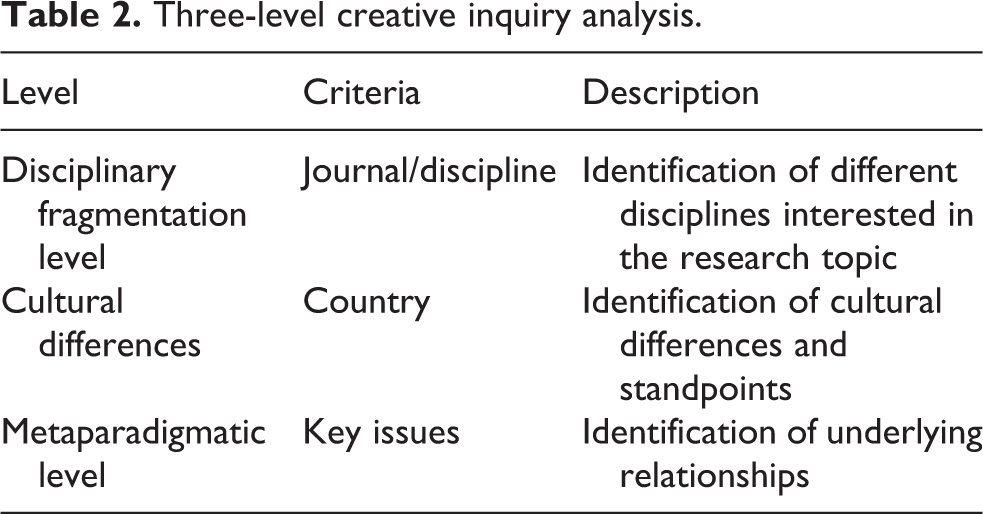
An analysis according to the three steps of the creative inquiry approach followed (Table 2).
Map of the research terrain—Results
Analyzing the 73 sources identified according to the three-step creative inquiry process, it can be seen that, before 2000, publishing activity was rare in the field of integrating technology into the learning process in HEIs as it was still in a developmental phase. From 2000 to 2009 this situation changed, and more articles were published. Activity increased from 2010 to 2018, indicating that the topic was becoming more important and prominent, and that more recent research had been done as increased publishing activity could be seen. In sum, the identified sources consist of 11 books (or book sections, including manuscripts and dissertations), 45 peer-reviewed journal articles (or conference proceedings), and 18 reports and practical research papers (including working papers, essays, reports released by associations and research institutions, etc.). Sixty-three of those are empirical studies, and most are conceptual papers or reviews (literature reviews or critical reviews) and essays (32) with the aim of developing and enhancing theory. Furthermore, it can be assumed that traditional quantitative approaches (17) are preferred over other methods—for example, qualitative studies (5), case studies (6), mixed-method studies (2), and experiments (1).
Journals addressing the phenomenon of integrating technology into the learning process traditionally belong to the disciplines of pedagogy, informatics, or psychology (Adult Education Quarterly; American Journal of Distance Education; Distance Education; Information Systems Research; Procedia Computer Science; British Journal of Educational Technology; Education and Information Technology; Alt-J; Technology, Pedagogy and Education; Computers and Education; Computers in Human Behavior). Sources that cannot be clearly assigned to only one discipline most often position themselves at the intersection of those disciplines and management (Journal of Leadership & Organizational Studies; Development and Learning in Organizations; Journal of Management Development), focusing on the more specialized area of HE management research (Higher Education Policy; Higher Education Management and Policy; Higher Education; Internet and Higher Education; Innovate Learning; International Journal of Educational Management; Academy of Management Learning and Education; etc.). It was not possible to identify one or more dominant scholars, and still less so to identify a dominant journal.
Whereas the pedagogy literature focuses on the learner, learning skills, teaching methods, and related themes, the informatics literature is more interested in the technical components, investigating learning management technologies and information systems. Studies in both disciplines build on the interaction of the learner, the virtual environment (learning management system), and the teacher. Furthermore, many studies present a one-sided focus on success (e.g. Chen and Jang, 2010; Jones and Issroff, 2005; Rovai, 2003; Sander et al., 2000; Wu et al., 2010). The management side, however, is left unexamined in most cases.
Regarding countries, most of the identified papers represent the US (40%) and European (32%) perspectives, and 8% of the sources refer to both (with Canada also included at times). The rest (12%) adopt an international perspective or refer to other countries, including Australia (5%) and Asia (3%).
After the in-depth screening, the following key issues emerged as being of particular relevance: internationalization, marketization, terminology, motivation, implementation, new student segment, strategy, and change (see Table 3). The issues that have been addressed most often are the terminology related to and the definition of online education, as well as online education in terms of change. Another major issue in online education research is the implementation of online education, followed by a debate on new segments of learners and target groups and an investigation into the online learner and his or her characteristics and needs. Furthermore, strategy is an important issue and is often addressed in the context of the motivation (aims) for investing in online education, the assimilation of HE into conventional markets and internationalization. Looking at the most current debate, in particular motivation and aims, strategy and change are the topics most often tackled in the literature. These identified key issues were clustered and assigned to the following categories: – internationalization and marketization; – new student segment; – terminology; – motivation, strategy, and implementation; and – change.
Extract overview of key literature.
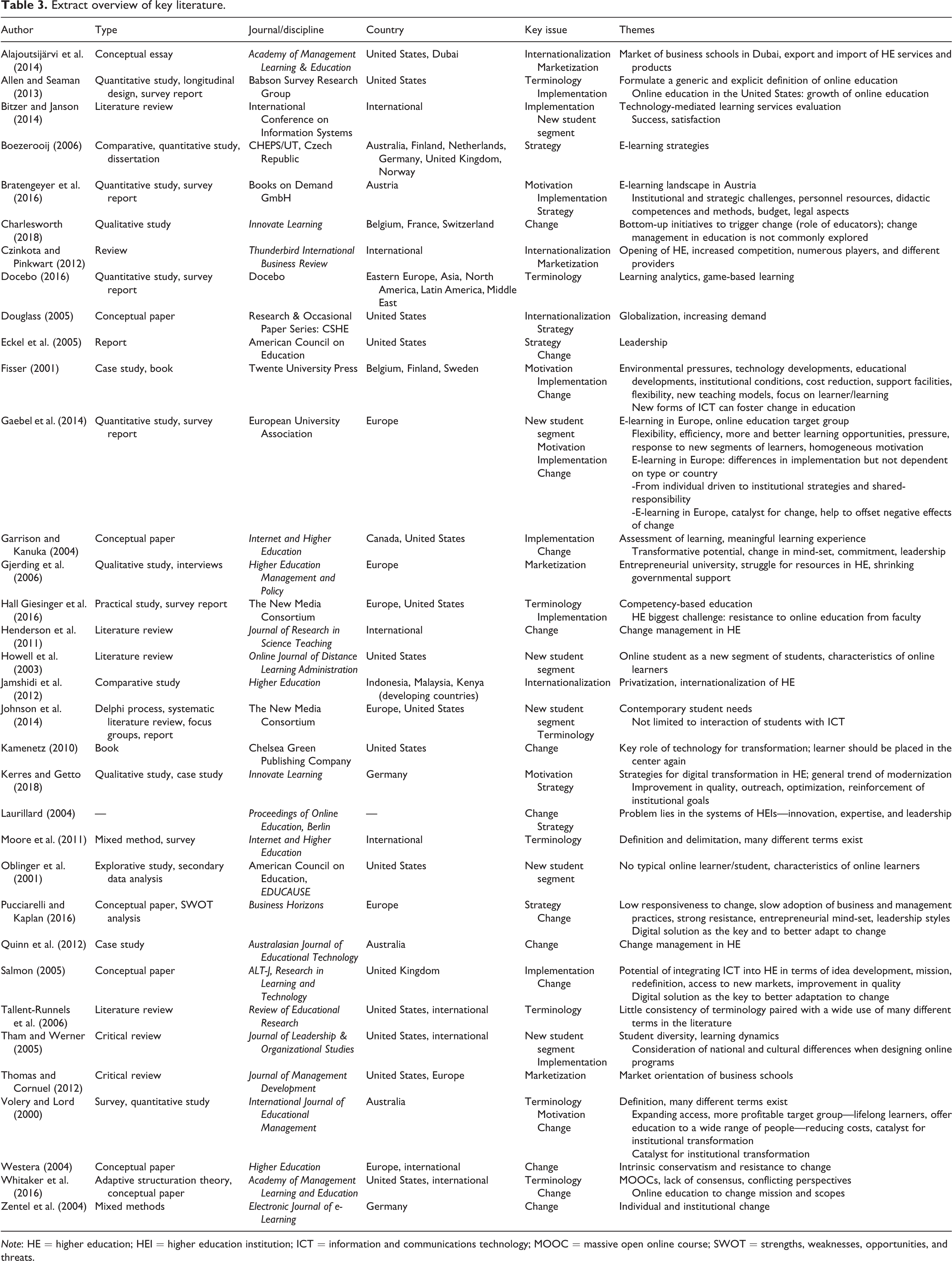
Note: HE = higher education; HEI = higher education institution; ICT = information and communications technology; MOOC = massive open online course; SWOT = strengths, weaknesses, opportunities, and threats.
Internationalization and marketization
Internationalization is the result of globalization and liberalization, and has led to the opening up of the HE sector. Students now are no longer only local residents, and recruitment takes place on an international level. Competition has increased, and it has become more difficult to sustain and keep up on a global scale with numerous players and different HE providers (Czinkota and Pinkwart, 2012; Jamshidi et al., 2012). As a consequence, HEIs are also finding themselves struggling for resources (Gjerding et al., 2006), with shrinking governmental support (Bowen, 2012; Breneman, 2011; Gjerding et al., 2006; Sheets et al., 2012) on the one hand and, on the other, an increase in costs (Bowen, 2012). In turn, an ongoing trend of market orientation can be observed (Bowen, 2012; Breneman, 2011; Gjerding et al., 2006; Sheets et al., 2012; Thomas and Cornuel, 2012). As students have to pay more for their education, they are also demanding higher standards and a certain quality of educational experience, and thus they behave more and more like actual customers. Indeed, the assimilation of the HE industry into conventional markets has recently become apparent (Barber et al., 2013; Bowen, 2012). Hence, HEIs, more than ever, are striving to become more competitive and are eager to provide high-quality and alternative and differentiated modes of learning at a lower cost. Thus new educational models that build on e-learning are envisaged (Johnson et al., 2016). While the internationalization and marketization of the HE sector have been high on the agenda for around the last 10 years, today other issues are moving to the center of the debate—among them, the future student profile.
New student segment
As demographic trends are changing, the worldwide demand for HE is growing. This phenomenon is often termed the “massification” of HE, with a dramatic increase in the participation of students from very different backgrounds (Massy, 1996) entailing a growing demand for lifelong learning. In turn, learning and studying are no longer limited to the early years of life, but rather life itself is seen as a process of continuous learning (Field, 2000). Hence, the composition of the student body has changed over the years, and the typical student who attends a university right after high school is no longer the only market. In turn, new groups of learners have developed, such as the adult learner, the working student, and the lifelong learner, and all desire better and more differentiated access to education. Thus the student profile has changed, and HEIs are being challenged once more to adapt their curricula, contents, structure, and mode of delivery to the needs and requirements of these diverse students, as Gibbons et al. (1994) argued earlier.
In many cases, ICT has been implemented successfully to reach distant students interested in earning a (foreign) degree while not having to change location (Bjarnason et al., 2000; Van der Wende, 2001). Online students are very often seen as a separate category of learners, differing from “traditional on-campus students” (Howell et al., 2003). Oblinger et al. (2001) highlight that, although the adult learner is a classic example of a student enrolled in an online program or course, online student segments may vary considerably. A general and uniform definition of the online student may not be possible, but different aspects, such as individual goals, maturity level, and financing options (Howell et al., 2003) and, according to Oblinger et al. (2001), professional advancement, external expectations, and social relationships, as well as interest and pleasure, have to be taken into account.
Terminology
Terminology is one of the issues most often discussed in the literature. There is still inconsistency in the meaning and understanding of the phenomenon of integrating technology into the learning process, and still no uniform definition available. There are many different terms that describe the integration of technology into the learning process (Hiltz and Turoff, 2005; Moore et al., 2011; Oblinger, 2012; Volery and Lord, 2000). The result is often a lack of consensus regarding the role of ICT in HE in practice (Whitaker et al., 2016). In general, and as defined by Volery and Lord (2000), online education can be understood as the online delivery of distributed knowledge through the integration of technologies into the learning process, enabled by the Internet. In the literature, however, there is an ongoing debate about the actual meaning of the term “online education/learning” and about the difference between this term and related terms such as “e-learning” and “distance education/learning,” which are found to be the most prominent ones in the literature, and other related terms such as “technology-enhanced/supported learning” or “computer-mediated learning” (Liang and Chen, 2012; Moore et al., 2011). Thus, little consistency of terminology along with the wide use of many different terms in the literature has been identified (Tallent-Runnels et al., 2006).
Also, in practice, different types and forms of online education have developed. The blended model, for example, which combines online and face-to-face education, is not only widely known but is also appreciated as an uncomplicated means of implementation. Another type is the MOOC, which allows for unlimited participation, and there are also mobile or social media learning, game-based learning, and competence-based learning, which is believed to unfold their full potential through the complementary use of online education (Hall Giesinger et al., 2016). Reflecting on the different approaches in online education, it becomes clear that the influence of technology on HE is not limited to the interaction of students with ICT, but that different types of technologies have to be considered, especially with regard to the future. Examples are Internet technologies (cloud computing), social media technologies (crowdsourcing), and also other digital strategies (flipped classroom) and future developments in consumer technologies (robotics), enabling technologies (affective computing) and visualizing technologies (3-D printing) (Johnson et al., 2016).
Motivation, implementation, and strategy
Online learning, which was formerly typically practiced only by specialized HEIs in distance learning or open universities, has become prominent in conventional and traditional HEIs. Gaebel et al. (2014) found that almost all European HEIs were already embracing e-learning, with blended learning still the most popular approach to implementing technology into the learning process. They also found out that contrary to expectations, technical universities or open universities did not always lead in ICT-supported teaching or digitization in general. E-learning is often used in disciplines such as business and management, but rarely in law or the arts and design (Gaebel et al., 2014). HEIs in the United States (Docebo, 2016), Germany, Spain, Switzerland, and the United Kingdom, in particular, involve students in e-learning, whereas those in Italy, France, and Turkey show the lowest student involvement rate in online education (Gaebel et al., 2014).
Gaebel et al. (2014) observed striking differences between how and to what extent individual institutions were approaching and implementing e-learning. They see the reasons for this in the HEI’s profile and mission, its availability of resources and access to funding, and its focus on certain subject areas, target groups, and students’ different stages of experience (including personal skills and open-mindedness). Apparently, however, there seems to be no clear correlation between an HEI’s approach to e-learning and the provenance or type of institution (private, public, etc.).
HEIs are challenged to operate in a far more competitive environment than in the past. In turn, a general assumption has been established that HEIs also have to define clear and comprehensive strategies in order to be sustainable, especially in regard to the increasing demand for new and differentiating programs and services (Douglass, 2005; Eckel et al., 2005), and the application of new technologies in the delivery of education to reach new student markets and expand enrollment (Boezerooij, 2006; Douglass, 2005).
Allen and Seaman (2011) carried out a longitudinal study over 10 years (2002–2012) in the US online educational market to determine whether or not online education can be described as strategic. Their study provided evidence that the majority of HE decision-makers are convinced that online education is critical to their long-term strategy (Allen and Seaman, 2011, 2013). This is interesting, as Bratengeyer et al. (2016) found that, for example, in Austria often no dedicated strategy papers existed and thus no formal strategies were in place; instead, only vague strategy information was apparent. Indeed, Gaebel et al. (2014) assume that e-learning strategies have not yet achieved their full impact in the European region. They observed that HEIs might have long-standing and well-developed e-learning activities in place but without dedicated institutional strategies. On the other hand, there are HEIs that have only recently adopted a strategy for integrating technology into the learning process, and have therefore not yet developed a strong portfolio of e-learning activities.
Kerres and Getto (2018) claim that universities often see digital transformation as a general trend for modernization only, failing to recognize its potential for strategic positioning against competitors. As a result, they often make imprudent and huge investments in digitization that do not follow a strategic plan but rather are based on daily micro-politics and the intraorganizational negotiations of stakeholders. Kerres and Getto (2018) warn that it might not be enough simply to implement technology, and that it is more important to determine how this approach can help reinforce institutional goals.
Moreover, a study by Gaebel et al. (2014: 8) shows that, although investment in online education has become a kind of trend, an inconsistent and “patchy implementation” of e-learning throughout the institution can still be seen in Europe. Furthermore, e-learning activities or strategies have turned out to be driven by individual departments or faculty members rather than by the whole faculty. Gaebel et al. (2014) observed implementation along an “institutional innovation path,” which means that initiatives are introduced and piloted by individual departments and staff members and, if they turn out to be feasible, robust, and useful, finally become mainstreamed at faculty and institutional levels. Nevertheless, in recent years, a clear trend toward centralization or a shared-responsibility institutional approach can be observed, with a shift away from faculty- and teacher-driven activities and toward institutional strategies (Gaebel et al., 2014).
Regarding institutional strategies, there are different reasons why HEIs embrace online education, which may seem widely homogeneous and independent of country and type of institution (public, private, applied, etc.), as Gaebel et al. (2014) indicate. First, HEIs often perceive the integration of technology as a pressure that must be embraced in order to remain sustainable, and as kind of modernization trend that cannot be ignored (Kerres and Getto, 2018). Second, HEIs strive for more flexibility (Collis, 1999; Collis and Moonen, 2012) in learning and try to attract nontraditional students, including adult learners, professional learners, lifelong learners, and other underserved or isolated segments. At the same time, they attempt to satisfy the expectations of the next generation of learners and to serve the knowledge economy in the future by improving the quality of the learning experience. Third, economic reasons have also been revealed as important, which means serving a wide range of students at the same time, reducing costs and increasing productivity (Bratengeyer et al., 2016; Farrell, 1999; Gaebel et al., 2014; Kerres and Getto, 2018; Volery and Lord, 2000). Fourth, the possibility of increased collaboration within the institution itself and among international HEIs has also been mentioned (Gaebel et al., 2014).
As Allen and Seaman (2013) found, although the majority of HE decision-makers now perceive online education as critical to their long-term strategies, they also feel confronted with several barriers that will impact the growth of online education, in particular, a lack of faculty acceptance, a lack of discipline from the student side (dropout rates) along with lower retention rates, and a lack of acceptance of online degrees. Hall Giesinger et al. (2016) see resistance to online education, especially from faculty, as a major challenge to be overcome. This resistance is a reason why the learning curve of technology adoption has slowed. Currently, HEIs do little to combat it and to prepare faculty for the shift in teaching approach that online education entails, as Hall Giesinger et al. (2016) argue.
It thus becomes apparent that integrating technology into the learning process does not come without challenges. However, as Gaebel et al. (2014) claim, such challenges nonetheless do not seem to constrain the motivation to invest in and implement e-learning.
Change
Zentel et al. (2004) regard online education as a complex issue that entails more than the sole provision of technology; it also requires individual and institutional change, and the involvement of multiple contexts and stakeholders (Pittard, 2004). Westera (2004) suggests that the intrinsic conservatism of most universities fosters resistance to change and therefore makes the issue even more complicated. Laurillard (2004) sees weaknesses regarding change, especially in the systems of HEIs, and in relation to innovation, expertise, and leadership. Garrison and Kanuka (2004) argue that most HEIs still have to find their transformative potential. When Pucciarelli and Kaplan (2016) investigated threats to and weaknesses in HE, they found that HEIs assumed a low responsiveness to change in the corporate world, adopting business and management practices and strategies slowly. They proposed that HEIs “must undergo a major shift in terms of their managerial approach” (Pucciarelli and Kaplan, 2016: 8). In turn, HEIs should adopt an entrepreneurial mind-set and make use of leadership styles that can balance market-driven logic with the original goals and missions of the HEI to serve the public need. Pucciarelli and Kaplan (2016: 9) see “digital solutions” as the key here, because they have the power to foster better adaptation to change while preserving universities’ societal role. Kamenetz (2010) see a need for change, especially in the American HE system, assigning technology a key role for transformation too. Gaebel et al. (2014) not only observe that many European HEIs acknowledge that e-learning can change their approaches to learning and teaching, perceiving it as a catalyst for change in teaching methods, but also find proof for strategies that can be useful in helping HEIs offset the negative effects of change, such as duplicated action, competition between different parts of the same HEI, and investment in incompatible technologies.
Although change obviously seems to play a critical role for HEIs when implementing online education, change management in HE is not commonly explored (Charlesworth, 2018). Still, traditional change management theories (e.g. Kotter, 1995; Lewin, 1958) and instruments are also applied and discussed in the HE context. For example, Quinn et al. (2012) employed these theories in the context of engaging students in blended learning. Henderson et al. (2011) conducted a review embracing the whole literature on change management in HE. In their study, they identified two commonly used change strategies in the HE context that are not effective: first, the developing and testing of best practices and, second, the influencing of instructional practices from the top down. Henderson et al. (2011) claim instead that more effective strategies are aligned with the beliefs of the individuals involved, are long-term oriented (at least one semester), understand HEIs as complex systems for which the strategy in place must be compatible, and assign organizational culture a key role.
Gaebel et al. (2014) observed that, in most European HEIs, senior staff were in charge of e-learning (heads of e-learning centers, vice rectors, coordinating or managerial staff, professors). This senior leadership status reflects an increasing institutional interest in e-learning and indicates that there is already a degree of change in governance and management structure indicated by the creation of new positions, as Gaebel et al. (2014) found, such as vice rector for technology/ICT. In addition, Löfström and Nevgi (2007) highlight the continued commitment by department heads to take a critical approach when integrating ICT into the teaching and learning process. Similarly, Fisser (2001) believes that internal involvement and the identification of key people and pioneers who can influence the change process are critical to pushing the use of new forms of ICT in education. Hence, many scholars argue that such a process requires qualified leadership and an efficient governance model.
Discussion and implications for further research
Research activity in the area of integrating technology into the learning process is carried out within two main disciplines—pedagogy/psychology and informatics (Bratengeyer et al., 2016; Gaebel et al., 2014). The rest of the relevant literature is located at the intersection between these two disciplines, HE and the field of management. This literature positions itself within a specialized discipline that can be referred to as HE management research, tackling the topic of technology integration into the learning process from a management perspective. Although disciplines such as pedagogy and informatics deal with the integration of technology into the learning process, a one-sided focus on success is often apparent in the literature, as well as a dominant silo attitude. Indeed, single aspects are often extracted and processed independently of each other (e.g. Chen and Jang, 2010; Jones and Issroff, 2005; Rovai, 2003; Sander et al., 2000; Wu et al., 2010). A good example is the debate terminology: more research in this area would likely not lead to a solution but rather would contribute to the complexity of the issue. Another approach would be to accept the different perspectives, stop searching for a universal definition and recognize that different viewpoints might coexist and do not have to be mutually cannibalizing. The terms or forms used should not be the central point, nor should disciplines, but instead there should be a transparent understanding throughout the institution or research community which can be transferred to stakeholders (as students) and interest groups. This debate actually recalls the desperate attempt to find a uniform definition of the “online student” some years ago, with scholars finally concluding that this was neither necessary nor constructive as different and individual aspects had to be considered depending on the learner’s background, expectations, and goal orientation (Howell et al., 2003; Oblinger et al., 2001).
The HE management literature, however, perceives the integration of technology as a mere tool—something that helps a particular activity be accomplished—and pays less attention to the wider impact it may have on the institution.
Although some countries are less reluctant to embrace e-learning (e.g. the United States, Germany, the United Kingdom) than others (e.g. Turkey, Italy), the assumptions and perspectives of different countries in regard to integrating technology into the learning process are homogeneous in the literature. The same can be seen in practice. Researchers found that the motivation for, as well as the implementation of, e-learning in HE seems quite independent of geographical location as well as of institutional type (Boezerooij, 2006; Fisser, 2001; Gaebel et al., 2014). Although the motivations for implementing online education are often the same (increasing the quality of teaching and learning, attracting more students, having flexibility), the approach varies among HEIs (blended learning, MOOCs, etc.). Gaebel et al. (2014) track this back to the institution itself and in particular to its mission and structure. Hence it seems that, in the context of online education, it is not so much about cultural differences in terms of country or legal form, but more about the individual organizational culture (mission, vision, policies, values, structure, goals, procedures, tradition, beliefs, perceptions, norms, etc.). Indeed, sufficient proof for this assumption may be found in the literature. One reason might be that technical or open universities are not always the front-runners in online education. Moreover, the preference of HEIs to offer specific programs online (often business and management studies) and not others (design or law studies), or the evident insufficient preparation of faculty (HR development and training) for online education are other indicators that organizational culture is a potential influence factor worth considering and investigating in future research. Salmon (2005) confirms that in the past HEIs merely concentrated on the explicit characteristics of online education rather than recognizing the potential for integrating ICT into HE in terms of idea development, mission redefinition, access to new markets, and improvement in quality.
Furthermore, although change is an often-discussed topic when HEIs implement technology into the learning process from a theoretical and practical perspective, change management in HE is not commonly explored (Charlesworth, 2018). Also interesting is the fact that, although online education is often perceived as change that entails various challenges (student support, assessment, faculty acceptance and resistance, lack of experience and competences, etc.) that HEIs struggle with, it is often presented in an optimistic way. Some even see online education as a change agent in itself or as a catalyst for change in HE (Gaebel et al., 2014; Pucciarelli and Kaplan, 2016; Volery and Lord, 2000), implying that there is a reciprocal reinforcing relationship between online education and organizational change. On one side, online education is claimed to have the power to offset negative consequences that accompany the change process which online education provokes; on the other side, implementing online education is believed to reinforce organizational adaptation and development.
Thus, on a metaparadigmatic level, a potential reciprocal relationship between online education and organizational culture has been revealed. If both the motivation for and the implementation of e-learning seem independent of geographical location, as well as institutional type, the question emerges: what do motivation and implementation depend on, then? In the literature, there is evidence that motivation, implementation, and strategies related to e-learning can be influenced by the organizational culture (technical universities or open universities are not always pioneers; some subjects are preferred to others for transfer online; faculty have insufficient preparation and training; there is a need for consensus that e-learning should be aligned with organizational beliefs). However, the role of organizational culture has not been of great importance in earlier research, if it has been examined at all, and thus this subject opens up scope for further research.
The literature seems to suggest that it can be assumed that online education not only has the potential to access new markets (attracting more students and responding to the new student segment of the lifelong learner) and to improve the quality of teaching and learning, but also—and even more so—to impact the organizational culture by revealing opportunities to redefine the institutional mission and achieve institutional aims (Kerres and Getto, 2018; Salmon, 2005), and thus to support organizational development. Still, we also need empirical evidence to confirm the potential of online education in supporting organizational development. Some scholars see the adoption of an entrepreneurial culture as the key to making use of this potential. Entrepreneurial skills and mind-sets are assumed to be of increasing importance for adapting to a rapidly changing world and taking action to deal with related challenges. Regardless of all the literature focusing on the entrepreneurial university (Bratianu and Stanciu, 2010; Clark, 2004; Philpott et al., 2011), there is still no uniform concept that can be applied to a university in order for it to become an entrepreneurial one. At this point, there are only a small number of “real” entrepreneurial universities, and they are realized only on a small scale from a global perspective (Gjerding et al., 2006). Nevertheless, there are several prime examples of entrepreneurial universities in practice which serve as role models for how to become an entrepreneurial university, which is still missing in theory. This opens up scope for further research: we need to find out more about the relationship between online education and different types of organizational cultures which might foster or hinder the successful integration of technologies into the learning process.
Finally, previous studies have found that almost all HEIs integrate technologies into the learning process, making use of many different approaches and implementing various types and forms. However, most HEIs do not have a formal strategy for implementing e-learning (Bratengeyer et al., 2016; Gaebel et al., 2014; Kerres and Getto, 2018). Thus, the question arises, why this is the case? In the context of business schools, this seems ironic because strategy making is their “core business.”
To sum up, three issues for which further research is needed have been identified. First, an investigation into the role of organizational culture is necessary and, in particular, it would be interesting to determine which kind of organizational culture is beneficial for fostering online education. Especially intriguing in this context might also be an investigation into the entrepreneurial university, because a theoretical framework on how an institution can become one is still lacking. Second, we need to discover more about the proclaimed potential of online education as a change agent for fostering organizational development. Consequently, more research regarding change management in the context of HE will be inevitable. Finally, yet importantly, we need to reflect on the fact that many HEIs do not consider e-learning strategies crucial for the integration of technology into the learning process. Further research could increase understanding here by investigating the reasons for this.
Furthermore, bearing in mind that little research has been done until now, as well as the general need for the development of theory in the field, qualitative, ethnographic, and grounded theory approaches in particular should be the focus in the future. Such a focus might offer new insights about HEIs as cultural entities by allowing for observation and an immersion in their day-to-day running. Finally, it would also help to balance the overrepresentation of quantitative studies in the field.
Conclusion
The literature in regard to e-learning management (aims, strategy, implementation, change) is sparse. The findings suggest that further empirical and theoretical research is necessary in this area, where disciplines overlap and are merging with the field of HE management. Whereas previous studies have often investigated the integration of technology from a silo perspective, the present study was able to examine the subject as a phenomenon, adopting a more holistic perspective by recognizing multiple aspects and relating them to each other. It was also possible to reveal new relationships on a metaparadigmatic level, providing an up-to-date call for future research in HE management.
Finally, by conducting a creative inquiry, the study presented an innovative and underemphasized method for extending the repertoire of the literature review approach.
At this point, and since it is claimed that the present study is systematic, it is important also to note its limitations. First, it is acknowledged that, when the author was creating a map of the research terrain, she made selective decisions based on her implicit and explicit assumption criteria. This is the inherent nature of a creative inquiry and is therefore part of the process of active knowledge creation. In doing so, the author covers only the integration of technology in the HE context, although it is also a phenomenon at lower educational levels as well as in nondegree and nonacademic education. Focusing on other educational levels and means of delivery outside HE was beyond the scope of this research, but the findings do open the door for assessing the impact of integrating technology at other levels.
Furthermore, references included have come mainly from major players in the field (North America, Europe). Further research might profit from including perspectives and insights from other players (developing countries). The present study paves the way for this through the approach adopted.
Finally, in investigating this specialized research field, it must be acknowledged that highly-ranked publications are in fact rare and this may have implications with regard to the quality of the references used. Nevertheless, this study should serve as a model to inspire and encourage other researchers to engage with the research field and increase publishing activity in this area in the future.
Footnotes
Declaration of conflicting interests
The author(s) declared no potential conflicts of interest with respect to the research, authorship, and/or publication of this article.
Funding
The author(s) received no financial support for the research, authorship, and/or publication of this article.
