




Abstract
Entrepreneurship education represents a popular area of contemporary study. Nonetheless, topical interest is heavily biased towards final outcomes, such as entrepreneurial intentions or ending motives to become an entrepreneur. In this regard, further development is needed to unearth the pedagogical processes that allow these perceived beneficial outcomes to emerge. The aim of this paper is to approach a commonly studied outcome variable – student motivation – from a novel perspective. An attempt is made towards its reframing as a processual construct that energises and directs effective engagement in learning itself. Contributing to the sharing of innovative pedagogical best practice and the linking of outcomes to methods of teaching, a way through which students’ motivation can be ignited and sustained is exposed. Specifically, an original approach towards increasing student autonomy is put forward and critiqued.
The context of the entrepreneurial classroom often creates a wide range of highly differentiated learning experiences for students (Shneor et al., 2020). Traditionally these experiences have been embedded in a positivist approach to entrepreneurial learning that has had a tendency to marginalise the wider social value that individuals can create for both themselves and others (Higgins et al., 2013; Lackéus et al., 2016). Although some may be able to explore their own interests and engage with the associated content and methods in meaningful ways, others may not be enthused by the same prospects. More developed educational research in different subject areas has indicated that this lack of motivation can originate from several sources including an absence of belief in one’s own domain-specific ability, a natural disinterest, or a failure to see the value or appeal in the learning activities themselves (for example, see Green-Demers et al., 2008; Moore et al., 2008; Shen et al., 2010; Symonds et al., 2019). This means that there is a strong possibility that not everyone will end their time spent in the classroom with positive experiences (Brentnall, 2020). Unintended consequences can transpire, including boredom, apprehensiveness and unrealistic expectations, which may eventually lead to psychological distress, academic underachievement and other detrimental outcomes (Bandera et al., 2020; Fiet, 2001; Mann and Robinson, 2009).
These divergent realities stimulate much curiosity from an entrepreneurship education (EE) researcher and practitioner standpoint, given their perceived capacity to unearth underlying mechanisms of student motivation and achievement (Marsh and Martin, 2011; Martin and Elliot, 2016). New discoveries can arguably be useful for both the ‘narrow’ (new business creation) and more expansive (enterprising competencies) forms of EE (Hägg and Gabrielsson, 2020). The main premise of the current ‘best practice’ paper is constructed with the belief that, as entrepreneurial educators, we have influence over this subject-related motivation and, as a consequence, the entrepreneurial development of students thereafter (Joensuu-Salo et al., 2020). Motivation, for us, is broadly considered to be the energy and direction of behaviour (Pintrich, 2003), the subject matter of which being the processes – needs, cognitions, and external events – that give rise to its strength and purpose (Reeve, 2018).
From a social constructivist learning paradigm accepting of the belief that focus should not only be bestowed on economic growth but also on the personal growth of the individual (Leffler, 2009), we employ Self-Determination Theory (SDT) (Deci and Ryan, 1980, 2000) as a useful lens to help articulate and explain how interactions between educator, student and learning activities can help in the promotion of students’ goal-driven behaviours. Deci and Ryan established the belief that, if we are to fully understand motivated behaviour (that which is goal-directed), then the various needs that provide psychological potency towards such goals must be considered, including a need for autonomy, competence and relatedness. A strong emphasis is placed on efforts to satisfy these basic and universal needs to the point that internally derived motives – as opposed to those that are external – energise student engagement (Cheon et al., 2012). It is assumed that they can provide the psychological nutrients for successful learning, a positively functioning classroom and a general feeling of overall psychological well-being (Jang et al., 2009; Vansteenkiste et al., 2004).
More specifically, and in attending to the call of numerous entrepreneurship scholars for the sharing of innovative teaching and learning practices (Brentnall, 2020; Fayolle et al., 2016; Hytti et al., 2010; Neck and Corbett, 2018; Ratten and Usmanij, 2020), the purpose of our article is to both describe and explain the content, structure and rationale behind an entrepreneurial classroom-based activity that has been adapted from Osterwalder et al.’s (2014) Value Proposition Canvas (VPC). The context in which this activity has been implemented is an entrepreneurial university (EDEM) located in Valencia (Spain) which forms an integral part of a larger entrepreneurial ecosystem initiative known as the Marina de Empresas. Its intended learning objective is to empower intrinsic motivation in students through the individual construction of their own outcomes (Deci and Ryan, 2000; Sheldon and Elliot, 1999), recognising that this process is seen as an essential part of entrepreneurial learning (Kyrö, 2015). The premise follows that the same tools used in an important subset of EE – that is, attempts to increase the rate of new business entry – may still be implemented, but in much more imaginative and less restrictive ways to produce qualitatively different learning outcomes (Kyrö, 2015).
The emphasis we choose to impart on the motivational component of EE affords several perceived novel and interesting benefits for the field. Firstly, it offers a potential pathway for us to ensure that all students are provided with the best opportunities for personal growth, helping us to avoid the pitfalls of EE and its perceived ‘taken for granted’ competitive nature – inclusive for some but isolating of others (Brentnall, 2020: 2; Ryan and Deci, 2020). It is believed that through such provision, composed of a paradoxically universal but at same time individuated purpose, the potentially harmful effects that emanate from the ‘darker side’ of EE, such as an inability to cope with failure, anxiety and the grief of rejection (Bandera et al., 2020), can be somewhat ameliorated. In this way, by satisfying our basic needs, we are thought to be better able to deal with more emotional, uncertain and stressful situations (Trépanier et al., 2013).
Secondly, within EE there has been a tendency to address motivation predominantly as an outcome variable. That is, given its recognition as a key driver of student intentions towards becoming an entrepreneur, it is used to subjectively evaluate whether a course has stimulated interest ex-post-facto (Donaldson, 2019; Nabi et al., 2017). Although in itself this is problematic given the lack of consensus among findings (Martin et al., 2013; Nowinski et al., 2019; Shneor et al., 2020), it is perhaps more concerning that we are arguably not fully embracing the process through which learning occurs. Instead, as SDT suggests (Ryan and Moller, 2017), in our approach we shift emphasis towards the reframing of motivation as a processual construct that energises and directs effective engagement in the learning itself (Pintrich, 2003).
Finally, research within EE from an educator’s perspective has been described as relatively silent in comparison to the degree of attention devoted to the student (Neck and Corbett, 2018). SDT allows us to approach this issue by proposing that autonomy-supporting educators can create shared benefits for both teacher and learner (Jang et al., 2016a). For example, if we take the perspective of our students and encourage them to act on their initiative, they can progressively develop greater interest and become more engaged (Patall et al., 2018; Tsai et al., 2008). Additionally, allowing students to work in their own way, at their own pace (Assor et al., 2002; Jang et al., 2016b) and providing explanatory rationales for activities (Steingut et al., 2017) communicated in compassionate ways (Reeve, 2016) create opportunities for them to experience autonomy-need satisfaction that can stimulate interest, classroom engagement, unsupervised self-regulation and conceptual forms of learning through depth and flexibility in thinking (Jang et al., 2016a; Vansteenkiste et al., 2005).
Building on this introduction connecting motivational learning, SDT and EE, the remainder of the paper proceeds structurally as follows. Firstly, it begins with the outlining of the philosophical framework that guides our thinking and reasoning throughout the work, helping to situate the practice in the overall narrative of EE. We then provide the theoretical background that has led to the construction of the learning activity with a particular focus on explaining the concept of autonomous regulation and its origins. Next, the entrepreneurial activity is described and detailed with a potential method for implementation suggested. Included in this description is a more precise linking of the theory to practice while also highlighting potentially troublesome areas based on the authors’ own experience.
The paper concludes with summarising thoughts on the usefulness of this tool within the EE domain and beyond. It should be made clear from the outset that our goal is not the empirical testing of the methodology presented; instead we aim to share our innovative pedagogical best practice (Noyes, 2018) while linking expected motivational outcomes to our methods of teaching (Pittaway and Cope, 2007). As a generic, but paradoxically specific mechanism our hope is that it can been taken, refined, tested and adapted for application not only within the EE domain, but so too across other areas.
Theoretical background
Guiding philosophy
Before engaging with the relevant literature surrounding the development of our classroom-based activity, we think it important firstly to explicitly share the educational values on which it is based. This is a useful undertaking as our ways of thinking and subsequent practice are presupposed by our own personal philosophy (Gigerenzer, 2007). By conveying this guiding framework, we hope to provide the reader with greater insight into the what, how and why of our actions (Hannon, 2006), and how these align with wider paradigmatic thinking in the field.
Education in general is constituted by several dualisms that can be conveyed more parsimoniously by the ideas of traditional versus progressive philosophies (Lackéus et al., 2016). The entrepreneurial educator is therefore charged with the difficult proposition of finding their own fit between (or within) the two. Importantly, paradigms are not exclusive, meaning that it is not an either–or scenario; however, pragmatism may be adopted regarding various outcomes set (Bell, 2021). More traditional philosophies are what Freire (1970) refers to as the banking perspective, meaning that they assume an empiricist approach regarding teacher-centricity. In this light, the learner is a detached object of control (the depositor) and the role of the teacher becomes a provider of content in more formally organised learning environments.
Behaviourism, for example – expressed through conditioning theories – attempts to explain learning in terms of the external environment (Watson, 1924). When speaking of EE, attention would be devoted to the specific activities entrepreneurs perform to develop business ventures in which critical judgement is not promoted (Dewey, 2013; Gartner, 1988). The internal workings of human thought processes and mental faculties, although important, would not be essential for learning to be explained (Schunk, 2020). Connections are made through stimulus and response, and strengthened via reinforcement or repetition (Ertmer and Newby, 2013; Pavlov, 1927; Thorndike, 1913). Motivation is therefore taken as the quantity and rate of behaviour as opposed to internal processes (Schunk, 2020).
Cognitivism, a temporal displacer of behaviourism, sees the teacher as a relayer of knowledge; it is still the teacher who decides what the student needs to know and what the right knowledge is (Kyrö, 2015). Contrasting with earlier approaches, however, focus is placed on cognitive elements such as perception, attention, encoding, storage and retrieval, whereby learning emerges from more critical forms of thinking (Bell, 2021). Teachers strive to provide as much organised knowledge as possible, with the learner viewed as part of a machine designed to process and memorise information, thus motivated by such control processes (Brieger et al., 2020; Schunk, 2020).
Progressive philosophies, on the other hand, are typified by a student-centred approach based on action and collaboration (Tynjälä, 1999). Iterative uncertainties are deemed to occur in specific contexts as students become involved in more meaningful and emotionally attached ways (Lackéus, 2014). Humans are viewed as operating in complex environments with knowledge taken to be constructed through social interactions compared to a simple one-way transfer (Higgins et al., 2013). Students, as agents of power, can be selective in interpreting and assimilating information that is most relevant for them (Kyrö, 2015). The teacher, as a social actor, becomes a support for collective learning by trying to establish a conducive context for its occurrence (Joensuu-Salo et al., 2020).
Taking these main learning paradigms into consideration, and given that we perceive EE as an inclusive process of holistic enrichment in which the creation of value is not limited to a narrow role preparation view of starting a business (Hägg and Gabrielsson, 2020), we envisage that learning to ‘become’ entrepreneurial is competency- and value-oriented and thus transcends many different learning areas and levels (Lackéus et al., 2016). For us, traditional paradigms by themselves are too restrictive in their capacity to stimulate genuine autonomy, interest and lifelong entrepreneurial learning (Labaree, 2005; Reuber and Fischer, 1993). They have a tendency to break content down functionally (Cope, 2005), directing the student through a number of causative and additive sequential stages that, upon completion, it is hoped will increase their capacity to ‘be’ an entrepreneur (Higgins et al., 2019).
Entrepreneuring, however, is not devoid of context – it is a social phenomenon in which learning is conceived to be situated in relevant communities of practice (Lave and Wenger, 1991; Welter, 2011). Therefore, we align more closely with a social constructivist philosophical way of thinking (Table 1). Put somewhat differently, the student is perceived to be a creative actor in their own learning process, both influencing and at the same time being influenced by their environment. In this respect they move from reactionary, as in traditional views of education, to a meaning-maker, an effectuator and a trailblazer of their own future (Sarasvathy, 2001; Shepherd and Patzelt, 2017). According to a social constructivist view, the nature of the world means that they are confronted with an ever-changing reality that renders the knowledge possessed transitory and wherein reflexive practice acts as a discrepancy checking mechanism – ‘what have I achieved and where am I aiming for’ (Higgins et al., 2013). In this respect, learning continuously emerges through the accumulation of experiential interactions (Neck et al., 2014; Pittaway and Cope, 2007) and evaluations that entail pragmatism with regard to individually held interests (Kyrö, 2015).
Five central tenets of the constructivist teacher.
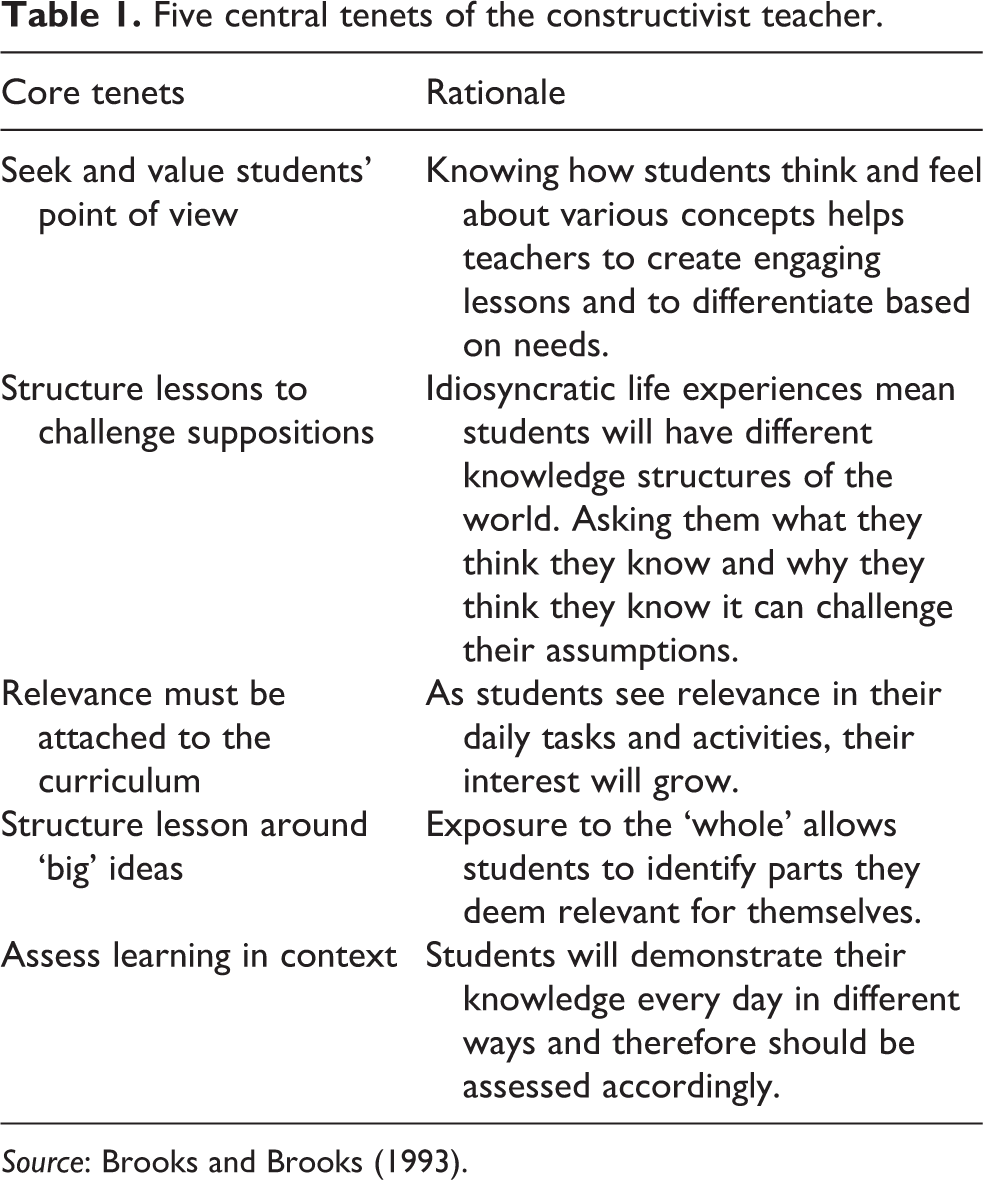
Source: Brooks and Brooks (1993).
For us as educators, this means that our starting point will be the students themselves and the context in which they are positioned – the way individuals will learn and experience activities will be inextricably connected with their complex historical trajectories (Mezirow, 1991). In this way, as Cope (2005) puts it, they can learn about themselves, their strengths, areas for improvement and personal goals. Learners will need to be supported in relation to the interplay between their own motive status by taking into account their needs, cognitions and emotions (Reeve, 2018). Passive learners will be encouraged to take ownership of their own learning, actively answering questions, seeking solutions and self-regulating thereafter (Higgins et al., 2013). SDT, as a general theory of psychology, seems to complement this paradigmatic position by encouraging students to be autonomous and engage in active exploration for their own self-interests (Ryan and Deci, 2017). Doing so can help to build a sense of competence with the social nature of their environment, placing them within a community of learning that permits interaction with knowledgeable others. Therefore, given that, from a constructivist stance, learners will control their own learning, SDT as an explicatory mechanism for EE could prove to be a compelling move forward (Brooks and Brooks, 1999).
Self-determination theory
Brief overview and rationale
The scholarship surrounding the concept of motivation is vast and far-reaching (Reeve, 2018). As a consequence of this invested interest, a richness of understanding clearly demarcating motivation as a critical driver of learning has emerged (Boiché et al., 2008; Good and Brophy, 2000; Guay et al., 2008). Contemporary motivational theories take root in the belief that behaviours drive goal accomplishment (Deci and Ryan, 2000) depending on the values attributed, the determination of feasibility and the regulation of progress thereafter (Abrahamson et al., 1978; Carver and Scheir, 2000; Vroom, 1964). Attention, by and large, is devoted to the processes of the selection of goals, their intensity and their pursuit, in lieu of a more detailed engagement with their substantive content (Deci and Ryan, 2000).
Allowing us to gain greater understanding of goal contents, SDT is perceived as unique among theories through its positioning of the parallel satisfaction of three empirically supported universal needs – the need for competence, relatedness, and autonomy – at the core of its explanatory model (Jang et al., 2009; Nalipay et al., 2020). The need for competence is related to an individual’s search for mastery experiences and manifests through various actions, such as curiosity and manipulation. A need for relatedness centres on the desire to feel connected – to love and to be loved. What ensues is not only a desire for acceptance from others, but so too a desire to actively contribute to the social group. The third and final need, for autonomy, denotes one’s desire to enact volitional experiences that are aligned with interpretations of the self. In this sense, an individual’s psyche endorses outcomes as originating from the self, while also belonging to this self (van Gelderen, 2010). Individuals will strive to regulate their own behaviours and experiences, meaning that they become congruent with a person’s true authentic interests and values (Ryan and Deci, 2017).
Needs as an important motivational concept have occupied much literature on psychology, and indeed SDT was neither the first nor the only theory to highlight their importance (Allport, 1937; Hull, 1943; McClelland, 1985; Maslow, 1943; Murray, 1938; Pittman and Zeigler, 2007). Scholars have focused on individual differences concerning need intensity relating to several outcomes (Ryan and Manly, 2005); however, some fail to differentiate between that which is basic and that which is desirable (Ryan and Deci, 2017). For example, a widely employed theory in the entrepreneurship and education literature has been McClelland’s (1985) need for achievement, which is closely aligned with the basic need for competence. Nevertheless, achievement needs are not simply a pure reflection of a need for competence, even though they are an important source of this motive (Deci and Moller, 2005). Put differently, a need for achievement is not a basic need in its own right and is at best a surrogate. SDT, on the other hand, seeks for universal application of fundamental needs based on our human nature to adapt and grow. Ryan and Deci (2017) contend that many contemporary basic theories of motivation emphasise the importance of efficacy or the attainment of goals without taking a critical stance concerning the purpose of efficacy. Lack of consideration of the nature of the goals one efficaciously pursues and achieves (e.g. Bandura, 1996) can mean that much predictive value is lost.
The necessity of satisfying all three needs across a lifespan also separates SDT from another prominent theory applied to educational research – Maslow’s Hierarchy of Needs (Maslow, 1971). Maslow, in his intuitively compelling and humanistic take, alludes to the requirement that deficit needs clustered at particular levels must be well-satisfied before higher-level needs, such as those that are cognitive, can start to exert saliency. Contrasting with this notion of linearity, 1 SDT emphasises interdependence of needs that are hierarchically equivalent. Maslow’s needs are conceived as deficiencies while in SDT basic needs should not require a deficit to provide motivation for action and can be satisfied through self-interest or attached importance. A dialectical interaction between active individuals and their social environment is considered sufficient as one searches for needs-based solutions (Deci and Ryan, 2000). This way of thinking appears to better align with a pragmatic social constructivist view of entrepreneurial learning. As entrepreneurship educators, our primary focus will therefore be directed towards the extent to which these needs are supported or frustrated (Ryan and Deci, 2020).
A continuum of motivation
By way of a schematic diagram (Figure 1), SDT exposes a useful continuum that helps depict the process of behavioural regulation in accordance with levels of autonomy or self-perceived volitional control. Two major motivational types are discerned as those that are inherent or intrinsic and those that are extrinsic, attempting to shape behaviour from the outside. The SDT framework was initially developed with an interest in the former and, therefore in the natural integrative tendencies of humans (Deci, 1971).
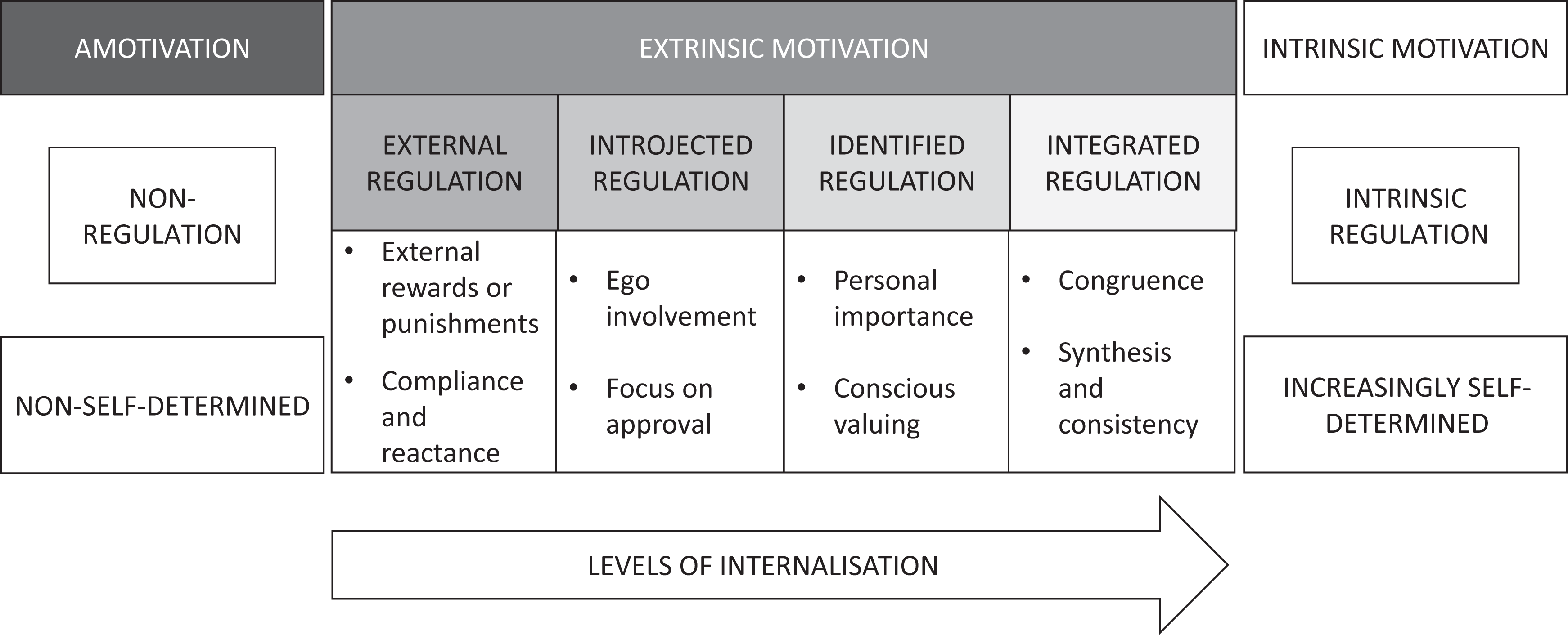
A continuum of self-determined regulation. Source: Extracted from Ryan and Deci (2020).
It is suggested that intrinsic motivation is embedded in the concept of lifelong learning (Deci, 1971; Ryan and Deci, 2017) and, if present, individuals consider themselves as the causal agent of their own action (DeCharms, 1968). Intrinsically motivated behaviours, therefore, are conceived as the prototype of self-determined activity and, with it, participation is seen as a consequence of free will, curiosity, interest and spontaneity (Vansteenkiste et al., 2010). The individual is autonomous and the imposition of external contingencies perceived as threatening, such as deadlines (Amabile et al., 1976) and other externalities, appears to have an undermining power (Kohn, 1993).
Extrinsic forms, on the other hand, bypass these inherent satisfactions, moving towards an instrumental separation from the activity itself (Ryan and Deci, 2017). Activities are engaged in based on the perceived attractiveness of outcomes, such as obtaining a good grade or receiving a monetary prize for winning a business plan competition (Deci et al., 1999). Externally derived motivation is not one-dimensional, and there are differing degrees to which a behaviour can be internalised (external demands have been assimilated) or integrated (external demands have assumed an integral role) (Deci and Ryan, 1985). In SDT, extrinsic motivation can be further subdivided depending on the level of perceived volitional control (see Figure 1).
Actions can be influenced by external regulation via the imposition of rewards or punishment (‘Do this because there will be an exam’) – it is typically characterised and experienced as controlled and therefore non-autonomous (Ryan and Deci, 2020). If extrinsic motivation has been partially internalised, then internal pressures of avoiding disapproval, guilt, shame or fear (‘Do this because it is something you should do’) can regulate behaviour. In this instance, extrinsic motivation is described as being introjected. In the entrepreneurial classroom environment introjected regulation may transpire as the ego of the student exerts a controlling influence over the behaviours they expose (Ryan, 1982).
In contrast to the previously described sub-categories of extrinsic motivation which are postulated as controlled forms, two more sub-types exist that are more autonomous. Identified regulation occurs through a person’s identification and acceptance of the value that an extrinsic behaviour holds for the self (‘Do this because it will increase your ability to positively contribute to society’). Accordingly, a person transitions from compliance towards engaging in behaviours for their personal importance – the cause of the behaviours being perceived as volitional and internally derived (Ryan and Deci, 2000). Finally, integrated regulation is the most comprehensive type of internalisation, providing foundation for the highest level of autonomy that can be achieved from extrinsically motivated action. Here, through a transformational process of self-reflection and assessment of compatibility, values are brought into synchrony with other aspects of the individual psyche, exerting greater influence towards behavioural regulation.
A key point is that identified and integrated types of extrinsic motivation are not normally converted into that which is intrinsic, given that it still retains an instrumental nature (Ryan and Deci, 2017). Thus, more autonomous external regulation encourages activities based on the perception that they are worthwhile and that they have importance for the goals or values of the individual. However, intrinsic motivation is focused on the inherent enjoyment of and interest in activities. Figure 1 additionally highlights a further category of amotivation (or apathy). Amotivation is the least internalised and is characterised by an indifferent attitude towards behaviour. People in this scenario lack intention and there is an absence of motivation (Deci and Ryan, 2000). Normally, amotivation is a consequence of efficacy beliefs being below those required for goal accomplishment or of a lack of interest (Ryan and Deci, 2020). The idea from the continuum follows that, if we can satisfy students’ basic psychological needs in EE, then we will be able to experience intrinsically regulated behaviour.
Entrepreneurship education and SDT
It has been suggested that, if we want to promote active engagement in our students, we should place emphasis on those strategies that inspire deep learning through focusing on motivation and freedom (Biggs, 2003). SDT’s centrality in stimulating feelings of control, responsibility and psychological ownership would therefore be assumed to afford apparent synergies with EE (Man and Farquharson, 2015). Surprisingly however, unlike other educational disciplines such as physical education or engineering (Behzadnia et al., 2018; Gero et al., 2016; Haerens et al., 2015; Warburton et al., 2020), there is limited research specifically adopting an SDT lens. This may be because of the acknowledged nascency of the area which, although it is receiving heightened contemporary interest, still exhibits large amounts of diversity regarding the theoretical models applied to its study (Kakouris and Georgiadis, 2016).
Nonetheless, some research does address several constituent aspects of SDT without employing the core premise of basic need fulfilment as a mechanism for explanation. For example, in one of the few studies that considers perceived psychological ownership of the EE process, Man and Farquharson (2015) discovered that a feeling of responsibility and a commitment to introspective behaviours were important drivers of the development of ownership beliefs. Involvement in entrepreneurship activities was posited to provide experience that allowed for the dynamic fulfilment of the needs for efficacy and effectance. Mueller and Anderson (2014) also reinforced the importance of considering responsibility and personal development, noting that constructivist approaches to EE delivery promoted both active engagement from students and a contribution to the governance of their own learning.
Another recent study took a novel approach by looking at the impact of elective versus compulsory courses, showing that the outcomes of a compulsory course were influenced by the surrounding context (Hanh et al., 2020) whereas for elective courses the positive impact was present irrespective of the environment. Reasoning was suggested to be indicative of a selection effect whereby students voluntarily participating in entrepreneurship courses are already more motivated to learn (Rauch and Hulsink, 2015). It would be naïve of us to conclude that elective courses will create the fewest motivational challenges and that our work will focus more on compulsory EE. For instance, research examining student motivations to study entrepreneurship showed that students who were considered to be more intrinsically motivated perceived less satisfaction with learning outcomes (Hytti et al., 2010). This was taken to be partly explained by discrepancies in previous expectations and restrictive pedagogical practices. On the other hand, extrinsically motivated students were not focused on the process of learning, but instead engaged in exploitation behaviours that had instrumental value. In this case it should be noted that extrinsic motivation was implemented as a construct in direct opposition to intrinsic motivation and this does not align with the reasoning of SDT, according to which it can vary in the extent of its autonomy (Taylor et al., 2014). A key influence of Hytti et al.’s study (2010) was the requirement for us as educators to avoid preconceptions about student motivation while it also provided us with the encouragement to experiment with new methods that could better satisfy a plurality of needs (Joensuu-Salo et al., 2020). It is believed that, in doing so, we have more opportunities to appeal to higher-quality motivational types (those more associated with identification, integration and intrinsic regulation), which have been shown to benefit from a greater likelihood of producing positive outcomes such as increases in self-esteem, learning, interest and even academic performance (Mageau and Vallerand, 2003).
The Value Proposition Canvas
This idea for the promotion of autonomous, or self-determined motivation in EE touches on, but at the same time moves beyond, the fundamental issue of what it is that a student wants to achieve from a particular subject or course (Balan and Metcalfe, 2012). In this regard, some may become involved simply because it is mandatory (a set requirement to complete their degree) whereas for others it may be to gain the necessary skills to create a business venture (Hytti et al., 2010) and there is a range of further possibilities, including the development of a competency toolkit for everyday life (Bacigalupo et al., 2016). However, through SDT, our emphasis, although incorporating these desires, is on underlying psychological needs.
There is a wide variety of EE teaching methods for us to select from, and it is our responsibility as educators to choose those that will afford the best opportunities for students’ engagement, depending on their idiosyncratic profiles (Balan and Metcalfe, 2012). In this regard, it is recommended that the methods we select are creative, challenging, imaginative and realistic (Berglund et al., 2020; Hindle, 2007). One way to increase the likelihood of meeting such criteria is to adopt a practice-based approach (Neck and Greene, 2011). In attempts to make pedagogy more relevant, entrepreneurship educators have appropriated and adopted activities and tools from other areas, including Design Thinking (Sarooghi et al., 2019), experimentation (Perote et al., 2016), serious gamification (Neck and Greene, 2011) and serious play (Neck et al., 2014).
What is noticeable in such attempts is that many of these instruments and activities are simply translocated to the educational domain – meaning that they are implemented in the same way (or as closely as possible) as they would be in the real world. This is extremely beneficial in the provision of learning experiences related to the functionally specific tasks and activities students may encounter in their future careers (Cope, 2005). However, in this paper we also signal another innovative use that cuts to the core of the learning process (Kyrö, 2015). The specific tool used and advocated here for individualised outcome setting is an adapted version of Osterwalder et al.’s (2014) Value Proposition Canvas (VPC) – see Figure 2. The VPC offers a more intricate insight into various components of the original ‘Business Model Canvas’ – itself another example of a tool implemented in the formal education environment (Osterwalder et al., 2011) – which is designed to describe how an organisation creates, delivers and captures value.
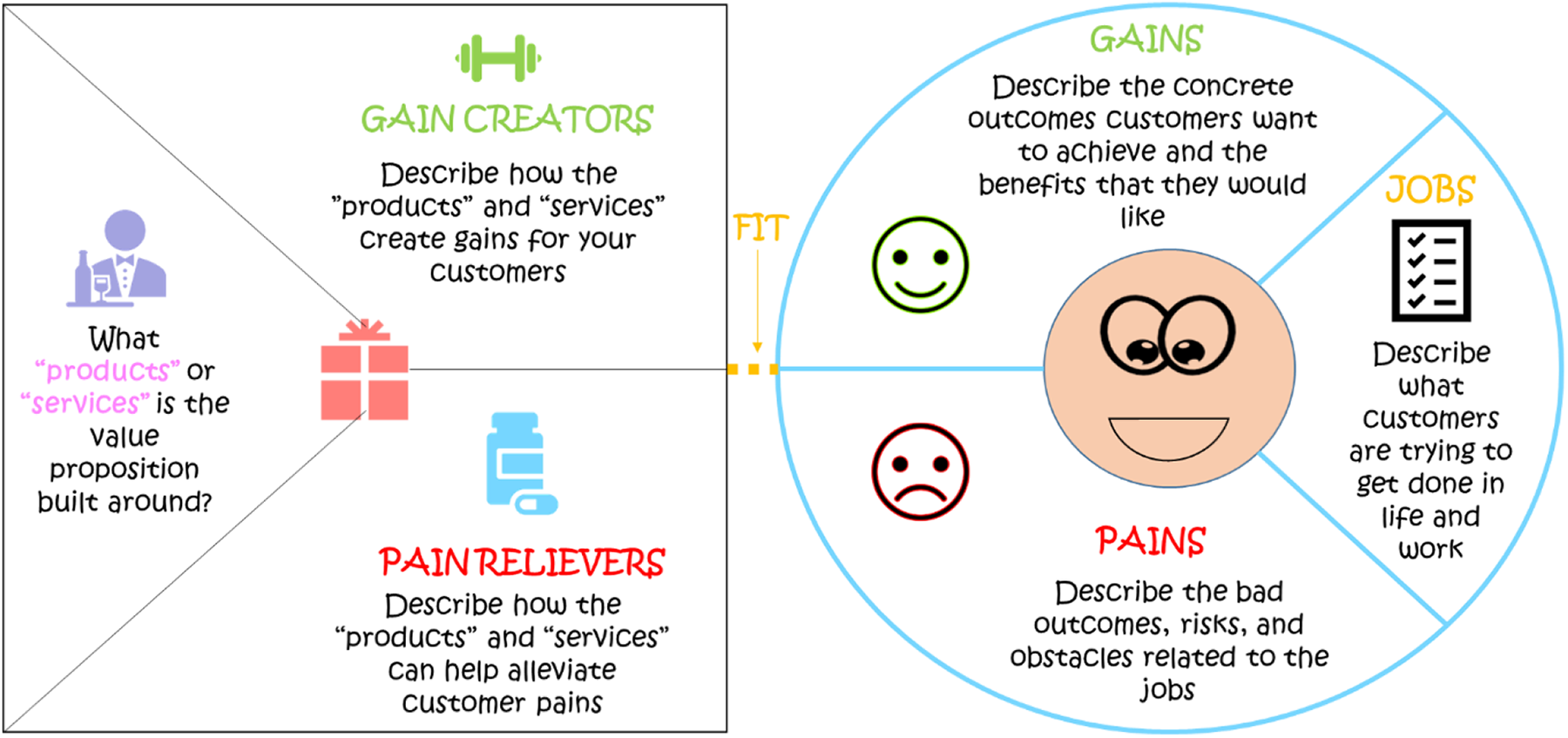
Osterwalder et al.’s Value Proposition Canvas. Source: Osterwalder et al. (2014).
The VPC is divided into two mutually influencing parts: on one side, a customer profile that allows the entrepreneur to generate an understanding of what the customer wants through assessing the tasks they need to complete (jobs to be done), the outcomes they want to achieve (gains) and the outcomes or risks they must avoid (pains); on the other side of the canvas is a value map that describes how value is going to be created through the products and services offered, which can either create gains (gain creators) or alleviate pains (pain relievers). A subsequent ‘fit’ is made between the two sides when important jobs are attended to, extreme pains are alleviated and essential gains are created – in other words, when one side matches the other (Osterwalder et al., 2014). In what follows is a description of how this tool has been adapted to identify the idiosyncratic needs of EE students (Table 2). After each step in the activity a cursory discussion that conveys its rationale and relationship to SDT research is presented. Furthermore, several ‘teaching tips’ are offered based on the authors’ previous experiences, which highlight potentially problematic issues that merit consideration.
Overview of suggested activity.

Note: aAn extension activity is included in the Appendix which involves finding the fit between learner needs and activities that can potentially meet those needs.
Activity outline: Building an entrepreneurial ‘learner profile’
The learning objectives of the specified activity for the students are as follows: to actively lead in the creation of your own learning outcomes thinking about what is most important for you and your own unique needs; and to develop an understanding of, and to apply, a tool that can be used to build empathy and optimise value creation for both customers and the self.
The key steps in the process in the process are as follows.
Step 1. Introduction to the module/subject (10 minutes)
Normally, it is recommended that this activity be used during the first session of a particular subject or module. The question is posed, ‘What would you like to achieve from this subject?’. When asking, tell students that you are not expecting an answer straight away, but that they will be provided with the necessary tools to effectively respond to it throughout the lesson. Here, as a facilitator, be transparent as to why you are asking this question. You can briefly delve into the theory that has been presented previously, highlighting that as humans we have three fundamental needs and that the most potent form of motivation is that which stimulates autonomous learning. You are co-creating the learning experiences so that you can be synchronised with one another.
Teaching tips
Do not go too deep into the theory. Provide some rationale as to why you are asking the question and the benefits of co-creation. Be honest: accept that you have much to learn from the students and notify them that you will continuously adapt your content to make it as valuable as possible for them. We have previously asked the question without any prior input about the module and its structure, whereas at other times we have provided an overview of the topics to be covered and assessment procedures beforehand. The decision is completely a matter of personal preference. With the former, you are providing the students with the opportunity to use their own imagination to determine what the subject is or should be about, which lessens any influence of potential biases. With the latter, you are being clear about what is expected and providing a scaffold from which to adjust. In using the second option, you can also display that you are actively taking students’ suggestions into consideration by modifying the syllabus or explaining in which parts their needs will be covered.
Rationale
Framing the module as an opportunity for personal growth allows you to develop a deeper understanding of what your students want to achieve in the ‘bigger picture’ of their personal circumstances (Brooks and Brooks, 1993; Reeve and Jang, 2006). Through a participative approach and engaging in a dialogue, you convey an openness and a willingness to take students’ needs into consideration while also affording a meaningful choice that can ignite curiosity (Schutte and Malouff, 2019; Vermote et al., 2020). More autonomous forms of regulation are thought to be energised through identifying inherent enthusiasms, with the implication that passion is a vital resource for entrepreneurial action, commitment and persistence (Mandel and Noyes, 2016). Students can begin the process of internalisation by identifying with the activity and perceiving it as personally significant for their own individual values and longer-term goals (Vansteenkiste et al., 2018). If an explanatory rationale is needed (for example if the activity is deemed uninteresting), an authentic communication of reasoning behind the task that connects with the students’ own ambitions can lead to a greater feeling of autonomy and competence (Steingut et al., 2017). Research indicates that rationales can benefit motivation in a variety of ways, from increasing engagement and enjoyment to learning and performance (Deci et al., 1994; Jang, 2008).
However, there is a need to proceed with caution. There is a risk that derives from the fragility of speculative thinking. We are entrusting our students to actively participate in the co-construction of learning outcomes. If a student makes a suggestion that is impossible to achieve within the boundary conditions set – for example, recommending the removal of a compulsory assignment altogether – a dilemma may arise: do we make every effort to accommodate the student’s request and safeguard the trust we seek to establish, or do we respond in conflict with the underlying objectives of the activity we have set? On such occasions, it becomes imperative that we are able to offer justification for the structures imposed. In so doing, we help students to internalise and endorse the reasons they are engaging in a particular activity (Jang, 2008). This is an educational tightrope that must be travelled; after all, students are deemed indispensable in the co-creation of knowledge and that lends immediacy to their needs (Wineberg, 1991).
During the first step, when we inform students that they are going to be actively involved in the construction of their own outcomes, some may not understand the reasoning behind it and so become apprehensive. In fact, in our experience it is likely that the majority will be inclined to assume this position. It is often the case, in EE especially, that novelty or those features perceived as childlike and playful cause the most unease (even in educators themselves, who run the risk of being stigmatised for their pedagogical approach). Blame is almost automatically bestowed on the educator. However, we must endeavour to help students transition from an emotive response to one that is analytical which will enable them to begin to develop an appreciation of why they are participating (Wineburg, 1991). It is extremely important to be honest and truthful in explicating your motives; internalisation can occur only under the premise of validity and credibility (Kelman, 1961). What was once perceived as contradictory and irrelevant, perhaps owing to an institutionalised view pertaining to the unidirectional flow of knowledge, can thus be attributed with meaning and so is more likely to achieve integration and acceptance. If students are allowed to reflect on purpose in combination with their own experiences they can construct a much more vivid construal of the what and why of their learning (Wineburg, 1991).
Step 2. Introduce the VPC (10 minutes)
Provide an overview of the VPC in its natural habitat, showing how it is applied to generate customer insights in a much more structured way. Question whether any of the students have used the tool before and then proceed to explain that there is a need to build empathy with and understanding of the customer so that we can provide products and services that are of real value to them. Disaggregate and isolate each component part of the canvas, providing a short description of each. For example, when discussing the ‘jobs to be done’ section, it is important to state that these are the tasks customers are trying to complete while also explaining the four main types of jobs: functional, social, personal and supporting. Ask students how this could be applied to answer the question posed at the outset.
Teaching tips
If students have used the Canvas before, allow them to describe how it works. If not, instead of describing each component in rather static ways, you may wish to provide students with a completed VPC with the titles of each section omitted. Give the students around 3–5 minutes, asking them to discover what each section represents from reading its contents. In other words, can they provide a title to align with what information is included. Another adaptation is for each group to focus on a particular part, research it and then present their findings to the rest of the class (note that this will take longer, in the region of 15–25 minutes). It is essential to emphasise the difference between jobs and gains. As Osterwalder et al. (2014) note, jobs are focused on what individuals are trying to perform and the problems they are attempting to solve, whereas gains are the concrete outcomes a person wants to achieve.
Rationale
This component provides a structure to the activity through offering an overview and experience of the learning instrument that is to be applied, helping to clarify expectations and develop competence (Vermote et al., 2020). By discovering ‘where’ each student is regarding mastery of the content, guidance can be offered through informational feedback which has been found to increase perceptions of competence and autonomous motivation (Levesque et al., 2004). Students can gain more ‘functional’ knowledge through developing their understanding of the VPC in its original domain. Although the main philosophical driver of the tool is constructivist, as mentioned previously it is accepted that these learning paradigms are not exclusive and can be used for the promotion of differing outcomes provided the educator is aware of the what and why of their actions (Bell, 2021). In this respect we are branching into behaviourism, understanding that entrepreneurial skills are developed in a variety of ways (Zahra and Welter, 2008) and seeking to ensure that students have the foundational knowledge to be effective in their more creative implementation of the tool. By scaffolding the learning both in this specific component and throughout the implementation of the complete tool, students can be optimally challenged and receive feedback (Ryan and Deci, 2020).
Step 3. Learner profile map (45 minutes)
Hopefully, the students will have been able to make the connection between value for the customer and value for themselves as learners. Tell them they are going to develop their own ‘learner profile maps’, focusing on the right-hand side of the canvas. For this they will need to be provided with A3 paper, Post-It Notes, coloured markers, sticky tape and anything else that you may feel is relevant (you may wish to switch to an online tool to facilitate the activity if face-to-face learning is not possible – we have found that for this task Mural.co affords a robust platform). Notify the students that at the end of the session they will be required to stick their map on the wall and, as an exit ticket to leave the classroom, they will be asked to explain it to the rest of the class. You may choose to do this activity in small groups (no more than four) or individually. If doing it individually, we have previously substituted the exit ticket presentations to video format; i.e. the students, by way of homework, had to upload a short 1–2 minute video explaining their learner profiles. As a group activity, students are actively co-creating what they want to achieve with their peers, and this is perhaps more manageable for you as educator. Have students draw the learner profile map part of the Canvas on their A3 sheet. They will then work through each of the different parts of the map, trying to develop sources of value related to the subject and themselves. For this, they are encouraged to think of as many jobs to be done, pains and gains as they possibly can by writing down one idea per Post-It Note and sticking it on the relevant section.
Teaching tips
State that you will be adapting this tool to generate the learning outcomes for the course taking into consideration the students’ personal requirements and interests. It is important to be explicit that your objective is to make sure that the learning is going to be centred around their needs. One problem that is often faced is the provision of a superficial response which, although it may convey wants or desires, does not offer much input into deep-seated needs. To try to tap into these real and authentic needs we have found it useful to encourage students to go beyond their immediate thoughts, thereby promoting greater depth of reflection. For example, advise them to resist the urge to focus only on functional jobs, as these will probably be the most easily identifiable, and to also consider jobs that are more intangible such as the social, personal and emotional – for example, using the ‘5-Whys’ approach common in Design Thinking.
It is beneficial for the teacher to scaffold each different section as a specific task; that is, to dedicate 15 minutes for each segment – jobs to be done, pains and gains – and challenge students to use as many Post-It Notes as they can. Use PowerPoint slides to give examples specifically related to the learning process so that students can use these for inspiration. Make these examples tangible; for example, instead of saying ‘It takes too long to complete assigned tasks’, a potential pain could read: ‘It takes me two hours every night to complete just one task’. In other words, be more precise. Display a timer to allow students to manage their own time effectively and, as facilitator, be active in navigating the room, providing feedback at every possible opportunity.
Rationale
This part provides an answer to the question of whether the students will find the subject interesting as it is currently structured. Through questioning and interacting with students, not only is a genuine expression of interest being displayed about their concerns, but also there is an effort to make the module more relevant (Brooks and Brooks, 1999). We are attempting to make explicit, embrace and nurture pre-existing inner-held motivations that can be leveraged for the creation of more engaging and personally relevant learning activities (Patall et al., 2019). Sometimes students can be apprehensive about expressing these motives so, by attuning to personal needs through conveying interest, enthusiasm and openness with regard to their expression, we promote a climate of psychological safety (Aelterman et al., 2019; Reeve and Shin, 2020). Additionally, as a team-based activity, it has been empirically demonstrated in EE contexts that the resources provided by the group can positively moderate motivational processes in the direction of more intrinsic forms (Hytti et al., 2010). If a video reflection is applied as a means of assessment, this can help in the promotion of more in-depth thinking that is posited to help experiences transition into knowledge (Wraae et al., 2020). Furthermore, in reflecting through video we can lessen apprehensiveness in those students who are more reluctant to share thoughts and feelings (Wraae and Wlamsley, 2020). Another option is to create an e-portfolio that may help in reducing the time it takes for students to obtain constructive feedback and gain contact with the teacher, and so may increase their sense of belonging (Fuller, 2017).
Step 4. Organisation and prioritisation of jobs, pains and gains (10 minutes)
During this step, students will proceed to the ordering of the various ideas they generated for the different sections of the map. They are provided with 2 minutes for each component, which should be sufficient time for the effective organisation of each idea based on the most important jobs (from highest level of significance to the lowest), the severity of pains (from most extreme to moderate) and, finally, how essential each gain is (from highly essential to nice to have). Have the students prioritise these on a separate A3 sheet by dividing it into three different columns, selecting 5–10 of the most important ideas from each section and then copying these onto new Post-It Notes and sticking them into the different columns in order of priority.
Teaching tips
You may wish to prioritise after the completion of each component part or do this for all parts at the end. The reason for duplication rather than simply removing the Post-It Notes already created is to allow the students to present the process accurately during the plenary session. If they simply remove the Post-It Notes, we lose the bigger picture of their learner profile map. As educator, you may find it tempting to influence what is most important. Avoid this temptation and, if questioned by students, remind them that it is about what they think and feel. In this way you drill down into the authentic reasoning behind their selection of one aspect over another. Again, as before, teacher-led scaffolding by working through each part in systematic fashion is recommended. This is an optimal moment to facilitate constructive discussion among the students, helping them to internalise the values of consideration for others. Emphasis is placed on trying to figure out what matters most: if we can understand this, we have a much better chance of improving the learning experiences that are afforded. Focus on a few jobs and seek to satisfy these well.
Rationale
It will be extremely difficult for us to address all the needs our students hold internally, so it is advisable to make the process manageable and structured (Vermote et al., 2020). The underpinning belief is that the profiles and motivations of each student will shape the design of a course (Henry et al., 2003). As educators we are therefore challenged with the selection and development of those that are considered most important for our classroom context (Balan and Metcalfe, 2012). Through this step we can uncover possibilities for subject adaptation and redesign to satisfy the learners’ most pressing requirements. Importantly, this is not prioritisation in the ordering of need fulfilment per se; rather, it is implemented to discover whether we are able to meet fundamental needs as defined by the learner through existing contents.
Step 5. Plenary and ‘Tell me what you want to achieve’ (25 minutes)
After prioritisation, ask students to stick their learner profile maps and prioritisation exercises visibly on the wall of the classroom in ‘art gallery’ style. Firstly, have all students walk through the room for 5 minutes examining the maps other groups have created. Next, have each group present its maps to the rest of the class, explaining the different areas and why some aspects have been prioritised over others (this can take anywhere from 3 to 5 minutes per group). After everyone has presented, ask the class if they were surprised about their discoveries? We normally find that, although learners have their own idiosyncratic needs, there are common points that be leveraged as the core of our pedagogy for the module. It is also extremely important for the teacher to focus on those areas that are distinct, as this is where we can stimulate autonomously derived motivation in each student. During the next session it is critical to synthesise your findings and present these to the class. Identify their main needs, differentiating these from desires and explicitly demonstrating to them how you are modifying the course to meet those needs.
Teaching tips
During the walk around, ensure that there is complete silence in the room so that the students can concentrate on each ‘work of art’. Make sure there is sufficient space on the wall for all groups to post their work. Have students present while everyone else is standing around their work. When presenting the synthesised findings, stimulate discussion and debate by asking the group about their thoughts and feelings about their profile and those of others. Get them to suggest how we could successfully use the information in the module. Can they transfer this knowledge to any other subjects or aspects of their lives?
Rationale
This component offers a formative means of assessing whether the learning objectives for the lesson have been met (Brooks and Brooks, 1993; Hytti et al., 2010). Given its formative nature, it permits dialectic engagement with the learners (Bell and Cowie, 2001). It affords the opportunity for students to acknowledge the needs of their peers helping them to develop a sense of connection with, and appreciation for, others (Jang et al., 2016b; Ryan and Deci, 2000). It is proposed that, by visually and verbally presenting their ideas in ‘gallery’ style format, students can learn from the work of others through the process of simultaneous reporting (Kennedy et al., 2020; Michaelsen and Sweet, 2008). Indeed, it is suggested that this collaborative form of activity, alongside poster type presentations, has the greatest value adding potential for student engagement (Balan and Metcalfe, 2012). The ability to listen is described as a key autonomy-supporting teacher skill (Reeve and Jang, 2006; Reeve et al., 1999) so, through an explicit demonstration of acting on student needs and requests, one displays a genuine interest. As we have discussed, the option to choose freely between activities has been demonstrated to increase levels of intrinsic motivation (Zuckerman et al., 1978). Importantly, however, volition normally pertains not just to this prior petitioning of learner preferences, but also to showing that these preferences have been acted upon (Dwyer, 1995).
Closing thoughts
Morris and Liguouri (2016) perceive this as a watershed moment for EE, because the pace at which entrepreneurship is developing exceeds our knowledge about how it should be taught and which outcomes should be prioritised. Neergaard et al. (2020: 817) argue that ‘all universities have to have it; all students need to participate in it’. So, if everyone needs EE but we are not really sure about the most appropriate content, tools or teaching methods to use in its delivery (Hägg and Gabrielsson, 2020), it may prove difficult to harness its perceived array of value generating potential (Lackéus, 2020). Attempts are being made to find a niche for the discipline, which is caught in a ‘rift’ between traditional and more progressive paradigms for learning (Bell, 2021; Higgins and Galloway, 2014; Kyrö, 2015; Lackéus et al., 2016).
Berglund et al. (2020), acknowledging this, advocate an unsettling of the terrain through an evolution of pedagogical practices to align with the needs of learners who reside in an increasingly unpredictable entrepreneurial society. To achieve this, more openness is encouraged in the sharing of ‘best practices’ for critical appraisal (see Brentnall, 2020; Neck and Corbett, 2018). In the midst of this frenetic milieu of dynamic change, it is recommended that we take a moment to pause, catch our breath and re-focus on the more foundational aspects of EE delivery (Seikkula-Leino et al., 2010). This is what the current paper has attempted to do by emphasising the development of more intrinsically driven forms of motivation. Its purpose has been to describe and explain the content, structure and rationale behind an entrepreneurial classroom-based activity adapted from Osterwalder et al.’s (2014) VPC, the foundations of which were constructed on Deci and Ryan’s (2000) SDT.
SDT has progressively evolved into a broad theory of psychology from a discourse that was heavily focused on behaviourism, seeking to regulate behaviours through externalities. Although there were many other humanistic theories of motivation, they were without a strong empirical or methodological base. In contrast, SDT focused on intrinsic motivation arising from the reciprocal interaction of the human and the social environment. Unlike other theories, in a relatively short time SDT developed a solid foundation of evidence in support of its propositions (Vansteenkiste et al., 2020). The core tenet of the theory is that, if we wish to understand motivation, we have to understand an individual’s fundamental psychological needs that can serve to energise, direct and sustain action (Gagné and Deci, 2005). As educators, one of our many responsibilities will be to ensure that these needs are supported and not thwarted.
With this in mind, we believe that, when developing new and novel pedagogical content in EE, we must start with the basics – and those basics are clearly articulated in SDT. In other words, if we can explicitly incorporate intrinsic motivational concepts as an integral component of our teaching content (learning because of enjoyment) as opposed to extrinsic forms (an overemphasis on external grades or other rewards), we may better position ourselves to effectively engage our students (Kusurkar et al., 2012). The current activity is just one of the many imaginative ways to adapt and adjust the tools we already use in our discipline. In its new application however, it has arguably acquired both functional and constructive power (Kyrö, 2015). This is perhaps a worthwhile way of bridging the inherently perceived competitive nature of the subject. Although some individuals will find competitive activities appealing, others will prefer the opportunity to accumulate experience and enjoy the process itself as opposed to its outcome (Brentnall, 2020). Furthermore, and of contemporary interest, the development of more internally regulated behaviours through the satisfaction of basic psychological needs can act as a coping mechanism with regard to negative consequences (Bandera et al., 2020). For example, Trépanier et al. (2013), although studying work-related burnout, provide some reasoning to suggest that, by satisfying the needs for autonomy, competence and relatedness, a buffer can be established against harmful contextual occurrences.
Given this applicability in various contexts, the approach can be used at differing levels and across subject areas. For example, one of the authors has implemented the tool at MBA level in a ‘Creativity and Innovation’ class, and within a module focused on the development of an entrepreneurial culture. These applications enabled the teacher to gain insights into learners’ motivations and to adjust the content accordingly. This transitions curriculum and policy thinking from a focus on motivating to ‘be’ an entrepreneur in the sense of creating a new business to the acknowledgement that everyone can ‘become’ entrepreneurial through finding motivation and relevance in the learning process itself. However, to reiterate, our aim was not the empirical testing of the task: therefore, it is recommended that future efforts are made to determine its utility and usability via its implementation in a range of different contexts.
A focus on the functional components of creating a business can create a ‘Taylorism of the mind’, based on a desire to leverage methods and tools used in more traditional ways. In EE terms, and drawing from the authors’ experience, this may lead to the search for adequate competence that will allow the student to effectively learn how to use the tool within the isolated confinements of a classroom. Ends are emphasised over means, implying that ambitions are fuelled largely by a desire to meet pre-set reified learning outcomes and to achieve a ‘good’ grade or create a specific venture. The complexity and variability of the entrepreneurial learning process become oversimplified. On closer scrutiny of the ‘Taylorism’ approach, this input–output or conveyor belt principle involving the separation of individual cognition and the practical notion of ‘doing’ instils a contradiction related to the promotion of entrepreneurial learning – the idea of creativity, self-direction and trailblazing one’s own path as opposed to predefined sub-specialisations (Holmgren and From, 2005). It can also be considered as myopic with regard to the skills and abilities an entrepreneurially educated student needs: are these just about task completion or do they also involve the navigation of many and varied tasks and activities that are not uniformly distributed or common to all pathways? Such myopia leads to results that are contrary to those of the deeper forms of learning that SDT can provide (Vansteenkiste et al., 2005).
To generate innovative new solutions and methods for teaching requires risk-taking. In EE there needs to be at the very least acceptance that some things may not work out as expected and can be improved (Hytti, 2001). Others will go beyond this acceptance and actively embrace the uncertainty and inherent riskiness of trying new things that can enhance interest and engagement. Although our focus is on stimulating motivation in the learner, it is the teacher who can create an environment which is conducive to this, whether through the activities and material they provide or how they speak and act (Joensuu-Salo et al., 2020). Therefore, for EE, much work needs to be done to discover the best ways for teachers to enhance students’ levels of self-determination.
Evidence emerging from other learning areas suggests that educators need to become autonomy-supportive and provide structure. We are advised to avoid more controlling and chaotic teaching strategies that are characterised by their domineering nature and greater likelihood of student abandonment (Aelterman et al., 2019). However, according to Vermote et al. (2020), it is not just style that is important but also mindset. In higher education teachers who are more committed and teach for their own enjoyment reportedly invest larger amounts of time in preparing their classes so that they are attuned to students’ interests and worldviews. It has also been argued that they tend to be more participative in seeking to engage in conversations, provide greater clarity in their expectations and continuously help and encourage through guiding in contrast to demanding. On the other hand, teachers who are motivated by control – for example when they are burdened with heavy administrative pressures (Pelletier and Sharp, 2009) – are more likely to have less patience and adopt an insistent tone. These findings signal that it is not just about the activity itself but also about its human delivery.
Under the right conditions, evidence suggests that students have the power to motivate their own learning. For them to do so, the classroom environment needs to foster autonomy, which entails both an understanding of the key tasks involved and a demonstration of those behaviours that can better support the cognitive needs of students. This study has identified a method by which such an environment can be established. Learner profile mapping affords a mechanism whereby the focus can be directed to providing students with a selection of activities from which they can make decisions that are most relevant for them. Explicit appreciation and enthusiasm for the sharing of internal goals are displayed. From this point, it is our responsibility as educators to ensure that intrinsically regulated behaviour is maintained to help avoid the costs of motivational depreciation.
Footnotes
Declaration of conflicting interests
The author(s) declared no potential conflicts of interest with respect to the research, authorship, and/or publication of this article.
Funding
The author(s) received no financial support for the research, authorship, and/or publication of this article.
