



Abstract
Academic engagement with small business and entrepreneurship was facilitated by the availability of European Union (EU) funding, which also stimulated the emergence of a small business and entrepreneurship (SBE) ‘community of practice’. Gradually, the SBE community developed into a ‘landscape of practice’ as small business research moved towards maturity. Furthermore, the SBE landscape of practice has coalesced around three core concepts: entrepreneurial learning, social networks and social capital. EU funding was the catalyst for many SBE academics in the UK to engage with practitioners involved with starting and managing their own businesses. The UK’s exit from the EU will inevitably mean that universities will no longer have access to EU Structural Funds. This has major implications for the UK SBE community’s engagement with practice as well as for entrepreneurs and business owners who have benefitted from a range of programmes designed to improve the performance of smaller firms.
Keywords
Industry and Higher Education was launched in 1987. Its first issue included introductions by the Advisory Editor, John Kelly, and James Prior MP, then Chair of the UK’s Council for Industry and Higher Education. Kelly (1987: 3) explained the new journal’s purpose: ‘The worlds of industry and academe have different objectives and values, but there is a common territory between them where they have much to contribute to each other’. In the last 30 years, IHE has published a substantial number of papers dealing with entrepreneurship education 1 (Watkins and Stone, 1999) and the entrepreneurial university (Etzkowitz, 1996). Since 1970, the UK’s small business and entrepreneurship (SBE) research community has moved from the ‘margins to the mainstream’ (Blackburn and Smallbone, 2007). Initially, the small business community was fragmented and few academics had regular interaction with either entrepreneurs or small business owners. From 2000 onwards, many UK universities began to access European Union (EU) Structural Funds and this helped the SBE community to engage with small business practitioners in a more intensive manner. European Social Fund (ESF) and European Regional Development Fund (ERDF) projects have very specific ‘outputs’, based on the amount of funding allocated to individual projects (number of jobs created, number of jobs protected, increases in turnover). Hence, this was not conventional research funding (as per the Research Councils) because academics were required to provide practical support for entrepreneurs and small business owners. I argue that this resulted in a virtuous circle of ‘theory and practice’ as direct involvement with the reality of setting-up and managing small businesses helped academics refine key theoretical concepts.
Before Harold Wilson, Labour Prime Minister, commissioned the Bolton Report (1971) on the state of the UK’s small businesses sector, industrial policy in the post-war period concentrated on large organizations. In fact, small firms were widely regarded by UK politicians and policy makers as outdated and primarily associated with less developed economies (Bridge et al., 2003). In contrast, Germany and Japan dramatically transformed their post-war manufacturing sectors and both had strong, innovative small business sectors (Braun et al., 2002). Publication of the Bolton Report (1971) stimulated interest in small firms and entrepreneurship from both policy makers and academics (Curran, 1986; Stanworth and Curran, 1991). Some pioneering start-up programmes were established in the 1960s at institutions including the Central London Polytechnic, Durham Business School, the London Business School and Manchester Business School (Blackburn and Smallbone, 2007; Watkins and Stone, 1999). By the early 2000s, most UK universities were offering entrepreneurship programmes/modules to their undergraduate students (Herrmann et al., 2008). This growth of interest in entrepreneurship education can be partly explained by the acceptance of the topic as a genuine academic discipline (Gibb, 2002, 2011; Gibb and Ritchie, 1982). Also, universities were increasingly encouraged by the government to make a larger contribution to regional and national economic growth (Clark, 1998).
According to the website of the Institute of Small Business and Entrepreneurship (ISBE), 2 ISBE meetings began in the mid-1970s soon after publication of the Bolton Report ‘which led to the emergence of entrepreneurship as a legitimate public policy target and focus for academic research’. By 1977 the ad hoc meetings of small business and entrepreneurship researchers became an annual international conference, which took place at Durham University. In 1989 these activities became formalized as the UK Enterprise Management and Research Association (UKEMRA). Three years later, in 1992, the name changed to the Institute for Small Business Affairs (ISBA) and, in 2004, the organization became the Institute for Small Business and Entrepreneurship (ISBE). In recent years, the BAM (British Academy of Management) entrepreneurship special interest group (SIG) and conference track have also become important fora. The entrepreneurship track attracts over 100 submissions to the annual conference (second only to the Human Resource Management [HRM] track) and entrepreneurship is a very active special interest group.
There have been several publications examining the state of enterprise-related research in the UK (Blackburn and Smallbone, 2007, 2008; Blackburn and Kovalainen, 2009) as well as more broadly focused studies (Landström, 2005; Landström et al., 2012; Landström and Harirchi, 2018). I utilize two case studies that illustrate the role played by EU funding in supporting academic engagement with the small business sector. The Centre for Enterprise (CfE) is based at Manchester Metropolitan University and the Centre for Enterprise and Entrepreneurial Leadership (CEEL) is based at Liverpool University. EU funding, in the form of ERDF and ESF grants, has been important in helping to professionalize the management of smaller firms as well stimulating research and knowledge-sharing among the academic community. As a result of Brexit (Kelly and Pearce, 2019), the ending of these funding streams in 2021/2 has implications for the small business communities of academics and owner-managers.
The UK Government’s Teaching Excellent Framework (TEF) 3 has placed increasing emphasis on the ‘quality’ of teaching in UK universities. The longer-standing Research Excellence Framework (REF) means that most UK academics are under institutional pressure to publish in high-quality journals. REF 4 also places considerable stress on universities demonstrating that their research has a broader societal impact (beyond publication in top-ranked journals). My argument is that EU structural funding was the catalyst for small business and entrepreneurship academics’ engagement with practitioners (Sjöö and Hellström, 2019). As demonstrated below, this engagement contributes to the ‘impact agenda’ in many institutions. The paper begins with an outline of the research approach. I then examine the evolution of SBE research, and this is followed by an analysis of EU funding and its contribution to the creation of an SBE community. These strands are brought together in a discussion about the importance of academics engaging with practitioners and the emergence of an SBE ‘landscape of practice’.
Research methods
In this paper I draw on a range of sources to provide evidence of events and initiatives associated with research and policy (Bennett, 2008; Huggins and Williams, 2009; Storey and Greene, 2010; Storey et al., 2007). At the start of the 21st century, several UK reports stressed the importance of universities making a bigger contribution to economic growth (DTI, 1998; 2000; HMT, DTI and DfES, 2004; DfES, 2003). Incorporation of the ‘third mission’ (Clark, 1998; Van Vught, 1999), through which universities became an integral part of regional economic development, formalized a process that had been evident for some time in the USA (Etzkowitz, 1998; Galvao et al., 2019; Henry, 1998). In addition, changes to UK government funding regimes promoted the ‘third mission’ to the very top of the agenda for Vice-Chancellors (Woollard et al., 2007). For example, involvement with the New Entrepreneur Scholarship Fund (NES) enabled several English universities to develop innovative programmes designed to support individuals from disadvantaged backgrounds in starting their own businesses (Jayawarna et al., 2011; Lee et al., 2019).
In addition, two case studies are introduced to provide examples of the ways in which EU structural funding has been used by academics engaging with small business owners and entrepreneurs. Data for the case studies are drawn from previously published material (Thorpe et al., 2008a, 2008b), websites and publicly available material from the two institutions: the University of Liverpool Management School 5 and the Manchester Metropolitan University Business School. 6 In addition, I used Google Scholar and EBSCO Discovery to search for the published papers using key terms (‘entrepreneurial learning’; ‘social networks’ and ‘social capital’) that are central to the emergence of the SBE community of practice. It is important to acknowledge that this paper is based on my own subjective experiences as a member of the SBE community for more than 20 years. This approach fits with the principles of ‘social constructionism’, which, according to Lindgren and Packendorff (2009: 30), ‘is explicitly based in a hermeneutic tradition’. Hence, all knowledge about human behaviour is founded on subjective and intersubjective interpretations of reality (Berger and Luckmann, 1966). Accordingly, social constructionists examine various societal processes as a basis for interpreting how people construct and understand their reality and actions (Cunliffe, 2008).
The emerging SBE research community
As pointed out by Blackburn and Smallbone (2007), there were some ‘significant, if somewhat isolated UK studies’ in the broad area of small firms before the Bolton Report (Batstone, 1969; Goldthorpe et al., 1968; Hart and Prais, 1956; Ingham, 1969; Singh and Whittington, 1968). These early publications focused on the sociology of employment, social class or the size distribution of firms rather than examining the nature of entrepreneurship or the ‘entrepreneur’. According to Landström et al. (2012) there have been three phases of entrepreneurship research since the 1970s. The take-off phase was stimulated by the Bolton report in the UK and Birch’s (1979) work in the USA. The growth phase of the 1990s involved both the creation of a research infrastructure and greater fragmentation as a new generation of researchers questioned the earlier economic assumptions. From 2000 onwards, the maturity phase has incorporated much greater understanding of the phenomena of entrepreneurship with the emergence of various sub-groups who have challenged the dominance of economic and psychological approaches to the study of entrepreneurship (Landström et al., 2012: 1156). As the focus of this paper is on the UK, Figure 1 provides an overview of significant events in the field of SBE research. As indicated above, the Bolton Report was the catalyst for the emergence of SBE as both an academic subject with a coherent research agenda and a topic of interest to politicians and policy makers (Curran, 1986; Stanworth and Curran, 1991).
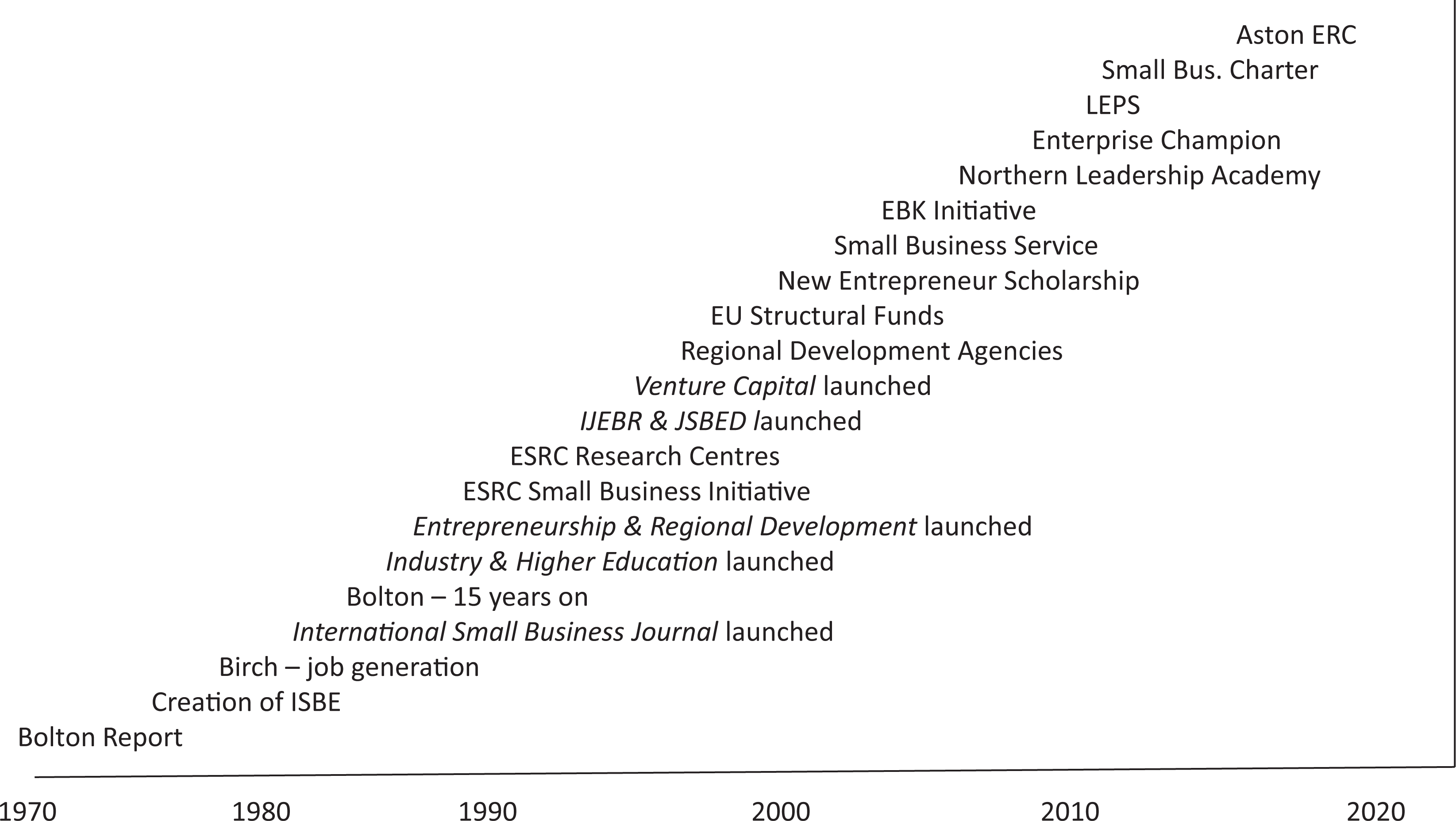
Evolution of the UK’s SBE community.
Birch (1979) claimed that 3% of small firms were responsible for creating 70% of the net new US jobs. These firms, known as ‘gazelles’, were growing at 20% per year and had annual sales of at least $100,000 (Birch, 1979, 1987). According to Storey (1994), the small business research initiative of the Economic and Social Research Council (ESRC) was a direct response to Birch’s work. The initiative led to the creation of three small firm research centres: Kingston Polytechnic (now Kingston University), the University of Cambridge and the University of Sussex (see Atkinson and Storey, 1993; Curran and Storey, 1993; Hughes and Storey, 1994). Storey’s (1994) influential presentation of the research findings suggested that government intervention should be restricted to creating the appropriate macroeconomic conditions for small firms to thrive. In essence, this meant low inflation, low interest rates, economic growth and high aggregate demand (Storey, 1994: 513).
During the period 2000 to 2010, there were no further, large ESRC-funded SBE projects other than the Evolution of Business Knowledge (EBK). Researchers from Manchester Metropolitan University 7 obtained a grant of £350,000 to examine 90 SMEs based in the Northwest of England and operating in three sectors: services (media/culture and retail), client-based (bespoke and formulaic advice) and manufacturing (high-tech and low-tech). Firms also varied according to what were conceptualized as their levels of maturity: start-up, stable and innovatory (Zhang et al., 2006). The outcomes focused on the key role played by owner-managers in developing smaller firms focusing on learning and critical reflection (Thorpe et al., 2008a). Moreover, the findings indicated that learning should be institutionalized in routines and systems to ensure that it was embedded at the organizational level (Sharifi and Zhang, 2009). To accomplish this transformation owner-managers must create strategic space by reallocating internal resources to improve motivation and enhance capabilities while allowing leaders to reflect on existing organizational practices (Thorpe et al., 2008a).
A major research initiative was launched in 2012 by the ESRC in partnership with the Department for Business, Innovation and Skills (BIS) the British Bankers Association (BBA) on behalf of the funding banks, and the Technology Strategy Board (TSB). The ESRC invited proposals for the establishment of an independent Enterprise Research Centre. The call offered £3.637 million over 36 months for the development of an ‘evidence base’ related to the problems of barriers to starting and growing new businesses
8
: understanding the drivers of business development and growth; understanding the barriers to business development and growth; SME growth and development – SMEs in the emerging economy; and the exploitation of data.
Three consortia were shortlisted: Kingston, Leeds, Liverpool and Lancaster; Strathclyde; and Aston and Warwick Business Schools. The successful bid, led by Aston and Warwick Business Schools, established the Enterprise Research Centre (ERC) in 2013 with the aim of providing high-quality, independent research and analysis to inform government policy on small and medium-sized enterprises (SMEs). The ERC’s core research team is based at Warwick and Aston University Business Schools, but works with a network of researchers based in a range of institutions. The Centre claims to be ‘the leading reference point for anyone looking for robust, trusted data and insights on SME performance’. 9 For example, Anyadike-Danes et al. (2015) revisit the Birch discussion by analysing the role of UK new firms in job creation and destruction. The original 3-year funding (2013–2016) was extended for a 2-year period at the end of 2015 and there was a further 3-year extension from 2018 to 2021. 10
As the SBE field grew, there was clearly a need for specialist journals in which the academic community could publish. In 1982 the European Small Business Journal (later ISBJ) was launched by Guardian journalist Clive Woodward (Blackburn and Smallbone, 2007). This was followed in 1989 by Entrepreneurship & Regional Development and, in the mid-1990s, Emerald introduced the Journal of Small Business & Enterprise Development (1994) and the International Journal of Entrepreneurial Behaviour & Research (1995). Venture Capital, a journal focusing primarily on the funding of entrepreneurial firms, was launched by Taylor and Francis in 1999. Until recently, Environment & Planning C (launched in 1983) published many policy-oriented small business papers (Bennett, 2008; Huggins and Williams, 2009). In 2017 the journal changed focus from ‘government & policy’ to ‘politics & space’. Blackburn and Smallbone (2007) claimed that the SBE research community also ‘publish regularly’ in the following journals: Employee Relations, International Journal of HRM, Regional Studies, Work, Employment & Society and Urban Studies.
Leading entrepreneurship and small firm journals in the UK (Entrepreneurship & Regional Development and International Small Business Journal) and the USA (Entrepreneurship: Theory and Practice, Journal of Business Venturing, Journal of Small Business Management, Small Business Economics and Strategic Entrepreneurship Journal) are all rated 3* or 4 according to the Academic Journal Guide (Chartered Association of Business Schools, 2019). There is also increasing evidence of entrepreneurship-related research appearing in top-rated mainstream business and management journals: British Journal of Management (Jayawarna et al., 2020), Journal of Management Studies 11 (Fisher et al., 2020), Organization Studies (Ganzin et al., 2020), Academy of Management Journal (Clarke et al., 2019), Academy of Management Review (Wry and York, 2019), Administrative Science Quarterly (McDonald and Eisenhardt, 2020) and Organizational Science (Schifeling and Demetry, 2021). 12 This is an important and significant trend which clearly indicates that the field of entrepreneurship and small business management is moving towards maturity.
EU funding and the SBE community
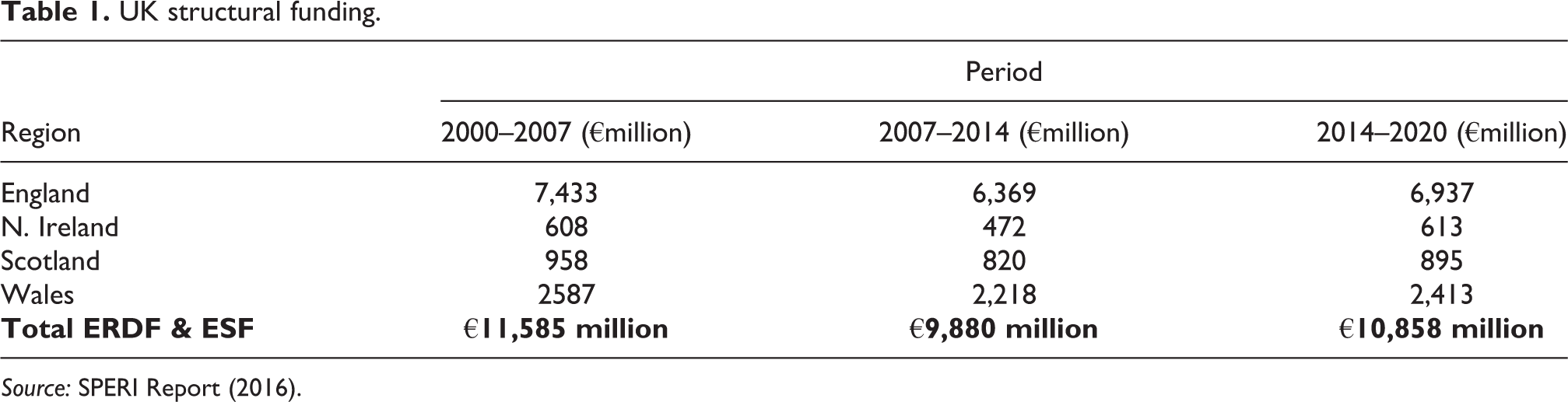
Although EU Structural Funds have been available since the 1970s, in this paper I concentrate on the period from 2000 to 2020. In that time there have been three rounds of funding, each comprising a period of 7 years (Table 1). Since 2000 the UK has on average received €10.77 billion in Structural Funds for each 6-year cycle and most of this was from the ERDF and ESF. According to the European Commission, 13 the ERDF ‘aims to strengthen economic and social cohesion in the European Union by correcting imbalances between its regions’. The ESF ‘invests in people, with a focus on improving employment and education opportunities across the European Union. It also aims to improve the situation of the most vulnerable people at risk of poverty’ (see SPERI, 2018). Between 2007 and 2013 EU funding (ERDF) generated 132,000 jobs and supported 26,000 small businesses 14 in the UK.
UK structural funding.
Source: SPERI Report (2016).
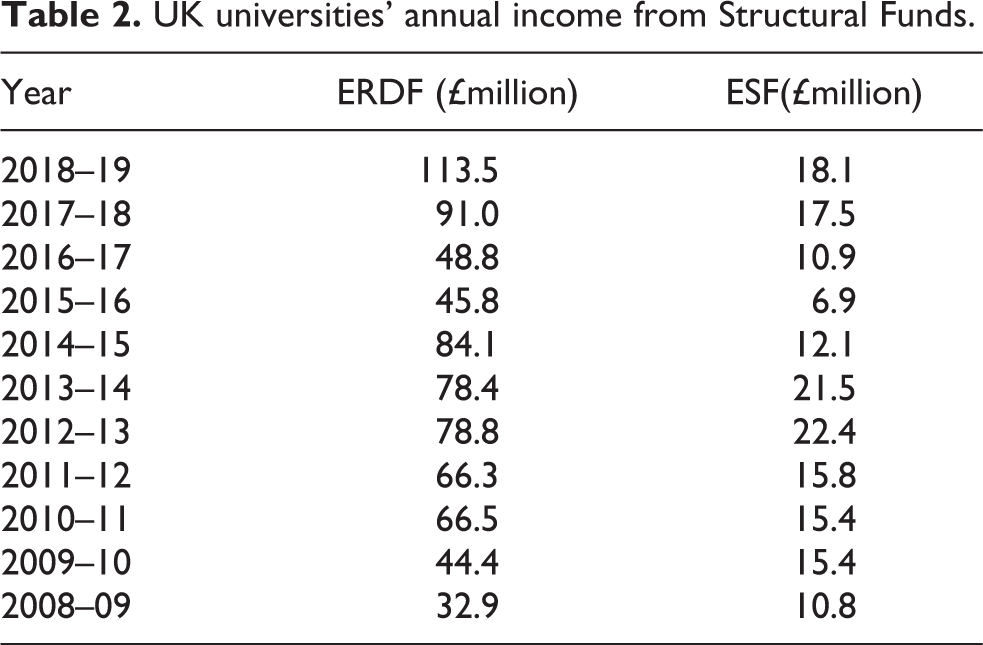
As shown in Table 2, UK universities have accessed substantial amounts of EU funding in recent years. 15 However, it is important to note that Structural Funding is not distributed equally across the sector and a number of universities have never obtained EU funding. On the other hand, the Welsh universities draw down large amounts of Structural Funding: in the 2014–2020 period Cardiff drew down £33 million, Swansea £25 million, Bangor £13 million and Aberystwyth £11.6 million. In addition, these four institutions are unusual in that they also obtained ESF funding. In Northern Ireland, the University of Ulster accessed approximately £8 million and Queens University Belfast £2 million in the most recent period. The Scottish universities appear to make little use of Structural Funding with the exception of the University of Highlands and Islands (£2 million). Other Scottish universities, such as Aberdeen, Glasgow, St Andrews, Strathclyde and the West of Scotland, have accessed relatively small amounts of Structural Funding (less than £1 million). In England, many institutions have obtained some ERDF projects but the bulk of the funding goes to a small number of universities: Birmingham (£20 million), Exeter (£10 million), Hertfordshire (£10 million) Lancaster (£26 million), Liverpool (£8 million), Teesside (£7 million) Wolverhampton (£9 million) and York (£10 million). Other English universities, including Coventry, Leicester, Manchester Metropolitan, Manchester, Nottingham Trent, Plymouth and Reading, have accessed Structural Funding during the most recent period. The reason why some institutions choose not to engage with Structural Funding is the increasing complexity associated with providing evidence of ‘matched funding’, as well as the administrative burden concerned with maintaining accurate records of both the participating companies and their outputs. The rules related to matched funding 16 (co-finance) are complicated and depend on the level of regional development: more developed (50%), transitional (60%) and less developed (80%).
UK universities’ annual income from Structural Funds.
To illustrate the role of EU funding in supporting entrepreneurship and small business I draw on two examples: the Centre for Enterprise (CfE) at Manchester Metropolitan University Business School (MMUBS) and the Centre for Enterprise & Entrepreneurial Leadership (CEEL), now known as the Brett Centre for Entrepreneurship, at the University of Liverpool Management School.
The CfE was launched in March 2001 to deliver a programme for potential entrepreneurs from disadvantaged areas to start their own business (Taylor et al., 2004). Social deprivation is a UK Government measure (http://neighbourhood.statistics.gov.uk/dissemination) and NES 17 participants were recruited from postcode areas in the lowest 25% based on a composite measure of income, housing and education (Jayawarna et al., 2007). As NES activity increased in size and importance it provided a steady flow of funds into the CfE, which supported several staff members (Jones et al., 2008). Ultimately, NES, which was eventually funded by the Learning & Skills Council, ran from June 2001 to May 2007 and brought in £6.6 million to the CfE (Jones et al., 2008). In addition to NES, the CfE made a successful bid to the ERDF for a 3-year project (£364,000) to improve the competitiveness of Northwest SMEs, which began in 2002. This project supported the recruitment of four full-time business analysts/researchers and another project manager (Jayawarna et al., 2006, 2007; Macpherson and Jayawarna, 2007). Following the successful completion of the first ERDF project, a range of ESF/ERDF funded projects to the value of £1.8 million was undertaken by CfE staff between 2001 and 2008 (Jones et al., 2008). By that time, the Centre employed 21 full-time staff, including project managers, administrators and those charged with the delivery of the various programmes as well as conventional research outputs.
A student-focused incubator, known as InnoSpace, was established by CfE staff in 2007 using existing resources and £300,000 in set-up costs provided equally by the ERDF and MMUBS (Meckel, 2014; Jones et al., 2021). Another major initiative associated with the CfE was the ESRC evolution of business knowledge project discussed above (Jones, 2019; Thorpe et al., 2008a). The CfE continued to attract funding from a wide range of sources, including EU Structural Funds and a Goldman Sachs initiative known as 10,000 Small Businesses UK. In fact, the Centre doubled in size within 3 years and was employing more than 40 staff by 2011.
The CEEL was founded in 2007 and formed part of the Northern Leadership Academy (NLA) in partnership with Leeds and Lancaster Business Schools. CEEL staff were primarily responsible for developing the NLA interactive leadership ‘portal’, which was intended to improve leadership skills in smaller firms across the Northwest. Thorpe et al. (2008b) claim that the driving force for creation of the NLA was a desire to close the £30 billion output gap between the North and the UK average GVA (Gross Value Added). The NLA itself was launched in June 2007 and formed part of the N8 partnership between leading northern universities (Thorpe et al., 2008b). Other resources offered by the NLA included a think-tank to provide advice on leadership and enterprise development, a network of ICT hubs to act as development areas for business in the North, and a rolling programme of master classes, mentoring and scholarships to help champion leadership. 18 Between 2008 and 2010, CEEL staff obtained EU funding for two small projects. One of these was IDEAS at Daresbury, which was a joint programme with Lancaster University to support 40 small businesses trying to internationalize their activities.
The second project, known as the ‘Enterprise Champion’, was an initiative by the National Council for Graduate Entrepreneurship (NCGE) in combination with the Northwest Development Agency (NWDA) and funded by the ERDF. This programme focused on universities in the Northwest of England and, in the initial phase, was designed to evaluate the level of support for graduate entrepreneurship in participating institutions. There were two subsequent rounds of funding in which the Enterprise Champions had specific targets for the creation of new graduate businesses in their institutions.
The CEEL was also successful in obtaining substantial amounts of ERDF funding to promote leadership in small firms. The Leadership, Enterprise and Development (LEAD) programme was based on a template developed by staff at the Lancaster University Entrepreneurial Centre (Barnes et al., 2015; Gordon et al., 2011; Kempster and Cope, 2010; Kempster and Smith, 2015; Smith and Robinson, 2007). This was followed by a further project, known as Growth Catalyst (a revised version of LEAD developed by CEEL staff), which in total attracted £1.61 million of ERDF funding. LEAD 19 was one of four Impact Cases submitted by the University of Liverpool Management School (ULMS) to the 2014 REF. Two of the other cases were related to entrepreneurship and small firms: the promotion of female entrepreneurship in India and the adoption of IT to enhance supply chain management practices in small firms (EU-funded). ULMS was ranked 13th 20 out of more than 100 business schools in terms of the quality of its social and economic impact. One of the few published accounts of the ERDF’s impact on smaller firms analyses the links between universities and the growth of SMEs in Finland and Romania (Kajunus et al., 2009).
These two cases illustrate the important role played by EU Structural Funding in helping SBE academics to engage with small firms as well as providing useful support to the owners of those businesses. As illustrated in Table 1, the EU allocated €10.8 billion to the UK for the 2014–2020 funding cycle. According to the Institute for Government, 21 the 2017 Conservative Party manifesto pledged to replace ERDF and ESF with a United Kingdom Shared Prosperity Fund to ‘reduce inequality between communities across the four nations and deliver sustainable, inclusive growth’. The 2019 Conservative Party manifesto promised that ‘£500 million of the UK Shared Prosperity Fund [will be] used to give disadvantaged people the skills they need to make a success of life’. However, the Institute for Government goes on to say that the devolved administrations (Scotland, Wales and Northern Ireland) expressed concerns that the level of funding promised by the government would not be ‘equivalent’ to the level of Structural Funds. Another important issue for the SBE community is that the private sector is generally favoured over the public sector by the Conservative Party. Even before Brexit and the COVID-19 crisis the UK was undergoing a political ‘reconfiguration’: ‘alongside cuts in general expenditure, the shape and priorities of the state have been transformed. In the UK, as elsewhere, there has been a dramatic increase in the value of private capital and a decrease in the value of public capital following privatisations, outsourcing and marketisation’ (Farnsworth, 2021: 90). In the 2021 Budget, the Chancellor, Rishi Sunak, did announce a £220 million fund to support growing small businesses delivered by universities holding the Small Business Charter. 22 Small businesses themselves will have to contribute £750 towards the cost of the programme and this sum may prove a barrier to the recruitment of 30,000 organizations.
EU funding and engaged scholarship
I have demonstrated that EU funding has been important for enabling the SBE community to engage with entrepreneurs and small business owners (Finch et al., 2016; Macheridis et al., 2020; Trehan et al., 2018). In the UK, ideas associated with engaged scholarship 23 were initially promoted by Gibbons et al (1994) who developed the concept of ‘Mode 2’ knowledge production, which occurs as a result of interaction between theory and practice (see de Sousa and Wood Jr, 2020). This is the antithesis of ‘Mode 1’ research, in which theoretical knowledge generally precedes application to empirical problems. Consequently, not only is Mode 2 transdisciplinary, it is also much more dynamic or ‘problem solving on the move’ as described by Gibbons et al. (1994: 5). Mode 2 brings together universities, which represent the ‘supply side’, and businesses, which comprise the ‘demand side’; academics and managers/entrepreneurs work together creating a virtuous cycle of understanding, explication and action. The EBK project discussed above was designed according to Mode 2 principles and regular engagement with owner-managers/entrepreneurs certainly contributed to the programme’s ‘excellent’ rating from ESRC assessors (Thorpe et al., 2008a).
In setting out their vision of ‘engaged scholarship’, Van de Ven and Johnson (2006) acknowledge the earlier work of Gibbons et al. (1994). According to Whitehurst and Richter (2018), there are a number of other contributors to the idea of co-produced knowledge (Antonacopoulou, 2009; Aram and Salipante, 2003; Hodgkinson et al., 2001; Rynes et al., 2001; Starkey and Madan, 2001; Wensley, 2007). Whitehurst and Richter (2018) adopt Van de Ven’s (2007) framework to develop a fuller understanding of engaged scholarship in small business and entrepreneurship research. Four interrelated activities are the basis of engaged scholarship: problem formulation, research design, problem solving and theory-building (Van de Ven, 2007). Several scholars (Kieser and Leiner, 2009; McKelvey, 2006) criticize the concept of engaged scholarship for its implausibility because it is claimed that researchers and practitioners cannot collaborate to produce knowledge. While Whitehurst and Richter (2018) explain that using Van de Ven’s (2007) framework was valuable and helped to ‘illuminate the challenges of conducting engaged scholarship’, they do identify tensions. These include stakeholder tensions, research team tensions (Jones, 2019), identity tensions and career tensions (Whitehurst and Richter, 2018). Nevertheless, the authors refute claims by critics (Kieser and Leiner, 2009; McKelvey, 2006) that the conditions for engaged scholarship do not exist: Our experience so far in this project tells us that a protracted relationship offers up opportunities to build trusted relationships and to expose the members of respective domains to the possibilities of creating new knowledge of value to both theory and practice. (Whitehurst and Ritcher, 2018: 395)
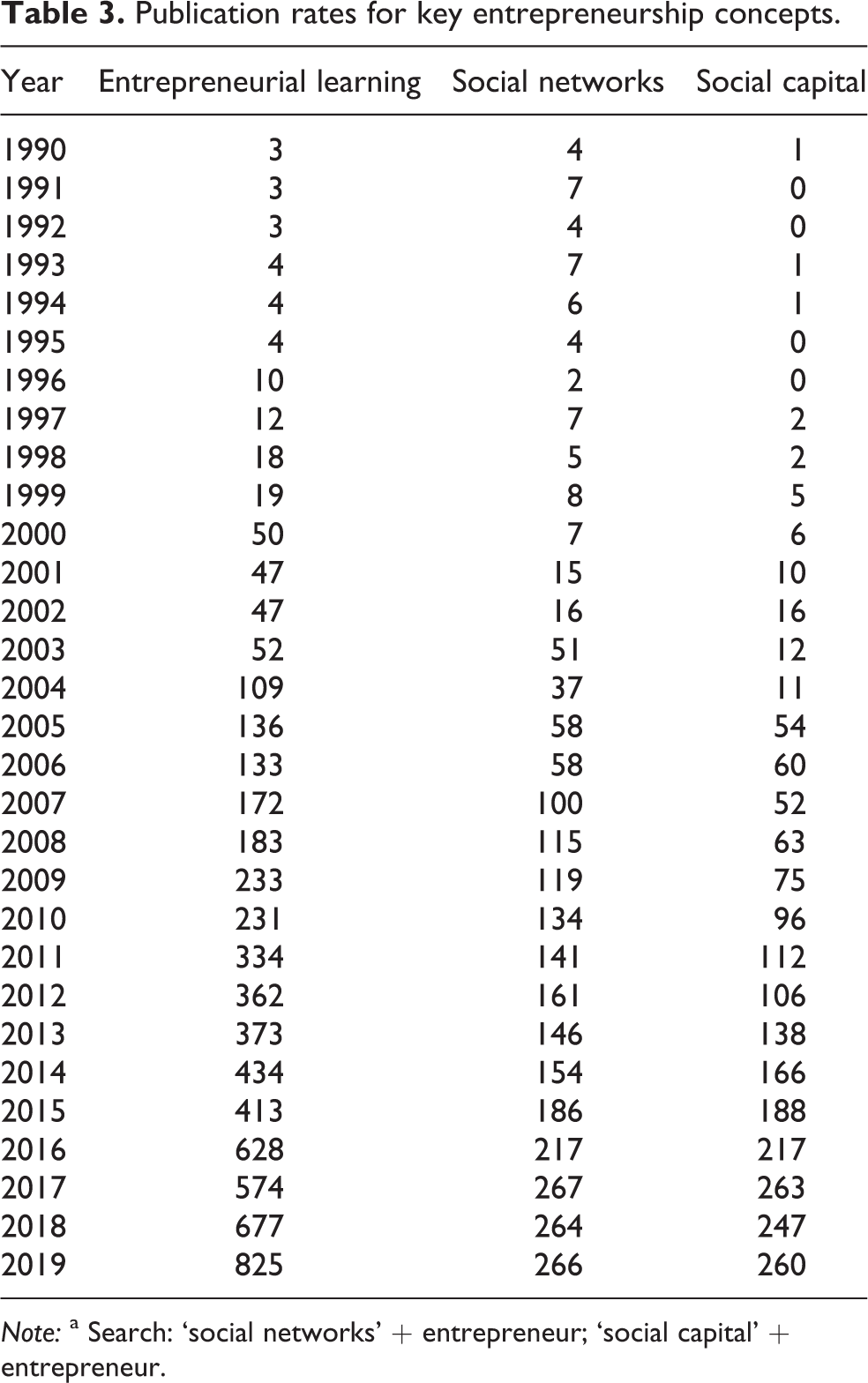
A related issue is the emergence of three core entrepreneurial concepts over the last 20 years, as illustrated in Table 3. First, the significance of entrepreneurial learning has become a central feature of SBE research (Hyams-Ssekasi and Caldwell, 2018; Smith, 2008). The first paper that explicitly referred to entrepreneurial learning was published in the Journal of Small Business Management (Lamont, 1972). The number of published papers dealing with entrepreneurial learning increased from 3 in 1990 to 19 in 1999. It is important to highlight Jason Cope’s contribution to promoting the role of experiential learning in enhancing entrepreneurship skills (Cope, 2003, 2005, 2011; Cope et al., 2007; Pittaway and Thorpe, 2012). A paper Cope published in IJEBR with his PhD supervisor is certainly seminal in the entrepreneurial learning literature, attracting almost 1,300 citations (Cope and Watts, 2000). Significantly, only three entrepreneurial learning papers 24 have slightly higher citations: Minniti and Bygrave (2001), Politis (2005), and Cope (2005). From 2000 onwards research on entrepreneurial learning grew rapidly, with 825 papers published in 2019. To summarize, published papers on the ‘entrepreneur’ increased from 830 in 1999 to 6,459 in 2019, an increase of 7.8 compared to entrepreneurial learning, 43.4; social networks, 33.2; social capital, 52.0.
Birley (1985) was one of the first scholars to recognize the importance of social networks for entrepreneurs to identify and exploit new opportunities. Throughout the 1990s, an average of five papers were published each year dealing with entrepreneurial networks, and most utilized Granovetter’s (1973) work on the relative importance of strong and weak ties. From 2003 onwards, the number of published papers grew steadily and reached 266 in 2019. The related concept of social capital (Anderson and Jack, 2002; Lee, 2017) was recognized as a significant feature of entrepreneurship following Burt’s (1992) seminal publication. Walker et al. (1997) published a widely cited paper in Organization Science and Honig’s (1998) work also provided a sound basis for research that followed. Social capital became increasingly important from 2000 onwards and publications also rose steadily, with 260 papers in 2019. Between 1990 and 2000, there were 54 published papers analysing social networks and only 12 related to social capital. Although the two concepts grew at similar rates, they appear to be largely independent. Between 2000 and 2019, there were 2,490 papers referring to social networks and 2,152 referring to social capital, and just 378 drawing on both concepts. In summary, what the data indicate is that these three concepts have been widely adopted by the SBE community over the course of the last 20 years.
Publication rates for key entrepreneurship concepts.
Note: a Search: ‘social networks’ + entrepreneur; ‘social capital’ + entrepreneur.
SBE researchers and a landscape of practice
Active engagement in situated learning is believed to be key to individuals developing their identities and enhancing their working practices (Brown and Duguid, 2001; Handley et al., 2006; Lave and Wenger, 1991; McDonald and Cater-Steel, 2017; Mercieca, 2017). Originally, situated learning in communities of practice was associated with small groups of craft-based learners (Brown and Duguid, 1991; Handley et al., 2007). More recently, there has been more focus on ‘geographically distributed groups of individual members’ who do not necessarily meet face-to-face (Soekijad et al., 2011: 1005). As pointed out by Agterberg et al., (2010: 86), most networks of practice (NoPs) research has focused on intra-organizational learning in large companies, such as Shell (Wenger et al., 2002) and Unilever (Rumyantseva et al., 2006). The authors examine the issue of what they describe as the management dilemma associated with the creation of effective NoPs. Networks, even in the context of large organizations, are often self-organizing and, therefore, independent of direct managerial control (Alvesson et al., 2002; Thompson, 2005). Wenger (1998) also introduced the ‘landscapes of practice’ concept to explain how different communities of practice interact to develop practice-based knowing. As Pyrko et al. (2019a: 485) explain, NoPs are ‘looser social formations’ than CoPs but still tend to be connected through work-based activities. Rather than being linked by a network, LoPs are a ‘totality of practitioners’ involved in a ‘living and emerging body of knowledge’ (Wenger-Trayner et al., 2014: 27). Individuals are engaged in local CoPs where they develop their competence as practitioners while also being linked to knowledgeability associated with the broader LoP (Pyrko et al., 2019b). Unlike the study by Lefebvre et al. (2015), which focuses on formal CoP networks, the SBE ‘community’ is characterized by a geographically dispersed group of researchers belonging to a variety of different disciplines. For example, SBE researchers may be part of discipline-based CoPs such as economists, psychologists, marketeers or organizational theorists, or may belong to more multidisciplinary groups associated with the study of entrepreneurship or small business in their institutions. For a different approach to the analysis of networks associated with entrepreneurship scholars, see Landström and Harirchi (2018).
The nature of the SBE LoP cannot be compared to networks of practice in large companies associated with earlier studies (Rumyantseva et al., 2006; Wenger et al., 2002) or even the ‘Development Organization’ discussed by Agterberg et al. (2010). I suggest that SBE scholars belong to an organic community that has gradually coalesced around the core set of ‘mediating artefacts’ discussed above: entrepreneurial learning, social networks and social capital. A community’s collective understanding can be shaped and sustained through artefacts that mediate social interactions (Blackler et al., 1993; Engeström, 1990). Artefacts represent past learning that is embodied in the ‘tools’ used by individuals when engaging in knowledge-based activities (Knorr Cetina, 2001). Mediating artefacts are abstract concepts while also representing shared understanding (Engeström, 1987); they are meaning-producing and practice-generating (Knorr Cetina, 2001). As such, objects or artefacts have an active role in perpetuating and transforming practice arrangements that sustain organizations (Knorr Cetina, 2001). Artefacts are embedded in existing social arrangements and possess meaning, since they both represent past understandings and are things through which intersubjective interactions occur. As Blackler (1993) explains, object-centred actions in social contexts are expressions of the existing state of knowledge within that community. Artefacts not only mediate relations between subjects but also between separate practice communities (Bechky, 2003). The argument proposed here is that entrepreneurial learning, social capital and social networks are the mediating artefacts that link SBE researchers to a landscape of practice (see Figure 2).
Conventional intra-organizational networks are guided by ‘managerial involvement’ to ensure that dispersed knowledge is integrated into organizational routines and practices (Soekijad et al., 2011). Soekijad et al. adopt Crossan et al.’s (1999) 4i model by focusing on interpreting, integrating and institutionalizing because intuiting takes place at a ‘sub-conscious level’. The three remaining micro-processes that link learning at the individual, group and organizational levels are defined as follows (Soekijad et al., 2011: 1007): Interpreting involves the development of cognitive maps and language that can be shared with others, and represents both an individual and a social activity at the individual and group levels. Integrating relates to the process of developing a shared understanding among network members to integrate learning at the group and organizational levels. This process will initially be informal, but if the action is recurring and significant it will be institutionalized. Institutionalizing is the process of ensuring that actions become routinized into day-to-day activities. It ensures learning that takes place at the individual and group levels becomes embedded in the organization’s (network’s) systems, structures and procedures.
Although it is not a ‘managed’ network, the SBE community has become a landscape of practice (LoP) through a process of interpreting, integrating and institutionalizing based on the mediating artefacts discussed above (Figure 2). These concepts (entrepreneurial learning, social networks and social capital) form the basis of a common language among network members. The concepts were integrated into the SBE communities’ mutual understanding of entrepreneurship in three ways. First, they were integrated through active engagement with various practitioner communities, usually based on EU funding as discussed in relation to the LEAD and Growth Catalyst programmes. Second, mutual understanding developed via engagement in various conferences such as BAM and ISBE, which have been important in the community, developing a clearer understanding of the key issues associated with entrepreneurship (Table 2). Third, the core UK journals have been central to debates featuring these mediating artefacts. IJEBR has been particularly important, having published over 85 papers dealing with entrepreneurial learning. Articles dealing with social capital and social networks are also well represented in the core journals. As confirmed in Table 2, most papers have been published since 2000, when these concepts started to become institutionalized in entrepreneurial discourse. Hence, the central argument here is that engagement with practitioners has strongly influenced the research and publishing agendas of SBE scholars.
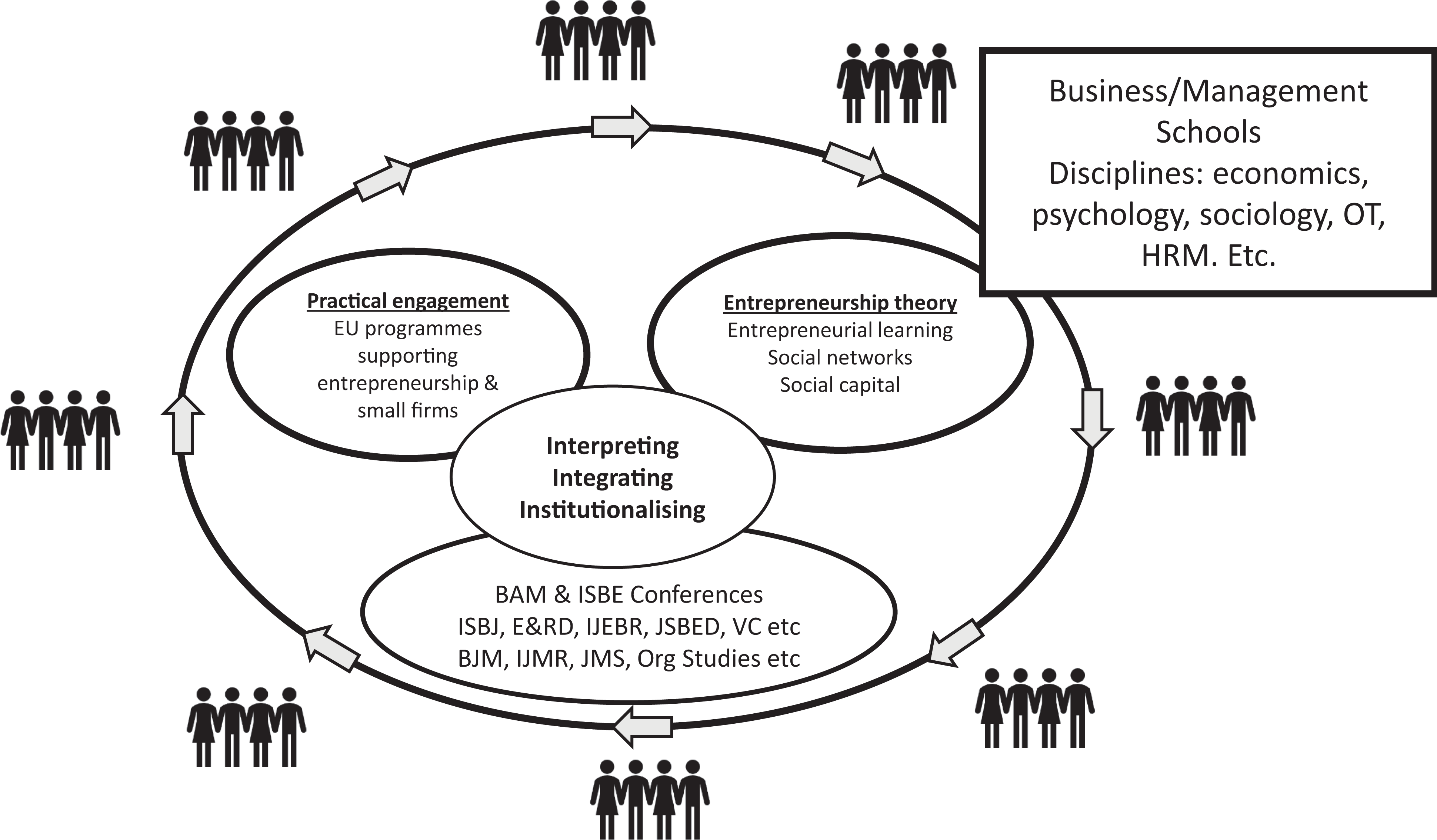
The SBE landscape of practice.
Conclusions
Figure 1 provides an overview of the evolution of SBE community over a 50-year period, beginning with the Bolton Report published in the early 1970s. In this paper, I have focused on the last 20 years as that period has seen a significant rise in the amount of EU Structural Funding obtained by UK universities to support entrepreneurs and those managing existing small businesses (Table 2). My argument is that this funding has enabled many academics from the SBE community to engage with those involved in starting and managing their own businesses. Secondly, this engagement has encouraged greater knowledge-sharing among the academic community and underpins a more sophisticated understanding of entrepreneurship and small business ownership. As illustrated in Table 3, the concept of entrepreneurial learning has become an important factor in a more nuanced academic understanding of entrepreneurship.
These changes are summarized in the suggestion that the SBE community can be described as a ‘landscape of practice’ which has coalesced around three core concepts: entrepreneurial learning, social networks and social capital. The importance of these concepts has been reinforced as a result of academic engagement with the world of practice. In fact, Figure 2 illustrates that there is constant cycle of knowledge-sharing based on practical engagement, understanding of entrepreneurial theory and conference attendance and publishing. This cycle represents a ‘virtuous circle’ whereby new knowledge is constantly co-created and shared by members of the landscape of practice. As discussed above, much of this engagement has occurred because UK universities have accessed large amounts of EU Structural Funding (Table 2), which has been the catalyst for various programmes designed to assist entrepreneurs and owner-managers.
Footnotes
Declaration of conflicting interests
The author(s) declared no potential conflicts of interest with respect to the research, authorship, and/or publication of this article.
Funding
The author(s) received no financial support for the research, authorship, and/or publication of this article.
