



Abstract
Entrepreneurship education in higher education institutions (HEIs) increasingly aims at fostering an entrepreneurial mindset (EM) in students. However, large heterogeneity exists in conceptualizations of EM. This is a challenge for educators as it is difficult to develop instructional strategies to foster students’ EM when there is no clarity about what this mindset is. The purpose of the article is to address this challenge. It does so by analysing and synthesizing current literature in the field of entrepreneurship education in HEIs and develops a taxonomy that depicts three dominant conceptualizations of EM, their theoretical origins and the type of attributes typically associated with each conceptualization. The article goes beyond the integrative literature review by reflecting on the consequences for the design of entrepreneurship education of the simultaneous existence of these three dominant conceptualizations. The author develops a typology for aligning instructional strategies with the EM conceptualizations and thus contributes to practice by providing a better understanding of how to achieve coherence between learning outcomes and instructional choices. The article advances the field’s conceptual knowledge about EM and thereby facilitates future theory generation.
Keywords
The subject matter of entrepreneurship education (EE) in higher education institutions (HEIs) has grown from a focus primarily on new venture creation and small business management to one that encourages (simultaneously) the development of broader skills, competencies and attitudes which should enable students to manage their careers and lives in an entrepreneurial way (Galloway et al., 2015; Hytti and O’Gorman, 2004: 4; Lackéus, 2015). With this broadened purpose, EE has permeated a broad range of disciplines and is thus no longer contained within a business school and management education context (Henry and Lewis, 2018; Morris and Liguori, 2016; Rideout and Gray, 2013). These developments reflect the fact that students of all disciplines today experience economic and societal realities that are complex, fast-changing and uncertain. Although the nature of entrepreneurship, and consequently also the content of EE, is continuously debated (Fayolle et al., 2016; Morris and Liguori, 2016), EE is increasingly accepted as an essential means to equip students with the autonomy, mindset and innovative abilities necessary for successfully navigating such realities. The purpose of EE is thus no longer solely to increase students’ intention and ability to start and run new ventures but to teach them how to ‘become entrepreneurial’ and ‘behave entrepreneurially’ across a broad range of situations (Gibb, 1999; Hytti and O’Gorman, 2004).
With this broader purpose, the specific learning outcomes of EE have simultaneously become more diverse. Previously, the outcomes of EE centred on the knowledge and skills relevant to the practicalities of starting and managing new ventures (Hägg and Gabrielsson, 2019). Today, various desired learning outcomes have been added to the functionalistic outcomes. These outcomes, which include creative competencies, values, predispositions and attitudes (Mitra, 2017), are aimed at a more holistic development of students along cognitive, affective and conative dimensions that enable them to interact with and influence the world as proactive, risk-taking and responsible actors (Fayolle et al., 2016; Kyrö, 2018).
One of the learning outcomes of EE that has received vast attention over the last 10 years is the entrepreneurial mindset (EM) (Fretschner and Lampe, 2019; Zappe et al., 2018). The interest in EM as a learning outcome reflects the broader, more holistic purpose of EE as it concerns the development of ‘entrepreneurial people’ (Mitra, 2017), who are drawn towards entrepreneurial behaviour as ‘an everyday practice’ in which ongoing change is considered to be a natural state (Blenker et al., 2012; Hultén and Tumunbayarova, 2020). Neck and Corbett (2018) identify EM as one of three central outcomes of EE, where the mindset complements the skills and practice necessary for starting new ventures and living more productive lives.
Although the EE field increasingly recognizes that EM is an important antecedent of entrepreneurial intention and behaviour (Kaffka and Krueger, 2018; Nabi et al., 2017), the field is still highly fragmented in terms of its conceptualization of EM. For example, a Delphi study carried out by Neck and Corbett (2018) showed agreement among educators that EE includes developing a mindset to engage in entrepreneurial activities, but it was unclear exactly what this mindset is. This is problematic, as concept clarity is critical not only for advancing theory but also for comparing and replicating empirical studies and accumulating knowledge about EE’s role in developing students’ EM (Robinson and Gough, 2020; Zappe et al., 2018). For educators, the heterogeneity and the inchoate understanding of what EM is and how it develops present a challenge when choosing appropriate instructional strategies (Krueger 2015), and some might, as a result, refrain from including activities aimed at developing EM. Parting from the argument that EE ultimately seeks to foster an entrepreneurial way of being and behaving, and that EM is an important antecedent of such behaviour, supporting and encouraging educators to include activities that may trigger this EM emerges as a priority of the field.
This last challenge is an indication of a more general knowledge gap in the existing EE literature, which involves our need to better understand the appropriateness and coherence of instructional strategies applied to achieve particular learning outcomes in higher education, including less functional outcomes such as EM (Fayolle, 2018; Morris and Liguori, 2016; Rideout and Gray, 2013). The EE field displays a general lack of theoretical robustness in explaining the pedagogical rationale upon which EE is designed (Fayolle, 2018). Drawing more extensively on theories from education research and psychology combined with entrepreneurship theories is paramount if scholars are to progress our knowledge of how instructional strategies support learning outcomes such as EM (Fayolle, 2013; Kyrö, 2018; Lackéus, 2015).
In the light of the presented challenges, this article analyses and synthesizes existing literature on EM in the field of EE in higher education in order to address two research questions: 1. How has existing literature conceptualized EM in EE? 2. How can instructional strategy be adapted to different conceptualizations of EM?
In answering these questions, the article makes two contributions to research and practice. It advances conceptual knowledge by developing a taxonomy that depicts three dominant EM conceptualizations in EE and identifies how they differ in theoretical origins and the attributes associated with EM. On the one hand, such knowledge aids future researchers in positioning their work within the broader literature; on the other, it facilitates future theory generation as the identification and juxtaposition of theoretical underpinnings of the different EM conceptualizations allow for a better theoretical grounding. The article’s second contribution is theory generation in the form of a systematically constructed typology that bridges the learning outcome of EM with different instructional strategies and their underlying learning theories. This typology rests on the taxonomy of dominant EM conceptualizations. Besides advancing theory about how to align EE outcomes and instructional strategy with a conscious grounding in learning theories, the typology also informs practice as educators can more readily access the EM concept and design learning interventions that fit their EM understanding.
The article commences with a description of the method applied, including the paper selection process and the integrative approach used for reviewing the literature. It then presents the review findings and analyses these to clarify the dominant conceptualizations of EM in the field and identify proposed instructional strategies. The article goes on to develop the typology that links conceptualizations of EM with suitable instructional strategies. This is followed by a discussion that takes a critical stance on the EM concept and its various conceptualizations. Finally, the article outlines suggestions for future research.
Method
The method employed for this study is an integrative literature review (Cronin and George, 2020; Torraco, 2005), which follows the recommendation for a systematic literature review in the paper selection process (Siddaway et al., 2019). The integrative review aims to synthesize and evaluate the current state of research, but also to hone in on best practices of research or promote new kinds of research with respect to a topic (Cronin and George, 2020). These aims support the purpose of this article, which is first of all to produce a detailed picture of the study of EM in different EE contexts and thereby bring forth different underlying theoretical assumptions about the nature of a mindset and how to foster its development. This is achieved through a critical content analysis (Torraco, 2005) conducted on the selected papers, which informs the development of the taxonomy that synthesizes the main EM conceptualizations. The taxonomy subsequently becomes the foundation for new theorizing (Torraco, 2016), which takes the form of a typology that aligns instructional strategies to EM conceptualizations. Thus, the article contributes with sense-making and a certain redirection to the field (Cronin and George, 2020), as it goes beyond synthesizing and proposes avenues for further research. The following three research phases will be described in detail below: paper selection, organization and analysis, and reporting.
Paper selection phase
A systematic subject search was completed in Business Source Complete, Emerald Insight and Scopus from 17 to 21 January 2020. Three search criteria were applied to identify the most relevant academic literature addressing EM in a higher education context. First, the search words used were ‘EM*/mind-set*’ AND ‘entrepreneur* education/learning’ OR ‘enterprise education’ and occurrences were looked for in title, abstract or keywords. Second, publications included journal articles, books, book chapters, conference proceedings and papers, work in progress, dissertations and reports, but excluded book reviews, the business press, periodicals and case studies. Third, only papers written in English were considered. No date limit was introduced because EM as a learning outcome is a relatively recent research area, and therefore, it was not necessary to limit the search to specific years.
The search strategy outlined might result in the exclusion of relevant papers that use synonymous or close substitutes for EM, such as ‘entrepreneurial thinking’, ‘entrepreneurial orientation’, ‘entrepreneurial attitude’ or ‘enterprising mindset’. However, the exclusion criterion was deemed necessary in light of this study’s objective, which includes offering insight into how scholars understand and research the concept of ‘EM’ in the EE field.
The subject search led to the identification of 288 papers which, after eliminating duplicates among the databases, left the first screening with 243 papers. An initial review of the papers was undertaken by reading the abstracts and, when necessary, the main text more broadly, to include only papers relating specifically to EE in higher education with an actual focus on EM. This content review limited the list of papers to 38. At this point, it was noted that only two of the identified papers came from the two dominant journals in the field of EE, namely, Education + Training and Industry and Higher Education (Blenker et al., 2014; Hägg and Gabrielsson, 2019). Therefore, the selection process included a review of articles in these journals, which resulted in two additional papers. A reference and citation search performed in Google Scholar elicited 23 papers. Finally, in the period during which this paper was developed, new relevant literature was identified which had not been picked up by any other selection method. These eight papers were mainly published after the initial subject search took place or were identified by suggestion software analytics on Google Scholar and reference management software. The papers were deemed relevant to include in the review due to their specific focus on EM in higher education.
The final paper selection resulted in 71 papers to be reviewed. The sample is considered appropriate and adequate in both content and size. Morse (1991) argues that, in order for a qualitative sample to be appropriate, it should facilitate understanding of the research problem. The 71 selected papers provide a basis for identifying the different conceptualizations of EM because the sample provides considerable variation, yet theoretical meaningfulness can rather clearly be found in this variation. Furthermore, the amount of selected papers is adequate in terms of providing informational completeness. As papers were added to the selection, the variation in new information became increasingly less, leaving no ‘thin areas’ of the research topic and achieving an adequate information saturation level (Morse, 1991; Neergaard, 2007). The list of papers is not included here due to space constraints, but is available from the author on request.
It should be noted that the 71 papers selected for review display great variety in terms of publishing outlets. The majority (46) are articles published in very diverse journals, though generally with a relatively low journal ranking. There is a large representation of grey literature, including books, book sections and reports. Conference proceedings are especially well represented with 16 papers, primarily from the American Society for Engineering Education (ASEE) Conference and Exposition. These 16 papers reflect a growing interest in the field of STEM education in incorporating elements of entrepreneurial learning into the curriculum in order to achieve some of the benefits of EE for their students, such as increased employability, innovative abilities or skills for implementing technological solutions for change and value creation. Besides the papers dealing with EE in STEM disciplines, the reviewed papers cover disciplines such as arts, sports science, educational studies, TESOL education and business and management studies.
Organization and analysis phase
Each of the 71 papers was carefully reviewed to identify content related to the two main themes around which this study is organized: (i) conceptualizations of EM in EE and (ii) instructional strategies to foster EM in EE. The first theme addresses the definitions and understandings of EM and seeks to clarify its theoretical underpinnings. The second theme sheds light on how EE is currently designed to instill EM in students and whether any best practices exist. It should be noted that this study uses the term ‘instructional strategy’ to refer to the didactic choices the educator makes when instilling EM in students and the underlying assumptions about learning which influence the choice of didactics.
The analysis of the findings is performed according to guidelines for critical analysis in an integrative literature review process to synthesize previous research (Snyder, 2019; Torraco, 2016). The analysis explores the theoretical origins of conceptualizations and determines whether any patterns exist among the varied understandings of EM and among the proposed instructional strategies. The article subsequently presents a reflection, which leads to developing the typology that combines EM conceptualizations and instructional strategies. This combination is driven by a logic that seeks to achieve coherence between how a mindset is conceptualized and the theories about learning underlying an instructional strategy.
Reporting phase
The literature review findings are presented and analysed in the following sections. Content analysis has been criticized for focusing too much on reporting findings and less on analysing them (Elo and Kyngäs, 2008). Therefore, this study combines the reporting of findings with a critical analysis of them before developing the typology.
Defining the entrepreneurial mindset
A striking and rather worrying revelation is that, in 28 of the 71 reviewed papers, the authors do not offer an actual definition of EM, despite it being a central concept treated in the study. The lack of definitions is particularly problematic for the empirical studies that aim to measure or influence EM. Without a proper definition and delimitation of the key concept, any conclusions reached about the effect of the educational efforts must be questioned with regard to their validity, and the conclusions regarding the role of the educational practice in fostering EM are put in serious doubt.
Apart from the missing definitions of the core concept, the literature review reveals considerable variation and a general lack of theoretical rigour in conceptualizing EM. Three approaches to defining EM can be identified. The first involves using one definition provided by previous authors. However, no reference article can be seen as dominant when researchers define EM in a higher education setting. The second approach involves basing the definition of EM on several previous articles. Unfortunately, this typically results in a very broad understanding of the concept, which often encompasses a series of quite different constructs, including competencies, cognitive abilities, values, motivation, capabilities and actual behaviour. The third approach involves defining EM after a minimal or no literature search, including few or no references to previous studies about EM.
Definitions of an entrepreneurial mindset in the entrepreneurship education literature.
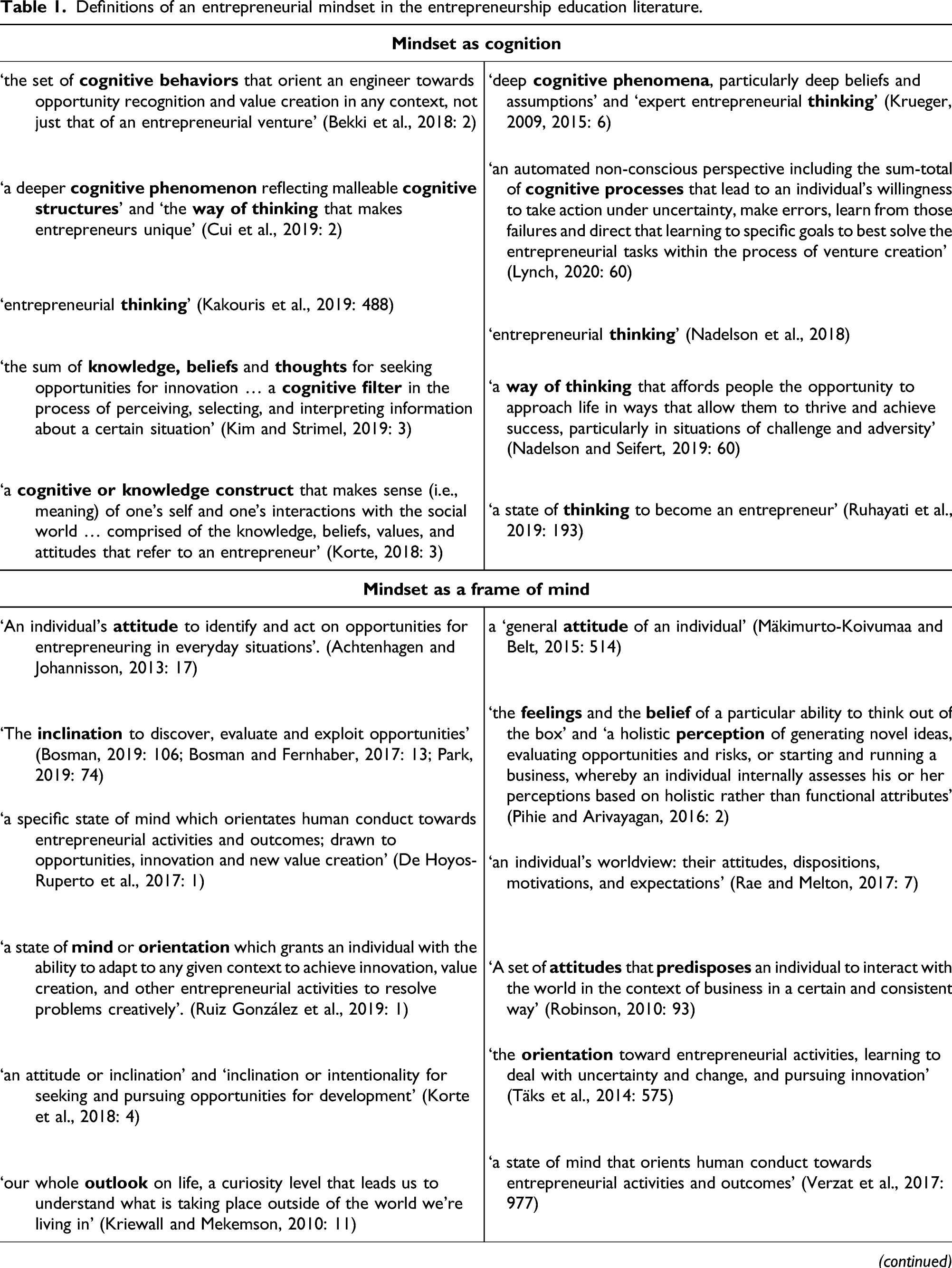
It should be noted that the placement of definitions into the different understandings has been achieved not only by looking at the actual definition but also through a broader review of how that definition is used and conceptualized more generally in the paper. For example, although Krueger (2009; 2015) addresses attitudes and beliefs as elements of a person’s mindset, the inherent understanding of his approach is that EM is a cognitive phenomenon related to ‘knowledge structures and knowledge processes’ which together represent an ‘entrepreneurial way of thinking’. The same is the case for Kim and Strimel (2019) and Korte (2018). Similarly, the words ‘attitude’ and ‘thought processes’ can be found in definitions placed under the understanding of mindset as a capability. That is because this understanding has a very broad conceptualization of EM which includes several aspects that can be considered human assets, where attitudes and cognitive abilities represent such assets.
The variety in definitions is a symptom of a severe challenge in the field, namely, the lack of transparency of theoretical assumptions underpinning the assertion of what a mindset is. Not only does it reveal a research field that lacks overall rigour, theoretical attention and transparency in the utilization of core concepts, it also has practical implications because an educator who seeks to foster EM in students needs to develop an instructional strategy in line with her or his fundamental understanding of what a mindset is, how EM differs from other mindsets and to what extent this mindset can be influenced in an educational situation. Nevertheless, let us delve into the three dominant understandings.
Mindset as cognition
The papers adhering to an understanding of mindset as cognition consider it a specific way of thinking that is characteristic of entrepreneurs. Different terms are applied to describe the mindset, including cognitive behaviours, cognitive structures and cognitive filter.
This first dominant understanding of mindset is founded primarily in psychology literature on individual cognition. Cognitive psychology theory has been widely applied in entrepreneurship research to study a broad range of aspects of the entrepreneurial decision-making process, including entrepreneurial alertness, cognitive bias, pattern recognition and the acquisition, processing and comprehension of new information, which is central to discovering new business opportunities (Grégoire et al., 2011; Mitchell et al., 2002; Shepherd and Patzelt, 2018). There is a significant overlap between these cognitive aspects and the type of cognitive abilities and processes addressed in the reviewed papers that conceptualize EM with a grounding in cognitive psychology (Naumann, 2017). Thus, understanding EM from an individualistic cognitive perspective means conceptualizing mindset as the knowledge structure and cognitive processes of entrepreneurs, which are different from those of, for example, managers and salary takers (Krueger, 2015; Lynch, 2020).
The reviewed papers additionally show certain influences from social cognitive theory, specifically from Bandura’s (1977) social learning theory. These influences are evidenced in papers that refer to EM as a type of cognitive filter that allows individuals to make sense of themselves and the world around them. Whereas the cognitive psychology perspective focuses on the individual cognitive processes applied when confronted with a specific task, the social cognitive perspective examines more broadly how individuals use social feedback to make sense of themselves and their surroundings (Günzel-Jensen et al., 2017). Thus, the social cognitive perspective incorporates interaction with the environment – for instance, the educational setting – in the development of cognitive abilities and knowledge structure.
Mindset as a frame of mind
The second dominant conceptualization of mindset considers EM to be a specific frame of mind that draws somebody towards entrepreneurial activities. Common for many definitions in this stream is thus that EM is considered an important antecedent of entrepreneurial behaviour. This is displayed in the use of terms such as inclination, intentionality, attitude and predisposition towards entrepreneurship.
The conceptualization of mindset as a specific frame of mind has its origins in social psychology, with the dominant influence coming from attitude theory. A frequently used model of attitudes is the tripartite model, which determines that attitudes have cognitive, affective and conative components that predispose a person favourably towards an object or behaviour (Katz, 1960; Robinson, 2010), in this context, entrepreneurship and entrepreneurial behaviour. Within the primary research field of entrepreneurship, the social psychology influence is extensively present as well, specifically in the application of the theory of planned behaviour, in which attitudes are considered an essential predictor of entrepreneurial intention and ultimately entrepreneurial action (Ajzen, 1991). Several of the reviewed papers draw specifically on the theory of planned behaviour or refer to the tripartite of attitudes when conceptualizing and studying the concept of EM in EE.
As a frame of mind, EM represents positive beliefs about and emotions towards entrepreneurship and oneself as entrepreneur or change agent, as well as a predisposition to engage in behaviour consistent with that of an entrepreneur, including a predisposition to be proactive and persistent in the face of challenges and feeling comfortable in the process of change. It should be noted that the cognitive aspect in this conceptualization differs from the understanding of EM as cognition as it does not deal with knowledge structures or cognitive processes needed for opportunity recognition and decision-making. When conceptualizing EM as a frame of mind, the cognitive element instead primarily concerns individuals’ beliefs and assumptions about entrepreneurship and themselves as entrepreneurs and the role these play in drawing an individual towards behaving entrepreneurially.
Mindset as a capability
The definitions in Table 1 reveal that although the conceptualization of mindset as a psychological construct is dominant, a largely non-psychological perspective is also present. This view corresponds to a human capital view, where individuals who possess an EM are equipped with an asset profile that supports entrepreneurial behaviour and increases the chance of entrepreneurial success (Unger et al., 2011). Common to conceptualizations of EM as a capability is an emphasis on entrepreneurial knowledge, skills and competencies deemed critical for entrepreneurial success. The review findings show that the skills and competencies associated with an individual’s EM can mainly be categorized into cognitive/psychological, social and behavioural skills and competencies. Hence, although human capital theory does not have its roots in psychological literature, there are constructs dealt with under this perspective in entrepreneurship research that reflect certain psychological factors, albeit more surface-level factors, including intentions and perceptions (Lindberg et al., 2017b).
The cognitive skills correspond broadly to the cognitive abilities and thought processes identified under the individual cognitive conceptualization of EM and are primarily the skills applied for creative thinking, opportunity recognition and decision-making. However, cognitive skills also include self-confidence and motivation as important psychological human capital assets, which shape students’ ability to discover and exploit entrepreneurial opportunities (Lindberg et al., 2017b; Solesvik et al., 2013). The social skills and competencies deemed essential for entrepreneurial success encompass the ability to communicate, collaborate and focus on customers (Bodnar and Hixson, 2018; De Villiers Scheepers et al., 2018; Secundo et al., 2015). Finally, the skills and competencies that can be regarded as behavioural tendencies include the ability to exploit opportunities, action orientation and the tendency to experiment and innovate (Bodnar and Hixson, 2018; De Villiers Scheepers et al., 2018; Ndou et al., 2016).
Dominant mindset conceptualizations in entrepreneurship education research.
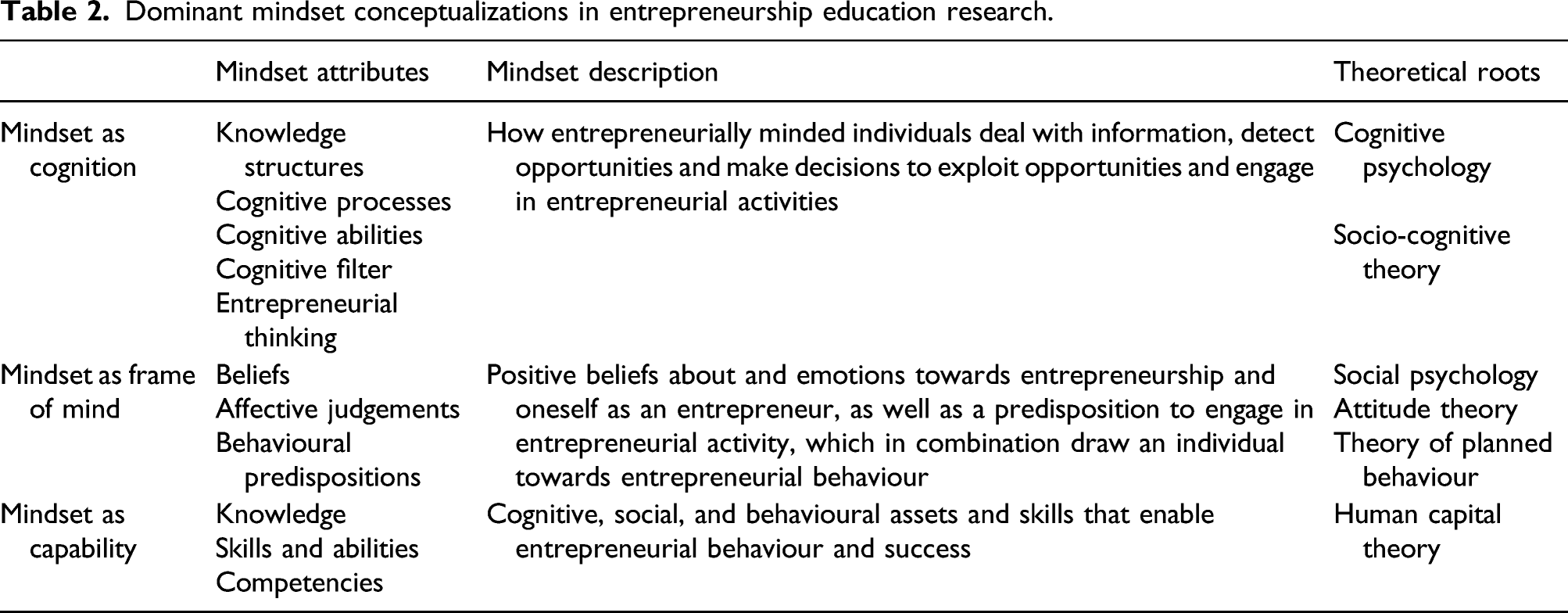
The division into three dominant understandings contributes a clarification of the main theoretical underpinnings that have given rise to the conceptual fragmentation in EE research. It is important to be aware that these three understandings are inherently different as they build on quite different theoretical research streams. Indeed, a study of EM rooted in the cognitive psychology stream can hardly examine the same phenomenon as a study based on a human capital view, and comparison of results becomes futile. Therefore, heightened attention to how the EM concept is framed according to underlying theoretical roots is paramount because the framing will affect how a research study is designed and how learning processes should be designed to shape students’ EM.
EM as a learning outcome of EE
The reviewed papers concur that EM is an important learning outcome when EE interventions seek to encourage entrepreneurial behaviour in a broad sense and not just aimed at venture creation. When it comes to designing education to foster the development of EM, the findings show that researchers mainly suggest active, student-centred and experiential strategies. The reviewed literature presents a series of single case studies that explore the impact of various experiential instructional strategies on the development of EM, including games (Achtenhagen and Johannisson, 2013; Johnsson et al., 2016), design thinking or other design-focused frameworks (Bosman, 2019; Lindberg et al., 2017a), project-based learning (Ali et al., 2012; Kim and Strimel, 2019), improvisation activities (Balachandra, 2019) and workshop formats (De Hoyos-Ruperto et al., 2017; Ruiz González et al., 2019; Secundo et al., 2016). In all instances, the authors conclude that the explored active approach plays a positive role in developing students’ EM.
Despite the prevailing consensus that student-centred, experiential learning is the appropriate approach to fostering EM, arguments can also be found that EM can be fostered in a more traditional, teacher-centred, knowledge-imparting approach. The argument is that a more traditional approach can potentially instill a positive attitude towards entrepreneurship in students by enhancing their awareness and understanding of the role of entrepreneurs in society, the entrepreneurial process and the main tasks and challenges in entrepreneurship (Morris, 2017; Secundo et al., 2016). Mäkimurto-Koivumaa and Belt (2015) suggest that fostering EM is a time-consuming process and a combination of different types of teaching approaches assists the development of EM in different phases. Consequently, EM will develop as the students are exposed to a combination of teacher- and student-centred learning over a prolonged period. Thus, this viewpoint posits that EM can hardly be developed during a one-semester module in entrepreneurship, but should be incorporated as an element of entire programmes for optimum effect.
It is symptomatic that the studies reviewed tend to be based on a combination of ill-defined constructs and a lack of theoretical grounding, which leaves the field with important room for improvement. Indeed, most papers rarely include argumentation for instructional strategy choice based on an understanding of the educational psychology and learning theories that underlie the strategy. This clearly presents a problem, as educational designs with learning outcomes based on ill-defined constructs on the one hand and instructional strategies lacking a theoretical foundation on the other run the risk of misalignment between the instructional strategy and the learning outcomes it attempts to address. This highlights that individual preferences guide the choice of instructional strategy to a greater extent than theoretical and empirical evidence of what works and what does not work in EE. Therefore, it is paramount that the field takes a more critical stance towards the generally accepted approach of active, experiential learning and that the choice of instructional strategy more consciously builds on learning theories that can support that choice depending on the overall conceptualization of EM. Therefore, this article continues with a reflection on how a more solid reliance on a broader array of learning theories can help develop instructional strategies to foster EM depending on whether it is conceptualized as cognition, as a frame of mind or as a capability.
Towards a typology for instructional strategies for fostering EM
Instructional strategies for entrepreneurial mindset development.

If an educator considers EM to be purely cognitive, learning represents the development of knowledge, a change in knowledge structures and the development of cognitive abilities – primarily those involved in opportunity identification and evaluation and decision-making regarding entrepreneurial behaviour. This corresponds largely with the approach that Neck and Greene (2011) denote as cognitive entrepreneurship education, which focuses on the potential of each student to become an (expert) entrepreneurial thinker, characterized by, among other things, an ability to recognize meaningful patterns of information, engage in counterfactual thinking and tolerate ambiguity.
A cognitive conceptualization of EM reflects the EE objectives of education ‘about’ and ‘for’ entrepreneurship. In education ‘about’ entrepreneurship, the objective is to increase students’ knowledge and awareness of entrepreneurship and the entrepreneurial process (Kakouris and Liargovas, 2020; Mitra, 2017). This can be done through a traditional instructional strategy, including classroom lectures, readings and guest speeches by entrepreneurs, where students learn about entrepreneurial purpose, activities and processes. Nevertheless, a pure knowledge-imparting approach is unlikely to create any change in cognition and thinking if students do not reflect on this new knowledge and allow it to alter their current knowledge structures. By combining information in new ways through the activation of prior knowledge and the incorporation of new knowledge, students must practise and learn different cognitive strategies and develop their thinking skills (Barrows, 1986; Willingham, 2009). Therefore, education ‘about’ entrepreneurship must be complemented by a ‘for’ approach, in which cognitive processes needed for entrepreneurial behaviour are trained.
A seemingly suitable approach that allows students to construct new knowledge and develop entrepreneurial thinking and decision-making skills is problem-based learning (Barrows, 1986; Schmidt, 1993). According to Krueger (2007), problem-based learning is a learning-centred approach that can enhance students’ entrepreneurial thinking and change their knowledge structures remarkably. O’Brien and Hamburg (2019) likewise argue that a problem-based approach in which students deal with ill-defined situations and unstructured problems allows them to develop cognitive abilities related to problem identification and alternative-seeking. This enrichment of cognitive structures and information processing capabilities is a fundamental goal of learning in problem-based education (Schmidt, 1993).
In practice, an instructional strategy that relies on fostering EM through problem-based learning will develop students’ understanding by increasing their knowledge base and developing their entrepreneurial thinking by practising cognitive abilities. This can be done by combining traditional lectures with a case-solving method and adding an element of reflective practice. Through casework, students practise cognitive skills, including critical thinking, counterfactual thinking, self-directed learning and sense-making, as they are faced with increasingly challenging entrepreneurial decision-making scenarios. The scenarios must resemble real-world, uncertain situations (Krueger, 2007) in order for students to subsequently enact the knowledge structures and cognitive processes when confronted with similar situations in real life. Learning should be student-centred, but the educator helps students by sharing knowledge and planning for a reflective, iterative process in which students develop entrepreneurial thinking as they build on prior knowledge and are guided towards explicit learning and performance objectives (Barrows, 1986; Savery and Duffy, 1995).
If an educator considers EM to be a frame of mind that draws an individual towards entrepreneurship, learning represents the development of or a change in the individual’s habits of mind and points of view (Mezirow, 1997). This change will take place in cognitive as well as affective and conative aspects. The educator thus aims to help the students revise their belief systems and affective understandings of the self, the entrepreneurial reality and their current behaviour and lifestyle to instill a positive inclination towards entrepreneurial behaviour. A conceptualization of EM as a frame of mind most closely reflects the EE objective of education ‘through’ entrepreneurship, which is to foster positive attitudes towards becoming entrepreneurial and behaving entrepreneurially, independent of the field of study and in an indefinite time (Aadland and Aaboen, 2018; Kakouris and Liargovas, 2020). This type of learning is very personal (Middleton and Donnellon, 2014) and inherently transformative (Kakouris and Liargovas, 2020).
Transformative learning theory provides a framework for designing education that aims to foster EM as a frame of mind. Transformative learning can be considered as a change in the basic premises of thoughts, feelings and actions (Kitchenham, 2008) and corresponds therefore directly to the conceptualization of EM as a frame of mind consisting of cognitive, affective and conative elements. An instructional strategy based on transformative learning should incorporate vast opportunities for reflection, including self-reflection, and participation in discourse to question and validate beliefs, intentions, values and feelings (Mezirow, 1997).
It can be especially useful to provide students with engaging learning experiences, as experiences evoke emotions and provide a setting on which students can reflect, particularly with regard to how their assumptions, beliefs or behavioural preferences may have been altered as a result of the experiences (Mezirow, 1997; Pittaway and Thorpe, 2012). This alteration might be achieved by drawing on Bandura’s (1977) concept of mastery experiences to provide students with a sense of success when acting entrepreneurially and allowing those behaviours to form the basis of future positive attitudes towards entrepreneurial action. Besides the essential use of individual and group reflection exercises (see, for example, Ilonen and Heinonen, 2018), other activities often associated with transformative learning include role-plays, case studies, life stories, serious games and simulations, as these provide affective experiences and engage students (Mezirow, 1997).
Finally, if an educator considers EM to be a capability consisting mainly of a combination of entrepreneurial skills and competencies, learning reflects a change in an individual’s ability to carry out entrepreneurial activities. Learning is thus the development of an entrepreneurial functionality enabling the individual to behave entrepreneurially and deal with entrepreneurship challenges. Interaction with the environment in which the behaviour is to be enacted is paramount for learning capabilities related to entrepreneurship (Illeris, 2007). A conceptualization of EM as capabilities reflects the EE objective of education ‘for’ entrepreneurship, which is to prepare the students for entrepreneurial careers by providing them with requisite knowledge and skills for venture creation and small business management (Aadland and Aaboen, 2018; Mitra, 2017). This approach relies to a great extent on existing motivation towards entrepreneurship (Kakouris and Liargovas, 2020).
Action-learning methods that focus on students’ entrepreneurial agency are relevant when attempting to foster knowledge, skills and competencies associated with EM (Rauch and Hulsink, 2015). Practical, real-life development projects in which students actually carry out the entrepreneurial process provide a setting in which capabilities are learnt by doing entrepreneurship. It is essential that students choose and own their projects and that the process includes interaction with the outside world because this, on the one hand, increases student motivation and responsibility and, on the other hand, allows the process to become uncertain and ambiguous, reflecting what students will encounter outside a classroom setting.
Among the action-learning theories, the experiential learning theory proposed by Kolb (1984) provides insight into how EM and the associated capabilities can be fostered through active experimentation and concrete experiences in real-life projects. Experiential learning also relies on reflective observation and abstract conceptualization, which allow students to draw connections between new entrepreneurship knowledge and concepts, the entrepreneurial process and their own lives. Tools to apply in an experiential and experimental process could include, besides real-life projects (see, for example, Mason and Arshed, 2013), domain-related theories such as effectuation or the Business Model Canvas.
Discussion
This article rests on a broad understanding of EE, the purpose of which is to create change and value in various forms. To achieve this purpose, the objective of EE programmes is to enable students to engage in entrepreneurial behaviour and to become more entrepreneurial individuals. The papers reviewed concur that having EM as a learning outcome supports this objective and overall purpose of EE. First, scholars acknowledge that EM is relevant not only in the context of entrepreneurship but also for society, the business environment and personal lives in general. EE that addresses students’ EM thus entails benefits beyond potential venture creation as it contributes to the development of individuals who are better equipped to deal with novelty, change and uncertainty, which are existential facets of both professional and personal life (Fayolle, 2013; Kuratko and Morris, 2018).
Second, focusing on the EM of students means designing education to make entrepreneurship more desirable and feasible for a higher number of students in the long term, including those who at the outset have minimal entrepreneurial inclination (Ilonen and Heinonen, 2018; Kuratko and Morris, 2018). Much attention in the field of EE has been directed towards increasing the entrepreneurial intent of students (Liñán and Fayolle, 2015; Nabi et al., 2017). It can, however, be questioned how fruitful it is to promote the entrepreneurial intent of students who are not ready for entrepreneurial behaviour (Achtenhagen and Johannisson, 2013; Hultén and Tumunbayarova, 2020). Especially with EE having spread to various disciplines outside business and management, many EE students might not contemplate entrepreneurship as a career option. Therefore, EE should instead develop students’ EM as an important antecedent for entrepreneurial intent and ultimately entrepreneurial behaviour (Kaffka and Krueger, 2018; Rauch and Hulsink, 2015).
Despite these benefits of focusing on fostering EM in EE, the study reveals that the EM concept is not yet mainstream in the field. Missing definitions in 28 of the papers is the most obvious symptom of this. Furthermore, the wide range of dissemination channels in which research is published, combined with the varied academic quality of these channels, indicates that higher-ranked journals still display caution towards the study of EM in EE. This article posits that a reason for this caution could be that researchers have difficulty grasping the concept because of the many fragmented ways it is defined and the fact that conceptualizations often rest on quite different research streams, which are not sufficiently accounted for in existing studies. This article contributes by making the EM concept more accessible for application by both researchers and educators. Therefore, it is argued that if the conceptualization of EM is thoroughly clarified, there is indeed great potential in EE that aims to foster EM in students in higher education. Nevertheless, one question that remains to be addressed is: Does any of the three dominant conceptualizations of EM offer an avenue for future research that is more relevant for EE than the others?
If we accept the premise that the overall purpose of EE is to encourage students to engage in entrepreneurial behaviour, whether in their own lives or in organizations, and that EM is a means to that end, then the conceptualization of EM as individual cognition may be the least fruitful to pursue. Understanding EM as individual cognitive structures and processes means focusing on developing students’ mental abilities through a problem-solving process, but it is unclear how this will ultimately lead to entrepreneurial action (Kuratko et al., 2020). Furthermore, when EM is conceptualized as cognition, it does not differ significantly from the concept of entrepreneurial cognition, and thus, this line of research has little relevance as a tradition on its own in EE.
The understanding of EM as capability probably aligns best with the traditional role of education as a place for students to obtain knowledge and develop domain-specific skills to deal with work-related tasks. As this perspective highlights the development of students’ abilities to do something, it assumes a closer link between EM and entrepreneurial behaviour than the other two perspectives. However, the perspective also assumes an already existing interest in and motivation for entrepreneurship. Therefore, it might be best suited for a target audience that is already drawn towards entrepreneurial behaviour, as the acquired skills and competencies might otherwise not be acted on. With the spread of EE into a wide range of diverse fields, prior entrepreneurial knowledge, experience and motivation are less likely to be found among the students, and this interest must first be sparked by the EE programme (Fayolle et al., 2006; Santos et al., 2016). Furthermore, the close link to competencies can be considered a drawback of this conceptualization, as mindset should not be confused with a skillset and the human capital view runs the risk of doing precisely this when considering the attributes of EM to be knowledge, skills and competencies.
The EE field currently leans towards a conceptualization of EM grounded in social psychology and social learning theory. Understanding EM as a frame of mind that draws an individual towards entrepreneurial action may be especially relevant when EE seeks to encourage entrepreneurial behaviour in students of diverse disciplines in higher education, who often have no prior knowledge of, experience with or even interest in entrepreneurship. Conceptualizing EM as a frame of mind implies supporting the formation of positive attitudes towards entrepreneurship and enhancing students’ conscious reflections on entrepreneurial activity as a potential choice. EE thus presents students with an opportunity to imagine other ways of being and acting (Frederiksen and Berglund, 2020). Furthermore, the inclusion of conative aspects, such as motivation, volition and behavioural preferences, still creates an important link to the action-oriented and behavioural aspect of entrepreneurship, which sets EE apart from other managerial education (Frese, 2009). Despite the apparent preference for understanding EM as a frame of mind, this line of research struggles to separate the EM concept from or to relate it to other psychological concepts studied in entrepreneurship, including entrepreneurial self-efficacy and entrepreneurial identity.
Future research
Besides a call for including definitions, ensuring more rigour in mindset conceptualization based on entrepreneurship and psychology research and for a more theoretically grounded choice of instructional strategy, two areas for future research emerged from this study. First, the article has identified three dominant conceptualizations of mindset that have arisen from different theoretical perspectives on what a mindset is: cognition, frame of mind or capability. Within each of these overarching conceptualizations it is, however, still unclear which specific attributes, such as perseverance, tolerance for ambiguity, creativity or self-efficacy, can be associated with the specific mindset we call an ‘entrepreneurial’ mindset. A delimitation of these attributes is highly important for operationalizing the EM concept and enhancing its applicability both in research and by educators who seek to foster students’ EM. Second, as EE seeks to promote certain entrepreneurial behaviours among students, more attention to the mindset–action link is required. This article demonstrates that for some researchers, entrepreneurial action and behaviour are an inherent part of EM (see Table 1), whereas the majority regard EM as a prerequisite for entrepreneurial action. However, further research is needed to enhance our understanding of the link between mindset and action. Such knowledge would allow more focused instructional strategies to address those mindset attributes that are most likely to spur subsequent entrepreneurial behaviour.
Conclusion
This article combines an integrative and generative approach to make a theoretical contribution to the field of EE. It analyses and synthesizes existing literature to clarify the main understandings of EM. It generates a new way of conceiving the EM concept as three dominant conceptualizations that have developed simultaneously. The article further advances theory by asking what it means for instructional strategy that three different EM conceptualizations exist. It is acknowledged in the discussion section that an educator’s conceptualization of EM and the corresponding learning outcomes of EE are closely related to EE’s overall purpose. Both will bear an important influence on how instructional strategies are enacted in practice.
Although the article identifies three dominant conceptualizations of EM, it is proposed that future efforts in the EE field draw principally on social psychology theories when conceptualizing EM. It could be argued that this adds to the conceptual confusion surrounding EM, as the primary entrepreneurship field mainly applies a conceptualization of EM that originates in cognitive psychology (Naumann, 2017). However, this move towards a more holistic understanding of EM from a socio-psychological perspective may enhance the legitimacy of studies of EM in EE. To encourage students to engage in entrepreneurial behaviour, it is not enough to focus on developing cognitive processes through a problem-solving instructional strategy. Students must realize that acting entrepreneurially is both feasible and desirable for them, and, without a mindset that provides a positive view of entrepreneurial action, it is unlikely that students will be drawn towards actual entrepreneurial behaviour. When educators develop programmes inspired by transformative learning theories, the opportunity exists to shape cognitive, affective and conative elements of students’ EM, and the resulting benefits for both students and society are believed to be greater than those achieved by merely focusing on the cognitive element of EM or the skills associated with such a mindset.
Footnotes
Declaration of conflicting interests
The author(s) declared no potential conflicts of interest with respect to the research, authorship, and/or publication of this article.
Funding
The author(s) received no financial support for the research, authorship, and/or publication of this article.
