



Abstract
Because employers highlight time, cost, and quality factors in an architect’s work environment, it has become essential to emphasize management techniques and the application of required skills in the project design process. The aim of this study is to compare the factors influencing the management of architectural design in both the professional and academic fields. A quantitative research method was adopted and, using questionnaires and the Fuzzy Analytic Hierarchy Process (FAHP), important factors were compared and analyzed. In this regard, six influential factors in architectural design management were identified: namely, project management, business management, education management, personal skills management, information management, and knowledge management. These factors were further classified into three areas: design processes, competitiveness, and structuring. These three areas were scaled according to their importance in academic and professional work. It was found that project management and business management had greater importance in professional environments, whereas education management, information management, personal skills management, and knowledge management had greater importance in the academic and educational environments.
Keywords
The term “architectural management” covers management functions related to competition in architectural offices. Project, design, structural, and facilitative management are aspects of architectural management, and they are dependent on the quality of management and on human resource management. As such, they form the culture of an architectural office (Emmitt, 1999).
The architectural profession is under great pressure to adapt and cope with current and future changes in the building industry (Fulcher, 2011), where design (i.e. responding to an employer’s requests through drawings and technical specifications) is a key process. A high percentage of faults in the design stage are due to the miscalculations and unpredictable factors in a constantly changing environment. Therefore, many stakeholders, including architects, project managers, structural engineers, installation engineers, contractors, and employers, are involved in the decision-making process. In recent years, the degree of complexity in the building industry has increased rapidly, highlighting the need to improve the performance of the design process in terms of time and cost. These complexities stem from factors such as technical knowledge, access to information, uniqueness of design, and connections between multiple stakeholders. As a result of these complexities, traditional project management techniques do not provide satisfactory performance. In order to control and minimize the effects of uncertainties, it is necessary to carefully manage the design process. Additionally, the competitive arena of today’s architectural profession is one of the areas that must be addressed in order to increase the quality of the product and the output of work. As a result, new disciplines and skills from various fields have entered into the profession so that these needs can be addressed (Imrie and Street, 2011).
However, the present abilities of architects are not consistent with these changes and this inconsistency has reduced the quality of architectural work, resulting in a decline in the position of architects in directing and leading projects (Gomar, 2014). Currently, coordination between different building disciplines and the control of the various factors involved in a project are carried out by experts from other disciplines, but these individuals typically do not have an adequate understanding of architecture and design. As Salvadori et al. (2017), a civil engineer, has said: “The architect must lead the building team. Some problems in contemporary architecture works are related to this issue. We can say due to the insufficient ability of architects in management, this role has been given to other professionals.”
Another factor in the success and marketing of professional architectural work is the quality of the projects. Inadequate quality of projects not only frustrates architects and results in a lack of credibility with employers but also reduces the possibility of new collaborations. The general damage resulting from such problems has led to a devaluing of the activities of architectural engineers (Alaei, 2001). In addition, providing a timely plan within the available cost framework, while considering factors such as sustainability, legal requirements, and building regulations further complicates the situation. Architects and designers need simple and effective techniques in order to be successful leaders of design projects. They can then monitor and control the project, design the implementation process, and deal with the various issues that may arise during the project (Zeiler et al., 2009).
Research conducted in Iran has shown that the abilities and skills of architecture graduates are insufficient to enable them to enter the job market (Eslami and Naghdbishi, 2011; Katoli, 2005; Litkoohi et al., 2008; Mahdavi Nejad, 2012). Graduates who have found employment in the architectural profession express concerns regarding their ability to undertake professional work and the differences between the demands of the workplace and what they learned in their academic studies (Mahdavi Pour and Shariatrad, 2012).
Overall, it seems that the views and attitudes expected of architecture graduates in the professional labor market in Iran are not being manifested. In other words, the appropriate values, interests, and tendencies have not been shaped during their education. The relationship between architectural education and the requirements of employers is critical, and the effects of its inadequacy can be seen in the performance of newly hired architects (Sultanzadeh, 2000).
Lack of training in management has reduced the quality of the architectural product and increased the time spent on and the cost of projects. A lack of preparedness in terms of the skills necessary in the professional work environment has meant that newly hired architects have had to acquire those skills through their work experience over a long period—an inefficient process. Reznik states that it is impossible to teach all the knowledge and skills that learners need during their life in a few years and in limited hours (cited in Nikseresht et al., 2019–2020). Therefore, instead of simply trying to ensure that students accumulate a large amount of specific knowledge, education should develop the general abilities that facilitate learning throughout life (Nadimi, 1996).
Management is one of the disciplines that is required in all engineering fields. Using the Delphi method and analyzing the factor q, Nikseresht et al. (2019–2020) identified six influencing factors in relation to architectural design management. The primary focus of the present study is to ascertain what are the priorities and significance of the components of design management in the areas of education and professional work. The study weights and prioritizes the main components of architectural design management in these two areas.
Methods
The study was conducted using a quantitative method. Recruited using snowball sampling, eight university administrators and teachers with at least a master’s degree and 20 years of experience in the architectural field participated. One of the major advantages of the Analytical Hierarchy Process (AHP) is that the analysis does not always require a large sample size (Baby, 2013).
Using the Fuzzy Analytical Hierarchy Process (FAHP) method and Excel software, an integrated decision matrix was formed. Three separate questionnaires were designed based on each of the components examined (design process, competitiveness, and structuring 1 ). Subsequently, the experts were asked to make paired comparisons of the model’s three components in terms of their importance. Content validity was used to investigate the validity of the questionnaires. For this purpose, after developing the initial framework, the views of the experts were obtained (five were university teachers and also had professional experience; the other three were working in the profession). The incompatibility rate of all questionnaires was calculated below 0.1.
Using linear and axial continuums from the intersection of the concepts obtained from the interviews and from reviewing the literature, new concepts, dimensions, and affected areas were identified. Then, a content table was drawn up detailing these components. In the next step, a questionnaire was developed by the researchers and all six components were rated by the experts (project management, business management, education management, personal skills management, information management, and knowledge management).
Results
The weighting and prioritization of the six components was performed based on the three indicators—design process, structuring, and competitiveness. These indicators were chosen using coding similar to that guided by grounded theory for interviews and adding items obtained from the literature review.
Design process
Cumulative comparisons matrix in the design process index.

Normalized cumulative matrix in the design process index.

Weight and priority of the model dimensions based on design process index.
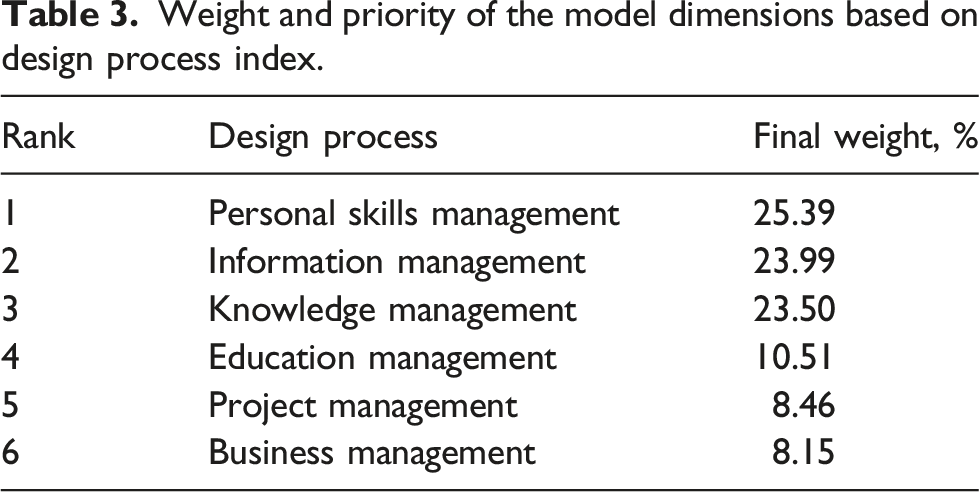
The importance of the components in the design process was allocated as follows: personal skills management, 25.39%; information management, 23.99%; knowledge management, 23.50%; education management, 10.51%; project management, 8.46%; and business management, 8.15%.
Structuring
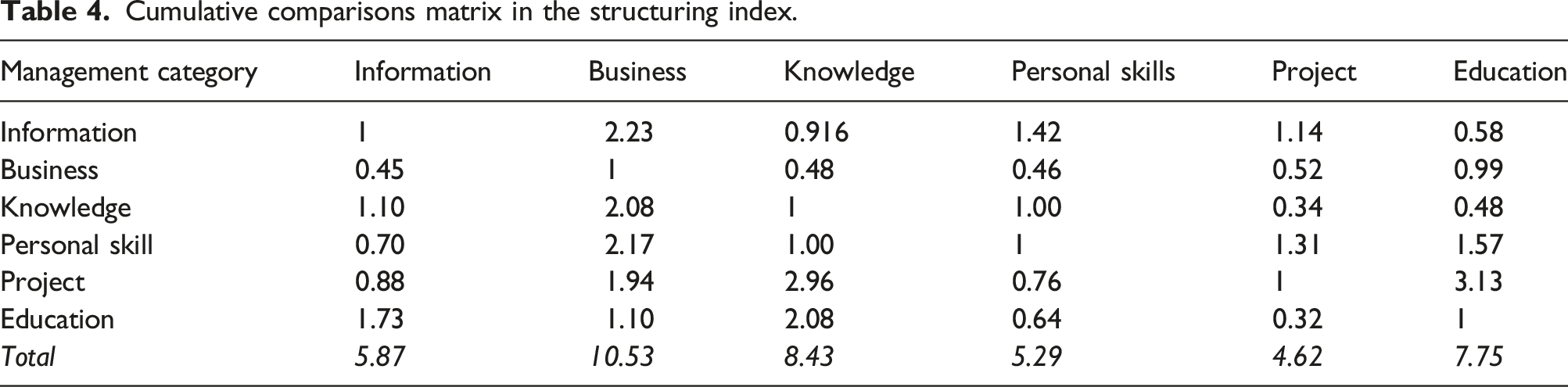
Cumulative comparisons matrix in the structuring index.
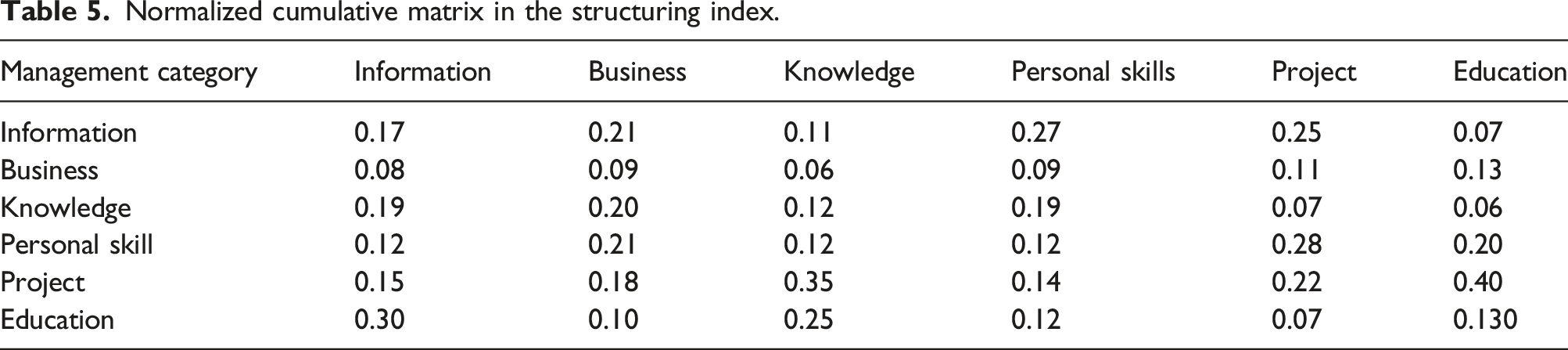
Normalized cumulative matrix in the structuring index.
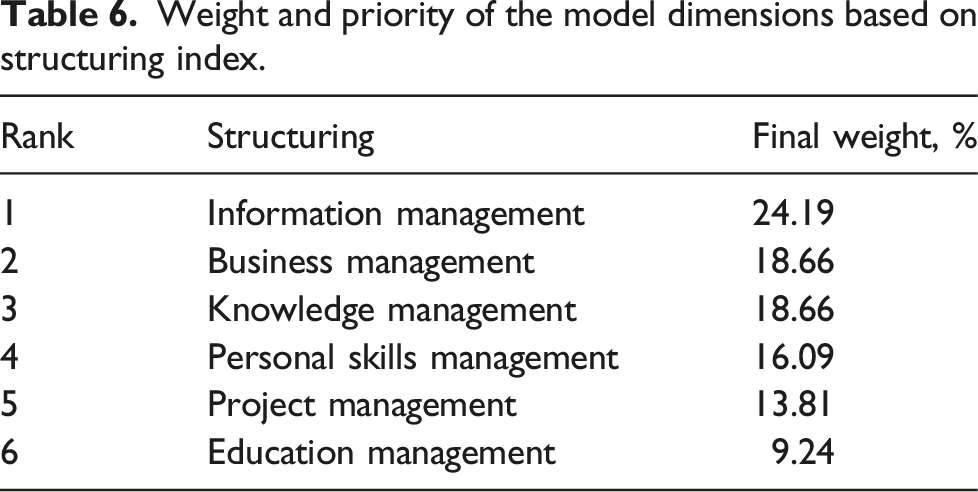
Weight and priority of the model dimensions based on structuring index.
Competitiveness
Cumulative comparisons matrix in the competitiveness index.
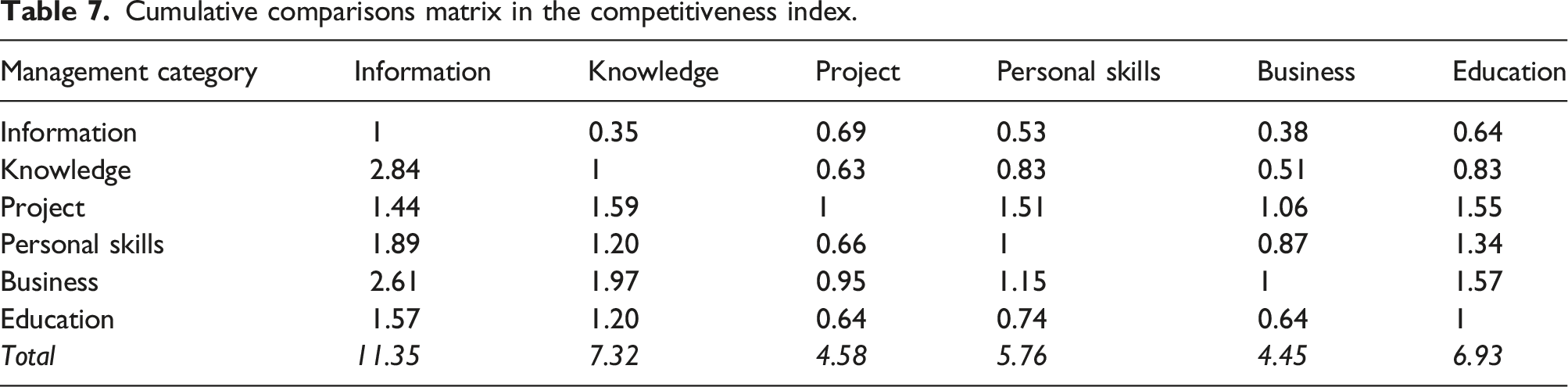
Normalized cumulative matrix in the competitiveness index.
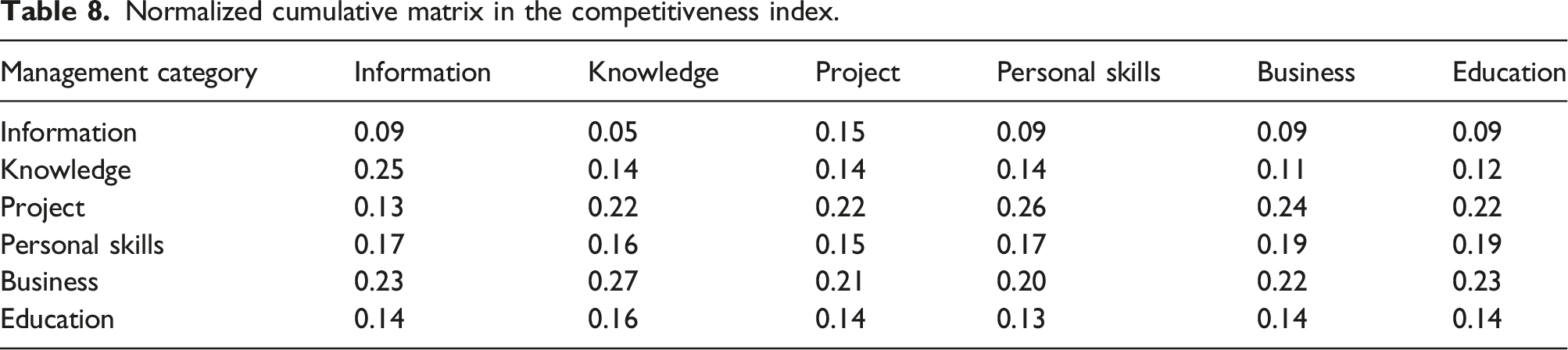
Weight and priority of the model dimensions based on competitiveness index.


Descriptive model of results.
Discussion and conclusions
The aim of the study was to compare the factors influencing architectural design management in the professional and educational fields. Prioritization of components in the three areas of architectural design management was obtained as follows.
Business management emerged as the first, second, and lowest priority in competitiveness, structuring, and design process, respectively, indicating its greater importance in the current competitiveness of professional work compared to its importance in the design process.
Furthermore, it is observed that project management was the first priority for competitiveness, but the fifth priority for structuring and design process, indicating its importance for the professional work environment.
Knowledge management was the third priority in structuring and design process, and was the fourth priority in competitiveness, indicating its moderate importance in both professional and academic environments.
Information management was the first, second, and lowest priority in structuring, design process, and competitiveness, respectively, indicating its importance in the academic environment.
Personal skills management was the first priority in the design process, the third priority in competitiveness, and the fourth priority in structuring, indicating its importance in the academic environment.
Education management was the fourth priority in the design process, the fifth priority in competitiveness, and the lowest priority in structuring.
Overall, based on the opinions of five university professors who were subsequently consulted, the importance of these three areas in the two environments were as follows: in the professional environment––(1) competitiveness, (2) structuring, and (3) design process); and in the academic environment—(1) design process, (2) structuring, and (3) competitiveness.
Thus it can be concluded that personal skills management, information management, knowledge management, and education management have a more prominent role in the academic environment, while business management and project management are more significant in the professional environment. Therefore, in the professional environment, competitiveness is more important, while paying attention to the design process is more important during one’s years of education. Understanding how to structure a question is equally important in both areas.
Regarding education, business management and introducing students to competition in the work environment should be covered, even in introductory courses, as well as allowing for student creativity.
Alharbi et al. (2018) identified four main areas for architectural management: project management, stakeholder management, business management, and education management. Although these have different labels in the present study, the findings of Alharbi et al. are consistent with the present findings. This study advances our understanding of what priority is given to addressing each issue is the educational and professional sectors.
Finnigan et al. (1992) reported that architects needed knowledge management and personal skills management depending on their age and stage in the career process. These included interpersonal, project management, office management, negotiation, human relations, financial planning, and contracting skills. The need for these skills varied according to the type and size of the company, and the age, responsibilities, and training of the employee. Business skills and expertise had to be acquired more quickly and at a higher level via education. Experience alone could be relied on, and there was widespread criticism of the education offered (Finnigan et al., 1992).
In order to help address the problems noted in the education sector, this study documents the critical factors in architectural management so that students can focus on increasing their ability to be successful in the architectural profession.
Symes et al. (1995) found that the increasing complexity in architectural activities and projects increased the need for architects to acquire managerial skills and knowledge. They reported that, based on the Architect’s Activity Scale (AAS), a significant amount of time was spent on managerial activities (90% in large companies, 81.1% in medium-sized companies, and 41.2% in small companies). The training of architects was not preparing students for their profession in terms of managerial skills and competencies. Symes et al. identified a lack of marketing, accounting, real estate, development, and budgeting skills, as well as skills in office management, relationships with customers, project management, building management, and communications.
Using the Gray Dimatel method, Nikseresht et al. (2019–2020) addressed the impact and effectiveness of six factors of architectural management. Their results showed that business management and project management had a more prominent role in the profession, while other factors were more important in education.
The study has some limitations. The first relates to the research tools, including the number of questionnaire items. Although an attempt was made to consider all relevant topics by drawing a goal versus content table, it is possible that some related theoretical and practical contents were omitted. The second limitation relates to the sampling method. A sampling error or bias may have occurred because there is no exact size for sampling in FAHP and the number of experts is limited. Another limitation is the lack of similar research in this area, which did not allow for more comparisons with previous findings.
Suggestions for the future include bringing the necessary management skills required for architects into the curriculum at university level. Future research should examine the generalizability of the findings to other regions of Iran and other countries.
Footnotes
Acknowledgement
This paper is based on a doctoral thesis in architecture by the first author. The Research Ethics Committee of North Tehran Branch, Islamic Azad University approved this study. We thank all the university administrators and teachers for their participation in the study, and the research assistants for helping in the collection of data.
Declaration of conflicting interests
The authors declare that there is no funding for the study, and they have no conflict of interest regarding the publication of this paper.
Funding
The author(s) received no financial support for the research, authorship, and/or publication of this article.
