



Abstract
The unemployability of many Nigerian graduates is somewhat attributable to the existing wide collaboration gap between Nigerian higher education institutions and industry. Against this backdrop, this study explores how Nigerian polytechnics and industry can collaborate to enhance graduates’ employability. Adopting a focus group discussion approach, three focus groups involving 20 people (eight polytechnic lecturers, six National Board for Technical Education officials and six industry executives) participated in the study. Content analysis of the focus group discussions revealed the need to involve industry experts in curriculum development and review to meet today’s job requirements in industry. The need to involve industry experts in teaching certain aspects of the curriculum was also highlighted. The findings further revealed the desirability of exposing students and lecturers to industrial work situations to equip them with workplace skills and experience. Additionally, the study found that a comprehensive collaboration policy framework, funding, commitment, mutual benefits and trust are required to achieve successful polytechnic–industry collaboration. This research demonstrates that effective collaboration between polytechnics and industry will help to improve the employability of graduates. The findings provide policy and practical implications for polytechnics, regulatory bodies, industry and government.
Keywords
Graduate employability has become a global and topical issue among higher education institutions (HEIs), students, employers, policymakers and researchers (Al-shehab and Al-hashimi, 2020; Herbert et al., 2020; Hossain et al., 2019; Joanna, 2014; Okolie et al., 2019). The reason for this increasing interest is that the labour market is highly congested and competitive, and there have been complaints about skills gaps (Bolli et al., 2021; Nghia and Duyen, 2018), with many graduates lacking the required skills for employment (Abbasi et al., 2018; Okolie et al., 2020). As a result many countries, particularly developing countries, have a high rate of graduate unemployment to contend with (Iyortsuun, 2020; Otache et al., 2020). Thus, there is a need to enhance graduates’ employability to increase their chances of securing jobs in the labour market. Interestingly, there is a consensus that collaboration between HEIs and industry will help to enhance graduates’ employability (Thapa, 2018).
The graduate unemployment rate in Nigeria is about 36.26% (Iyortsuun, 2020). To make the situation worse, Nigerian HEIs, which include universities, polytechnics and colleges of education, continue to produce thousands of graduates annually for a labour market that is already overcrowded. Besides, many Nigerian graduates have been found to lack the requisite knowledge and skills to meet modern-day job requirements in industry (Akinbode and Oyalude, 2020; Okolie et al., 2019; Sodipo, 2014). To a certain degree, the unemployability of many Nigerian graduates is attributable to the existing wide collaboration gap between Nigerian HEIs and industry (Nwajiuba et al., 2020). This study is, therefore, conducted to address the employability challenges of Nigerian polytechnic graduates. Specifically, the study explores how Nigerian polytechnics and industry can collaborate to enhance graduate employability. To achieve this objective, the following research questions are posed: ⁃ RQ1. How can Nigerian polytechnics and industry collaborate to enhance graduate employability? ⁃ RQ2. How can effective polytechnic–industry collaboration be achieved in Nigeria?
Several studies (Nwajiuba et al., 2020; Okolie et al., 2019; Pitan, 2016; Sodipo, 2014) have addressed the employability challenges of Nigerian graduates and have proffered various solutions, ranging from redesigning the curriculum to teaching generic skills. One notable feature of these studies is that they focus on how university graduates’ employability can be enhanced. However, there is a paucity of studies specifically addressing the issue of employability with regard to polytechnic graduates; a gap this study fills. It is important to note that Nigerian graduates can be categorized into university graduates, polytechnic graduates and college of education graduates (Onuma, 2016). Although they are all termed graduates, they have their peculiarities. For example, polytechnic graduates and university graduates have different orientations, which may affect their employability. Whereas polytechnic graduates are exposed to largely practice-oriented curricula, university graduates are exposed to largely theory-oriented curricula (Amedorme et al., 2014; Solanke, 2014). Therefore, addressing the employability challenges of these categories of graduates differently may yield more positive results.
The Nigerian polytechnics
Polytechnics are HEIs that ‘provide career-oriented applied education that spans disciplines and trades in an environment where students receive hands-on training that allows them to utilize their skills’ (Otache and Inekwe, 2021, Introduction section, para 3). Nigerian polytechnics were established to produce skilled technical manpower that meets the industrial and technological development needs of the country. The Federal Polytechnics Act 1979 provides the legal backing for the establishment of polytechnics. Nigerian polytechnics offer full-time and part-time courses in engineering, sciences and management that lead to the award of National Diploma and Higher National Diploma certificates (Agholor, 2017). The duration for both National Diploma and Higher National Diploma programmes is 2 years. However, the possession of a National Diploma certificate is a requirement for admission into the Higher National Diploma programme and National Diploma holders must undertake at least 1 year of Industrial Training (IT) before they are admitted into the Higher National Diploma programme.
Currently, there are over 100 polytechnics in Nigeria (Otache, 2019). A recent amendment to the Federal Polytechnics Act in 2019 empowers these institutions to produce both middle-level and high-level technical manpower. Nigerian polytechnics are regulated by the National Board for Technical Education (NBTE). Their mandate and orientation suggest that there should be robust polytechnic–industry collaboration in Nigeria. However, there is no clear collaboration between polytechnics and industry (Otache, 2019).
Graduate employability
There is no universally accepted definition for employability (Kornelakis and London, 2020). Yorke and Knight (2006, p. 3) define it as ‘a set of achievements – skills, understandings and personal attributes – that makes graduates more likely to gain employment and be successful in their chosen occupations, which benefits themselves, the workforce, the community and the economy’. Some scholars have simply defined employability as ‘work readiness’. Rowe and Zegwaard (2017) view it as a set of skills, both generic (e.g. teamwork, communication and organizational) and discipline-specific (e.g. the skills and knowledge relevant to engineering, sciences or law), as well as personal qualities (e.g. self-confidence, discipline and resilience) which are relevant to employment and required by industry. From these various definitions of employability, we may describe it as a set of skills, competencies and attitudes that graduates must possess to secure and sustain employment (Igwe et al., 2020). According to Creasey (2013, p. 16), graduates’ employability consists of ‘a good degree, generic skills, and a set of personal attributes’.
The world of work has become increasingly dynamic and job demands are evolving rapidly. Thus, it is not enough for graduates to have a sound knowledge of their academic disciplines (Okunuga and Ajeyalemi, 2018): the acquisition of hands-on and problem-solving or decision-making skills is equally crucial. Although there is no agreement about the set of skills that makes a graduate employable, the nature and amount of employable skills that graduates are expected to possess vary, depending on the job demands. Kornelakis and London (2020) suggest that employability skills include self-management, teamworking, problem-solving, communication, application of numeracy, application of information technology and business and customer awareness. Generally, graduates should possess certain generic skills which are common and apply to all endeavours or disciplines. Okolie et al. (2019, p. 3) define generic skills as ‘key skills or core competencies that are significantly used in the present conversations in society, working life and education’. Examples of generic skills are problem-solving, communicating, curiosity, adaptability and flexibility, creativity and initiative, patience, teamwork, good time management, lifelong learning, critical thinking, persistence, resilience and courage (Matsouka, 2016; Okolie et al., 2019; Pitan, 2016; Riebe et al., 2013; Stewart, 2020).
HEI–industry collaboration
In the recent past, HEI–industry collaborations have become increasingly crucial as HEIs explore innovative means to meet industry’s needs and enhance graduates’ employability. HEI–industry collaboration can be defined as the interaction between any HEI and industry that is aimed at encouraging knowledge and technology exchange (Ankrah and Al-tabbaa, 2017). It is generally perceived as a means to enhance innovation through knowledge and technology exchange and is beneficial to academia and industry. The HEI benefits in terms of gaining knowledge about practical problems, access to sources of research funding, increased access to proprietary technology from industry, reputation in general and exploitation of faster feedback (Gattringer et al., 2014). Similarly, industry benefits by gaining access to technological knowledge, world-class academics, obtaining answers to specific problems, enhanced R&D productivity, enhancement of reputation, financial support for expensive projects and the acquisition of competitive advantage (Gattringer et al., 2014). HEI–industry collaboration takes different forms, including joint research projects or conferences, student placements, consultancy by lecturers, research contracted to lecturers by industry, industry input into curriculum development and the training of employees in industry (Ishengoma and Vaaland, 2016; Malik et al., 2021). It has been argued that effective HEI–industry collaboration is necessary to deliver high-quality educational outcomes. Besides, studies have demonstrated that collaboration improves performance and value creation (Langrafe et al., 2020).
Government also benefits and plays an important role in the collaboration. The Triple Helix model identifies universities, government and industry as the three key stakeholders involved in any productive collaboration (Etzkowitz, 2015; Etzkowitz and Leydesdorff, 2000). These stakeholders must work closely together to address the social and economic development needs of society. Interestingly, HEIs have emerged as key actors in the knowledge-driven economy: HEI–industry interactions lead to improved economic development (Ishengoma and Vaaland, 2016).
Importantly, the collaboration between HEIs and industry has been perceived as a vehicle for enhancing student employability (Ishengoma and Vaaland, 2016). Industry plays a key role in work placements, which equip students with employability skills (Edwards, 2014). In some countries, particularly in developed countries, industry professionals have input into curriculum development and also participate in teaching certain aspects of the curriculum as guest lecturers (Riebe et al., 2013). They thus bring their practical and real-life experiences to bear in the classroom and this helps to improve student employability.
Stakeholder theory
Freeman (1984) stakeholder theory is popular among studies that explore HEI–industry collaborations (Aliu and Aliu, 2017; Langrafe et al., 2020). Freeman defined a stakeholder as ‘any group or individual who can affect or is affected by the achievement of the organization’s objectives’ (p.46). Stakeholder theory is an organizational management theory that accounts for multiple stakeholders. It is based on certain assumptions: first, that firms comprise a set of interdependent primary stakeholders; second, that the purpose of the firm is not to maximize shareholders’ value but to create value for many stakeholders; and third, that the accomplishment of this purpose depends on the support and cooperation of the stakeholders themselves (Minoja, 2012). Stakeholder theory emphasizes the need for organizations to maintain good business ethics, to apply the principles of fairness and to be socially responsible to society (Nwajiuba et al., 2020). It acknowledges the role of various actors within and outside the organization (Mishra and Mishra, 2013). Importantly, stakeholder theory stresses the need for organizations to consider and integrate the needs of all stakeholders in their operations.
Additionally, stakeholders play an important role in building an organization’s capacity. Thus, stakeholder management is a yardstick or tool for assessing organizational practices, strategies and performance (Nwajiuba et al., 2020). Good stakeholder management is key to organizational success and growth. Organizations, therefore, need to understand their stakeholders and manage them strategically.
Previous studies have applied stakeholder theory (Aliu and Aliu, 2017; Langrafe et al., 2020; Nwajiuba et al., 2020). For example, Nwajiuba et al. (2020) used stakeholder theory to explain the role of government, HEIs and industry in improving higher education quality and graduate employability in Nigeria. Similarly, Mishra and Mishra (2013) applied the theory to explain the role of organizational information system stakeholders in ensuring the effective application of new technologies. Despite its widespread application, stakeholder theory has attracted criticism from scholars. Shortcomings identified include imperfections in the graphical representation of the stakeholder framework, a lack of scientific rigour, a lack of clarity in the definitions of ‘stakeholder’ and ‘stake’ and insufficient environmental assessment (Antonacopoulou and Jerome, 2005; Fassin, 2008; Key, 1999). These criticisms notwithstanding, the author finds stakeholder theory relevant to the present study.
This study concerns how polytechnic graduates’ employability can be enhanced and it acknowledges the role of stakeholders in that respect. Stakeholders in the polytechnic sector in Nigeria include students, lecturers, administrators, governing councils, regulatory bodies, government, local communities and industry. These stakeholders have an important role to play with regard to the delivery by polytechnics of high-quality educational outcomes. For example, polytechnic lecturers are those who impart knowledge to the students. Industry provides work placement opportunities for students and employs graduates. The regulatory body (NBTE) is the commission that is in charge of polytechnic education. The NBTE is responsible for the development of curricula for the courses offered by the polytechnics. In the light of stakeholder theory and the role of stakeholders in the performance of polytechnics, the current study addresses polytechnic graduates’ employability by collating the perceptions of lecturers, industry experts and NBTE officials with regard to areas in which polytechnics and industry can collaborate to enhance graduate employability and how effective polytechnic–industry collaboration can be achieved in Nigeria.
Methodology
Research design
In addition to the review of the related literature on the best collaboration practices between HEIs and industry, this study adopted a qualitative approach. It has been argued that a qualitative approach enables researchers to elicit in-depth information about the phenomenon examined (Nyumba et al., 2018). Specifically, the study adopted a focus group discussion approach for data collection. A focus group discussion is a method of data collection in which a researcher gathers together a group of people to discuss a topic in order to draw on the experiences, perceptions, beliefs and attitudes of the participants through moderated interaction (Nyumba et al., 2018; Onwuegbuzie et al., 2009; Sim and Waterfield, 2019). A focus group discussion was thus adopted to enable the author to obtain different perspectives on the issues addressed in this study (Nyumba et al., 2018; Onwuegbuzie et al., 2009).
Sample and data collection
Participants’ characteristics.
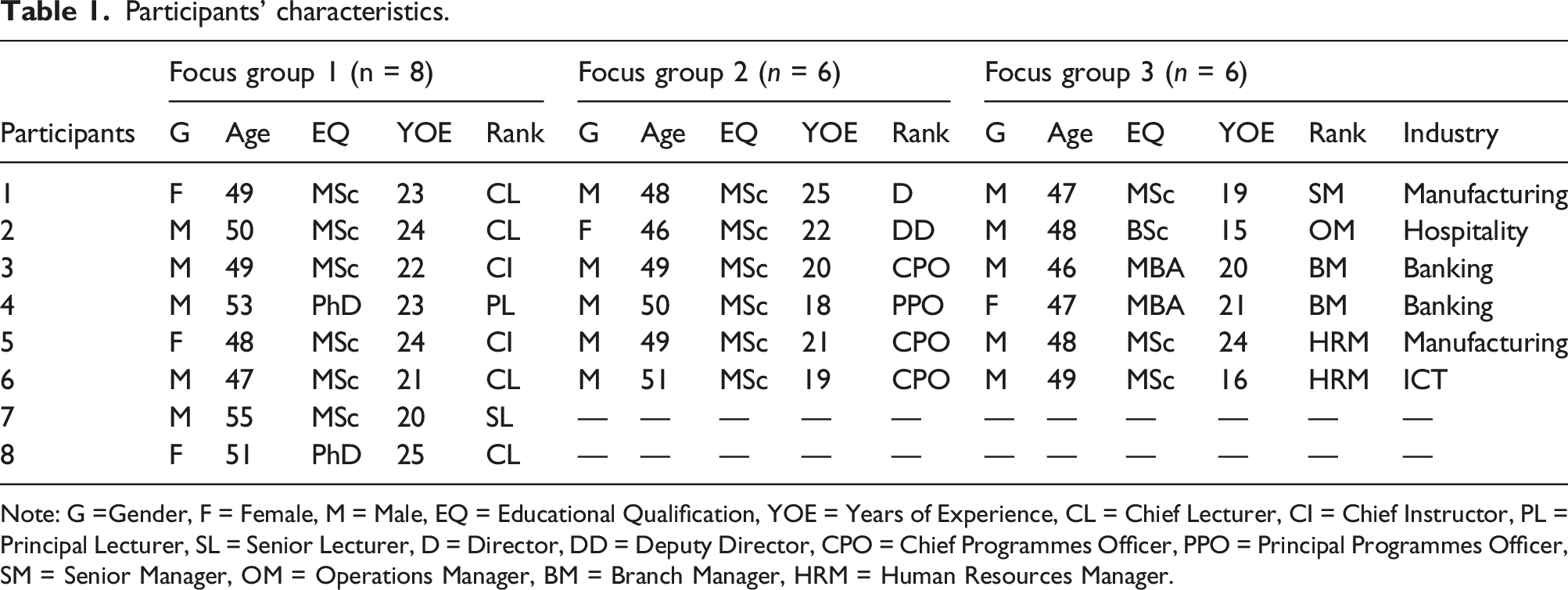
Note: G =Gender, F = Female, M = Male, EQ = Educational Qualification, YOE = Years of Experience, CL = Chief Lecturer, CI = Chief Instructor, PL = Principal Lecturer, SL = Senior Lecturer, D = Director, DD = Deputy Director, CPO = Chief Programmes Officer, PPO = Principal Programmes Officer, SM = Senior Manager, OM = Operations Manager, BM = Branch Manager, HRM = Human Resources Manager.
The participants consented willingly to take part in the study and were assured of the confidentiality of the information provided and that their anonymity would be maintained. To conceal their identity, participants were not allowed to introduce themselves during the discussions. The focus group discussions were conducted in English and were recorded. To enable participants to contribute meaningfully, the author briefed them in advance about the topic, the objective of the study and the research questions. Among the questions asked during the focus group discussions were: • Do you think that collaboration between polytechnics and industry can enhance graduates’ employability? • In what ways do you think polytechnics and industry can collaborate to enhance graduates’ employability? • What do you think makes polytechnic–industry collaboration succeed?
The discussions with groups 1 and 2 took place in February 2021, while the discussion with group 3 took place in May 2021. (The discussion with focus group 3 was delayed because it was difficult to gather together the industry executives.) Each focus group session lasted for about one and half hours and the author moderated the discussion.
Data analysis
As recommended for a focus group discussion, a qualitative content analysis technique was adopted to analyse the data collected (Bengtsson, 2016; Morgan et al., 1998; Nyumba et al., 2018). Content analysis was performed adopting both deductive and inductive approaches (Tavares et al., 2020). The author manually transcribed participants’ statements and then read and reread the transcriptions to become familiarized with the data. Thereafter, the transcriptions were coded based on the codes deductively generated from the literature and the emerging patterns in the data with the aid of NVivo (v10). The author then checked the meaning units (i.e. codes) identified to ensure that they related to the focus of the study. Afterwards, the meaning units identified were condensed, categorized and sorted into themes. In summary, the author followed the four steps outlined by Bengtsson (2016) to analyse the data collected. First, participants’ statements were transcribed and coded (i.e. decontextualisation). Second, the transcribed and coded statements were checked to ascertain that the content was related to the objective of the study (i.e. recontextualisation). Third, categories were created or established based on the meaning units identified (i.e. categorization). Lastly, data were analysed and interpreted and the report written (i.e. analysis and compilation).
Additionally, each focus group discussion was content analysed and the results were matched based on the identified themes. The unit of analysis was the group. Importantly, to ensure the credibility and accuracy of the findings, the author shared them with representatives of each focus group for validation and modification where necessary.
Findings
This study addresses two research questions. The first concerns how Nigerian polytechnics can collaborate with industry to enhance graduate employability. The second concerns how successful polytechnic–industry collaboration can be achieved in Nigeria. The findings are, therefore, reported accordingly. They are supported with direct transcriptions from the focus groups and literature is interwoven with the findings to give the story merit (Nowell et al., 2017).
Enhancing polytechnic graduates’ employability
This section reports findings relating to the areas in which polytechnics and industry can collaborate to enhance graduates’ employability. In all, four themes emerged from the content analysis: involve industry experts in curriculum development/review; involve industry experts in teaching; expose students to the industrial workplace; and expose lecturers to the industrial workplace.
As a preamble, all focus groups observed the existing wide collaboration gap between polytechnics and industry and unanimously expressed the need for effective polytechnic–industry collaboration to enhance graduate employability: ‘[…] the need for polytechnic–industry collaboration in Nigeria is long overdue. Generally speaking, the wide collaboration gap between Nigerian HEIs and industry is partly responsible for why many graduates are unemployable. An effective polytechnic–industry collaboration would help address the issue of unemployability of polytechnic graduates.’ (Focus group1)
Involve industry experts in curriculum development/review: First, all focus groups observed that the current curricula implemented by the polytechnics had become outdated and suggested that they should be revised and updated. Recent articles have also called for the review of the current curricula (Agholor, 2017; Samuel, 2020). The focus group participants noted that high-quality, knowledge-rich curricula would help improve graduate employability: ‘[…] the current curricula for most of the courses offered by the polytechnics have become obsolete. When was the last time they were revised and updated? Sincerely speaking, they no longer meet current industrial and societal needs. Therefore, they need to be completely revised.’ (Focus group1) ‘[…] the present curricula lack adequate generic or employability skills. So, there is a need to embed generic or employability skills in the curricula.’ (Focus group 3)
Importantly, all focus groups expressed the need to involve industry experts in curriculum development and review – their involvement is a common practice in many developed countries (Chryssou, 2020; Thapa, 2018). The participants argued that the input from industry experts would enrich the curriculum: ‘[…] industry experts know the kind of skills that they want prospective employees to possess. Therefore, involving them in curriculum development and review would enhance the curriculum and prepare the students for the world of work.’ (Focus group 2)
Involve industry experts in teaching: The involvement of industry experts in teaching in HEIs is supported by the related literature (Chryssou, 2020; Riebe et al., 2013). However, it is not common practice among Nigerian HEIs. Industry experts bring ‘real-life’ experiences into the classroom and thus help transform students into employable graduates. According to Riebe et al. (2013), the use of industry experts as guest lecturers makes students become active participants in their learning, exposes them to the world of work and enhances their employability. In this regard, the participants suggested that industry experts should be involved in the teaching of certain aspects of the curriculum: ‘[…] professionals from the industry should not only be involved in curriculum development and review but also they should be involved in teaching some parts of the curriculum so that they can bring their practical experience to bear.’ (Focus group 1)
Expose students to the industrial workplace: To enhance graduates’ employability, many scholars have suggested that work-based learning (WBL) should be integrated into the higher education curricula (Ehiyazaryan and Barraclough, 2009). Studies have shown that WBL programmes enable students to gain exposure to the world of work and help them develop employability skills (Khalil, 2015; Nunley et al., 2016; Ramakrishnan et al., 2018). In this regard, all the focus groups emphasized the need to expose students to the industrial workplace. The participants believed that this exposure would enable students to acquire hands-on experience and to blend theory with practice: ‘[…] work placements should be made compulsory for all polytechnic students so that they can experience the practical aspects of what they have learned in school.’ (Focus group 2) ‘[…] the current WBL programmes (referring to Students’ Industrial Work Experience Scheme [SIWES] and Industrial Training [IT]) have not been effective in the recent past. So, they should be made more effective.’ (Focus group 1)
Expose lecturers to the industrial workplace: The need for lecturers to have industry experience is emphasized in the related literature (Chryssou, 2020). Polytechnics are practice-oriented HEIs. Moreover, they have an industrial orientation. Therefore, polytechnic lecturers should be practice-oriented and should have industry experience. In this regard, all the focus groups advocated the need for polytechnic lecturers to be exposed to industrial work situations. The participants argued that exposing lecturers to industrial work situations would give them the opportunity to apply theories and principles that they had acquired over the years. The following excerpt illustrates this perception: ‘[…] polytechnic lecturers should spend their sabbatical leave in the industry. Spending their sabbatical leave in the industry would be more beneficial to the polytechnic system than spending it in other tertiary education institutions. The reason is that it enables the lecturers to have a balanced view of the theoretical and practical world.’ (Focus group 2)
Summary: The participants demonstrated in-depth knowledge and understanding of the issues examined. Their suggestions on how polytechnics can collaborate with industry to enhance graduates’ employability are consistent with those in prior studies. Rowe and Zegwaard (2017) and Pereira and Vilas-boas (2020) recommend curriculum review as a means to enhance graduate employability. Also, Thapa (2018) recommends industry involvement in curriculum design as a means of increasing employability. Additionally, several studies (Pereira and Vilas-boas, 2020; Rowe and Zegwaard, 2017) recommend that graduate employability can be enhanced through work placements such as internships.
Successful polytechnic–industry collaboration
On the issue of how to achieve successful polytechnic–industry collaboration in Nigeria, four themes emerged from the content analysis of the focus group discussions: policy/legal framework; funding; commitment; mutual benefits and trust.
Policy/legal framework: A policy or legal framework is required for successful HEI–industry collaboration (Awasthy et al., 2020; Malik et al., 2021; Sjoo and Hellstrom, 2019). In this regard, all focus groups observed the absence of a clearly stated policy and legal framework detailing how polytechnics should collaborate with industry and then suggested that the government should formulate policies and laws that would stimulate, facilitate and regulate collaborative activities between polytechnics and industry: ‘[…] to promote polytechnic–industry collaboration in the country, the government has a major role to play. The government needs to provide an enabling environment for a robust collaboration between polytechnics and the industry. The government can give tax incentives to companies that collaborate not only with the polytechnics but also with the HEIs generally to promote HEI–industry collaboration in the country.’ (Focus group 3)
‘[…] the government should establish polytechnic–industry collaboration centres that would help stimulate and facilitate collaborative activities between polytechnics and industry in certain parts of the country.’ (Focus group 1)
Funding: Resources, particularly financial resources, play a significant role in any successful collaboration between HEIs and industry (Guimon, 2013; Rybnicek and Königsgruber, 2019; Sjoo and Hellstrom, 2019). Some collaborative projects are capital-intensive. Inadequate funding or unavailability of funds can frustrate such collaborative projects. In this regard, all focus groups suggested that the government should fund collaborative research projects that had a significant impact on the economy: ‘[…] collaboration between polytechnics and industry is good, but it requires funding. The government has the responsibility to budget a significant amount of money for research projects that would be beneficial to the polytechnics, the industries and the economy. The government can also encourage industries to fund research projects.’ (Focus group 2)
Commitment: Successful collaborations require commitment on the part of the parties involved (Rybnicek and Königsgruber, 2019). That commitment may be in the form of time, finances or personnel. Also, the parties must respect collaboration agreements and be committed to the collaboration goals. Top management support is a demonstration of the commitment of the collaborating organizations. In that regard, all focus groups noted that effective polytechnic–industry collaboration required that polytechnics, industry and government must be committed to it: ‘[…] commitment is key in any successful collaboration. All parties must work together to achieve the collaboration goals. Importantly, they must be willing to commit their resources to ensure that the collaboration succeeds.’ (Focus group 3)
Mutual benefits and trust: A successful collaboration benefits the participating partners (Guimon, 2013; Rybnicek and Königsgruber, 2019). Organizations will be willing to collaborate when they see that collaboration will produce benefits. Additionally, collaboration is built on mutual trust (Awasthy et al., 2020; Bond-barnard et al., 2018; Getha-taylor et al., 2018; Kaymaz and Eryiğit, 2011): any collaboration that is not built on trust is bound to fail. In this regard, the participants observed that polytechnic–industry collaboration could be effective only if both polytechnics and industry would benefit from it and if they had trust in each other: ‘[…] collaboration suggests a symbiotic relationship. The parties involved should benefit from the relationship. For example, the polytechnic should benefit from such collaboration in terms of funding research projects by the industry and in terms of gaining access to industrial equipment for research purposes. Similarly, the industry should benefit from such collaboration in terms of gaining access to certain technological knowledge and also benefit from the expertise of the lecturers and students.’ (Focus group 2)
Stressing the importance of trust in collaboration between HEIs and industry, it was observed: ‘[…] trust is important in collaborations. The parties involved in collaborations should be trustworthy. There may be certain information about the collaborating parties or activities that may require utmost confidentiality. The parties involved in such collaborations should be able to keep the secrets without divulging them.’ (Focus group 3)
Conclusions: contributions and implications
Contributions
Against the backdrop of the unemployability of many Nigerian graduates and the apparent wide collaboration gap between Nigerian HEIs and industry, this study explored how Nigerian polytechnics and industry can collaborate to enhance graduates’ employability. From the findings, the study concludes that polytechnic graduates’ employability can be enhanced by: involving industry experts in curriculum development and review, involving industry experts in teaching certain aspects of the curriculum and exposing students and lecturers to the industrial workplace. The study further concludes that a comprehensive collaboration policy/law framework, funding, commitment, mutual benefits and trust are required to achieve effective polytechnic–industry collaboration in Nigeria.
On a general note, the findings provide policy and practical implications for polytechnics, regulatory bodies, industry and governments. The study clearly shows that effective collaboration between polytechnics and industry would help improve graduates’ employability. Thus, there is a need to promote effective polytechnic–industry collaboration. In this regard, relevant stakeholders in the Nigerian polytechnic sector such as the government, the polytechnics themselves, the regulatory body (NBTE) and industry should do what is necessary to ensure that strong polytechnic–industry collaboration is promoted.
Specifically, the findings should help regulatory bodies to ensure that HEIs deliver high-quality educational outcomes, which include the production of employable graduates. Consistent with the extant literature (Rowe and Zegwaard, 2017), the findings suggest that curriculum enrichment improves graduate employability. Thus, it is suggested that NBTE should revise and update the existing curricula. In doing so, emphasis should be placed on the acquisition of employability skills. In addition, industry experts in the relevant fields should be involved in curriculum development and review – this will enrich the curriculum with skills that are needed in the industry and will enhance graduate employability (Chryssou, 2020; Thapa, 2018). Besides, industry experts should be engaged to teach certain aspects of the curriculum so that they can bring their practical knowledge and experiences to bear in the classroom (Riebe et al., 2013).
Additionally, the findings emphasize the importance of exposing students to the industrial workplace. According to Ramakrishnan et al. (2018), this exposure improves employability. In this regard, the existing WBL programmes (i.e. IT and SIWES) should be reformed. The IT and SIWES programmes are meant to equip students with practical knowledge and experience. However, as things stand, their potential benefits have not been fully exploited by students. It has been noted that, while some students do not even enrol in the programmes, others enrol in organizations that do not offer them the opportunity to acquire practical knowledge and skills relevant to their fields (Otache, 2019). Thus, the Industrial Training Fund (ITF) and the polytechnic administrators should ensure that students participate in these programmes.
The findings further highlight the importance of exposing lecturers to industrial work situations. Possession of industry experience enables lecturers to teach students how certain concepts are applied in industry. Therefore, the regulatory body and the polytechnic administrators should make sure that lecturers should have industry experience. To achieve this, lecturers could spend their sabbatical leave in industry, thus gaining practical knowledge and experience which they could impart to students on their return to teaching.
The findings have implications for industry. Industry benefits when HEIs produce employable graduates (Donovan, 2018) and this study confirms that collaboration with industry is necessary if polytechnics are to improve graduate employability. Thus, industry experts should be willing to make a contribution to curriculum development and review. Similarly, they should also be willing to serve as guest lecturers to teach certain aspects of the curriculum. Importantly, firms should be willing to sponsor or fund certain collaborative research projects.
Furthermore, the findings have implications for government. The aim of this study is to help address the problem of unemployability among polytechnic graduates in Nigeria and, by extension, to address the problem of graduate unemployment confronting the Nigerian government. Given that, as the study confirms, effective collaboration between polytechnics and industry will improve graduate employability, the government has an important role to play in promoting such collaboration. Thus, it is suggested that the Nigerian government should provide an appropriate policy and legal framework to stimulate, facilitate and regulate collaborative activities between polytechnics and industry. Furthermore, the government should provide adequate funding for collaborative activities between polytechnics and industry. The government might also consider establishing collaboration centres that would be responsible for the facilitation and coordination of collaborative activities between polytechnics and industry.
Overall, this study contributes to the literature on graduate employability in general and polytechnic graduate employability in particular. The study is the first to address the issue of unemployability of many polytechnic graduates in Nigeria using a qualitative approach. It provides insights into how graduate employability can be enhanced through effective polytechnic–industry collaboration. Importantly, the study addresses the long and continuing wide gap in collaboration between Nigerian polytechnics and industry.
Limitations and implications for future research
Despite the contributions of this study to the literature, policy and practice, some limitations should be mentioned. The findings may not be generalizable considering the limited number of participants (20). Moreover, because of the small sample size, the groups may not be a good representation of the larger population. Thus, future researchers might use a larger sample of participants to gain a better understanding of the issues addressed. Additionally, the study submits that polytechnic graduates’ employability is a function of students’ and lecturers’ exposure to industrial work situations and the involvement of industry experts in curriculum design and teaching. Therefore, future researchers might explore quantitatively the impacts on polytechnic graduates’ employability of students’ and lecturers’ exposure to industrial work situations and the involvement of industry experts in curriculum design and teaching.
Footnotes
Acknowledgements
The author would like to thank the editor and the anonymous reviewers for their valuable comments and suggestions.
Declaration of conflicting interests
The author(s) declared no potential conflicts of interest with respect to the research, authorship, and/or publication of this article.
Funding
The author(s) received no financial support for the research, authorship, and/or publication of this article.
