



Abstract
This study examines the employability of Ghanaian graduates who have completed education and business degree programmes through distance education in a public university. A descriptive research design is used, and the study is cross-sectional in nature. The sample of 643 was drawn from 19,832 graduates who had completed business and education programmes between 2014 and 2018, using the simple random sampling technique. Data were collected through a telephone-administered survey with a structured questionnaire. Data were analysed with descriptive and inferential statistics and are presented in tables and figures. The findings indicate that these distance education graduates are employable and possess many employability attributes. The results further show that there are differences in employability attributes among those graduates who studied business and those who studied education, with the business graduates having a higher mean score. The study highlights the factors that the graduates believed would have enhanced their employability. The author concludes that the university management needs to strengthen its collaboration with industrial stakeholders in the design and implementation of curricula.
Graduate employability has become an important issue for researchers. Many scholars have identified a mismatch between the competencies and skills developed by graduates through their education and the requirements of industry. For instance, Samkin and Stainbank (2016) noted that the curricula of higher education institutions (HEIs) have not succeeded in preparing work-ready graduates to meet the changing skill requirements of employers. Moreover, Nesaratnam and Gayen (2018) observed that, despite the growing calls from stakeholders for HEIs to develop employable skills in graduates, business communities continue to lament the lack of graduates who meet employers’ requirements and expectations.
Issues relating to graduate unemployment have therefore become of great concern to policymakers, HEIs and governments, not least because of high competition, digitalization and global labour market dynamics. Graduates with similar characteristics are competing for jobs while the labour needs of industry continue to decline as a result of the increasing use of automation and artificial intelligence. These trends are having negative impacts on graduate employment throughout the world: for instance, in Malaysia it is reported that graduate unemployment accounts for 23% of the total youth unemployment (Nesaratnam and Karan, 2018).
In Ghana, the unemployment rate is reported to be 6.7% (Ghana Statistical Service, 2019). Biney (2018) noted that unemployed graduates in Ghana were estimated to be over 700,000, according to a report by the National Labour Commission in 2016, and that between 250,000 and 300,000 graduates were produced every year for the labour market. Many of these graduates failed to acquire jobs or create jobs for themselves, making it difficult for them to start a career (Biney, 2018). This raises serious concerns among all stakeholders, including HEIs, graduates, student bodies, parents and government. In spite of the state of graduate unemployment reported in Ghana, scholarship on graduate employability in the country has not advanced, although there have been many studies on the subject in the context of other countries and regions. Moreover, Ghanaian graduates’ experiences and perceptions, especially with respect to those who have completed degree programmes from distance education institutions, remain a relatively unexplored area of research. Given the number of degrees awarded by distance education institutions, both public and private, these graduates have the potential to exert significant influence on the Ghanaian economy.
Study objectives, research questions and hypotheses
In light of the above, this study was undertaken with the following objectives: • to examine the state of employability among graduates who completed degree programmes through distance education; • to determine the type of employability attributes possessed by graduates from distance education; • to ascertain whether there are differences in employability attributes among graduates from distance education in relation to their area of study; and • to investigate factors perceived by graduates from Distance Education to enhance their employability.
The research questions associated with these objectives were: 1. What is the state of employability among graduates who completed degree programmes through distance education? 2. What types of employability attributes are possessed by graduates from distance education? 3. What factors are perceived by graduates from distance education to enhance their employability?
In order to address these questions, the following hypotheses were considered: • Ho: There is no statistically significant difference in the mean values among the employability attributes across the area of study. • H1: There is a statistically significant difference in the mean values among the employability attributes across the area of study.
Overview of distance education in Ghana
The increasing demand for higher education in Ghana and the inability of the conventional university system to admit large numbers due to inadequate physical facilities led to the need for strategic initiatives to provide university education for all who qualified. Accordingly, the Ministry of Education (MOE) in collaboration with the Commonwealth of Learning (COL) and the United Nations Educational, Scientific and Cultural Organisation (UNESCO) undertook a number of surveys to assess distance education needs in Ghanaian universities (Mensah and Owusu-Mensah, 2002). By 1996, four public universities in Ghana had been given a mandate to start distance education programmes. These were the University of Cape Coast, the University of Ghana, Kwame Nkrumah University of Science and Technology, and the University of Education, Winneba.
Distance education was primarily established to provide teachers and other professionals with opportunities for higher education for professional development. Additionally, the distance education programme was intended to train high-calibre personnel for national development, develop the professional competencies of serving teachers and personnel of the Ghana Education Service and of accounting and secretarial personnel in the civil and public services, commerce and industry. This mode of study was also aimed at providing opportunities for applicants who, though qualified for university admission, had not been able to obtain a place.
Since 2008, the University of Cape Coast has been the leading distance education institution in Ghana, and has a student population of around 47,000 according to the Students’ Records and Management Unit (SRMU, 2020). The university’s distance programmes are not solely online. However, it employs the hybrid delivery mode or blended approach, which utilizes both technology and face-to-face meetings with students. It runs degree programmes in business, education, mathematics and science. For business programmes, the university has a 2-year Diploma in Commerce for Accounting and Management options and 4-year Bachelor’s degrees in Accounting, Finance, Management, Human Resource Management, Procurement and Supply Chain Management and Marketing Management. It also runs the following education programmes: 4-year Bachelor of Education (BED) degrees in Accounting, Management, Social Studies, Arts, Early Childhood Education, Primary Education, Junior High School Education, Educational Foundation and Educational Psychology, Mathematics Education and Science Education. During the 2014/2015 academic year, the university commenced postgraduate programmes in both education and business. By 2019/2020, it had introduced additional postgraduate programmes, including Master of Philosophy, Master of Education, Master of Science, Master of Commerce and Master of Business Administration.
The major mode of delivery of distance education in the University of Cape Coast has included face-to-face meetings organised weekly in designated study centres. In addition, there is a students’ learning management platform, which allows lectures to be organised online and enables students to access the platform at their convenience. The main function of the study centres is to serve as avenues for interaction between staff and students and tutoring and counselling, and to provide physical facilities such as classrooms, laboratories and libraries to assist and support students. Officials from the university visit the centres weekly to monitor the face-to-face sessions to ensure the smooth running of teaching and learning. Additionally, students are provided with print media in the form of modules written by faculty members.
Literature review
The concept of employability
Existing literature on the concept of employability has so far been ambiguous and controversial. Govender and Wait (2017) observed that the numerous studies and discussions of different stakeholder viewpoints on employability over the past decades had still not produced a generally agreed description of the subject. Jeswani (2016) describes employability as the qualifications and skills required of graduates to increase their opportunities for employment in the labour market. Shivoro et al. (2018) define employability as the ability of graduates to find employment, retain employment and acquire employment when there is a need. Nesaratnam and Gayen (2018) argue that employable graduates have distinctive attributes and are identified as good communicators, with good interpersonal skills, and effective decision-makers who have the ability to apply and integrate theory and practice. Tang (2019), however, disagrees with the view that employability consists of special attributes and argues that it does not centre solely on graduate attributes but also on the curriculum and instruction in the university system, as well as on the organisations that employ the graduates and their prospects.
Paterson (2017) notes that employability is not a guarantee of securing employment but only enhances the chances of employment. Shivoro et al. (2018) assert that employers look for special attributes in graduates apart from their education. According to these authors, employability is divided into two categories: subject- or discipline-specific skills and transferable skills. They note that subject-specific skills are essential to graduate career progression and professional development, while transferable skills are competencies that can be applied to different job roles throughout one’s career. Kinash et al. (2015) propose that the strategic way to enhance graduate employability is through effective collaboration between stakeholders; HEIs, employers, graduates and alumni. They suggest that, with good leadership and support, including standards, policy guidelines and professional development, HEIs can establish employability activities and requirements in their curricula to improve graduate performance. Yorke (2006) argues that employability is a set of achievements that includes skills, understanding and personal attributes which enhance and ensure a person’s self-sufficiency and economic benefit in his or her selected occupation.
Employability plays a key role in informing labour market policy in both developed and emerging economies (Lindsay et al., 2007; Smith, 2010; Tran, 2015). There is, however, a basic inconsistency between what scholars think good pedagogical practice means for employability and what employers want or need of their graduates. From the job seeker’s perspective, employability implies that alumni of higher education have developed the ability to obtain and/or create jobs. It can be seen as referring to an individual’s relationship with a single job (or class of jobs), so that someone considered as ‘employable’ for one job may not be so considered for a different job. Employers, on the other hand, are typically not satisfied with the skills with which students graduate (Kornelakis and Petrakaki, 2020). From an employer’s perspective, a graduate with appropriate employability attributes may be ‘employable’, but this may be only the minimum criterion. Ultimately, employability is ‘the ability to be employed’. Within this context, the drive for employability is more than a means of offering graduates the opportunity to develop flexible skills. Rather, developing the employability of individuals is viewed as a critical step towards better access to work. Hence, this is a necessary element in employment strategies that seek to address unemployment and social exclusion.
Employability strategies
Most universities in advanced countries have developed employability strategies that assist graduates to be employable (Bennett et al., 2017; Boden and Nedeva, 2010; Tran, 2015). These strategies include industrial training and internships that give students first-hand experience of real work situations and multiple forms of work-integrated learning (Freudenberg et al., 2011); optional or compulsory stand-alone employability units; and employability activities embodied throughout the degree programme. According to Magolda (2009), employability development can be seen as a self-authorship process, with individuals evolving to make informed decisions regarding knowledge, self-principles and relationships with others, through interrelated epistemological, intrapersonal and interpersonal dimensions. Li (2013) and Clarke (2018) stress that, when employability is regarded as the sole means to claim and retain employment in the labour market, it becomes a crucial issue that needs to be negotiated and worked on by the individual. Tomlinson (2007), in agreement, adds that developing employability involves not only developing the profiles and qualifications of individual students, but also specific attitudes and appropriate strategies for entering the labour market. These strategies need to be implemented by individuals, HEIs and stakeholder bodies.
According to the findings of Lindsay et al. (2007), it is imperative for individuals who are unemployed to be encouraged to enter the labour market with a view to gaining some degree of work experience. The UK approach to employability is discussed by Lindsay et al. (2007). The researchers conducted case studies on two employability strategies – the work first approach and the human capital development (HCD) approach – which encourage and foster employability. They argue that HCD approaches are distinguished by the rationale that job-seekers will often require substantial support (potentially over a long period) to improve their long-term employability, with the implication that this will require substantial investments in the education, skills and health of individuals. The aim is not to establish a long-term career goal but to reinforce the belief that any job is a first career step, no matter how precarious the employment might be. In summary, the HCD approach represents a combined short-term and long-term strategy in which individuals acquire skills to foster their employability on the job and in school, respectively.
Moreover, Huang et al. (2014) suggest two strategies that foster employability: locus of control and self-esteem. Their approach indicates that, to develop transferable employability skills, there is a need to nurture problem-solving, collaboration, organizational and professional skills – as identified by employers. Employability means more than acquiring the skills necessary for specific work: it should instead be recognized as a set of achievements and personal attributes that enable individuals to gain, sustain and advance in graduate work and to succeed in their future roles (Bennett et al., 2017; Walkington and Bernacki, 2014). According to Higher Education Research Development, 2016, employability can be developed effectively and over the long term through the implementation of higher education employability strategies. In their view, such strategies might include engaging in extracurricular activities, international exchange, part-time employment and mentoring. Ezit (2014) recommends entrepreneurship training in HEIs as one way to enhance employability among graduates. Kinash et al. (2015) found that entrepreneurship presented a feasible and important career pathway for graduates, allowing them to create their own jobs and to avoid dependency on traditional employment vacancies.
Employability attributes
Aida et al. (2015) defined employability attributes as skills necessary not only to acquire employment but also to advance within the organisation to contribute successfully to its strategic direction and to achieve personal ambitions. Kornelakis and Petrakaki (2020) argue that employability attributes are a set of personal characteristics and capabilities that augment graduates’ likelihood of gaining employment and being successful in their chosen career. They identified key attributes as self-management, teamworking, problem-solving, communication, the application of numeracy, the application of information technology and customer awareness. Shivoro et al. (2018), on the other hand, note that critical thinking skills, leadership skills, management skills, interpersonal skills, system thinking skills and work ethics are the core employability attributes seemingly expected by the employers. Potgieter (2014) suggests that employability attributes explain proactive career management behaviour in changing environments and the career-related attributes and skills individuals employ to enhance their suitability for appropriate and sustainable employment.
In a quantitative study, Coetzee et al. (2016) found that self-management, proactivity and emotional literacy were the attributes employers expected in graduates. Pheko and Molefhe (2017) identified 14 employability attributes including literacy, communication, commitment, team-working and job-specific skills. Another survey of current jobs and skill trends by a recruitment consulting firm revealed that employers emphasized general skills such as communication, interpersonal abilities, adaptability, creativity and collaboration in recruiting graduates (Bhattacharjee and Jaafar, 2018).
In relation to the above, Alshare and Sewailem (2018) specifically explored the existing gap between the competencies provided by business colleges and the needs of the current job market. They found that employers focused on soft skills and work ethics, communication, adaptability and flexibility as competencies which should be possessed by graduates to enhance their employability. In the view of Lundberg et al. (2018), employability can be divided into categories such as personal skills and people skills, professional knowledge and skills, and technological knowledge and skills.
Relatedly, Nirmala and Kumar (2018) found that the following skills were needed to equip job applicants: (i) basic skills (e.g., numeracy skills, reading, comprehensive skills and presentation skills), (ii) higher-order thinking skills (e.g., creative thinking and critical thinking), and (iii) affective skills (e.g., self-motivation). In a systematic review to explore the employability skills perceived as necessary by employers, Subbu and Rajasekaran (2018) also discovered the following to be the most commonly sought-after skills and attributes: oral communication, written communication, non-verbal communication, teamwork and positive attitudes. A similar study in Malaysia by Nesaratnam and Karan (2018) concluded that the key attributes required by employers included communication, leadership, problem-solving and teamwork.
Research methodology
Study design
A descriptive research design was employed for the study. Hair et al. (2002) suggest that, when the research objective is to describe the characteristics of a specific population and to evaluate the status of a particular phenomenon in a defined target population, a descriptive research design is the most appropriate. Mugenda and Mugenda (2003) believe that a descriptive research design helps researchers to gather, summarize, present and interpret information for the purpose of clarification regarding a defined population.
The study was cross-sectional in nature because data were collected at one point in time and inferences about the population were made. A survey strategy was used for data collection. Research suggests that the survey approach allows for a large amount of data to be collected economically from a large population. Saunders et al. (2009) particularly recommend this strategy as allowing researchers to collect quantitative data that are analysed quantitatively using inferential statistics. The method is also comparatively easy to explain and to understand.
Target population
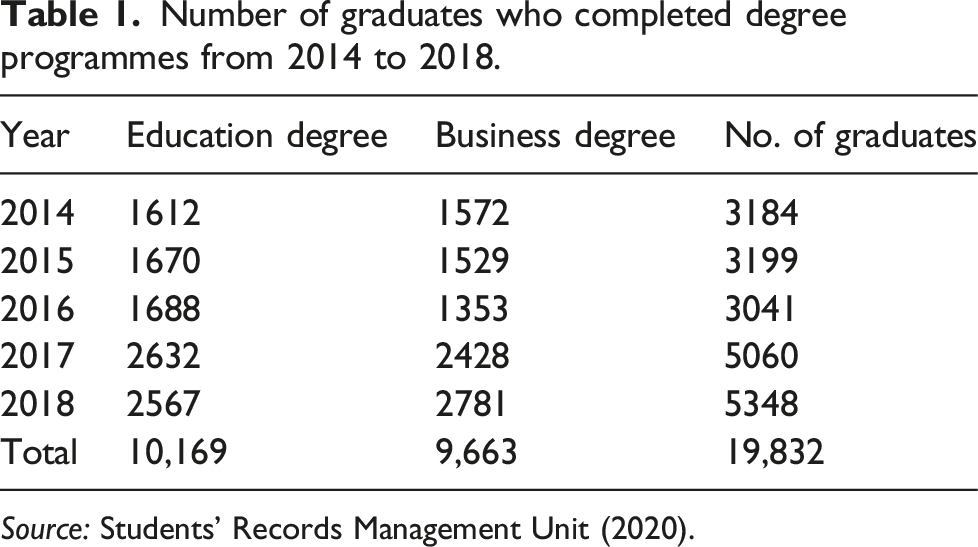
Number of graduates who completed degree programmes from 2014 to 2018.
Sample size and sampling technique
A simple random sampling strategy was utilized to select the sample. This was to ensure that all graduates who had completed their studies within the 5-year period had an equal chance of being selected. The purpose was to avoid sampling error and biases and to guarantee reliable results which could be generalized. Data from the Students’ Records and Management Unit (2020) records 19,832 graduates for the period under study. Using the adjusted formula of Yamane as proposed by Adam (2020), a confidence level of 99% with a population proportion of 50% and margin of error of 5%, the minimum sample required was 618 graduates. This figure was, however, adjusted for a 10% non-response rate and accordingly a sample of 643 graduates was obtained for this study.
Data were collected from this sample through a telephone-administered survey. This method was deemed suitable for gathering data from this number of respondents because, at the time of data collection, the Covid-19 protocols did not allow for face-to-face administration of the questionnaire. Moreover, the telephone numbers of graduates were available and easily retrievable from the student database. Also, this method was most appropriate because of the wide geographical distribution of the graduates, making it difficult to contact them on a face-to-face. A research team was constituted, consisting of the principal investigator and three research assistants (MPhil students who had completed their course work). Initially, the researchers called the graduates on their mobile phones to discuss the purpose of the study and the nature of the questionnaire, and to agree an appropriate time when they would be available to respond to the questionnaire.
A total of 482 graduates responded to the instrument, yielding a 75% response rate. Data collection spanned a period of 6 weeks. On average, each researcher was able to conduct five interviews daily. Participants who could not answer the calls were later called back to answer the questionnaire. To ensure correct and compete responses, the telephone interviews were recorded and replayed at a subsequent time. Data were tidied, edited and coded for easy analysis. The data were analysed with descriptive statistics such as means and standard deviations, and inferential statistics such as the t-test. The SPSS version 26 software facilitated the analysis.
Instrumentation
The survey instrument was a structured questionnaire which was designed to solicit information on respondents’ demographic characteristics (gender, age, programme of study and year of completion) and items that represented employability skills that were perceived as necessary by industry employers in Ghana. The instrument used was adapted from Jeswani (2016). It contained constructs such as Knowledge, Self-Management Skills, Time Management Skills, Communication Skills, Critical Thinking, Learning Skills, Teamwork, Managerial Skills, Leadership Skills and Autonomy. Items were measured on a five-point Likert scale, ranging from one (strongly disagree) to five (strongly agree). The reliability estimate of the instrument was ascertained using Cronbach’s alpha reliability co-efficient, with a score of 0.71. Additionally, the survey employed open-ended questions to solicit information on the factors perceived by graduates to enhance their employability.
Ethical issues
Great importance was attached to quality assurance in the execution of this study from start to finish. The protocol for the study was subjected to critical review by an Institutional Review Board of the university. Issues relating to the ethical conduct of research such as informed consent, confidentiality, privacy and anonymity were upheld. Participants were given full information on the purpose and objectives of the study which helped them to make informed decisions to partake or not. All information regarding respondents’ identity and personality was treated with utmost confidentiality and was used for the sole purpose of the study.
Results and discussion
The first study objective was to examine the state of employability among graduates of distance education. The finding is presented in Figure 1. The results indicate that 30.2% of respondents had gained promotion after obtaining their certificates, 22.9% had maintained their old jobs and 19.8% had acquired advanced skills for their current job after completion of the degree programme. Moreover, 18.2% had obtained a new job while 8.8% had started a business or created their own job after the completion of the degree programme. According to Tendongmoah (2019), graduates are employable when they are able to create, acquire or maintain a job and to be effective at work. Based on the results shown in Figure 1, it is confirmed that graduates from distance education are employable after their training. It is worth noting, however, that only 8.8% of respondents had created their own job or started their own business. This suggests that graduates depend on existing jobs in the labour market, which then becomes very competitive as large numbers of graduates are produced annually (Biney, 2015). State of employability of graduates. Source: Field survey, 2020.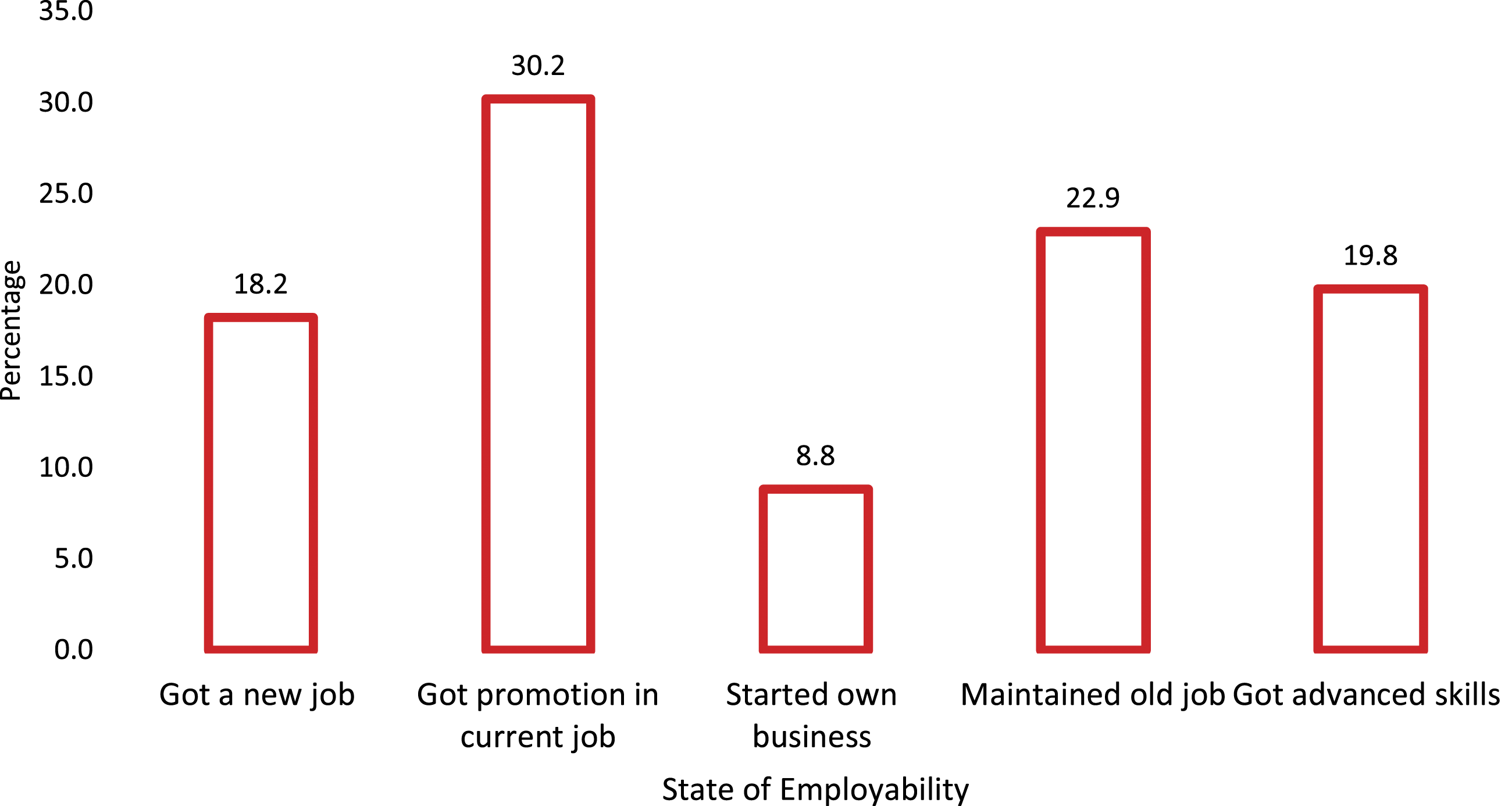
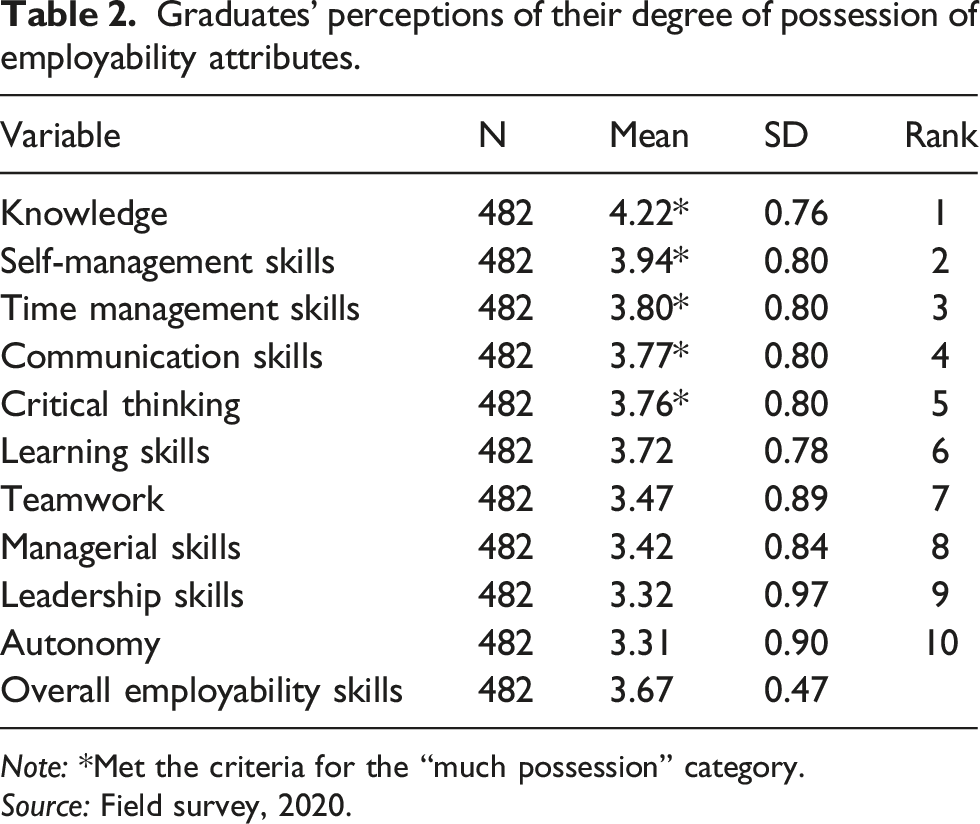
Graduates’ perceptions of their degree of possession of employability attributes.
Note: *Met the criteria for the “much possession” category.
Source: Field survey, 2020.
Furthermore, the results indicate the following ranking of attributes: (1) knowledge (mean = 4.22); (2) self-management skills (3.94); (3) time management skills (3.80); (4) communication skills (3.77); (5) critical thinking (3.76); (6) learning skills (3.72); (7) teamwork (3.47); (8) managerial skills (3.42); (9) leadership skills (3.32); (10) autonomy (3.31).
The results indicate that distance education is meeting its core mandate of providing knowledge for learners that will equip them to navigate through the turbulent socio-economic environment (Tendongmoah, 2019). Distance education students are not on physical campuses, so they need self-management skills to help them steer through the learning process. Thus, it is not surprising their possession of this attribute was ranked second in the above list. Time management skills are also essential for adult learners as they struggle with family commitments as well as job roles in addition to their studies. Possession of this attribute is important for carrying out these various roles successfully. The findings of Pheko and Molefhe (2017), Bhattacharjee and Jaafar (2018), Alshare and Sewailem (2018), and Nesaratnam and Gayen (2018) show that communication skills are critical for obtaining employment and being effective at work. Thus, with regard to the first objective of this study, the results indicate that distance graduates are in fact employable.
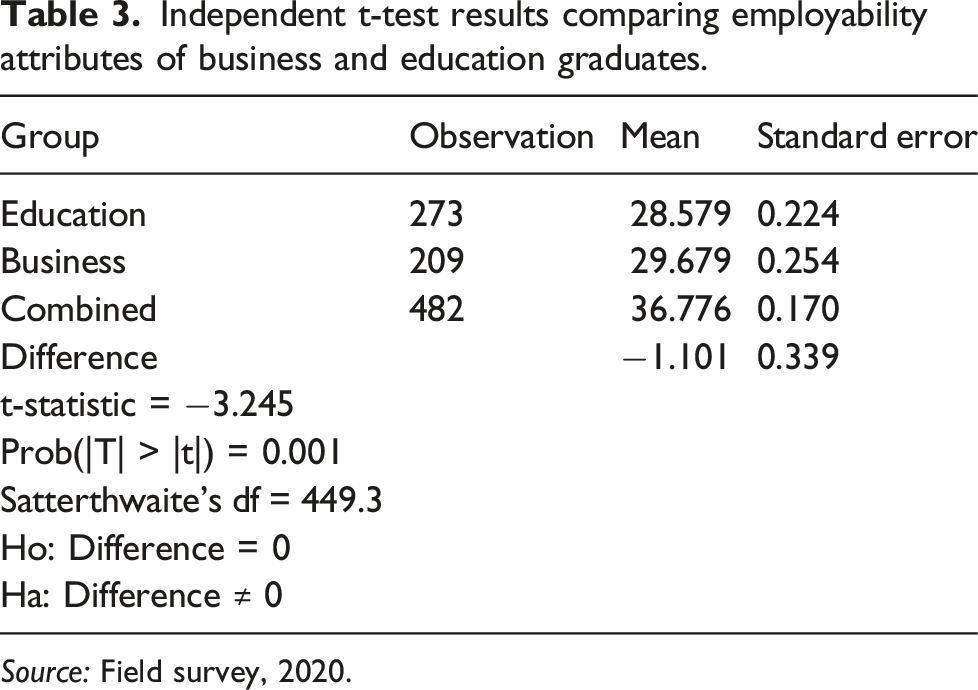
Independent t-test results comparing employability attributes of business and education graduates.
Source: Field survey, 2020.
In order to enhance the employability of distance education graduates, the researcher sought to ascertain graduates’ perceptions regarding factors that could help to boost their employability. As shown in Figure 2, 23% of the respondents thought that the incorporation of practical aspects like industrial attachments into the curriculum would help enhance employability. This finding is in agreement with Bennett et al. (2017) who found that initial training in the form of industrial attachment provided undergraduates with a first experience of real work situations. Some of the respondents indicated that the introduction of internships and in-service training (20%), workshops and seminars (19%), computer skills (15%) and entrepreneurship skills (5%) could also help to increase employability. Furthermore, respondents suggested that the managers of distance education should involve industry in curriculum design (11%) and establish a careers guidance service (4%). These findings are in line with the arguments of Samkin and Stainbank (2016) and Nesaratnam and Gayen (2018), who advocate for stakeholder participation in the design of more integrative lifelong learning opportunities in HEIs’ curricula. Other factors in improving employability, such as professional courses and the creation of career centres, were also suggested by a small percentage of respondents (see Figure 2). Graduates’ perceptions of factors that would enhance their employability skills. Source: Field survey, 2020.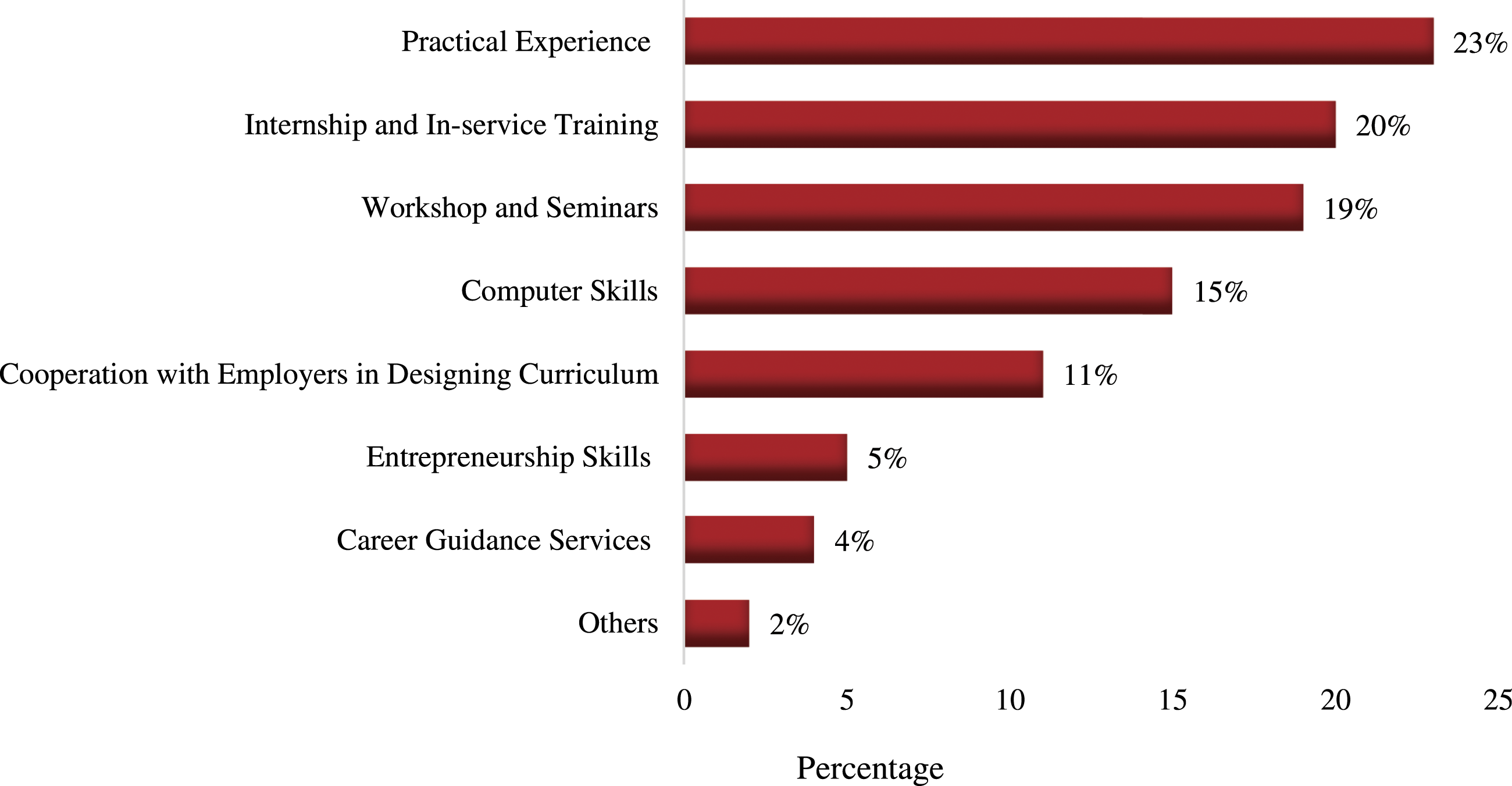
Conclusion
This paper examines the employability of graduates who completed their studies through distance education, presenting evidence concerning their employability after their training. The study found that a number of the graduates had employability attributes, but that most of these graduates depended on securing an existing job in the labour market rather than creating their own. This suggest a need for more initiatives to provide entrepreneurship training and the embedding of entrepreneurship education in curricula.
The study showed that the attributes possessed by the graduates were in conformity with findings in the literature on employability. It also, however, found differences in the employability skills of those graduates who had studied business-related programmes and their counterparts from education-related degree programmes. The respondents thought that their employability would have been enhanced through the inclusion in the curriculum of industrial attachments, internships and in-service training, and workshops and seminars on the requirements of and opportunities in the labour market. The implication is that the university needs to strengthen its collaboration with stakeholders in the development and implementation of its curricula to embed such activities in degree programmes and so to enable graduates to create their own jobs or to compete effectively in the labour market.
Footnotes
Declaration of conflicting interests
The author(s) declared no potential conflicts of interest with respect to the research, authorship, and/or publication of this article.
Funding
The author(s) disclosed receipt of the following financial support for the research, authorship, and/or publication of this article: This work was supported by the University of Cape Coast (RSG/INDI/CoDE/2020/101).
