



Abstract
The authors examine the perceptions of undergraduate students with business majors to determine the leadership competencies they most value. Prior research examined business major rankings in a smaller private school. This research examined the generalizability of those findings by surveying 667 students from a regional public college in the Southeast of the USA. The study also examined student empathy and age, as a representation of life experience, as indicators of preferred leadership trait rankings. Students ranked 10 leadership competencies and both student empathy and age were examined in relation to those 10 competencies through ordinal regression. The results indicate that both empathy and age influence leadership competency preference. The specifics of those findings as well as the theoretical and practical implications are discussed, as are potential directions for future research.
Do students have different mental models of leadership? Do they value certain competencies based on their own personal characteristics? This study examines student rankings of 10 leadership competencies in general and then delves more deeply into differences in ranking among the students. The study seeks to understand perceptual differences among students based on age and empathy in relation to evaluations of leadership competencies.
Empathy is the ability to take the perspective of the other person (Baker, 2017). It is both cognitive and affective (Hoffman, 2000). Empathy is perspective-taking, and the “tendency to spontaneously adopt the psychological point of view of others” (Davis, 1983: 114). Empathy is an important skill in business. Baker (2017) notes that “both cognitive and affective measures of empathy are linked to prosocial attitudes and behavior, such as sharing, helping, comforting, and caring” (p. 580). Higgins and Kram (2001: 267) state that empathy is likely to encourage the formation of developmental relationships, such as “mentoring, help received from peers, subordinates, and superiors”.
Literature review
Empathy within leadership
Throughout the 20th century, leadership research often focused on theories that emphasized certain traits which were identified with ideal leadership prototypes. These leader traits described characteristics that distinguished effective leaders from non-leaders (Zaccaro, 2007). A natural implication of the leader trait approach is that leaders are to a substantial extent born, not made (House and Aditya, 1997). A more contemporary view of leadership traits has recognized that the context and content of traits have shifted to a focus on what might generally be categorized as softer skills and attributes. “Hard skills, such as intelligence, analytical/technical prowess, determination, rigor, and vision—the defining leadership traits of the 20th century—were maneuvered to the backseat in order to make way for softer skills, which Goleman (2000) identifies as self-awareness, self-regulation, motivation, and empathy” (Holt et al., 2017: 3–4).
Empathy has received an increasing level of interest from academics and practitioners as emerging research recognizes its importance in leadership (Holt, 2022). Researchers argue that leaders should understand which emotional intelligence competencies they are lacking and increase the presence of those competencies in leadership styles applied to unique situational factors (Goleman, 2000). As an essential aspect of 21st century leadership, empathy can no longer be ignored if we wish to prevent the continuation of ethical disasters in the world we live in (Holt, 2022).
Past research has demonstrated a wide array of definitional issues pertaining to whether empathy is a cognitive mechanism or an affective construct (Konrath et al., 2011). Cognitive empathy pertains to logical rationale while affective empathy is related to emotional rationale (Hogan, 1969). The emotional component of empathy has been defined as the ability to experience the emotions of others as one’s own (Beadle et al., 2012). Pavlovich and Krahnke (2012) argue that empathy enhances connectedness through the unconscious sharing of neuro-pathways between oneself and others, which facilitates the ability to find common ground. Empathy can be viewed as having compassion for and being attuned to the emotions of others (Holt, 2022). Goleman (2000) asserts that emotional empathy – sensing how people are feeling in the moment – allows leaders to build rapport with individual employees by responding in ways that are highly congruent with their emotions. This relationship has been described as “leader empathy”, a connection that occurs when leaders become good listeners who understand the needs of their followers and thereby build trust (Bass, 1960). Research has found a significant positive relationship between the active empathetic listening skills of supervisors and their employees’ work engagement (Jonsdottir and Kristinsson, 2020).
Leaders who are thoughtful in their interaction behaviors with followers are able to use emotional support as a means of enhancing performance (Kingsley Westerman et al., 2018). Building on existing leadership theories, empathetic leadership has been posited as a way for managers to create emotional support for employees by validating their work experiences, showing concern for emotional expressions and affirming workplace security (Kock et al., 2019). Wibow and Paramita (2022) confirmed a positive relationship between empathetic leadership and resilience. Furthermore, their study demonstrated that empathetic leaders increased employees’ ability to cope with stress, adapt to change and bounce back after illness or hardship, and gave them the confidence to achieve their goals. Research has found that empathetic leaders have statistically positive effects on followers’ job satisfaction, innovation and performance (Kock et al., 2019).
In the business environment, leadership styles have emerged that underscore the importance of building leader–follower relations. Among these, servant leadership is unique in that its focus is directed first on followers to succeed and second on success of the mission (Gandolfi et al., 2017). Compared to other leadership styles, servant leadership concentrates more on serving subordinates first (Marinan and Brown, 2019). Among the characteristics present in Greenleaf’s (1970) description of servant leadership, Spears (2004) identified the presence of empathy, with a focus on the needs of employees. Positive outcomes can be seen in the linkage between servant leadership and followers’ emotional well-being (Abu Bakar and McCann, 2018). Servant leaders tend to be admired and respected by followers, who thereby become motivated to emulate the leader’s behaviors (Liden et al., 2014). Servant leadership builds trust with employees by conveying compassion, which sends important information about the leader’s empathy, acceptance and benevolence (Lu et al., 2019).
Empathy among college students
Researchers have emphasized the important role that empathy has in relation to higher education, and studies have noted a decline in empathy levels among college students across disciplines and fields of study (Konrath et al., 2011; Neumann et al., 2011; Rockwell et al., 2019). A meta-analysis conducted by Konrath et al. (2011) of research on college students also found that sociocultural changes might be a contributor to this phenomenon. These researchers speculated that one contributor to declining empathy is the rising prominence of personal technology and media use in everyday life.
Changes in the sociocultural environment can have significant influences on individuals, dependent on which birth cohort they are a member of (Stewart and Healy, 1989; Twenge, 2000). During the early 2000s, a certain level of cynicism with regard to empathy began to set in, especially among younger individuals (Holt, 2022). An overemphasis on tough or hard skills and a restraint of soft skills led to a lack of inter-human sensitivity (Marques, 2013). Millennials and Generation Z tend to view leadership from a different perspective than the generational cohorts that came before them in that they may not automatically respect someone older and respect only those who show appreciation for them (Holt, 2022). It has been suggested that consideration should be given to the diversity of the generational cohorts working within organizations (Holt et al., 2012). For example, leadership styles deployed in previous generations do not motivate Millennials in the same way and it is argued that leaders should expend energy to understand the unique circumstances and characteristics of these workers (Holt et al., 2012). Marques (2013) argues that an overemphasis on hard skills has resulted in disastrous effects in corporate environments, making it essential for business educators to seriously consider the greater adoption of soft skills into their course content.
Among undergraduate students, researchers have found rule-consciousness to be the strongest predictor of positive attitudes towards older adults, along with the associated traits of warmth, emotional stability and low tension (Mansfield-Green et al., 2015). In a study of undergraduate design students, empathy was considered as the students designed an experience for older users (Woodcock et al., 2008). Student motivation to participate in the study, however, was very low, even though the project relevance and advantages of empathetic awareness to employability were highlighted. Despite this low participation, the results indicated that students were surprised at experiencing the needs of other people not typically considered in design activities. In a study of 463 undergraduate students in Turkey, researchers found meaningful differences in empathy levels among age groups (Belli et al., 2015): their results indicated that students aged 27 and older had higher empathy levels than the 18–20 age group. The researchers suggested that this difference might be due to older students having more experience with changing environments and difficulties in life compared to younger students. Hatcher et al. (1994) identified that empathy training might be most effective during college years as it is during this time that abstract thought, augmented moral development and the ability for introspection will appear. There may therefore be unique opportunities for instructors to incorporate empathy training into their classrooms as these findings suggest that empathy can be learned or developed.
Prior examination of leadership competencies
Student perspectives of preferred leadership traits in previous research have yielded interesting results. Researchers who taught a class entitled “Leadership Theory and Practice” conducted a study of undergraduate students over the course of 3 years at a small private university in the Los Angeles area (Holt and Marques, 2012). A total of 87 students participated in the study and represented wide-ranging diversity in age, life/work experience, ethnicity and culture. The study simply asked students to rank 10 leadership qualities in order of importance and, of all the traits selected, empathy was ranked lowest (Holt and Marques, 2012). Subsequently, the researchers utilized this data and conducted a second study by sharing these results in a separate group of 35 MBA students who were all enrolled in non-traditional courses and were predominantly working adults. After being given the information and findings of the previous study, these students were asked to speculate why empathy had been ranked the lowest. Qualitative data were gathered and topical themes developed. Holt and Marques (2012) identified eight topics from the completed surveys. Some of these topics included: ‘empathy may be perceived as a sign of weakness’, ‘misunderstanding the meaning of empathy for pity’ and ‘empathy being fleeting/situational as opposed to other stable leadership traits’. From the eight topics, two major themes were developed (i.e., respondents believe that empathy is inappropriate in business settings and respondents have a lack of familiarity with empathy). Holt and Marques (2012) recommended that business educators should include empathy as a soft skill to be taught in the classroom. In addition, the researchers suggested that studies should be conducted in other business schools to determine whether perceptional changes occur. A similar study of 191 undergraduate business students demonstrated the same results, with empathy being ranked lowest among preferred leadership traits (Holt et al., 2017). In both of these studies, the researchers suggested that future studies should be replicated through demographically different populations and should consider other relationships between empathy and other factors. We extend the research in these prior studies (i.e. Holt and Marques 2012; Holt et al., 2012) by examining these factors in population samples of business students in other institutions. The traits selected for our research are replicated based on the findings of previous studies.
As a result, we examine the following three hypotheses: • Hypothesis 1: Students will rank the 10 leadership traits in the same way as in the previous (Holt and Marques, 2012; Holt et al., 2017) studies. • Hypothesis 2: Student empathy will statistically significantly impact the ranking of preferred leadership traits. • Hypothesis 3: Student age will statistically significantly impact the ranking of preferred leadership traits.
Methodology
Data
The data used in this analysis come from a survey distributed to undergraduate business students at a demographically diverse regional college located in the Southeast area of the USA. These students were enrolled in a ‘Principles of Management’ course and completed the survey online. Data were collected over a 2-year period, from 2019 to 2021.
Participants
Recruitment
The students were participants in the School of Business research pool. Emails were sent to them providing them with the opportunity to participate in the study. Students could choose from multiple studies in the research pool which one they wished to participate in. No incentives were offered for participation. Participation in the subject pool was an expectation of all sections of the Principles of Management course.
Responses
Initial data collection produced 729 survey attempts in which a student clicked “yes” to begin responding. Some surveys were incomplete (ranging from never beginning after clicking “yes” to insufficient responses for items concerning leadership qualities, empathy and age). Ultimately, 667 were almost or fully complete and sufficient for use in the analysis.
Participant demographics
Of the participants who responded to the question concerning race, there were 143 (21.70%) Black/African Americans; 225 (34.14%) Whites; 159 (24.13%) Hispanics/Latinos; 84 (12.75%) Asians; 1 (0.15%) Pacific Islanders; 6 (0.91%) Native Americans; 34 (5.16%) Multi-Ethnic; and 7 (1.06%) unknown. 660 participants answered the item for gender, indicating there were 348 (52.73%) females and 312 (47.27%) males. There were 660 responses for enrollment status, with 102 (15.45%) being part-time and 558 (84.55%) full-time. 660 participants reported their country of origin, of which 548 were US natives and 112 were originally from outside the USA. Among the 660 participants who responded to the question, 426 (64.55%) were non-managerial employees, 76 (11.52%) were managers and 158 (23.94%) were not employed. Finally, of the 660 participants who responded, there were 4 (0.61%) Freshmen, 104 (15.76%) Sophomores, 413 (62.58%) Juniors, 134 (20.30%) Seniors, and 5 (0.76%) Transients.
Measures
The following measures were used in this study. In addition to the three primary measures, additional demographic data were collected.
Leadership qualities
The survey included a ranking scale of 10 qualities modeled after previous studies assessing preferred leadership traits (i.e., Holt and Marques, 2012; Holt et al., 2017). The leadership qualities included intelligence, charisma, responsibility/commitment, vision, authenticity/integrity, drive/passion, courage, empathy, competence/experience and service as available options.
Student empathy
The instrument used to measure empathy is the Basic Empathy Scale (Jolliffe and Farrington, 2006), which was developed based on the definition of empathy as the sharing and understanding of another’s emotional state (affective) and understanding another’s emotions (cognitive) (Cohen and Strayer, 1996). The instrument includes items such as “I find it hard to know when my friends are frightened”; “Seeing a person who has been angered has no effect on my feelings”; and “I can usually work out when people are cheerful”. The Cronbach’s alpha for this study was 0.82.
Age
Students were asked “What is your age group?” Response options consisted of four choices: 18–22, 23–34, 35–44 and 45 and over.
Race
Students were asked “What is your race?” (1 Black/African American; 2 White; 3 Hispanic/Latino; 4 Asian; 5 Pacific Islander; 6 Native American; 7 Multi-Ethnic; 8 Unknown.); Gender. The item was “What is your gender?”
Year of college
It was expected that most of the students would be in their sophomore year because the course is usually taken in the second year by business majors, but some students were not business majors but were taking the course as an elective and some business students took it earlier or later in the program. In addition, there were some taking the class who were only transient students and were not planning to stay at the college. The item was “What is your year in school?” (1 Freshman; 2 Sophomore; 3 Junior; 4 Senior; and 5 Transient).
Enrollment statusvv
This item was “What is your enrollment status? (1 Full-time; 2 Part-time).
Country of origin
Students were asked if they were from the USA or another country. Specifically, “What is your country of origin?” (1 United States of America; 2 Non-US country).
Job role
Students were asked about their employment role. The item is “Select your job role type” (1 Employee; 2 Manager).
Analysis
This study involved data that were ranked as well as Likert-type data. For Hypothesis 1, the means were calculated and compared. For Hypotheses 2 and 3, two-way ANOVA was used for the analysis. SPSS was utilized with the resulting ranking of leadership qualities ranged from 1 to 10, with SPSS treating each one within each leadership trait as a separate category within the variable.
Results
Ranking of leadership qualities.
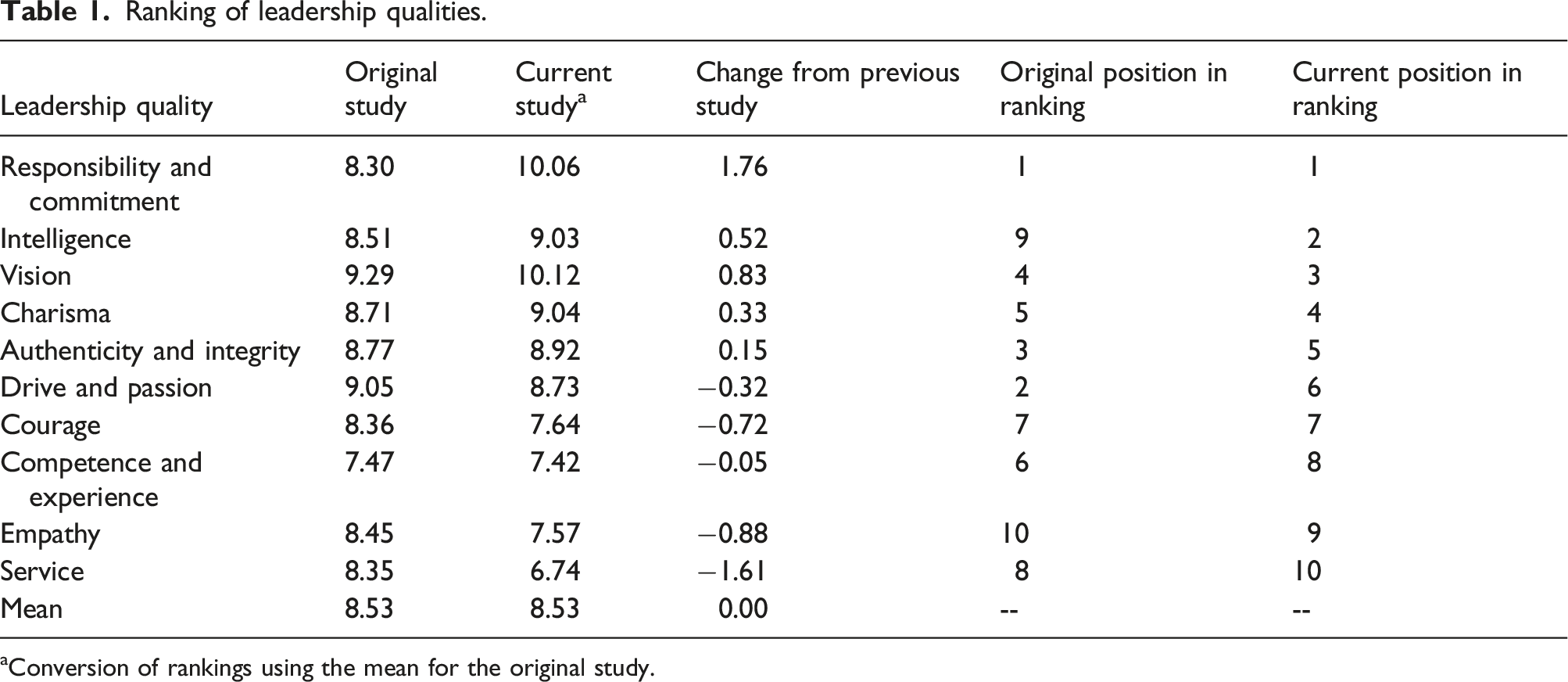
aConversion of rankings using the mean for the original study.
Quartile statistics.
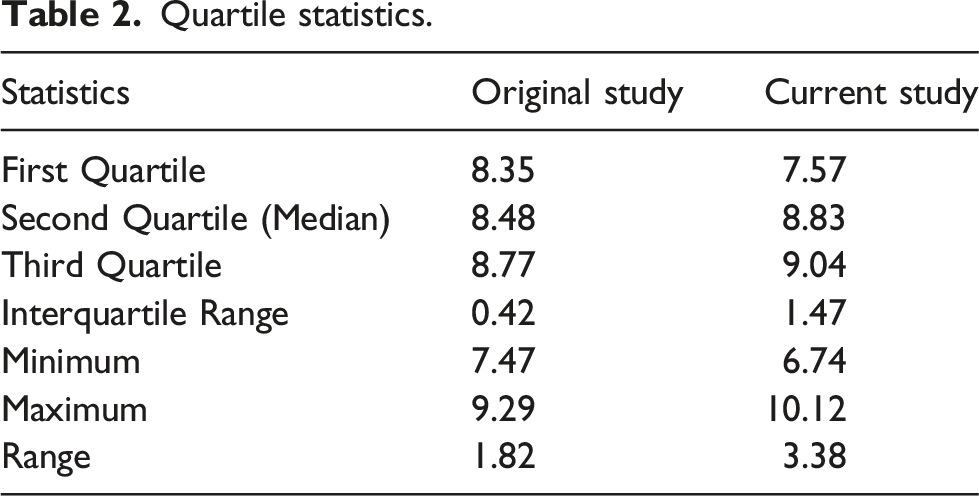
For Hypotheses 2 and 3, a nonparametric method was utilized. The ranked data are nonparametric and did not meet the assumptions of normality based on Wilks' Lambda (λ = 0.938, F (27,1890) = 1.55, p = 0.04). A log10 transformation was used to transform the leadership quality data. Additionally, using Levene’s test, the transformed leadership qualities of responsibility and commitment (F (3,656) = 4.41, p = 0.00), vision (F (3,656) = 2.93, p = 0.03), and empathy (F (3,656) = 1.18, p = 0.04) did not meet the assumption of homogeneity. The other seven qualities are non-significant, indicating homogeneity. The two-way ANOVA is robust to violations of homogeneity and normality; thus, it was used for the analysis and is shown in Figure 1. Leadership quality rankings for original and current studies.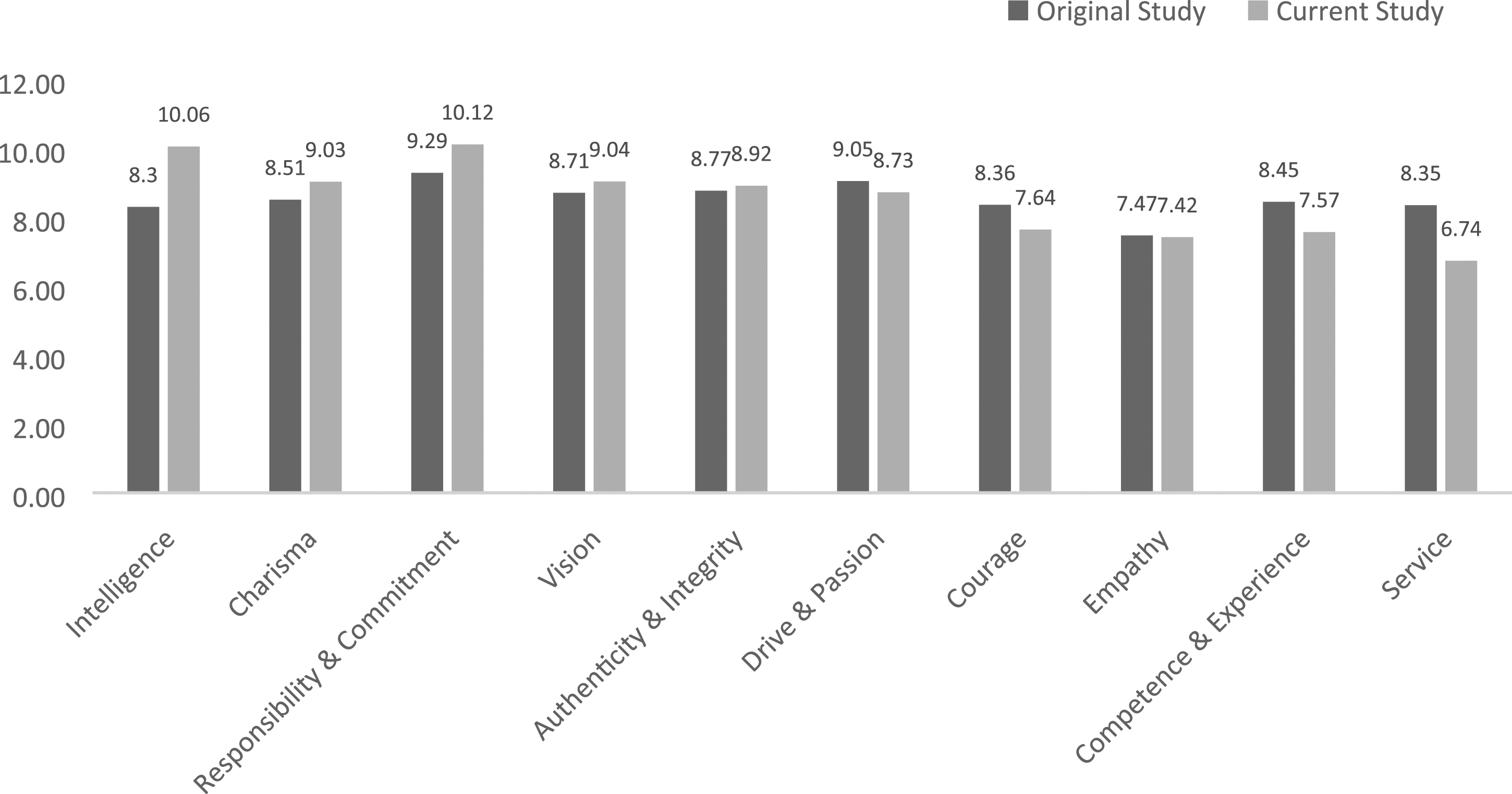
Support was found for Hypothesis 2, which states that student empathy will statistically significantly impact the ranking of preferred leadership trait. Statistically significant interaction between a student’s level of empathy was found for the rating of two leadership qualities: charisma (F (1,657) = 6.554, p < 0.05, ηp2 = 0.010), and empathy (F (1,657) = 8.037, p < 0.01, ηp2 = 0.012). There are no significant interactions for the other leadership qualities. Additionally, support was found for Hypothesis 3 as well. Hypothesis three states that student age will statistically significantly impact the ranking of preferred leadership traits. A student’s level of empathy had a significant interaction for four of the 10 leadership qualities: charisma (F (1,657) = 4.717, p < 0.05, ηp2 = 0.007), authenticity and integrity (F (1,657) = 5.371, p < 0.05, ηp2 = 0.008), courage (F (1,657) = 9.034, p < 0.01, ηp2 = 0.014), and competence and experience (F (1,657) = 4.770, p < 0.05, ηp2 = 0.007). The effect sizes were small for all of the statistically significant interactions for both empathy and age (Cohen, 1988, 1992).
Discussion
The impetus for this project is a response to Holt and Marques’s 2012 call to duplicate their empathy study among students in other business schools “in order to find out whether any perceptual changes occur” (Holt and Marques, 2012: 104). We have done just that, with a diverse student sample at a large Southeastern college. We extend our study by exploring relationships between empathy and the noted leadership characteristics as well as age/experience and noted leadership characteristics.
Holt and Marques (2012) ranked the 10 leadership traits in order of importance. Although the traits were listed in order of importance, this does not mean that the students did not value the lower ranked traits: it simply means they ranked some traits higher than others. The traits were: responsibility and commitment, drive/passion, authenticity and integrity, vision, charisma, competence and experience, courage, service, intelligence and empathy. Our ratings came out differently from those of the original study. In our survey, the traits were ranked in this order of importance: responsibility and commitment, intelligence, vision, charisma, authenticity and integrity, drive and passion, courage, competence and experience, empathy and service. It is clear from the two rankings that our survey results differ. We ranked intelligence far higher than in the Holt and Marques study. Drive and passion ranked much higher in the Holt and Marques study. Empathy was ninth in our study compared to 10th in theirs. Based on these findings, we reject Hypothesis 1, that the students will rank the 10 leadership traits in the way as in the previous Holt and Marques (2012) study.
Despite the differences in the rankings, one takeaway from Hypothesis one is how closely empathy is ranked in the two studies. In the Holt and Marques scale, empathy as a leadership trait was ranked 10th out of 10 traits and in ours ninth out of 10 traits. Empathy is clearly not as prioritized as the other traits by the surveyed students. Why might this be? One reason is technology and work demands and their effects on students and their superiors. Butcher (2019: 22) discusses this idea in the context of student doctors. She states, “It’s their schedule, their workload, the degree of responsibility, the new documentation requirements, and the recent emphasis on measuring just about everything. People start to take shortcuts – for example, going right to the computer before really greeting a patient and having them experience someone who is there to greet them and listen to them.” The student doctors turn away from personal contact in order to keep up with their job demands. Empathy takes a back seat to the functionality of the work environment.
Burnout is a factor. Schaufeli and Van Dierendonck (1993) call emotional exhaustion the affective component of burnout. One’s emotional resources deplete; they have no energy left. Depersonalization is also a part of burnout: people become less social and sometimes even cynical. In work settings, this detachment can be toward students or colleagues alike. Less empathy accompanies such circumstances and perhaps other traits are seen as more important in those scenarios. Social media may have impacts on students as well. Behaviors online can impact empathy. People begin to rely more on social media interaction and less on in-person interaction. On the other hand, practicing perspective-taking improves empathy (Holt and Marques, 2017). If students spend more time in online interactions, and less time tuning into others, then empathy stagnates. It becomes less important due to the emphasis on online interactions.
We find that students with more empathy valued empathy and charisma in their leaders. Cognitive empathy means connecting to the feelings of another person without actually going through those emotions personally (Hoffman, 2000). Affective empathy is the action part of feelings (Hoffman, 2000). Empathy connects people to one another through these emotional states. Individuals have the most empathy for people in similar circumstances or with similar features: this is referred to as identification. Identification is a psychological process whereby the individual absorbs identifies with another who has some desirable characteristics (Miyazono and Inarimori, 2021). If a student sees a leader as being empathetic, and they are empathetic, they will value that level of empathy more because they identify with the person and the attribute.
Social exchange theory explains why higher empathy in students leads to greater prioritization of empathy as a leadership trait. A social exchange is a mutually beneficial exchange between people. Blau (1964) sees social exchanges in business, in personal relationships, and the like. In this theory, there is a connection between the students and what they prioritize in a leader. If the student sees a benefit in imitating a leadership characteristic, they will do so. Those with higher levels of empathy better understand the benefits of being empathetic. Consequently, they would more likely prioritize empathy as a beneficial characteristic in leaders.
We also determined that students with greater empathy prioritized charisma as a leadership trait. Behr (2021) mentions that empathy is a part of charismatic leadership. Charismatic leadership links to identification and submission (Behr, 2021). Targets of the charismatic leader begin to feel kinship (as if he or she speaks for them and feels for them). The leader provides a basic need in the follower. Spiritual and emotional fulfilment create an almost physical attachment based on loyalty (Behr, 2021). Charisma “engages the susceptible person at a deep emotional level; some people feel an almost soulful connection to the leader” (Behr, 2021, p, 209). Empathetic people would be able to relate to the connection between charisma and empathy. They may mistake charisma for empathy, and so would value this trait. There are positive qualities to the charismatic leader. Bass (1985: 188) states that “socialized charismatic leaders are oriented to serving others. They develop shared goals with their followers and inspire attainment of such goals.” Empathic people connect to the needs of others, and value connection in their leaders. Servant leadership models take empathy as one of their core components (Greenleaf, 2003): individuals connect with the charismatic leader on the basis of his or her desire to develop a shared goal and servant stance.
Another aspect of the charismatic leader is vision. Bass (1985, 1990) states that the charismatic leader articulates a specific vision for his or her followers, which then motivates them and provides the basis on which meaning is created (Bass 1985, 1990). Given that empathy is perspective-taking, a leader who is motivational through an appealing vision and the development of shared goals will inspire followers. Empathic individuals attuned to the charismatic leader’s vision and energy are likely to approve of the energy with which the leader articulates vision and action. Hence, we accept Hypothesis 2, that student empathy will statistically significantly impact the ranking of perceived leadership traits. We clearly see that higher levels of student empathy impact empathy as a leadership trait, and we also see that higher levels of empathy lean towards the prioritization of charisma as a leadership trait as well.
We see four relationships under Hypothesis 3 (that student age will statistically significantly impact the ranking of preferred leadership traits). We will use the word ‘experience’ rather than age in this regard. Those with greater experience prioritized charisma, authenticity and integrity, courage, and competence and experience as leadership qualities in the survey. More experienced people prioritized charisma as a leadership characteristic. Waldman and Yammarino (1999: 136) defined charismatic leadership as a relationship between leader and follower, resulting in “internalized commitment to the vision of the leader, exceptionally strong admiration and respect for the leader, and identification of followers with the leader, the vision, and the collective forged by the leader.”
There is a connection between transformational leadership and charismatic leadership. Transformational leadership is “charisma, intellectual stimulation, individualized consideration, and inspirational motivation” (Avolio et al., 1999: 442). People value charismatic and transformational leaders. Fein et al. (2010) have shown the existence of differences in preference in age cohorts with respect to leadership style. In their paper, conducted with Romanian subjects, they noticed that older people had a higher preference for the transformational style than did younger subjects. Consequently, there is evidence that more experienced people prioritize charisma, as a part of the transformational leadership model, considering the importance that charisma has in that model.
More experienced people prioritized authenticity and integrity in the leadership traits. Authentic leaders value knowledge, understand themselves and their own viewpoints and believe in the power of their leadership, including their values and convictions (Shamir and Eilam, 2005). Authenticity is the connection of behavior with values and beliefs. There is a connection between authenticity and integrity; authentic behavior is linked to integrity (Goffee and Jones, 2005; Shamir and Eilam, 2005). Followers understand the connection between authenticity and integrity as well. Behavioral integrity “is the extent to which employees believe a manager ‘walks her talk’, and conversely, it reflects the extent to which they see her as ‘talking her walk”’ (Simons, 2002: 19).
Older people are usually more competent in levels of cognition such as problem-solving and creation of goals. Wiser people have greater empathy, are more accurate in their views of others’ emotional status and are more thoughtful of the wellbeing of other people (Samuel, 2017). Wisdom and emotional intelligence are connected (Samuel, 2017). Thus, there is a connection between age and wisdom, from an empathetic viewpoint. Older cohorts are more likely to be wise, and thus to have a better understanding of leader authenticity and integrity. They could see through leaders who lack these characteristics, and are likely to “see” the real leader from his or her words and actions.
There is a connection between experience and courage (Taneva et al., 2016). Soto et al. (2011) observe that older workers are more open to new experiences than their younger peers. Openness to experience relates to courage and confidence connects to courage. “You can have a broader perspective, you are not just taking everything what is said. Just because everything has been done this way, it doesn’t always need to be done in this way…it is the confidence” (Taneva et al., 2016: 404). So, there is support for the idea that experience leads to confidence and courage, and that people will most likely prioritize leadership characteristics as well, given that leadership is a quality espoused by more experienced workers.
Finally, there is a link between experience and competence and experience. Older workers value experience because they possess it and it is logical to assume that they would value the same kind of experience in their leaders. In the Taneva study (2016: 408), for older workers, knowledge and experience were markers of greater cognitive functioning: “For example, a male British ICT worker indicated that ‘…experience also enables you to maneuver out of trouble and around obstacles,’ and a male health worker from Bulgaria expressed the view that ‘we know better how to cope with different situations. This is especially obvious in complex situations.’” There is a clear connection between experience, knowledge and competence. Therefore, we accept Hypothesis 3, that student age will statistically significantly impact the ranking of preferred leadership traits. From the research, more experience leads to a connection between charisma, authenticity and integrity, courage and competence and experience.
Practical implications and recommendations
We provide practical implications and recommendations through extant research. Holt and Marques (2012) ranked empathy at 10th out of 10 on leadership characteristics, and our study ranked empathy ninth. There was very little difference over the 10-year period of the two studies. While empathy is important in the extant research, it does not seem to be prioritized as much as other leadership traits by students. We examine research and make practical recommendations for empathy as an important characteristic in workplace interactions.
Baker (2017) calls on educators to teach empathy in business schools. She comments on student activities that connect empathetic concern and better business decision-making (Baker, 2017: 577, 581): “Increased awareness of how an emotion such as empathy affects decisions may encourage thoughtfulness and reduce limits to ethicality.” Baker is hopeful that the “relationship between one’s environment and empathy is changeable”, and therefore can improve. The practical implication is the need for an increase in class discussions, which are important to the process. If students examine moral scenarios, they can reflect with the help of the teacher – they become active in “perspective-taking”. Teachers can ask students about business scenarios and encourage reflection. Reflection on decisions and actions helps students gain empathy for the person and the circumstance.
Traiser and Eighmy (2011: 332) believe in a redirection of the business ethics curriculum, arguing that curriculum redesign would assist in the moral development of students. They believe that assessment is the key to “establish appropriate objectives and tools to evaluate ethics education outcomes”. With better ethics outcomes, students will look at empathy as a viable subject of inquiry, as opposed to the status quo. The practical implication is the need to redesign ethics curricula. This would involve teachers directly in a process of reflection and in the creation of new curricula with case scenarios of ethical decision-making. For example, teachers could include scenarios with questions like: “How would you react to a friend/co-worker who you caught stealing company material?” This would engage students in intense scrutiny of their own beliefs, helping them to become effective workers and corporate citizens. Adding such elements to business curricula would be a first step in examining empathy and its limits in the workplace.
Shivarajan and Andrews (2021) discuss EI (emotional intelligence) and its ramifications for students. They advocate a series of improvisational exercises that force students to listen nonjudgmentally and to support each other (Shivarajan and Andrews, 2021). This theatrical approach to emotional intelligence creates “engagement, active listening, and collaboration” (Shivarajan and Andrews, 2021: 153). Since active listening and engagement are components of empathy, these acting techniques could be very beneficial for students. Effective listening is an important aspect of developing empathy and it has been recommended that education curricula should include learning experiences which encourage students to develop their listening and interpretation abilities (Holt, 2022). These types of activities will assist students to cultivate empathy-related skills as they prepare for leadership roles in the business environment. In sum, the practical implication of theater techniques is for students to “get out of themselves” and take on roles. A student could take a non-empathetic role and act out its consequences as well as taking on an empathetic role and seeing its corresponding consequences. Students will have fun with the theater approach as well as learning the real implications of empathy in the workplace.
Brown et al. (2010: 207) believe that personality structure is an aspect of moral decision-making. They believe that teaching empathy is only one factor in the growth of the individual. They reason that pedagogical experience “must contain examples, exercises, and opportunities to develop personality traits that are conducive to ethical behavior.” To extend this practically, teachers could inculcate moral exercises in their exams as well as their writing exercises. For example, one such essay assignment would be to roleplay the part of a manager listening to an employee who is having personal problems. How would the students react to such a scenario? Not only would there be a practical writing component to the exercise; there would also be an inward turn on how to deal with a difficult situation at work. Since these are commonplace events in the workplace, this writing exercise would help train students to clarify their empathic intentions on the job.
Warren (2018) argues for increased perspective-taking and believes in help for teachers in this regard. Higher education professionals must help teachers to use classroom strategies that work. These strategies will help students improve common interactions, enrich school culture and serve to boost academic and social outcomes (Warren, 2018: 173). The use of empathy in teaching schools will be vital in assisting new teachers to develop attitudes that assist them in creating what she calls culturally responsive pedagogy (Warren, 2018: 176). For example, in teacher preparation curricula, there could be a stronger emphasis on ethical training. Course development in order to achieve the degree could be considered, as well as weaving ethical aspects of teaching and learning into all curricular areas. Some teachers come to the job from a transactional perspective (‘I give you a grade if you give me the work I want’) and that perspective could be challenged through the implementation of curricular changes in teaching programs.
Friedland and Jain (2022: 16, 21–23) want to reframe the idea of business, arguing that affective motives have been “crowded out” by explicitly financial incentives. They examine moral self-awareness (24–25) and ask if it will lead to “personal fulfillment, social significance, and sustained impact beyond present effects”. To that end, they want to reframe what they call the ethos of business education, with business schools placing their students in “increasingly narrow vocational tracks” without much ethical or critical thinking skill. We can conclude from this research that moral self-awareness is the key. We recommend some changes to current educational practices as proposed by Friedland and Jain (2022: 24–25), mainly “targeting and recruiting students already motivated by social purpose through promotional materials and recruitment, using civic and prosocial appeals to moral self-awareness, and re-envisioning curricula through rewarding careers as opposed to profit centers”. A number of scholars have discussed the idea that empathy is teachable, and self-reflection and perspective-taking should be valued.
We strongly believe that each of these options should hold a place for future study.
Limitations
Several limitations are acknowledged. Since our purpose was to compare the findings of the current study to the original study (Holt et al., 2017), a comparable methodology was utilized. If a comparison to the original study had not been the intention, a Likert-type instrument could have been used so that the data would have been parametric. This would have indicated an independent evaluation of a quality’s importance rather than a dependent positional one. The data for the current study do not imply that a low ranking means that a leadership quality is not valued or unimportant. Rather, the results indicate a quality’s importance relative to the other qualities, with a lower ranked quality being perceived as less important than those qualities that are more highly ranked.
The study’s cross-sectional design means that it is just a single point in time. Given that it was done in comparison to the original study (Holt et al., 2017), this could mean that participants have changed over that period. However, differences may be attributable to other influences, such as the participants in the current study mostly being students who live primarily in the highly diverse suburbs near a large metropolitan area, or that they are attending a medium-sized public institution rather than a smaller private institution (like the participants in the original study).
Another limitation is that self-reported data might be influenced by people’s tendencies to respond in a socially desirable fashion. This could impact the way participants ranked the qualities. It is possible that some ranked the qualities according to what seemed most socially desirable. Some may have chosen their rankings based on what they believed the researchers, management faculty, would want. Others may have chosen their rankings based on what they believed their peers would consider most appropriate.
Because this study was in response to the previous study by Holt and colleagues (2012, 2017), it was constrained by the design of that study, which imposed a number of limitations. Methodologically, this study used the same ranked data choices as the original study. The 10 leadership qualities were defined and utilized in the original study, and this study was obliged to use the same qualities so that the results could be compared. Because of the lack of access to the prior study’s data, this study was based on the research and results reported in the original article.
The use of nonparametric data also presents statistical issues and restrictions because the ranked data were nonparametric. Nonparametric tests robustly compare skewed or ranked data, but the disadvantages of using a non-parametric test is that the results may not provide an accurate answer because they are not based on a standard distribution. This study utilized nonparametric methods as well as two-way ANOVA, since it is robust when using nonparametric data.
Directions for future research
There is a need, beyond the scope of this study, to examine student empathy and its relationship to leadership perceptions among college students. Aside from student empathy and age, several other student characteristics could be predictive of their ranking of leadership qualities. Future research might also examine more specific areas of leadership in relation to student perceptions. Changes in student perceptions based on empathy-related experiences and learning could also be examined to understand how student empathy and their perceptions of leaders can be further informed and developed.
Footnotes
Declaration of conflicting interests
The author(s) declared no potential conflicts of interest with respect to the research, authorship, and/or publication of this article.
Funding
The author(s) received no financial support for the research, authorship, and/or publication of this article.
