



Abstract
This paper presents the findings from a study on the dynamic and nuanced relationship between strategy theory and strategy practice in a South African context. Grounded in a strategy-as-practice perspective and based on an abductive analysis of sixteen semi-structured interviews, the empirical findings deepen our conceptual understanding of how the relationship between strategy theory and strategy practice is constituted. The findings further reveal how practice environments influence the effective use of academic knowledge and skills by graduates in the workplace. Primarily, strategy theory is foundational to effective strategy practice. We theorise that strategy practitioners construct the relevance of strategy theory through adaptation and bricolage to suit complex and eclectic practice contexts. The study findings confirm that strategy theory plays a critical role in shaping and guiding strategy practitioners’ praxis. As the ontic sites of knowledge and skills application, practice contexts are important for testing and validating academic knowledge and skills. In this relationship, strategy practitioners are the primary actors who transpose knowledge and skills from academe to business. What they become after completing a qualification is critical.
Keywords
Contemporary strategy practice environments are increasingly complex, dynamic, equivocal, eclectic, chaotic and uncertain (Milite et al., 2013; Pina e Cunha and Rego, 2010; Tworek et al., 2019). To navigate these uncertain environments sucessfully, strategy practitioners draw on academic knowledge and skills as well as tacit knowledge and experience. However, in the management literature there appears to be a dichotomy between what is said in theory and what is done in practice (e.g., Augier and March, 2007; Pfeffer and Fong, 2002). That is, management scholars and practitioners appear to be talking past each other (Kriz et al., 2021). To glean some insights into this behaviour, Pfeffer and Sutton (2000) explored the knowing–doing gap in different industries in the USA and found that the phenomenon had no simple answers. In their subsequent study on evidence-based management that was modelled on the practice of medicine, particularly the work of Dr David Sacket and his colleagues (Sacket et al., 1996), they report that, often, seasoned practitioners neglect to gather relevant evidence because they trust their own clinical experience (Pfeffer and Sutton, 2006).
The interplay between theory and practice brings into focus the dialectical tensions in the relationship between academe and business. In practice environments that present novel problems with no precedent (Mckeown, 2018), business schools have faced heavy criticism for being out of sync with practical reality (Bennis and O’Toole, 2005; Ghoshal, 2005; Kovoor-Misra, 2020; Parker, 2018). Despite their considerable influence, Parker (2018) contends that business schools are intellectually fraudulent; they attempt to gain scientific respectability at the expense of producing practically relevant knowledge (Rajagopalan, 2020). Bennis and O’ Toole (2005) argue that business schools’ academic offerings embody academic rigour instead of graduate competence as a sole measure of excellence. On a counterpoint, Rajagopalan (2020) argues that dynamic and eclectic practice environments demand the highest standards of rigour that should yield insights that endure over time and across practice contexts. Instead of thinking in terms of incompatibility between rigour and relevance, a turn to a mindset that appreciates how practical relevance emerges from academic rigour is required (Chia, 2014). As business schools educate and prepare graduates for a complex and dynamic world of practice (Higgins, 2018), to embody practical relevance, their academic offerings should be rigorous. According to Woodside (2018), to increase business school graduates’ adaptability in eclectic business practice environments and to ensure they embody relevant industry competencies that will enable them to succeed in the workplace, they require real-world rigour. To gain insights into the rigour and relevance of South African business school education, we interviewed business school alumni in practice with a direct focus on the content covered in strategy courses and how such content is delivered.
Accordingly, this study examines and conceptualises the relationship between the academic rigour and practical relevance of strategy education produced by South African business schools. In South Africa, most university-affiliated business schools were established during a period of racial segregation. With the advent of democracy, they have since evolved to mirror the realities of a democratic and non-racial society. For example, apart from the increase in the number of institutions providing MBAs, the number of female and previously disadvantaged students has also grown (Council on Higher Education, 2004). That said, South African business schools still mimic Western models of management education which, according to some scholars, follow a neoliberal (e.g., Fleming, 2020; Matthews et al., 2019; Parker, 2014; Troiani and Dutson, 2021; Waddock, 2020) or marketisation approach (Kornelakis and Petrakaki, 2020) that emphasises economic expediency and a productive workforce (Troiani and Dutson, 2021; Waddock, 2020).
We adopted a qualitative research design and asked South African business school alumni about their lived experiences with the relationship between strategy theory and strategy practice. We adopted the strategy-as-practice perspective to gain a rich understanding of situated phenomena with criteria for outcomes that are better suited to idiographic research (Jarzabkowski and Spee, 2009). Idiographic studies command both theoretical and empirical explanatory power (Tsoukas, 1989). Therefore, our practice-oriented lens enabled us to establish outcomes drawn from different forms of praxis (Jarzabkowski et al., 2016). The concept of praxis involves the dialectical interplay between theory and practice, between reflection and action (Barker, 2006; McLaren and Crawford, 2010; Sachs, 2014). That is, praxis is conceptually inspired ‘creative doing’ which synthesises theory and practice (Barker, 2006; McLaren and Crawford, 2010). As practising academics, we set out to engage communities of business school alumni to gain insights into how they use their academic knowledge and skills in practice contexts so that we could generate useful practice-based organisational knowledge.
Theoretical underpinnings
The interplay between strategy theory and strategy practice is complex and nuanced. At the heart of contemporary strategy practice should be theoretically sound and practically relevant strategy education. Cognisant of the different forms that practical relevance in management literature may take, we align with Nicolai and Seidl’s (2010) taxonomy of conceptual, instrumental and legitimative relevance. Conceptual relevance is realised when theoretical concepts influence practitioners’ conceptualisation of problems (Kieser et al., 2015), instrumental relevance is realised when concepts directly influence managerial action (Astley and Zammuto, 1992), and, finally, legitimative relevance can be realised in the form of credentialising people or knowledge domains (Kieser et al., 2015; Nicolai and Seidl, 2010). Sound theories should inform good practice, which in turn should provide contextual feedback on the usefulness of such theories (Anderson et al., 2017). The nexus between strategy education and strategy practice brings together business schools as knowledge producers and business organisations as knowledge users. Connecting business schools and business organisations are alumni who understand and apply modern management theories in practical settings (Elmuti, 2004). Consequently, management theory and practice co-exist in a symbiotic relationship. However, theory building is said to be following rigorous academic processes with minimal regard to practice (Bennis and O’Toole, 2005), thus opening a gap between academic rigour and practical relevance that has been a subject of intense debates among management scholars for decades.
The theory and practice of strategy
Sound strategy education that increasingly focuses on scholarship that is both relevant for and actionable by industry (Finch et al., 2016) will enable business school graduates to accomplish creditable work (Shakespeare, 2010). This kind of education would be steeped in curricula grounded in content, teaching and assessment practices that prepare graduates for practice roles in dynamic and eclectic environments (Higgs et al., 2010). Such curricula should embody multiple practice understandings to help graduates command different facets of practice in dynamic and ambiguous environments. To this end, most business schools offer strategic management as a capstone course that requires synthesis, integrative thinking, experiential learning, innovation and practical application (Carter and Stickney, 2019; Kachra and Schnietz, 2008). The strategy capstone course does not provide new content; instead, it focuses on the synthesis of knowledge and skills obtained from disparate areas of business management for practical application in different practice contexts (Bauman and Bauman, 2018; Lee and Loton, 2019). Synthesis emphasises mutuality other than duality, recognising the embeddedness of elements within the whole (Forray and Mir, 1994). It further allows graduates to derive meaning from information and to reconstruct or visualise new pathways and opportunities (Albert and Grzeda, 2015), a critical competence in dynamic and complex strategy practice settings. The synthetic approach to strategy scholarship embodies the ‘both/and’ mindset (Martin, 2009), which cements the idea that success in academic and practical spaces requires disciplinary and interdisciplinary knowledge and skills (Donaldson, 2019).
Strategy education in business schools also introduces students to numerous strategy tools (Jarzabkowski and Kaplan, 2015), which constitute a critical component of the strategy literature. For decades now, strategy tools have been embedded in strategy practitioners’ professional lives (Rigby and Bilodeu, 2015). They support strategising in turbulent environments by streamlining and simplifying messy activities, thereby bridging abstract concepts to specific practicalities (Stenfors and Tanner, 2007) and helping practitioners to be resilient and agile (Kovoor-Misra, 2020).
Our research was grounded in existing theoretical resources such as design theory, practice theory and activity theory. Design theory engenders multiple ways of thinking and behaving; practice theory posits that practices are social phenomena enacted in a broader social milieu; and activity theory helps to explain the totality of human practices and praxis. From the start, we positioned our research outside the traditional strategy theory that focuses on macro-organisational phenomena and that appears to fall short on the nitty-gritty of emergent and socially enacted strategising (Begkos et al., 2020; Stander and Pretorius, 2016). To focus on the doing of strategy (Pugh & Bourgeois III, 2011), and to recognise those who are doing the actual work of strategising (strategy practitioners), we adopted the strategy-as-practice perspective that borders on some elements of design theory, practice theory and activity theory. The strategy-as-practice perspective distinctively foregrounds the micro-social activities, processes, and practices embodied in organisational strategy and strategising (Golsorkhi et al., 2015; Surju et al., 2020). The strategy-as-practice perspective seeks to empirically and theoretically explain the consequentiality of practitioners’ actions; that is, what practitioners actually do and how their actions iteratively shape and are shaped by practice contexts (Jarzabkowski et al., 2019). As the people who do the ontic work of strategising (Jarzabkowski and Spee, 2009; Rouleau, 2013), strategy practitioners are the critical connection between intra-organisational praxis and the organisational practices (Whittington, 2006). In their doing of strategy, strategy practitioners draw on strategy practices, the social, symbolic and material tools of practice (Stander and Pretorius, 2016), as they engage in praxis, the streams of activity that connect the micro-actions of individual strategy practitioners to the wider institutional domains of their practice (Jarzabkowski and Spee, 2009). The practice turn in strategy refocuses attention from the what of strategy to how it is accomplished in practice. In strategy-as-practice, strategy is locally co-created and enacted in situated actions, interactions and negotiations (Schmachtel, 2016). As strategy is a social practice, the power of the strategy-as-practice perspective lies in its ability to explain how strategy-making is enabled and constrained by prevailing organisational and societal norms and practices (Vaara and Whittington, 2012). Accordingly, the study sought to gain deeper insights into the academic rigour and practical relevance of strategy scholarship in dynamic and eclectic environments.
Methodological underpinnings
The enactment and re-enactment of practices illuminate both micro and macro outcomes (Guérard et al., 2013; Jarzabkowski et al., 2016; Jarzabkowski and Spee, 2009), meaning that the understanding of outcomes may depend on the unit and level of analysis (Jarzabkowski and Spee, 2009). Such outcomes may be at the individual, group, strategising, organisational and institutional levels (Jarzabkowski and Spee, 2009). The study is situated at the micro-level of analysis and focuses on the individual practitioner internal to the organisation (Jarzabkowski and Spee, 2009). In this paper, we explore the lived experiences of selected South African business school alumni with their strategy practices and praxis as mediated by their strategy academic knowledge and skills. We did not set out to observe managers in situ, but we wanted to gather data from their experiences and personal descriptions. To this end, we developed an interview protocol that delved into the participants’ experiences from their days at business school to their transition to practice domains. The study was concerned with practices and praxis of Master of Business Administration (MBA) and Master of Business Leadership (MBL) graduates as strategy practitioners in their social milieus. For breadth and depth of inquiry, the study adopted a qualitative research design situated in the strategy-as-practice perspective on human action taken as whole and messy (Holt and Sandberg, 2015).
Study participants
The study’s target population comprised South African business school alumni with MBA/MBL degrees obtained between 2006 and 2015 who worked across industries in both the public and private sectors. We did not distinguish between full-time and part-time students. However, over 90 per cent of the MBA/MBL programmes participants had completed required some form of work and management experience as an admission critierion. From this population, the size of which was unknown, we drew a purposive sample. As we sought to produce rich and deep data, a non-probabilistic, purposive sampling design was the most appropriate for identifying participants who would provide information-rich accounts of their experiences. As practising strategy professionals at the top and middle levels of their organisations with experience, knowledge and skills, participants had unique and important perspectives and insights into the academic rigour and practical relevance of the strategy body of knowledge and skills produced by South African business schools.
Data production and preparation
Research data were produced over a period of 4 months in 2018 through face-to-face semi-structured interviews conducted by one of the authors with 16 business school alumni working in different industries. Thirty eight per cent of the participants were directors and the rest occupied managerial positions – all with some strategising responsibilities. We asked each participant preplanned questions that we followed up with more probing questions. The interview questions were structured around management practices and actions, the application of management theory to organisational issues and participants’ views on knowledge and skills gained from MBA/MBL programmes. Against the background of scholarly debates on the relevance or utility of the concept of saturation in qualitative research, we adopted the conceptual depth criteria to ensure the conceptual rigour and quality (Low, 2019; Sebele-Mpofu, 2020) of the study. The criteria emphasise the depth and richness of the conceptual understanding of the material (Nelson, 2017). That is, the adequacy of the sample size was measured by the depth and richness of the data rather than the number of participants (Morse, 2015; Morse et al., 2002). This stance is substantiated by the conceptual models and theoretical explanations (Low, 2019) that are presented in the findings section. Participants’ responses resulted in 600 minutes of audio data. The verbatim transcriptions amounted to 147 pages.
Data analysis
Data were analysed using thematic analysis. Thematic analysis imbues a study with rigour while retaining the creative and revelatory power of generating new concepts and ideas from participant accounts (Gioia et al., 2012). We used Atlas.ti to organise and manage the data analysis process within a germane analytical framework. The analytical framework used is shown in Figure 1. The framework presents the triadic elements of strategy academic knowledge and skills, academic rigour and practical relevance as the core elements of the study. It also encapsulates the nexus between strategy education and strategy practice positioned within strategising activity where practitioners, practices and praxis intersect. The analytical framework.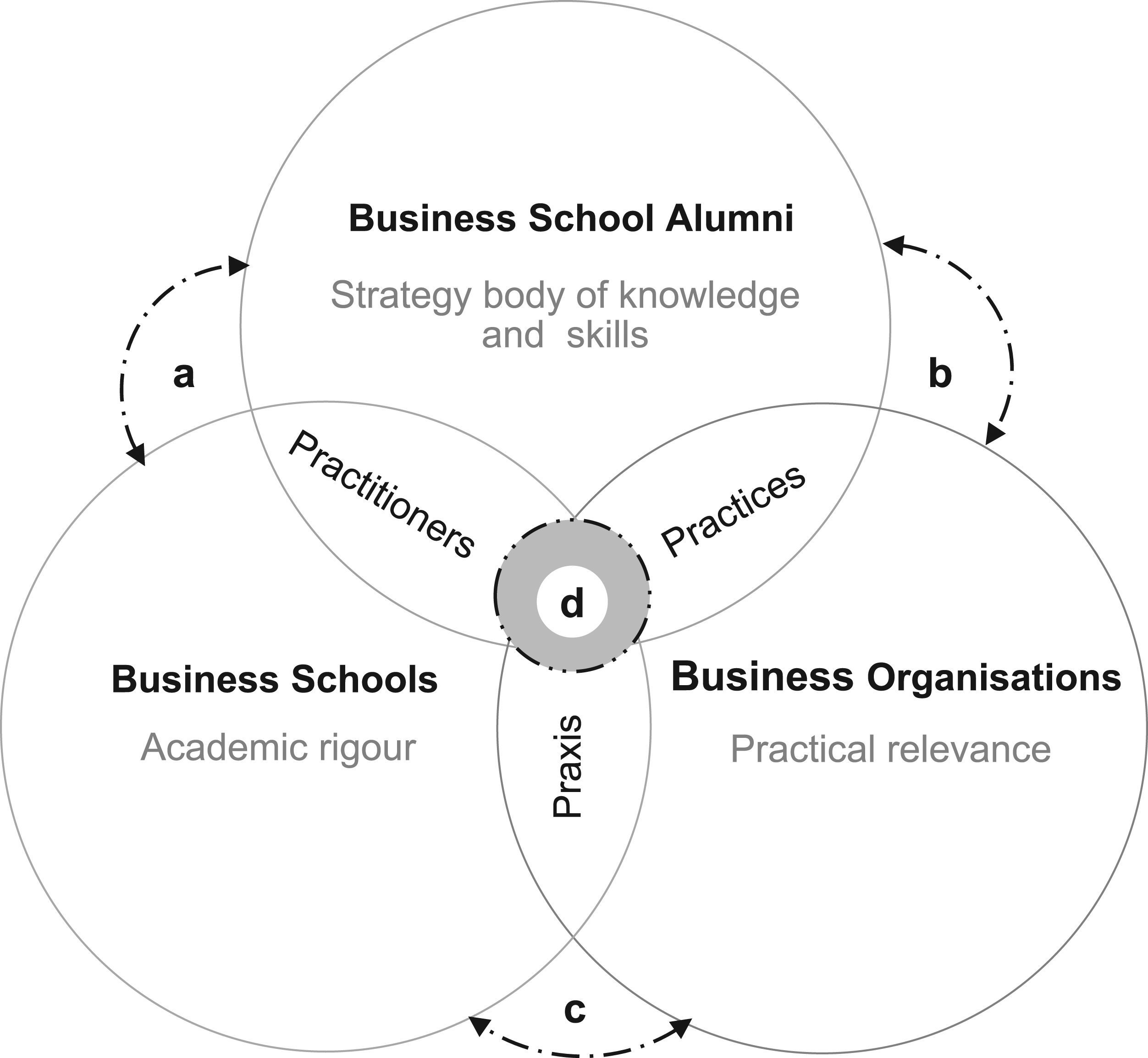
The analytical unit of the study was business school alumni's experiences with the academic rigour and practical relevance of their strategy knowledge and skills. In keeping with the strategy-as-practice canons of analysing the doing and not only the knowing of strategy, participants included practitioners who would not traditionally be associated with strategising. Although the elements and corresponding embodiments are conceptually distinct, they are interrelated (Jonsen et al., 2018). As the influences between elements are interconnected and mutually constitutive, the connecting arrows in Figure 1 are double-headed. Business schools interconnect with alumni and business organisations. The interconnection between business schools and alumni embodies academic rigour, whereas the interconnection between alumni and business organisations embodies practical relevance. The dynamic and nuanced interplay between rigour and relevance informs the design and redesign of academic offerings. Finally, the interaction between the triadic elements plays out within a strategy-as-practice context. Although we had specific issues to explicate, we were open to discovering unexpected aspects of participants’ experiences and the way they assigned meaning to the phenomena under study (Gale et al., 2013).
Findings
Our phenomenological stance allowed us to find commonalities in participants’ lived experience accounts which then enabled us to gain invaluable insights into, and deeper understanding of the practical relevance of strategy education. From these accounts, we developed several codes that were then grouped into specific categories, revealing five broad themes through which the relationship between strategy theory and strategy practice is constituted. The first two themes are rooted in the academic rigour of strategy education, while the other three are rooted in its practical relevance. Although scholars express their concern over the gap between strategy theory and strategy practice, we find a dynamic interplay between the concepts. Our study finds that rigorous academic preparation enhances the practical relevance of the knowledge and skills produced, and feedback from the field improves academic offerings. To offer a visual account of our findings, we present Figure 2, which shows an extraction of some of the original codes, categories and our interpretation of the dynamic and nuanced interplay between strategy theory and strategy practice as co-constituted concepts (Cabantous et al., 2018). Extraction from the data structure depicting the interplay between strategy practice and strategy theory.
As Figure 2 depicts, themes emerged from the data through codes that were categorised according to relative meaning. That is, data analysis moved from thick and rich data through coding and catergorisation to the generation of themes. Although the themes are rooted in different logics – the logic of scholarship in the case of rigorous academic preparation and the logic of practice in the case of relevance to the practice of knowledge and skills produced – they are interwoven. This implies that the distinction between knowledge for practice and knowledge in practice (Smith, 2018) is blurred. In this nuanced interplay, applied learning is associated with the firm foundation for effective practice, whereas contextual conditions of practice are associated with adaptive and innovative use of strategy knowledge. Applied learning develops strategy theory, which becomes a bedrock of effective strategy practice. In contrast, strategy practitioners adapt and apply strategy theory in new and innovative ways in diverse practice contexts. Applied strategy scholarship is designed to closely mirror varied practice contexts. This mirroring is rooted in pedagogy that comprises case studies, site visits and international assignments. On the significance of case studies in academic preparation, one participant, a Managing Director in the pharmaceutical industry, said: ‘It allowed you to take what you had learnt in theory and put it into practice in a practical setting. You know, these were the challenges, and this is how they overcame those challenges and you can somewhat apply those to any business’.
Applied strategy scholarship develops competence in astute practitioners through rigorous teaching and learning, equipping them with the knowledge and skills for effective performance. Practice contexts are practitioners’ lifeworlds, workplaces that are grand theatres of ontic and idiosyncratic praxis. Strategy theory is then adapted by practitioners as dictated by their practice conditions. Strategy practitioners adapt and apply theory in new, innovative and idiosyncratic ways, thereby melding abstract theory and ontic practice.
Academic rigour
Business schools produce strategy knowledge and skills in an environment that is meant to prepare graduates for dynamic and eclectic work environments. For example, one participant, an Audit Director in professional services, stated that ‘[m]y MBA really taught me what I should expect and what I should be prepared to undertake as a business leader’. In a similar vein, another participant, a development finance Specialist, said: ‘that rigorous study of […] is helpful to me because it makes me understand how to approach my work in a way that will deliver the desired results for the organisation’. Although strategic management content at the postgraduate level is similar to that offered at the undergraduate level, pedagogical and assessment methods are notably different. Undergraduate-level pedagogy is mostly lecture-based, whereas at the postgraduate level it is mostly case and syndicate-based. Case study teaching in business schools is an accepted approach to melding theory and practice (O’Shannassyet et al., 2010). Postgraduate learning focuses on higher-order cognitive domains such as critique, analyse, create and evaluate (Culver et al., 2019; Tan and Ko, 2019). To closely align their teaching and learning activities with practice, some business schools offer site visits, industry seminars and overseas study missions for their MBA students. Such activities acquaint students with industry vagaries and keep them abreast of current industry trends while deepening their understanding of how academic knowledge is applied to solve real-world business problems (Tan and Ko, 2019). In other words, the practical value of a postgraduate qualification does not lie so much in its content; but it lies in contexts in which it is developed and applied.
Applied learning for strategy theory development
The primary purpose of a business school education is to develop competent managers and strategy practitioners who can efficiently and effectively run business organisations of varied sizes and complexity. Such an education equips practitioners with the applied knowledge and skills required to function in complex management situations (Baldwin et al., 2011). The applied learning theme reflects how business schools impart knowledge and skills in their graduates for application in varied and dynamic work settings. Applied learning occurs under rigorous teaching conditions designed to closely mirror those of the real world and to match the reified, idiosyncratic and messy realities of practice. On strategy theory, one participant had the following to say: ‘...but the theoretical knowledge that I gained through my studies is very handy in my day-to-day work because I am in a position to think logically, to plan my work logically, to drive corporate and business planning logically as well as monitoring and reporting on performance in a logical manner.’
Although an MBA qualification is comprehensive and rigorous, it still manifests some shortcomings. A few participants believed that the qualification was too theoretical and did not make any significant difference in their work. When asked how strategy theory assisted her in coping in a volatile and dynamic business environment, one participant (a motor glass Franchisee) said: ‘In the end what helps you cope is who you are as a person, not book knowledge because an MBL is a very theoretical skills set.’ Another participant, an Operations Coordinator in the fast-moving consumer goods (FMCG) industry, had the following to say about the value of her MBA: ‘I don’t think the MBA makes a difference. And the reason why I say that is because every company is different.’ Although the finding that an MBA/MBL is too theoretical may be rooted in course design, interestingly, when asked about their motivation to do an MBA, one participant (an Operations Coordinator) cited her love for learning and another, (motor glass Franchisee) indicated that in her previous job she had reviewed the CVs of many job candidates with MBAs and this had inspired her to enrol for one herself. Notwithstanding some shortcomings, applied learning seeks to produce practically relevant knowledge and skills, an outcome that depends on business schools, their alumni and the organisations for which their alumni work.
The astute practitioner
The life-changing power of education is indisputable. Education shapes the thinking and guides the actions of the educated. It not only frees people from the cruelty of ignorance and irrationality, but also guides them to commit certain acts and execute certain functions effectively (Calkins, 1946). As Calkins affirms, more than anything, a person’s virtue is their behaviour; educated people choose what they become. In other words, it is not so much about the qualification one holds as it is about what one becomes after obtaining a qualification. Based on the study findings, we argue that education has the potency to produce astute professionals who can turn situations to their advantage. Despite a small minority of participants (12.5%) indicating that the knowledge and skills they obtained from their MBA/MBL did not have any impact on their jobs, in hostile and restrictive work environments academic knowledge and skills encourage graduates to stand up and make a difference. Attesting to our argument that practitioners should take the initiative to make a difference, an FMCG Production Manager and an Audit Manager in the higher education sector made the following statements: ‘It’s not the material that I studied, but the issue is [with] the individual. How do you carry yourself forward after graduating because you make a difference? So, it’s upon an individual […] I said to myself that this knowledge, I must utilise it.’ ‘In my environment it came up with me being more proactive than the employer […] expecting it because now I have the qualification. It’s about me […] creating that environment to say I’ve got this qualification, I’ve got this knowledge, how can I now incorporate it into my environment and not the other way around.’
What an educated person becomes and can do is embodied in the individual attributes the qualification developed in that person. As much as the relevance of strategy scholarship is embodied in the intersection of academic knowledge and skills production and contextual conditions of practice, the interplay is strongly influenced by practitioners themselves. More than 60% of the participants described how their MBA education had transformed their narrow thinking into a more open and integrative mindset.
Practical relevance
As can be seen from Figure 2, practical relevance is encapsulated in the themes of the theoretical foundations of strategy, contextual conditions of strategy practice and the inventive use of strategy theory by strategy practitioners. Antithetical to the established dogma that strategy is a normative phenomenon (George, 2021; Kafel and Ziębicki, 2021; Kools and George, 2020), these themes capture the essential characteristics of strategy as emergent, situated and idiosyncratic. As management education is an applied science, practical relevance should be its hallmark (Nicolai and Seidl, 2010). Thus, our findings reveal three forms of practical relevance suggested by Nicolai and Seidl (2010). First, we found that strategy knowledge embodies conceptual relevance, as it provides practitioners not only with tools and techniques but also with highly general concepts and ideas (Astley and Zammuto, 1992). Academic knowledge provides conceptual frames that allow practitioners to frame decision situations and connect business activities holistically. The concepts aid in decision-making by allowing practitioners to see the business holistically while appreciating the interconnectedness of the individual parts that make up the whole. One participant, an Industrial Goods and Services Marketing Lead summed up this notion as follows: ‘What my MBA qualification has given me is an ability to have a big picture perspective regarding all the aspects of the business and how they work together.’ Another participant, a mining services Managing Director, said: ‘I draw my insight into decision making from the models I have studied through my MBA degree.’ The conceptual form of relevance was found to be the most prevalent.
Second, we found strategy knowledge to embody instrumental relevance which, as Astley and Zammuto (1992) note, is the direct influence of management theory on managerial action. Strategy knowledge provides practitioners with heuristic tools, techniques and systems that enable them to take appropriate action in dynamic and ill-defined practice situations. Responding to a question about the utility of the strategy tools that are taught at business schools as part of an MBA programme, an industrial goods and services Marketing Lead said: ‘[…] you have systems that you put into place that you make sure you can catch any hurdles or any bottlenecks […] that might impact on your final delivery well before they become problems.’ Another participant, a mining services Managing Director, illustrated the instrumentality of strategy knowledge as follows: ‘[…] because the MBA gave me some systems, processes and procedures of dealing with certain things, I’m doing them with ease.’ This form of relevance was found to be the least prevalent.
Third, we found that an MBA/MBL qualification embodies legitimative relevance. It positions graduates for management and leadership roles in different types of organisations; the knowledge acquired legitimises their actions. These qualifications command both extrinsic and intrinsic value in that they increase the odds for a better job and career opportunities with current and potential employers. An Audit Director in the professional services space illustrated this point: ‘I strongly believe that the manifestation of some of the things and some of the ways of thinking that I learnt in business school helped me to be able to easily demonstrate that I could direct and lead my own portfolio.’ Intrinsically, holders have the confidence that they can perform certain functions effectively even if they may not always produce the intended results. One participant, a Manager in health services, raised the following point: ‘When you feel confident you are comfortable to make mistakes because you don’t assume those mistakes come from not knowing.’ Legitimative relevance was found to be prevalent, but not as much as conceptual relevance.
Theoretical foundations of sutuated strategy praxis
Strategy knowledge commands a pervasive array of principles, frameworks, models and concepts intended to inform, guide and shape strategy practitioners’ thinking, activities and actions in their strategising. In a sense, strategy theory is foundational to strategy praxis. In a study on universities’ contributions to South African labour market needs, Mobarak (2021) reports that managers acknowledge that universities cannot develop the skills and knowledge needed by the labour market to the full extent required. Our study findings indicate that strategy theoretical principles provide guidance to practitioners’ actions and enhance their practices and praxis, thereby lending credence to this acknowldgement by practising managers. The principles have become embodied in their professional beings and ways of knowing and doing. Practitioners unconsciously apply the principles as they have become ingrained in them. A consulting engineering Director described his lived experiences as follows: ‘I must say, sometimes we do these things on the fly, but there’s always a theory behind it.’ In a similar vein, two other participants, a professional services Audit Director and a development finance Specialist, commented: ‘They become embedded. […] they develop on you and you kind of learn to think in terms of those models and you just begin to apply them unconsciously. If you truly embed the things that you were taught in business school, they just become part of your everyday life.’ ‘But the theoretical knowledge that I gained through my studies is very handy in my day-to-day work because I am in a position to think logically, to plan my work logically, to drive corporate and business planning logically as well as monitor and report on performance in a logical manner.’
This finding reveals a complex web of interconnected elements between strategy theory and practitioners’ praxis.
Contextual conditions of strategy practice
Although strategy practitioners may have similar academic credentials, their practice environments differ significantly. Given the differences between the environments in which strategy concepts are developed and those in which they are applied, their direct application is impossible. Although strategy knowledge is broad and general, the study findings reveal that the application thereof is idiosyncratic and contextual. ‘Strategy is a strongly contextual concept’ (Rumelt, 1979: 200). Our findings support the notion that strategy concepts are malleable in relation to contextual conditions of practice. Over two thirds of the participants acknowledged that environments in which strategy knowledge is applied are critical for its effective application. Responding to a question on how the content of his MBA qualification compared with the practical demands of his job, one participant, an Operations Manager in insurance broking, responded: ‘In my position, I leverage a lot of what I’ve learnt and it’s highly applicable.’ Another participant, a Management Consultant, said: ‘I think it is applicable. But again, I get to use it a lot because my work allows me to. I have very different types of projects.’ Practitioners actively construct the practical relevance of academic concepts according to the contextual demands of their organisation (Splitter, 2017).
Our findings lend credence to the notion that context is a critical aspect of deriving meaning and relevance of phenomena (Gergen, 1982). Context, as described by Whetten (1989) is the ‘when’, the ‘where’ and the ‘who’ of a particular phenomenon that presents a rich intellectual heritage in which our understanding of events depends on accounting for expanded networks in which the focal event is embedded (Gergen, 1982). As part of our overall findings, the theme resonates with Creaton and Anderson’s (2021) findings concerning the impact of a professional doctorate on professional practice. On issues of organisational context, they report that the position one holds in the organisation influences the extent and nature of the impact the professional doctorate exerts on professional practice (2021:8). For example, study participants who held junior positions on completion of their professional doctorate considered their qualification a disadvantage to their organisational contribution, whereas those who held senior positions were more positive about is impact on their professional practice. Consideration of the context is especially important for experience-based theories (Whetten, 1989). The who, where and when (Whetten, 1989) dimensions of context draw attention to the richness, diversity and manifold facets of the phenomenon (Welter, 2011). To this end, Newbert et al. (2022) contend that only by considering the context in which our theories will be applied will we truly generate knowledge that is both interesting and important. As Finch et al. (2018) note, practice context has a significant influence on the level of integration between academia and industry.
Adaptive and innovative use of strategy theory
The practice epistemology on which this study is premised assumes the use of strategy concepts as practical-evaluative wisdom that deals with getting things done on the spur of the moment within the particular contingencies (Jarzabkowski and Wilson, 2006). The findings reveal that practitioners resort to bricolage to solve unstructured and ambiguous problems of strategising. Bricolage combines theory and practice, both of which develop out of and because of the contextual setting in which the application occurs (Jarzabkowski and Wilson, 2006). Strategy theory is hardly, if ever, applied in practice as raw as it is taught at business school. By implication, practitioners make the theory work for them in their unique contexts. For example, one participant stated: ‘I have learnt that the practical application of the theory sometimes must be softened or modified […] but the integrity of the intent doesn’t change, […] the execution and the how we do it sometimes must change.’ This adaptative and innovative process involves deconstructing strategy concepts to extract valuable elements that have contextual relevance and meaning to practitioners’ immediate environments. The deconstruction of concepts means tearing them apart to reveal underlying points that are not immediately clear, opening and expanding them to invite a limitless number of interpretations (Summers et al., 1997). That is, faced with the complexities and multi-dimensionalities of practice, practitioners construct their own relevance through the inventive use of theory. An Operations Manager in insurance broking commented: ‘It’s up to me to do that, […] it gave me the principles of what the art of the possibility is.’ And a development finance Specialist said: ‘We try by all means not to use them raw as they are, but apply the intricacies that are peculiar to those particular strategic tools.’
Knowledgeable and skilled strategy practitioners who are effective in their work exercise some degree of evaluative judgement and inventiveness. Laud, Arevalo and Johnson (2016) argue that there is an abundance of empirical evidence supporting some unique combination of content knowledge and various capabilities and personality attributes for job success.
Discussion
Despite the dialectical tensions between strategy theory and practice, the concepts are actually in dialogue (Freeman, 2017). Against the background of perennial debates in the scholarly community on the disconnect between strategy theory and practice, our motivation for this study is to contribute to the conversations on strategy scholarship and practice in South Africa. In particular, we aim to contribute to the academic rigour and practical relevance of the strategy knowledge and skills discourse. We examine strategy practitioners’ experiences with the rigours of their academic preparation and the practical relevance of the knowledge and skills gained. Rigour is embodied in the academic preparation of graduates by business schools, whereas relevance is embodied in professional practice in the workplace. Amid voices bewailing the gap between strategy theory and strategy practice, the findings of this study point to a situation in which discussions should shift focus from their dichotomy towards their dynamic and nuanced interplay.
Strategy practitioners’ academic preparation
Perennial debates on strategy education, in which many scholars have participated, are mainly predicated on the underlying assumption that theory and practice are in tension (Asdemir and Ahrens, 2019; David et al., 2021; Yoder, 2019). For the most part, the debates have been between scholars advocating for the theory approach to strategy teaching and learning (e.g., Buckley, 2018; Grant, 2008) and those advocating for the practice approach (e.g., Bower, 2008; Mintzberg and Gosling, 2002). However, a third line of argument, to which we subscribe, which advocates for the blending of the two approaches has recently emerged (e.g., Jarzabkowski and Whittington, 2008; Priem, 2018; Yoder, 2019). This line of argument will likely illuminate the debate as it seeks to blend theory and practice in the teaching and learning of strategy. Blending theory and practice in the classroom is poised to improve both the rigour and the relevance of the knowledge and skills produced. Our findings suggest that this objective is highly desirable. Theory and practice are better together (Yoder, 2019); analogous to bone and marrow, one cannot have one and not the other. Other than their similarities, differences between theory and practice are what makes one matter to the other.
The blending of theory and practice in preparing business school graduates for practice cannot be overemphasised. Business school graduates should perceive key variables in decision situations and examine multiple contingencies and configurations to determine how the theory works in their context (Priem and Harrison, 1994). Such competencies should be developed through pedagogical means in the classroom, thus bringing the knowledge for practice and knowledge in practice together at the production point (Smith, 2018). The connections between strategy theory and strategy practice are crystallised in strategy teaching and learning in the classroom (Jarzabkowski and Whittington, 2008). Synthetic strategy teaching and learning that combine theory and practice to form a solid, connected and coherent learning experience are better positioned to prepare strategy graduates for complex, eclectic and uncertain work environments. ‘Theory and practice are dialectic, […] one concept cannot exist without the other, one acquires its properties from its relation to the other, and […] the properties of both evolve because of their interpenetration’ (Levins and Lewontin, 1985: 3). The purpose of strategy education is to improve strategy practice (Carter and Stickney, 2019).
Strategy practitioners’ professional practice
Business school strategy education embodies some theories that provide insight and foresight into complex business phenomena in unpredictable practice situations. Business schools also impart to their graduates hard and soft skills necessary for their efficacy in their individual and professional lives after graduation. The study findings reveal that strategy theory informs strategy practice by providing practitioners with the multiple lenses necessary for dealing with contradictions and uncertainties of practice and the ability to engage in novel actions in varied and eclectic practice environments. As Patton and Higgs (2018) affirm, professional practice is dynamic, multidimensional, experiential and embodied, and is transformed through individual and contextual actions and praxis. In practice engagements, practitioners develop mastery and, ideally, practical wisdom. Practical wisdom is the fruit of continuous behavioural adjustments developed through banal, non-heroic experiences of situated, everyday action (Hahn and Vignon, 2019). Practitioners who achieve mastery in their work have come up against many challenging situations (Hahn and Vignon, 2019). Their mastery embodies business school learnings (Raelin, 2007) and their experiential lessons as they transcend rational explanations to find creative solutions to novel situations they encounter in their strategising (Hahn and Vignon, 2019). The coalescence between practitioners’ professional beings and the contextual settings of their practice determines the relevance of their academic knowledge and skills. The practice is a situated and idiosyncratic phenomenon. Professional practice is inseparably interwoven with the context within which it plays out (Patton and Higgs, 2018).
The rigour and relevance of strategy theory
From the perspective of South African business school alumni, strategy theory appears to be academically sound and practically relevant. As an established academic discipline, strategy is rooted in a rigorous body of knowledge (Wiklund et al., 2019), the practical relevance of which our study findings demonstrate. Notably, academic rigour and practical relevance in strategy are not antithetical; one does not have to be sacrificed in favour of the other. Sound strategy scholarship embodies both academic rigour and practical relevance. Relevance without rigor is irrelevant (Wiklund et al., 2019), and rigour that does not translate into practical relevance is worthless. Our findings reveal that South African business school strategy scholarship is, to some degree, both scholarly sound and practically relevant. Rigour is embodied in both subject content and how such content is delivered. Practical relevance is more a function of practitioners’ reinterpretation of the content as applicable to their contextual setting. To this end, strategy scholars should not view rigour and relevance as separate from one another; instead, they should view them as entwined concepts.
Strategy knowing, doing and the ‘state of being’
Teaching and learning should produce both intellectual and behavioural outcomes (Radosevich and Ullrich, 1971). Santini, Marinelli, Boden, Cavicchi, and Haegeman (2016) posit that thinkers and doers are distinctive. In contrast, our study suggests that thinking and doing are embodied in one person, implying that graduates should be thinkers as well as doers (Radosevich and Ullrich, 1971). A strategy is not just an intellectual pursuit; beyond that, it involves doing (Grant and Baden-Fuller, 2018). Very few, if any, graduates would acquire an education just for the sake of it, especially business management graduates. Business management is an applied science – it applies academic knowledge to solve business problems. A business management qualification elevates the holder to a higher realm of thought and action – the knowing and doing of strategy. Business school alumni acquire knowledge and skills and develop values, attitudes and behaviours necessary for effective strategy practice (Azizi and Mahmoudi, 2019). The strategy knowing and doing nexus shapes strategy practitioners into professional beings. Strategy practitioners do not necessarily act according to blueprints or recipes; much of their praxis involves solving complex, ill-defined and novel business problems in ambiguous, uncertain and high stakes situations. As such, praxis requires insight and judgement; strategy knowledge enables them to frame problems by connecting disparate pieces of information (Bhardwaj et al., 2018).
Performativity of strategy and relevance construction
Relative to strategy practice, which is ontic, idiosyncratic and contextual, strategy theory is abstract and general. However, it connects with ontic practice through performativity (Callon, 2007; Mackenzie, 2006), a concept that holds that strategy theories describe and create scenarios, situations and conditions of practice. Another dimension is that strategy practitioners deconstruct and reconstruct strategy theoretical concepts for idiosyncratic use in practical settings. In other words, the practical relevance of strategy theories is not necessarily embodied in the actual content of the concepts but in the ‘meanings’ practitioners assign to them. Academic knowledge is considered practically relevant based on practitioners’ own experiences, regardless of the means of producing such knowledge (Splitter, 2017). That is, practitioners infuse ‘imprecise’ academic concepts with ‘contextual’ and ‘idiosyncratic’ meaning (Rasche and Seidl, 2020) to determine how such concepts become practically useful (Splitter, 2017). Academic content and the delivery thereof are essential, but the meanings strategy practitioners assign to certain elements of such content are equally important. From their academic knowledge, strategy practitioners construct practical relevance according to the contextual demands of their practice. Strategy theories are not ‘hard and fast rules’ of the strategising game that can be applied mechanically. Instead, they seek to address ‘intangible’, ‘socially constructed’ phenomena entangled in the praxis of everyday strategising.
Strategy education rigour and relevance model
Critical interpretation of the study findings encapsulated in the five themes resulted in the development of an explanatory model (Figure 3). The development of a model was not the study’s initial goal but it became necessary in light of the findings. As indicated above, the two themes rooted in academic preparation embody academic rigour, while the three rooted in professional practice embody practical relevance. Together, they encapsulate the dynamic and nuanced relationship between strategy theory and practice. The academic rigour and relevance model.
As Figure 3 depicts, strategy education produces ‘graduateness’ in business school graduates. Graduateness is the intellectual (and affective) ability grounded in both disciplinary and functional knowledge (and skills) that enable competent and ethically sound graduates to work efficiently and effectively in complex and varied work environments (Bernstein and Osman, 2012; Grant, 2010). In turn, graduateness feeds into strategy practice through graduates’ ability to work effectively in complex and varied environments. Academic systems and activities that produce applied learning and foundational knowledge in graduates lay the foundation for effective strategy practices and praxis in the workplace. The workplace is highly complex, dynamic, unpredictable and ever-changing, rendering professional practice contextual and idiosyncratic. Therefore, strategy practitioners must be adaptive and innovative in their application of academic knowledge and skills. Comprehensive, integrative, holistic and insightful teaching and learning improve the academic rigour of business school offerings. Rigorous academic preparation by business schools produces graduates who develop into competent and astute practitioners equipped with practically relevant knowledge and skills for professional practice. Academic rigour imbues astuteness in practitioners who then embody practical relevance as they adapt academic concepts to suit the contextual conditions of their practice. In a sense, the relevance of strategy theories does not lie so much in their content as it lies in the meanings constructed by practitioners. However, the relationship between the concepts and the meanings constructed is more complex and nuanced. The relationship is affected by other factors, such as the demographic profile of the individual practitioner and the context or the decision situation. The model, therefore, is a tentative one that requires further empirical examination.
Further research
Relative to the debates on the gap between strategy theory and practice, this study reveals scant regard for the interplay between strategy theory and strategy practice in the extant literature. Although their emphasis on the gap is not entirely flawed, scholars fail to capture and appreciate the richness of ‘the dynamic interplay between unified oppositions’ (Baxter and Montgomery, 1996: 10). We recommend further research directions. First, ethnographic studies should be conducted to understand how strategy practitioners discern academic strategy concepts in practical settings. These studies will enhance our understanding of the interplay between strategy theory and strategy practice. Second, longitudinal studies spanning graduates’ experiences at business schools and their practical experiences in the workplace should be conducted with a view to understanding the development of strategy knowledge and skills and their subsequent application in practice. The findings of such studies may not only address the strategy theory and practice gap problem but may also improve strategy theory development. Third, experimental studies aimed at determining the causal nature of the relationship between academic rigour and the practical relevance of strategy theory may lead to a better understanding of the phenomenon. The relationship can then be better managed for practical outcomes. Some research on how best practices are applied, adopted and spread in the organisation may also lead to a better understanding of Szulanski’s (2003) notion of sticky knowledge. To this end, we recommend deeper inquiry into how best practices, which may result from the interplay between strategy theory and strategy practice, are adopted in varied contexts.
Conclusions
This study explains how the relationship between strategy theory and practice is constituted in South Africa. Within the strategy-as-practice scholarship, the findings offer perspectives on how theorising can inform managerial practice. We believe that participants’ lived experiences, their reflections on and their descriptions of how they adopted theory in practice, presented us, as scholars, with insights to develop more relevant theories. Strategy theory forms the bedrock of effective strategy practice by providing principles, concepts and frameworks that aid practitioners’ framing of decision situations and spurs action in complex and eclectic environments. Furthermore, contextual conditions of practice embedded in strategy practitioners’ lifeworlds play an important role in constructing the relevance of strategy theories. In dynamic and eclectic practice environments, context is important in the use and utility of strategy concepts. Business school graduates not only transpose knowledge and skills from academe to business, but also construct their relevance in professional practice through adaptation and bricolage. In dynamic, eclectic and ever-changing practitioner lifeworlds, practitioners deconstruct and reconstruct strategy concepts as they enact and re-enact them in their strategising. Although it is generally acknowledged that an MBA/MBL is one of the best professional qualifications for preparing graduates for senior management globally (Strasheim, 2001), by design, the theories and concepts it proffers to guide practice may be neither entirely relevant nor sufficient – especially in operating environments that are dynamic, ambiguous, in constant flux and prone to social and cultural diversity. Despite inherent shortcomings, strategy theory is relevant to practice as it legitimises practitioners’ ontic actions and adds instrumental and conceptual value to their practices and praxis.
Footnotes
Acknowledgements
The manuscript is based on a Master of Commerce in Business Management dissertation at a university in South Africa.
Declaration of conflicting interests
The author(s) declared no potential conflicts of interest with respect to the research, authorship, and/or publication of this article.
Funding
This work was supported by the institution (University of South Africa) where the first author was registered as a student.
