



Abstract
Whilst student engagement with learning has been consistently linked to positive academic outcomes, there has been an increasing focus among higher education institutions on the importance of producing employable graduates. This study investigated whether individual differences in socially aversive personality traits predict different types of student engagement, students’ understanding of employability or their attitudes towards this construct. Ninety-four undergraduate students completed the Short Dark Triad and questionnaires measuring engagement, understanding of employability and attitudes towards employability. Regression analyses revealed that narcissism positively predicts general and emotional engagement, whilst psychopathy negatively predicts general engagement. Narcissism positively predicts, and Machiavellianism negatively predicts, attitudes towards employability. Although no Dark Triad traits predicted understanding of employability, students who were highly engaged tended to better understand the concept. These findings can aid university educators by informing more individualised approaches to encouraging engagement and fostering employable skills and attributes in university students. The results are also discussed in the context of employability in higher education, with recommendations for improving student engagement and graduate employability outcomes.
Learning begins with student engagement (Shulman, 2005: 38). Accordingly, recent endeavours to enhance teaching and learning in Higher Education (HE) have focused on the role of student engagement in producing positive academic outcomes (Qureshi et al., 2016). Meanwhile, researchers and policy-makers have placed increasing emphasis on the importance of employability in graduates (Davey and Tucker, 2010), resulting in pressure on Higher Education Institutions (HEIs) to foster this essential attribute in their students. However, few studies have examined the role of individual differences in student engagement or how such differences affect students’ attitudes towards employability or how they understand the concept (Qureshi et al., 2016). Thus, the present study investigates whether individual differences in socially aversive personality traits predict different types of student engagement, students’ understanding of employability or their attitudes towards this construct.
Student engagement
In recent years, UK HEIs have faced mounting governmental pressure from schemes such as the Teaching Excellence Framework (Gunn, 2018) and the UK Quality Code for Higher Education (Quality Assurance Agency for Higher Education, 2018) to improve student participation (Greenbank, 2006), retention (Gunn, 2018) and engagement in learning (Higher Education Academy, 2014). Engagement can be defined as ‘participation in educationally effective practices, both inside and outside the classroom, which leads to a range of measurable outcomes’ (Harper and Quaye, 2009: 2–3). Indeed, studies have consistently demonstrated associations between student engagement and improvements in cognitive development, psychosocial development, moral and ethical development, critical thinking skills, self-esteem, student satisfaction, persistence, practical competence and grade point average (see Trowler, 2010, for a review).
Despite its prevalence in HE research and policy, the student engagement literature is characterised by a lack of consensus on how to define the term (Gibbs, 2014; Groccia, 2018; Trowler, 2010). It has further been proposed that, rather than representing a unitary construct, student engagement involves several different dimensions (Trowler, 2010; Trowler, 2015). According to Fredricks et al. (2004) and Groccia (2018), successful learning requires the student to engage on behavioural, affective and cognitive levels. Behavioural engagement involves participation, effort and persistence from the student (Groccia, 2018), who complies with norms such as lecture attendance and assignment completion (Fredricks et al., 2004) and does not display disruptive or negative behaviour in the classroom. Affective or emotional engagement, on the other hand, refers to active interest in learning that leads to high levels of motivation, enjoyment and commitment to the learning process. Lastly, cognitive engagement refers to mental effort in learning activities (Groccia, 2018), and is said to be present when a student is invested in their learning and enjoys being intellectually challenged through their coursework.
Given the sheer scope of the construct, there has been a multitude of strategies proposed for how educators, HEIs and policymakers can enhance levels of student engagement. The concept of student engagement is rooted in the constructivist perspective that learning is a process which occurs through the student’s active participation in meaningful educational activities (Coates, 2005; Krause and Coates, 2008). Thus, in order for this kind of learning to occur, motivation is crucial (this notion is in line with the proposed emotional dimension of engagement). Although there is no one-size-fits-all approach when it comes to what motivates students to learn, according Zepke and Leach (2010) self-belief in one’s abilities is essential. Students must also invest time and effort, interacting with their coursework on all levels of engagement.
At the staff level, strategies for improving student engagement include creating a classroom environment that promotes active, deep learning (Trowler, 2010) and where students are encouraged to work both with others and autonomously (Zepke and Leach, 2010). Educators should aim to foster strong learning relationships, encourage collaboration, incorporate diverse perspectives and create learning experiences that challenge and enrich students’ abilities (Zepke and Leach, 2010). Meanwhile, HEIs should make efforts to listen and respond to the student voice and adapt to their students’ diverse and changing needs (Trowler, 2010). Furthermore, they must commit to institutional policies that (a) value their teaching staff; (b) facilitate students’ growth as active citizens with social and cultural capital (Zepke and Leach, 2010) and (c) are welcoming to students from diverse backgrounds. At the same time, they must invest appropriately in a variety of support services to ensure that no student experiences barriers to engagement.
In addition to the positive outcomes to which engagement can lead, personal attributes such as IQ (Furnham et al., 2009) and thinking style (Zhang and Huang, 2001) have been associated with this construct. It is therefore important to consider the role of individual differences when attempting to improve a student’s level of engagement (Qureshi et al., 2016), as the effectiveness of engagement strategies or activities may differ across students (Kuh et al., 2008). The present study therefore investigates the influence that personality traits may have on students’ levels of general, behavioural, cognitive and emotional engagement.
Employability
Over time, there has been a focused effort among governments and HEIs to improve participation rates in HE (Davey and Tucker, 2010). Consequently, participation has proliferated in recent decades, with enrolment more than doubling in the UK between 1991 and 2013 (Tymon, 2013). Accordingly, the Department for Education (2021) estimates that 53.3% of young people in the UK will have participated in higher education by the age of 30. However, the purpose of this push for widened participation has shifted from a recognition that education is valuable in and of itself to regarding higher education as a means through which to increase the social and economic benefits that derive from an educated populace (Barnett, 2009; Glover et al., 2002). Hence, the expectations of students, HEIs, employers and governments have shifted in line with a changing economic and social context, resulting in mounting emphasis on the notion of employability as an essential graduate attribute (Artess et al., 2017; Trowler et al., 2019).
In the 1990s, swift changes in the economy and labour market led to a recognition that HEIs needed to adapt (Dearing, 1997) their curricula to ensure that graduates were equipped with skills that would lead to gainful employment (Davey and Tucker, 2010). Consequently, employability concerns are central to HEIs’ current remit in the UK. Employability has become one of the core metrics on which higher education outcomes are measured (Department for Education, 2020a; 2020b) and the quality of institutions (Forstenzer, 2018) are judged. As a result, 10 years after graduation, approximately 82% of UK undergraduates (Department for Education, 2020a) and 76–81% of postgraduates (Department for Education, 2020b) have engaged in further study, sustained employment or both. However, the recent sharp economic downturn that has occurred as a consequence of the COVID-19 pandemic suggests that the labour market will become even more competitive for new graduates who are entering it in the midst of a historic recession.
Like engagement, employability has been defined in a multitude of ways, as it can be interpreted differently by students, HEIs, employers and policymakers. Employability has been described as an ‘enhanced capacity to secure employment’ (Glover et al., 2002: 294) and as ‘a set of achievements – skills, understandings and personal attributes – that make graduates more likely to gain employment and be successful in their chosen occupations, which benefits themselves, the workforce, the community and the economy’ (Yorke and Knight, 2004: 8). The latter definition is two-pronged: it incorporates both employment and the ability to acquire it. In this regard, Yorke and Knight (2004) highlight the interests of both the student (skills, ability to achieve personal success) and the government and wider society (a populace who are in gainful employment). Employability can therefore be conceptualised as encompassing both macro-level and micro-level outcomes.
Higher education institutions have become increasingly aware of their responsibility to produce employable graduates (Davey and Tucker, 2010). Indeed, the employability of a cohort is said to be one of the major indicators of an HEI’s quality (Senior et al., 2014; Tymon, 2013), and it is believed that employability is largely determined by education (Donald et al., 2018). According to Artess et al. (2017), a focus on employability may even be conceptualised as a moral duty for HEIs, given that students invest in a university degree with the expectation that it will result in better career opportunities and their overall success. Thus, in addition to discipline-specific knowledge (Glover et al., 2002; Harris-Reeves and Mahoney, 2017), HEIs now prioritise cultivating key transferable skills in their students and developing work-based experience opportunities for them to engage in (Senior et al., 2014; Zajacova et al., 2019). Accordingly, employability is embedded in their approaches to curricula, teaching and assessment. Moreover, there is recognition that stakeholders in every corner of the HEI system have roles to play in the integration of employability in the university structure and ethos (Dalrymple et al., 2021). In this way, employability is emphasised as a critical aspect of HEI culture, with university staff, students and employers all contributing to this process.
As participation in higher education has increased, so too have employers’ expectations of graduates (Zajacova et al., 2019). Employers (Tymon, 2013) and students (Donald et al., 2018) recognise that, for a graduate seeking employment, a degree no longer serves to differentiate or elevate one’s application. Graduates are aware of the competitiveness of the labour market (Donald et al., 2018; Fotiadou, 2020) and that personal attributes and skills have become crucial to their career success (Tymon, 2013). However, students also tend to believe that their degree classification will automatically lead to employment in that field; as a result, they often fail to engage in extra-curricular activities that are designed to enhance their employability (Greenbank, 2015). Consequently, research consistently demonstrates that graduates are lacking the skills employers require (Fotiadou, 2020; Succi and Canovi, 2019). For example, 54% of UK employers report encountering an abundance of highly qualified graduate applicants, but their lack of soft/transferable skills results in continued job vacancies (Llewellyn Smith, 2015). Not surprisingly, it has subsequently been found that employers and students disagree in their perceptions of which soft skills are most important (Succi and Canovi, 2019), with employers emphasising professional ethics, adaptability to change, creativity and innovation, and teamwork, whilst students rank conflict management skills and strong professional networks as more important.
It is therefore evident that educators must help bridge the gap between students’ understanding of employability and the actual soft skills sought by employers. Furthermore, previous research has established that when a student values their learning the skills they acquire transfer more successfully to other domains (Bransford and Schwartz, 1999). This highlights the important role that a student’s attitude or commitment towards employability may play in the successful development of this essential graduate outcome. Taken together, these findings indicate that students’ level of engagement may be linked to their understanding of and attitudes towards employability. The present study seeks to determine whether these factors, which are theoretically linked to positive graduate outcomes, may differ in accordance with individual differences in personality.
Personality traits
It has been suggested that HEIs should be responsible for developing proactive personality traits in their students (Villar and Albertin, 2010) as one of the personal attributes that may aid their career success. These traits include taking personal responsibility for their learning and actively investing effort in their education (Tymon, 2013). However, although it has been established that personality traits predict academic achievement (e.g. Chamorro-Premuzic and Furnham, 2003; Jensen, 2015; Khatibi and Khormaei, 2016), little attention has been paid in the literature to the specific role personality may play in a student’s engagement with their learning (whether in relation to discipline-specific information, transferable skills or work-based knowledge), or how individual differences in personality may impact how students understand or regard the notion of employability.
One previous study (Qureshi et al., 2016) has examined the role of Five-Factor model (FFM; McCrae and Costa, 1987) personality traits on students’ levels of engagement and their understanding of and attitudes towards employability. It was found that agreeableness positively predicted all four levels of student engagement (general, cognitive, behavioural and emotional), whilst conscientiousness predicted general, cognitive and behavioural engagement. Extraversion predicted general and behavioural engagement, and openness predicted behavioural engagement. Collectively, these results indicate that agreeableness and conscientiousness are particularly influential on an individual’s engagement with their learning. Meanwhile, agreeableness was positively predictive of an understanding of employability and neuroticism was negatively predictive of attitudes towards this construct.
Another study (Neneh, 2019) examined relationships between FFM traits and perceived employability, defined as ‘the individual’s perception of his or her possibilities of obtaining and maintaining employment’ (Vanhercke et al., 2014: 594). Perceived employability combines two essential elements: a student’s understanding of and belief in their competencies, and a proactive attitude towards work in general. In Neneh’s (2019) study, agreeableness, conscientiousness and openness to experience were positively associated with this construct.
The results of these previous studies indicate that the prosocial traits of agreeableness and conscientiousness are particularly influential on an individual’s engagement with their learning, their perceived employability and their attitudes towards employability. However, no studies to date have investigated the impact of maladaptive personality traits, such as the Dark Triad (Paulhus and Williams, 2002), on these factors.
The Dark Triad (DT) is a model of three socially aversive personality traits: Machiavellianism, subclinical psychopathy and subclinical narcissism. Machiavellianism, deriving from the works of Machiavelli and first conceptualised by Christie and Geis (1970), is characterised by a cold and manipulative interpersonal demeanour (Paulhus and Williams, 2002). Individuals who score high on this construct have a cynical world view (Jones and Paulhus, 2014) and tend to demonstrate difficulty in getting along with others (Dowgwillo and Pincus, 2017). They are strategic and calculating, skilled at planning and cultivating a positive reputation. Subclinical psychopathy, meanwhile, is associated with impulsivity, thrill-seeking behaviour and low levels of anxiety and affectivity (Paulhus and Williams, 2002). Individuals who score high on this trait tend to be mistrusting and demonstrate an inability to care about the wants and needs of other people (Dowgwillo and Pincus, 2017). They focus on short-term gains, even if those gains jeopardise their long-term interests (Jones and Paulhus, 2014). Finally, subclinical or ‘normal’ (Paulhus and Williams, 2002: . 557) narcissism refers to such attributes as entitlement, superiority, grandiosity and interpersonal dominance (Paulhus and Williams, 2002). The behaviour of individuals who score high on narcissism is generally driven by the goal of reinforcing one’s ego.
Whilst these three personality traits are theoretically distinct, they share some core elements, including behaviour driven by self-promotion (Paulhus and Williams, 2002), affective callousness and a lack of empathy (Jones and Figueredo, 2013). The three traits correlate positively with one another (Glenn and Sellbom, 2015; Paulhus and Williams, 2002). When compared to the FFM traits, all 3 DT traits are negatively associated with agreeableness, and psychopathy and Machiavellianism are both negatively linked to conscientiousness. Given the results of Qureshi et al. (2016) and Neneh (2019), these correlations suggest that DT traits may cause differences in individual students’ levels of engagement as well as their understanding of and attitudes towards employability.
This notion is further supported by observed associations between DT traits and other academic and related outcomes. For instance, aspects of psychopathy and narcissism have been positively linked with avoidance procrastination behaviours (Lyons and Rice, 2014), and high scores on Machiavellianism have been associated with more instances of academic misconduct (Veríssimo et al., 2022). Meanwhile, narcissism and Machiavellianism have both been positively associated with academic entitlement in university students (Turnipseed and Cohen, 2015). Similarly, university students who score high on Machiavellianism perceive distracting or disruptive classroom behaviours that undermine learning (known as academic incivility) as both appropriate and commonplace (Turnipseed and Landay, 2018). Both academic entitlement and incivility are likely to compromise engagement with learning.
Finally, all three DT traits have been found to predict an orientation towards achievement and power, with Machiavellianism being most strongly linked to achievement and narcissism most closely associated with power (Kajonius et al., 2015). These findings suggest that DT traits may enhance students’ attitudes towards employability, as those who score high on these traits are likely to be strongly driven towards achieving their career goals.
The present study
This study investigates whether Dark Triad (Paulhus and Williams, 2002) personality traits predict undergraduate students’ engagement with learning and their understanding of and attitudes towards employability. Accordingly, three research questions are posed: 1. Do Dark Triad traits predict levels of (a) general, (b) cognitive, (c) behavioural and (d) emotional engagement with learning in undergraduate students? 2. Do Dark Triad traits predict undergraduate students’ understanding of employability? 3. Do Dark Triad traits predict undergraduate students’ attitudes towards employability?
It is hypothesised (H1) that DT traits will negatively predict all four levels of engagement (Qureshi et al., 2016) and (H2) that DT traits will negatively predict understanding of employability (Neneh, 2019). Lastly, it is predicted (H3) that DT traits will positively predict attitudes towards employability (Kajonius et al., 2015).
Method
Participants
Participants were recruited from a university in the Northwest of England. The final sample comprised 94 psychology undergraduates, of whom 87 (92.6%) were female and seven (7.4%) were male. Participants ranged in age from 18 to 55 (M = 19.45, SD = 4.16). The vast majority (95.7%) were British.
Materials
Engagement
To measure students’ engagement with learning, the Student Engagement Questionnaire (SEQ; Qureshi et al., 2016) was used. The SEQ was adapted from the Cognitive Engagement Scale (Mazer, 2012) and the Engagement versus Disaffection with Learning Scale (Skinner et al., 2008). Question wording was adapted where necessary in order to assess participants’ engagement across all their university modules, rather than their engagement with a specific module. Eighteen items are included in the questionnaire, yielding a metric of general engagement with learning in academic contexts. However, questions are also divided among three subscales measuring cognitive, behavioural and emotional engagement.
The internal consistency of the questionnaire was assessed using Cronbach’s alpha. For the subscales, results ranged from α = 0.51 to α = 0.66, indicating poor-to-questionable degrees of reliability. However, the overall scale yielded a high level of internal consistency, α = 0.80. Furthermore, as the questionnaire has demonstrated high reliability across all scales in previous research (Qureshi et al., 2016), it is regarded as a sufficiently reliable instrument with which to measure student engagement with learning.
Understanding of employability
To measure students’ understanding of employability, a 23-item questionnaire (Qureshi et al., 2016) was used, incorporating items such as ‘I think employability skills classes are an important aspect of university learning’. Responses were measured using a 7-point Likert scale, with 12 items reverse-scored. This measure demonstrated high internal consistency in the present study (α = 0.77).
Attitudes towards employability
Students’ attitudes towards employability were measured using a 15-item questionnaire (Qureshi et al., 2016), with items such as ‘Employability is a very important part of my learning’. Responses were measured using a 7-point Likert scale, with seven items being reverse-scored. Cronbach’s alpha indicated a questionable degree of internal consistency with the present dataset (α = 0.65). However, in Qureshi et al.’s (2016) study, this instrument demonstrated strong reliability (α = 0.84), suggesting that it is a reliable measure of attitudes towards employability.
Dark Triad
The Short Dark Triad (SD3; Jones and Paulhus, 2014) was used to measure the DT personality traits. This 27-item questionnaire contains three subscales (one for each DT trait), each with nine items. Responses were measured on a 7-point Likert scale and five items were reverse-scored. The SD3 demonstrates strong convergent validity with longer measures of Machiavellianism (Mach-IV; Christie and Geis, 1970), narcissism (Narcissistic Personality Inventory; Raskin and Hall, 1979), and psychopathy (Self-Report Psychopathy-III; Paulhus et al., 2009), as well as robust incremental and discriminant validity (Maples et al., 2014). In this study, all subscales demonstrated sufficient internal consistency, ranging from α = 0.70 to α = 0.77.
Procedure
Ethical approval was obtained from the university’s Centre for Teaching and Learning Research Ethical Approval Panel. Participants were then recruited via flyers posted on campus and data were collected online using Qualtrics software. Students signed up to take part in the study through the SONA study recruitment platform, and were subsequently directed to complete the questionnaires online. Questions were presented in random order. On average, the questionnaires took approximately 15 min to complete. Students received course credit in exchange for their participation.
Results
Correlations between Dark Triad traits, types of engagement, understanding of employability, and attitudes towards employability.
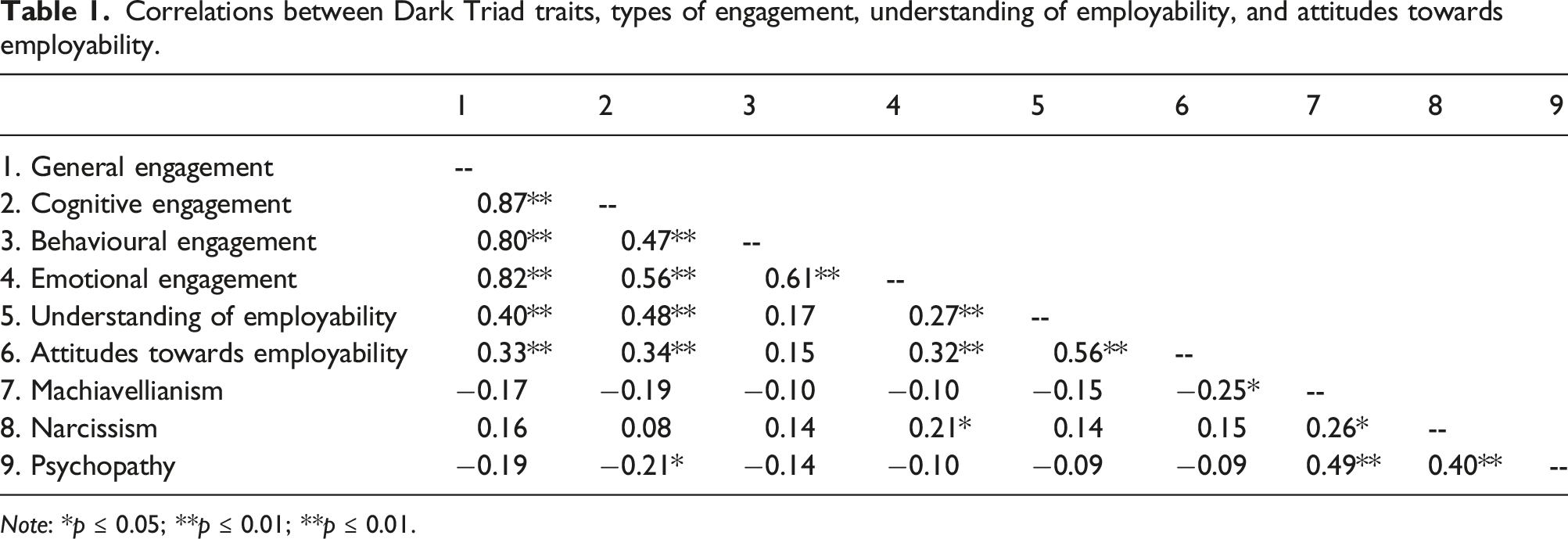
Note: *p ≤ 0.05; **p ≤ 0.01; **p ≤ 0.01.
Prediction of engagement, understanding of employability, and attitudes towards employability by Dark Triad personality traits.
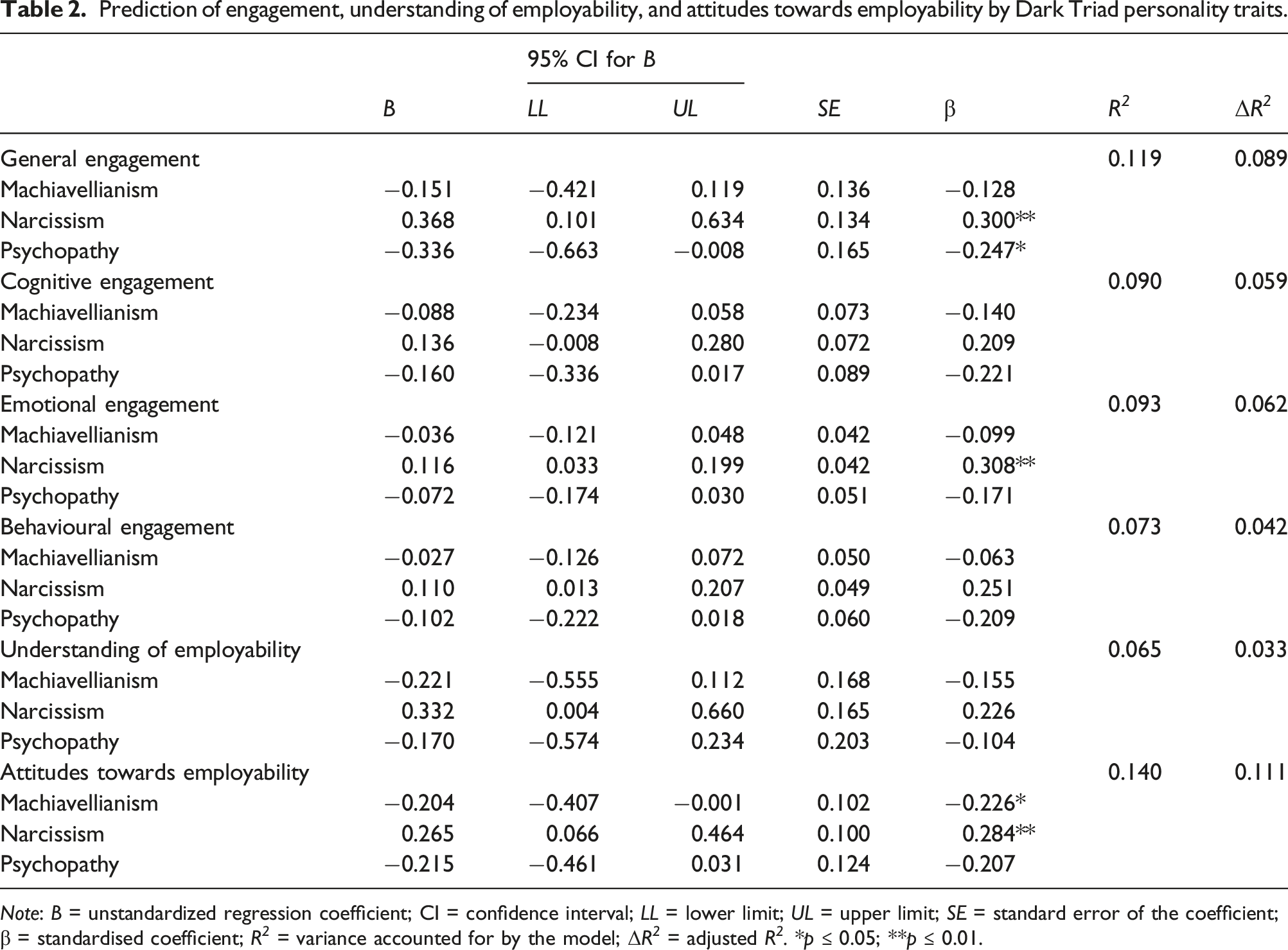
Note: B = unstandardized regression coefficient; CI = confidence interval; LL = lower limit; UL = upper limit; SE = standard error of the coefficient;β = standardised coefficient; R 2 = variance accounted for by the model; ΔR 2 = adjusted R 2 . *p ≤ 0.05; **p ≤ 0.01.
General engagement
A multiple regression was run to determine whether DT traits predict general engagement with learning. The model was significant: F (3, 88) = 3.968, p = 0.01, adj. R 2 = 0.09. Increases in narcissism (β = 0.30, p < 0.01) and decreases in psychopathy (β = −0.25, p < 0.05) were both associated with increased general engagement. Machiavellianism (β = 0.27, p > 0.05) did not predict general engagement.
Cognitive engagement
A multiple regression was run to determine whether DT traits predict cognitive engagement. The model was significant: F (3, 88) = 2.911, p < 0.05, adj. R 2 = 0.06. However, none of the individual predictors reached significance; thus, Machiavellianism (β = −0.14, p > 0.05), narcissism (β = 0.21, p > 0.05) and psychopathy (β = −0.22, p > 0.05) were not associated with increased cognitive engagement.
Behavioural engagement
A multiple regression was run to determine whether DT traits predict behavioural engagement. The model was not significant: F (3, 89) = 2.348, p > 0.05. However, increases in narcissism were associated with increases in behavioural engagement: β = 0.25, p < 0.05. Consequently, a linear regression was conducted to assess whether narcissism is independently predictive of behavioural engagement. The resulting model was non-significant: F (1, 92) = 1.818, p > 0.05. Thus, none of the DT traits predicted behavioural engagement.
Emotional engagement
A multiple regression was conducted to determine whether DT traits predict emotional engagement. The regression model was significant: F (3, 89) = 3.029, p < 0.05, adj. R 2 = 0.06. Increases in narcissism (β = 0.31, p < 0.01) were associated with increased emotional engagement. Machiavellianism (β = −0.40, p > 0.05) and psychopathy (β = −0.17, p > 0.05) did not predict emotional engagement.
Understanding of employability
A multiple regression was run to determine whether DT traits predict understanding of employability. The model was non-significant: F (3, 89) = 2.051, p > 0.05. However, increases in narcissism were associated with increases in understanding: β = 0.23, p < 0.05. Consequently, a linear regression was conducted to assess whether narcissism is independently predictive of understanding of employability. The resulting model was non-significant: F (1, 92) = 1.873, p > 0.05. Thus, none of the DT traits predicted understanding of employability.
Attitudes towards employability
A multiple regression was conducted to determine whether DT traits predict attitudes towards employability. The model was significant: F (3, 89) = 4.826, p < 0.01, adj. R 2 = 0.11. Increases in narcissism (β = 0.28, p = 0.01) and decreases in Machiavellianism (β = −0.23, p < 0.05) were both associated with more positive attitudes towards employability, but psychopathy (β = −0.21, p > 0.05) was not.
Discussion
Despite the well-documented associations between personality traits and positive academic outcomes (e.g. Chamorro-Premuzic and Furnham, 2003; Jensen, 2015; Khatibi and Khormaei, 2016), existing research tends to utilise the FFM of prosocial traits when investigating the impact of personality on engagement or students’ approaches to employability. Thus, the aim of this study was to ascertain whether socially aversive personality traits (the Dark Triad; Paulhus and Williams, 2002) predict different levels of students’ engagement with their modules; students’ understanding of employability; or students’ attitudes towards employability.
Following Qureshi et al. (2016), it was hypothesised (H1) that the 3 DT traits would predict lower levels of all types of engagement. This hypothesis was only partially supported, with psychopathy negatively predicting general engagement. Pearson’s correlations indicated that psychopathy was also negatively associated with cognitive engagement; thus, psychopathy may be linked in some way to lower levels of cognitive engagement. However, unlike the relationship between psychopathy and general engagement, this trait cannot be said to be causally related to cognitive engagement. Meanwhile, narcissism was found to be positively predictive of both general and emotional engagement, contradicting what was predicted in H1. Lastly, Machiavellianism was not found to predict any level of student engagement in this study.
It was further hypothesised (H2) that DT traits would negatively predict students’ understanding of employability (Neneh, 2019). This was not supported by the study’s results, as neither psychopathy, narcissism nor Machiavellianism were predictive of this construct. Finally, the prediction (H3) that DT traits would positively predict attitudes towards employability (Kajonius et al., 2015) was partially supported. Narcissism positively predicted attitudes, but Machiavellianism was negatively predictive of attitudes towards employability. Psychopathy did not predict this construct.
Taken together, it appears that subclinical narcissism is positively predictive of general and emotional engagement, as well as attitudes towards employability. Meanwhile, high scores on psychopathy predict lower levels of general engagement with learning, and scoring high on Machiavellianism is predictive of holding less positive attitudes towards employability.
It is also worth noting that all types of engagement (general, behavioural, emotional and cognitive) yielded moderate to high positive correlations with one another (Table 1), and both understanding of employability and attitudes towards employability were positively correlated with general, cognitive and emotional engagement. This illustrates that, although student engagement is a multifaceted construct, it is unlikely that a student will exhibit high levels of one type of engagement without also being strongly engaged on the other dimensions. Moreover, students who demonstrate high levels of engagement tend to understand the concept of employability and hold positive attitudes towards it; the only exception is for behavioural engagement, which was not linked to employability in this study. This pattern indicates that students who are engaged on general, emotional and cognitive levels with their learning are likely to simultaneously engage with the concept of employability and believe in its value. However, this link disappears if the student is only engaged behaviourally, whereby they complete their tasks and attend classes as required, but fail to do the deeper work of engaging with course material on emotional or cognitive levels. This pattern illustrates the necessity of fostering holistic engagement in students, whereby behavioural, cognitive and affective engagement are all targeted in the curricula and mode of delivery.
Furthermore, research by Trowler (2015) built on the tripartite model of engagement presented by Fredricks et al. (2004) suggesting that, although these three types of engagement adequately represent the type of learning that is effected in further education (college), several additional facets of engagement can be considered to differentiate students’ experiences of learning in higher education. These facets are critical (the student’s orientation to authority), political (the student’s agency) and socio-cultural engagement (the student’s relationship to structures, systems and processes). According to Trowler et al. (2021), this expanded, more nuanced model of student engagement better captures the student experience in higher education, and it is important to acknowledge that their engagement will be fluid and multifaceted. Thus, all types of engagement must be targeted by HEIs, with the understanding that not all types will be achieved at all times (Trowler et al., 2021), but this is part of the student’s journey through higher education as they become graduate workers and citizens (Artess et al., 2017).
Although it was not predicted that narcissism would positively predict general and emotional engagement, this finding may be explained by the aforementioned associations between this trait and academic entitlement (Turnipseed and Cohen, 2015) and power (Kajonius et al., 2015). For instance, students who score high on narcissism are likely to have a strong motivation for career success, requiring some degree of engagement with their studies. However, because they feel entitled to high grades with little effort, they may deem it unnecessary to engage with course material or activities on a behavioural or cognitive level, believing that they can and should succeed academically without exerting this effort. Nonetheless, this proposition does not explain why this study did not find negative causal relationships between narcissism and behavioural or cognitive engagement, between psychopathy and cognitive, behavioural or emotional engagement, or between Machiavellianism and any level of engagement. However, perhaps the lack of negative relationships between these traits and various types of engagement can be explained by the fact that employability is increasingly embedded in the curricula. It is emphasised in the literature that today’s university students are acutely aware of the competitiveness of the job market (Chan, 2012; Fotiadou, 2020), and that their participation in higher education is often largely motivated by the desire to make themselves more employable (Artess et al., 2017; Trowler et al., 2019). In this way, ‘student success’ can no longer be measured in a purely academic sense, as graduate outcomes are increasingly linked to their acquisition of gainful employment and their ability to succeed in a competitive job market. Given that employability is increasingly integrated into course materials and assessments, success in one’s modules cannot be easily separated from success in the obtainment of employable skills, as the two concepts are intrinsically linked. Thus, given the strong associations between DT traits and orientations towards achievement and power highlighted by Kajonius et al. (2015), students high on these traits may in fact thrive on this ideology of competition in modern HEIs. As a result, high-DT students may have harnessed this awareness of the competitive job market, understanding that, in order to achieve their career goals, they must engage with their modules. This would explain why engagement was not consistently negatively linked with the DT traits in this study.
Implications
The results of this study demonstrate that when a student is engaged with their learning on one level they are likely to engage on the other levels as well. Furthermore, students who are highly engaged with their studies tend to better understand employability, an essential graduate attribute (Davey and Tucker, 2010; Zajacova et al., 2019) and to regard it more positively. To this end, university teaching staff have a responsibility to deliver the curriculum in a manner that positions students for success in achieving the required learning outcomes. Thus, fostering high levels of engagement in undergraduate students is crucially important for both subject-level learning and students’ broader development as employable citizens who possess the necessary skills to achieve their career goals.
This study, in conjunction with Qureshi et al.’s (2016) findings regarding FFM trait differences in students, has highlighted that individual differences can impact students’ engagement with their learning. Tentatively, the results indicate that students who are high in narcissistic traits are more likely to engage with their learning and hold positive attitudes towards employability, whilst students who are high in psychopathic traits may be less likely to engage with their learning, and those who are high in Machiavellianism may hold more negative attitudes towards employability. Educators should therefore endeavour to consider ways they can adapt their teaching approaches to better engage students for whom the status quo is ineffective. In the case of students who exhibit high levels of socially aversive personality traits, this may involve appealing to their logical, goal-driven or egotistical tendencies. For example, activities that involve self-promotion or competition between students are likely to appeal to individuals who score high on Dark Triad traits, as are activities that are transparently, explicitly conducive to helping them obtain their desired career. In the case of professional degrees (e.g. nursing, teaching), assignments and activities are often inherently linked to career development; for example, work-based learning such as industry placements or internships are frequently integrated as compulsory components of professional degree programmes. However, for students on non-professional degree programmes, the real-world applicability and purposes of assigned tasks are not always readily apparent. For students who possess high levels of socially aversive traits, these links may need to be made more explicit in order to foster adequate levels of engagement.
This study has highlighted that students who are engaged only on a behavioural level do not tend to fully understand employability, nor do they regard it positively. However, students who are high in DT traits are characteristically disengaged emotionally (Jones and Paulhus, 2014; Paulhus and Williams, 2002), regardless of situational context. Thus, appeals to enhance emotional engagement may not be the most effective route through which to foster overall engagement in these students. Consequently, on the basis of individual differences in personality traits, it is crucial that university educators aim to encourage all 4 levels of engagement, as students will naturally vary on which type is most effective for their personal academic success. However, recent work by Trowler (2015) and Trowler et al. (2021) highlights the need to look beyond these 4 levels of engagement in a higher education context, and to include the three additional facets of critical, political and socio-cultural engagement. Future studies should therefore endeavour to incorporate these types of engagement in their research, examining how the seven types interact and under which conditions students are most likely to thrive in achieving them. It is particularly important to scrutinize the roles of the 3 additional facets that differentiate higher education from further education, as they may hold unique explanatory power when investigating how to encourage university students’ engagement with their learning. According to Trowler et al. (2021), critical engagement may be enhanced by encouraging greater depth of reflection in students; political engagement may be improved by facilitating autonomy; and socio-cultural engagement may be underpinned by fostering student belonging among their peers, teachers and within the university community itself. Higher education institutions have a responsibility to ensure that these avenues are addressed in curricula and in the university culture as a whole, in order to bridge the gaps between students’ motivation and their ability to succeed in university and in their future careers.
Limitations
The current research holds some key limitations that may explain why so few of the hypothesised relationships were observed in the data. First, the vast majority (92.6%) of the sample identified as female. Although this is not ideal, it is representative of the typical gender distribution of psychology undergraduates, from which the sample was taken. However, it has been well-documented in the DT literature (see Furnham et al., 2013, for a review) that females consistently score lower on these traits than do males. Second, the sample was even more homogenous with regard to academic discipline, with 100% of participants being psychology students. Previous research indicates that individuals who major in psychology tend to score lower on these traits than students in other academic disciplines. One study (Mooney, 2019) observed that psychology students score lower than business students on all three traits, whilst another (Vedel and Thomsen, 2017) confirmed that psychology students score lower on narcissism and Machiavellianism than business students, and lower than law and political science students on all DT traits. Overall, these findings suggest that female psychology students may score particularly low on DT traits; this homogeneity may have resulted in an elevated risk of Type II error, or floor effects regarding the sample’s distribution of DT traits. This highlights a need for future studies to incorporate students of other genders and majors when attempting to further investigate relationships between DT traits and academic outcomes. For instance, it would be beneficial to explore whether business students or those on professional programmes have a qualitatively different understanding of employability from students on other programmes that do not translate as directly into a specific career path, such as psychology or history, and how the relationships between their engagement and their attitudes towards and understanding of employability may vary compared to the current study. It would also be useful to examine these relationships in students of other nationalities, as cultural differences may impact patterns in personality traits (e.g. Jonason et al., 2017).
Finally, the materials used to measure student engagement, understanding of employability and attitudes towards employability (Qureshi et al., 2016) in this study have not yet been widely validated, nor have their psychometric properties been established. Consequently, measurement issues may have impacted the study’s results, particularly given the subthreshold internal consistency observed in the Student Engagement Questionnaire. The emotional engagement scale comprises just four items, and the behavioural engagement scale only has five; these scales may therefore be insufficient to accurately capture these constructs. In addition, wording was altered on Student Engagement Questionnaire in order to ensure that questions were asking about students’ engagement with their modules in general, rather than with one specific module. This may have resulted in confusion for participants, who may feel highly engaged on modules in which they are genuinely interested but who exhibit lower levels of engagement on modules they deem less interesting. In some cases, this contradiction may have prevented the questionnaire from accurately capturing the student’s overall level of engagement at university. Hence, future research should seek to validate these measures further in order to establish their psychometric robustness for measuring the variables of interest. Furthermore, given the recommendations of Trowler (2015) and Trowler et al. (2021), the Student Engagement Questionnaire should also be expanded to include the three additional facets of engagement discussed above. The incorporation of these other facets is believed to represent a best-practice approach to investigating engagement in higher education, as the previous model by Fredricks et al. (2004) has been suggested to better capture the student experience in further education (Trowler et al., 2021), rendering it inappropriate for use in higher education settings. Future research can therefore improve greatly on the current study by taking a more current approach to its conceptualisation of student engagement in higher education.
Conclusion and recommendations
This study has highlighted some of the ways in which individual differences in DT personality traits may influence the manner and degree to which different students engage with their learning or perceive the notion of employability. Although the study has some limitations that justify a need for further research, it can be tentatively concluded that students who are high in narcissistic traits are more engaged and hold more positive attitudes towards employability whilst less favorable attitudes are held by individuals who score high on Machiavellianism. Meanwhile, students who are high in psychopathic traits may be less likely to engage with their learning. Together, these findings underscore the necessity of tailoring teaching approaches to appeal to that which motivates students (e.g. power, achievement; Kajonius et al., 2015) who are high on these traits. Accordingly, university educators should diversify their approaches to fostering student engagement in a reflection of the varied traits and drives exhibited by different students. Likewise, to facilitate student engagement with employability, HEIs should prioritise offering work-based learning opportunities to all students, not just those enrolled in professional degree programmes, with the long-term goal of integrating such experiences as compulsory degree components. According to Durazzi (2021), the employability agendas of HEIs in England are more driven by the needs of the higher education market than they are aligned with the needs of the labour market. Higher education institutions should therefore work in partnership with employers to ensure that the employability and skills initiatives embedded in the HEI structure and curricula accurately reflect the needs of the labour market their graduates will be entering. As employability is increasingly emphasised in higher education, it is clear that HEIs should not operate independently of the labour market, nor should they neglect the wealth of insight that industry can provide. Research and practice in HEIs should therefore prioritise partnerships with industry to ensure students’ seamless transitions to graduate citizens whose skills meet the needs of their future employers.
Footnotes
Acknowledgements
The author would like to thank Helena Knapton for her invaluable feedback on this research project.
Declaration of conflicting interests
The author(s) declared no potential conflicts of interest with respect to the research, authorship, and/or publication of this article.
Funding
The author(s) received no financial support for the research, authorship, and/or publication of this article.
Ethical considerations
In designing this study, appropriate consideration was given to potential ethical issues. Ethical approval was obtained from the university’s Centre for Teaching and Learning Research Ethical Approval Panel. The study was conducted in an online environment in order to minimise physical barriers to participation, such as having to travel to campus to complete the questionnaires in person. Participants were also appropriately compensated with course credit for their contribution to this research. Finally, the topic itself was chosen for its direct relevance to improving the university experience and its associated outcomes for its participants and the wider undergraduate population in the UK.
