



Abstract
Inherent Simmelian foundations anchor the theoretical base of the Triple Helix model. The Triple Helix model polishes the theoretical lens of Georg Simmel, revealing the empirical basis of intermediating ties in entrepreneurship and innovation. This Viewpoint article takes the path-breaking weak and strong ties approach of Mark Granovetter a step beyond the search for existing jobs into the realm of entrepreneurship and innovation: the task of creating new jobs. Building on Granovetter’s counter-intuitive social ties model, the perspicacity of intermediate ties is that they constitute an often invisible category of collegial and friendship ties that may be induced or repressed in varying organizational formats. Such ties are key building blocks, supplying missing dimensions of talent and mediation in entrepreneurial start-ups, often making the difference between success and failure.
Who is Mark Merkulla? Santa Clara university faculty and students may recognize the name as the donor of the university’s Ethics Center while Apple trivia aficionados will know him as the firm’s third founder, save the temporary presence of an early investor who returned stock, spooked by ownership responsibility. Steve Jobs, charismatic entrepreneur, and Stephen Wozniak, technical wizard, were close childhood friends, morphing into adulthood with the intention of turning the personal computer, a hobbiest obsession, into a commercial enterprise. Although they had a demo machine and a garage-based assembly team, the nascent Apple firm had difficulty being taken seriously until they recruited Mark Merkulla, at 35, an early retired executive from the semi-conductor industry who provided a key missing element – business experience – enabling firm take-off (Freiberger and Swaine, 1984).
We hypothesize that the intermediate tie, a relatively invisible yet commonplace ordinal category of colleagueship and friendship, in between the weak ties of simple information provision and the strong ties of emotional attachment, is the key to the successful formation of entrepreneurial ventures. Apple’s British analogue, Acorn, provides a converse cautionary exemplar. Begun in Cambridge in the UK, before Cambridgeshire emerged as a modest high-tech district, Acorn’s two partners disputed issues without a moderating third element, resulting in the dissolution of a promising firm, arguably due to the lack of sufficient suitable candidates in a region in the earliest stages of high-tech agglomeration. Even before the Silicon Valley label was affixed in the 1970s, technology entrepreneurship had been characteristic of the mid-peninsula region of northern California. For example, Federal Telegraph, an early firm, contributed a large-scale magnet, technically superseded in its radio transmission business, to the construction of the Berkeley cyclotron in the 1930s. The technology industry had emerged virtually simultaneously with the founding of Stanford University. Indeed, the university was a significant impetus to its development given that the founding administration and engineering faculty foresaw the need for a technical industrial penumbra to nurture academic excellence, and vice versa, in a symbiotic relationship, and took steps to nurture its creation (Etzkowitz, 2022).
Thus, the entrepreneurial university existed in nucleo long before the term was invented. Similarly, the Triple Helix of university–industry–government relations was an early 20th century New England regional renewal practice, decades before it was theorized (Etzkowitz and Leydesdorff, 2000). In the following, we explore the social foundations of the Schumpeterian Mark I enterprise, bringing sociological analysis of social ties into innovation studies, following social media entrepreneurs like Mark Zuckerberg, who have built their enterprises reinventing Sociology 101. We depart from an actor-centric individualistic approach characteristic of classical and contemporary micro-economics towards a ties-focused view as the basic social unit, following Aristotle rather than Hobbes. This paper thus views the entrepreneurial venture as a cooperative interactive phenomenon rather than an entity springing from the brow of the heroic entrepreneur, a strong tendency especially noted in 19th century accounts of Andrew Carnegie and his peers (Godelier, 2007).
Social economy and civil society
Civil society is the undergirding of the Triple Helix of university, industry and government rather than an institutional sphere on the same level. Civil society institutions, such as a free press, the rights of assembly and free speech, guaranteed by constitutional and legal frameworks, constitute the environment in which interaction may freely take place – rather than requiring permission for groups of more than three to assemble, a typical totalitarian limit. It is in the context of civil society that voluntary associations arise for a variety of purposes: social, political, religious, charitable and innovation (e.g., hackathons). As such, with a few notable exceptions, such as contraceptive technology, civil society has been more successful outside the remit of the government where it has been very resolute in halting the development of dangerous technologies – for example, the peace movement with respect to nuclear weapons and the anti-nuclear movement with respect to nuclear reactors. In these activities, the precautionary principle has provided a framework for civil society organizations to question the ill effects of new technologies and to request the legislation of restrictions. In fact, during the outbreak of Covid-19 pandemic, Triple Helix cluster initiatives with industry and government in collaboration were in full flow as they addressed the vaccine gap. Start-ups and large firms acting like start-ups, with governments providing resources and encouraging multiple initiatives, were the order of the day.
Whereas control of land and the extension of territory constituted the traditional basis of political and economic power, the acquisition and expansion of knowledge supersedes the traditional definition and is the basis of a fundamental transformation of the sources of power and authority in contemporary societies, with implications for the institutional order. Just as the economy and polity were the primary institutions of traditional territory-based societies, universities, as the leading knowledge producing and dissemination institutions, have risen to the status of primary institutions in equality with the economy and polity. This transformation of the institutional order from a Double to a Triple Helix has several consequences. Notable among these is the reduced prominence of control over land mass as the basis of political power – for example, during the Vietnam War as the Vietminh gained people’s loyalty, running a shadow administration that became visible at night, marginalizing the Americans’ and their allies’ perilous facade of control over land, superseding Max Weber’s classic definition of the basis of power.
As economic decline propels more investment in research in hopes of stimulating future economic development and economic rise makes more surplus available to support science both good time and bad times are supportive of research spending. This perhaps explains the continuing rise in scientific productivity, at least as measured by articles published. The Second World War validated the usefulness of scientific knowledge for a variety of military purposes and took it a level beyond narrower First World War and previous industrial and agricultural uses.
In societies in which separate spheres with strong boundaries exist, the societal goal is towards the emergence of a Triple Helix innovation regime that harnesses the overlapping spheres for knowledge-based innovation and development. There is the fear, though, that in this scenario, especially where intermediaries are superfluous given the integration of the spheres towards a unified regime, there is the likelihood that a disequilibrium may emerge if the trilateral linkages are not given an institutional cast: university, industry and government each acting as a tertius gaudens to instigate innovation (Etzkowitz, 2008: 25). This is so because predicating transformations only on the basis of strong ties is untenable, especially in innovation performance, without equally strong support from weak and intermediate ties.
From nominal to ordinal intermediate ties
The current understanding of social ties highlights strong and weak types of ties – corresponding to a relatively stronger or weaker trust-bond between individuals as well as smaller or larger gaps in individuals’ perceptions shaped by the institutional logics (Thornton and Ocasio, 2008) they are rooted to (Granovetter, 1973). Strong and weak ties seem to play different, often complementary, roles in the processes of innovation and entrepreneurship. For instance, in innovation processes ‘weak ties aid exploration (the generation of new ideas), whereas strong ties aid exploitation (the implementation of new ideas)’ (Barrie et al., 2019: 212). Regarding entrepreneurship, ‘nascent entrepreneurs draw especially on their weak tie network for bootstrapping activities’ (Grichnik et al., 2014: 311), while strong ties are useful for entrepreneurs in acquiring resources, support and information (Jack et al., 2004; Villanueva et al., 2006).
Intermediate ties may arise informally, available as a substrate of friendship and collegial interactions that traditionally emerge from contiguity (or also through contemporary social media interaction). Such ties may even appear in extreme situations of expected antagonism, such as that in a Columbia FARC guerrilla unit where romantic attachment arose between a guard and a hostage prisoner (the former was eventually killed and the clandestine relationship ended during a successful rescue by a national military unit). Camaraderie arises among prisoners who have little in common apart from their common incarceration. A Nous la Liberté, René Claire’s classic film, shows the solidarity in such a relationship when, during an escape attempt, one is about to be caught and encourages the other to flee. When they later meet up by chance after the latter has achieved a high position while the former has not, their relationship as equals spontaneously revives, renewing their early solidarity as fellow prisoners.
Intermediate ties are often structurally induced byproducts of the normal, everyday workings of an organization; for example, the distribution requirement in US universities, instituted to ensure that graduates have a diverse educational experience across the educational spectrum also places people with different but complementary skills in contiguity, serendipitously opening up new possibilities. Thus an undergraduate computer science student taking a biology module was recruited by graduate student teaching assistants to do coding in their biotechnology start-up. The operation of an academic system of a particular type produced a result that otherwise would only be achieved through direct policy intervention. In this context, the incubator director at the National Autonomous University of Mexico (UNAM) organized a joint course involving business and engineering students in the expectation that the social ties created in the course would be available to be called upon later in life, bringing together business and technical skills for high-tech venture creation.
Retzer (2010) builds on Granovetter’s (1973) classic strong–weak divide of social ties with a focus on unexpected utility of distant contacts for transfer of useful knowledge under conditions of discrete interactivity into the realm of reciprocal exchange of information across research organization boundaries in public, private and academic sectors. The context of such Triple Helix relations provides a particularly interesting setting for studying the social ties further and exploring any additional forms the ties could take as it implies that actors with very different institutional logics can build and maintain a relationship for advancing innovation and entrepreneurship (Perkmann et al., 2022). Retzer (2010) and Retzer et al. (2012) further uses the reciprocity and contact frequency of social relations on a sliding scale to define intermediate ties as an inter-organizational linking mechanism.
His paper, thus takes steps towards perceiving different social tie types not as nominal but as ordinal, interlinked categories of ties that could be captured through a two-dimensional typology (Figure 1). The first dimension distinguishes the trust level between two actors connected through a social tie: High and Low. The second dimension distinguishes the institutional distance between the networks to which the actors, connected through a social tie, belong. Two essential things to be noted: (1) the weak ties defined by Granovetter may concern both weak and intermediate ties in our typology; (2) while strong and weak ties relate to dyadic relations, intermediate ties deal with triad/two-pair relations. Our preliminary conceptualization of different types of ties in our typology is described as follows. A new typology of social ties.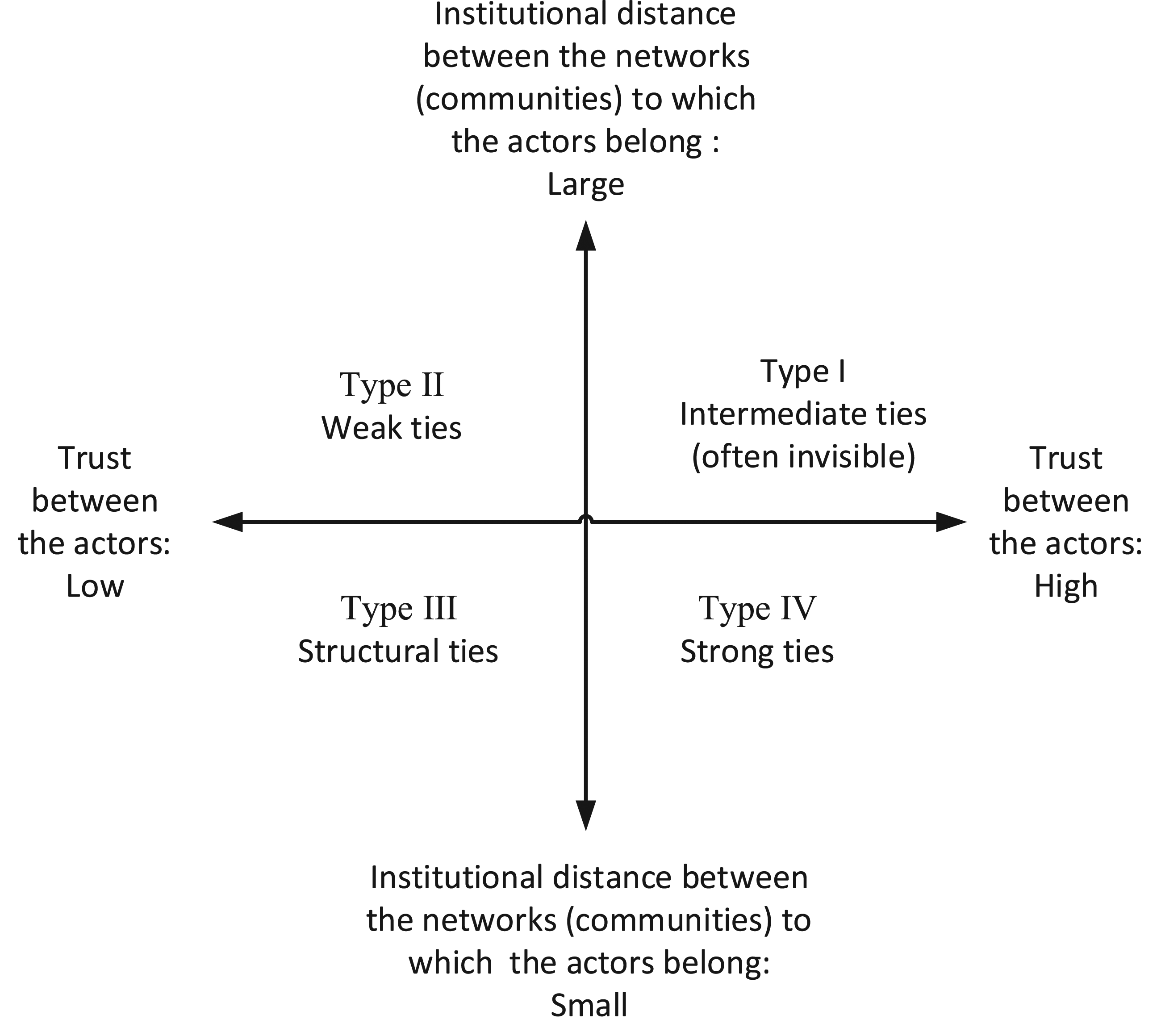
Strong ties represent a widely-studied phenomenon of tight inter-organizational connection, where institutional logics align and inter-organizational trust has been developed (Todo et al., 2016). This kind of tie could develop organically because of institutional isomorphism, where organizations with similar institutional logics naturally build trust between each other relatively quickly (DiMaggio and Powell, 1983). An example of such ties could be relations between researchers from two research institutions (typically in the same field) working on a joint research project – their institutional logics align as both are representing the research sector and the level of trust is organically high as competition is minimized and complementarity of resources and capabilities is embraced. That could provide a basis for science-driven idea generation – an integral part of innovation; see what a young researcher says about a particular strong social tie helping their research-to-business idea emerge: “[…] Most active person number one is […] my [PhD] opponent and collaborator […] He is not very close to actually business reality as it is in companies […] he actually recognized quite a potential in this and also being context independent or context agnostic. And he started to force me to actually direct my research into more into making this approach apply to different cases, which we started slowly to do […] for judging that it's indeed industry agnostic and might be applied to any computational model […]”
Another interviewee starting a business highlights the importance of trust: “We first met at the engineering school in 2015. It was in the school before and shortly after, as I said, we joined the club […] for promoting social entrepreneurship […] And from then, our relationship started, and it kept till this date. So, it has been on for seven years now […] it's based on trust, trust is my number one like criteria for making that friend or business partner […]”
Although this kind of strong social tie develops organically and proves its value, the research also points out the weaknesses of such relations, particularly in terms of innovation performance (Fliaster and Spiess, 2008). The argument is simple: “interaction brings similarity” (Brass et al., 1998; Fliaster and Spiess, 2008: 107). Well-aligned institutional logics push organizations and individual actors towards a homogeneous way of thinking and development, which may eventually hinder new value creation and innovation.
An opposite to a strong alignment in institutional logics is “institutional arbitrage” – a concept proposed by Perkmann and Phillips (2011) and referring to diverging organizational logics where room for complementarity in terms of resources, legitimacy and ideas exists and provides opportunities for innovation development (Cai, 2022). In such relations, trust has yet to be developed and organizations come from diverse organizational groups; the inter-organizational relations across groups represent weak ties (Granovetter, 1973). Leveraging such weak ties helps overcome the homogeneous thinking present in strong ties and provides more room for less linear but more disruptive innovation. The lack or weakness of such ties creates ‘structural holes’ between organizational groups, and so brokerage is called on to help fill those gaps (Burt, 2004). An example of weak ties in the innovation management context is a weak link between a research institution and commercial company existing in parallel networks or consortia and linked via, for example, a player belonging to both consortia.]
Collaboration between different sectors or fields often creates large institutional distance, and trust between collaborators has yet to be developed. However, such ties may eventually form a basis for a fundamental innovative shift – a thesis that provides ground for open innovation practices across organizational boundaries and institutional logics (Bessant and Möslein, 2011; Laursen and Salter, 2004; Lauto et al., 2013). However, weak ties inevitably have complications due to both diverging institutional logics and a low level of trust; see how a young academic facing a dilemma of whether to establish a new business out of their research idea struggles while seeking advice from an experienced start-up community: “They [the start-up community] all push me towards fundraising, while I struggle: the idea does not fly as fast as I hoped it would, and it could happen that it never flies […] I start to doubt whether a start-up is the right way for my idea, maybe I should bring [my idea] to the world via writing a book […] And yes, they [start-uppers, investors] share positive feedback on my idea, very encouraging, but when it comes down to investment they pass […] ”
Note how diverging institutional logics (commercial versus scientific; closed versus publishing) clash and how an organically low level of trust limits the initially intended innovation pathway.
While the evolution of institutional logics towards more homogeneity between two institutionally distant organizations is hardly possible and even unnecessary – to avoid being homogeneous and embrace diverse thinking – trust development is possible. However, as the trust level is increased, the tie stops being a classical ‘weak tie’ and we arrive at intermediate ties. Usually, such relations are not obvious and trust is often developed or activated through bridging actors. Examples of these types of tie can be found in Cai’s (2022) research on developing transnational university–industry co-innovation networks. For instance, researchers from universities across two countries who have past relations with business actors in those countries can bridge the business actors. The institutional distance between the research and commercial actors is large, but the trust is present through past relations and established networks. Other examples of intermediate ties are actual intermediary actors – research and commercialization offices, independent advisors and business mentors; see our interviewee’s reflection: “[The mentor] was the one bringing the perspective of commercialization into the space […] They introduced me to all the new terminology, all the new processes, was how it can be done in terms of bringing the invention from academia to the business […]”
This is a borderline example representing links existing somewhere in the middle of the strong–weak spectrum, and thus the ‘intermediate’ ties are the university researcher’s or teacher’s ties with students and alumni: “I was tapping into the pool of my best [course] students […] who got out years ago and started to be somebody in industry […]”.
In such cases there is room for some level of trust already developed through past teacher–student interaction and familiarity with different institutional logics due to a shared university environment in the past.
The last type of social tie on the proposed matrix conceptualizes relationships where the institutional distance is small and the trust level is expected to lean towards high, as organically happens in strong ties, but does not. Despite the low level of trust, the existence of such relations may prove its necessity. We expect this kind of tie to exist in, for instance, a legal context. For example, even in homogeneous consortia of research institutions, where the level of trust between research teams is organically high (low competition, high complementarity), the administration team, and particularly lawyers, should purposively keep the attitude towards its organizational partner cold – to protect the organization’s own interests and boundaries, and to avoid lock-ins, knowledge leakages and power imbalances. These are structural ties, which are necessary and are established to support the innovation process but are not directed towards innovation activity. This type of tie can support not only strong but also weak ties through, for example, such tools as shared digital identity (Bouncken and Barwinski, 2021). Another example of structural ties in the academic world can be found in an academic author–reviewer relations, where a high level of trust a priori cannot be established given the policy of anonymity and the very nature of the reviewer’s task: “[…] We were also fighting with reviewers quite a lot for some applied journal, and those reviewers were forcing us to compare our methods to commercial solutions that are already available. The point was that, OK, maybe in academia nothing is published, but commercially [something like that] already exists. So, your paper is not worth anything. And that forced me for the first time to actually think what is outside in the, in the kind of applied world and in the commercial world. And we realized while defending the positions of our paper that the methodology actually stands some chances also out there, not just academically alone.”
Different ties perform different functions, rather than existing on a continuum, with relationship strength the defining criteria. As the Triple Helix mechanism for diffusion of innovation intensifies, there may be an increase in the call to add more helices, especially in regions where the university and industry spheres are weak. However, consider, for example, the Ghana market environmental oven case, in which Dr Zanetor Agyemang-Rawlings, a legislator for the Klottey Korle constituency in Accra, identified in her climate change advocacy market oven air pollution as an environmental, health and economic issue and utilized her intermediate Triple Helix ties to solve the problem. She focused on oven construction after an initial attempt to solve the problem through improved chimneys had failed. She was linked by a friend to an academic who had a technical solution but lacked the means to expand his innovation. By combining forces, in working together, they solved the community problem in a typical Triple Helix fashion. This was, in fact, a Triple Helix to the rescue moment and not only for the community oven, but for the Triple Helix model itself, which undergoes theoretical reconstruction and empirical consolidation through the mechanism of intermediate ties based on the principles of trust and reciprocity of action. These issues play out within an expanded framework of multiple triple helices – for example, the complementary Triple Helix twins of innovation and sustainability (Gebhardt et al., 2022; Zhou and Etzkowitz, 2021). There is also a “dark side” of agonistic military–industrial complexes (Eisenhower, 1961) and a confusing array of ad hoc reified static systems and their critique (Leydesdorff and Lawton-Smith, 2022).
Triple Helix foundations
Single actor institutional logics are superseded in Triple Helix theory and practice by a model that posits interaction among key institutional spheres as the prime mover of innovation and economic development. Paradoxically, the Triple Helix model of innovation and entrepreneurship is typically empirically investigated in studies focusing on a single actor, such as an entrepreneurial university (Etzkowitz, 1983), industry as a driving force of economic growth, the role of capital and the regulatory role of government (Perez, 2003).The pathway to a fully-functioning Triple Helix innovation regime is where “renovation in social relations occurs comparable to the one that took place during the transition to industrial society” (Etzkowitz, 2008: 25).
The Triple Helix represents, first and foremost, the complex exchange relations among various players, anchored in the novel principle of institutional role-taking, transcending single-purpose institutional logics. A partnership dominated by one actor only provides a limited source of ideas and initiatives, whereby one institutional actor initiates actions without broad consultation with the others. In the context of the Triple Helix, the ideas of classical social theorists Marx, Weber and Simmel and the later generations, among them Berger and Luckmann, informed the Triple Helix as a theory of the cooperative relationship between the institutional spheres that produce new conurbations of knowledge-based economic growth and clusters. In the process of this transition from the vertical hierarchies of traditional industrial epochs and their constitutive knowledge forms, tradition and expertise, to the knowledge-based society, “a renovation in social relations occurs comparable to the one that took place during the transition to industrial society” (Etzkowitz, 2008: 25). Political power generates economic wealth and the ability to live off politics, while ideas may be translated into economic and political power. As Simmel suggested, “every interaction is properly viewed as a kind of exchange though the meaning of exchange, moreover, is that the sum of values is greater afterward than it was before, and this implies that each party gives the other more than he had himself possessed” (Simmel, 1971: 43–44).The entrepreneurial university seeks out collaboration at various levels, from the micro level of the individual faculty member and the student to the meso-organizational level of the department and center and the macro level of the university as a whole becoming entrepreneurial, translating knowledge into new economic activity.
So, in a fully functioning Triple Helix regime where the consensus, innovation and knowledge spaces are fully operational based on the reciprocity of habitualized action that operates through institutional role-taking, the triadic interaction becomes active and enabling of the capitalization of knowledge. In Simmelian analogy: “The sociological structure of the dyad is characterized by two phenomena that are absent from it. One is the intensification of relation by a third element, or by a social framework that transcends both members of the dyad. The other is any disturbance and distraction of pure and immediate reciprocity. In some cases, it is precisely this absence which makes the dyadic relationship more intensive and strong. For, many otherwise undeveloped, unifying forces that derive from more remote psychical reservoirs come to life in the feeling of exclusive dependence upon one another and of hopelessness that cohesion might come from anywhere but immediate interaction. Likewise, they carefully avoid many disturbances and dangers into which confidence in a third party and in the triad, itself might lead the two. This intimacy, which is the tendency of relations between two persons, is the reason why the dyad constitutes the chief seat of jealousy.” (Wolff, 1950: 136)
However, the mere appearance of the third party is a signal that change is on the way. As Simmel put it, the triad indicates transition, conciliation and abandonment of absolute contrast. The triad as such seems to result in three kinds of typical group formations. All of them are impossible if there are only two elements; and, on the other hand, if there are more than three, they are either equally impossible or only expand in quantity but do not change their formal type (Wolff, 1950: 145). ‘Tertius gaudens’ offers various benefits in social relations, from mediation and cooperation to conflict and balance of power. The advantages of “tertius gaudens accrue to it not only from outright fight, but from the mere tension and latent antagonism between the other two: the advantages derive from the mere possibility of deciding in favour of one or the other, even if the matter does not come to an open contest” (Wolff, 1950: 158). The advantage accruing to the tertius derives from the fact that she or he has an equal, equally independent, and for this very reason decisive, relation to two others.
The advantage, however, does not exclusively depend on the hostility of the two. A certain general differentiation, mutual strangeness or qualitative dualism may be sufficient. This, in fact, is the basic formula of the type, and the hostility of the elements is merely a specific case of it, even if it is the most common (Wolff, 1950: 159). As such, what is needed to reconfigure the Triple Helix model is the awareness that power asymmetry and conflict are an inbuilt mechanism of the model itself, along with collaboration and cooperation, exemplified by “innovation organizer” led lateral brainstorming, for example, the classic New England Council U-I-G deliberations, breaking through innovation blockages, inventing and implementing the venture capital firm to bridge the ‘Valley of Death’ gap between invention and firm formation (Etzkowitz, 2002) as well as bottom-up multi-directional, multi-nodal sociation such as Internet crowdfunding. The evolutionary process from the institutionalization of habitualized practices of action and the restructuring and coordination of the constitutive elements from either top-down or bottom-up initiatives must aim at facilitating conditions that make it possible for a seamless integration of interaction-based exchange processes (Cai and Etzkowitz, 2020).
Berger and Luckmann (1966) showed how societies stabilized through their theory of institutionalization by de-emphasizing change processes and focusing more on institutional segmentation. This is done based on the erroneous impression that institutional segmentation alone might be the panacea for overcoming rigidities. Unfortunately, pursuing this one-sided rationalization means that we are often oblivious to the reality that, like all social edifices of meaning, the strength of the particular collectivity is what carries its sub-universe. To this end the question that requires our immediate attention is how social ties facilitate knowledge exchange for innovation and entrepreneurship in Triple Helix relations,
Conclusions
Gaps are filled in a Triple Helix regime with institutional spheres utilizing their taking-the-role-of-the-other potentials, with one or more spheres substituting for the relative absence of another. A seamless overlap of different types of social ties is created. Once fully absorbed and integrated, the full component of the innovation system is harnessed: the entrepreneurial university, science park, incubator, accelerator and venture capital are creatively brought together and engaged within and across Triple Helix boundary spaces (Champenois and Etzkowitz, 2018) based on their multiplicity of strong, weak and intermediate ties. Stated differently, the social ties represent a basic foundational element of the Triple Helix; the Crisscross of strong, weak, intermediate and structural ties improve the ability of a region to mobilize its knowledge base for innovation, entrepreneurship and job creation (GreaterCNY – US National Science Foundation Innovation Engine, Type 2 project proposal, 2023).
Classical economic theory tends to focus on the individual actors and the market (Smith, Ricardo, Mill), while classical sociological theory takes a more holistic view of society, examining the ways in which different actors interact and influence each other. Marx, Weber and Durkheim, despite their different political and ideological orientations, view social relations rather than the individual as the fundamental unit. Durkheim’s view in his analysis of suicide is that modern society is disintegrating from nomos into anomie. In Weber’s model of bureaucracy, democratic forms are inevitably sclerotizing into societal rigidification, with totalitarian implications. Impelled by rising industrial productivity, Marx’s analysis is that the contradictory social relations of capitalism will erupt into a clash, producing an egalitarian societal synthesis. Forces of production periodically supersede the relations of production in a dialectical chrysalis. In other words, while classical economic theory approaches the actor as the unit of analysis, sociological theory focuses on relations or social ties between the actors, seeing those ties as a foundation for social and economic institutions and their renovation (Granovetter, 2017).
The need for a deeper understanding of how the various forms of ties emerge and how they transform each other, as well as what role a specific dyadic tie could eventually play in triadic helix relations (e.g., enhance or hinder trust, protect further distinct institutional logics or push for other hybrid forms of organizations (Perkmann et al., 2022), invites further research and practice. Another avenue for future study is to understand how social ties evolved in the digital, post-Covid era of platforms and Zoom meetings and how business, political and social interactions have been transformed as a result. Might a specific type of tie be developed in digital, platform-based interaction relying on algorithms (Rajkumar et al., 2022)?
Note
This Viewpoint article draws on a pre-study for a comparative international research project on the role of different types of social ties in start-up formation and growth. Eschewing the ideology of the descent of new ventures from the brow of an heroic entrepreneur, we build on previous work on academic research groups as “quasi firms” (Etzkowitz, 1983) and the group qualification entry process of the Stanford Student Government originated StartX accelerator (Etzkowitz, 2013). Quotations are from initial interviews with start-up founders conducted in accordance with the Interview Guide reproduced in the Appendix. Enquiries are welcome for induction into the project, whose present members are based in Finland, Morocco, Ghana, Brazil and the USA.
Footnotes
Declaration of conflicting interests
The author(s) declared no potential conflicts of interest with respect to the research, authorship, and/or publication of this article.
Funding
The author(s) received no financial support for the research, authorship, and/or publication of this article.
