




Abstract
Building on social identity theory, the paper sheds new light on knowledge creation and performance within teams by enhancing our understanding of the role played by shared skill-based identity on knowledge creation and team performance. Besides addressing team coordination issues, this study helps bridge the gap between shared skill-based knowledge and knowledge creation as well as team performance. Based on two field studies, the authors found that (1) a shared skill-based identity leads to higher behavioral integration; (2) having skill-based knowledge enhances shared skill-based identity; (3) behavioral integration mediates the shared skill-based identity–team performance relationship. Overall, our findings demonstrate that shared skill-based identity plays a crucial role in team performance and knowledge creation by enhancing behavioral integration. However, although shared skill-based knowledge positively impacts shared skill-based identity, it has no direct effect on knowledge creation and team performance. The authors hence demonstrate that the factors influencing team performance are complex and individuals need to feel integrated in teams to create knowledge. Furthermore, the study provides empirical evidence that may advance the study of team performance and inform managers on how to form effective teams. For instance, the authors suggest that, when forming teams, managers should consider how each potential member defines their identity.
Evidence suggests that when employees feel integrated into their teams, the firm earns 21% higher profits (Harter, 2018) and revenues are 5.5 times higher than when they are not (Chandni, 2019). However, teams per se do not always lead to success and improve team performance (Allen and Hecht, 2004). For instance, managers report that 96% of failures are due to ineffective team collaboration (Stein, 2012) and 55% of surveyed corporate leaders indicate that team member misalignment is the primary barrier to knowledge creation and team effectiveness (Arruba, 2019; Lara and Hughey, 2008). Accordingly, advancing knowledge on team performance is an important topic for many businesses.
Extant research confirms that teams sometimes lead to higher knowledge creation and better firm performance. In essence, teams result in better ideas than a reliance on individuals (Carmeli and Shteigman, 2010; Woolley et al., 2010) because having a number of individuals working together offers access to diverse sets of knowledge, skills and perspectives (Bell et al., 2011; Lee et al., 2020; Perry-Smith and Shalley, 2014). Effective behavioral integration, where each team member is able to participate in the decision-making process, enables access to the knowledge and skills held by each member (Chen et al., 2021; Lara and Hughey, 2008; Tekleab et al., 2016). However, it is well-documented that teams do not guarantee success, as teamwork requires coordination (Salas et al., 2005) and poor integration or coordination can undermine teamwork achievements and knowledge creation (Barron, 2003; Chen et al., 2021; Mitchell and Nicholas, 2006). Overall, the current debates on team performance reveal that the factors and underlying mechanisms that enhance team coordination and ultimately knowledge creation and team performance are still unclear (Klotz et al., 2014; Lee et al., 2020; Mathieu et al., 2008; Rousseau et al., 2006).
One avenue for providing clarity to this debate is to investigate team members’ knowledge and identity. In fact, there are increasing discussions about the role played by knowledge (Fiore, 2008; Rink and Ellemers, 2010) and/or identity (Ford et al., 2013; Hinds and Mortensen, 2005; Lundqvist et al., 2015) in teamwork. Social identity theory (SIT: Tajel, 1982; Turner, 1975) helps towards an understanding of team coordination and its impact on team outcomes by offering a succinct prescription for improving outcomes and knowledge creation: when team members feel they have a similar identity coordination improves, resulting in higher team performance and enhanced knowledge creation (Ford et al., 2013; Hinds and Mortensen, 2005). This is because having a shared identity enables individuals to view team members as part of the in-group, thereby reducing coordination barriers since they approach problems with a similar perspective (Stets and Burke, 2000). However, existing research has focused on self-categorization in the team (Hinds and Mortensen, 2005) while ignoring the possibility of team members self-categorizing themselves in a task-related identity, such as project management, instead. Therefore, this study goes beyond the development of a shared team identity, via team identification, and instead focuses on the role of a shared skill-based identity, via skill identification, in team performance. Focusing on the mediating role of team identification may result in team management advice that is unnecessary and difficult to implement (Carlile, 2002). Developing team identification hence diverts resources to promoting social interactions that strive towards team formation instead of expending resources on the problem at hand. Instead, we argue that teams composed of members who identify with a task-relevant function, like project management, can improve behavioral integration and team performance. Moreover, the role knowledge plays in identity formation and ultimately in behavioral integration and team outputs has been ignored.
Collectively, these gaps guide this research. Specifically, this work focuses on whether and how having shared skill-based knowledge and identity impacts team processes and outcomes. ‘Shared skill-based knowledge’ refers to the average level of knowledge that teams have regarding a specific skill, ability or competency. Similarly, ‘shared skill-based identity’ refers to the average level at which team members identify themselves with a social group related to a skill. For instance, individuals can see themselves as sharing a part of their identity with the team or, as we argue, with various skills, such as project management, data analysis or writing. However, theorizing on the role of team member identity remains incomplete (Raible and Williams-Middleton, 2021). Specifically, research has failed to consider how a team member’s skill-based identity and corresponding knowledge level support or hinder knowledge creation and team performance. This is problematic as managers may mistakenly believe that selecting teams based on what potential members know is more important than who they think they are.
Therefore, to better understand how teams can integrate each team member into the decision-making process, facilitate teamwork behavior and improve overall team performance, this work investigates the factors and underlying mechanisms that enhance behavioral integration, knowledge creation and team performance. Specifically, we examine whether shared skilled-based knowledge and/or identity can help teamwork coordination by providing a shared orientation to work. To this end, building on SIT, we develop a conceptual framework wherein knowledge creation and team performance can be facilitated through behavioral integration and shared skill-based identity. We implement two complementary field studies to test our model. Study 1 tests the shared skill-based knowledge–behavioral integration relationship in a conservative context, one where team members do not have the necessary time to form routines and overcome coordination barriers; that is, a short-term project. Study 2 extends the project’s timeline, enabling us to examine whether the identified relationships still hold over longer projects, wherein teams can experience multiple coordination barriers and/or form routines. In particular, we situate this study in a project management context. Project management is an important and relevant skill in advancing team performance(Perry-Smith and Mannucci, 2017). Effective project management involves coordinating (Randel and Jaussi, 2003; Reagans et al., 2016) and sharing views and opinions (Mitchell et al., 2009; Van Knippenberg et al., 2004) that enhance team performance. We suggest that shared project management knowledge – shared skill-based knowledge – has a positive effect on knowledge creation and team performance via improved behavioral integration. However, this relationship is mediated by the team’s shared project management identity level – shared skill-based identity.
In this paper, we describe the theoretical background and the hypotheses of this work before presenting the methods designed to bridge the gap between shared skill-based knowledge and knowledge creation as well as team performance. Then, we explain the main results of our work. Last, we discuss the main findings of our study and provide concluding remarks.
Theoretical background and hypotheses development
Knowledge creation and team performance
In the pursuit of performance and innovation, teams are often developed. Relying on a team provides different perspectives on the problem at hand (Hoogendoorn et al., 2017; Horwitz and Horwitz, 2007) and generates more novel connections and ideas (Perry-Smith and Shalley, 2014). A team can consider and evaluate more ideas and options than a single individual (Williams & O’Reilly, 1998). However, team selection and formation are important factors in elevating team performance and knowledge creation. Indeed, teams composed of members with homogenous knowledge may generate knowledge redundancies, thereby creating less novel knowledge than those composed of individuals who are able to bring differing knowledge sets to the team (Chandrasekaran and Linderman, 2015). However, teams composed of heterogeneous individuals can lead to coordination difficulties (Cronin and Weingart, 2007), potential conflicts and information sharing inefficiencies (Ambrose et al., 2018), due to differing knowledge sets but also contradictory mindsets and behavioral orientations (e.g., Dougherty, 1992; Vad Baunsgaard and Clegg, 2013). Regardless of the source of the coordination difficulties, diverting resources towards resolving personal conflicts and procedural misunderstandings is not only costly but can lower overall knowledge creation and team performance.
One popular theoretical perspective for understanding team coordination issues and its impact on team performance is that of social identity theory (SIT: Tajfel, 1982; Turner, 1975). SIT has long been applied in organizational research (Mael and Ashforth, 1992) and is particularly appropriate for understanding interactions within teams (Ambrose et al., 2018; Tekleab et al., 2016). SIT rests on the idea that social categorization and identification drive behavior. Essentially, an individual categorizes groups through assigning them values and meanings according to which the individual self-selects into or out of the group, whereby they begin to feel that they are or are not part of the group (Elsbach and Bhattacharya, 2001). As the process of identification builds, the individual develops a sense of group membership, aligning their behaviors to those of the group (Lembke and Wilson, 1998) and, ultimately, they emotionally invest in the group and its associated values (Lin et al., 2017). Thus, individual behavior is seen as a process of alignment. Individuals adjust behavior to match the expected group behavior, thereby developing a similar mindset or world-view. Accordingly, SIT offers a succinct prescription for improving team performance and knowledge creation: teams coordinate better and have higher team performance and enhanced knowledge creation when team members share an identity.
Shared skill-based knowledge and shared skill-based identity
Drawing from the SIT literature (Hinds and Mortensen, 2005), shared skill-based knowledge refers to the average level of knowledge teams have regarding a specific skill, ability or competency, such as project management. A high level of shared skill-based knowledge indicates that team members are more likely to approach problems in a similar manner, as they have a similar skill-set and mindset (Bell et al., 2011). Furthermore, as an individual’s knowledge level increases they are more likely to identify with the social category related to the knowledge (Algesheimer et al., 2005). This is because they not only know the behavioral norms and expected roles related to the social category (Mael and Ashforth, 1992) but also feel pressure to conform to behavioral expectations (Algesheimer et al., 2005). In addition, having knowledge about or knowing a skill includes both explicit and tacit dimensions of skill performance (Janowicz-Panjaitan and Noorderhaven, 2009). Contrary to the concept of self-efficacy, SIT is based on the notion that individuals feel like group members rather than believing they have a specific capability or ability to accomplish a task (Costin et al., 2022). Accordingly, as knowledge increases the individual begins to identify with a social category and their behaviors and attitudes begin to align with those of a prototypical group member (Stets and Burke, 2000). Therefore, extrapolating to the group level, we expect shared skill-based knowledge to positively predict shared skill-based identity. Shared skill-based identity refers to the degree to which a team is composed of individuals who view themselves in a similar manner. • H1: Shared skill-based knowledge will positively predict shared skill-based identity.
Shared skill-based identity and behavioral integration
Our conceptualization of shared skill-based identity includes any social category, such as a skill or job function. For example, someone who believes they are a project manager should feel a high level of identity overlap with project managers as a social group. Conversely, those who do not think they are a project manager should see themselves as having no or little identity overlap with project managers. Teams composed of members who all identify with a skill should see each other as part of the same group while offering a conceptual bridge, via a similar mindset, to improve coordination (Carlile, 2002). Additionally, team members who share an identity are less susceptible to rivalry and social tensions because they are less likely to view other members as being from an out-group (e.g., Richter et al., 2006; Salazar et al., 2012). Thus, teams composed of members with a shared skill-based identity should evidence improved behavioral integration and coordination (Lin et al., 2017).
Behavioral integration refers to the ability of team members to engage in productive and collaborative action (Carmeli and Halevi, 2009). Productivity increases because teams with behaviorally integrated members share information and engage in joint decision-making (Chen et al., 2021; Simsek et al., 2005). Accordingly, high behavioral integration indicates that the team members are sharing knowledge and considering each other’s opinions. Behavioral integration also involves being open and sharing information with other team members (Tjosvold et al., 2014). Teams with a shared identity view members as part of the in-group, thereby facilitating openness and the acceptance of others (Sethi et al., 2001; Tajfel and Turner, 1979). Accordingly, shared skill-based identity should mediate any effect of shared skill-based knowledge on behavioral integration. • H2: Shared skill-based identity positively predicts behavioral integration. • H3: Shared skill-based identity mediates the shared skill-based knowledge–behavioral integration relationship.
Behavioral integration, knowledge creation and team performance
Teamwork involves social interactions and decision-making. Teams work smoothly and constructively when all team members feel included in the decision-making process (Simsek et al., 2005). Team performance is enhanced when members’ orientations are similar and when task-related conflict is minimized (Seong et al., 2015). Furthermore, behavioral integration is a catalyst for enhanced knowledge creation in teams (e.g., Du et al., 2021; Mitchell et al., 2009). Teams evidence improved knowledge creation when their members feel integrated into the decision-making process, with all views being shared and considered (Mitchell and Nicholas, 2006). Overall, improving behavioral integration enhances knowledge creation and team performance as the merits of a potential solution are debated and evaluated (Sethi et al., 2001).
Accordingly, we expect behavioral integration to mediate the shared skill-based identity–knowledge creation–performance relationships because behavioral integration is more than just having a similar mindset or experiencing a sense of “we-ness”. Behavioral integration entails specific ways of functioning within a team and involves synchronizing processes and behaviors; therefore it improves the team’s ability to draw out knowledge residing in its members (Lubatkin et al., 2006). Consequently, behaviorally integrated teams are better able to overcome coordination barriers and conflicts, resulting in improved knowledge creation and team performance. • H4a: Behavioral integration positively predicts knowledge creation. • H4b: Behavioral integration positively predicts team performance. • H5a: Behavioral integration mediates the shared skill-based identity–knowledge creation relationship. • H5b: Behavioral integration mediates the shared skill-based identity–performance relationship.
To summarize our theoretical reasoning, Figure 1 presents the model to be tested. Theoretical framework-based input–mediator–output (IMO): a process of knowledge creation and team performance through behavioral integration and shared skill-based identity.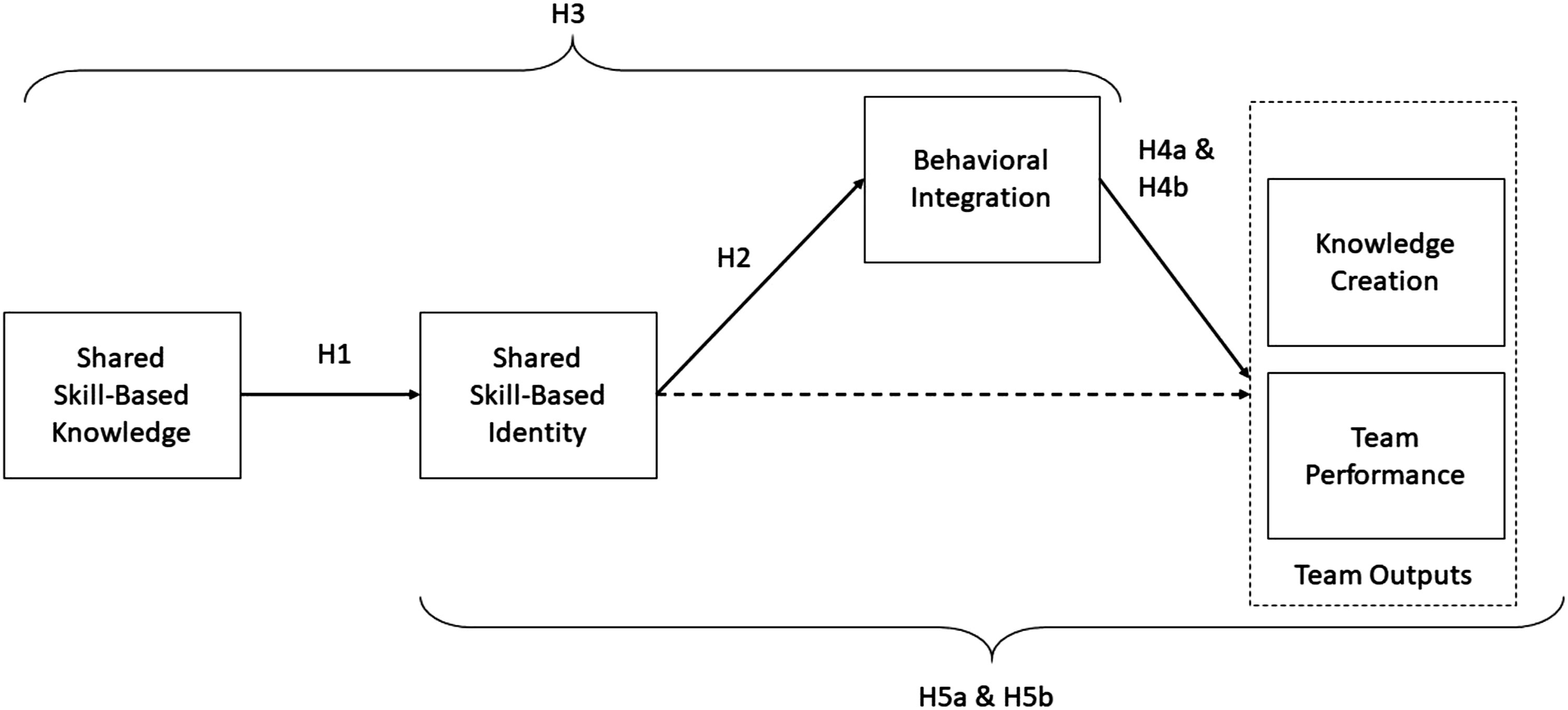
Methodology
Research design
To investigate whether and how having shared skill-based knowledge and identity impacts behavioral integration, knowledge creation and team performance, we employ two complementary field studies with undergraduate and graduate students that allow us to sequentially test our model while determining the impact of project length on our findings. Indeed, over time teams can develop routines and processes that help overcome coordination barriers (Majchrzak et al., 2012), potentially decreasing the importance of a shared skill-based identity. We selected project management as the specific skill investigated for several reasons. First, it is an important and relevant skill in advancing team performance (Perry-Smith & Mannucci, 2017) through effective coordinating (Randel and Jaussi, 2003; Reagans et al., 2016), where views and opinions are shared (e.g., Mitchell et al., 2009; Van Knippenberg et al., 2004) which enhance team performance. Furthermore, project management is a universal task that readily transfers across different teamwork settings, thereby offering increased managerial importance. Thus, if team members do not have project management knowledge, management may be more inclined to provide this training than more domain-specific task-relevant knowledge that offers little opportunity for exploitation in different projects.
Study 1 (partial model) tests the shared skill-based identity–behavioral integration relationship in a context in which team members do not have the time needed to form routines or a process to overcome coordination barriers (H1–H3). In this case, new, randomly assigned teams were formed to work on a short-term project, which had to be completed in less than an hour.
Study 2 (full model) extends the project’s timeline, enabling us to determine whether time serves as a boundary condition as teams have the time needed not only to form routines but also to experience multiple coordination barriers (H1–H5). Specifically, teams worked on an intense medium-term project, which had to be completed in one week.
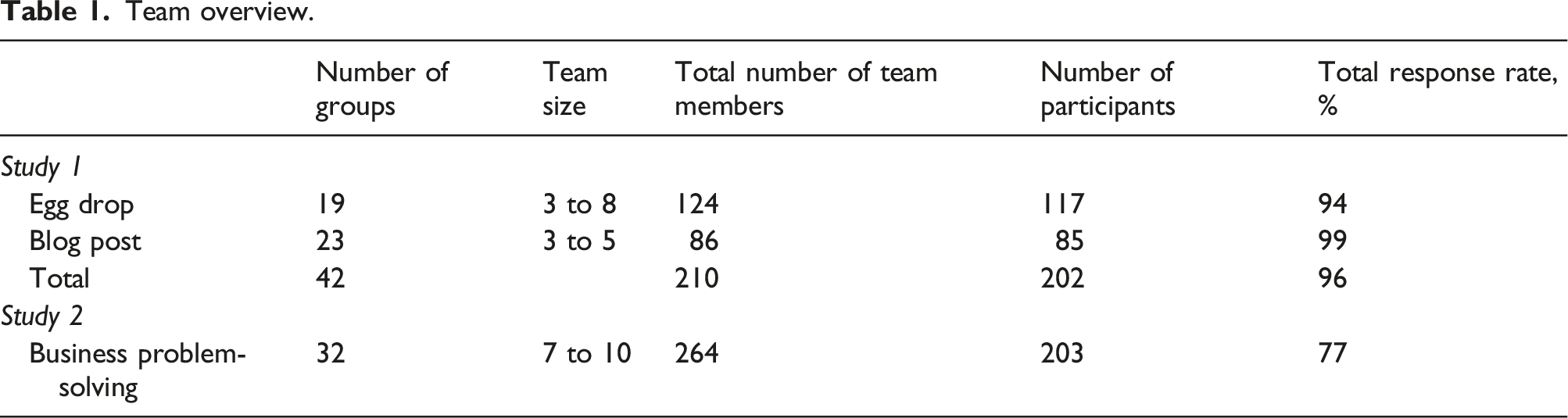
Team overview.
Study 1 design
Study 1 addresses the following question: is shared skill-based identity an intervening variable between shared skill-based knowledge and behavioral integration?
To address this question, we placed teams in a context in which they faced a tight time constraint to reduce the likelihood that they would form routines or engage in the deep dialogue necessary to overcome coordination barriers (Dougherty, 1992; Majchrzak et al., 2012).
In Study 1, we collected data through two different short in-class projects. These required students in a private French business school to work in teams to generate a solution to a problem (egg drop) or generate a creative story (blog post). Over 50% of the members of each team responded to the questionnaire and all teams had over three participants. Therefore, all teams were included in the subsequent analyses.
For the egg drop activity, participants were Master’s students completing an in-class assignment for a human resources core class. Teams were given 45 minutes to construct a structure to keep their egg from breaking when dropped over 15 feet onto a concrete floor. The purpose was to engage participants in an innovative problem-solving activity with limited material and a time constraint. In total, nineteen teams, ranging from three to eight members, were formed. 94% of the participants voluntarily submitted a completed survey (117 out of 124).
For the blog post activity, participants were final-year Bachelor’s students completing an in-class assignment for a core marketing class. Teams were given 15 minutes to create a blog post about the two best friends of an object they had in their backpack. The teams gave a two-minute presentation about their blog post to the other teams. The purpose was to encourage participants to creatively explore how one product needs other products to provide value to the user. In total, 23 teams, ranging from three to five members, were formed. 99% of the participants voluntarily submitted a complete survey (85 out of 86).
Overall, this approach allowed us to collect data on each team member’s perception of their skill-based (i.e., project management) knowledge and identity levels as well as the team’s integration level. Of the 202 participants from 42 groups, 105 were female (52%) and two did not disclose this information (1%). Age ranged from 19 to 30 with an average age of 21. 48% of the respondents were French, followed by Chinese (7.9%) and Brazilian (6.9%). 42 groups is an adequate sample size for team studies, especially field studies (Pelled et al., 1999).
Given that we do not observe any statistical differences in key variables across these projects, in what follows we present only the results from pooling the data from the two aforementioned activities.
Study 2 design
Study 2 addresses the following question: does a shared skill-based identity have an indirect effect on knowledge creation and team performance, through behavioral integration?
To this end, we relied on teams working on an intense one-week project. We used a mandatory capstone-based experiment project that required teams of Master’s students from three different French schools (Art, Engineering and Management) to apply and integrate the skills they had learned across core disciplines developed in their program curriculum by solving complex art, business and/or technology real-life problems faced by companies (business problem-solving). Successful project completion required interactions among team members on multiple occasions. Thus, on the one hand, coordination barriers, conflicts or procedural disagreements had many opportunities to arise. On the other hand, repeated interactions could facilitate the development of routines to address them. Additionally, having teams working on an intensive multi-day project enabled us (1) to examine knowledge creation and team performance as a process that forms over time; and (2) to overcome any applicability issue that might be raised in a very short project, like in Study 1.
In Study 2, the student teams had the opportunity to combine and integrate design, technical and business knowledge to solve a company’s real-life problem over the week. 2 This project enabled participants to navigate through the four phases of the idea journey, from conception to completion, through idea generation, idea elaboration, idea championing, and idea implementation (Cardon et al., 2017) based on the four phases of project execution – planning, build-up, implementation and closeout. Each team’s proposed case resolution was presented to a panel of judges composed of senior staff members of the involved companies (organization or community) and academic coaches.
Overall, this approach enabled us to collect data on each team’s decision-making processes, its knowledge creation level and its performance. Moreover, we collected useful data at both individual and team levels. Each team was composed of students from at least two of the three selected schools; 62.5% of the teams included students were from all three schools. We had a total of 32 teams, of which 78% consisted of eight members. 77% of the team members submitted a completed survey (203 out of 264). Of the 203 participants, 99 were female (49%) and three did not disclose this information (2%). Age ranged from 20 to 43, with 24% reporting French nationality followed by Moroccan (8%) and then Chinese (3%). All groups had at least four members voluntarily participate in the survey; thus, all teams were included in the analysis.
Dependent variables
In the full model, we account for knowledge creation and team performance. 3 First, knowledge creation involves generating novel ideas, even if they are not incorporated into the project (Mitchell et al., 2009). Under this conceptualization, knowledge creation levels are personal to each team member. Thus, it is acceptable to have, within a team, different views about how many new ideas were developed when working on the project. Accordingly, we measure knowledge creation using two items from Mitchell et al., (2009). These items operationalize knowledge creation as an output of new ideas generated by teamwork. Additionally, as a perceptual measure, this conceptualization gives participants the opportunity to express their, potentially differing, views of the team’s output (Mitchell et al., 2009). After obtaining adequate reliability (Study 2: α = 0.68), we form a composite variable for each team member. Then the team members’ composite variables are averaged to form a team score.
Second, at the team level, we measure team performance based on an external evaluation of its output; that is, the team’s grade generated by an assessment rubric. Team members are not always responsible for judging the success of their output, so an outsider often evaluates the output. Additionally, common method bias can be reduced by using an evaluation from someone who is not a team member (Hinds and Mortensen, 2005).
Independent variable
Consistent with our conceptualization of shared skill-based knowledge as a compositional variable (Lawrence, 1997), we measure a participant’s perception of their knowledge on project management. Measuring personal evaluations of their project management knowledge level captures explicit and tacit knowledge as well as interest and prior experience, insofar as the participant reflects on these sources of knowledge. We do not measure participants’ understanding of specific project management principles or strategies, nor do we capture specific prior project management instances. Hence, we avoid comparing idiosyncratic differences on how to perform project management and instead focus on capturing participants’ self-judged perceptions regarding their project management knowledge.
In particular, we adapt Algesheimer et al.’s (2005) three-item knowledge scale to our specific context. Based on the satisfactory Cronbach’s alpha (Study 1: α = 0.89, Study 2: α = 0.87), we create a composite variable for each participant and then we compute a group average to represent the team’s shared skill-based knowledge level. As a composite score, agreement among members is not necessary nor expected, as each member may have different knowledge levels. Accordingly, within-group indices are neither appropriate nor calculated (Fladerer et al., 2021).
Mediating variables
The team’s shared identity with a skill (i.e., project management) is measured with an adapted version of Aron et al.’s (1992) pictorial measure for inclusion of another into the self. This simple, visual scale captures the participant’s sense of closeness with another and has been used to measure relationships with organizations (Bergami and Bagozzi, 2000), brands (Lam et al., 2010) and teams (Hinds and Mortensen, 2005). Contrary to classifications based on educational background or specific training, this scale captures the social categorization component that drives identification and mindset formation (Kearney et al., 2009) and is hence a theoretically consistent scale with wide applicability. Similar to shared skill-based knowledge, we measure each member’s project management (PM) identity overlap and not the perceived project management identity of the group as an entity. Further, we expect different identification levels with project management to exist and one member’s score does not necessarily need to align with the scores of other members. Individual data are averaged into a single composite score representing the team’s shared skill-based identity level.
Following Mooney et al. (2007), we measure behavioral integration using a three-item scale. These items capture the degree to which the team integrated all members into the decision-making process. As this scale measures the group’s level of integration, we calculate the scale’s reliability and intraclass correlation coefficients before averaging each member’s composite variable into a team variable (Biemann et al., 2012).
Control variables
Gender and country diversity are controlled because they have been shown to impact intragroup relations (e.g., Gill et al., 2020; Seong et al., 2015) and creativity levels (Baer et al., 2013). Additionally, country diversity may negatively impact coordination or improve knowledge creation through expanding access to knowledge domains (Perry-Smith and Shalley, 2014). We compute Blau’s heterogeneity index for each diversity variable. Lastly, we control for team size as it can influence knowledge creation levels (Mitchell and Nicholas, 2006).
Results
Results of OLS regression analyses for H1 and H2.

Note: Unstandardized coefficients are reported with standard errors in parentheses. + p ≤ 0.10; ∗p ≤ 0.05; ∗∗p ≤ 0.01; ∗∗∗p ≤ 0.001.
Table 2 reveals that shared skill-based knowledge has a significant positive impact on shared skill-based identity (see Model 1), supporting H1. Furthermore, we find that shared skill-based identity has a significant, positive impact on behavioral integration (see Model 2), supporting H2. Of the control variables, both team size and country diversity have a modest negative impact on shared skill-based identity.
Moreover, H3 argues that shared skill-based identity mediates the shared skill-based knowledge–behavioral integration relationship. First, a separate OLS regression reveals that shared skill-based knowledge has a modest effect on behavioral integration (b = 0.2, t = 1.73, p < 0.10). Then, we use Model 4 in the PROCESS v.3 macro for SPSS to test for mediation effects. Due to our small sample size, we use the 5000 samples bootstrapping technique to obtain stable confidence intervals (Hayes, 2013) and to address non-normal distributions (Byrne and Barling, 2017). This procedure allows us to discover potential mediations and to measure any direct and indirect effects of shared skill-based knowledge on behavioral integration. All control variables are entered as covariates.
Mediation analysis of shared skill-based identity on the shared skill-based knowledge–behavioral integration relationship.
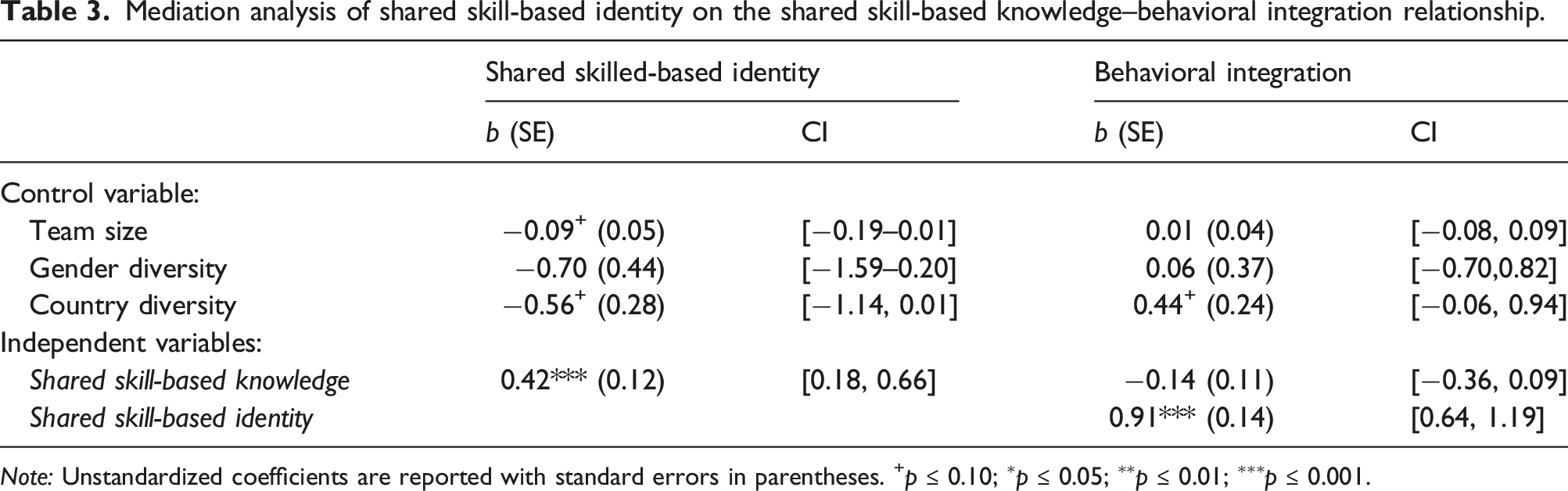
Note: Unstandardized coefficients are reported with standard errors in parentheses. + p ≤ 0.10; ∗p ≤ 0.05; ∗∗p ≤ 0.01; ∗∗∗p ≤ 0.001.
Besides reaffirming that shared skill-based knowledge has a positive impact on shared skill-based identity (b = 0.42, CI[0.18, 0.66]), offering additional support for H1, this analysis shows that shared skill-based identity also has a positive impact on behavioral integration (b = 0.91, CI[0.64, 1.19]). No control variable is significant. As expected, shared skill-based knowledge does not have a direct effect on behavioral integration (b = −0.14, CI[–0.36, 0.09]) but does have an indirect effect through shared skill-based identity (b = 0.38, CI[0.14, 0.73]). Therefore, H3 is supported.
We now move to testing the entire model (H1 to H5) through Study 2.
5
Study 2 enables us to determine whether behavioral integration predicts knowledge creation (H4a) and team performance (H4b) and whether it mediates the relationship between shared skill-based identity and knowledge creation (H5a) and team performance (H5b).
6
Figure 2 illustrates the results of the entire model of Study 2. Overview of tested model (Study 2). (a) Knowledge creation as dependent variable. (b) Team performance as dependent variable.
Full results of tested model (Study 2: knowledge creation).

Note: Unstandardized coefficients are reported with standard errors in parentheses. + p ≤ 0.10; ∗p ≤ 0.05; ∗∗p ≤ 0.01; ∗∗∗p ≤ 0.001. N = 32.
Full results of tested model (Study 2: team performance).

Note: Unstandardized coefficients are reported with standard errors in parentheses. + p ≤ 0.10; ∗p ≤ 0.05; ∗∗p ≤ 0.01; ∗∗∗p ≤ 0.001.
The analysis reveals that shared skill-based knowledge has a positive impact on shared skill-based identity (b = 0.41, CI[0.17, 0.65]), further supporting H1. As expected, only shared skill-based identity has a positive impact on behavioral integration (b = 0.64, CI[0.02, 1.26]), offering additional support for H2. Moreover, only behavioral integration (b = 0.45, CI[0.15, 0.76]) has a positive impact on knowledge creation, supporting H4. The aforementioned direct relationship between shared skill-based identity and knowledge creation vanishes when adding behavioral integration into the model (b = 0.18, CI[–0.33, 0.68]). Thus, behavioral integration fully mediates the shared skill-based identity–knowledge creation relationship, offering support for H5. Of the control variables, only gender diversity has a significant positive effect on behavioral integration (b = 1.92, CI[0.27, 3.57]).
Furthermore, regarding team performance, the OLS regression results reveal that a shared skill-based identity within the team has a positive impact on team performance (b = 1.78, t = 3.07, p = 0.005). No control variables are significant. The results are similar to those obtained with the self-reported knowledge creation measurement scale. Having shared skill-based knowledge has a positive impact on shared skill-based identity (b = 0.41, CI[0.17, 0.65]). Shared skill-based identity has a positive impact on behavioral integration (b = 0.64, CI[0.02, 1.26]). Behavioral integration fully mediates the relationship between shared skill-based identity and team performance as behavioral integration is significant (b = 1.06, CI[0.21, 1.91]) but shared skill-based identity is not (b = 0.75, CI[–0.67, 2.17]). Additionally, shared skill-based knowledge does not have a direct effect on the external evaluation (b = 0.36, CI[–0.61, 1.32]). No control variable has a significant impact on the external evaluation. Overall, these results provide additional support for the proposed model (H1–H5). This finding supports the main premise of our study. A shared skill-based identity in teams improves behavioral integration and team performance.
Discussion and concluding remarks
Although teams, as compared to individuals, can achieve higher performance and knowledge creation levels (Hoogendoorn et al., 2017), poor integration or coordination within a team can undermine performance and knowledge creation (Bell et al., 2011; Pelled et al., 1999). Indeed, having diverse individuals in a team can sometimes lead to improved knowledge creation (Bell et al., 2011), but working in teams can also lead to increased coordination barriers that reduce knowledge creation (Pelled et al., 1999). Building on SIT, we predicted and confirmed that shared skill-based identity plays a key role in knowledge creation and team performance, thanks to enhanced behavioral integration. However, prior research suggests that shared skill-based knowledge can foster shared skill-based identity (Algesheimer et al., 2005). Accordingly, we tested shared knowledge and shared identity simultaneously, elucidating the intervening role that shared identity plays between shared knowledge and knowledge creation as well as team performance. Overall, our findings contribute to team performance research by demonstrating that shared skill-based identity plays a crucial role in how teams function and coordinate.
Specifically, Study 1 reveals that shared skill-based knowledge in a team has a positive impact on shared skill-based identity. Extending the team identification literature (Ashforth et al., 2011) within SIT (Tekleab et al., 2016) and team coordination research (Randel and Jaussi, 2003), our work reveals that teams composed of members sharing a skill-based identity evidence improved coordination and behavioral integration. Indeed, we found that shared skill-based identity had a direct and positive relationship with behavioral integration. Thus, a sense of ‘we-ness’ or in-group membership can develop around skills and not just teams (Ashforth et al., 2011). Further, the data show that shared or redundant skill-based knowledge enhances coordination, albeit indirectly. In other words, shared skill-based knowledge has an indirect effect on behavioral integration through shared skill-based identity. Accordingly, our study demonstrates that teams composed of members who identify with a skill, like project management, can directly improve team integration and coordination while having skill-based knowledge does not. However, improved behavioral integration might matter only if it can lead to knowledge creation and better team performance. Study 2 was specifically designed to address this aspect. Our findings in Study 2 indicate that behavioral integration mediates the shared skill-based identity–knowledge creation–performance relationships. Thus, we suggest that teams composed of members who identify with a skill, like project management, are better able to overcome coordination barriers by drawing on their shared skill-based knowledge and mindset (Bell et al., 2011) and hence exhibit higher knowledge creation and team performance. Overall, our research refines the extant team performance literature (Ford et al., 2013; Hinds and Mortensen, 2005) by establishing that shared skill-based knowledge fosters a shared skill-based identity and indirectly improves coordination, knowledge creation, and team performance.
Contributions to research and practice
The results of this study provide new insights into why and how members’ identity and knowledge may play a crucial role in the way teams function. Thus, the study offers multiple contributions to team research and managerial practice.
First, building on research on team diversity (Cunningham, 2007; Jehn et al., 1999; Klotz et al., 2014; Van Knippenberg et al., 2004), we suggest that team members’ identity could be considered as a key diversity variable. Redundant knowledge can support the development of a shared skill-based identity because knowledge appears to enhance an individual’s sense of having a particular identity. Scaled up to a team, we show that, when multiple members have a high level of knowledge on a particular skill, they also have a higher likelihood of identifying with the social identity of that particular skill. We therefore offer clarity to the knowledge diversity versus knowledge redundancy debate (e.g., Cronin and Weingart, 2007; Horwitz and Horwitz, 2007; Van Knippenberg et al., 2004) by demonstrating that teams with a high level of shared skill-based knowledge lead to knowledge creation and improved team performance via increased shared skill-based identity and behavioral integration. This suggests that future studies should investigate identity diversity versus identity redundancy, as identity appears to be the lynchpin between having knowledge and knowledge creation. Second, contributing to the identification literature (Ford et al., 2013; Hinds and Mortensen, 2005; Lundqvist et al., 2015), we reveal that improved behavioral integration, knowledge creation and team performance are related to having a shared skill-based identity and not shared skill-based knowledge. Third, this research also enhances the transactive memory systems (TMS) (Wegner, 1987) literature, which argues that sharing knowledge, coordination and team fit improve overall team performance (Reagans et al., 2016; Zhang and Guo, 2019). Our study shows that a team member’s identity is an intervening variable between having knowledge and behavioral integration. Identity appears to serve as the bridge between having knowledge and utilizing the knowledge. Having knowledge does not mean the team can access the knowledge, especially if a team member does not have the corresponding identity. Future TMS research should consider the gate-keeping role identity plays in accessing and utilizing team member knowledge, as having teams composed of redundant identities leads to higher knowledge creation and team performance.
Managerially, our findings have implications for how organizations build effective teams. First, managers are often encouraged to form cross-functional teams as a way to avoid redundant knowledge and to obtain differing perspectives on the problem being solved and solutions provided (Sethi et al., 2001). Our results suggest that selecting team members is not simply a question of identifying workers with a specific skill, job classification or degree. Instead, we show that shared skill-based identity enhances behavioral integration and ultimately positively influences knowledge creation and team performance. This finding suggests that, when selecting team members, managers should consider how each potential member understands themselves and defines their identity; that is, who they think they are. Second, developing a shared team identity involves expending resources towards enacting rituals and practices that bring the team together, as a group. For teams working on short-term projects, where the benefits of developing a shared team identity will not have enough time to offset the resource investment, activating an existing shared skill-based identity may be a better use of resources. While additional research is necessary to identify effective shared skill-based identity activation strategies, (Bartel and Garud, 2009) show that effective narratives unite diverse teams by enabling each team member to find guidance in the narrative as they can translate it into their specific context. Situating prior research into our findings, managers or team leaders can develop team narratives that focus members’ attention towards a shared identity, such as a skill. In this way, this shared skill-based identity dimension will be activated, resulting in improved behavioral integration, knowledge creation and team performance. Last, developing a shared identity, whether it be team- or task-focused, is particularly crucial in cross-functional and cross-disciplinary teams that pursue common objectives while demonstrating collaborative efforts and complementary contributions (Fiore, 2008; Lundqvist et al., 2015; Rink and Ellmers, 2010). Cross-functional teams unite individuals with differing professions, and therefore testing project management has the advantage of involving a more general skill with which diverse team members might be familiar. In addition, the universality of project management, as a practical skill, improves the relevance and applicability of the study findings to practice. Thus, while differing skills can be tested, such as problem-solving, leadership, creative thinking or entrepreneurial mindset, we believe that developing project management, a widely applicable skill, in employees can offer firms benefits that extend beyond teamwork.
Limitations and future directions
This research is not without limitations. First, our data do not offer insights into the exact skill-related behaviors, processes or routines team members may have implemented. Additionally, team members self-reported their perceived knowledge levels and identity overlap with the social category of project management. While self-reported measures are common in team research, this does leave questions for future research regarding how project management was implemented. Moreover, in our research we utilized a cross-sectional approach which limits our ability to make causal claims. Thus, longitudinal studies are needed to shed additional light on the skill-based identity–behavioral integration process. Second, because team research is challenging to conduct, it is common to rely on data related to student training (Tekleab et al., 2016). Although its applicability may be limited, we believe this research can nevertheless serve as a valuable baseline for future studies on knowledge creation and team performance, especially because Study 2 relies on real-life company problems. Researchers are encouraged to test the proposed model across contexts, using differing populations. However, our primary finding about the crucial role played by skill-based identity in behavioral integration among team members was supported by two complementary studies.
Our analysis could be extended in several ways. First, besides time constraints, additional boundary conditions, such as team size or activity complexity, could be tested. Second, testing simultaneously the effect of self-efficacy and identity could offer additional insights, as having an identity is different than believing one has the capability to enact a particular skill (Costin et al., 2022). Furthermore, prior research suggests that self-efficacy is positively associated with identity (Guan and So, 2016; Mei et al., 2022; Robnett et al., 2015). Third, in our work, we measured project management skill identity only once the task had been completed. Implementing an identity assessment before and after the task would offer additional clarity on knowledge and identity acquisition.
Supplemental Material
Supplemental Material - Facilitating knowledge creation and team performance through behavioral integration and skill-based identity
Supplemental Material for Facilitating knowledge creation and team performance through behavioral integration and skill-based identity by Matthew A Hawkins, Mahamadou Biga-Diambeidou, Sandrine Jacob Leal in Industry and Higher Education
Footnotes
Acknowledgements
The authors would like to thank Raphaelle Friot, ARTEM team leaders and Kubra Canhilal for helping us collect data. We are grateful for the Editor’s and the two reviewers’ constructive and insightful comments. All the usual disclaimers apply.
Declaration of conflicting interests
The author(s) declared no potential conflicts of interest with respect to the research, authorship, and/or publication of this article.
Funding
The author(s) received no financial support for the research, authorship, and/or publication of this article.

Supplemental Material
Supplemental material for this article is available online.
Notes
References
Supplementary Material
Please find the following supplemental material available below.
For Open Access articles published under a Creative Commons License, all supplemental material carries the same license as the article it is associated with.
For non-Open Access articles published, all supplemental material carries a non-exclusive license, and permission requests for re-use of supplemental material or any part of supplemental material shall be sent directly to the copyright owner as specified in the copyright notice associated with the article.
