




Abstract
This article presents findings on factors hindering academic employees from becoming involved in collaboration activities. Based on survey data, we map out perceived barriers to collaboration whereby five categories emerge: teaching obligations, partner (dis)interest, partners’ resources, academic freedom, and university resources. By means of multiple regression analysis, we examine the extent to which individual, intra-, and inter-organisational factors explain these perceived barriers to collaboration. The study was carried out in Iceland, where university objectives are still heavily based on teaching activities, and few entrepreneurial activities take place in academia. Our results reveal that age and academic disciplines play a main role in the perceptions of academics regarding barriers to collaboration, especially when it comes to barriers grounded in teaching obligations or university resources. Most perceived barriers are based on the internal level that is lack of resources on behalf of universities. The study, therefore, provides a new perspective relative to earlier findings that have indicated that barriers to collaboration exist mostly at the individual level. We conclude that academic institutions can play a more prominent role in the activation of third mission activities than they have been doing so far.
Introduction
For centuries, the main role of universities has been to provide students with learning and training, and to contribute to new knowledge and innovation through research. In recent years there has been a growing pressure on universities to open up to societal, environmental, and economic challenges with the purpose of serving society in sustainable and responsible ways (Muff, 2017). However, to a large extent, academic rewards and incentive systems are still mostly based on the first (teaching activities) and second mission (research excellence). Outreach activities where academics collaborate directly with stakeholders outside academia, such as industrial companies, media, and other research or educational organisations (Mejlgaard and Ryan, 2017), often specified as the ‘Third Mission’ (TM), have so far not found significant acknowledgement within universities, especially on behalf of academics as they prefer to maintain rather their “academic role identity” (Jain et al., 2009: 933) which is built on the first two missions. Prior research on the Icelandic context has shown that activities connected to innovation, entrepreneurship, or commercialisation are almost non-existent (Karlsdóttir et al., 2022). Given this, it appears worth investigating determinants of academic collaboration behaviour.
Apart from the obvious reason of simple inertia, academic freedom continues to have a high priority within universities and is often seen as a negative factor to engage in collaborative activities with industry (Tartari and Breschi, 2012). Accordingly, more involvement of governments or industry could be seen as a way to directly control research activities by offering rewards or disincentives based on the activities of academics (Jóhannesson, 2013; Kristinsson et al., 2015; Chantler, 2016; Shore and Taitz, 2012). Furthermore, global university rankings continue to prioritise research output, which causes a reluctance to align university mission and reward structures with outreach activities related to TM (Callagher et al., 2015; Benneworth et al., 2015). However, other authors such as Larsen (2011) argue that academic engagement is rather complementary to teaching and research activities.
Nevertheless, society, government and investors increasingly demand results and changes based on research activities and there is a claim to make science more transparent to increase the competitiveness of countries (Siboni et al., 2013; Cohen, 2021). Some stakeholders also want to measure the return rate that can be expected when investing in science (Miettinen et al., 2015).
Here, we assess academics’ perceived barriers to collaboration as part of TM and examine whether they are grounded in individual factors, i.e. among academics, or in organisational factors. We define perceived barriers as barriers that academics report as preventing them from starting or increasing collaboration activities with industry and communities. Our research question is hence: How do academics perceive individual and organisational factors as barriers to collaboration with non-academic stakeholders?
TM activities outside academia are either connected to the commercialisation of academic knowledge or to academic engagement emerging as a collaboration between academic researchers and non-academic organisations (Perkmann et al., 2013). We focus on individual perceptions, which provides a valuable perspective, as socio-economic engagement factors such as motivation, human capital, and networks are considered. This can help develop more accurate university policies based on individual differences and not on a ‘one size fits all’ approach (Iakovleva and Adkins, 2022). In this study, organisational factors are divided into inter-organisational and intra-organisational factors. Inter-organisational factors are not in the direct control of the organisation but are determined by government bodies or geographical location, while intra-organisational factors derive from within an organisation. For instance, incentives and rewards, organisational values and cultures, are examples of intra-organisational factors that can affect academics’ performance.
Similar to the qualitative approach of Bjursell and Engstrom (2019), this study contributes further to the theory of TM by distinguishing barriers on the individual, intra- and inter-organisational level. In our research, however, we try not only to classify but also to quantify barriers and propose a framework which could with further refinement be used to identify barriers stemming from the individual, the organisation, and external factors in different settings.
The study is carried out in Iceland, which has a university system that is organised in a similar manner as in the other Nordic countries. Iceland has five public universities, and two private institutions 1 . All universities receive financial government support in line with the number of students and composition of courses, thereby only private universities are allowed to charge tuition fees. University collaboration with industry is rather low in Iceland, and neither ambition nor incentives are designed to change this (Karlsdóttir et al., 2022). As about two thirds of the total population live in Reykjavik, also most (potential) collaboration partners are located here which facilitates industry collaboration for universities in the capital area over those in other regions of the country.
Theoretical framework
Motivations for participating in TM and collaboration
Multiple mechanisms have been identified regarding why academics engage in TM activities, such as entrepreneurship, technology transfer, or UIC (university-industry collaboration). To derive policy conclusions, it is important to know which individual motivations and organisational factors are stimulating TM engagement. Ajzen’s (1991) theory of planned behaviour stipulates that behavioural intentions are a combination of attitudes, intention, social and subjective norms, perceived power and behavioural control. As such, intentionality has been claimed as the best predictor for planned behaviour as they reflect a person’s motivation and attitude on achieving an intended goal.
In line with this reasoning, Goethner et al. (2012) argue that this model is crucial regarding stimulating entrepreneurial intentions within academia. Bourelos et al. (2012) demonstrate the importance of including factors based on the individual characteristics of academics, such as personal experience and personal networks. Further, knowledge transfer, which has its roots in collaboration activities, is mostly pursued by individuals and not scientific institutes (Breschi and Catalini, 2010; D’Este and Patel, 2007).
Male academics have been found to be more involved in entrepreneurship and collaboration with industry than their female counterparts (Pita et al., 2021; Calvo et al., 2019; Lam, 2011) and have higher entrepreneurial intentions (Iakovleva and Adkins, 2022). Reasons for this are higher proportion of male academics in innovation and technology-driven fields in science, technology, engineering, and mathematic fields (STEM), as well as a higher participation in networks outside of academia (e.g. Abreu and Grinevich, 2013; Bozeman and Gaughan, 2011).
Some studies show that younger academics tend to concentrate more on publishing articles in peer-reviewed journals and have less experience and expertise in ‘selling’ their research, (Lam, 2011; Carayol, 2007; Stephan and El-Ganainy, 2007; Munshaw et al., 2018), while other studies show that younger academics take part in a higher variety of industry interaction, probably in order to strengthen their position in academia (D’Este and Patel, 2007; D'Este and Perkmann, 2011). Furthermore, younger academics seem to be more open to TM as they might be more open to changes, and have been trained with an entrepreneurial mindset (Ambos et al., 2008). There is also a positive relation between academic rank and knowledge transfer activities such as contract research, consultancy, training, and personnel mobility (D'Este and Perkmann, 2011; Olmos-Peñuela et al., 2014). Results regarding both age and academic seniority, when it comes to the likelihood of TM participation are, according to a recent study, mixed (Barbieri et al., 2018). In the fields of medicine (Powers, 2003; Stuart and Ding, 2006), engineering and life sciences (Bercovitz and Feldman, 2008; Owen-Smith and Powell, 2001), academics participate highly in commercialisation of research compared to other disciplines such as social sciences and humanities (Fini et al., 2017).
Inter-organisational factors refer to the variability between organisations, such as size of university, university governance, year of foundation (age), the legal status or governance (that is private or non-private, or state or non-state university), specialisation, location, and funding that can have an impact on academics’ engagement in TM. According to Fini et al. (2017) non-state universities have greater institutional autonomy and are less constrained in their technology transfer activities. Others have found that state universities have greater success when it comes to commercially viable outputs (Bonaccorsi et al., 2021) because private universities may be more teaching-oriented with less emphasis on either research or TM activities (de la Torre et al., 2017). Previous research has shown that universities of applied sciences are more engaged in regional knowledge transfer than regular universities (Jaeger and Kopper, 2014). Additionally, universities can be distinguished into generalist and specialist universities where generalist universities have better conditions for commercialisation due to higher internal collaboration between different scientific disciplines, such as interaction between STEM and social sciences and humanities (SSH) (Bonaccorsi et al., 2021; Giuri et al., 2019). As for location, knowledge transfer is more likely when industry and universities are in close geographic proximity (Wang et al., 2013). Larger universities also have the advantage of being better prepared for building networks and external collaboration due to different scientific disciplines, experience, human capital, and long-term strategy (Holm-Nielsen, 2018); they produce significantly more spin-offs and academics are more engaged into consulting activities (Fini et al., 2017; Amara et al., 2013; Landry et al., 2006; Meoli et al., 2018, 2019). When considering year of foundation or age of university, there are mixed results depending on the type of TM, where younger universities have a higher spinoff activity but less patenting activity (Meoli et al., 2018, 2019).
A literature review by Perkmann et al. (2013) gives a good overview of academic engagement and commercialisation based on individual characteristics, the organisational, and institutional context. Hereby, male academics are more engaged with industry, academics with higher seniority due to network effects, and academics with a high academic performance. On the organisational level group-level norms, engagement of peers, and existence of research or technological research centers matter. Regarding the institutional context, scientific discipline, policies, and funding are determining factors.
Overall, studies have suggested that individual characteristics of academics, especially intrinsic motivation have a stronger impact on UIC than organisational factors (D’Este and Patel, 2007; Lam, 2011).
Barriers to TM and collaboration
Previous studies have highlighted that academics’ contribution to TM varies highly. The variation is evident between different academic departments, for example, and there is a comparable variation in the barriers to collaboration perceived by academics (Muscio and Vallanti, 2014). Goduscheit and Knudsen (2015) have investigated the barriers that stand in the way of universities collaborating with research and technology organisations and small and medium-sized enterprises (SME). They found that resource scarcity and lack of interest among companies were main barriers to collaboration. Other studies have highlighted barriers such as cultural differences, lack of academic expertise and reputation, inadequacy of institutional policies and regulations, lack of trust, issues of intellectual property rights, lack of an appropriate reward system, and lack of funding or financial resources (Azman et al., 2019; Brings et al., 2018; Siegel et al., 2003).
The negative effect on research performance is also a barrier to participation in TM (Zhang et al., 2017). A study in food industry revealed that barriers to good collaboration are connected to different goals lying between academia, industry, and negative experience from previous projects (Garnweidner-Holme et al., 2021). Another study identified the problem of companies not finding suitable research partners within universities (Wang et al., 2017). In some cases, intermediaries or so-called ‘boundary-spanners’ (Nsanzumuhire and Groot, 2020; Boehm and Hogan, 2014; Rosli et al., 2018) such as technology transfer offices (TTO), university incubators, or research centres that can facilitate cooperation (Etzkowitz and Leydesdorff, 2000) were identified.
Within individuals, different interests, motivation, and skills exist that influence perceived barriers. Generally, women perceive higher barriers than men when it comes to collaboration with industry, especially transaction barriers to knowledge exchange (Tartari et al., 2012). Academics with previous collaboration or industry experience report, in general, lower barriers (Tartari et al., 2012; Bruneel et al., 2010). Another concern, according to Siegel et al. (2004), is the unawareness of academics regarding the possible wide-ranging results of research for wider society, including innovation management or market research.
Bjursell and Engstrom (2019) distinguish between individual, intra-, and inter-organisational level of barriers to collaboration, and provide an overview over all three levels. When considering barriers within the organisation, they find that the composition of teams, scientific discipline, resource distribution, administration, support systems, and academic traditions are crucial (Bjursell and Engstrom, 2019). Jongbloed et al. (2008) identified three main barriers to community engagement within universities, which are inertia to adapt research agenda and study supply to the needs and demands of external stakeholders, internal reward structure, and the lack of entrepreneurial culture.
When it comes to inter-organisational factors, differences between universities’ funding structures, age of organisation, administration, and organisational orientation have an influence on perceived barriers (Bjursell and Engstrom, 2019). For example, academics at younger universities might experience higher barriers to collaboration as they have not yet established themselves in regional networks lacking connections to regional actors (Hauge et al., 2018). It further depends on the location of universities, where academics employed at universities within metropolitan areas perceive lower barriers than academics in more rural areas (Belkhodja and Landry, 2007).
Data and methods
In this section we present the research instrument, participants and data analysis used in the research.
The research instrument
The research instrument was an online survey sent to academics at all seven Icelandic universities in early 2021. It contained items about collaboration activities and barriers related to TM activities of universities covering a 3-year period (2018 – 2020). Questions on barriers to collaboration were translated from a Nordic survey conducted by Goduscheit and Knudsen (2015). The software QuestionPro was used to collect data online, with the sampling frame receiving an email with survey link and survey information in March 2021. Two follow-up reminders were sent out over the next 20 days.
Participants
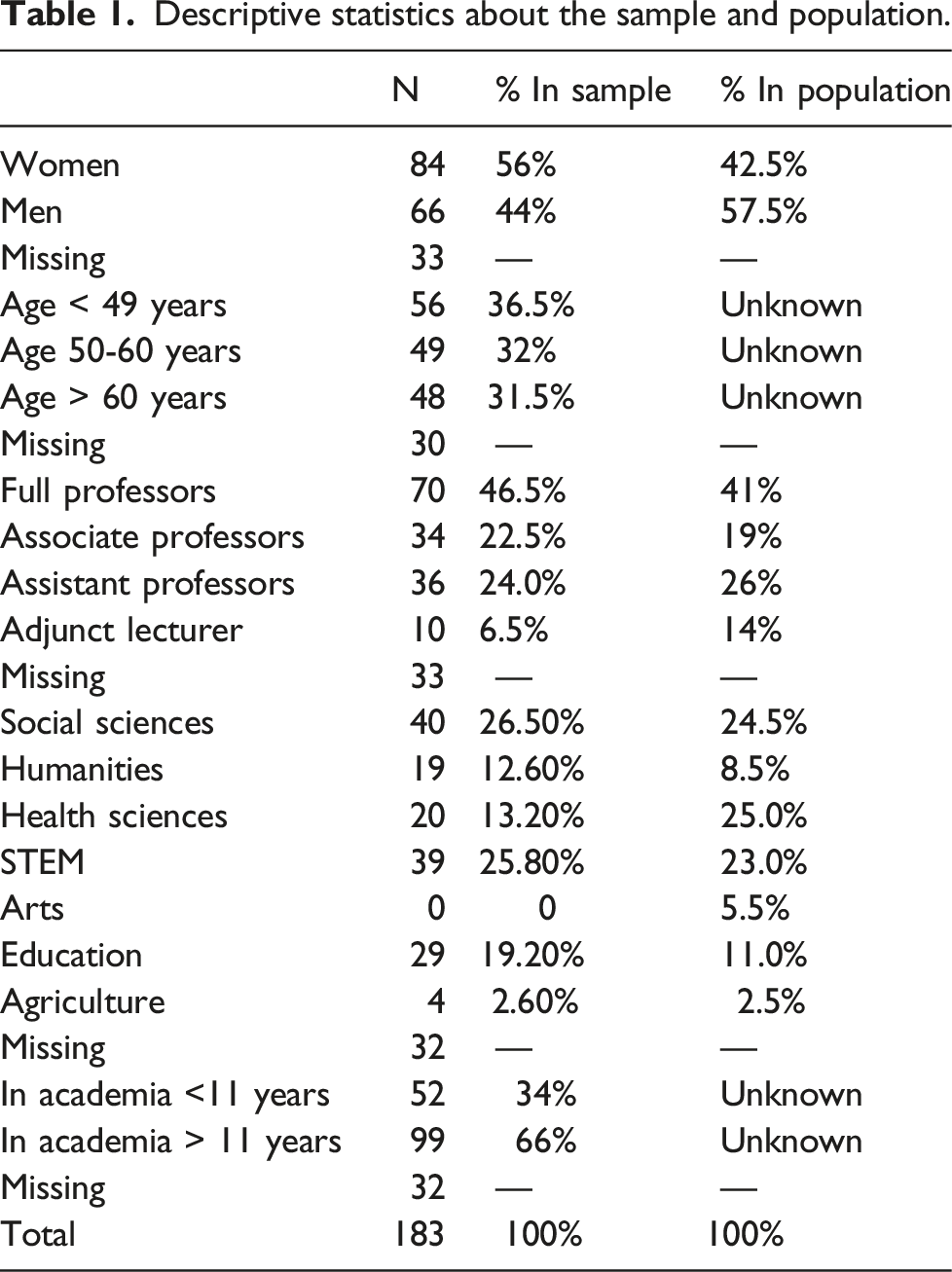
The study contained the total population of academics at all seven universities in Iceland consisting of 1034 academics, that were titled adjunct lecturers, assistant professors, associate professors, or professors. We collected 183 responses; the response rate was therefore 17.7%. Around 56% of the participants were women, 36.5% were 49 years old or younger, and 31.5% 60 years or older. Most participants were from the School of Social Sciences (26.5%) and School of Natural Sciences (25.8%). The fewest answers were received from the Agricultural University of Iceland (2.6%) and none from the University of Arts. Most responses came from full professors (46.5%), followed by associate professors (22.5%) and assistant professors (24%). The fewest responses came from adjunct lecturers (6.5%). Of the respondents, 66% had been in an academic position for more than 11 years. It needs to be considered that responses are not entirely representative for the total population of academics in Iceland as about 57.5% of academic staff are male in the total population. This is also the case for the distribution of position, whereas 41% are full professors, 19% associate professors, and 26% assistant professors.
Measures
Data regarding barriers to collaboration was collected with 20 questions based on Goduscheit and Knudsen (2015). These questions were in the form of statements where respondents were given answer possibilities on a 5-point-Likert scale from ‘No importance’ to ‘High importance’ and ‘Does not apply’.
The independent variables contain measurements at the individual, inter-, and intra-organisational level. At the individual level, Gender is measured by a dummy variable (1 = men, 0 = women), and Age is measured in three categories (49 years or younger; 50 – 59 years, 60 years or older 2 ).
Descriptive statistics about the sample and population.
The variable Co-authoring measures if academics have authored or co-authored articles with at least one non-academic co-author (e.g. from industry). The variable is measured as ‘None’, ‘One article’, ‘Two articles’, ‘3–4 articles’, ‘5 or more articles’. About 49% of academics answered that they have not authored or co-authored an article with a non-academic in the last 3 years.
The last intra-organisational variable is Applied contract research, a composite variable constituted of measuring frequency of ‘Application for funding together with industry/public organisation’ and ‘Formal research and development (R&D) co-operations such as contract research or joint research projects’ on a 5-point Likert scale from ‘Never’ (1) to ‘Very often’ (5).
Finally, there is one inter-organisational (across-organisation) variable, measuring the Size of university. Here, we are measuring a medium-sized university with over 10,000 students (University of Iceland – 1) against smaller, more specialised universities with less than 10,000 students (0). Other inter-organisational variables such as type of governance (public or private university), geographic location (within the capital area or located in the countryside), as well as year of foundation were dropped due to multicollinearity, as all variables concentrate on the distinction of the largest university in Iceland and smaller ones.
Data analysis
Data analysis was performed using the statistical programs SPSS 17.0 and R 4.1. A principal component analysis (PCA) (Hair et al., 2019) was applied to identify higher-level components based on the individual items that were reported as barriers to collaboration. A reliability analysis (Cronbach’s α) was further performed to evaluate the measurement properties and the reliability of scale. For the component analysis, varimax rotation and kaiser normalisation were used.
We estimated five sets of multivariate regression analyses, each comprising of four models. In the first three models, respectively, individual, inter- and intra-organisational factors are examined. The fourth model then includes all variables from all three blocks for a total of eight independent variables. By comparing the variance explained (adjusted R 2 ) we compared the relative importance of the three different factors in predicting barriers to collaboration. 3
Results
All 20 barriers are presented in Figure 1, starting with the barrier which has the highest influence of preventing collaboration which is teaching being too time consuming. For this, about 60% of the responses fall on the positive part of the axis. Other important barriers are the lack of partners’ funding for R&D, the lack of interest and knowledge of partners in scientific projects and potential collaboration possibilities and the fact that partners have other ideas about time and cost and/or productivity. Therefore, the main barriers involve a mismatch between academics and non-academics and their interest. Respondents perceive property right problems and a lack of entrepreneurial approach within their department as the barrier having the least impact. As some respondents chose the answer option of ‘Does not apply’ the number of answers in Figure 1 varies slightly which also provides evidence on the importance and relevance of several barriers as some might not apply for every academic in different disciplines. This is especially the case for academics employed in disciplines such as SSH, education or agriculture as these disciplines are not fields with strong traditions for research collaboration. Barriers to collaboration.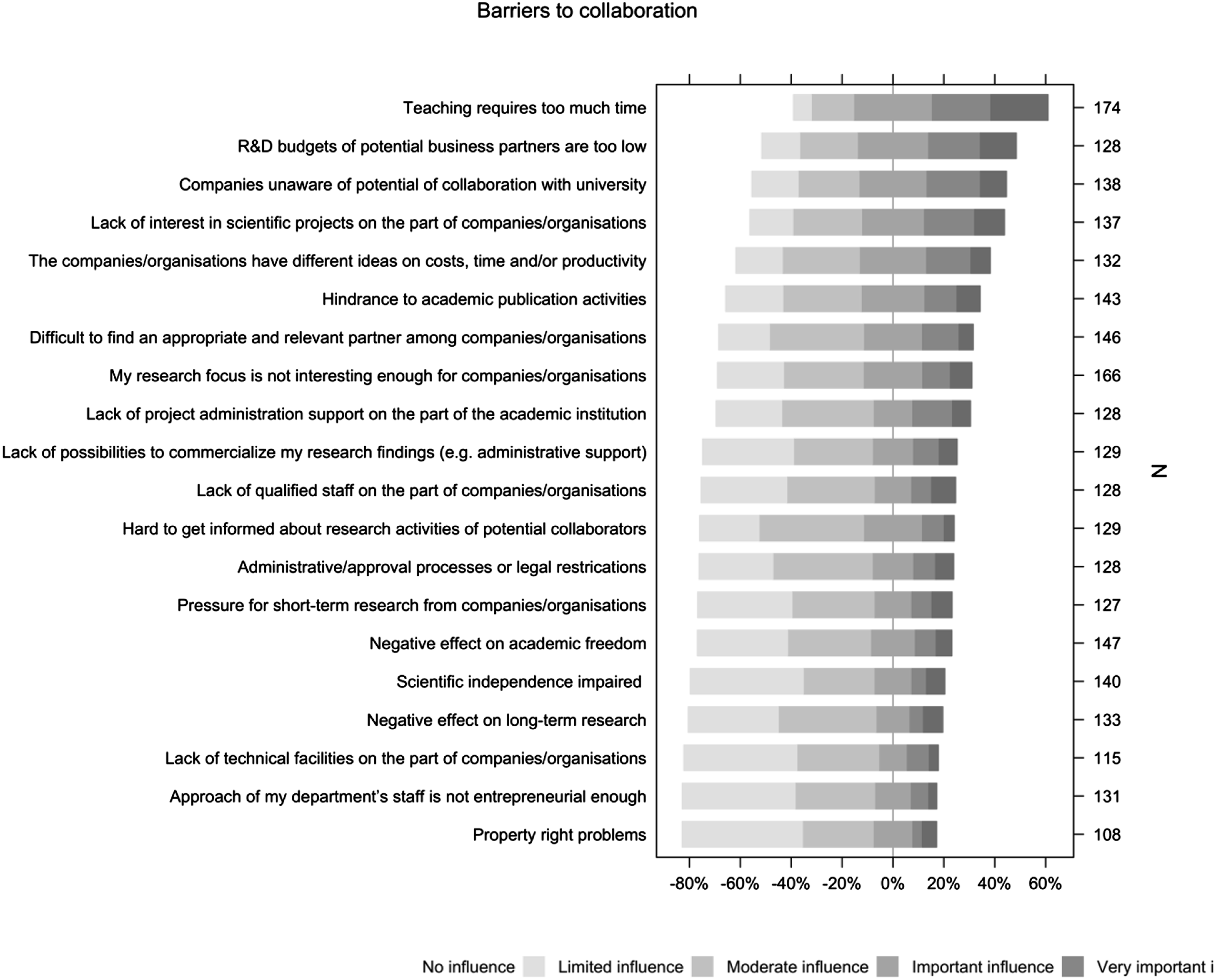
Barriers to collaboration: principal component analysis
Five components (dependent variables) of Barriers to collaboration.
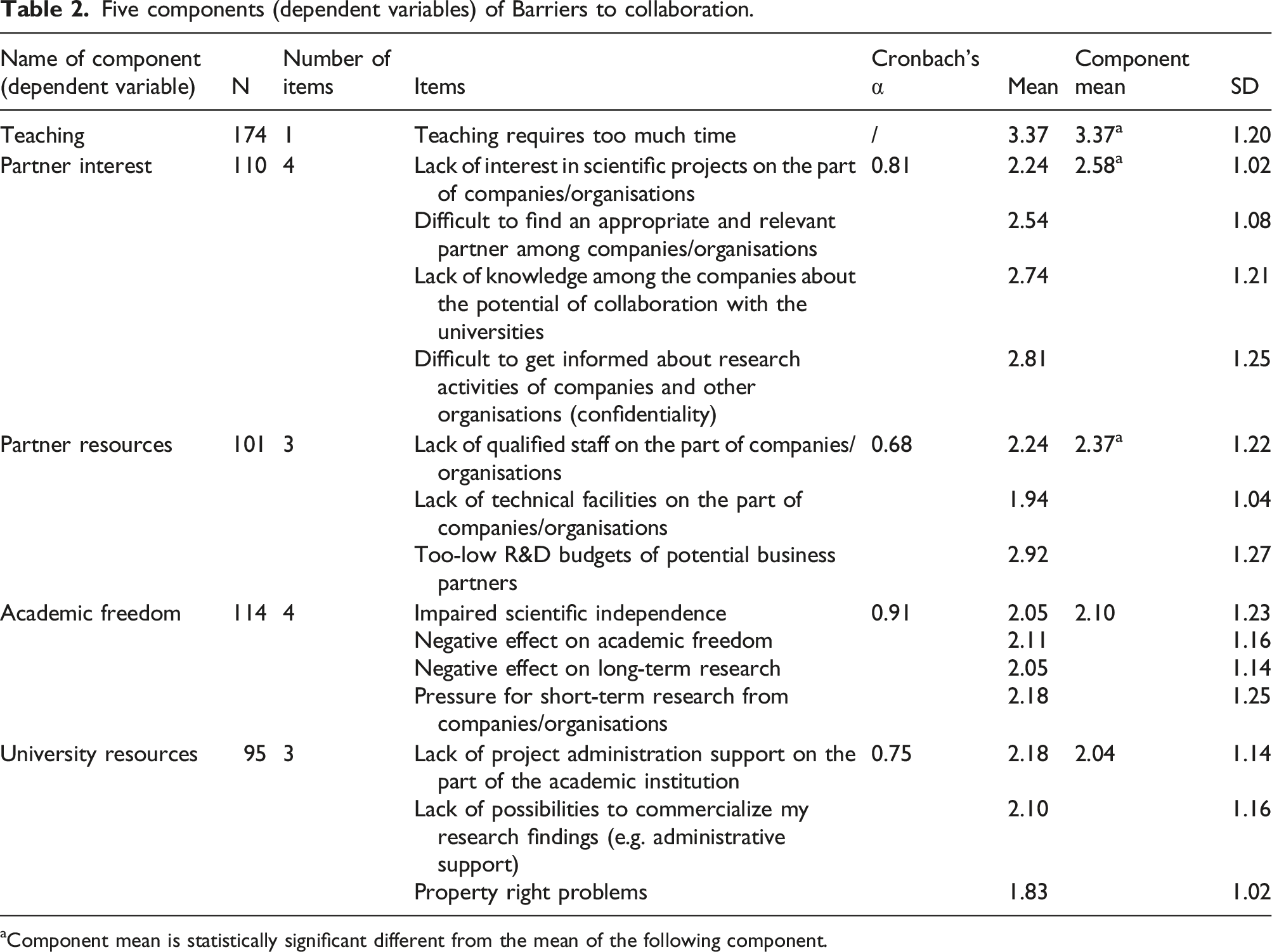
aComponent mean is statistically significant different from the mean of the following component.
The five barriers can further be classified into individual barriers concerning academics (Teaching; Academic freedom), external barriers concerning collaboration partners (Partner interest, and Partner resources), and organisational barriers concerning the research institution (University resources). Paired samples t-tests reveal that Teaching is perceived as the greatest barrier (M = 3.37). Second is Partner interest (M = 2.58), which differed in a statistically significant manner from Teaching (p < 0.001). Third is Partner resources (M = 2.37), statistically significant different compared to Partner interest (p = 0.043). Fourth and fifth are Academic freedom (M = 2.10) and University resources (M = 2.04). The difference between these final two barriers is not statistically significant, but each of the components is significantly lower than Partner resources (p = 0.004).
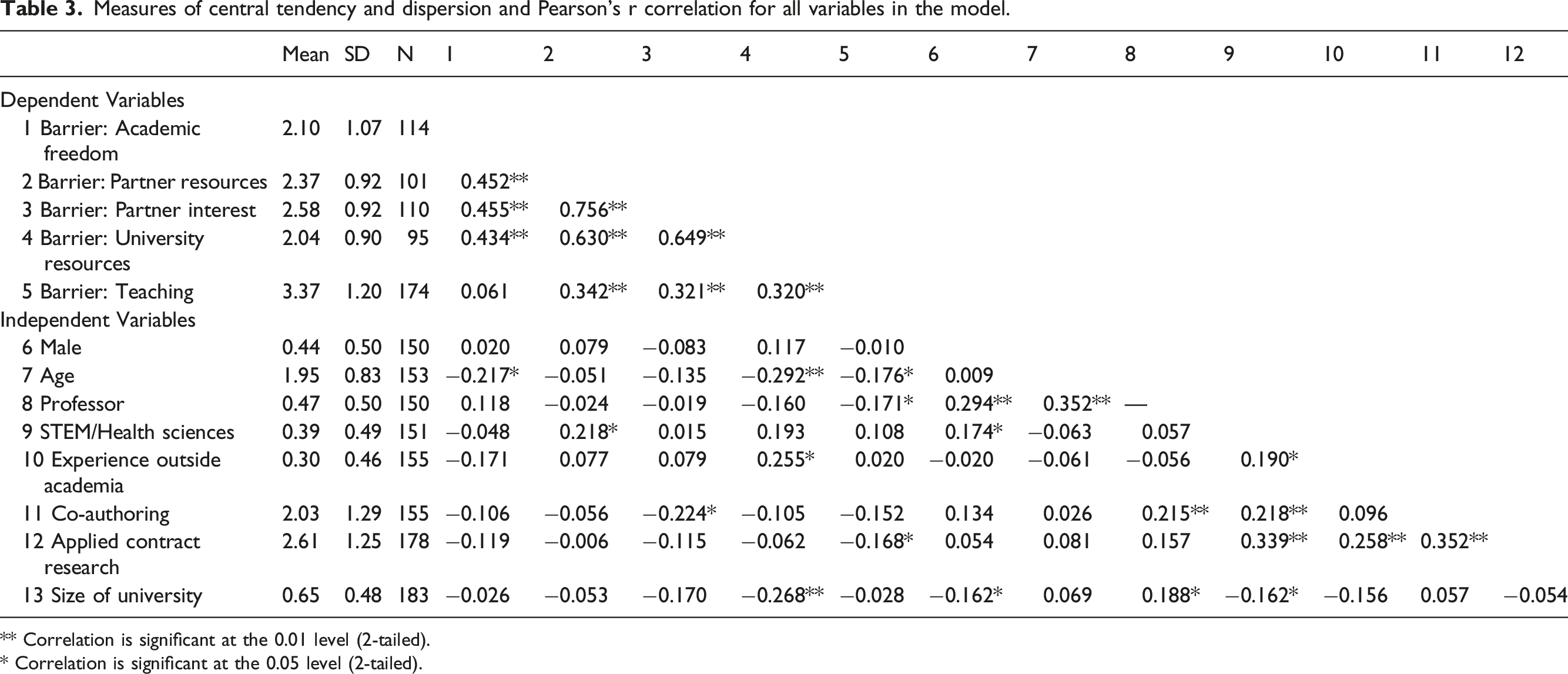
Measures of central tendency and dispersion and Pearson’s r correlation for all variables in the model.
** Correlation is significant at the 0.01 level (2-tailed).
* Correlation is significant at the 0.05 level (2-tailed).
Teaching
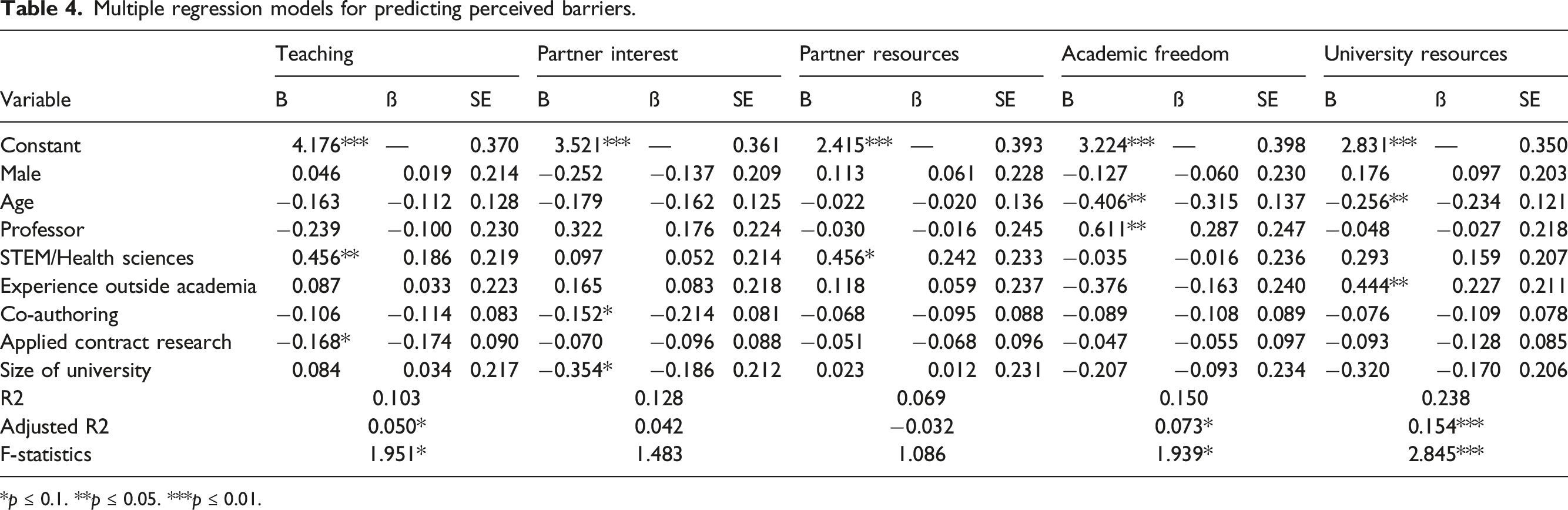
Multiple regression models for predicting perceived barriers.
*p ≤ 0.1. **p ≤ 0.05. ***p ≤ 0.01.
The intra-organisational variables STEM/Health Sciences and Applied Contract Research are further statistically significant in model 5b and in the overall model 5 days in Table 5, indicating that academics within these fields are more likely to perceive teaching obligations as a barrier to collaboration. These results may come as an unexpected result as teaching loads especially in Social Sciences and Humanities are higher due to a higher student per teacher ratio (University of Iceland, 2020). Academics which have a higher teaching load have accordingly less time left for research activities, which also involves applied contract research.
Even though rank is not significant in any of the regression models, there is a weak trend towards significance (p = 0.126) and it was slightly negatively correlated with teaching (r = −0.171, p = 0.05), which suggests that academics with a lower rank may perceive teaching as a higher barrier to collaboration than professors do.
The overall model 5 days in Table 5 is statistically significant (F = 1.951) only explaining 5% of the total variance according to the adjusted R 2 .
Partner interest
Only the size of university (if used in the model 6days in Table 6) and co-authoring are significant predictors of the barrier ‘Partner interest’ (B = −0.152*, and B = 0.-354**, respectively). Academics at smaller universities find disinterest among partners and lack of transparency as a higher barrier than academics at a larger, more broadly organised university. When considering the overall models, only model 6c, examining the size of university as an inter-organisational factor, is significant (F = 3.212). However, this model only explains about 2% of the variance.
Partner resources
In examining ‘Partner resources’ as a barrier to collaboration, we estimate a third set of models (Table 7). In these models, only the coefficient for STEM/Health Sciences is statistically significant (B = 0.776**), indicating that academics in those disciplines are more likely to see resource scarcity among potential collaborators as a barrier. The model does not address whether the reason is that potential collaborators have fewer resources, or that these disciplines require greater resources for fruitful collaboration. However, given the general resource intensity of these disciplines, the latter explanation seems more likely. Although the abovementioned coefficient is statistically significant (p < 0.05), none of the models presented in this table are significant as a whole based on their F-statistics, and the variance explained is limited based on the adjusted R 2 .
Academic freedom
A fourth set of models examines what factors predict ‘Academic freedom’ being perceived as a barrier to collaboration (Table 8). In model 8a, which includes individual factors, age has a significant negative effect, and the overall model has a statistically significant predictive power (F = 2.343). None of the variables in model 8b or 8c are statistically significant and the F-statistics for the model as a whole do not reach statistical significance.
The full model is statistically significant, according to the F-statistic (F = 1.939) and predicts around 7% of the variation in this barrier based on the adjusted R 2 . Interestingly, in the full model, which includes both age and academic rank, we find that the coefficient for age becomes more negative and the coefficient for academic rank becomes more positive and is, in fact, statistically significant. That is, controlling for rank, younger faculty members are more likely to perceive academic freedom as a barrier to collaboration, and controlling for age, full professors are more likely to perceive those effects as barrier. Thus, according to the model, young faculty members who have already achieved the rank of full professor are the group that is most likely to perceive this as a barrier.
Even though experience outside academia is not statistically significant in any of the regression models, there is a weak trend towards significance (p = 0.121), which tells us that having no experience outside of academia – mainly due to a lack of networks – somewhat predicts perceiving a negative effect on academic research as a higher barrier than academics with experience.
University resources
The last barrier related to collaboration activities is ‘University resources’ (Table 9). Here, younger academics with experience outside of academia see higher barriers to collaboration at the academic institution (B = −0.256*, and B = 0.444**, respectively). Further, the size of university and discipline (STEM/Health Sciences) also have a significant effect in model 9b and 8c (B = −0.320, and B, = 0.293, respectively). However, in the overall model 8days, there is only a weak trend toward significance.
Academics at smaller universities with smaller financial models perceive university resources as a higher barrier than academics at a bigger one. The overall model predicts about 15.4% of the variability regarding university resources as a barrier (F = 2.845). The most important variable is age, followed by experience outside academia.
Discussion
To the extent that universities want to promote and increase collaboration with stakeholders outside academia, it is crucial to identify the barriers that stand in the way of doing so. Here, we examined which individual, intra-, and inter-organisational factors influence academics’ perception of perceived barriers to collaboration.
The results revealed that in our sample, academics reported time spent teaching as the main barrier to collaboration and generally, spending more time on teaching was found to have a negative impact on collaboration activities. This suggests that additional TM activities cause an even higher workload for academics, which contradicts the strategy of universities that want to see an increase in academic engagement in society. As stated in previous research, implementing TM comes with a cost (Klincewicz et al., 2022); if there are not enough financial and human resources within the university, following a TM beyond the first two missions of research and teaching is unlikely to be successful. However, access to resources on behalf of collaboration partners is seen as a positive factor that might spur collaboration (Tartari and Breschi, 2012). Yet, a high teaching load adds to a lack of recognition for TM activities at the university level (Monteiro et al., 2021). Consequently, by placing more duties on academics they risk becoming stuck in a ‘mission overload’ (Jongbloed et al., 2008; Benneworth et al., 2016, 2017) where they cannot manage all their tasks adequately with the same excellence.
Taking a closer look at the teaching barrier, we find that younger academics, academics in STEM/Health sciences, and academics who are conducting less applied contract research are more likely to perceive teaching as a barrier to TM activities. Rank was slightly negatively correlated with teaching, showing a tendency in which non-professors perceive teaching as a higher barrier than professors. Similar results have been found in a study by Watson et al. (2016).
The fact that young academics in STEM/Health sciences perceive teaching as a greater barrier compared to other disciplines is surprising, and in contrast to former findings (Fini et al., 2017). One possible explanation is that there is more pressure to publish in high ranked international journals and applying for funding in such disciplines. That can be related to Ajzen’s (1991) theory of planned behaviour within a university settings. Alternatively, this could be considered in conjunction with other barriers, since all significant estimates of STEM/Health coefficients were positive, indicating that academics in these disciplines perceive higher barriers overall – despite being quite active in TM activities. It is possible that experience with engaging in TM activities makes these groups more attuned to the barriers that one may run into when doing so (Goduscheit and Knudsen, 2015). Younger academics generally have a higher teaching load and need to establish themselves in academia through academic excellence (Moutinho et al., 2007). This suggests that additional pressure, long working hours and high internal expectations may negatively impact extra TM activities. Younger academics with children experience a double disadvantage due to more extensive family obligations (Gazea and Stevens, 2011).
We also found that academics who have no experience of working outside academia, those who are younger, and those who hold a professorship are more concerned that collaboration negatively effects their academic research, believing that it can impair academic freedom. However, academics with experience outside academia are more likely to perceive barriers to collaboration in the academic environment (‘University resources’). These results are in some aspects similar to those of Goduscheit and Knudsen (2015), where academics with collaboration experience perceived higher barriers than other academics. However, our study makes a distinction between different types of perceived barriers, whereby academics with no collaboration experience in the form of co-authoring identify a lack of potential partner interest as a higher barrier than academics with collaboration experience, i.e., they see the fault in the external environment and not within themselves or the university. When looking at work experience outside of academia – which can be seen as a prerequisite to build up future networks and cooperation between academia and industry – academics with no further experience find a threat to academic freedom as a higher barrier than academics with work experience outside the academic setting which means they take on a rather conservative view where they see the research mission as most important in their work.
In contrast, those academics with working experience perceive shortcomings of university resources as a higher barrier. In addition, especially academics in STEM/Health disciplines see resource scarcity among collaboration partners and at their university as higher barriers than academics from other disciplines. Universities and companies in Iceland operate mostly on a small scale in international comparison, and Icelandic universities still have the vision of achieving high global university rankings, which points to a potential tension between an ambition for publications in high ranked journal and TM participation.
What is more, academics at smaller universities experience that possible collaboration partners have little interest in their research and projects, followed by a higher perceived deficit when it comes to university resources and opportunities to commercialisation. Both barriers correlate highly and therefore availability of university resources, and the interest of potential collaboration partners build upon each other. Similar results have been observed, e.g. in China (Tang et al., 2020). Further, more collaboration with industry is linked to universities which have obtained public funding compared to those with international funding (Klasova et al., 2019).
There were no gender differences in any of the models, even though one could have expected a difference regarding teaching as a barrier, given that among the respondents, women hold overall lower academic positions that have a higher teaching load. Similar results were obtained in a study of American scientists conducted by Bozeman and Gaughan (2011) where the authors deduced that ‘the decades-long policy focus on reducing family-related barriers to women’s participation in scientific work may well be paying off’ (p. 1399). Iceland is one of the most gender-equal countries in the world (United Nations Development Programme, 2021), which may explain the lack of a gender effect; however, future studies might reveal gender differences in countries where gender equality is not yet as high.
Overall, we find that younger academics perceive more barriers than their older colleagues. This is the case regarding academic freedom, time that is required for teaching, and university resources. Interestingly, younger academics also see a lack of support at their university. This might be because the closer in time an academic has completed academic training, academics have a higher entrepreneurial attitude (D’Este and Patel, 2007). Principally, this is a concern as perceiving higher barriers at a younger age might prevent these academics by taking a first step to collaboration with partners outside academia.
The issues that our participants are most likely to perceive as barriers relate mostly to intra-organisational factors, especially regarding teaching, partner resources, and university resources. This means that factors preventing collaboration are mostly due to deficits at the academic institution itself, and not – as previous research disclosed, according to individual factors (D’Este and Patel, 2007; Lam, 2011). These results suggest that the internal structure within universities can have a higher influence on academics perceived barriers to collaboration than individual or inter-organisational factors. Perceived barriers to collaboration are displayed in a matrix according to three main levels as shown in Figure 2. Matrix of perceived barriers to collaboration.
It becomes clear that intra-organisational factors impact all three levels of barriers, inter-organisational factors, i.e., size of university, only the internal and external level, and individual variables influence barriers on the individual and internal level of universities.
Lastly, we are aware of the limitation of the low response rate in the survey with respect to data reliability and generalisability, at the same time, however, the low response rate can be indicative of little interest and/or engagement in the subject. As both Dohse et al. (2021) and Salminen et al. (2014) have pointed out, TM activities are still controversial with academics in general having little to no interest towards entrepreneurship. Many academics might also not have considered to contribute as they may have felt they had little to say on the topic. Questions on ‘Property right problems’ or ‘Lack of technical facilities on the part of companies/organisations’ (see Figure 1) were sparsely answered as they may simply not have applied to most academics – also as most respondents were from SSH and education sciences with little experience in applied research and collaboration.
There are also minor differences between the observable characteristics of the participants in the study and the characteristics of the population of Icelandic academics, in particular regarding gender, discipline, and academic ranking. Women were overrepresented in the sample, as well as professors, while academics in health sciences, and arts, are underrepresented. This may have some impact of the results as former studies (Pita et al., 2021; Calvo et al., 2019; Lam, 2011) have shown that males are more active in innovation and entrepreneurial actives than females, and academics in health and life sciences are more active in commercialisation of research than academics in social sciences and humanities (Powers, 2003; Stuart and Ding, 2006). Younger academics are also more likely to participate in TM activities than professors as already noted. Finally, it is worth noting that only one university was classified as a large university. Our view was that size was the most salient difference between this university and the others, but it is not possible to rule out that other aspects, such as culture and management, differ to some extent as well.
Nevertheless, this study is the first of its kind in Iceland, considering the total population of academics, including disciplines such as social sciences and humanities which have often been neglected in previous research, which makes it a valuable contribution to the theory of academic entrepreneurship.
Implications and future research direction
The results contribute to the discussion of how to improve the future strategy of universities and indicate that in order to strengthen collaboration of academics and universities, different types of barriers perceived by academics need to be considered. University management has limited influence on external barriers such as resource scarcity and lack of interest of possible collaboration partners. However, it can have a direct influence on mitigating barriers based on intra-organisational factors through effective strategies and approaches.
It is clear that some of the perceived barriers have negative effects on academics’ intention to increase or even start collaboration, which should be taken into consideration when developing collaboration strategies or reward systems. However, not every academic that participated in the study has collaborated or even considered collaboration with industry or community. The incentive structure and work evaluation system were mentioned in this context. Therefore, it may be necessary to review rating and salary systems to support TM projects.
When taking into account the theory of planned behaviour (Ajzen, 1991), the risks and benefits of participating in TM activities vary for academics belonging to STEM/Health disciplines in contrast to other disciplines, professors and non-professors, and academics who are younger in contrast to those that are older. This requires different policies, evaluation, and reward structures for different groups of academics within academia itself. Academics also need to be better informed about TM activities and academic projects need to be more visible for potential external partners.
As academics with no networks outside academia have difficulties in establishing cooperation, boundary-spanners, or intermediaries (Abreu et al., 2009; Long et al., 2013; Awasthy et al., 2020; Goethner et al., 2012) may be beneficial to support such activities. Intermediaries can be in the form of technology transfer offices or people inside academia with experience of the academic and external environment that try to improve and build university-industry relations.
The analysis also made clear that the approach to measuring long-term societal impact –beyond research publications – must be improved. Collaboration with partners outside of academia is crucial to broaden the impact in a non-academic sphere, such as influencing policy, creating new sources of income, or improving systems, processes, and designs. An approach that focuses solely on the publication of research results in peer-reviewed journals means that the potential for societal impact is not fully realized.
Footnotes
Declaration of conflicting interests
The author(s) declared no potential conflicts of interest with respect to the research, authorship, and/or publication of this article.
Funding
The author(s) received no financial support for the research, authorship, and/or publication of this article.

Notes
Appendix
Multiple regression models for predicting teaching as a perceived barrier. Note. In model 1a we entered individual variables, in model 1b intra-organisational, in model 1c inter-organisational, in model 1day all independent variables *p ≤ 0.1. **p ≤ 0.05. ***p ≤ 0.01
Variable
N
Model 5a
Model 5b
Model 5c
Model 5days
B
ß
SE
B
ß
SE
B
ß
SE
B
ß
SE
Constant
3.879***
0.268
3.968***
0.245
3.419
0.153
4.176***
0.370
Male
150
−0.020
−0.008
0.199
0.046
0.019
0.214
Age
153
−0.255**
−0.175
0.120
−0.163
−0.112
0.128
Professor
150
−0.307
−0.128
0.200
−0.239
−0.100
0.230
STEM/Health sciences
151
0.476**
0.194
0.212
0.456**
0.186
0.219
Experience outside academia
155
0.087
0.033
0.219
0.087
0.033
0.223
Co-authoring
155
−0.097
−0.104
0.082
−0.106
−0.114
0.083
Applied contract research
178
−0.179**
−0.186
0.089
−0.168*
−0.174
0.090
Size of university
183
−0.071
−0.028
0.190
0.084
0.034
0.217
R2
0.031
0.091
0.001
0.103
Adjusted R2
0.017
0.058
−0.005
0.050
F-statistics
2.263
2.79**
0.140
1.951*
Multiple regression models for predicting partner interest as a perceived barrier. Note. In model 2a we entered individual variables, in model 2b intra-organisational, in model 2c inter-organisational, in model 2days all independent variables *p ≤ 0.1. **p ≤ 0.05. ***p ≤ 0.01.
Variable
N
Model 6a
Model 6b
Model 6c
Model 6days
B
ß
SE
B
ß
SE
B
ß
SE
B
ß
SE
Constant
2.937***
0.260
2.93***
0.244*
2.789
0.145
3.521***
0.361
Male
150
−0.151
−0.082
0.193
−0.252
−0.137
0.209
Age
153
−0.149
−0.135
0.117
−0.179
−0.162
0.125
Professor
150
0.086
0.047
0.199
0.322
0.176
0.224
STEM/Health sciences
151
0.136
0.073
0.212
0.097
0.052
0.214
Experience outside academia
155
0.228
0.115
0.219
0.165
0.083
0.218
Co-authoring
155
−0.161*
−0.227
0.082
−0.152*
−0.214
0.081
Applied contract research
178
−0.071
−0.097
0.088
−0.070
−0.096
0.088
Size of university
183
−0.324*
−0.170
0.181
−0.354*
−0.186
0.212
R2
0.025
0.071
0.029
0.128
Adjusted R2
0.003
0.016
0.020
0.042
F-statistics
1.130
1.286
3.212*
1.483
Multiple regression models for predicting partner resources as a perceived barrier. Note. In model 3a we entered individual variables, in model 3b intra-organisational, in model 3c inter-organisational, in model 3days all independent variables *p ≤ 0.1. **p ≤ 0.05. ***p ≤ 0.01.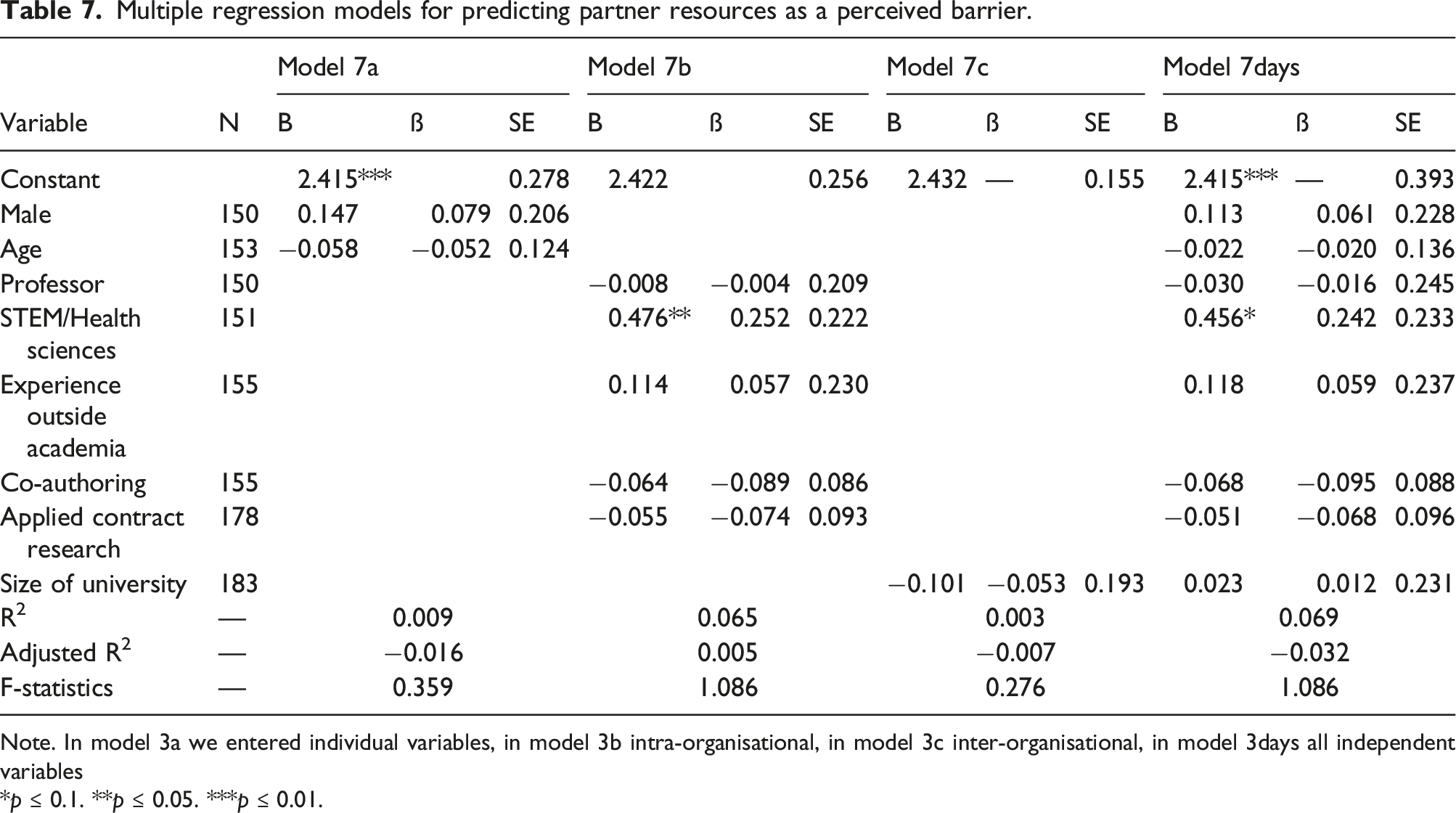
Variable
N
Model 7a
Model 7b
Model 7c
Model 7days
B
ß
SE
B
ß
SE
B
ß
SE
B
ß
SE
Constant
2.415***
0.278
2.422
0.256
2.432
—
0.155
2.415***
—
0.393
Male
150
0.147
0.079
0.206
0.113
0.061
0.228
Age
153
−0.058
−0.052
0.124
−0.022
−0.020
0.136
Professor
150
−0.008
−0.004
0.209
−0.030
−0.016
0.245
STEM/Health sciences
151
0.476**
0.252
0.222
0.456*
0.242
0.233
Experience outside academia
155
0.114
0.057
0.230
0.118
0.059
0.237
Co-authoring
155
−0.064
−0.089
0.086
−0.068
−0.095
0.088
Applied contract research
178
−0.055
−0.074
0.093
−0.051
−0.068
0.096
Size of university
183
−0.101
−0.053
0.193
0.023
0.012
0.231
R2
—
0.009
0.065
0.003
0.069
Adjusted R2
—
−0.016
0.005
−0.007
−0.032
F-statistics
—
0.359
1.086
0.276
1.086
Multiple regression models for academic freedom as a perceived barrier. Note. In model 4a we entered individual variables, in model 4b intra-organisational, in model 4c inter-organisational, in model 4days all independent variables *p ≤ 0.1. **p ≤ 0.05. ***p ≤ 0.01.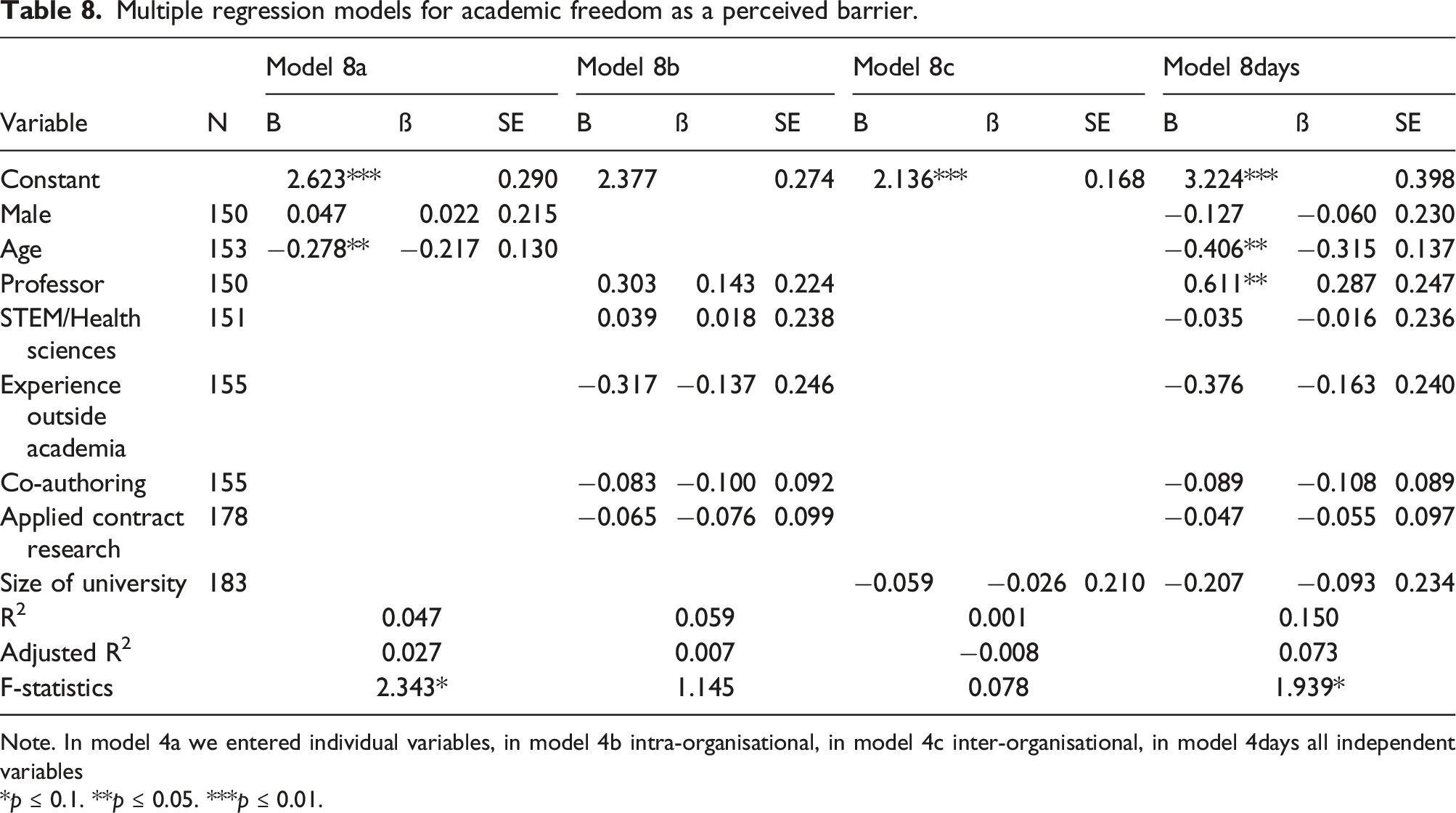
Variable
N
Model 8a
Model 8b
Model 8c
Model 8days
B
ß
SE
B
ß
SE
B
ß
SE
B
ß
SE
Constant
2.623***
0.290
2.377
0.274
2.136***
0.168
3.224***
0.398
Male
150
0.047
0.022
0.215
−0.127
−0.060
0.230
Age
153
−0.278**
−0.217
0.130
−0.406**
−0.315
0.137
Professor
150
0.303
0.143
0.224
0.611**
0.287
0.247
STEM/Health sciences
151
0.039
0.018
0.238
−0.035
−0.016
0.236
Experience outside academia
155
−0.317
−0.137
0.246
−0.376
−0.163
0.240
Co-authoring
155
−0.083
−0.100
0.092
−0.089
−0.108
0.089
Applied contract research
178
−0.065
−0.076
0.099
−0.047
−0.055
0.097
Size of university
183
−0.059
−0.026
0.210
−0.207
−0.093
0.234
R2
0.047
0.059
0.001
0.150
Adjusted R2
0.027
0.007
−0.008
0.073
F-statistics
2.343*
1.145
0.078
1.939*
Multiple regression models for university resources as a perceived barrier. Note. In model 5a we entered individual variables, in model 5b intra-organisational, in model 5c inter-organisational, in model 5 days all independent variables *p ≤ 0.1. **p ≤ 0.05. ***p ≤ 0.01.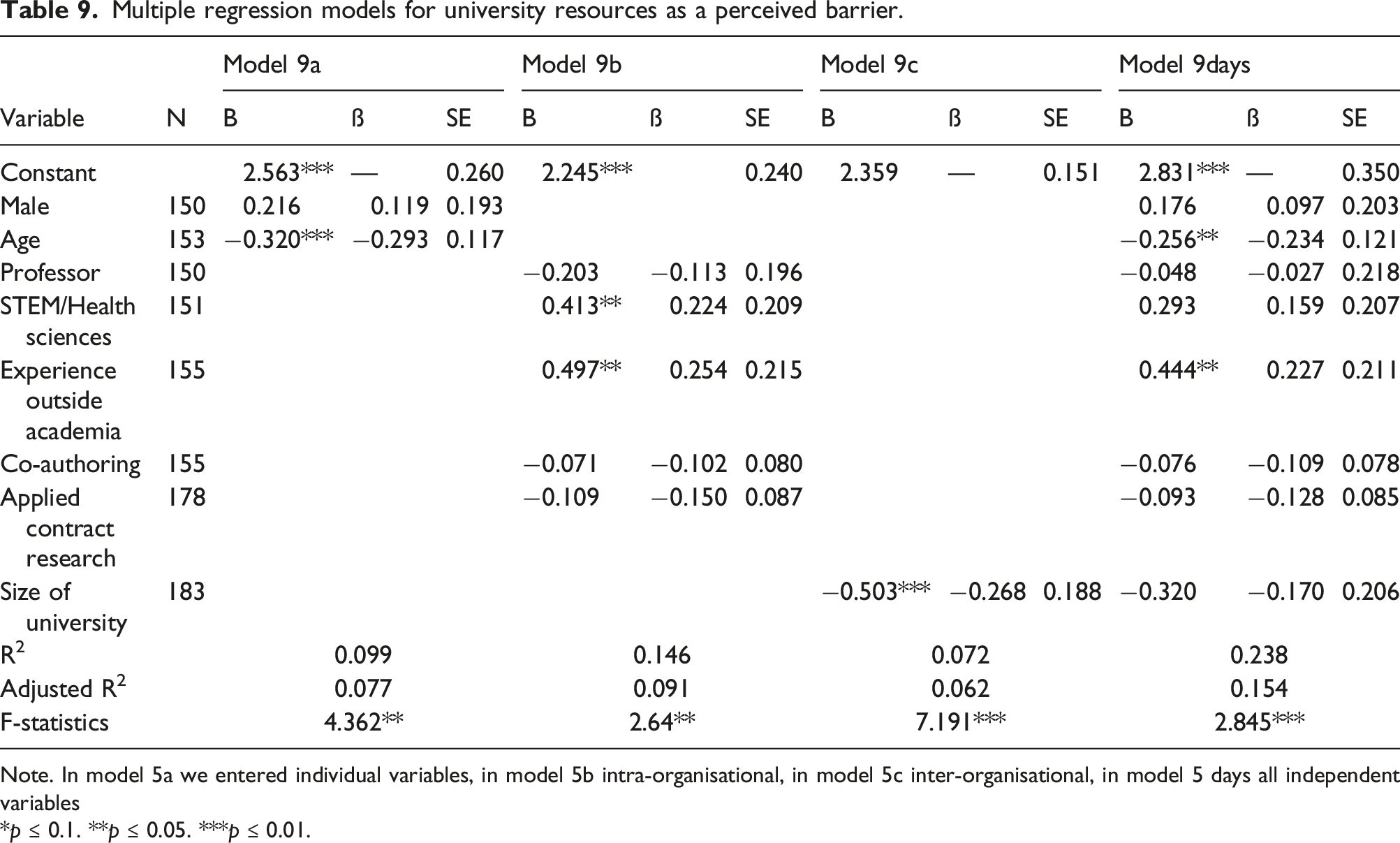
Variable
N
Model 9a
Model 9b
Model 9c
Model 9days
B
ß
SE
B
ß
SE
B
ß
SE
B
ß
SE
Constant
2.563***
—
0.260
2.245***
0.240
2.359
—
0.151
2.831***
—
0.350
Male
150
0.216
0.119
0.193
0.176
0.097
0.203
Age
153
−0.320***
−0.293
0.117
−0.256**
−0.234
0.121
Professor
150
−0.203
−0.113
0.196
−0.048
−0.027
0.218
STEM/Health sciences
151
0.413**
0.224
0.209
0.293
0.159
0.207
Experience outside academia
155
0.497**
0.254
0.215
0.444**
0.227
0.211
Co-authoring
155
−0.071
−0.102
0.080
−0.076
−0.109
0.078
Applied contract research
178
−0.109
−0.150
0.087
−0.093
−0.128
0.085
Size of university
183
−0.503***
−0.268
0.188
−0.320
−0.170
0.206
R2
0.099
0.146
0.072
0.238
Adjusted R2
0.077
0.091
0.062
0.154
F-statistics
4.362**
2.64**
7.191***
2.845***