




Abstract
This study aims to examine the impact of students’ entrepreneurial self-efficacy on their opportunity recognition capability after their exposure to classroom-based entrepreneurship education, leading to the development of intention to undertake an entrepreneurial activity. A detailed questionnaire was used to collect data from 351 students pursuing undergraduate and postgraduate courses. Results confirm that the student’s entrepreneurial self-efficacy positively influences their intention to undertake an entrepreneurial activity directly and indirectly via their opportunity recognition capability. Also, entrepreneurship education significantly moderates the link between students’ entrepreneurial self-efficacy and opportunity recognition capability. These results have practical implications for universities and policymakers, as universities that are not providing entrepreneurship education can adopt the same module of classroom education. Also, policymakers can frame policies directing institutions to start similar kinds of entrepreneurship education programs, even at the intermediate level, particularly in lower-middle-income countries.
Keywords
Introduction
Entrepreneurship is the activity whereby an individual or a body of individuals utilize coordinated efforts and methods to explore opportunities to generate and develop value by meeting desires and necessities via innovation and creativity, regardless of the available resources (Hassan et al., 2022; Karimi, 2020). Entrepreneurship has attracted the curiosity of both researchers and governments in recent decades. The primary source of concern is the growing need for entrepreneurs that can assist in stimulating financial growth by constructing fresh concepts and transforming them into profitable ventures. Entrepreneurial efforts bring not just technical advancement but are also responsible for employment generation and economic development (Lopes et al., 2022). A country with a low economic growth rate can rely on new start-ups and small firms to repair its economic growth (Heilmaier and Ling, 2021).
Higher educational institutions (HEI’s) providing entrepreneurship education, play a vital role in the development of a feasible entrepreneurial ecosystem (Isenberg, 2011; Lopes et al., 2022). As entrepreneurship education helps in inculcating an entrepreneurial mind-set in students (Hassan et al., 2020, 2021), leading to the development of intention towards undertaking an entrepreneurial activity (Daniel, 2016). Researchers believe that entrepreneurship education enhances student’s entrepreneurial knowledge and makes them believe in their ability to undertake an entrepreneurial activity (Ubierna et al., 2014; Lopes et al., 2022). Additionally, according to Indian Ministry of Skill Development and Entrepreneurship (MSDE) 2021–2022 report, India would benefit greatly from investing in programmes that encourage and teach entrepreneurship. This shows how important entrepreneurship education is for the future growth and competitiveness of lower middle income country like India, which is struggling with the increased unemployment (Hassan et al., 2020). Based on the importance of entrepreneurship education, India has started giving more attention towards promoting entrepreneurship education courses even in the major Indian Institutes of Technology (IIT’s), Indian Institutes of Management (IIM’s), and centrally funded universities.
Entrepreneurship can be stimulated through entrepreneurial education. The majority of the studies have discovered a link between entrepreneurship education (EE) and entrepreneurial intention (EI) (Saeed et al., 2015; Fietze and Boyd, 2017). EI is necessary so that students can try and mould their entrepreneurial skills to make an informed decision about their intention to pursue entrepreneurship as a career (Fretschner and Weber, 2013). EI is a cognitive perspective that occurs before activity and emphasises a specific objective, such as setting up a new enterprise (Krueger and Carsrud, 1993; Molaei et al., 2014). Entrepreneurial process begins from the onset an individual develops the intention to undertake an entrepreneurial activity (Gartner et al., 1994; Al Mamun et al., 2016).
Without considering the quality of education and other crucial aspects affecting students’ intentionality, policymakers and governments will not succeed in achieving the objectives they set out to achieve via policies they framed (Sahoo and Panda, 2019). There has been a great deal of arguments regarding the effectiveness of the classroom entrepreneurship education being provided to students (Hassan et al., 2021) and its role in influencing the efficacy, opportunity recognition capability, and development of the entrepreneurial intention among university students. Studies with conflicting findings have contributed to the growing debate over its effects (Daniel, 2016). Students’ entrepreneurial intention is a key variable used to predict entrepreneurial action, and some research suggests that entrepreneurship education programmes have a positive effect on the intention to undertake an entrepreneurial activity (Küttim et al., 2014; Martin et al., 2013). However, some researchers have found no effect from entrepreneurship education at all (Von Graevenitz et al., 2010; Lorz, 2011; Oosterbeek et al., 2010). Case studies, group discussions, business/computer game simulations, role models, business plan development, and guest speakers are just a few examples of the types of active methods that have been shown to be effective in encouraging entrepreneurial behaviour in students (Hassan et al., 2021; Mwasalwiba, 2010). The current study is based on examining the effectiveness of classroom based entrepreneurship education in developing the efficacy and opportunity recognition capability among students in Indian settings, which enhances their chances of undertaking an entrepreneurial activity. The classroom based entrepreneurship education involves theoretical sessions, interactive sessions with entrepreneurs, case-based discussions and practical problem solving, with the aim of providing necessary basic entrepreneurial knowledge and building competence among students to cope with the changing business environment affecting their intention to undertake a new venture.
Entrepreneurial self-efficacy (ESE) is another important aspect in determining EI (Nowiński, et al., 2019). ESE is a set of cognitive thought processes that entrepreneurs use to discover their strengths and utilise them to achieve better results (Wang et al., 2016). Entrepreneurs with high self-efficacy are more organised and dedicated (Hassan et al., 2020). It can also assist entrepreneurs in seeing new possibilities and acting effectively through their will to solve issues, enthusiasm for addressing challenges (Forbes, 2005), managerial abilities, and attitude to take risks (Wang et al., 2016).
Entrepreneurs need not only to build intention but also to be efficient in detecting possibilities overlooked by others or are unable to recognise and then utilise these possibilities promptly and effectively if they want to be successful in starting and managing new businesses (Santos et al., 2016). Opportunity recognition (OR) is seeing an opportunity to start a new venture or substantially improve the status of an established one, both of which result in increased potential profit (Hunter, 2013). Entrepreneurship education and recognising entrepreneurial opportunities have been shown to have a favourable link (Manesh and Rialp-Criado (2019). Wen-Long et al. (2014) discovered that a successful structure and implementation of an education program substantially influenced the ability to recognise entrepreneurial opportunities (Wen-Long et al., 2014).
The aim of this paper is to analyse the impact of students’ entrepreneurial self-efficacy on their opportunity recognition capability after their exposure to classroom based entrepreneurship education, leading to the development of intention to undertake an entrepreneurial activity. Also this study contributes to the entrepreneurship education theories by examining the feasibility of conventional classroom based entrepreneurship education approach in developing the student’s intention to undertake an entrepreneurial activity. Research evolved in the entrepreneurship education field prompted for more inclusive framework by examining the role of various cognitive factors in addition to the antecedents of the Theory of Planned Behaviour (TPB) in determining the entrepreneurial intention of students (Hassan et al. 2021), based on this current study developed an inclusive conceptual framework by examining the direct and indirect impact of student’s entrepreneurial self-efficacy, mediated by opportunity recognition, and moderated by the entrepreneurship education (as shown in Figure 1). Thus, the following research questions are going to be investigated in this paper: Conceptual model.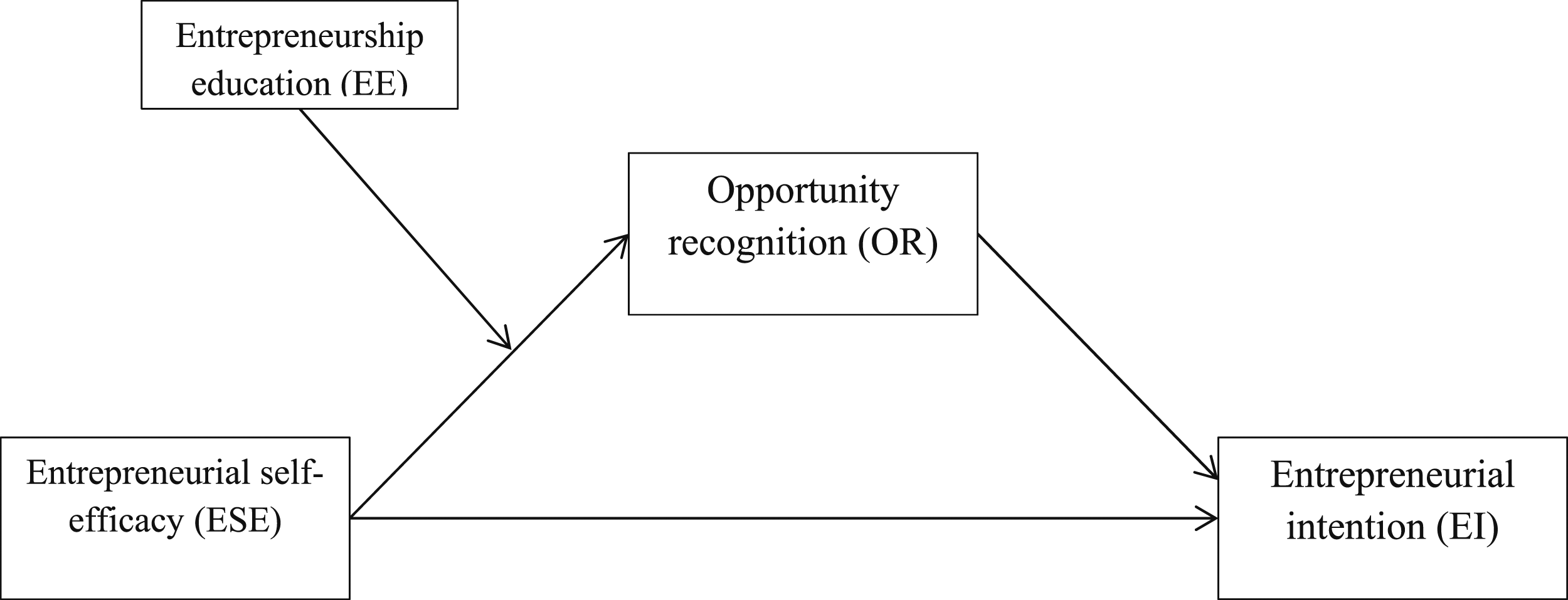
What is the relationship between entrepreneurial self-efficacy, opportunity recognition and entrepreneurial intention of students?
Is there any mediating role of students’ opportunity recognition capability in between their entrepreneurial self-efficacy and intention relationship?
Is there any moderating role of entrepreneurship education in students’ entrepreneurial self-efficacy and intention relationship?
Is the classroom entrepreneurship education effective enough to influence the entrepreneurial intention of students?
Theoretical foundation
Researchers argue that entrepreneurial behaviour is the aftermath of entrepreneurial intentions (Molaei et al., 2014). These intentions are affected by various cognitive and contextual factors (Lopes et al., 2022; Hassan et al., 2022). Various theories have been developed over the years in order to predict the entrepreneurial intention of an individual. One of the prominent among them is the Ajzen’s theory of planned behaviour (TPB), which is based on three cognitive antecedents’ viz., attitude towards entrepreneurship, subjective social norms and perceived behavioural control. Studies have shown that TPB has the ability to explain 45% of variance in predicting the entrepreneurial intention, indicating that 55% of variance remains unexplained (Van Gelderen et al., 2008; Liñán and Chen, 2009). Researchers have suggested an extension of the TPB by examining the role of other cognitive and contextual factors in predicting the entrepreneurial intention of an individual (Karimi, 2020). Based on these suggestions, current study incorporates entrepreneurial self-efficacy, opportunity recognition and entrepreneurship education in the theoretical model in order to predict the entrepreneurial intention of students.
Literature review
ESE and EI
ESE is a motivational source as it boosts one’s self-confidence and faith in one’s ability which influences one’s cognitive degree (Dissanayake, 2013; Kuo et al., 2004), i.e., the idea is linked with self-evaluation, which determines the efforts and courage to face adversity and decides the steps to be taken (Kuo et al., 2004). A person can undertake better in a job with a greater level of self-efficacy; contrarily, he tends to ignore a job with low self-efficacy due to fear of failure (Piperopoulos and Dimov, 2015).
This topic has grown in popularity throughout the period, especially in entrepreneurship-related research (Chen et al., 1998; Markman and Baron, 2003). The study by Krueger and Brazeal (1994) regarded ESE as necessary for entrepreneurship (Krueger and Brazeal, 1994). ESE acts as an entrepreneurial behaviour stimulator (Nowiński et al., 2019; Laviolette et al., 2012), as ESE assists in proceeding through the entrepreneurial process by successfully recognising the right opportunity and tackling the challenges faced during the process (Kumar, 2007). Researchers have confirmed a favourable relationship between ESE and EI in various nations, like the USA, South Korea, and Poland etc. Therefore, multiple studies have proven that a rise in ESE increases EI (Hassan et al., 2020; DePillis and Reardon, 2007). Based on this premise of determination of entrepreneurial intention in students through their self-efficacy, following hypothesis has been proposed:
ESE positively influences the EI of students.
ESE and OR
OR is the mental ability (or abilities) whereby a person deduces that he has discovered an opportunity (Timmons, 1989; Baron, 2006). According to Ardichvili et al. (2003, p. 106), the substantial elements that influence the main operation of opportunity recognition and growth leading to business formation are entrepreneurial vigilance; asymmetric information and prior understanding; social connections; personality attributes such as positivity, self-efficacy and innovation, and the kind of opportunity on its own. While experts argue that entrepreneurial self-efficacy is an essential precondition of opportunity recognition (De Koning and Muzyka, 1999; Park, 2005), there is little data to support this claim. Opportunity recognition happens before and after a venture’s establishment (Lumpkin et al., 2001). Nevertheless, much of the existing research on ESE and its potential impact on OR is theoretical (Park, 2005). Ozgen (2003) discovered empirical proof of a favourable association between ESE and OR in his study. Therefore, it would be interesting to analyse the impact of ESE on OR, and hence following hypothesis has been proposed:
ESE positively influences the OR capability of students.
OR and EI
EI leads and steers a person’s efforts to create and introduce a fresh business idea (Bird, 1988). A large amount of research suggests that entrepreneurial intention plays a crucial part in the choice to initiate a new venture (Liñán and Chen, 2009). Consequently, in the past few years, the model of employment status choice, which concentrates on entrepreneurial intention, has attracted much attention in entrepreneurship studies (e.g., Engle et al., 2010; Iakovleva et al., 2011; Karimi et al., 2013, 2014). Krueger et al., (2000) discovered that intention models present an excellent chance to improve entrepreneurial knowledge and forecasting capabilities.
Entrepreneurial intentions are driven by identifying and recognising opportunities which significantly impact business start-up decisions (Hill and Birkinshaw, 2010; Wasdani and Mathew, 2014; Shane and Nicolaou, 2015). Studies have suggested a positive association between OR and EI of an individual (Krueger, 2009), as individuals who are good at recognising the opportunities are more inclined towards entrepreneurship (Hassan et al., 2020). Based on the premise that better opportunity recognition capability enhances an individual’s chances of undertaking an entrepreneurial activity, thereby developing the entrepreneurial intention, following hypothesis has been proposed.
OR capability positively influences the EI of students.
OR as a mediator between ESE and EI
Identifying opportunity is viewed as a cognitive characteristic of an entrepreneur that influences his other cognitive abilities (Yitshaki and Kropp, 2016). With ESE, OR also increases the EI of a person (Puni et al., 2018; Hansen et al., 2011), and because being able to recognise, select, and implement the right opportunity will actually result in a successful business. A person’s entrepreneurial mind-set encourages them to search for the right business opportunities, increasing their ESE (Hassan et al., 2020; Ozgen, 2003). Following the literature review, it has been determined that ESE and OR are positively associated (Anwar et al., 2022).
Opportunity recognition is one of the essential steps in entrepreneurship because doing so helps one to choose an idea before implementing it into an enterprise and embrace and utilise all the necessary abilities (Hunter, 2013; Santos et al., 2016; Okudan and Rzasa, 2006; Hassan et al., 2020). Opportunity recognition improves one’s positive attitude and behavioural intention toward entrepreneurship. The identification of a potential favourable business opportunity lays the groundwork for the development of a new enterprise (Timmons, 1989; Krueger and Carsrud, 1993; Boyd and Vozikis, 1994; Santos et al., 2016). People better at spotting these opportunities are more likely to commence their businesses and have a higher propensity for entrepreneurship (Manesh and Rialp-Criado, 2019; Hassan et al., 2020). Based on the premise that individuals having belief and trust in their capabilities to successfully proceed through the entrepreneurial process are more likely to have better opportunity recognising capability, leading to the development of intention to undertake an entrepreneurial activity, following hypothesis has been formulated:
The OR capability of student’s mediates the ESE and EI relationship.
EE positively moderates the relationship between ESE and OR
Self-efficacy or self-reliance in a specific field is determined by a person’s introspection of talents and capabilities. This idea represents a person’s inner opinions about whether they possess the skills deemed essential for job completion and the faith that they will be capable of translating those abilities into desired output successfully (Bandura, 1989, 1997). Self-efficacy is a helpful term for studying people’s behaviour since studies reveal that it affects a person’s choice, effort level, and persistence (Chen et al., 2004).
A study reveals that the signs learners take from an entrepreneurship course in an academic context affect their self-efficacy perceptions (Von Graevenitz et al., 2010); another study shows contrary results (Hmieleski and Baron, 2008). In certain circumstances, they may diminish; perhaps due to a realisation during the course that entrepreneurship is much more than simply eye-catching (Oosterbeek et al., 2010). EE can play a vital part in promoting self-efficacy in people by equipping chances to perform feasibility analyses, design business strategies, and participate in on-going businesses (Wilson et al., 2007). ESE is a prerequisite for OR (De Koning and Muzyka, 1999; Park, 2005). Recognition of entrepreneurial opportunities is a skill that can be cultivated just like any other, and the best method to do so is through entrepreneurship education (DeTienne and Chandler, 2004). Role of EE in entrepreneurship has always been a debateable topic, due to its mixed results. Studies like (Hassan et al., 2021) have prompted for more rigorous approaches in examining the role of entrepreneurship education particularly the classroom entrepreneurship education in enhancing students’ skills and determining their intention to start an entrepreneurial activity. Based on this premise positing entrepreneurship education as a moderator, following hypothesis has been proposed:
EE moderates the ESE and OR relationship.
Research design and methodology
Demographic profile of the sample (N=351).

Samples and education programme
Students enrolled in business and management courses were preferred for this study. These students are taught a separate subject named entrepreneurship education during their undergraduate and postgraduate course. The entrepreneurship education subject is taught in these institutions through conventional classroom education method. The survey was conducted after they had completed the particular semester in which entrepreneurship education subject was taught. The different business and management courses taught in these universities are bachelors in commerce, bachelors in business administration, masters in commerce, and masters in business administration. The purpose of choosing students seeking entrepreneurship and business education was to examine the impact of EE they were seeking on their ability to recognise an entrepreneurial opportunity, as education is an important predecessor in attaining entrepreneurial ends (Küttim, et al., 2014; Adekiya and Ibrahim, 2016; Pedrini et al., 2017; Puni et al., 2018). The students were contacted and asked to rate as to how their exposure to entrepreneurship education helped them in gaining knowledge about entrepreneurial environment and necessary abilities to become an entrepreneur with questions, “knowledge about the entrepreneurial environment, and “the necessary abilities to be an entrepreneur”.
Questionnaire development
For the purpose of data collection, a questionnaire with validated scales was adapted and contextualised from previous published studies. The constructs of ESE, EE and EI, were measured by using the well-known and generally recognised EIQ (Entrepreneurial intention questionnaire) devised by Liñán and Chen (2009), on a seven-point Likert-type scale. The OR construct was measured using a scale adapted from (Ozgen and Baron, 2007). A total of 20 items were used in the questionnaire (see appendix 1), except the items ascertaining to the demographic profile of respondents (gender, age, course, the father being self-employed and the mother being self-employed).
Data Analysis
This study employed Smart PLS (4.0), statistical software, to analyse the data via partial least square equation modelling (PLS-SEM). The selection of this method of evaluation is based on the characteristics of the sample and the moderation analysis. Likewise, this strategy has become more prevalent in HRM, marketing, and related studies (Tian et al., 2020; Hair et al., 2012; Kura et al., 2015; Li et al., 2020; Min et al., 2020; Hair, et al., 2011). To estimate the impact of dependent variables, Hair et al. (2011) suggested the use of PLS-SEM. Correspondingly, Davari and Rezazadeh (2013), indicated that this approach is well suited for forecasting a set of simultaneous equations for the hypothesised model and establishing the link between the variables. The current study applies PLS-SEM, a validated reporting method, to undertake robust analysis in the domain of management sciences. SEM is a multidimensional data investigation technique of the second generation that evaluates theoretically developed linear and additive casual associations (StatSoft et al., 2013).
It enables researchers to investigate the connections between concepts. Since SEM examines the complex and unseen latent variables, it is believed as the most effective method for measuring direct and indirect paths. There are two types of analyses in structural equation modelling (SEM): inner model analyses and outer model analyses. These analyses probe the connections between independent and dependent variables, latent variables, and their respective indicators. By employing Smart PLS, PLS concentrates on variance analysis (Vinzi et al., 2010). Consequently, this methodology was chosen for this study.
Results
Measurement model
The conceptual model postulated in this study comprised of latent variables: entrepreneurial self-efficacy, entrepreneurship education, opportunity recognition, and entrepreneurial intention. A measurement model was run on Smart PLS (4.0), in order to check reliability and validity of data. Cronbach alpha (CA) and composite reliability (CR) were used to determine reliability. Table 1 displays the findings of CA and CR for EE (0.948, 0.958), EI (0.857, 0.904), ESE (0.825, 0.869), and OR (0.873, 0.907) respectively. The permissible limit for CA and CR values suggested by Hair et al., 2011 is greater than 0.70, and the findings of the current study are within this limit, conforming no reliability issues.
In order to verify the convergent validity for each latent construct, the AVE was established by squaring the average factor loadings. Convergence is achieved, when the values of AVE are found to be above the threshold limit of 0.50 (Henseler et al., 2017). The AVE values of the latent constructs in this study (as shown in Table 1) are above the recommended value of 0.50, ensuring convergent validity for every latent construct.
Measurement model.
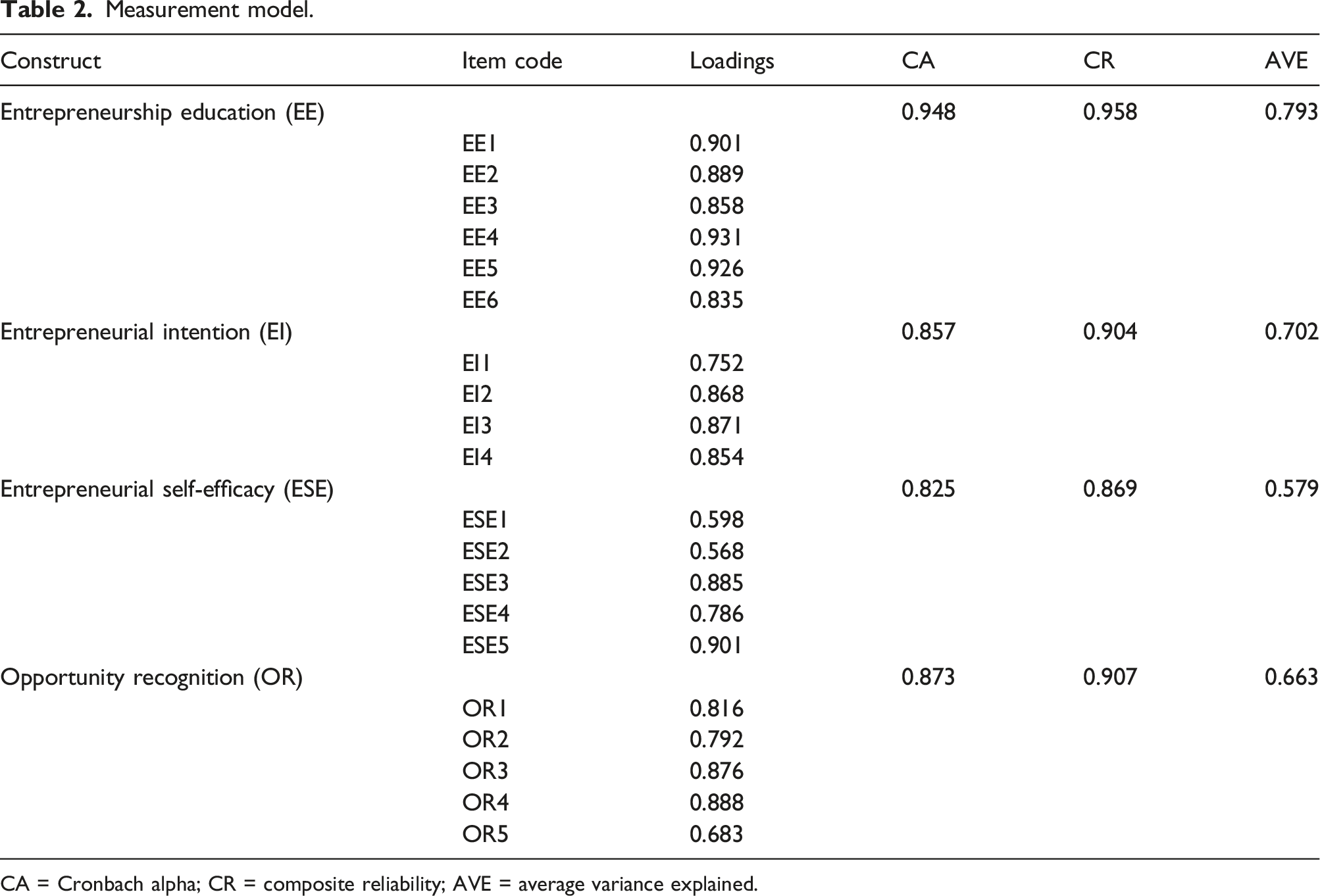
CA = Cronbach alpha; CR = composite reliability; AVE = average variance explained.
Hypotheses testing (direct effects)
Heterotrait-monotrait ratio (HTMT).

Note: Entrepreneurship education (EE); Entrepreneurial intention (EI); Entrepreneurial self-efficacy (ESE); Opportunity recognition (OR).
Indirect effects (mediation analysis)
The study also aimed at analysing the indirect effect of entrepreneurial self-efficacy on entrepreneurial intention of students via opportunity recognition, posited as H4. Testing the mediating relationship bootstrapped at 5000 samples confirmed that opportunity recognition partially mediates the ESE and EI relationship with a standardised effect of 0.203 (t = 6.16, p ≤ .01) (as shown in Table 3), leading to the acceptance of hypothesis H4.
Moderation analysis
Path coefficients.
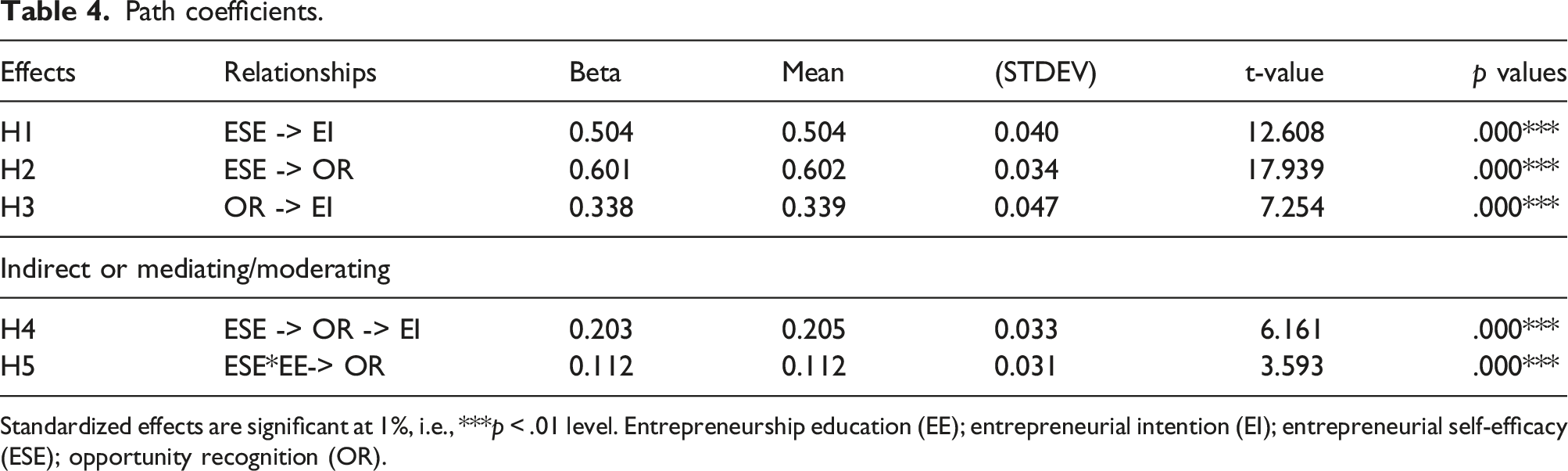
Standardized effects are significant at 1%, i.e., ***p < .01 level. Entrepreneurship education (EE); entrepreneurial intention (EI); entrepreneurial self-efficacy (ESE); opportunity recognition (OR).
Discussion
Entrepreneurs play a pivotal role in reviving economies because they generate new jobs for a wide range of people. So, it’s crucial to create programmes that encourage entrepreneurship. It was commonly held before the 1990s that entrepreneurs possessed innately unique personalities. The story has since shifted, however, with studies on entrepreneurship suggesting that the ability to be an entrepreneur is not innate but rather, can be taught. University support systems, exposure to role models, and entrepreneurship education and training are all factors that have been studied as potential causes of entrepreneurial behaviour (see, for example, BarNir et al., 2011; Roy et al., 2017; Brunel et al., 2017; Bazan et al., 2019; Anwar et al., 2020; Hassan et al., 2021).
By providing students with opportunities to hone their skills and learn new ones, universities play a crucial role in fostering EI and preparing graduates for the market. According to Tomy and Pardede (2020), a university’s resources, including its education and ecosystem, can significantly increase an individual’s ability and motivation to carry out an entrepreneurial activity.
In this study, both direct and indirect effects of entrepreneurial self-efficacy on entrepreneurial intention have been examined. Results of the existing research have depicted a positive association between the two, current study’s findings are in agreement with the results of the existing studies, indicating that self-efficacy boosts students’ confidence in their own entrepreneurial abilities, which helps them to develop entrepreneurial intention. In other words, having self-confidence in one’s ability to conduct and manage a business, thus, leads students along the path of entrepreneurship, even though self-efficacy is in synchronisation with an entrepreneurial mind-set since it enhances self-confidence in one’s entrepreneurial abilities.
Also the current study examined the direct effect of entrepreneurial self-efficacy on the opportunity recognition capability of students. The study’s results are in conformity with the outcome of study conducted by Ozgen (2003). The results of this path infer that students having self-belief in their entrepreneurial capabilities have higher chances of finding a right opportunity regarding an entrepreneurial activity. The students who believe in their own entrepreneurial skills have more chances to take up entrepreneurship as a career. However, this study found that these chances are more certain when the students are able to spot the right entrepreneurial opportunity.
Moreover, OR, which refers to a person’s capacity to identify, explore, or build patterns and ideas, has been incorporated into some models (Ozgen and Baron, 2007; Hunter, 2013). The researchers have come to a variety of conclusions regarding the link between OR and EI. Although certain researchers believe that the OR should come before the process of EI (Mahmood et al., 2019; Puni et al., 2018), other researchers have proved that it should come after the process (Jarvis, 2016; Asante and Affum-Osei, 2019) despite the fact that there is very little published research on the association between OR and EI. The study also analysed the direct effects of the OR on EI, and the findings discovered that OR strongly influenced EI. Thus, suggests that a mere positive outlook toward entrepreneurship is not sufficient to form EI leading to an actual behaviour; rather, a more positive behavioural attitude toward initiating an entrepreneurial career would be stimulated by spotting a potential business opportunity. The present study conforms to the results of previous research by Puni et al., 2018; Mahmood et al., 2019.
Furthermore, the indirect effect of entrepreneurial self-efficacy on students’ entrepreneurial intention via the mediating effect of opportunity recognition was found significant. This infers that the ESE-EI relationship strengthens in the presence of OR. In other words, students having self-belief in their capability are more likely to have the capability to identify an entrepreneurial opportunity, which in-turn increases the chances of developing the intention to undertake an entrepreneurial activity.
The authors also discussed the moderating effect of entrepreneurship education on the relationship between entrepreneurial self-efficacy and opportunity recognition. The results confirmed that increasing the level of entrepreneurship education by 11.2% increased the influence of self-efficacy on opportunity recognition. Entrepreneurship education not only directly increases student’s entrepreneurial self-efficacy and opportunity recognition capability, but it also supports the prevailing link between self-efficacy and opportunity recognition. When entrepreneurship education is properly and adequately imparted, self-efficacy is more likely to improve student’s opportunity recognition capability. This means that if an individual knows or has faith in his or her abilities to undertake an entrepreneurial activity, then education increases the chances of identifying the right entrepreneurial opportunity.
Implications
Theoretical implications
This study has some theoretical contributions to offer in entrepreneurship field. First, the findings of this study reveal that students’ who believe in their competence and ability are more likely to develop the intention to undertake an entrepreneurial activity, as entrepreneurship helps in developing these competences and skills, therefore, debunking the myth that entrepreneurs are born rather than created. Secondly, the findings of this study revealed a positive association between student’s self-efficacy and their opportunity recognition capability, therefore, adding to this less explored path of literature. Thirdly, the findings showed that finding the student’s opportunity recognition capability mediates the ESE-EI relationship, therefore contributing to the literature of more inclusive intention based models. Finally, this study reveals that entrepreneurship education moderates the ESE-OR relationship, therefore, demystifying the critical role of entrepreneurship education in building the student’s self-belief and capability to identify entrepreneurial opportunity.
Practical implications
The current also has some practical implications to offer both to universities and policymakers. Firstly, the findings of this study revealed the importance of classroom entrepreneurship education in driving students towards entrepreneurship, by influencing their self-efficacy and opportunity recognising capability. Henceforth, universities where only business education is being offered can take note of it and include entrepreneurship education as a subject in their course. Secondly, policymakers can frame policies to include entrepreneurship education at the intermediate level also, in order to create an entrepreneurial mind-set in students even before joining the university level education, as entrepreneurship education can manoeuvre their behaviour towards entrepreneurship and help them in building self-confidence, competence and capability to recognise entrepreneurial opportunity at the earliest. Finally, in order to make stronger impact on students’ intentionality, in addition to classroom education, universities can include the projects of real life problem solving in their course syllabi and increase their interaction with entrepreneurs.
Conclusion
The current study aims at understanding the impact of students’ entrepreneurial self-efficacy on their opportunity recognition capability after their exposure to classroom based entrepreneurship education, leading to the development of intention to undertake an entrepreneurial activity. There are five takeaways from this study. First, entrepreneurial self-efficacy positively influences student’s entrepreneurial intention to undertake an entrepreneurial activity. Second, entrepreneurial self-efficacy influences student’s opportunity recognition capability. Third, opportunity recognition capability positively influences student’s intention to undertake an entrepreneurial activity. Fourth, student’s opportunity recognition capability positively mediates the relationship between their entrepreneurial self-efficacy and intention to undertake an entrepreneurial activity. Lastly, entrepreneurship education positively moderates the entrepreneurial self-efficacy and intention relationship.
Limitations and future directions
Despite the current study’s contribution, it is not free from limitations that present chances for future research opportunities. The first drawback of the study is that it includes students from business and management backgrounds only, excluding out those with other backgrounds. Future researchers can consider this limitation and include students from other backgrounds, regardless of business and management students. The second limitation of the study is that human behaviour cannot be predicted accurately. Therefore, the students’ perceived entrepreneurial intention might change later, and they may opt for other careers. The third limitation of the study is that only two variables, entrepreneurial self-efficacy and opportunity recognition, were considered to draw conclusions about entrepreneurial intention. Future researchers can rectify this limitation by considering other variables like social capital, exposure to role models, behavioural attitude, subjective social norms etc. Finally, current study employed a cross-sectional research design, indicating that the responses were gathered in a single instant. This methodology might not be capable of precisely replicating exact entrepreneurial intention because the stages of forecasting and outcome variables are prone to change throughout the study (McCann and Vroom, 2015). Therefore, a longitudinal study carried out by researchers would act as a solution to this limitation and offer a deeper understanding.
Footnotes
Declaration of conflicting interests
The author(s) declared no potential conflicts of interest with respect to the research, authorship, and/or publication of this article.
Funding
The author(s) received no financial support for the research, authorship, and/or publication of this article.

Entrepreneurial self-efficacy Source: Linan and Chen, 2009
Indicate your level of agreement with the following statements from 1 (total disagreement) to 7 (total agreement)
1. I can control the creation process of a new business
2. If I tried to start a business, I would have a high probability of success
3. Starting a business and keeping it functional would be easy for me
4. I know the necessary practical details to start a business
5. I am prepared to start a viable business
Opportunity recognition Source: Ozgen and Baron, 2007
Indicate your level of agreement with the following statements from 1 (total disagreement) to 7 (total agreement)
1. I see many opportunities to start and grow a business
2. Finding potential venture opportunities is easy for me
3. In general, there are many opportunities for new product innovation
4. I have a special sense of new venture ideas
5. During my routine day-to-day activities, I see potential new venture ideas
Entrepreneurship education (EE) Source: Linan and Chen, 2009
To what extent do you think that entrepreneurship education course helped you in developing the following aspects? Indicate from 1 (total disagreement) to 7 (total agreement)
1. Knowledge about the entrepreneurial environment
2. Greater recognition of the entrepreneur’s figure
3. The preference to be an entrepreneur
4. The necessary abilities to be an entrepreneur
5. The intention to be an entrepreneur
Entrepreneurial intention (EI) Source: Linan and Chen, 2009
Indicate your level of agreement with the following statements from 1 (total disagreement) to 7 (total agreement)
1. I am ready to make anything to be an entrepreneur
2. My professional goal is becoming an entrepreneur
3. I will make every effort to start and run my own firm
4. I am determined to create a firm in the future
5. I have very seriously thought of starting a firm