




Abstract
This research contributes to the global understanding of employability debates, specifically, why graduates from rural and disadvantaged communities in Nigeria struggle to secure employment despite earning university degrees meant to enable social mobility. Drawing on 30 interviews and guided by Mamdani’s (1996) account of decentralised despotism and Bourdieu’s concepts of capital and habitus, it examines how place, social connections, and labour-market imaginaries of “success” shape who gets hired. Findings show that a degree alone rarely opens doors because opportunities are tied to proximity to cities, professional certifications, and informal networks that structure recruitment and referrals. Many rural graduates relocate, pursue extra credentials, and rely on “who you know” to compete, efforts largely invisible in education and employment policy. Rather than a skills gap, graduate precarity reflects spatialised inequalities that advantage urban and well-connected candidates. The article argues for spatial justice policies that widen pathways beyond metropolitan centres, reform recruitment transparency and redefine what counts as graduate work.
Keywords
Introduction
This research asks how and why university degrees do not translate into stable employment for rural-origin graduates in Nigeria, and what these reveals about meritocracy and social mobility in an unequal labour market. Specifically, it examines (a) how spatial inequality and urban bias shape access to graduate opportunities, (b) how informal networks and “connection capital” influence recruitment and graduate visibility, and (c) how the rising demand for professional certifications reshapes what counts as merit and pushes rural graduates into precarious work or alternative livelihoods.
Across low- and middle-income countries, Higher education (HE) has become a central component of national strategies for economic transformation and global competitiveness (Favara et al., 2015; Pitan, 2016). In Nigeria, the largest economy in sub-Saharan Africa, HE is widely portrayed as the engine of a future knowledge-based economy (Danjuma and Rasli, 2013; Lanre and Okotoni, 2018), a policy vision promoted by national governments, multilateral agencies, and private actors alike (Chankseliani et al., 2020). According to a report on Nigeria’s skills for competitive and employability, education is expected to deliver the skills and competencies needed for the Fourth Industrial Revolution and reduce poverty through graduate employment (Favara et al., 2015). The labour market projections in this report also confirmed this optimism, asserting that each additional year of schooling in Nigeria significantly increases employability, with university graduates earning over 130% more than their peers without formal education (Favara et al., 2015). However, despite this aspirational framing, the unemployment rate for Q2 2023 was 4.2%, a marginal increase from 4.1% in Q1 2023 (National Bureau of Statistics (2023) [NBS]). Similarly, the “share of employed people who are working less than 40 hours per week, but who would be willing and available to work more (p.12)”, described as time-related underemployment was 11.8% in Q2 2023 (NBS, 2023). Several scholars have argued that this number conceals deeper spatial and structural inequalities in access to work that it merely visibilises statistically (Conley and Topa, 2002; Dewan and Peek, 2007).
Furthermore, these inequalities are particularly disproportionately experienced by rural graduates, who remain largely invisible in policy narratives and statistical aggregates. While dominant framings of graduate unemployment often cite oversupply, skill mismatch, or youth indolence (Adewolu, 2023; Pitan, 2016), they rarely interrogate how geography, class, and cultural capital shape transitions into work. For example, NBS (2023) reported that 5.3% of Nigeria’s rural population are discouraged job seekers, nearly double the rate in urban areas of 2.8%. However, this figure does not explain the underlying reasons behind these figures, specifically, whether rural graduates are excluded from graduate-level opportunities or whether their imagined pathways to a ‘decent job’ are misaligned with the labour market’s expectations and structures. For instance, while agriculture employs about 70% of Nigeria’s workforce, it contributes only 22% to the GDP in 2013 (Adesugba and Mavrotas, 2016). Despite being positioned in literature as “common” work for rural youth and a major employer of labour (Adesugba and Mavrotas, 2016), evidence from this study show that the sector is viewed by rural graduates as a temporary fallback rather than a “decent job,” due to its low productivity, limited economic return, and perceived as unfit for university-educated youth. This disconnect visibilised how such statistics mask the broader challenges rural graduates face, making it even more critical to examine the spatial inequalities and underlying barriers that shape their labour market outcomes.
While SDG4 emphasises inclusive, equitable, and quality education, and SDG8 promotes full and productive employment and decent work for all (United Nations, 2015), these global goals risk becoming abstractions unless they account for the spatialised disjunctures that characterise graduate transitions in countries like Nigeria.
The study contributes to a rethinking of employability in an emerging knowledge economy, not simply as a function of skill acquisition or market readiness, but as a social, spatial, and affective process structured by historical inequalities. It drew on Mamdani’s (1996) theory of decentralised despotism and Bourdieu’s (1977, 1986) concepts of habitus and capital to show how colonial patterns of governance continue to shape opportunity and to trace how rural graduates internalise, negotiate, and sometimes resist the symbolic hierarchies of employability. Together, these theoretical lenses helped reveal how the labour market is not a level playing field but a field of power where history, geography, and cultural recognition determine who becomes visible as ‘employable’ and under what conditions.
Postcolonial graduate labour markets and inequality
Dominant conceptions of the graduate labour market have been largely shaped by Global North scholarship of human capital production, where graduates are seen as “labour market winners” (Brown et al., 2020; Tholen, 2017) whose credentials ensure access to stable employment. This normative framing, as Brown et al. (2020) and Tholen (2017) argue, isolates graduate employment from its wider social and historical contexts and portrays it as a purely economic phenomenon. Such assumptions travel into policy debates in emerging economies like Nigeria, where HE is positioned as the engine of a future knowledge-based economy (Danjuma and Rasli, 2013; Olaniyan, 2025a). However, this vision overlooks how colonial histories, spatial hierarchies, and uneven institutional development influence access to education and graduate outcomes.
For example, postcolonial legacies in Nigeria, such as the forced amalgamation of different regions and the imposition of foreign religious identities (Christianity and Islam), continue to influence social hierarchies and access to power (Audu and Ekpendu, 2016). The historical boundaries drawn by colonial powers still shape the distribution of capital and resources, including the ‘connection capital’ that often determines who secures high-status jobs and under what conditions (Omolawal, 2023). As a result, rural graduates, particularly those from marginalised ethnic and religious backgrounds, are disadvantaged in the job market, as their geographic location, social networks, and religious affiliations often limit their opportunities, even when they possess the necessary educational qualifications. Similarly, the present-day spatial economy of Nigeria can be traced back to the colonial period, with its economic structure shaped by British colonial policies. As Mabogunje (1965) explains, prior to European colonisation, Nigeria’s urban economies were already flourishing through regional trade networks, particularly in the north. However, colonial rule disrupted these systems by focusing economic activity on extractive industries, particularly those that served the British Empire’s needs. The construction of railways, for instance, connected cities like Lagos and Kano to the coast, solidifying their roles as key economic hubs (Mabogunje, 1965). However, this created a perennial imbalance in regional development, where northern and western urban centres became more connected to global trade, while many pre-colonial trade centres, like Oyo and Benin City, experienced a decline in significance (Aka, 1994). This history of uneven economic development persists today, with major urban centres such as Lagos continuing to dominate employment opportunities, particularly in sectors like finance and technology, leaving rural areas with limited access to high-status jobs (Bloch et al., 2015).
Additionally, the federal character principle, introduced in Nigeria’s 1979 Constitution, was meant to ensure fair representation of different ethnic and regional groups within the government. Nevertheless, as Olaniyan, (2025b) argued, this policy “did not originate as a widening participation measure in the contemporary sense of affirmative action. Rather, its roots lie in Nigeria’s post-independence political architecture, where early efforts at federal integration, such as consociationalism and later the Federal Character Principle enshrined in Section 14(3) of the 1979 Constitution, sought to ensure balanced representation across ethnic and regional divides (p.10). However, while the intention was to promote national unity, it has often resulted in the prioritisation of regional quotas over merit, leading to inefficiencies in civil service appointments (Akinwale, 2014). This approach, which has shaped Nigeria’s bureaucratic structure since independence, continues to favour graduates from more connected urban areas, where access to elite networks and political power is more concentrated (Akinwale, 2014).
Historically, HE served colonial administration and later replaced expatriate officials after independence (Ahmed, 1989). Commissions such as Asquith 1943 and Ashby 1959 imagined universities as sites for cultivating professional classes and specialist manpower rather than broadening social mobility (Ahmed, 1989). Post-independence expansion, marked by new universities and later massification policies, shifted this exclusivity but did not dismantle its elite orientation (Saint et al., 2003). Credentials became tied to aspirations of salaried, high-status work, embedding a persistent belief that degrees guarantee success in the labour market (Bourdieu, 1986; Collins, 1979).
The rise of the knowledge-based economy further fortified this credentialist logic. Knowledge work is valorised as the hallmark of graduate success (Tholen, 2017), while “decent” employment is increasingly equated with white-collar jobs in finance, ICT, and government service (Burchell et al., 2014; Favara et al., 2015). This discourse, however, masks growing underemployment and skills mismatch in Nigeria’s labour market (Pitan, 2016) and neglects the uneven geography of opportunity. Rural-origin students, often entering universities with fewer resources, social networks, and cultural capital (Uleanya, 2022), face structural barriers to converting degrees into employment.
Global research similarly highlights that credential inflation and elite closure operate together to stratify graduate outcomes. Studies in South Africa (Ncube et al., 2018) and India (Chelshi and Pushpa, 2023) show how rural and working-class graduates struggle to get employment, often pushed toward informal sectors or underpaid work despite formal qualifications.
This literature indicates that HE expansion alone cannot deliver equitable graduate employment. Instead, employability must be understood as a social, spatial, and postcolonial process, shaped by historical inequalities, institutional prestige, and informal gatekeeping rather than individual skill deficits alone. This study builds on these debates by examining how rural-origin Nigerian graduates interpret, navigate, and challenge dominant imaginaries of graduate work, exposing the fragility of merit and the geography of exclusion in Nigeria’s emerging knowledge economy.
Theoretical logics
Theoretically, this study draws on Mamdani (1996) and Bourdieu (1977, 1986) to examine how rural Nigerian graduates navigate a labour market shaped by spatial inequality, credential hierarchies, and exclusionary forms of recognition. Together, their theoretical logic provides a historically grounded and sociologically attuned lens for understanding how power operates in postcolonial education and employment systems.
Mamdani’s concept of decentralised despotism provided me with an understanding of how colonial governance fragmented populations and produced uneven access to resources and institutions. In Nigeria, these colonial arrangements, missionary education in the South, indirect rule in the North, and uneven administrative development continue to structure HE and graduate opportunities. Rural regions remain under-resourced and symbolically devalued, leading to limited exposure to elite networks, digital infrastructure, and pathways into high-status jobs. Although access to universities has widened since independence, entry into stable, well-paid employment remains unevenly distributed along these inherited spatial lines.
Bourdieu’s (1977, 1986) concepts of habitus, field, and capital complement this reading by showing how inequality is reproduced through recognition and value-making in the labour market. Rural graduates’ habitus is shaped by navigating underfunded schools, familial obligations, and precarious institutional systems, which often do not align with the soft skills, networks, and professional certifications that employers equate with employability. Credential inflation further intensifies these dynamics where a degree alone rarely secures a graduate job without additional certifications or insider networks. As Bourdieu (1986) argues, capital only works when it is socially recognised, and recognition in Nigeria’s labour field is unevenly tied to urban exposure, symbolic “fit,” and connection capital (Omolawal, 2023).
The combination of these frameworks allow the graduate labour market to be read as both a legacy of colonial spatial divisions and a contemporary field where merit is fragile, professional capital is costly, and access is mediated by networks and privilege. It situates the struggles of rural graduates not as individual failings but as outcomes of historically sedimented power relations and socially contingent definitions of employability.
Methodology
This study is grounded in a qualitative, interpretivist paradigm that recognises knowledge as situated, partial, and socially co-produced (Acharya, 2024). Rather than seeking generalisable truths, the research aimed to surface the meanings that rural graduates attach to their labour market experiences, as shaped by history, geography, and inequality.
Profile of rural-origin graduate participants (N = 30).
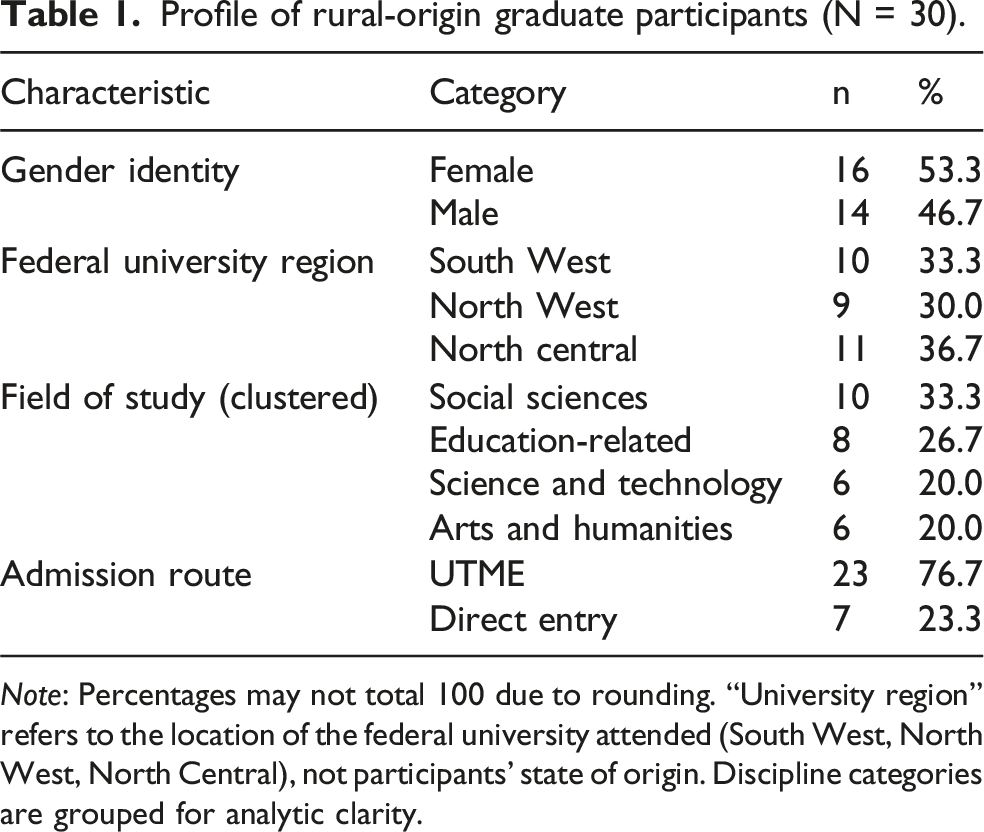
Note: Percentages may not total 100 due to rounding. “University region” refers to the location of the federal university attended (South West, North West, North Central), not participants’ state of origin. Discipline categories are grouped for analytic clarity.
Participants were purposively selected to capture variation across gender, region, discipline, admission pathway, and post-university trajectories. While all had studied at federal universities across three geopolitical zones, their backgrounds reflected different educational routes and social positions within Nigeria’s higher education system. This diversity enabled the study to move beyond a single institutional or regional narrative and instead examine how structurally similar degrees translate into uneven labour-market outcomes depending on location and social embeddedness.
At the time of interview, participants occupied varied employment positions, including formal teaching roles, contract-based appointments, self-employment, informal trade, and periods of job searching or underemployment. These differing trajectories were analytically important, not simply descriptive, as they illuminated how graduates navigate transitions through relocation, additional certifications, or reliance on personal networks. Attending to this range of experiences allowed the study to explore not only employment outcomes but also the strategies and compromises through which rural graduates negotiate Nigeria’s spatially stratified labour market.
Participants were recruited through university alumni networks, informal peer referrals, and local community-based organisations. Ethical approval for this research was obtained from the relevant institutional ethics committees. All participants received clear written and verbal explanations of the research aims, and informed consent was obtained before interviews began. Participation was voluntary, and anonymity was ensured through the use of pseudonyms and the removal of identifying details.
Interviews were conducted in English, and each interview lasted between 25 and 45 minutes. All sessions were recorded, transcribed and anonymised. I drew on reflexive thematic analysis (RTA) (Braun and Clarke, 2019) as an analytical approach to analysing the data. I used RTA to identify and organise patterns of meaning across the dataset manually with digital highlighters. Themes were not extracted mechanically but developed through an iterative, dialogic engagement with transcripts, coding, rereading, memoing, and re-coding to ensure conceptual depth and contextual sensitivity (Braun and Clarke, 2019). Following Braun and Clarke’s (2019) model, I treated themes as constructed rather than discovered, shaped by the encounter between participant voices and my own intellectual, emotional, and cultural position. My analysis was not neutral because it bore the imprint of my past as someone raised in Nigeria, educated both locally and abroad, and returning to ask questions that are at once academic and deeply personal.
However, reflexivity was integral throughout. I did not enter this research as a neutral outsider. My position was more fluid, shaped by shared histories, as well as by my changed location in the world. I approached the study as a partial insider, someone who had grown up within the same socio-spatial environment as many of the participants, but who now occupied a different set of social and academic coordinates. As Natifu (2016) argue, insider and outsider identities are not binary positions, but rather a continuum that constantly shifts across moments of interaction, power, and interpretation. I found myself moving along this continuum throughout the research process. Also, returning to familiar regions to conduct fieldwork brought both access and discomfort. On one level, my background gave me a certain legitimacy. Participants welcomed me, and many spoke with a level of openness that may not have been extended to a perceived outsider. Yet the feeling of being “back home” was complicated. As Robinson-Pant (2005) suggests, the act of returning to one’s own community for research carries its own cross-cultural tensions. My way of speaking, my educational background, even the way I asked questions, occasionally made me feel distant from the very spaces I once called home.
Also, being close to the field did not always mean I fully understood what was said. Sometimes, participants assumed I already knew what they meant and skipped over things. Other times, I could sense they saw me differently, someone who had left and come back changed. This was most obvious when they called me one of those who had “made it out.” In those moments, I was not just another researcher. I was a symbol of something they were still trying to reach. I often felt unsettled. It was hard not to feel complicit in the same inequalities I was hoping to study. These moments made me pause and think carefully about the position I was taking. I realised that being from a similar background did not erase the distance between us. Instead of assuming shared experience, I began paying more attention to where my understanding might fall short.
This shaped how I approached the writing. I wanted to avoid both romanticising their stories and reducing them to victims. I tried to stay close to how participants made sense of their lives, how they held on, adapted, and hoped, even when options were limited. That shift helped me see their stories more clearly, not as problems to solve, but as ways of navigating a system that often refuses to see them. The result is not a universal map of graduate outcomes, but a textured cartography of how inequality is inhabited, challenged, and endured in postcolonial Nigeria.
This study draws primarily on graduates’ accounts and therefore lacks actor triangulation. Perspectives from employers, policymakers, and higher education institutions were not included, which may limit how fully the study can capture decision-making processes within recruitment and policy settings. In addition, the sample comprises 30 participants, largely drawn from federal university backgrounds. While appropriate for an in-depth qualitative inquiry, the findings are not statistically generalisable and may not fully reflect the experiences of graduates from private universities, polytechnics, colleges of education, or other non-elite institutions.
Findings
Fragile merit, connection capital and demand for professional exams
Across the accounts of rural-origin graduates, the bachelor’s degree, long upheld as the principal marker of merit and vehicle for socioeconomic mobility, emerged as a credential whose power had been steadily eroded within the Nigeria graduate labour market. While all participants had invested years of effort and substantial personal and familial resources into their university education, they now found themselves navigating a labour market that no longer regarded the degree as sufficient. Instead, employers appeared to demand ever more specialised, often costly, professional certifications as the new currency of employability. This perceived shifting of the goalposts produced what many participants described as frustration, resignation, and ultimately, disillusionment with the very idea of merit itself. At the same time, participants repeatedly framed access to jobs as shaped not only by qualifications, but by who could “make calls” and activate networks, showing the centrality of connection capital in determining outcomes.
A recurrent pattern in the data was a sense of betrayal, the realisation that academic performance and completion of a degree did not, in fact, guarantee access to formal employment, let alone upward mobility. As Aliyu put it, “The issue is not that we’re not qualified… We’re not from the kind of homes where people can make calls for you. We’re on our own.” (Aliyu, Male, North Central).
One participant replied, when asked about their expectations before and after graduation, whether these were met and what they are doing now: “It does not! Sometimes I do feel like I shouldn’t have graduated [Laughing]. Life has been tough and rough, so sometimes I feel like, Why did I even graduate? Had I known the life after graduation would be like this, I wouldn't have graduated. But we thank God, the journey has been rough and tough, but we thank God. Because I just finished my service last year October, and on the 10th of October will make it 1 year that I finished my service, you know, during the NYSC, I tried to get proper Place of Primary Assignment (PPA), I was expecting to work with Edo state government, but, should I call it fate or I don’t know what I will call it, but this is Nigeria, life happens…well, let me say it is Nigeria that has happened, not life” (Samuel, Male, Southwest)
Another participant, a Microbiology graduate from University of Asa (Pseudonym), explained: “I graduated with a 2.1 in Microbiology. I thought once I had my certificate, things would fall into place. But everywhere I apply, they either want experience or some expensive course I cannot afford. Now I just help my brother in his shop and save small to maybe start my own little thing.” (Clara, Female, Southwest)
Her narrative captures a common trajectory in which high expectations associated with a university degree gave way to economic precariousness, pushing many graduates toward informal or family-based economic activities. The anticipated transition from education to stable work had failed to materialise, leaving her in a liminal space, neither fully unemployed nor meaningfully engaged in graduate-level work.
Another participant, a male graduate who studied health education, echoed this concern: “…I look forward to having a career in Health, Safety, and Environment. I was told that if I want to get a job in all these fast-moving consumer goods companies that I will have to have a certification in HSE, that my degree alone cannot give me access…” (Samuel, Male, Southwest)
Another participant who studied Accounting expressed similar concern: “Having the bachelor's in Accounting is not enough in the labour market... I have attended a couple of interviews, and they keep asking for ICAN [Institute of Chartered Accountants of Nigeria]. Even in the job adverts, you will see ‘chartered accountant preferred.’ But the money for the exam is much. My mum even had to borrow money from the cooperative to complete my final year in uni.”(Aliyu, Male, North Central)
For him, the structural barriers extended beyond the job market and into the familial and moral economy that had sustained his university journey. The ICAN qualification, framed as essential by employers, was economically unattainable. The narrative powerfully illustrates how rural graduates are excluded from employment opportunities and from the additional credentialing that might enable them to compete. These forms of exclusion were experienced as cumulative, recursive, and deeply unjust. This exclusion was also narrated as explicitly political and spatial, where state-linked opportunities were perceived as reserved for insiders and indigenes rather than open competition. As Hadiza observed, “Government jobs are for people that already have someone in Abuja. Not people like us. You can apply, yes, but it’s just a formality.” (Hadiza, Female, Northcentral).
This sense of a “moving target” was also described by a participant who had studied Political Science: “When we were in school, they always said, ‘just finish school and everything will follow.’ But I have applied for so many jobs, nothing came. Now I just sell data [internet bundles] and run POS [Point of Sale], at least that gives me something daily. This was not the plan.” (Sunday, Male, North Central)
The notion that “this was not the plan” featured frequently in interviews, suggesting a shared script of aspiration that had been systematically undermined. Selling recharge cards and operating a POS business, while generating income, did not align with the social and personal expectations of what it meant to be a graduate (another theme which is explored in greater detail next). Participants did not reject informal work per se, but resented the conditions under which it became their only viable option.
Crucially, the accounts revealed how professional certifications such as ICAN (Institute of Chartered Accountants of Nigeria), CIPM (Chartered Institute of Personnel Management), PMP (Project Management Professional), and HSE (Health, Safety, and Environment) had come to function as new gatekeeping mechanisms, often more decisive than the university degree itself. As one participant explained: “It’s like the degree is now only the first step. To get any real job, you need to add ICAN or something. My friend with a 2.2 got a job because his uncle paid for his project management course. I have better results, but no course, no job.” (Aliyu, Male, North Central)
This sense of credential inflation was not simply about academic qualification but about access to economic and social capital. Participants who lacked the financial means to enrol in such courses, or who did not have familial networks to support their transition, were effectively locked out. In several interviews, the bitterness of this realisation was compounded by comparisons with peers who had access to such resources. As Fatima put it bluntly, “The jobs are for only the children of people who are in power or know somebody. The rest of us are just praying.” (Fatima, Female, Northwest).
For many, these dynamics undermined the very premise of higher education as a meritocratic path. A female graduate from Basa (pseudonym) University reflected: “I worked hard, no carryover, no issues. I thought that was the real thing, just focus, graduate, and move forward. But now, it’s not about what you studied. They are asking for things we did not plan for, like digital skills, data science, ICAN. Who planned for all these when we were struggling for school fees?” (Esther, Female, North Central)
Here, the speaker positions her academic journey as one marked by resilience and hard work, yet the rules of the game seem to have changed. The “things we did not plan for” refer to additional costs and the cognitive and temporal labour required to make sense of a rapidly shifting employment landscape.
Importantly, many participants did not passively accept this exclusion. Some attempted to resist it by reconfiguring their aspirations or seeking alternative routes. A graduate who studied Education and who now runs a fashion business stated: “It was so tiring, at some point I had to leave job searching and learn tailoring, that was 2022, I left the job searching for the highly connected people or individual, so I went into skills, so I learn fashion designing, and in the process I was still searching…I do not want to beg anybody for work” (Hadiza, Female, Northcentral)
This narrative blends resignation with determination. While the speaker’s actions are framed as entrepreneurial, they also reflect the absence of institutional pathways or targeted graduate support mechanisms. The emphasis on “not begging” highlights the moral dimension of rural graduate struggle, where self-reliance becomes an economic necessity and a form of dignity preservation.
This redirection into subsistence or informal livelihoods was often accompanied by a quiet grief, an acceptance that the imagined future had failed to materialise. What emerged was a pattern of resignation shaped not by lack of ambition, but by repeated rejection and the perceived futility of playing by rules that consistently disadvantaged them. Collectively, these accounts invalidate the narrative of merit as a neutral or universal pathway. For rural graduates, merit is deeply mediated by geography, economic capital, and access to social networks. Godwin’s account of cross-state recruitment practices also points to how “merit” is filtered through subnational boundaries and informal exclusions: “I applied for a government job in another state, we were not invited for interview or whatsoever. All we saw was a list of selected candidates and almost 98% of the selected people are from the state… I do not think this is fair.” (Godwin, Male, Southwest). Their experiences challenge the idea that educational participation alone can unlock access and highlight the urgent need to reconsider how merit is defined, supported, and rewarded in Nigeria’s evolving graduate labour market.
Graduate job imaginaries
While the preceding section have brought to the fore how structural barriers, both financial and relational, undermine rural graduates’ ability to convert academic qualifications into employment, this next theme shifts focus to the symbolic and affective dimensions of graduate transition. Specifically, it explores how participants made sense of their post-university trajectories in relation to internalised imaginaries of what graduate life should look like, and how the dissonance between expectation and experience shaped their identity, confidence, and sense of social recognition.
A prominent thread running through participants’ accounts was the misalignment between their imagined futures as graduates and the actual nature of their post-university employment experiences. From early schooling through to university, participants had internalised a widely held cultural script of graduate success: the promise of professional, white-collar employment; the symbolic donning of office wear; and the material affirmation of one’s academic investment. This imagined trajectory, rooted in institutional messaging, family expectations, and broader national narratives, was powerfully persistent. However, as participants moved into the labour market, they encountered a series of structural and symbolic obstacles that rendered these imaginaries increasingly unattainable.
What emerged was a deep sense of contradiction between the social meaning of being a graduate and the kinds of work many were actually doing. In several interviews, participants described feelings of discomfort, even shame, when asked about their current occupation. One participant shared: “If you tell people you’re selling something, they look at you like you wasted your certificate…” (Bukola, Female, Southwest)
The use of “wasted” here reveals a powerful stigma where the implicit hierarchy of labour that devalues entrepreneurship or informal work when performed by university graduates. This sentiment was echoed by others who, despite being engaged in productive activities, felt their work was not socially recognised as legitimate “graduate” employment. A female participant helping her mother with petty trading explained: “They’ll ask you what you’re doing now… I just say I’m still looking. Because to say I’m helping my mum sell, it’s like saying somebody have failed… (Joy, Female, Southwest)”
Here, the performance of unemployment, “I’m still looking”, is strategically deployed to mask the social perception of failure attached to informal labour. The participant’s reluctance to name her work reflects a broader anxiety about respectability and the symbolic weight attached to graduate status.
Several participants described attempts to hide or minimise their work due to the pressure of public perception. A graduate working in a community school offered the following reflection: “I work in a small community school… I’m even training people in basic computer… But it’s not like anyone counts that as graduate work.” (Ibrahim, Male, Northcentral).
This account illuminates how even skilled, socially valuable labour can be dismissed if it does not align with narrow imaginaries of what a graduate is “supposed” to do. The speaker’s tone suggests both pride in their work and a recognition that external validation remains elusive. The category of “graduate work” thus emerges not as a neutral descriptor, but as a socially constructed status marker, one that privileges formal, salaried employment over locally embedded or informal contributions.
The emotional labour of navigating this disjuncture was a recurring theme. One participant described deliberately avoiding questions about her occupation: “Sometimes I hide what I do… Not because I’m ashamed, but because people ask too many questions. Like, Are you not a graduate? And I don’t know what to say.” (Hadiza, Female, Northwest).
The question, “Are you not a graduate?”, functions rhetorically, not as a request for information, but as a judgment on the speaker’s failure to meet the expectations associated with that identity. The graduate label, once a source of pride, becomes a burden, a benchmark against which lived experience is found lacking. For this participant, concealment becomes a survival strategy in the face of social interrogation.
Other participants spoke less about external perceptions and more about internal disorientation. A graduate from a university in south-western Nigeria reflected: “I know I’m doing okay, but it doesn’t feel like what they promised. Like, when you’re in school, they make you think you’ll wear suit and tie. Now I just dressing like a normal person and hustling.” (Samuel, Male, Southwest)
This comment encapsulates a deep sense of disillusionment. The image of the graduate, visualised through professional attire and an office setting, is contrasted with the speaker’s reality of “hustling.” The phrase “what they promised” alludes to a broader collective expectation, one shaped by educational institutions, parents, and society at large. The disappointment one could say is material as well as symbolic, a perceived betrayal of the narrative that effort and education would yield dignity and status.
The persistence of the office job as the ultimate symbol of graduate success was evident even among those engaged in entrepreneurial or creative ventures. One participant who ran a fashion design business explained: “I am doing fashion designing as my job while I wait for a better job… like an office job (white collar job).” (Esther, Female, Northcentral)
Another one added a similar thing: “It was so tiring, at some point I had to leave job searching and learn tailoring, that was 2022, I left the job searching for the highly connected people or individual, so I went into skills, so I learn fashion designing, and in the process I was still searching and before I got my new job…” (Hadiza, Female, Northwest)
Similarly, another participant who owned a printing shop on a university campus remarked: “I currently own a shop on campus where I do printing… I am just doing that before better jobs come…” (Abdul, Male, Northwest)
In these cases, the graduates’ current work is framed as temporary, a placeholder until they access the “real” work associated with their degree. Despite the autonomy and skill involved in these roles, they remain outside the imagined boundaries of graduate labour. This distinction between interim survival and aspirational destination speaks to the durability of the graduate job imaginary, even in the face of structural exclusion.
These narratives also reveal how perceived graduate identity is professional aesthetic and affective. For several participants, becoming a graduate was imagined as a transformation in comportment, dress, and status. A Business Administration graduate shared: “When I was in school, I used to imagine how I’d dress for work, neat shirt, ID card, office bag. Now I wear slippers, carry nylon, and go to market. I’m not shy, but it’s not what I thought I was working for.” (Ruth, Female, Northcentral)
This poignant reflection captures how the graduate imaginary is performed through occupation, the body, dress, posture, and accessories. The daily rituals of employment were expected to signal one’s transition into a new social class. The dissonance between this expectation and reality contributes to a sense of anticlimax. Participants were not just denied jobs; they were denied the social script they had spent years preparing to enact.
Geography of deficit
If earlier themes examined how academic merit and social networks act as gatekeeping forces in the graduate labour market, participants’ narratives in this theme highlight the geographical aspects of exclusion. Specifically, rural graduates’ accounts consistently emphasised what I refer to as a “geography of deficit”, a framing where rurality itself is seen as a disadvantage, and where one’s place of origin influences access to opportunities and perceptions of ability, employability, and future prospects. Participants shared how their rural backgrounds affected job availability, the feasibility of returning home, the costs of mobility, and their overall feeling of being placed on the margins of the national graduate economy.
For many, the idea of returning to their home communities after graduation was not a meaningful option, not because of personal unwillingness, but because of the complete absence of viable employment opportunities. A graduate captured this sentiment plainly: “In my place, if you are not farming or riding Okada (bike), there is nothing else to do. That is why I stayed in the city even without a job... I believe something will sup (come up) here” (Samuel, Male, Southwest)
The juxtaposition of degree-level education and subsistence labour illustrates the collapse of a promised pathway where even in the absence of urban employment, remaining in the city is seen as a more hopeful bet than returning to a place where “there is nothing else to do.” In this logic, the rural hometown functions a site of no return and a space of stagnation, where educational credentials are devalued or made irrelevant.
This spatial abandonment was echoed by another participant who explained: “I could not go back home after NYSC, there’s nothing waiting for me there. Because I am from a village, I do not have people in the system. That’s why I stayed back in the city, hoping something comes.” (Ibrahim, Male, Northcentral)
Here, the rural home is a place of limited opportunity devoid of connection capital. The phrase “nothing waiting for me” points to both material and relational absence of no jobs, no networks, no foreseeable path forward. As in earlier themes, social capital plays a role, but geography is its precondition. One is disconnected because of who one knows and because of where one comes from.
This framing of the rural as a zone of exclusion was pervasive. Other participants put it more bluntly: “I do not go back to my village because there are no opportunities there, it is just farming. After all the stress of school, how do I survive with that?” (Bashir, Male, Northcentral) “I have never even thought about going back to my village” (Ruth, Female, Northcentral)
The affective weight of “all the stress of school” underscores the emotional and financial labour invested in education, labour which participants felt should logically yield a different kind of future than what was available in their home regions. Farming, though essential to national sustenance, is not recognised within their imagined graduate futures, and is seen as antithetical to the very purpose of formal education. In this light, the village becomes economic dead-end, a symbolic reversal, and a return to the very conditions education was meant to transcend.
Importantly, geography also functioned as a form of disqualification within state-level employment contexts. One participant described how, even within their own state, being from a rural area disadvantaged them in accessing public sector jobs: “Even the small jobs in my state go to people who know someone. Coming from the rural side, I don’t have anybody there.” (Hadiza, Female, Northwest)
This quote captures the internal fragmentation of states, where urban and administrative centres hoard opportunities, and rural spaces are relegated to the periphery, not just spatially, but bureaucratically. Being “from the rural side” signals a double exclusion where lacking physical proximity to decision-making spaces and lacking social ties to those who occupy them. This spatial dislocation operates as both a practical and symbolic barrier.
Several participants shared stories of family members urging them to return home, unaware of the futility such a move might entail. A male graduate recounted: “My uncle kept saying, ‘Come back home,’ but what would I come back to? There is no future there unless you want to become a teacher in one small private school.” (Abdul, Male, Northwest)
Teaching in a local private school, a position often lacking formal salary structures or long-term prospects, was framed as the only visible employment pathway in rural areas. While not inherently demeaning, the role is perceived as limiting, especially in contrast to the broader career aspirations nurtured during university. The phrase “there is no future” is not a rejection of community life per se, but a recognition of its structural abandonment by state and market systems alike.
For some participants, even when jobs were advertised in distant cities, the cost of relocation functioned as a de facto exclusion criterion. A participant from Northwest shared: “I didn’t even try to attend the interview. It was in Lagos. I just knew I wouldn’t make it. How do I get accommodation and transport? I don’t know anybody in Lagos.” (Abdul, Male, Northwest)
Here, mobility itself becomes a form of capital. Without resources for transport, accommodation, or local contacts, the very idea of pursuing urban job opportunities is rendered impossible. Lagos, while brimming with employment possibilities, exists as a distant and uninhabitable world, a site of imagined opportunity that is materially inaccessible. This echoes broader trends in urban–rural dynamics in Nigeria, where spatial centralisation of employment opportunities reinforces patterns of internal migration, precarity, and exclusion.
Even among those who remained in the city post-NYSC, the decision was often driven not by access to opportunity but by a refusal to return to perceived zones of stagnation. One participant described the psychological calculus behind staying in Ilorin (state capital) despite lacking employment: “I’m squatting with my friend in Ilorin. It’s not easy, but I keep telling myself it’s better than going back to just be sitting at home. At least here, I can try.” (Joy, Female, Southwest)
This strategy of urban persistence, anchored in hope and endurance, is widespread among rural graduates. The city becomes a site of possibility not because it delivers outcomes, but because it keeps open the prospect of movement, of contact, of eventual breakthrough. In contrast, the village is imagined as a space where nothing changes, where potential evaporates.
Geography, then, is not simply the backdrop to graduate transitions, it is an active force that structures access, shapes identity, and informs decision-making. Participants’ narratives revealed that where one is from, where one lives, and where one can afford to go are all entangled in the production of inequality. The rural is materially underdeveloped because it is discursively cast as a place outside the graduate labour market altogether.
Discussion
Evidence from this study has shown that rural-origin graduates in Nigeria experience a fragmented and exclusionary labour market, one increasingly shaped by the imperatives of a knowledge economy yet underwritten by infrastructural deficits, spatial inequality, and informal gatekeeping. Contrary to the dominant narrative of HE as a guaranteed route to social mobility, rural graduates encounter an employment landscape where merit is porous, and access to opportunity is tied to credentials, geography and connection. Similarly, across the typologies explored, from the slow erosion of faith in formal recruitment to the pursuit of informal trade and low-capital enterprise, the findings reveal that labour market engagement for rural graduates is less about seamless transition and more about continual negotiation. Many participants expressed that their informal jobs, such as POS agents, tailors, petty traders, and private school tutors, felt like placeholders, not destinations. Even when such work brought daily income, it did not bring the legitimacy they had associated with being a graduate. This disjuncture between qualification and recognition signals a deeper tension within Nigeria’s knowledge economy where who is employable, and what kinds of work are considered graduate-appropriate?
Brown et al. (2020), in their book “The Death of Human Capital,” caution against the assetisation of human capital, warning that traditional human capital theory, which treats individuals as assets analogous to property or money, overlooks the complexities of how skills and education are translated into economic value. They argue that unlike other assets, human capabilities cannot be bought or sold in the marketplace. This perspective, they argue, is misleading and fails to account for the uncertainty and risks inherent in leveraging human capital for employment. In Nigeria, this issue is reflected in the struggles of rural graduates, whose degrees fail to guarantee meaningful employment despite the increasing value placed on education within the knowledge economy. The disconnect between qualifications and available opportunities points to structural issues within the labour market because it is not simply about skill shortages but about the scarcity of quality, well-paying jobs. As Brown et al. (2020) suggest, this scarcity reflects deeper economic issues, such as the inability to create enough high-quality jobs for graduates, leaving rural students without the opportunities to convert their credentials into employment success. The frustration expressed by many participants, who felt that their degrees, hard work, and aspirations for a “decent” job were not being fulfilled, aligns with Brown’s et al. (2020) assertion that the real issue in today’s economies is not a lack of skilled workers but the absence of meaningful, stable employment opportunities that align with the promise of HE.
Within this disillusionment is what might be called a politics of wage expectation. Graduates measure the worth of their labour not just by employment status but by whether it reflects the investment, emotional, social, and financial, made in their education. When informal work yields less than Nigeria’s minimum wage (₦70,000 [$46] monthly as of 2025) (BBC, 2024), it is not simply insufficient; it is symbolic of a failed promise. In this context, the informal sector, even when sustaining, remains structurally and emotionally misaligned with graduates’ imagined futures. As Littler (2017) argues, the “myth of meritocracy” endures through narratives of individual failure, not systemic injustice, rendering these graduates both visible and blameworthy for their own exclusion.
The pursuit of government work emerged repeatedly as a preferred aspiration, not necessarily because of public service ethos, but due to perceived stability, status, and salaried security. Yet here too, participants encountered exclusion. Many described the postcolonial federal character principle, which presumably ensures geographical representation in public sector recruitment (Akinwale, 2014), as a gatekeeping system that advantages urban elites and connected insiders. Quota allocations to states do not trickle down to rural constituencies; instead, participants observed that vacancies are often “reserved” for candidates from capital cities or political families. Those without ties to a senator, a civil servant, or a local party chieftain felt locked out of public sector opportunity, even when they met formal criteria.
This spatialised exclusion mirrors Mamdani’s (1996) thesis of decentralised despotism, wherein postcolonial governance structures, though nominally unified, retain internal divisions that mediate citizens’ access to state benefits. In the case of graduate employment, this manifests in the urban bias of opportunity and the cultural scripting of elite work as a city-based, network-dependent pursuit. What the state offers in degrees, it withholds in job pathways, leaving graduates to improvise livelihoods at the periphery of visibility and legitimacy. Mamdani also argued that independence in postcolonial African contexts does not democratize access or deracialize opportunities, instead, it reinforces spatial and social hierarchies. These inherited divides continue to manifest in the Nigerian labour market, where geographical origins, ethnicity, and religion continue to play pivotal roles in determining access to opportunities, particularly in the public sector. What this means, as found in this study, is that who you know and where you are from, rather than what you know, continues to determine one’s access to employment, thereby relegating rural graduates to a subordinate position in the labour market. Practically, this is visible in the everyday infrastructure through which “graduate jobs” are accessed, such as how the recruitment information circulates through urban campus networks, professional associations, and digitally mediated social ties that are densest in Lagos, Abuja, and other metropolitan centres. Even where application portals appear open and standardised, shortlisting and referrals often move through informal endorsements like party-affiliated intermediaries, or kinship-based introductions. Thus, employability is quietly redefined as proximity to the right social worlds rather than possession of the right credentials. Rural-origin graduates, by contrast, face higher costs of participation (travel, accommodation, unpaid internships, and the time required to “stay around” where opportunities surface), making urban labour markets less a neutral arena than a spatial regime that filters access through mobility and embeddedness.
The effect of this filtering one could argue from the findings of this study, is amplified in the public sector, where formal rules of inclusion can coexist with informal practices of mediation. Requirements such as state-of-origin identification, “local” references, or endorsements from recognised community and political figures can operate as boundary-making devices that translate national citizenship into differentiated labour-market citizenship. In this sense, decentralised despotism describes the state’s territorial administration and help explain how employment itself becomes a governed good distributed through layered jurisdictions of ethnicity, religion, and place-based patronage. The result is that rural graduates are unemployed and positioned as marginal claimants to opportunity, compelled to pursue livelihoods that remain socially undervalued because they do not align with the urban script of legitimate graduate work. Similar dynamics are well documented in postcolonial and Global South contexts. For example, research on rural Punjab graduates in India (Narwana and Gill, 2021) and South Africa (Macrander, 2015) shows how educational expansion often masks persistent spatial and network-based exclusions.
Bourdieu’s (1977) notion of habitus also offers further analytical traction here. Many participants in this study do not lack aspiration or effort; rather, they operate within a habitus shaped by rural austerity, communal survival logics, and historically sedimented narratives of exclusion. Their labour choices are not failures of ambition, but embodied responses to constrained topographies. Even when they reject or reframe the normative scripts of graduate success, by returning to villages, embracing informal labour, or building community enterprises, they are not opting out of productivity. Instead, they are re-signifying value, agency, and belonging within margins long excluded from formal economic imaginaries.
But even this re-signification is complicated because they spoke of their own doubts about what “counts” as graduate work. Several still believed that a job worthy of their education should involve an office, a desk, or a government stamp. The internalisation of formal labour as the only legitimate outcome of a degree reflects how graduate job imaginaries are socially constructed and spatially inherited. As Tholen (2017) notes, employability is not just a skills issue, it is a cultural script shaped by institutional expectations and social class. This raises critical questions around What skills are valued in rural job markets? Can digital literacy, teaching experience, or local entrepreneurship be recognised as graduate competencies? Or are these simply coping mechanisms read as failure?
Lastly, while Getachew et al. (2022) and Petrin et al. (2014) suggest that stronger familial and community ties can increase graduates’ willingness to work in rural areas, the findings of this study contradict that narrative. Many rural-origin graduates in Nigeria expressed deep connections to their home regions yet avoided returning due to structural barriers, especially, lack of graduate-level jobs, the low status of rural employment, and exclusionary recruitment systems shaped by federal character politics. In several accounts, returning home was not constrained by aspiration or belonging but by the symbolic devaluation of rural work and the absence of opportunities that recognised their degrees. This visibilised how familial and community bonds alone cannot counterbalance systemic labour market stratification.
Conclusion
The cases examined in this study show how the promise of HE as a pathway to employment and social mobility is increasingly out of step with the lived realities of rural-origin graduates in Nigeria. Within the current knowledge economy discourse, university degrees are framed as tickets to merit-based opportunity. However, what this study has shown is that employment outcomes are not determined by qualification alone, but by geospatial proximity, informal networks, and cultural legibility. In this context, the labour market functions less as a meritocratic space than as a fragmented one of uneven visibility and selective recognition.
What is most striking is how the very structures designed to promote fairness, such as the federal character principle, are experienced by rural graduates as muddy, inaccessible, and biased in favour of the connected few. While the quota system claims to ensure representation across regions, its implementation reproduces urban concentration and political patronage, sidelining the rural poor in both visibility and opportunity. They are embedded in the spatial and symbolic hierarchies of Nigeria’s labour market, where city-based elites continue to dominate access to valued work.
The findings also complicate dominant narratives of youth agency, particularly the assumption that informal employment reflects graduate disengagement or failure. What this study highlights is that many rural graduates are not passive in the face of exclusion; they are negotiating, adapting, and re-signifying work in ways that challenge mainstream definitions of graduate success. Still, this improvisation comes at a cost. The informal jobs they take on, like POS agents, tailoring, shopkeepers, tutors, are rarely seen as legitimate graduate outcomes. Despite requiring skill and resilience, these forms of labour fall outside policy definitions of employment, which continue to privilege salaried, white-collar roles.
This narrow framing of what counts as a graduate job is consequential. It shapes how graduates view themselves, how their families interpret success, and how future students imagine what a degree can offer. What remains missing in policy is a serious engagement with graduate imaginaries, how young people envision their futures and what it means when those futures are deferred, distorted, or discredited. As several participants noted, it is not that they oppose working in their communities. Local economies often fail to recognise their skills, and formal structures do not validate their contributions.
These contradictions point to a larger failure in the design of Nigeria’s knowledge economy. While education policies emphasise the production of skills for the Fourth Industrial Revolution, they say little about where those skills are needed, how they will be matched to local realities, or how equity will be ensured in their valuation. In the absence of a spatially just employment strategy, the system rewards the already visible and further marginalises those at the periphery.
To realise the democratic promise of HE, more attention must be given to the political economy of employment and the spatialised logics of exclusion that underpin it. This includes strengthening transparency and accountability in public-sector recruitment, reducing reliance on informal networks in hiring processes, and expanding merit-based entry pathways that are independently monitored. Targeted financial support or subsidised access to professional certifications could reduce the credential gap facing rural graduates. In addition, regional graduate employment schemes and incentives for organisations to recruit beyond major urban centres may help redistribute opportunity more equitably. Without reforms that address both spatial inequality and informal gatekeeping, higher education alone cannot deliver meaningful social mobility.
Without this shift, the knowledge economy will remain a hollow promise for many, rewarding credentials without providing fair opportunity, and constructing graduate futures that are stratified not by ability, but by origin, connection, and proximity to power.
Footnotes
Acknowledgments
I would like to express my sincere gratitude to my project supervisor, Professor Michael Donnelly and Aline Courtois, whose guidance, expertise, and invaluable feedback were essential throughout the course of this research. His support and encouragement have greatly enhanced the quality of this work. I would also like to extend my deepest appreciation to my collaborative partners, Five Cowries Arts Educational Initiatives, for their assistance during the data collection process. Their resources, commitment, and cooperation were instrumental in facilitating this study. Finally, I am grateful to all the participants in this study who shared their experiences and insights, making this research possible.

Ethical consideration
Ethical approval for this research was obtained from the University of Bath ethics committee, and participants’ consent was obtained before data collection.
Funding
The authors disclosed receipt of the following financial support for the research, authorship, and/or publication of this article: This work was supported by the University of Bath and the ESRC under the South West Doctoral Training Partnership. It is part of my research for the award of a doctoral degree in Education.
Declaration of conflicting interests
The authors declared no potential conflicts of interest with respect to the research, authorship, and/or publication of this article.
Data Availability Statement
The data supporting the findings of this study are available upon reasonable request from the corresponding author. Due to privacy and ethical considerations, the raw data (i.e., interview transcripts) cannot be publicly shared. However, anonymised excerpts and summaries can be provided in accordance with the ethical guidelines set forth by the University of Bath review boards.