



Abstract
By applying Barney’s Resource Based View (RBV) and Bourdieu’s Capitals Concept, the authors seek to examine how university students perceive they will compete in the graduate jobs market and to what extent they have pursued the acquisition of competencies to give them a competitive advantage over other graduates. Semi-structured interviews are used to obtain data from a sample of eighteen business degree students at a UK university. The findings were analysed thematically. It was found that the participants had not considered their strengths using the RBV framework. Instead, they understood how ‘fields of work’ worked using Bourdieu’s habitus. Additionally, the participants knew that skills that embodied cultural capital mattered but were not sure which ones. Participants valued work experience, in particular, for the skills they learned. This paper provides a novel application to education of a strategic management concept to yield original insight into graduate employability. The approach discussed in this paper, offers a practical tool for graduates to consider their own development, in relation to the increasingly competitive jobs market.
Introduction
The competitive graduate jobs market
New UK graduates must enter an extremely competitive job market (Jack, 2024). In particular, there is a declining graduate premium (CIPD, 2022) resulting in one third of graduates from 2023 not entering a graduate level job (DfE, 2025) and resulting in employers seeing an average of 140 applications for each graduate level job (Isherwood, 2024). This is largely due to job retrenchment as rising economic costs impact firms (Grant and Meierhans, 2025), but also an AI-fuelled record applications per graduate place (Mayne, 2024). For some students, sectoral inequalities make the scenario worse (O’Shea, 2023), since evidence suggests some employers filter out those from disadvantaged backgrounds (Dilnot et al., 2025).
Graduates are well aware of this competition (Kendall, 2025). The Bright Network Annual Research Report (2025) finds that 23% of graduates felt strong competition from other graduates which will prevent them from achieving their desired career path. In order, therefore, to succeed in this highly competitive market graduates must stand out from other applicants. Callaham (2025) and Archibald (2025) emphasise how graduates must differentiate themselves by highlighting how their skills exceed job requirements and, thus, how they can add extra value to the role. Similarly, Step (2024) states how important it is for graduates to demonstrate unique value in emphasising their distinctive personal profile. However, some students do not do this. De Schepper et al. (2022) report that graduates with lower Social and Economic Status (SES) are less likely to understand the job market, act strategically to increase their skills or contacts, or in their job search, nor possess or have developed, interests valued by their employer. Consequently, they are less likely to be employed, have lower wages when they are and are more likely to be working in jobs that do not require their qualification attainment. This may not be a matter of students’ understanding based on SES background (De Schepper et al., 2024) but could be, according to McCafferty (2022) and McCafferty et al. (2024) as a consequence of poorer students knowing what they should do but lacking the financial underpinning to develop skills and contacts.
This study seeks to examine if students do have an understanding of what skills or contacts, they need to enhance their employability prospects. In common with other papers such as Groves et al. (2022) and De Schepper et al. (2022), this study uses Bourdieu’s capitals as an analytical tool.
The paper takes a novel approach, in that it also uses Barney’s (1991) firm-based theory of the ‘Resource-Based View’ (RBV), which helps managers understand which, and why, assets and capabilities matter to the firm for driving competitive advantage in a market (Madhani, 2009). While RBV is designed for analysing companies’ resources, Barney’s model sets criteria that are a useful toolkit for assessing Bourdieu’s capitals as used in a competitive environment, such as graduate employability. By applying the RBV concept to nuance Bourdieu’s capitals, the authors seek to examine how students perceive they will compete in the graduate jobs market and to what extent they have deliberately acquired skills, contacts and capabilities to give them a competitive advantage over other graduates.
The authors suggest that those graduates who embrace the RBV approach to their own capabilities, even if they are not aware of the theoretical background, will have an advantage in the jobs market. The approach offers a practical tool for graduates to consider their own development in relation to the increasingly competitive jobs market. While some international jobs markets remain resilient, such as India and Singapore, others such as Europe, Australia and Canada are experiencing downturns largely due to prevailing economic conditions and geopolitical events (Moksh, 2025). This paper will, therefore, be of considerable interest to international readers.
Theoretical base
Bourdieu’s model
Bourdieu’s model has three interacting parts: fields, capitals and habitus. The fields are how Bourdieu described life-areas where there is conflict between agents for resources. He returns, time and again, to the metaphor of a game played by active agents (e.g. Bourdieu and Wacquant, 1992). The field is the social setting where one particular game takes place; winnings (and the cost of losing or taking part) depend on the game. Habitus can be understood as deeply embodied unconscious dispositions and skills acquired, typically during childhood (Bourdieu, 1990: p. 53), that enable agents to play games properly and succeed in the fields the agent finds themselves in. Capitals are the tools that agents need to play the games and there are four types (Bourdieu, 1986): economic (EC) (material resources that are or can be converted into cash), cultural, social and symbolic. Cultural capital (CC) is the collected skills, knowledge and behaviours that help an agent navigate the society’s dominant cultures and, in this particular case, how they fit to the workplace (Burke et al., 2016). Bourdieu (1986) distinguishes three types of cultural capital: two of which (embodied, institutional) are relevant. Embodied cultural capital is held in the body: how we behave, our skills and knowledge. Institutional cultural capitals include formal qualifications such as degrees. Social capitals (SoC) are networks that can provide advice and contacts. Symbolic capitals (SyC) are those capitals, and the signifiers of the capitals, that are considered valuable in particular fields. These can include accents or clothes to show social class and by inference, cultural capitals.
Though Bourdieu preferred football as his metaphor for a game, an alternative one is the childhood game “snakes and ladders” and this model stresses the competitive nature of fields with winners and losers rather than their ability to transform habitus (one that discusses transformation is ‘Fireline’ by Desmond, 2007). In this metaphor opportunities (forces that cause you to rise) are ladders and pitfalls snakes, the ladders and snakes are gated, and the agent needs a particular set of capitals (keys) to either climb a ladder or avoid falling down a snake. For example, if the game is “Management scheme for a FTSE 100 company” then one ladder could be “work in Berlin for a year”, and the cultural capital/habitus “speaks good German” may be essential to ascend it.
Barney’s RBV model
Barney’s RBV can be used to understand how important a capital is in those particular games where competition matters. Barney’s RBV does not describe the shape of the field in any detail, instead it discusses the qualities of the factors that a firm needs to win it.
Barney describes things that create competitive advantage for companies as having four qualities and these can qualities also be used to describe capitals for Bourdieu’s human agents in competitive fields. The qualities are (1) Valuable (so, does the factor create Value by allowing you to climb ladders or avoid snakes); they must be (2) Rare, in order to make them advantageous; they must be (3) Imperfectly Inimitable (so cannot be copied by another agent); and their effects cannot be (4) Substituted for by another factor. These fit Bourdieu’s (1984) study of French cultural capital (CC) very closely: CC gives access to higher paid jobs (Va), it is not common within society (Ra), and, as comments about the nouveau riche (Bourdieu, 1984:272) clarify, cannot be easily substituted for (Su) with money, nor can the extensive time and effort to develop it be copied (II). An accountancy degree, on the other hand, is valuable (Va), but not rare (Ra), and other agents can also possess one if they purchase it with time and money (II), or substitute for it with practical experience and professional examinations (Su).
Barney’s RBV does not describe field structure as Porter’s five forces might, but can be used to either look back upon, or forwards, to a field and using these four criteria (Va, Ra, II, Su) allows a more nuanced understanding of either the objective (looking back) or assumed (looking forwards) worth of each capital within a field. The students are looking forwards to the field of graduate employment.
The overlap of Bourdieu and Barney
There is considerable homology between the assumptions about Barney’s ‘firms within markets’ and Bourdieu’s ‘people within fields’. Barney (1991) assumes that firms differ in their strategic resources, that these differences between firms are long lasting and dependent on the firm’s history and he describes how firms can leverage internal factors to create competitive advantage in a market. Most firms do not innovate but, for Barney, an imperfectly imitable strategy creates a novel competitive advantage and other firms cannot, by definition, copy it. This is similar for Bourdieu (1990: 66-68), where agents within a field typically accept the field’s rules and only occasionally change. However human behaviour is more flexible than a company’s and so we find it easier to both innovate responses to rules and to copy. This implies that an ‘Imperfectly inimitable’ strategy is rarer among human agents within a field than it is for companies in a market. One difference is that, for Bourdieu, it is enough that an agent ‘wins’ the field, even if they are one of many winners, and different capitals are part of the explanation for why losers lose. However, this difference does not change the value of Barney’s criteria as thinking tools.
Applying Bourdieu’s and Barney’s frameworks to graduate students’ contexts
By applying the RBV concept to nuance Bourdieu’s capitals, the authors seek to examine how students perceive they will compete in the graduate jobs market: a field they only know by reputation and must predict what they will need. The authors examine the extent to which students have deliberately acquired skills, contacts and capabilities to gain a competitive advantage over other graduates. This study uses a broad definition of what capitals could be, keeping in mind that different capitals will be used in different employments.
The study, therefore, employs two theories to understand the graduate competitive advantage, making this paper a valuable reference. These frameworks provide a unique lens through which to analyse the factors that contribute to a graduate’s success in a competitive job market. By integrating these theories offers fresh insights that may inspire further research and practical applications in educational settings.
Research method/approach
Following De Schepper et al. (2024), Groves et al. (2022) and McCafferty et al. (2024) a qualitative methodology was used. Semi-structured interviews were chosen to allow consistency between interviewers and the flexibility to explore student’s unique answers (Bryman, 2012).
Profile of interviewees (n = 18).
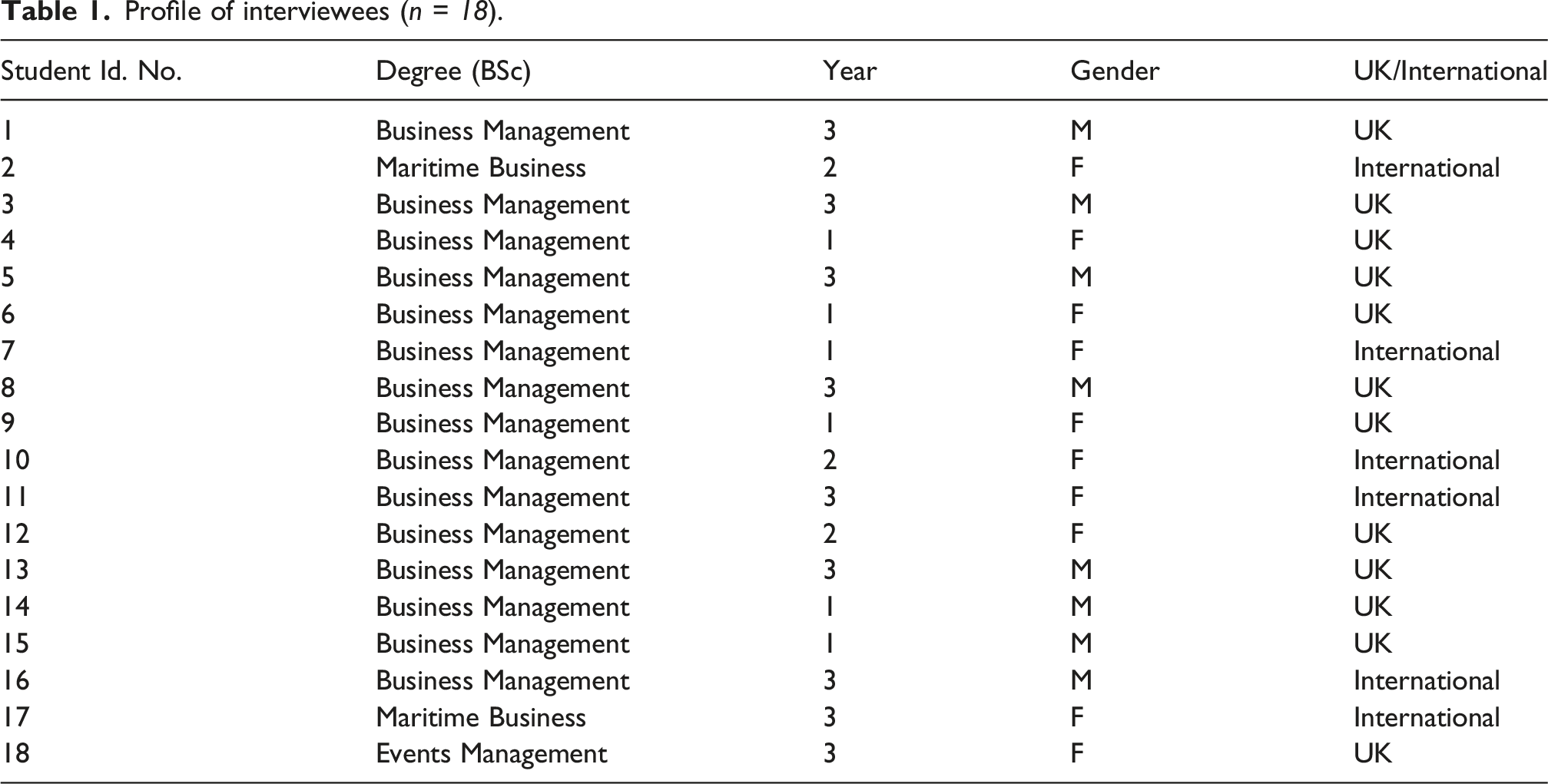
While there are formulae to determine how many interviews are necessary (e.g. Yocco, 2017) these can be seen as mechanistic and overly rigid (Barbour, 2001). This study, therefore, follows Hennink’s guidance. Hennink et al. (2017) found that between 16 and 24 interviews were necessary to achieve meaning saturation, less where the topic was less contentious. Hennink and Kaiser (2022)’s review found that where interviewees were relatively homogenous, and where there were narrow objectives, sample sizes of 9-17 interviews reached saturation. The present study has an uncontentious topic, a homogenous set of interviewees and narrow objectives, and therefore, the eighteen participants are deemed an appropriate sample size.
Ethical approval was granted by the University as a mandatory requirement for academic research using human participants. There were no credit or other rewards to students for participating, nor did either researcher interview those they were going to mark (Bartholomay and Sifers, 2016).
The semi-structured interview (Bryman, 2012) was based around seven questions (see Appendix A) designed by the authors
Findings were initially analysed to derive themes (Braun and Clarke, 2006) using words that reflect student understanding of Bourdieu’s capitals- CC included Work and volunteering experience, Placements and Qualifications; SoC included networking and SyC included the student’s USP. These were then altered to reflect emerging data and prevent the concepts becoming unwieldy; ‘Placements and Internships’ were separated from Work experience and Economic capital abandoned as students hardly mentioned it. These findings were then analysed by one researcher (before being checked by the other), using RBV, to identify if the student thought their capital was Rare, Valuable, Imitable or Substitutable.
Findings and discussion
The findings are presented in order of capitals: Cultural, Social and Symbolic, with an RBV analysis for each section. This RBV analysis is based on the student understanding: a final RBV analysis is based upon the authors’ understanding of the students’ responses.
Work and volunteering experience – embodied cultural capital
Sixteen of the eighteen participants had some form of work experience, eleven of whom had worked prior to their degree. Participants saw this as a key contributor to developing skills, qualities and competences, and thereby embodying CC. Reflecting the undergraduate base in the Business school prior experiences were very varied-ranging from “I did quite a lot of a few different jobs I feel like that just helped me be a little bit more confident” (P6) to “I have a working background with over 27 years’ experience and worked as a leader for 10 years” (P16). Similarly, Participant 14 had worked in the family textile business, while Participant 18 had worked in the hospitality industry since she was sixteen. Additionally, two participants had run their own businesses prior to enrolling on the degree, for example one said ““I’ve been buying and selling on eBay since I was 14 years old” (P5).
One unusual factor that emerged from discussing work experience is that participants saw more benefit derived from developing skills than from the utility derived from the wages part-time work paid. This could be a job that they needed “just for my CV and employability” … and to … “set up my personal statement for university” (P1) or, even if the “pay wasn’t that good” … “a lot of it was to help me in the long run” (P7). This contrasts with previous research that found students’ key motivator for work was financial (see for example, Evans et al., 2025). The lack of financial motivation was also highlighted by the two participants who referred to their volunteering experience: Participant 4 had been a local councillor while Participant 18 had improved her communication skills (especially with people who had intellectual disabilities) as she had been involved with the special Olympics. This suggests that students were less focused on the short-term financial gains derived from paid employment, but more focused on personal development for long-term employability prospects.
Alongside the work experience, seven participants described undertaking extra-curricula activities as part of their self-development. This typically centred on sport-related activities such as team working skills from playing National level netball (P12) but also included instructing in the army cadets. “I was a cadet for 4 years and in that time, my role was teaching the younger ranks. So going up in front of them and presenting information and making sure they understood it all. I think that helps especially when doing presentations. It helps a lot with confidence”. (P.1)
Soft skills such as effective communication are particularly demanded by employers (CMI, 2021). Students know that these are Valuable, but also that the skills they learn from work can be Substituted for with other jobs (P6) or using other areas of their life (P12). They are also Imitable as some (such as P7) deliberately learnt them even if they paid a financial penalty for doing so, and others’ (P4, P12) volunteered rather than did paid work. Few participants said that these specific skills they learnt at work were Rare (an exception being P8’s minute taking).
Institutional cultural capital – other courses
Participants also recognised that they were not a finished article and had a need to keep developing. Four participants referred to external courses as part of their development. The external courses are geared to the workplace and deemed to be vital in giving a competitive advantage over other graduates: Participant 3 stated that (according to his sister who “works in marketing”) he would “definitely” have “an edge” because “I'm always like trying to develop my skills and that I'm always trying to do extra courses I'm quite into video editing, and so I've done an Adobe Premier Pro course” (P3)
Participant 4 had done two bookkeeping courses prior to starting the degree, and Participant 18 emphasised that she had deliberately sought to improve her skills, stepping out of her comfort zone to undertake training and development courses.
Participants saw these skills as Valuable. Though they are, by definition, highly Imitable as the students have gone on courses to learn them, but they are Rare as the student must have sacrificed time and money to take the course. These courses give “an edge” as they cannot be Substituted for.
Placement/internships
Despite the perceived importance of work experience, there was a mixed response about the importance of internships and placements completed during their degree. Five students were explicit in stating they did not want a placement activity while on the degree programme. Two international students stated they would only seek an internship after graduating. Only Participant 3 regretted not doing a placement, only Participant 14 would like to do a placement if it were available and only Participant 11 had actually completed the typical one-year placement activity. P11 felt that the activity had been a positive experience that gave them an advantage, especially in developing communication and interpersonal skills: “So yeah, I feel like, I've honed that skill in the working environment and how to email clients, email team leaders, also your colleagues or communicating with your colleagues trying to make customers understand what you're saying different types of customers, and how to communicate with them. So, you always have to adapt, which is another skill that I believe I've also been able to improve on, coming from university, then to the working world during placement” (P11).
Although five participants had either completed, or were seeking, a shorter micro-internship at university either part-time work or prior work-experience is seen to generally negate the need for further work opportunity. For example, Participant15 stated that they “Wouldn’t mind a micro internship,” (P15) but their experience meant that they didn’t “See the point in a long placement” (P15).
Other participants referred to placements/internships prior to university, and did not think it necessary to repeat the activity while studying “I did a week’s work experience at Nationwide. I didn't get paid for it or anything. I had meetings with people from all different departments, and I think it gave me a real insight” (P6)
The two participants with their own businesses felt no value would be added by undertaking a placement as this would divert attention from their own business activity.
Using RBV this implies that many students believed that skills gained from the placement and internships are less Valuable than those gained from work experience: they are an inadequate Substitution.
Symbolic capital: Unique selling points (USPs)
Unique selling points must be Valuable, Rare, and difficult to Imitate.
Some participants highlighted unique selling points (USPs) from their stated experience, as they had run small businesses (P5, P8), taught themselves valuable social media skills (P3) or been a local councillor for whom the knowledge of “how the whole community operates and who’s responsible for what” (P4) is quite a “unique skill to have” (P4).
Others USPs were just the results of chance: maths ability (P8), or personality (P9). Incidentally, P2, P5 and P6 have disabilities, and all (in their narratives) used their disability as a source of strength to explain why they have certain capitals. For the international students, language abilities were mentioned as a notable skill to distinguish them in the jobs market. Participant 17 deemed her six languages important to support her work in the cruise industry. More significantly, she felt those languages signified her adaptability to work in different environments, something she felt would be desirable to graduate recruiters.
Some participants understood that bundling imitable and valuable skills makes them rare. They highlighted that it was not one aspect in their personal inventory that would make them stand-out graduate applicants, instead the accumulation of skills, experience and qualities bundled together would make them stand out in the graduate jobs market. “I know other people on the course also have part time jobs, but I think it’s the combination of things I’ve done, which is sort of unique” (P1).
Lacking a suitable gift such as maths (P8), or a background that gives languages (P17) or particular work experience (P14), means students must bundle together particular Imitable skills to make themselves unique (Rare). However, most students did not do this; P1 being an exception.
Networking – Highlighting social capital
Participants saw part of their development journey as including cultivating a network of people that would potentially be useful in the future, which again highlights the participants’ long-term orientation. Sixteen of the eighteen participants acknowledged the importance of networking with people who might be useful to support their future career aspirations. “I've got a good network of people I've worked with before. But I'm trying to build it up now I'm at Uni, because I can see the importance of it. I'd say I have. I have a relatively big network of people I know, but it's hard to gauge” (P8).
They saw three main routes for networking: LinkedIn, university and work (paid or unpaid). Five saw LinkedIn as a key tool for networking: P1 used it for “information about employers or jobs” as it gave them a “more sort of diverse spread of these things” (P1). Two participants mentioned their work as providing key contacts, especially their use for references in the future. Additionally, six participants mentioned events put on by the university or clubs/societies they are members of while at university. The meetings help them as (as Participant 1 says) they can “Meet people I probably wouldn’t have otherwise” (P1) who can help them by giving, “the inside scoop if you will, on what employers are looking for” (P1).
In particular, one participant is a member of the Shipping Society, and found this a useful group for networking with employers: “We have a lot of big shipping companies coming. Usually, they have a talk about what they do, graduate schemes, and so on, and then afterwards we have like a social. So you can go and talk to them directly” (P2)
Other students were more inventive: one participant deliberately made networking opportunities in leisure activities outside of the university: “The gym I go to is in is the Nuffield Health gym. It's a relatively expensive gym like for students. It's not particularly affordable. But when I go to the sauna specifically, I end up chatting to people there” (P8)
Moreover, Participant 17 has been actively developing contacts over the academic year, by attending conferences in order to collect business cards, to aid her future career.
An RBV analysis has shown that, typically, students had some understanding of how social capital works. All knew that it was Valuable, and it was their most frequently identified weakness (4 students). They do not know how to Imitate it as they have typically not (exceptions included both the maritime students, P1 and P8) tried to find Rare social contacts; nor have many tried developing more than one type (Substitutability), typically only using LinkedIn. In part this may be because of the sheer variety of people who could be contacts for a business student, and that the university is not based near a metropolis: students from other universities or disciplines may report differently.
Analysis using RBV
Students did not explicitly use the RBV framework: they did not consider how Imitable or Substitutable their experiences were, even if they could see how Rare and Valuable they were. This is similar to Bourdieu’s (2020) observation that people can see the field of struggles (that is, their explicit experiences) but not the field of forces that includes events that did not happen.
Their work experience is Imitable and Substitutable – volunteering or hobbies can teach teamwork (P12) or communication skills (P1). Students identified that a micro-placement was only of low Value, and only a poor Substitution for the CC that work creates. Micro-placements add Symbolic capital (SyC), even if the actual experience looks like it will be of only limited value to employers (P6’s week at Nationwide).
USPs, by definition, create competitive advantage and so must be Valuable, Rare, and neither Imitable nor Substitutable. Here, for young people, luck plays a role with a disability, maths ability (P8) or being international so having languages, creating a USP. Some students deliberately sought out extra courses in order to set themselves apart with unusual Institutionalised CC. Taken together, the student’s work experience is Valuable, but no students reported being encouraged to develop a USP with a bundle of Imitable skills that becomes Rare.
One thing that students can control is their network (SoC), and they knew that they should. All of the different methods are Substitutable. However, LinkedIn is Imitable and not Rare; University Societies are Imitable and may be Rare – very few Universities have a Shipping Society - and work experience is not Rare and is Imitable. Taken together these imply that most student’s social network is of limited utility.
Conclusion
The participants identified the process of acquiring skills, qualities and competences and gearing them to the world of work as a long-term activity that had started before university and continued alongside the degree. It was not suddenly embraced during the degree to compete in the graduate jobs market but was part of a much longer process of personal development and work preparedness. This, then, is habitus. The students’ habitus of a long-term future orientation meant that undertaking courses and cultivating useful contacts and growing their network was seen to be important to their future career. Participants valued work experience, in particular for the skills they learned. If they lacked cultural capital from work experience, they could substitute it for internships, although a cynic could argue that this process is part of the process by which universities enable those with economic capital to gain symbolic and social capital. Some students tried to make their skill sets ‘Rare’ by bundling together particular skills which they sought out to develop. The work experience not only helped hone an individual’s skills but was also perceived to provide evidence (symbolic capital) of being work-ready, post-graduation. Work readiness is a key feature of graduate employability demanded by employers, notably the ability to contribute to the business from the outset of employment (Prikshat et al., 2019).
This finding that respondents focussed on a long term, embodied cultural capital development differs from findings such as McCafferty et al. (2024) or Groves et al. (2022): their students who were first in family relied upon the Institutionalised cultural capital of getting a good degree. While ‘first in family’ was not recorded, this would typically restrict participants’ ability to accrue social and cultural capital (McCafferty et al., 2024). However, the participants in this study, have gone of their way to collect it. The causal difference may be that the participants in this sample were Business school students, it appears that none of McCafferty et al.’s (2024) or Groves et al.’s (2022) were. Alternatively, the interviewees were not representative students: they were exemplars of what successful students should be and included a local councillor and two small business owners. This limits how transferable (Bryman, 2012) the identified themes in this study are to other groups. The authors believe that interviewees are likely more agentic than other students and this agentic habitus could involve different beliefs about the job market or be primarily affective. Future research could disentangle these choices.
Despite this, the students did not (collectively) have a clear idea of what they needed to do for employers. Economic capital was hardly discussed (P14 mentioned that he did not need to work, P17 had spent all her money getting social capital) and students placed more importance on the cultural capital they had developed than the money they earned from work. This suggests that the students’ model of the business field is that success require social and cultural capitals, but they are unsure about how. The valuable capitals that the students reported they developed from work experience and placements were very varied. For example, adaptability was mentioned in several interviews. Work experience, be it full-time, part-time or through placement, is perceived to demonstrate adaptability to the workplace, and this is seen to underpin work readiness credentials: employers agree (CMI, 2021). However, participants did not mention ‘critical thinking’ and, for example, only three mentioned ‘time management’ as a skill they possessed, yet critical thinking and ‘self-management’ are important to employers (CMI, 2021). This implies that students do not know what they have to do, and that they need further guidance. This variation could be reduced if universities set structured reflective practice to encourage students to understand what they have learnt, and how it can be useful for employers.
University research could clarify how graduates are recruited in different fields so that students can concentrate their job search: as LinkedIn is not Rare and profiles are Imitable then they must be Valuable to be worth maintaining. Students did not all develop social capital deliberately: this could be because they are young and do not need to develop social capital for a career they have not yet chosen, but this could also be a suitable point for education (Badoer et al., 2021; Daniels and Dempsey, 2022). Further, five used LinkedIn as an alternative to other sources of contacts, but there was little evidence that they knew how to use it effectively (Daniels et al., 2023) and none said that they had curated their personal social media accounts (Garrido-Pintado et al., 2023) as they did not realise that these were another, substitutable, source of symbolic capital.
The participants in this study found that placements were not Valuable, but this may vary by university and country: again, research would clarify how useful it is in particular contexts. Finally, universities could embrace Neoliberalism and teach their students how markets work. This might demystify it and help students create unique selling points by bundling together their skills in an RBV approach. While the university field can do little to help students with non-imitable skills, it can help with bundling together imitable ones by providing, for example, language courses and advice about what employers want.
Nonetheless, employers’ input is essential since they will know precisely what they want from graduates. In this study for example, participants knew that symbolic capital mattered, but did not know how to get it. This could be a suitable point for universities to intervene. However, industry advice should be taken lest the sessions become a pastiche of education-sources such as Callaham (2025) are true, but so general as to be useless to neophytes.
Using RBV to understand the students was a mixed experience. The participants had not considered their strengths using the RBV framework, none explicitly described substitutable capitals and only one had the idea of inimitability. Instead, they understood how ‘fields of work’ worked using habitus. This illustrates that “far transfer” of ideas to different fields does not easily happen (another example being ‘Scaling’ for time management (Evans and Harrington, 2024)) and also supports Bourdieu’s point that those further down the field (and our students are typically working class) have a weaker idea of how the forces in a field actually work. This could, alternatively, be a result of interview technique, a further study using RBV and Bourdieu could ask students more directly (as Paley, 2017, recommends) to consider what they had not yet done and how they would do it (imitability), or ask what they could use as alternatives (substitute). However, the ability to nuance the use-value of the capitals was useful, in particular for understanding the competitive advantage that LinkedIn and the university societies actually give to Social Capital and for identifying placements as a substitutable symbolic capital that many degree students in particular, do not need. This paper, therefore, provides a unique lens through which to analyze the factors that contribute to a graduate’s success in a competitive job market and offers fresh insights that may inspire further research and practical applications in educational setting.
Footnotes

Ethical considerations
The research project was approved by the University Ethics Committee on 16/7/2024, reference 5505.
Consent to participate
Consent was sought from the participants prior to conducting the research.
Funding
The authors received no financial support for the research, authorship, and/or publication of this article.
Declaration of conflicting interests
The authors declared no potential conflicts of interest with respect to the research, authorship, and/or publication of this article.