




Abstract
The Healthy Cities Network (HCN) of the WHO seems to be an effective approach to introduce innovative ideas into the healthcare sector. It is a knowledge-based network and at the same time a learning network. Within literature, communication is carved out as an essential precondition for such organisational learning. Still, there exists no study that explicitly focusses on the communication processes of the HCN Germany. The aim of this study is to get first insights into such communication processes and the information flow within the HCN Germany and to analyse these with respect to the processes of inter-organisational learning. An online questionnaire was sent to all member institutions of the HCN Germany. The questionnaire analysed the communication between the member cities and also between the member cities and the other institutions of the HCN Germany. Furthermore, the efficiency and the outcome of the communication and information exchange is evaluated. The evaluation showed that the communication and the exchange of information within the network is rated rather good and that there is transfer as well as the sharing of knowledge. So far joint learning processes between the network members and also between the member cities and the other institutions of the HCN Germany are lacking. For the further development of the network and the development of the network as a learning organisation there should be also joint learning processes, which means the cooperation between the network members and the other network institutions should be deepened.
Keywords
Introduction
Governance networks such as the Healthy Cities Network (HCN) of the WHO seem to be an effective approach to introducing innovative ideas into the healthcare sector. As Green et al. 1 (p. i43) state, “developing new governance structures for public health at the city level is one of the most important features of the WHO Healthy Cities project”. Aiming for better health promotion, the idea behind the Healthy Cities Network is to anchor health promotion as a socio-political task in the public awareness. As de Leeuw et al. 2 point out, with being part of the European Healthy Cities Network, health is high on social and political agendas – new types of policies and governance are implemented. With the establishment of learning networks, with the process of knowledge transfer, the sharing of knowledge and joint learning processes, concepts of healthy living may be transferred from one city to another. The knowledge transfer between the cities is an important requirement for the success of the healthy cities concept. The aim is to reach a target achievement by means of inter-organisational learning processes within the network. So in this case the network does not lead to the development of new products, but rather to innovation in respect to new knowledge and new services for the citizens – new healthcare concepts. Former studies prove that the Healthy Cities Network “enables cities to innovate and learn from their innovations in substantive manners” (de Leeuw et al., 3 p. i41). There exist several studies evaluating the performance of the Healthy Cities Network from different points of view. De Leeuw 4 discusses utility-driven evidence for Healthy Cities. Heritage and Dooris 5 (p. i54) found that the Healthy Cities have been “successful in promoting community participation as part of good local governance”. De Leeuw 6 refers to the evidence on effectiveness of intersectoral action, policy and governance within the different phases of the Healthy Cities Network. Furthermore there are studies evaluating the previous phases of the Healthy Cities Network and giving an outlook to the advancing phases (particularly for phase V evaluation see de Leeuw et al., 7 Simos et al., 8 Ritsatakis et al., 9 Green et al., 10 Grant 11 ).
In contrast to these studies focusing on the outcome evaluation of the Healthy Cities Network, the study at hand aims to evaluate parts of the internal processes within one national Healthy Cities Network. As the Healthy Cities Network is based on the concept of inter-organisational learning, first the learning process itself is analysed and requirements for accomplishing it. Within literature, communication is carved out as an essential precondition for organisational learning (e.g. Chiva et al.
12
). Siciliano
13
(p. 104) points out that “although much of the research on learning in the public sector examines collaborative arrangements and interorganizational networks, it often stresses the importance of individual dialogue and social interaction as primary methods of learning. […]”. Additionally Krauss et al.
14
(p. 1) state that “[…] frequent communication among network partners is related to more highly productive relationships.” If the relationship within the network is more productive the network itself is more efficient. Therefore the study evaluates the communication processes within the network and between the network members as a precondition for knowledge sharing and knowledge transfer to analyse the ability of the network to share information and to foster health promotion. Hence we pose the following research questions:
How are the communication processes within the network and between the network members? How is information from other network members used for the development of projects within a region/municipality?
Governance networks as knowledge networks
With this present analysis of the HCN two scientific streams are combined. First the stream of network research that is investigated since the mid-1980s by scholars in the field of strategic management (e.g. Granovetter, 15 Håkansson and Snehota, 16 Provan and Milward 17 ). Second from the field of organisational behaviour, the research about (inter-) organisational learning.18–20 Literature combining these two research streams is increasing since the early 1990s (see for example Hanssen-Bauer and Snow; 21 Lei et al.; 22 Larsson et al.; 23 Knight 24 ).
Networks are forms of virtual organisations that can learn through the cooperation. 25 On the one side, networks generate knowledge through the interaction of different stakeholders. On the other side, they also bond knowledge, as they have access to accumulated knowledge through diverse nodes (individuals with special know how) within the network. Therefore networks have always new knowledge and competences available. 25 From a resource-based view, these are the main resources of those knowledge and learning networks. As Beeby and Booth 26 state this is also known as the “knowledge-based-view of the firm” or maybe better the “knowledge-based-view of the network”. A virtual organisation like the learning networks have to build their identity based on communication. The internal and external communication with the stakeholders is of tremendous importance. For virtual organisations the societal expectations give the direction for further development. 25 The Healthy Cities Network can be identified as a virtual organisation, it is a knowledge-based network and at the same time a learning network. In contrast to knowledge-intensive firms,27,28 the HCN is a knowledge-intensive network. The knowledge is bound within the network actors. Sydow and van Well 29 define knowledge-intensive networks as networks that (1) have knowledge and competencies as primary resources, (2) have an influence on the practice of other actors and (3) are able to increase their knowledge resources through inter-organisational activities. The process of network learning as it is described by Knight 24 (p. 435) has “a strong focus on the appropriation of learning by the individual organization […] – what each firm can learn (acquire) from the other, or from their interaction”.
Based on the knowledge-based view of the firm private firms use their know-how and competence as a competitive advantage against their competitors. For governance networks like the HCN, the advantages appear as a value added for the society. As de Leeuw et al. 3 (p. i41) state, cities claim, “that they are both learning to improve their practices, as well as learning to improve and adjust their policy and organizational systems”.
The Healthy Cities Network of Germany
The Healthy Cities Networks were established in 1988 on the basis of WHO Ottawa Charta of 1986 and the foundation of the WHO-project of the “Healthy Cities”. The networks present themselves as voluntary associations of cities, counties, municipalities and regions that aim to create healthy living conditions for their citizens. The overall objectives and topics of development are defined in a document of the European Network of the WHO’s Healthy Cities. Within Europe, 31 countries belong to the network, including Germany.
The Healthy Cities Network of Germany was founded in 1989. Foundation members were Essen, Frankfurt a. M., Mainz, Munich, Nuremberg, Saarbrücken and the county of Unna. 30 In 2014 the German network had 77 member cities. Besides the municipal members, the network also includes the Secretariat, which is responsible for all organisational tasks, and centres of excellence that deal with specific problems and have special competencies. Additionally there are regional centres: the regional networks Berlin with its districts; the region Heidelberg, Mannheim and Viernheim; HEREUN (Herne, Essen, Kreis Unna) and Mecklenburg-Western Pomerania/Schleswig-Holstein (Healthy Cities municipalities of both federal states). In the healthy city, health as well as physical, mental and social well-being is an important consideration for all decisions, including political ones. 30
The network aims to achieve the collaboration of politics, administration and citizens. The municipalities demonstrate living democracy and operate by connecting institutions and authorities as well as sectors and branches. The achievement of aims at the political and community levels is pursued by the process of inter-organisational learning. Ideas for knowledge generation and knowledge sharing as well as for the joint development of skills in the health sector are mutually exchanged between the municipalities. Within the context of best-practice approaches expert knowledge is made available, so that successful projects can be implemented by other municipalities. Political aims are thereby transferred to the municipal level. The network aims to help in the achievement of political aims. The superior aims are defined by the European network of WHO’s Healthy Cities
31
:
Promoting concepts and activities for health and sustainable development; Strengthening the position of Healthy Cities at the national level as well as strengthening the position of Healthy Cities; designing concepts for health promotion, public health and urban redevelopment; Creation of conceptual and practical expertise as well as evidenced knowledge and knowledge resources; Promoting solidarity, cooperation and good working relationships between the cities and networks in the European region as well as with other cities and networks of Healthy Cities movement; Advocating for health at European and global levels through partnerships with other organisations; Improving accessibility to the network of the European region for all Member States of the European Region.
The base of the network is the member cities as the actors of the network. Some member cities and regional authorities affiliate to superior networks, the so called regional networks. The aim of the regional networks is to strengthen local sites in the context of communal politics. The regional networks organise meetings, events and have their own projects. The competence centres are cities that have special knowledge and competencies within a special area of health prevention. The competence centres are able to provide resources for the transfer and discussion of those experiences. The expertise of the competence centres is the methodical implementation of specific components of health promotion that are oriented specifically to the intentions of the Ottawa Charter and the 9-point program of the Healthy Cities Network. 30 There is also an intermediate institution called “Sprecherrat” that consists of representatives of different municipalities. On top of the HCN Germany is the Secretariat that is responsible for the management and administration of the network. There is no strict hierarchy between single institutions of the HCN Germany. Therefore communication and information flow should be possible in both directions.
Communication as an essential element in the process of inter-organisational learning
Since the Healthy Cities Network is based on the principle of inter-organisational learning, the learning process itself is analysed below and requirements for accomplishing it are deducted. Inter-organisational learning takes place by the interaction of individuals of different systems. These systems form learning units and are responsible for the sharing and transfer of knowledge on the level of the whole network. 32 Therefore inter-organisational learning is about learning of and between single systems and organisations within a peripheral system. 33
In this study, the focus is on the learning process which takes place between the single cities as network members and the other institutions of the Healthy Cities Network – hence, all further remarks refer to these relationships. The process of inter-organisational learning primarily consists of the learning targets, the forms of learning, the learning types and the learning phases.
The learning targets are in our case the institutions or organisations that benefit from the network or the learning process. In the case of the Healthy Cities Network this can be the individual municipalities. On the other side, the whole network also benefits from the improvements at the organisational and institutional level. Here we mean all municipalities taken together, so the benefits are also forwarded to society. Overall benefits in the case of the HCN would be successful health promotion and a better health status of society. The learning targets may aim at improving the own organisation with participating at the network by getting as much knowledge as possible from the other organisations. By acquisition of new knowledge through inter-organisational learning organisations can try to compete against others within the network. Within networks some organisations can also have opportunistic behaviour and withhold knowledge. Once an organisation has reached its own learning aims it could see no more incentive for the partnership within the network. This is the classical prisoner’s dilemma. Therefore within a learning network the organisations (or individuals) have two options: lay all the knowledge open and cooperate or be opportunistic and only learn from the other network members.34–37 The whole network could be improved, if the organisations have complementary knowledge. This is the case if the organisations are not competing against each other. In the case of the HCN Germany the cities do not compete against each other as companies on the private market, therefore they can benefit from collaborative learning.34–37
The forms of learning relate the human characteristics with the forms that lead to the implementation of learning: cognitive, cultural and behavioural. It is essential to understand learning also in the sense of values, emotions and behaviour. 38 The cognitive perspective of learning helps to reduce the complexity of the reality to make it possible to handle all the information. 38 The cultural perspective of learning is about the interaction of the members of the learning system. 33 The behavioural perspective of learning means that learning processes are triggered by action and reflection about the resulting experience. 38 This means learning has not always to be a conscious process, it can also be a positive side-effect of any action. In the case of the Healthy Cities Network this would be the case, if members meet on an annual conference and communicate on an informal basis without questioning concrete information.
The learning targets depend to a considerable extent on the types of learning that are involved. These are knowledge transfer, knowledge sharing and collective learning processes. 33 As a result of the process of knowledge transfer, the level of knowledge of the individual institutions is improved. Knowledge transfer is defined as learning from other institutions, whereby the focus is on the exchange of knowledge between the network members.33,39 Inkpen and Tsang 40 (p. 149) define “knowledge transfer manifests itself through changes in knowledge or performance of the recipient unit”. It refers to the internal usage of knowledge of other network members or stakeholders. 41 The new knowledge, particularly from external institutions is often a stimulus for improvement within the organisation. 40 Regarding the knowledge transfer the exchange of knowledge between organisations or especially individuals within the network is in the focus. Reagans and McEvily 42 show that social cohesion and network range have a positive impact on the effect of knowledge transfer.
The latter types of learning (knowledge sharing and collective learning processes) deal with the learning targets for improving the whole network. The knowledge sharing process aims to design a common inter-organisational knowledge base by combining competencies. Compared to the knowledge of a single institution, a common inter-organisational knowledge base enables the user to access multifaceted competencies and skills. 33 Joint learning processes aim at the creation of new knowledge within the inter-organisational knowledge base. The joint learning processes can also be compared to deuteron learning as a way of “learning to learn” 43 – the process of learning itself, which means the improvement of learning aptitude, is thereby the focus of interest. At the interface between the cities as network members this would mean that a dynamic learning dialogue would be established and at some point the learning process would be evaluated by the local, regional or national Healthy Cities Network. New knowledge through joint learning processes is often the result of synergetic effects. Bosch-Sijtsema and Postma 44 point out that mutual learning is easier, if organisations have similar capabilities. This makes it easier to integrate each other’s knowledge (see also Colombo 45 ).
The learning phases are of particular importance for the analyses of the processes of inter-organisational learning. Specifically, the learning process is divided into six phases: identification (determining what knowledge is needed and what knowledge is available within the network), generation (creation of new knowledge by combining the expertise of the network actors), diffusion (making the existing knowledge within the network available to the appropriate persons), integration (integrating the new knowledge into the inter-organisational knowledge base), modification (the knowledge might have to be adapted to meet specific needs within the network), and usage of the knowledge that has been acquired (it has to be used and applied or implemented) (Figure 1).33,38

Building blocks of organisational learning. Source: Own compilation based on Hülsmann and Lohmann. 33
As Wang and Ahmed state organisational learning can be defined as changes in the state of knowledge. The same applies for inter-organisational learning. Inter-organisational learning is therefore related to the acquisition, creation and implementation of (new) knowledge. 46 Bierly et al. 47 (p. 597) point out that “learning is the process of linking, expanding and improving data, information, knowledge and wisdom”.
In our study we focus on the learning target and on the types of learning and evaluate how these are developed within the HCN Germany. Therefore Figure 2 illustrates these relations. It is assumed that all three types of learning can be found in the HCN Germany: knowledge transfer as a unilateral process and the sharing of knowledge as a bi- or multilateral process. Both types imply the exchange of established competencies. We presume also the existence of joint learning process with the generation of new knowledge and competencies.
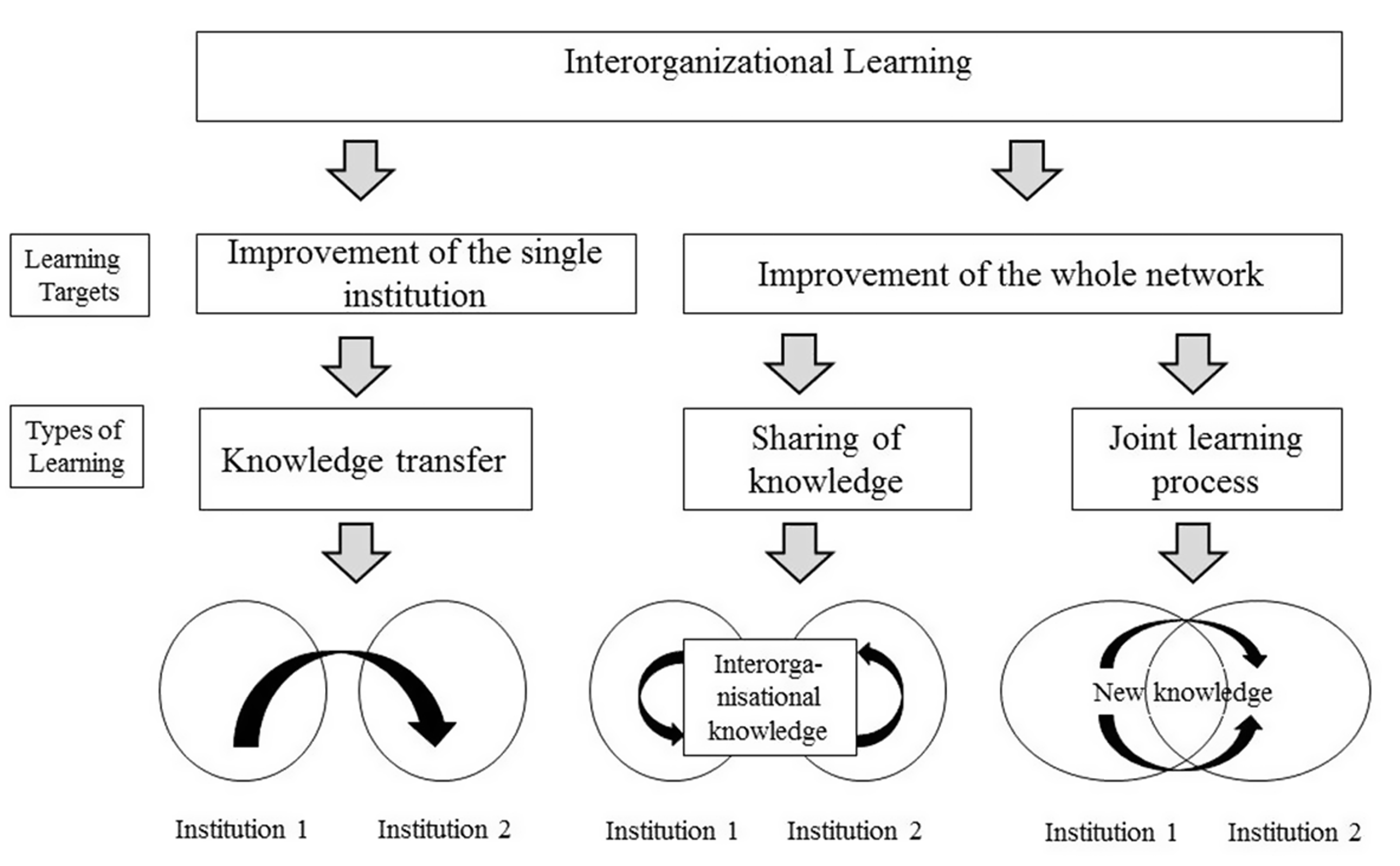
Learning targets and types of learning. Source: Based on Hülsmann et al. 32
For a long-term usage of knowledge and competencies it is important to store the knowledge. For the storage of network knowledge it is necessary to provide appropriate storage media. Furthermore it must be possible to have access to these media for all of the network members. 29 Within the HCN Germany, the knowledge is stored within the member cities. The regional networks and competence centres act as knowledge clusters.
Besides the building blocks of inter-organisational learning, further requirements for the successful implementation of a network like the “healthy city” are the congruence of the aims of the network participants, the transparency of the presentation of the information and the transfer of the knowledge to all involved individuals and the motivation of the actors – this means the communication between the network members.
From the literature it is known that two of the most essential factors for (inter)-organisational learning are transparency and communication. As Popper and Lipshitz 48 as well as Friedman et al. 49 state, the transparency is an important enabling factor for organisational learning, especially in the public sector. Barrados and Mayne 50 also emphasise the relevance of information dissemination for the process of organisational learning. The same can be assumed to be true for the process of inter-organisational learning. Previous to the learning process itself, the knowledge has to be accessible; a crucial premise for the learning process is that the information has to be visible and available. Chiva and Lapiedra 12 as well as Pemberton and Stonehouse 51 highlight that dialogue and communication are essential preconditions for organisational learning. The importance of communication in inter-organisational relationships is for example emphasized by Krauss et al. 14 (p. 9), when they point out that “it was clear that communication among agencies was an important factor for having productive relationships. […] This is logical because a productive relationship can only occur when at least some contact occurs between agencies. However, frequency of contact could be a factor here. The more often communication occurs among agencies, the more they work together and the more productive they feel their relationship is. It is relatively easy to investigate the amount of contact occurring among agencies. Little contact among agencies could be a symptom of other problems in the network that may lead to lower productivity.” Also Michailova and Sidorova 52 (p. 81) highlight that “the conceptual model and propositions put forward in this paper are grounded in the view that communication plays a paramount role in knowledge sharing and organisational learning. Communication has long been recognised as a critical factor in knowledge processes and group interaction.”
This means in the case of the Healthy Cities Network transparency and the quality of communication are especially important. Therefore in the following we will analyse the communication and information flow of the HCN Germany.
Evaluation of the communication processes and information flow within the HCN Germany
Research methodology
There exist several studies evaluating the Healthy Cities Network with respect to different foci (e.g. de Leeuw et al.,2,7 Simos et al., 8 Ritsatakis et al., 9 Greenet al., 10 Grant, 11 de Leeuw, 4 Heritage and Dooris 5 ). To the best of our knowledge, there exists no study that explicitly focusses on the communication process of Healthy Cities within Germany. The importance of evaluating the communication process is that it is one of the essential preconditions of a highly productive relationship as Krauss et al. 14 stated. Heritage and Green 53 point (p. 163) out that “NETWORK productivity could be enhanced by greater communication via physical, telephone or web-based meetings. WHO could enhance cross-border learning and possibly lead applications for EU funding to support specific projects.” Therefore we set the focus on the internal communication processes instead of analysing the network itself.
Except for a study about quality monitoring by Plümer and Trojan, which was published in 2004, 54 respectively a study by Plümer et al. 55 not much scientific information is available about the Healthy Cities Networks in Germany. Therefore we want to reduce this research gap and contribute to the scientific and practical progress. Additionally we chose the case of the HCN of Germany as Germany is one of the countries that is within the HCN since the very beginning. Therefore we think the structure should be stable and it is a network that is worth being analysed. As shown above, the HCN is a knowledge network as well as a learning network enabling network learning for their member cities and the whole network. The aim of the study is to get insights into the communication processes and the information flow of the HCN Germany and to analyse these with respect to processes of inter-organisational learning. In 2014 an online questionnaire was sent to all member institutions of the HCN Germany (at that date 77 cities or regions). Thirty members participated at the study that corresponds to a return rate of 39%.
The questionnaire analysed the communication between the member cities and also between the member cities and the other institutions of the HCN Germany. Furthermore the efficiency and the outcome of the communication and information exchange is evaluated. The evaluation focussed on knowledge transfer, the sharing of knowledge and joint learning processes.
Results
In a first part the member cities were asked about the communication. The results refer to the 30 members who answered the questionnaire. With respect to the structure of the network, the frequency of communication with the HCN Secretariat, with the competence centres and with other members was requested. With the HCN Secretariat the majority of the participating member cities (16) communicate several times a month or once in several months. Also with other members, nearly half of the participating member cities (14) communicate several times a month or once in several months. Some (7) communicate only biannually with other members. With the competence centres most of the participating member cities communicate either once a year (7) or less than once a year (12). The findings are illustrated in Figure 3.
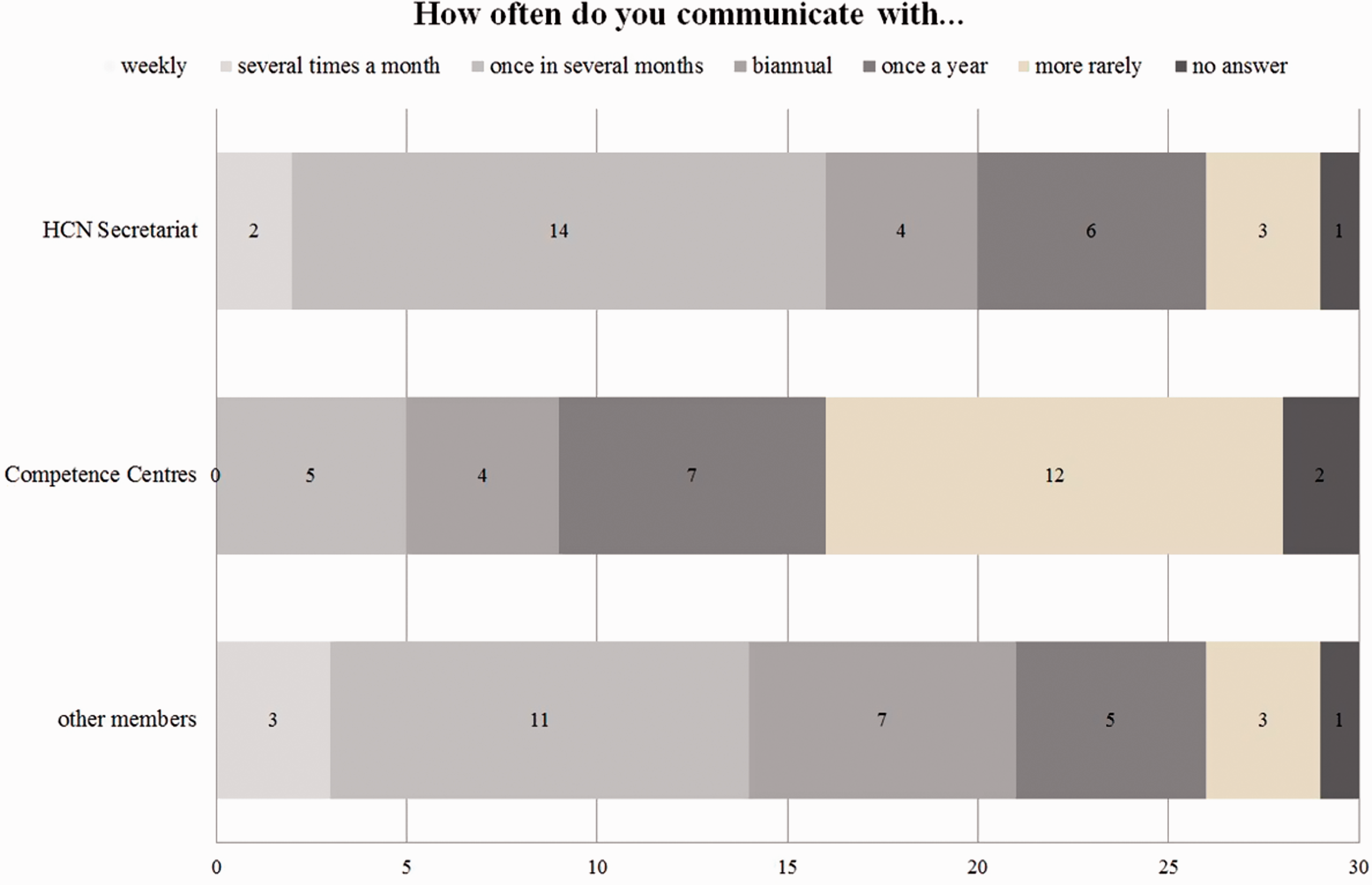
Frequency of communication. Source: Own compilation.
The next question was about the frequency of information exchange to concrete projects with the HCN Secretariat, other member cities and the competence centres. Regarding the information exchange with the HCN Secretariat it is interesting that 11 of the member cities exchange information several times a month but also 10 of the member cities exchange information only less than once a year. There is a similar picture for the information exchange with other members. Slightly more than the half of the member cities exchanges information either once in several months (8) or less than once a year (9). Also in this case most of the cities have rare contact to the competence centres. Sixteen of the cities exchange information less than once a year with the competence centres. The overall findings are presented in Figure 4.
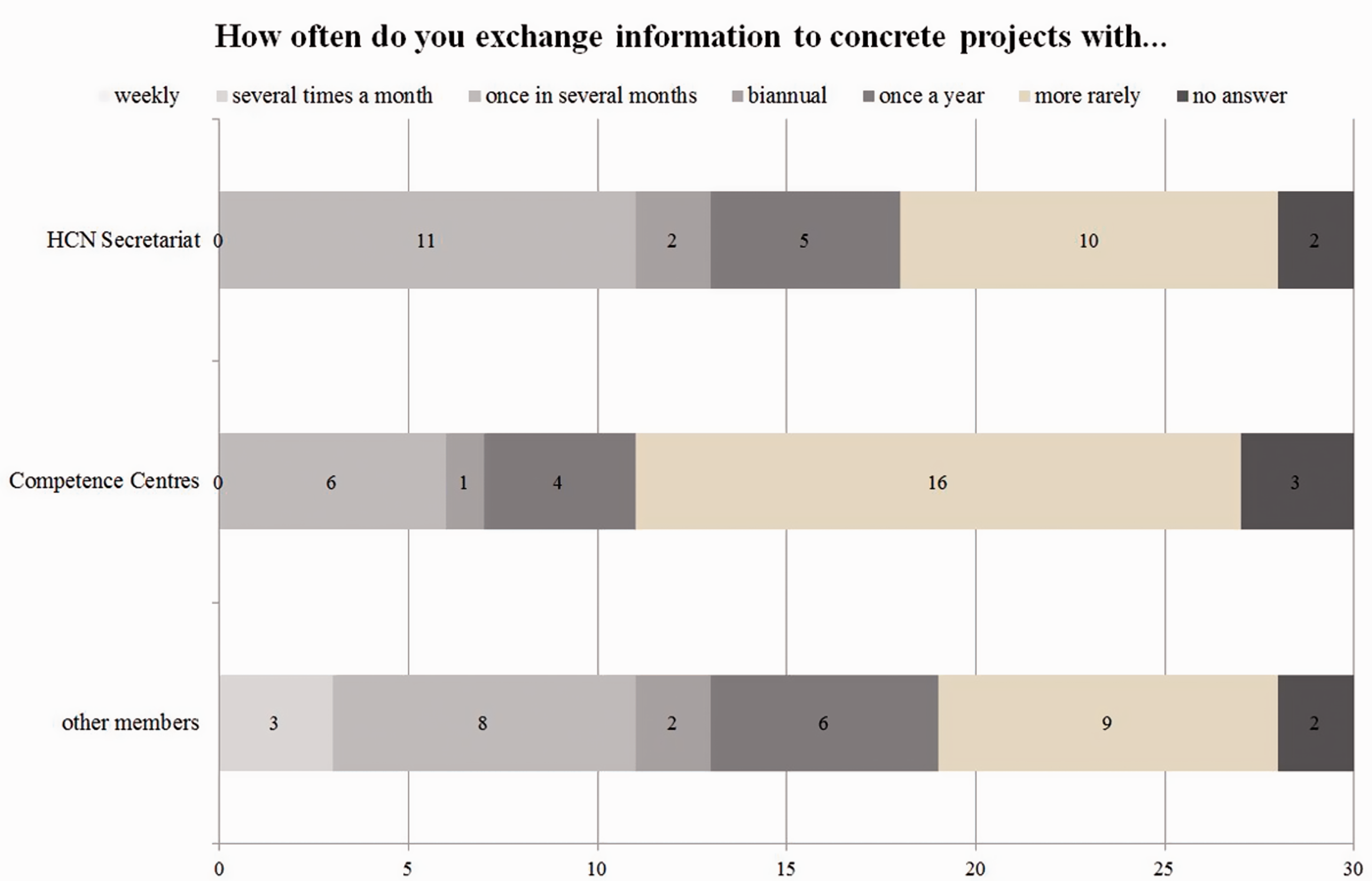
Exchange of information to concrete projects. Source: Own compilation.
Regarding the content of the cooperation with other network members, the cities were asked about the intensity of the cooperation with other members of the HCN Germany. Twenty-nine members say that their cooperation is only about the share of information, knowledge and competences. Only one member says that they have cooperation with the common use of resources. Three members have cooperation that is about the common operation of projects.
An interesting aspect is the usage of information from other network members. Twenty-three of the cities or regions and hence the vast majority point out that they use information from other members. The cities state that they use reports of projects and about the project structure. They use the experience of other members with specific projects. The cities emphasize that they use information to learn from failures and to get access to practical information. For the realization in the own city the information about concepts and ideas for projects is used as well as the consulting for projects by other members. Additionally the network members get support and help for self-help groups. In the sense of best practice projects, aims and strategies for the implementation of projects is used from other network members. Furthermore nearly one-third (9) of the member cities confirm that they integrated ideas from other members. Examples for project ideas that were adopted from other members are newsletters, health conferences, projects about childcare, projects about using bike helmets and also the KISS project (service for self-help groups).
As openness is an important requirement for inter-organisational learning, the members were asked to rate the openness of information exchange within the HCN Germany. Most of the network members rate the openness of information with all main institutions (HCN Secretariat, other members and the competence centres) as very good or rather good. The data are illustrated in Figure 5.

Openness of information exchange. Source: Own compilation.
The second important point for learning processes is the efficiency of communication. Hence the network members should rate the efficiency of communication with the main institutions of the HCN Germany. Thirteen of the cities rate the communication with the HCN Secretariat as very efficient (4) or rather efficient (9), 7 rate it as neutral (neither efficient, nor inefficient) and 5 rate it as rather not efficient. Twelve of the network members rate the communication with other municipalities as very efficient (5) or rather efficient (7) and 10 rate it neutral. Only three rate the communication with other members as rather not efficient or not efficient. The communication with the competence centre is from 12 members evaluated as very efficient (4) or rather efficient (8), 5 of the members rate the communication with the competence centres as neutral and 6 of them rate it as rather not efficient or not efficient (Figure 6).
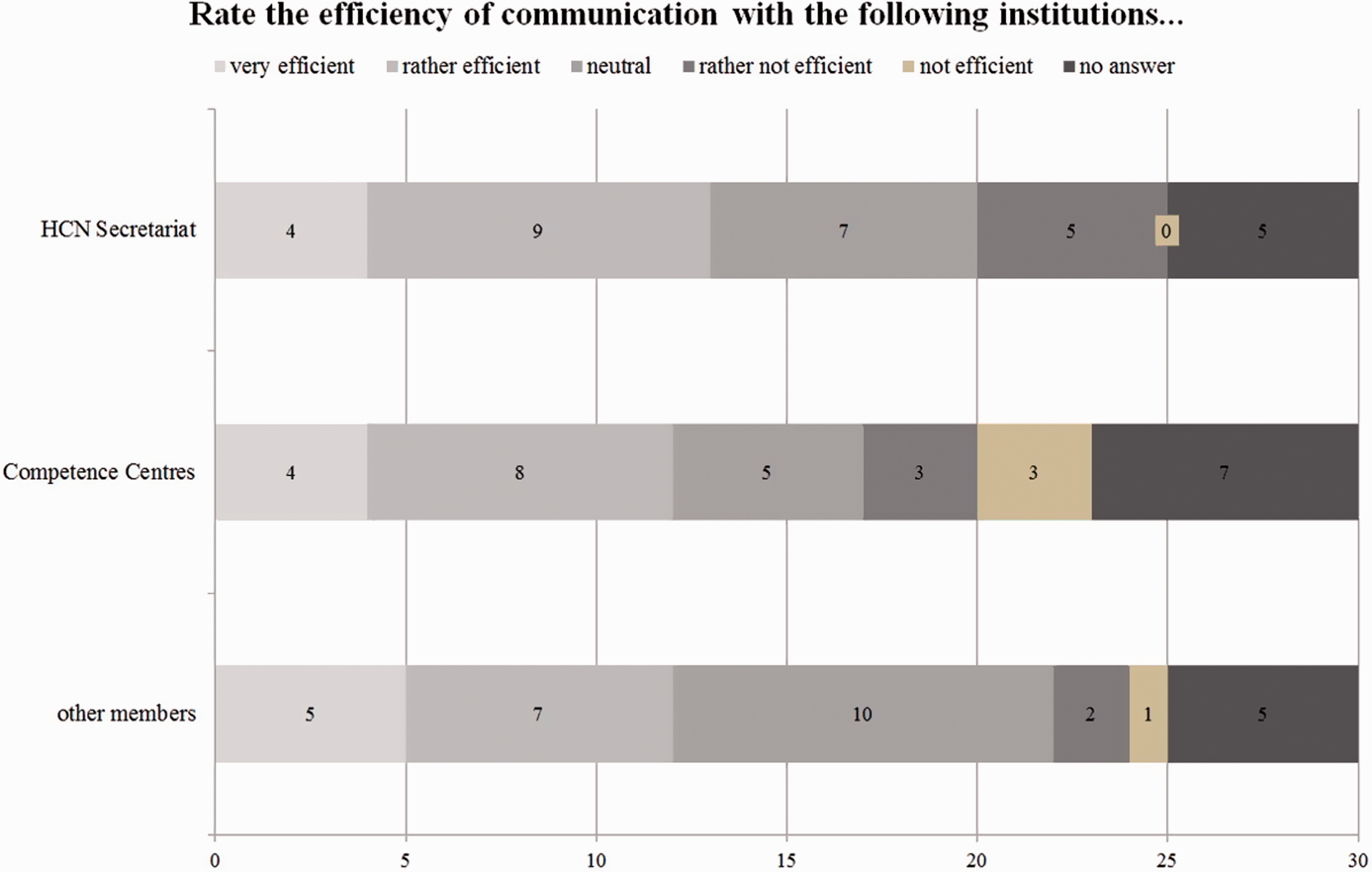
Efficiency of information exchange. Source: Own compilation.
To get an overview about the usage of information and knowledge from other network members, it was asked for the relevance of shared information. Therefore it was asked, if information from other network members is used and in what way this information is used. Twenty-three of the participating municipalities use information from other members. On the other side only nine of the municipalities adopt concrete project ideas from other network members. Information used from other municipalities are for example project reports (knowledge transfer), publications (knowledge transfer), individual consulting (knowledge sharing/transfer), newsletter and Healthy Cities Announcements (internal newsletter) (knowledge sharing/transfer), exchange of experience (knowledge sharing/transfer), best-practice examples (knowledge transfer) or concrete concepts of other municipalities (knowledge transfer). Information is integrated into the own municipality by using ideas for self-help groups, project ideas, learning from failures of other members to prevent from doing the same failures, projects are duplicated or the adoption of aims and strategies. It was also said that concrete projects are adopted from other municipalities.
To get some more educated evaluations we extended the analysis of the usage of information with respect to the size of the cities. As the size of the city might have an impact on available resources and possibly on the communication, the effect of the city size to HCN relevant communication is examined. Due to the small number of participants we decided not to run a correlation analysis but to evaluate the findings by a cross-classified table. Concerning the frequency of communication, cities with 250,000 or more inhabitants do in average communicate slightly more often with the HCN Secretariat, the competence centres and other members than cities with less than 250,000 inhabitants. The same findings result regarding the exchange of information to concrete projects, also cities with 250,000 or more inhabitants do in average exchange slightly more often information with the HCN Secretariat, the competence centres and other members than cities with less than 250,000 inhabitants.
In contrast the openness of information exchange with the HCN Secretariat, the competence centres and other municipalities is more positively rated by cities with less than 250,000 inhabitants than by cities with 250,000 or more inhabitants. Also the efficiency of information exchange with the HCN Secretariat, the competence centres and other municipalities is evaluated more efficiently by cities with less than 250,000 inhabitants than by cities with 250,000 or more inhabitants (Table 1).
Comparison of the key items with respect to the city size.

Discussion
The study concludes the following findings with respect to the theoretical framework and the process of inter-organisational learning. The availability of and access to information and knowledge48–50 is an essential precondition for inter-organisational learning. Therefore the communication processes of the HCN Germany were analysed. The findings should also be challenged against the background of the HCN being a governance network and therefore keeping in mind having specific structures.56–59
Regarding the first research question about the communication processes within the network and between the network members, the following findings can be highlighted. For the network members the HCN Secretariat and the other member cities are the most important communication partners. In this context the study of Plümer et al. 55 can be mentioned that confirms a regular contact between the member cities. In contrast to the study at hand Plümer et al. 55 only differentiate between the categories regularly, occasionally, if necessary, seldom and only on HCN meetings. Thus those results only provide first insights which are further investigated in the current study. Referring to this the regular contact is – as defined – one of the main foundations of the inter-organisational learning within the HCN. The communication with the competence centres is rated not that important for the participating member cities. The frequency of communication with the HCN Secretariat and with the other network members is mostly once in several months. Hence, the frequency of communication is not really regular. That the communication with the competence centres is mostly less than once a year can be interpreted as a sign that the competence centres are evaluated as not that helpful for the network members as they are intended to be. As it was stated above, the competence centres are member cities or regions with special competencies and experience in specific areas. However it seems as if the competence centres are not able to transfer the knowledge they store to the other member cities. Another point is that the competence centres are specialized centres for specific topics, for example migration, integration and health, health promotion for children and teenagers or health promotion for elderly people. 60 As some of the projects can also be about other topics than these specific topics the members can prefer to communicate with the HCN Secretariat or other member cities to exchange information about other projects. On the other side the competence centres offer very concrete information and services for the member cities. Many of the cities do not need that concrete information but more general information about setting up a project on a broader scope.
As the HCN Germany is created as a knowledge network, it is not surprising that the cooperation is mainly about the share of information and knowledge and not about the use of common resources. As it was described in the introduction the WHO National Healthy Cities Networks (as Germany) are aiming to motivate more cities “to join the movement, to help them to exchange information and experience, and to create more favourable political, social, economic and administrative conditions and capacity for developing and implementing healthy city strategies and plans”. 61 In all publications that can be found on the WHO regional office for Europe concerning the HCN62 (e.g. WHO 63 ; WHO 64 ), it is stated that the networks focus on information exchange, coordination of knowledge transfer and pooling expertise. Depending on the definition of the HCN the pooling of material resources is secondary. 62
As the openness of information exchange and the efficiency of communication are essential for the learning processes within a network, they were evaluated with the study. Within the HCN Germany most members rate the openness of information exchange as very or rather good. In this case, there is no difference between the single institutions of the HCN Germany. The openness of information exchange is rated very positive for the HCN Secretariat, for other network members and also for the competence centres. Members were asked, if they give all information to the other network members they are asked for, or if they withhold any information. This question relates to the literature when it was discussed that institutions (or individuals) within a network could behave opportunistic to improve the own organisation.34–37 In the HCN Germany no member stated that they hold back information intentionally to get a lead in information and therefore have more knowledge and advantages against the other members. Also the efficiency of communication is mostly rated as rather good or neutral. In this case it is obvious that some of the network members rate the efficiency of communication with the competence centres and with the HCN Secretariat as rather not efficient. The reason for this rating should be further analysed with the member cities. It should be evaluated, if this is a structural problem of the network or if the efficiency is dependent on individual relationship between responsible institutions. In these cases interviews will help to answer the question about dissatisfaction. The influencing factors for these poor evaluations have to be analysed further. Overall the communication process is rated positive by the network members, but there is no formalised structure for communication processes. The members said that they exchange information but they did not provide further insights into these processes. With analysing the structure of the HCN of Germany it can be concluded that many of the contacts and information exchange is on a more informal level (e.g. by knowing someone from the last general meeting) and depends in a way also on the personal contacts of the administrative level.
Regarding the second research question about the usage of the information from other network members for the development of projects within a region or municipality the following results are apparent. Regarding the learning targets the municipalities as the network members but also the whole network (the network as the collectivity of all municipalities) benefit from the learning processes. If there are efficient learning processes between the members, the whole network is able to develop further. Nonetheless, the learning processes between the network members are more visible and traceable (as they result in concrete projects), as the results of the learning processes and the development of the whole network.
With respect to the definition of the types of learning 33 the study shows that apparently two types of learning can be found in the HCN of Germany: knowledge transfer and knowledge sharing.24,26 The collective learning processes between the network members or between the other institutions (Secretariat or competence centres) and the network members can also be found but are not that visible as the other types of learning. When asked about the information that is used from other members the answers were that the information is used within the own planning, it is used for field reports, project reports, publications, individual consulting, newsletter and Healthy Cities Announcements (internal newsletter), the exchange of experience, best-practice examples of other members or concrete concepts of other municipalities. Information is further used for ideas for self-help groups, project ideas, learning from failures of other members to prevent from doing the same failures, projects are duplicated or the adoption of aims and strategies for projects. As the membership within the network and the exchange of information is voluntary, this information is chosen from the members to benefit from it by “learning” primarily in not doing the same mistakes and avoiding “tripping hazards” when implementing new projects. This shows that there is a focus on the usage of information for implementing projects. Additionally it was asked to what extent information is integrated into own projects. The answer to this question was primarily on a conceptual level or also on project basis, as brainstorming for planned projects.
If the exchange of information can be identified as knowledge transfer or knowledge sharing depends on the mutuality of the process. If one institution provides information to another and it is a unilateral relation, it is about knowledge transfer. If the exchange of information is mutual and the information flow is in both directions, it is about sharing of knowledge. A joint learning process where new knowledge is developed through the interaction of different parties was not directly mentioned from any of the network members. As stated before new knowledge through joint learning processes is the result of synergetic effects. If organisations have similar capabilities mutual learning is easier. 44 Nonetheless we think that the above stated assumption that all three types of learning (e.g. Inkpen and Tsang 40 ; Greve 41 ; Reagans and McEvily 42 ) can be found in the network can be confirmed as learning is – as it was pointed out in chapter IV – not always a conscious process but can also happen out of any action between the network members. In most cases network members use experience, knowledge and competencies about specific projects and best practice examples. The members learn from other network members about projects that work and those that did not work. They can benefit from the experience of other cities and also learn from their failures. Successful projects are adopted from other network members and implemented in the own city.
Regarding the phases of learning, the so-called absorptive capacity of the learning process that gives information about the effective absorption of new knowledge and competencies within the network, 38 no results could be generated. The study gives an overview about the usage of information but so far it was not possible to get insights into the detailed implementation process of the knowledge within the municipalities. Answers for implementing information are given fragmentary. Hence it can be concluded that even though information is visible and available as well as transparent within the HCN Germany, the potential of inter-organisational learning within the network is still developable. We think that the HCN is a learning network but the members are not aware of it and therefore have no conscious knowledge management. 46
We also found that cities with 250,000 or more inhabitants do in average communicate slightly more often with the HCN Secretariat, the competence centres and other members than cities with less than 250,000 inhabitants. The same findings result regarding the exchange of information to concrete projects. Our interpretation is that these findings result from the possibility that larger cities conduct a broader variety of projects than cities with less inhabitants and therefore communicate more about these projects. We do not have more specific data to evaluate the communication processes in detail between the single cities.
The openness of information exchange as well as the efficiency of information exchange with the HCN Secretariat, the competence centres and other municipalities is more positively rated by cities with less than 250,000 inhabitants than by cities with 250,000 or more inhabitants. One explanation is that smaller cities have more inquiries with more general issues. These can be answered more easily by HCN Secretariat, the competence centres and the other members. Larger cities like Berlin have very specific, comprehensive but partially also complex projects – above we stated that they have more communication and information exchange and assumed that they will have more projects proportional to smaller cities. 65 These inquiries are not that easy to answer as the less complex ones. As a consequence the smaller cities rate the openness of information exchange as well as the efficiency of information exchange with the HCN Secretariat, the competence centres and other municipalities more positively, as the inquiries are answered in a very timely and efficient manner. Another issue is that resources depend on the size of the city. In many cases the small cities have less resources (e.g. Acuto et al. 66 ) for the HCN and therefore often do not have the same opportunity for projects.
As stated above literature about network governance can help to understand why the network members are cooperating in a specific way and how network structure can influence this cooperation. Therefore as for example S⊘rensen and Torfing 56 analyse network design, network framing, network management and network participation. Issues like inclusion of actors, supporting or competing networks, performance of the network, sanctions for non-compliance regarding network regulations, transparency within the network and also policy support are discussed as important factors to enhance effective governance networks. 56 Ansell and Gash 58 emphasize in their paper collaborative governance. Important for the collaborative process are the face-to-face dialogue, trust-building, commitment to the process, a shared understanding and intermediate outcomes. Influencing factors are leadership and the institutional design. 58 Within the HCN of Germany actually all of the network modules (network design, network framing, network management and network participation) as they are highlighted in the literature can be found but the network members are not really aware of it or they do not really use it as they are too busy with their day-to-day routine.
With respect to the findings of the HCN network, Ansell and Gash 58 point out facilitative leadership and specifically on the services of an “honest broker that the respective stakeholders accept and trust. This honest broker might be a professional mediator” (Ansell and Gash, 58 p. 555). We have seen in the results that overall the information exchange was higher with the HCN Secretariat than with the competence centres and the openness and the efficiency was rated higher. The members see the HCN Secretariat as the broker, the mediator of the network.
So far within this paper it was not explicitly mentioned but a highly relevant point for governance networks like the HCN in Germany is the active engagement of politicians. Already S⊘rensen and Torfing 57 point out that “politicians must actively engage in the initial design of governance networks […] in the overall framing of the policy that is produced in and by governance networks” (Sørensen/Torfing, 57 p. 215). Not least as politics decide about resources and governance networks need resources for proceeding. Therefore some of the members stated that financial and/or personal resources are too weak for supporting more projects in the municipality and promoting the network within a city. That the political support is essential for those networks was also mentioned by some members when asked about requirements of learning in health networks.
As limitations for our paper we have to say that this study provides an explorative evaluation of the communication processes of the HCN of Germany to get first insights. Future studies should focus more on the processes of information exchange itselves (how exactly do they look like and how is the information exchanged – face to face or otherwise), as these processes were not asked for within the questionnaire. Therefore it could be interesting to conduct a network analysis and investigate which members exchange information with which other members and institutions. This would give further insights about the direction, content and frequency of information exchange within the whole network. We hope that the paper will give an impulse for more research in this direction.
Conclusion
The concept of prevention in the healthcare sector is becoming increasingly relevant. Networks foster inter-organisational learning in a multi-stakeholder perspective and facilitate the development of innovative ideas and concepts. Networks reshape public organisations and enable resources (in the case of the healthy cities, primarily knowledge and information) to be readily transferred between public and private institutions. The Healthy Cities Network of the WHO supports the idea of prevention by providing information and knowledge for the citizens and working health concepts for other cities. A process of inter-organisational learning thereby helps to diffuse the knowledge. The question was raised about the communication processes that enable inter-organisational learning between the network members within the network. The evaluation showed that the communication and the exchange of information within the network is rated rather good and that there is transfer of knowledge as well as the sharing of knowledge but also the creation of new knowledge. Although joint learning processes between the network members and also between the member cities and the other institutions of the HCN Germany are not mentioned directly, it can happen as a positive side-effect of the network communication between the members. For the further development of the network and the development of the network as a learning organisation there should also be more focussed joint learning processes, this means the cooperation between the network members and the other network institutions should be deepened.
Since very little information is available about the Healthy Cities Network in the German speaking countries, it would be advisable to undertake much more research. Therefore the next step should be a more detailed study which combines qualitative and quantitative methods and includes key informant interviews with experts and questionnaires for people involved in the network as well as for citizens. The topic of the research should be widened to include an analysis of the process of inter-organisational learning in the Healthy Cities Network. Also the phases of learning should be further investigated to analyse the absorption of knowledge within the network.
Footnotes
Declaration of conflicting interests
The author(s) declared no potential conflicts of interest with respect to the research, authorship, and/or publication of this article.
Funding
The author(s) received no financial support for the research, authorship, and/or publication of this article.