



Abstract
Over the last decade, second victim phenomenon (SVP) has been identified as a serious issue for healthcare workers (HCWs). Results from a 2018 survey of Canadian HCWs demonstrated that the majority of those who responded had experienced SVP and indicated that there was a lack of support in the workplace. The overall objectives of this paper are to a) heighten the awareness about SVP and its impact on HCWs and 2) to recommend an organizational/systems approach to support HCWs as second victims. This will be accomplished by first defining SVP and its relationship to patient safety. We will apply a health geography framework which incorporates the concepts of location, place, human interaction, movement and region to demonstrate the variability across care settings and the need for a systems approach to support HCWs. A human geography approaches to SVP would allow policymakers, leadership teams and managers within a health care setting to uniquely tailor their support systems to their individual contexts, which in turn will create a workplace culture of safety that builds on the organization’s unique qualities.
Introduction
Patient safety is a global health priority and is dependent upon a number of factors—including the skill and knowledge of health care workers, collaborative teamwork and organizational culture.1,2 The World Health Organization (WHO) defines patient safety as “the absence of preventable harm to a patient during the process of health care and reduction of risk of unnecessary harm associated with health care”. 3 The impact of these ‘unsafe health practices termed adverse events and/or medical errors (the term adverse events will be used throughout the paper) on patient outcomes are a continuum of experiences that range from having no impact on the patient at all to the death of the patient in the most extreme situation. 4
However, patients and their families are not the only victims of adverse events, Health Care Workers (HCWs) may also be impacted. “Second victims” are health care providers who are involved in patient adverse events and who subsequently have difficulty coping with their emotions and/or mental health.5–8 The experience of being a ‘second victim’ is defined by researchers as Second Victim Phenomenon (SVP). SVP has been identified as a serious issue for HCWs as it has a significant impact not only on their own personal mental health but also on the safety of their patients. 9
Education and training are important strategies to support HCWs who are experiencing SVP. Yet, there is a lack of these types of services in a number of health care organizations. Subsequently, a more comprehensive approach is necessary to address this growing phenomenon and manage the impact it has on both the emotional/mental health of HCWs, and the well-being of their patients. This article addresses the gap between the second victim’s need for organizational support and the support provided by health organizations. Supporting HCWs who are experiencing SVP should be considered a central issue for all health care managers and policy makers. With this in mind, the overall objectives of this paper are to a) heighten the awareness about SVP and its impact on HCWs and 2) to recommend an organizational/systems approach to support HCWs as second victims. This will be accomplished by first defining SVP and its relationship to patient safety and then describing how HCWs experience being a “second victim”. As a conclusion, we will describe how the use of a health geography lens can provide a framework for health care managers to use to develop highly tailored and unique strategies to respond to this growing need within their own health care organizations.
Background: Defining patient safety
Numerous articles have published on the impact of adverse events to patient safety.2,4,10 Patient safety is dependent upon a number of factors. Education, training and skills of HCWs are paramount; however, other factors play a significant role in supporting patient safety. The work of Reason (2012) and Vincent (2011) demonstrates that the occurrence of adverse events can be the result of a multitude of factors. For example, using Reason’s Swiss Cheese Model. 11 Figure 1 illustrates how a combination of factors align and contribute to a patient developing acute respiratory disease. This combination of factors can result in an adverse event where the patient experiences unnecessary harm associated with their care. Addressing patient safety requires a system approach, one in which the health care worker is only one factor to take into consideration.

Swiss cheese Model.
The situation: Second victim phenomenon
As Ozeke et al. note, HCWs deliver care “within excessively complex health care situations and [routinely] meet unexpected patient outcomes”. 12 While avoiding complications is the goal of all patient interaction, adverse events “will likely always be a part of the medical system due to the universal nature of human fallibility”. 12 As mentioned above, addressing patient safety requires a systems approach that carefully considers how all the different components of a patient’s care interact
In 2018, a national self-administered survey of Canadian frontline HCWs (N = 390) was conducted and included the Second Victim Experience and Support Tool, 13 which was used to identify second victim occurrences and victim support services that were available to HCWs experiencing SVP. 58% of respondents indicated that they had been involved in a serious patient safety event that adversely impacted one of their patients. 32% indicated that a patient safety event caused them to experience anxiety and/or depression and question if they were able to continue to do their job. Of the respondents who experienced psychological distress, 89% did not receive any second victim support at their organization and 35% of the respondents indicated that they were not satisfied with the amount and/or type of support they received. The results highlight that a) HCWs who experience adverse events often experience emotional distress and b) the majority of these HCWs do not receive support from their organizations to manage this distress. Based on the data collected, it is evident that the majority of frontline HCWs who have experienced a patient safety event are not receiving second victim support at their workplace thereby potentially impacting their ability to function in this environment.
A human geography context
It is well-documented that the relationship between humans and their environment is paramount to ensuring health and well-being. Human geography is the study of the interrelationships between people, place and environment and how these relationships vary between space and time and across locations. 14 Unlike the study of physical geography, which focuses on the natural world and draws on the physical sciences, human geography considers how spatial organization and processes shape the lives and activities of people by applying a set of 5 core geographical concepts to the phenomenon under investigation. 15 Figure 2 outlines these concepts.
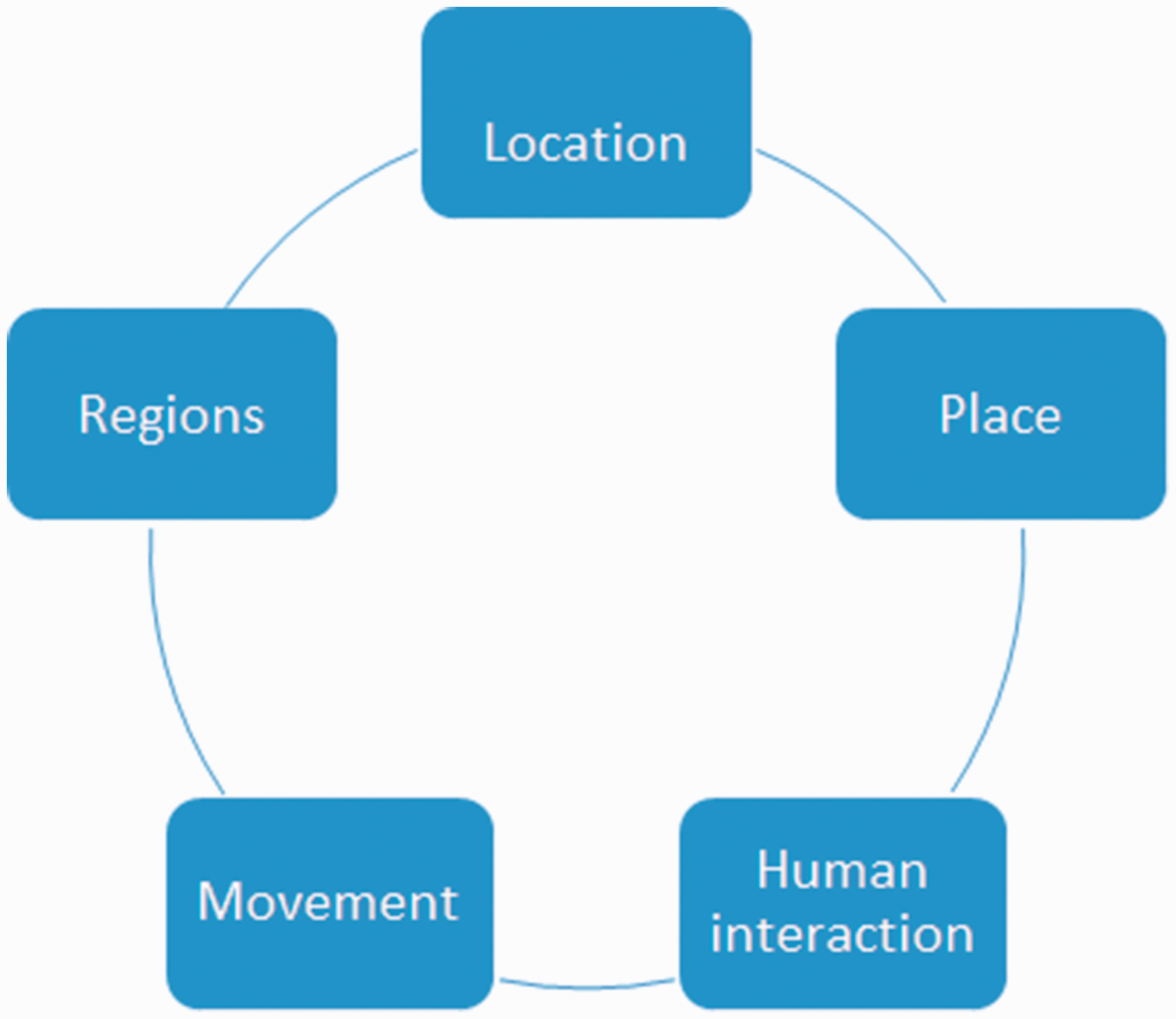
Core concepts of human geography.
What can this human geography perspective add to our understanding of SVP among HCWs?
Health geography focuses on the interaction between people and the environment and views health from a holistic perspective over time and space.14–16 As Dummer notes, “health geography seeks to explore the social, cultural, and political contexts for health within a framework of spatial organization and includes a careful consideration of the planning and provisions of health care services”. 15 The following section informed by this perspective identifies a number of contextual factors to take into consideration when developing and implementing a support program for HCWs who experience SVP.
Location
Health care workers deliver care in a variety of settings. The location of care delivery is relative to the resources available to support the health care worker in delivering care and receiving support. Consider the location of work for paramedics who in teams of two provide care in the community in public places and patient homes. Now, contrast this to health care workers employed in large health care institutions on health care teams who not only have access to their colleagues for support, but potentially support programs funded by the institution. Alternatively, HCWs working in remote and rural communities are often the only health care provider in the area. Developing support programs for isolated workers or for workers in the community and home will require implementation strategies that ensures accessibility to support programs that taken into consideration the location of work.
Place
The characteristics of a workplace are based on the interplay of human ideas and actions. For example, different management styles (e.g., autocratic, paternalistic, democratic, etc.) can influence the characteristics of the workplace. Does management support a culture of safety incorporating managerial personnel practices, workforce capability, and work design? 17 Does the approach to support patient safety take a person-centered perspective where adverse events are due to the inadequate knowledge and skills of HCWs? Alternatively, is a systems approach used to identify flaws in a poorly designed system? Different management approaches can make seemingly similar organizations different from one another and impact the human interaction within the organization. Support programs need to be cognizant of the interplay of human ideas and actions that influence the characteristics of the workplace. A social support program created for one workplace may not be effective in what appears to be similar work settings.
Human interactions
People through human interaction will modify their environment to meet their needs. Health care professional cultures vary and are informed by different philosophical underpinnings. For example, many of the health care disciplines (e.g. medical laboratory sciences, respiratory therapy, etc.) grew out of the practice of medicine which historically has been based on the biomedical model. 18 Nursing did not grow out of medicine and uses caring as a theory that informs the practice of nursing. 19 Further, the hierarchical health care division of labour can structure and impact the interactions between HCWs. 20 A health care worker’s position within the health care division of labour due to power difference can cause psychological stress for some workers. 21 When developing supports programs for SVP attention needs to be given to the potential impact of additional factors that structure behaviour. The degree of a health care worker’s responsibility can also mitigate the impact of an adverse event. Especially in the case of creating a culture of safety that supports the identification of near misses and addresses adverse events. 22 Do health care workers feel safe to report such events?
Movement
Health care systems are complex and multi-dimensional with the movement of patients between different types of care, health care workers, and health institutions (e.g., transfer from acute care institutions to long-term care institutions). The connections between the transitions of care are key to supporting quality patient outcomes. For example, miscommunication during transitions of care can potentially result in adverse events for patients. The movement of patients (transition of care) is an additional factor to take into consideration when developing a culture of safety and support programs for SVP. 23 Rather than focusing on one system of care (e.g., acute care institution), additional factors outside a specific system of care need to be identified to support the development of a more comprehensive inclusive support program for second victims across the continuum of care.
Regions
Regions are defined areas that are distinguished by physical characteristics (e.g., type of health institution), human characteristics (e.g., culturally, political, and socially), and/or size (e.g., urban versus rural and remote communities). Jurisdiction over health care in Canada varies. The funding and organization of health care in Canada is primarily the responsibility of provincial and territorial governments. Canada does not have one health care system but 13, including 10 provincial and 3 territorial health systems. 24 Variation in the funding and organization of health care also exist within provincial and territorial regions. Services such as cancer care, and public health are regionalized within existing provincial/territorial jurisdictional boundaries. Accessibility to health services varies by the size of a region. For example, patients in remote communities will have access to primary care but not secondary and/or tertiary care resulting in the need to travel to different regions to receive these additional services. How does this impact SVP and the development of support programs? HCWs providing telehealth servicesacross provincial and territorial boundaries need to be aware of the jurisdictional requirements within their own region and those for the region that care is being provided. Support programs for SVP need to include strategies that support these HCWs and to support a culture of safety.
Conclusion
Informed decision-making leads to the development of effective health policy based on evidence. Understanding SVP within the framework of human geography enables us to assess the interconnections between the emotional well-being of HCWs and the impact this has on overall patient safety by considering variation in policy, access to services, the types of services, and who delivers, pays and gets services. A human geography approaches to SVP would allow policymakers, leadership teams and managers within a health care facility to uniquely tailor their support systems to their individual contexts, which in turn will create a workplace culture of safety that builds on the organization’s unique qualities
Footnotes
Declaration of conflicting interests
The author(s) declared no potential conflicts of interest with respect to the research, authorship, and/or publication of this article.
Funding
The author(s) received no financial support for the research, authorship, and/or publication of this article.
