



Abstract
The role and tasks performed by hospital volunteers (HV), their relationship with other stakeholders and the management of volunteers, are controversial topics, not widely explored in literature. Through an exploratory study, which incorporated the collection and analysis of qualitative data, involving 46 interviews with volunteers, staff and hospital administration from three hospitals in Portugal, we analyze hospital volunteers, as well as the tasks they perform, how these tasks are assigned, and how they relate to other stakeholders. As a result, we conclude that the job definition of HV is generic, open to different interpretations and that the assigned functions of HV are not known from all stakeholders. This problem can have negative repercussions in the relationship between volunteers and health professionals, potentially fostering conflict. Nevertheless, most respondents are satisfied with the current format of volunteer management.
Introduction
Volunteers are recognized as people devoting significant time to provide unpaid services to social organizations.1,2 Nowadays, several non-profit organizations (NPOs) recognize the importance of volunteer management and the positive impact that volunteering can have in organizational performance, 3 meaning that adequate workforce policies and procedures will contribute to the match among human resource management (HRM) processes and organizational strategy, 4 and this is true for all the sectors (public, private and/or NPOs).1,5,6
The appropriate level of formalization for the role of volunteers and consequently for the tasks they perform, is not a consensual issue. 7 Being a voluntary work, and therefore not paid, the legitimacy of the institution to impose very strict rules and definitions, of what the work of the volunteer should be, is less than for any other type of paid work. The controversy over the management of volunteers, particularly in the hospital context, seems to be a subject that deserves greater understanding. So, this research intends to understand the role of hospital volunteers, the degree of formalization of volunteers' tasks, how their tasks and activities are defined, how they are related to those of other stakeholders and how these stakeholders perceive them, having in mind that the formalization of volunteers’ role might have flaws.
After this first introductory part, the next section gives a literature overview of major concepts included in the research: hospital volunteers and volunteers management. The Methodology section provides methodological explanations, presents research results and discussion. The final section of the paper is the conclusion and main implications are highlighted.
Literature review
Hospital volunteers
Volunteers play a key role in health and social care. 8 Using volunteers in the health sector can bring several positive impacts like improving patient experiences, making a closer relationship among services and communities and supporting health in vulnerable groups. 8 Health and social care is changing as a result of several variables like the health sector rules, technological innovation, demographic change and some other pressures. 9 So, if there are significant benefits on service providers, through the use of volunteers’ workforce, then we should strategically analyze the place, and the role, of volunteers within healthcare.
History shows that hospital volunteers are present in hospitals since longtime, and have an important contribution. 10 In addition, the hospital sector has suffered great pressure to reduce costs while maintaining the same high quality of care, which has been exacerbated by the current situation of economic and social crisis, namely in Portugal.11,12 In this scenario the benefits of hospital volunteers’ increase, and volunteers may be considered by hospitals as an important workforce, although an unpaid one. However, the fact that it is a “free” workforce has not put pressure on a reflection on the effectiveness and efficiency of its use or management.
Voluntary work is understood as an activity where the volunteer offers their time for the benefit of another person, group, organization or cause, without receiving any type of financial or material reward. 13 For this author, volunteering is proactive, involves effort and dedication of time, providing benefits to the volunteer and, at the same time, to the service receptor. Even though, there is no consensus on the definition of volunteering and much of the progress made over the last few years in the study of volunteering is due in large part to the growing concern about the provision of several services, in a context of great restrictions.13,14
The increasing use of volunteers in an hospital context is due to the fact that hospital volunteering is a way of contributing positively to the community.15–17 Moreover, this growth may also be justified by the progressive need for hospital care of the population, 3 which is becoming more and more aged.18,19 In Portugal the aging index, in 2018, was approximately 157% against 27.5% in 1961. 20
The use of volunteers in an hospital context is a very common practice, and it has reaffirmed its importance, since hospitals want to improve the quality of their care. 21
The existing literature on the role of volunteers is scarce, although we can mention some international examples, in a study on volunteering in Brazilian non-profit hospitals, the variety of roles played by volunteers are described, as well as the inherent advantages and improvements in patient care and attention; also the strategic sphere is mentioned, more specifically the use of volunteers in fundraising campaigns. 2 Still in the Brazilian context, we can see volunteers’ roles organized into typical volunteer activities (for example, fundraising), activities associated with “soft services” (such as emotional support), activities essential to the hospital (for example, helping to feed the disabled patients), activities that promote socialization (for example games and theater), pedagogical activities (such as painting and handicrafts) and special activities (for example hairdressing). 22 In other contexts, volunteering in hospitals is promoted as an opportunity for volunteers self- realization and personal fulfilment, 23 being that suggestions for improvement emphasized the need to further develop the role of volunteers, recognize volunteer contribution and provide opportunities to use current skills 24 and gain further training. 23
In Portugal, it is estimated that, in 2012, more than one million individuals (volunteer rate of 11.5%, which corresponds to approximately 10,40,000 individuals) with over 15 years old has participated in at least one volunteer activity. 25 This voluntary work corresponds to about 4% of the hours worked in the same year, with its monetary value being approximately 1% of the Gross Domestic Product. Despite being a value below the European average (around 24%), voluntary work in Portugal is an important resource of the social economy. In Portugal, in 2001, there were 108 public hospitals, being that sixty-nine of them have volunteers. 26 These authors concluded that most of the participants were part-time volunteers (dedicating about 6 hours per week to hospital volunteering), women and over 52 years old. Hospital volunteers tend to be older and very dedicated to their NPOs. 27 This dedication to the role of hospital volunteering may be due to the nature of the work, 28 since hospital volunteering is categorized as a “serious leisure”, that is, as a meaningful leisure activity for the volunteer, which allows them to acquire and/or implement their skills and competencies. In other words, volunteers make their time and effort available to volunteer work, allowing them to occupy their free time, perform activities for the benefit of others, and develop their skills. 29 Hospital volunteers are often motivated by personal interests and experiences, but also by the willingness to help others, and to carry out a meaningful activity. 30 Volunteers are also motivated by social relationships, the establishment of close relationships with others, 26 and get experiences that allows them to acquire skills that value their curriculum, when young volunteers are in stake. 31 In the Portuguese context, what motivates hospital volunteers the most is the possibility of using their skills, deepening their knowledge, improving their self-esteem, and also showing concern with those in need due to altruistic reasons. 26
Considering volunteers’ impact in the hospital context, volunteering allows the hospital to raise financial resources, improve its reputation and contribute to an improvement in the quality of the care service provided by hospitals. 10 Using the example of a Canadian hospital context, Handy and Srinivasan 21 show that volunteers’ work indirectly reduces the overload of tasks assigned to staff, allowing them to focus more on medical tasks, thus making them more efficient. Other benefits are related to the close relationship with the local community, 21 which allows the creation of knowledge networks and partnerships with other entities. 3 It should be added that the hospital also benefits since volunteers contribute to the satisfaction and comfort of patients and their families, increasing the perceived care quality. 3 However, in the Portuguese context, there is not much information on the impact of voluntary work in hospitals.
Volunteer management
The role of hospital volunteers and its formalization
Although the fundamental objective of volunteer work is to help others, volunteers must take into account the limitations of their status with regard, for example, to emotional and personal involvement. 32 Society has increased the demand for voluntary work, which leads volunteers to perform increasingly demanding and complex tasks.7,21,33For the volunteer to be able to carry out their tasks, it is necessary to “know what to do”, “how to do it” and the “impact” of performing these tasks.8,34 At the same time, as the motivation of this worker is mostly intrinsic and autonomous, the rules and external control can impair this type of motivation and consequently the engagement of the volunteer at work. 35 On the other hand, if the volunteer receives scarce information or clarification about his/her role, this may lead to discrepancies in expectations between the volunteer and the institution, as well as feelings of disillusionment or psychological contract breach 36 which will also be detrimental to the volunteer's work engagement. In addition, the caring work nature of the hospital volunteer has similarities with the work of health professionals, especially nurses, which may generate some role ambiguity or conflict and coordination challenges between volunteers and health professionals. Literature about volunteer’s role is scarce and in the hospital context is almost non-existent.
Hospitals that have volunteers tend to offer a better service to the community, the tasks usually performed by hospital volunteers involve direct contact with patients giving some kind of leisure support, helping to solve mobility issues and contributing in general to the growth of patients well-being. 16 Other authors affirm that hospital volunteers provide patients with “social support”, their tasks are through dialogue with patients about the problems/diseases that led them to the hospital, informing patients of the resources they have available in the hospital and making the patient feel welcomed. 37 Further tasks include the reception of patients and family members, 38 the provision of care to patients, 21 the delivery of information and emotional support, 39 or the organization of tombola’s, sales, and raffles, as well as NPOs quotas collection, 10 and the distribution of souvenirs on festive dates. 37 Summarizing, hospital volunteers perform non-medical tasks 21 that improve the stay of the patients in the hospital. These findings agree with other studies that show the importance of volunteers’ role in the process of humanizing hospitals, namely in the valuation of the human being and in the improvement of the care provided to patients.2,16,22 (Other authors, although without elaborating about volunteers role, explain that volunteers work allows the hospital to save and raise financial resources and improve its reputation. 10
Hospital volunteers activities should exclude the technical tasks developed by health professionals,24,40 and these limitations on voluntary work are due to the high technical skills required in this area. Although many volunteers may have technical training in the area, due to their professional experience, it is understood that this should not be the role of hospital volunteers. Hospital volunteers do not have access to the patients' clinical status or treatment 39 and should only perform tasks that do not require specific professional training. 41 They should act as a complement to the specific work of the health professionals, working the humanization of health care through nonmedical services such as providing information or giving emotional support. 21
The definition of volunteer role, as well as the level of formalization or bureaucratization that should be attributed to them, is an issue addressed by several authors and there are numerous arguments in favor and quite a few against.
On one hand the low level of formalization or bureaucratization of volunteers functions can be considered as the main characteristic of amateur or nonprofessional volunteering activity 42 and also one of its initial attractiveness. 29 In addition, professionalization may not be congruent with some volunteers’ activities, since might ignore their inherent heterogeneity or the diversity of the context and/or patients. The fact that there is not always a detailed description of the tasks to be carried out by the volunteers have a positive side, since volunteers can apply their skills and personal experience spontaneously. 43 In many contexts volunteers “do what is necessary”, not always having a clear description of their tasks and their limits of performance, which leads to the performance of tasks other than those complementary to those of the staff. 29 In this context, volunteers may perform tasks that are inherent to the staff’s functions and even replace it. Moreover, being HV role non mandatory and the tasks not clearly assigned to them, it may be quite obvious the experience of ambiguity by HV. 16 Uncertainty about the role played by hospital volunteers is the least satisfying factor and can be a stressor. 29 Some volunteers point out that the tasks developed should be fully described and should be standardized, 10 being favorable to a higher degree of formalization, and consequently to professionalization.
Professionalism and professionalization have been the topic of much critical attention in organizational context, the terms are extremely associated, and generally speaking only differ inasmuch as the former indicates practice and identity and the latter emphasizes structure and process. 42 The understanding of volunteering professionalism means that volunteers must have certain competencies such as responsibility for actions and should be emotional neutral, and this role implies the incorporation of HRM practices in volunteering and the existence of training programs. 44 The professionalization of the function facilitates public recognition, enables collaboration with other entities and allows the organization to be more mediatic, 44 particularly important if we consider that volunteers value their relationship with a certain organization from the very first stages of being recruited and expect an effective communication. 45 In addition, high levels of formalization and standardization of hospital volunteers’ tasks are in tune with a HV management perspective, but may be unfavorable to the affective support provided by these stakeholders to the patients, since many volunteers carry out their routines fairly independently, adapting their activities to a certain context, for e.g. to patients who seem lonely or are in an emergency situation. 39
Volunteer management (VM) has been highlighted in the literature. 46 In Portugal, hospital VM is provided by NPOs and not by hospitals as in other countries, e.g. Australia, 24 Canada, 21 USA 47 or United Kingdom, 37 since in these countries, volunteer programs are run by the hospital. In this context, the role of the hospital volunteer defines the skills, knowledge and qualifications that volunteers must own, as well as the tasks they will perform, their rights and duties. 48 In countries such as Canada and United States, hospitals recruit volunteers and develop volunteer programs with specific purposes, avoiding overlapping roles between paid professionals and volunteers, that do create benefits not only for the organization but also for the volunteers. 21
On the other hand, there are hospitals where volunteers perform a wide range of tasks, which are not always defined, and where volunteers have little training. In Portugal the reality seems similar to this scenario, since it is the NPOs that recruit and allocate volunteers to hospitals and not the hospitals themselves.
The uncertainty about the role and the tasks to be performed by the volunteers comes, in many cases, from the NPO itself that may not have a well-defined structure or concrete objectives. 46 In NPOs where organizational objectives are not well defined and where there are several stakeholders with different interests, there may be the possibility of ambiguity regarding volunteers role. 49 At the same time, this description may exist but may not be known; nevertheless, a possible consequence of this excess of freedom is the ambiguity regarding the role of the volunteer, 43 which might increase the stress levels experienced by the volunteers. 50
In the case of hospital volunteering, if role ambiguity or conflict is in stake an adequate strategy could include the definition, by the hospital, of the reasons/objectives and role of hospital volunteers. How do hospital administrations know how many volunteers they have in their service, what their competencies are, what tasks they perform and what training they receive from NPOs that allocate them to certain activities?
Considering what was previously presented, our first research question intends to verify according to HV and other stakeholders if the function of the HV is or is not properly detailed and defined, if role ambiguity or conflict are perceived by HV, therefore:
RQ1: Regarding the clarity of the role of HV, are the tasks of hospital volunteers adequately clarified?
Volunteer management has been identified as a form of support for these stakeholders that encourages the use and improvement of skills, 51 being that many NPOs often implement HRM practices to ensure the quality of service provided and to improve the organization's image. 48
A growing in-depth knowledge about volunteers is fundamental to expand NPOs performance, since HR performance is a vital factor that might impact performance. Thus, VM may contribute to a greater efficiency of volunteer work, improving the quality of the service and allowing the achievement of organizational objectives, being that the intensive use of HRM practices may decrease the propensity for problems in the retention of volunteers. 52 Although there is no consensual model of VM, there is a set of good practices that are recognized by some authors as fundamental, although limited to some topics, such as the recognition of the volunteers 'activities, initial and continuous training, detailed description of the volunteers' role, voluntary work and voluntary performance evaluation.48,53).
Relationship among stakeholders – Volunteers and staff
Stakeholders are fundamental elements that influence and are influenced by a certain organization. 54 The development of stakeholder management strategies, as well as the relationships established between them and the hospital, is fundamental since it will have an important impact on the hospital performance. 3
Several authors have suggested that ambiguity regarding the volunteer hospital role may lead to conflict between volunteers and staff.8,43 In analyzing the relationship between hospital volunteers and staff, it is essential to keep in mind the complexity as well as the nature of the tasks, 55 since this relationship tends to be more complex than it appears. The increasing use of volunteers in health services and the multiplicity of roles played by these stakeholders has raised the importance of studies that focus on the relationships established between hospital volunteers and staff. 55 In a comparative study between volunteers and staff, there were identified four dimensions of volunteer job satisfaction: organizational support, participation efficacy, empowerment, and group integration; at the same time results indicated that participation efficacy and group integration were significantly correlated with volunteer satisfaction and are predictors of intent to remain, which is not surprising since it has been associated with the expressive orientation that separates unpaid from paid work environments. 56
In the hospital context, volunteers and staff have similar attitudes towards their work, but for staff the benefit factor (which includes compensation such as salary) is very relevant, while for volunteers it is not significant. 47 Some authors also argue that volunteers/staff face other differences, for example in the process of monitoring grief among patients, reducing the stigma of seeking help, and helping patients to better understand their community and culture, 57 making a closer follow-up of their peers. Volunteers can contribute to reducing pressure on hospital staff, i.e., volunteers by undertaking some unskilled activities, reduce the burden on staff, thus indirectly contribute to an improvement in the quality of service provided, 21 so staff can focus on activities that require more technical expertise, while volunteers ensure tasks that do not require specific expertise. 24 Hospital volunteers can complement the service performed by staff through patient monitoring, information delivery and keep company, in short all the extras that staff are not willing to provide to patients.8,24,39,58
The literature about volunteering assumes that in contexts where volunteers and hospital staff work side by side, there will be conflicts between them, nevertheless there is no empirical evidence to fully support this hypothesis. 55 Thus, in the hospital context, there is a possibility that staff may perceive volunteers as a threat to their jobs.22,47 Also, in the Portuguese hospital context, this pre-conceived idea is derived from the lack of knowledge of the tasks assigned to the volunteers by the staff. 40 It is known, however, that although volunteers are a valuable asset that contributes to improving the service provided by the hospital, they should not replace staff. 21 The tasks to be performed by the volunteers should consider the time and skills of volunteers in order to ensure their correct performance and to avoid conflicts between the volunteers' role and their functions. 22
Relationship among stakeholders – Volunteers and hospital
Assessing the impact of voluntary work for the hospital becomes quite complicated because of the complexity of the topic and the lack of objective measures. 10 The inclusion of volunteers in the hospital context often improves the reputation and legitimacy of the organization in the community, which allows greater awareness and attraction of more financial and voluntary resources, mainly because the number of volunteers in the organization can be considered as a sign of its trustfulness. 10 In addition, using volunteer’s positive word-of-mouth may have positive impacts in the organization image. Volunteers can improve the services provided by hospitals, by providing information, emotional support and comfort to patients and families. 21 Hospital humanization developed through volunteers’ work may improve patients quality perception about the hospital experience, which might contribute to their satisfaction. 3 As previously mentioned, in Portugal, NPOs play the role of intermediaries between volunteers and the hospital, and this relationship between NPOs and hospitals should be improved, 38 it is essential that hospitals understands the importance and potential of volunteering and encourages it to cooperate with the institution's goals and objectives.16,59
Based on what was previously presented we intend to investigate the type of relationship among volunteers and staff, in order to understand if there is any type of cooperation between them, as well as possible conflicts and their causes. We also want to analyze how the relationship between the volunteers and the hospital is characterized, namely considering management, assignment of tasks and definition of function. Thus,
RQ2. What type of relationship is there between HV and other stakeholders (staff and hospital)? How does the role of HV impact on hospital performance?
Finally, we want to analyze the advantages and disadvantages if volunteer management were carried out by hospitals rather than by NPOs, considering volunteers, staff and hospital perspectives. It can also be analyzed whether the role of the volunteers would be different and whether the relationship with the staff would benefit or if other complications would arise. Thus:
RQ3. Regarding the management of hospital volunteers, if this is carried out by the hospital, how would be performed its role?
Voluntary work has a great impact on different societies around the world.10,18,60–62 However, the existing literature on volunteer management has focused essentially on the issue of motivation and satisfaction of volunteers,51,63–66 as a result, little is known about the remaining aspects of voluntary work, namely about the tasks performed by volunteers, their relationships with other stakeholders and the impact of volunteering on different stakeholders,58,62 at the same time there is a controversy regarding the level of formalization of the function of hospital volunteers,39,44 so we intend to clarify whether or not the volunteers feel ambiguity in relation to the role they perform in the hospital context, as well as to clarify the relationship between the volunteers and the other stakeholders. To analyze the impact of volunteering on different stakeholders, it is necessary to understand the relationship between volunteers and the hospital, users and NPOs. Thus, the fundamental objective of our paper is to understand what the role of hospital volunteers is, to assess whether it is properly described and whether it is known by different stakeholders.
Methodology
Using semi structured interviews, an analysis of the perceptions of volunteers, staff and board hospital was carried out. A guide was prepared for each different stakeholder, considering the different objectives and the literature review. Our guide had three dimensions (1) clarification of the role of hospital volunteers, (2) cooperation between stakeholders and the impact on the hospital and (3) management of volunteers and the hospital. The interviews were audio record, with prior authorization from the interviewees, and then transcribed. The fieldwork was also complemented with informal interviews done to the NPO coordinators and document analysis to the few regulations and legal statutes about hospital volunteering in the Portuguese context, as well as some brochures and websites from NPOs.
The HV interviewees were selected by volunteers’ coordinators and the staff interviewees by the head nurse. A guide was prepared for each different stakeholder, considering our research objectives. All the interviews were done in the hospitals. The interviews conducted with the NPOs coordinators were informal because the fundamental objective was to obtain an overview of volunteering, establish contact with the person in charge and respond to a small survey of the characterization of the volunteers. The sample is presented in Table 1, and for reasons of confidentiality hospitals names were omitted. The interviews had a duration between 20–30 minutes, are coded as follows, the first letter identifies the function (B-board, S-staff and V-volunteers), the second letter identifies the Leagues of Friends of Hospitals from the different hospitals – A, B and C, and the number is the interviewed. The hospitals selected are in the public sector, and therefore share the main environment circumstances and limitations. We have only one interviewee from the board (hospital A), due to the complexity of the schedules of board members from hospitals B and C, so it was not possible programming interviews with these elements.
Sample.

The Leagues of Friends of Hospitals (LFH) are NPOs run entirely by volunteers and its mission is improving the care and comforts given to the patients. LFH have autonomy and are not depend on the hospitals, although work closely to a specific hospital.
In order to proceed with the analysis, the transcription of the interviews was done. Content analysis techniques were used, following a two-step process that comprehends inventory (the relevant elements contained in the message are isolated) and classification (those elements are organized according to their similarities towards a specific category). 67 A matrix was structured, with three main themes, according to the three research questions (1) clarification of the role of HV, (2) cooperation between stakeholders and the impact on the hospital and (3) management of HV and the hospital. Each theme was further broken down into categories of contents.
With regard to the first dimension of analysis (1) Clarity of the role of hospital volunteers, three fundamental categories were defined: task ambiguity, job delimitations, job disclosure. The information was obtained from the various sources made available, namely the legal statutes, websites and/or Facebook pages, informal interviews and semi-structured interviews. The first category regards the degree of task ambiguity. We thus collected data regarding the current level of formalization of the role of the HR (existence or not of statutes, defined tasks and described activities) and the desirable level of formalization of the same. The second category is about the perception of the (in) existence of the limits of action of the VH. Finally, the last category, job disclosure, entails the degree of knowledge about the definition of the role of the VH, based on the information about the activities that the VH carry out, through the analysis of the voluntary statutes and regulations (when available), in the exploration of the institutional websites and/or official Facebook pages of the NPOs (when available) and also by the collection of interview data.
The two other themes include data exclusively from the interviews. The theme about the cooperation between HV and hospital stakeholders (staff, board and patients), include the description about the relationships with the staff, the relationship with the hospital and its potential impact on performance, and the analysis of HV as added value. The last theme is about management of HV, including two categories: i) management of HV: NPOs or Hospitals; and ii) human resource management practices of HV.
Results and analysis
RQ1: Regarding the clarity of the role of HV, are the tasks of hospital volunteers adequately clarified?
Task ambiguity
The three League of Friends of the Hospitals have volunteers’ regulations, which contains a task list to be performed by the HV. In the League of Friends of the Hospital A (LFH.A) regulation, there is a definition of the tasks to be carried out by the volunteers according to the frequency of their accomplishment. The definition of the tasks in the regulation of the LFH.C is made in a different way, since it follows a structure by service, allocating different tasks to different services. For example, they have daily task (e.g. newspaper distribution or patients visits), festive tasks (e.g. decoration and souvenirs) and fundraising tasks. The list of tasks in the LFH.B regulation does not follow any obvious structure and the clarity of wording is low, for example it mentions that “volunteer service-specific tasks are actions for the benefit of patients, including the support in several services.”
Volunteers’ interviews revealed some confusion related to their tasks, for example, for the “patient meal support,” some volunteers say that this is effectively a task for HV, but others say that this is a task for the staff. In short, despite the supporting documentation stating the tasks assigned to the volunteers, this does not seem clear enough to clarify about responsibilities. Some ambiguity remains in the volunteer’s explanations about who should do what, which may be the source of some divergences, for example V.C.5 says “there is nothing written about volunteer tasks” and V.A.12 mentions “some tasks are from my head”. This opinion is shared by the staff, S.B.18 says “I am not aware if the tasks volunteers perform are defined”. However, the board mentions that the tasks of the HV are properly defined, B.A.1 says “looking at the regulation we can see that the tasks of the HV are well defined”, although mention that most of stakeholders are not aware of the existence of this specific regulations, underlining that “we have to invest more in this dissemination of the tasks, because it is already well defined” (B.A.1).
After trying to understand why ambiguity exists, it became clear that most of volunteers did not knew about the existence of a document regulating voluntary activity. Staff are also very unfamiliar with the specific tasks of the HV. However, the staff is aware that their role is to support and help “volunteers make company to patients” (S.C.3), and “give emotional support” (S.A.12).
According to the volunteer regulations of LFH.A and LFH.B, the work of volunteers is limited to non-technical tasks and cannot replace hospital staff. Despite this, some volunteers have shown that they are not aware of it, “there is nothing written” (V.B.24), or “they never told me what I should and should not do” (V.C.21).
HV job delimitation. Replacement or complement to the work of health professionals
Volunteers can recognize some restrictions inherent to their function, namely confidentiality, respect for hospital procedures, and respect for the patient's silence, “we should not ask questions about the disease … I cannot comment on the disease … I cannot go beyond the opinions of relatives, doctors … I do not know if there is anything written” (V.A.12). In addition, some volunteers claim to perform tasks that are not related to their function, such as take patients to surgeries. These perceptions broaden the point of view of the staff about the lack of clear limits of hospital volunteer’s performance, “I think this definition is essential, but I do not know if exists” (S.A.15). However, some staff members believe the HV experience ends up delimiting their performance “If there is a formal definition I do not know, but I think through experience, the volunteers are realizing what they cannot do” (S.A.14).
Based on this assumption, it cannot be said that volunteers perform only complementary function to the staff, since the volunteers “do what is necessary” not having a clear description of their limits of performance. In sum, most interviewees argue that volunteers do not perform technical tasks, which excludes the hypothesis of replacing health professionals. However, it is possible to affirm that there are opposing opinions, from volunteers and professionals, so it is relevant that the job definition of HV is specifically presented, as well as the limits of their performance, avoiding the conflict that may arise with the job of other health professionals, namely nurses.
Level of disclosure of HV role – In the perspective of several stakeholders
Through the document analysis we can see that only the regulations of LFH.B and LFH.C had the HV function defined. These documents included the tasks of the volunteers properly enumerated, as well as the volunteer’s duties and rights, the identification of the volunteer manager, and a specific description of the service. It is very important for NPOs to clearly identify the beneficiary of their work and to disclose their role to stakeholders, LFH.B and LFH.C regulations state that the beneficiaries of their work are “the patients, their families and the community”, but some volunteers identify health professionals as the first beneficiaries. So, it is possible to conclude that not all the NPOs that provide hospital volunteers have the HV function strictly defined. Nevertheless, not completely objective which can lead to several interpretations.
Perhaps because of this low level of disclosure, 72% of the volunteers interviewed believe that hospital staff know which tasks they perform “staff knows” (V.B.22), as well as 20% reported that patients have this knowledge “I should even say that everyone knows the importance that the volunteers have in the hospital today. Volunteers are almost the pillow of the patients” (V.C.5), yet another 20% say there is a great lack of knowledge about the role of volunteers “family members and patients often do not know” (V.B.25), “sometimes we are approached less pleasantly…we are not well-regarded … they think we have come with the intention of withdrawing service from the staff” (V.A.13).
After analyzing the level of disclosure of VH role, patients and their families are the stakeholders who present a higher level of unawareness about the tasks performed by the HV, and it should be noted that the lack of knowledge about the function and the tasks of the HV by the patients is one of the weaknesses points of the HV. 58 According to most volunteers, staff is well-informed about HV tasks, yet this view is refuted by most of staff members. This incompatibility of opinions allows to conclude that, either there is no disclosure about HV functions, or its disclosure is not entirely clear and complete.
Despite this divergence of opinions about HV tasks, the three perspectives are consistent when they affirm that the service of the volunteers undoubtedly contributes to the humanization of the patient's stay in the hospital. According to the information gathered during the interviews, volunteers value tasks that focus patient support and the humanization of the patient's stay in the hospital. This is a contribution that is in accordance with the literature, because hospital humanization is one of the fundamental contributions of volunteering.2,22
RQ2. What type of relationship is there between HV and other stakeholders (staff and hospital)? How does the role of HV impact on hospital performance?
Relationship between HV and staff
The three presented perspectives affirm that currently the relationship between volunteers and staff is good, however there are some occasional situations of conflicts. Analyzing the volunteers' testimonies regarding the relationship with hospital staff, 80% of respondents says that they maintain a good relationship with hospital staff “with me it is good, there have never been conflicts. Staff usually appreciate the help we give” (V.B.21).
Most of these conflicts arise, according to them, due to the staff lack of knowledge regarding the tasks performed by the volunteers and the staff fear of their jobs being replaced by volunteers. This information is consistent with the literature,8,43 which argues that if the role of hospital volunteers is not clearly defined, conflicts with staff may arise, moreover this clear definition reduces uncertainty about substitution of volunteer work, and tends to develop harmonious relationships between volunteers and staff. This point of view is also shared by the hospital administration, which admits that from the date they drafted the document regulating volunteering, staff have become more receptive to volunteering. According to the board, in the early days of voluntary activity at that institution, the relationship with the staff was not harmonious, “there was a time when there was some reluctance from staff regarding volunteering” (B.C.1), however with the sedimentation of the relationship between stakeholders and the disclosure of the function there has been an improvement. Suggestions for conflict resolution may include strengthening the relationship among volunteers and staff, greater involvement of volunteers, and evaluating the performance of HV, as well as measuring volunteering contribution. 8
Cooperation between stakeholders and hospital performance
According to the three perspectives, the contribution that volunteers add to the work developed by health professionals is essentially related to the availability and emotional support. This creates a relationship of proximity with the patient (“… I notice that when I enter a room and a volunteer is there, there is always a smile on the patient's face, as a rule there is something good.” (FO3)), which can influence their opinions regarding volunteering, the hospital itself and the service provided by it. From the analysis of the interviews it was possible to perceive that some patients recognize the work of the volunteers and appreciate the support provided by these elements (“… A letter from a patient who was hospitalized here, where he thanked the volunteers on the 8th floor for the affection he received”. (VF24)), which shows that the performance of HV can affect the opinion that patients have about their stay in the hospital. Since these elements can influence the good performance of the hospital, 3 it is essential to potentiate volunteer work as well as the proximity to the patients, since this relationship can affect patients opinion regarding the service.
Although there is no teamwork between HV and staff, the board stresses that because the volunteers perform non-technical tasks while the staff perform the rest, this partnership between the NPO and the hospital unquestionably contributes to the improvement of their quality of service. Management interviews are congruent with the literature, 21 because volunteers perform unskilled tasks and this might reduce the overhead on staff, thus indirectly contributing to improve service quality. In other words, although these stakeholders do not work as a team, HV complements the service of the staff by performing non-technical tasks that staff are not willing to perform, but which provide patients with a high quality of service.39,58
HV as a stakeholder with added value for the hospital
Although is difficult to assess the impact of volunteer work to the hospital, 10 management unequivocally values its existence, realizing that it provides added value to the service provided by health professionals. This is consistent with literature that states that the work of volunteers complements the work of health professionals, 51 which allows patients to be more satisfied, 3 increasing the quality perceived by them. 10 The administration also emphasized that volunteering is a way for the hospital to be in contact with the community, and therefore HV is fundamental for a positive word-of-mouth and for the disclosure of the hospital.
RQ3. Management of hospital volunteers
Management of HV: NPOs or hospitals?
All volunteers interviewed are against the proposal of volunteer management being performed by the hospital, “I think it is better to remain independent, otherwise we can be treated as employees” (V.A.12). Confronted with this scenario, 40% of the staff interviewed also claimed to be against this option, “if it was done by the hospital, volunteers would have to comply with more rules, it would not be so spontaneous” (S.C.2), although, 20% of staff state that if VM was performed by the hospital, there was a clearer definition of the role of HV which led to a more harmonious relationship between stakeholders, “there would be a clear definition of the role of volunteers in the hospital, which would be known by all professionals” (S.A.13). The hospital board is in favor of maintaining the current conditions “I think there would be no advantages … we have never had any problems with the management in the way it is being done by the league” (B.C.1), and the hospital never considered assuming the management of the volunteers.
Human resource management practices of HV
The LAHDO regulation stipulates an “integration plan for the volunteers, the work team and the hospital” which includes a three-month internship period. 96% of volunteers, before admission to volunteering, went through an internship period in which they were accompanied by a coordinator or another more experienced volunteer.
By crossing the information gathered in the interviews with the literature review, it is possible to conclude that NPOs are already implementing some practices of volunteer management, such as volunteers training and a more professional coordination. 48 However, other practices that are fundamental to the correct management of volunteers do not yet occur, such as the existence of a detailed description of the volunteers ‘role or recognition of the volunteers' activities. However, these HV management practices are also fundamental to guarantee quality of service, 48 so it will be appropriate to implement them in NPOs, in order to enhance the work done by the volunteers. Another key practice, which is not yet implemented, and which has been mentioned by several volunteers, is feedback from the work they are developing “…I would like to know the feedback from colleagues and employees because I can even think that I am doing well and not being”. (VF25).The existence of feedback from the NPO to the HV performance leads to a reduction in the ambiguity of the volunteer role 68 and the real value of volunteering is more easily understood. 47
The document supports inherent to management volunteer’s regulation is scarce, there are many usual practices and important information that are, only, verbally transmitted. Besides the condensed number of documentations, several documents are outdated, and several are not profoundly developed. Most of the interviewees are in favor of a greater HV formalization of the function, since they believe that it contributes to the dissemination of the HV function, it provides the uniformization of the volunteer's function at the national/world level and allows the harmony of the relationship between the different stakeholders. However, the level of formalization adequate to the function of HV is a very controversial issue.21,37,47 In Portugal, based on our interviews, we can say that the reality of hospital volunteering is closer to a context in which volunteers perform a wide range of tasks, which are not always defined, where volunteers have little training and it is not always adjusted to their specific reality.
According to the board, VM is done autonomously by the NPO and hospital management strategies do not provide any specific management practice for volunteers. However, according to the literature review, it is essential that the hospital involves in its strategy, the management of the volunteers and the relationships established between them and the hospital, because only in this way they can guarantee a better delivery of services. 69 Another aspect worth highlighting is the fact that the board claims that by taking over VM it might lead to the loss of some benefits that the NPO provides to the hospital, for example regarding the established partnership or donations.
It is also interesting to note that the position of the board, the volunteers and the vast majority of the staff interviewed is against the management of the volunteers by the hospital. According to them, since the management of the various stakeholders is done independently, conflicts of interest and substitution of paid work for voluntary work are avoided. However, about 20% of the staff are in favor, because they believe that if the VM was performed by the hospital there was a clearer definition of the function of the HV, which would lead to a more harmonious relationship among stakeholders.
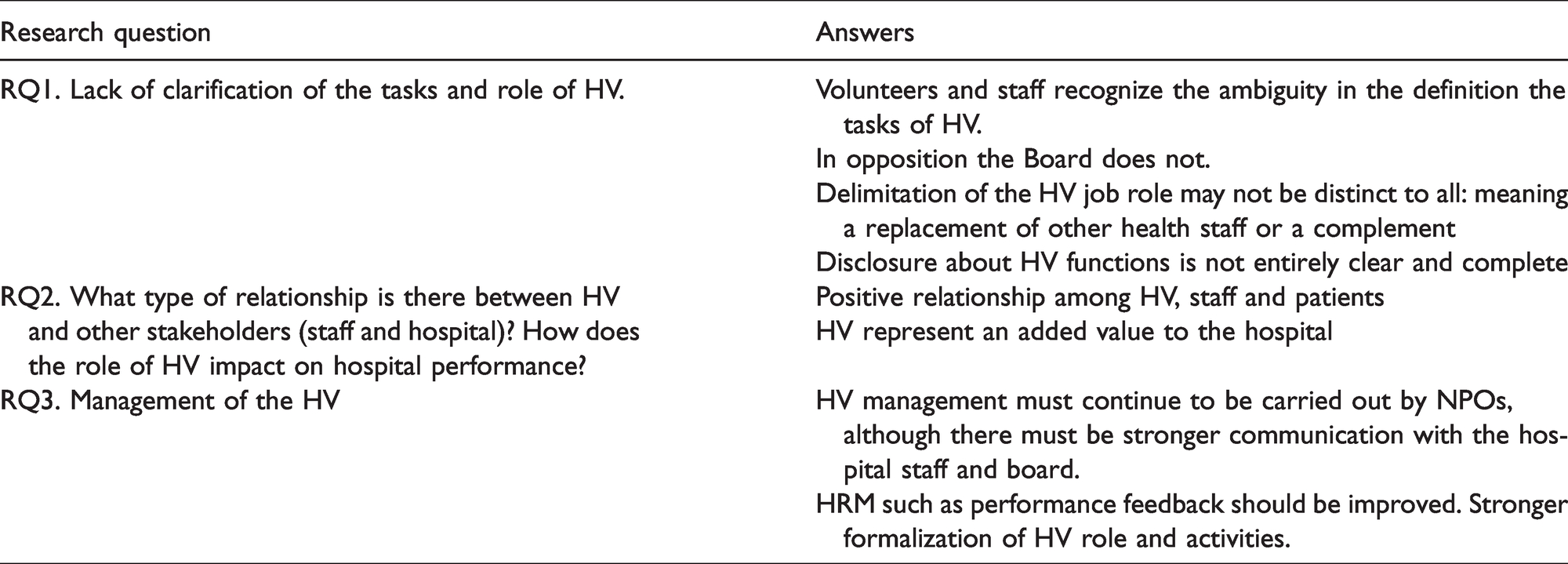
In Table 2 we can see the main answer to our research questions and therefore the conclusions of our results.
Results.
Conclusions
Our research aimed to contribute to the understanding of hospital volunteering and to clarify the role of these specific volunteers. Thus, the first objective was to understand the role of the volunteers in the hospital context.
A relevant finding is that although volunteering regulations often contemplate the definition of HV function, volunteers do not present a complete knowledge about it. The staff demonstrated a high degree of unawareness of the formal role of the HV and of the tasks they carry out. In addition, they mention that most patients are unfamiliar with HV functions. The role of HV is not always clear enough, regarding the tasks that they must perform, as well as the limits of their performance. This situation of ambiguity regarding the role of volunteers, leads the volunteers to the accomplishment of tasks that should be done by health professionals. In this way, we cannot assume that HV perform only non-technical tasks and that there can be no substitution situations for paid work. This fact contradicts the legislation that regulates volunteering in Portugal, as well as the normative literature in the area.
Our second objective was to understand the impact of HV on hospital performance, through cooperation among the various stakeholders. Although there is no team work, it is possible to conclude that the work done by volunteers adds value to the service provided by health professionals. We can say that HV can effectively influence the perception and opinion that patients have about the performance of the hospital and the service delivered to them. However, the potential of volunteers will not always be reached due to management problems, such as problems related to task definition. In addition, this problem may also have negative repercussions in the relations between volunteers and health professionals, and there may even be situations of conflict. To overcome this situation, it is necessary to define the role of the volunteers in particular by assigning them less technical skills.
Finally, our research intends to give hospital administration's perspective on VM, and our last objective was to understand if there would be a better management of the volunteers if it was performed by the hospital. In this regard, we can say that this is a hypothetical scenario, which was never considered by the hospital administration. Most interviewees believe there are no advantages to this change, mentioning specific disadvantages such as conflict of interests and the substitution of paid work for voluntary work.
Practical implications and limitations
In terms of practical implications, we can say that volunteers’ role has a, somewhat, generic definition, which allows different interpretations and that the tasks related to the function of the HV are not known from all stakeholders. We therefore think that there should be a greater focus by the NPOs on clarifying and communicating the HV functions, as well as a greater follow-up. As an implication of this proposal and to overcome the ambiguity felt by volunteers with regard to their tasks, a detailed description of functions, objectives and responsibilities underlying the volunteers' work should be provided. It is also essential to disseminate this information to the volunteers, as well as to the other stakeholders. So, it is necessary to define the role of volunteers in a very specific and detailed way, identifying less technical skills. Furthermore, the existence of moments of interaction between stakeholders will be pertinent, in order to promote communication and collaboration between all the stakeholders.
These results are important sources of information, for the NPO and for the hospital, and may have noteworthy implications for decision makers, developing a higher healthcare quality and hospital atmosphere.
Some limitations can be pointed out in this work, most of which are related to methodological issues. The first limitation relates to the fact that we only conducted an interview with the board. In addition, the employees and VHs interviewed were not selected randomly, but rather chosen by the chief and volunteer coordinator, respectively. It would be interesting to analyze the users' perspective, but due to time constraints, we were unable to do so, so we live this hint for future research. Moreover, this study focuses only on hospital volunteers, so it would be interesting that future research could make a comparison in different contexts of volunteering, obtain a broader perspective on the theme and the influence that the context has on the definition of the function.
Footnotes
Declaration of conflicting interests
The author(s) declared no potential conflicts of interest with respect to the research, authorship, and/or publication of this article.
Funding
The author(s) disclosed receipt of the following financial support for the research, authorship, and/or publication of this article: Marisa R. Ferreira gratefully acknowledges financial support from FCT- Fundação para a Ciência e Tecnologia (Portugal), national funding through project UIDB/04728/2020.
