




Abstract
How do strategic initiatives emerge? Despite rich tradition in the emergent strategy literature—focused on significant organizational change—surprisingly little insight exists on the dynamics of a new initiative’s emergence. This is particularly relevant in healthcare because of the increasing pressure to implement value transformation models focused on maximizing value at the point of care. The value transformation model prioritizes the decisions of the frontline providers and thus requires their expertise and commitment for the model’s implementation and success. In our case study of a dental organization, “OptiPlex,” we trace the emergence of a value transformation strategic initiative from its origination at the point of care to its formalization into the organization’s strategic plan. Using qualitative methods, we identify three phases in the emergence of the value transformation strategic initiative, each embodying different championing behaviors necessary for the initiative’s emergence. In doing so, we explicate the nature of these behaviors and how they link up across the organizational hierarchy to drive the value transformation strategic initiative’s emergence and implementation.
Recent years have witnessed a dramatic shift in healthcare away from patient volume and the related fee-for-service reimbursement systems and toward the patient experience and advancing health outcomes through value transformation strategic initiatives.1,2 Indeed, this shift is rapidly occurring in organizations such as Cedars-Sinai, Sutter Health, and others, with some leaders, such as Carlo Armato, President, and CEO of Novant Health, suggesting, “Our strategy for everything we do starts with the patient.” 3 The shift to the value transformation model thus entails a fundamentally different approach to care delivery, prioritizing the expertise and decision-making of those at the frontlines and driving changes from the frontlines across the organizational hierarchy.2,4 How these change processes occur, thus, is an important practical and theoretical question.
Studies thus far have predominately focused on top-down approaches to strategic initiative development, with strategic leaders originating and implementing them. 5 The main focus of the extant research has been on how strategic leaders positioned at the organization’s apex identify opportunities in the external environment and capitalize on these opportunities via top-down strategic initiatives.6,7 However, insights from extant literature may be only partially relevant for understanding value transformation strategic initiatives focused on maximizing patient value rather than organizational value creation 1 for at least two reasons. First, value transformation starts with those who give and receive care, heightening provider autonomy.2,8 Although strategic leaders of healthcare organizations may understand the entire enterprise, they are often separated from the frontlines of the organization. Thus, they may not know the most effective or efficient ways to maximize patient value. 5 Second, point of care is the focal emphasis of value transformation. Thus, point-of-care decisions must be prioritized over other organizational decisions. As such, the opportunities for point-of-care delivery improvements may be easier to recognize for frontline providers than for strategic leaders who are distant from them. 9 Indeed, the commitment and understanding of those at the frontlines are critical for the success of the initiative. However, how these individuals contribute to the emergence of a strategic initiative is less well understood.
The purpose of this study, thus, is to examine the emergence of a value transformation strategic initiative focused on improving care delivery at a healthcare organization in the U.S. called “OptiPlex.” The study traces a value transformation strategic initiative from origination to formalization, focusing on championing behaviors across the organizational hierarchy. In doing so, we contribute to theory and practice in three ways. First, our findings suggest that the period preceding the formal announcement of the value transformation strategic initiative was critical for the strategic initiative’s success. In examining this period, we uncover the emergent nature of the strategic initiative driven by individuals across organizational hierarchy and occurring over three phases—each embodying a different set of behaviors: originating and framing (Phase 1); developing and experimenting (Phase 2) and formalizing (Phase 3).
Second, we identify championing behaviors across the organizational hierarchy as critical to the strategic initiative’s emergence and implementation. We show how individuals at the point of care, rather than strategic leaders, perceive the opportunity for change and connect to others to resource the initiative from the bottom up. These champions had a common sense of ownership for the initiative and the intrinsic drive to advance it forward, but they also spanned a variety of organizational levels and roles. These individuals were not identified by the organization or compensated as champions but instead were self-identified and self-motivated. Finally, in focusing on championing behaviors in the value transformation strategic initiative emergence process, our findings augment the role of strategic leaders by illuminating the individual, team, and collective processes occurring inside the organization—and, at times, informally—as relevant to the initiative’s development.
Relevant literature
Studies have long considered the nature of strategic initiatives and the factors relevant to their success.10–12 Strategic initiatives are at the core of strategy and correspond to how organizations allocate resources but also improve or develop capabilities via new products, processes, or reorganization. 11 As such, previous literature examined how strategic leaders lead strategic initiative implementation through top-down approaches to increase employee commitment and use hierarchical power to drive the initiative forward. 12 A top-down approach is also effective when the strategic plan involves large-scale changes. 13 For example, in their study of determinants of large-scale changes in healthcare, Perla, Bradbury, and Gunther‐Murphy found that strong leadership is needed to effect change and that leadership includes both the roles and behaviors exhibited by individuals. 14
However, top-down approaches to strategic initiatives may not always be feasible or appropriate. For example, major strategic initiatives are resource-intensive, requiring the continuous attention and evaluation of strategic leaders. 15 If strategic leaders lack the resources and attention to implement the strategic initiative appropriately, the initiative may fail.11,14 In addition, middle managers may not always align themselves with the goals of strategic leaders. 16 For example, Sonenshein examined how employees construct an opposing narrative to stifle strategic efforts to change. 17 Finally, in many instances, the strategic initiative cannot be successful without the authentic commitment of employees and their specific expertise (such as in the case of healthcare organizations). 14 For these reasons, establishing a strategic initiative at the top level of the organization and intending it to trickle down to lower levels may not always be feasible or appropriate.
Given this, understanding how a strategic initiative may emerge from the bottom up may be particularly important for organizational performance in dynamic environments such as healthcare. 18 Although theoretical insights into the emergence of strategic initiatives remain limited, studies on strategy emergence may offer preliminary guidance.19,20 According to this literature, strategic leaders of the organization are not solely responsible for strategy making, rather, strategy making can also occur through activities of employees across the organizational hierarchy.21,22 For example, studies have suggested that when misalignment between the top and lower-level managers occurs, the opportunity arises for lower-level employees to accomplish strategic goals by mobilizing broader support and building momentum from the bottom up. 20 Key to this process is the presence of champions in the strategic initiative, defined as emergent leaders “who are centrally involved with effecting transformations” at all levels of the organization. 23 These champions take ownership of the strategic initiative’s implementation and success and the intrinsic drive to advance it forward.
Despite these insights, how strategic initiatives emerge remains somewhat black-boxed. This is particularly problematic in contexts such as healthcare, where dynamic complexity frequently requires the commitment and coordination of multiple individuals. 24 Indeed, healthcare organizations face rising costs, increasing demand for care delivery outside urban areas and to marginalized populations, digital transformation, and regulatory compliance, among other challenges, while simultaneously being responsible for many outcomes.1,24
To provide insight into the dynamics of an emergent strategic initiative, we trace a value transformation strategic initiative from its origination to its implementation. The value transformation model intends to improve patient outcomes and the overall quality of patient services by focusing on infrastructure, people, and care delivery. 9 In terms of infrastructure, value transformation goes beyond physical improvements to incorporate information technology into all aspects of care, and restructure payment models and cost structures for patients and providers. The people aspect of value transformation focuses on targeting and reaching new groups of patients, recruiting the workforce in new ways—such as through adjacent but relevant disciplines, including computer science and business—and connecting care teams through infrastructure changes. Care delivery considers social and economic factors and health history that affect patient care and population health. 25 Taken together, the model requires healthcare organizations to shift focus from patient volume to patient value, and strategic initiatives that do so entail fundamental changes in the ways individuals and organizations operate.
A value transformation strategic initiative is particularly appropriate for studying an initiative’s emergence process because all three pillars of value transformation—infrastructure, people, and care delivery—are, in part, executed by those at the frontlines. For example, frontline care providers use information technology as part of the infrastructure changes, treat new groups of patients as part of the people changes, and take a more holistic view of the patient’s health as part of the care delivery changes. Thus, providers at the frontlines of the organization must have practical and innovative knowledge. Both practical and innovative knowledge is important for shifting from a volume-based to a value-driven model of care. Consequently, understanding how a value transformation strategic initiative emerges and the behaviors of individuals in the organization may provide valuable insights for understanding the strategy of value transformation in healthcare.
Methods
We utilize an instrumental case study approach for the current study. This method allows for an in-depth exploration of the processes of the initiative’s emergence and implementation.26,27 The study was conducted in “OptiPlex,” a public dental healthcare organization. OptiPlex has operated in the U.S. for nearly a century and has a long history as a well-regarded organization. OptiPlex offers various dental and educational services and opportunities for research in specialized dental areas. At the time of the study, OptiPlex was one of 21 public dental service providers in its region in the U.S. OptiPlex was very competitive in this market because it was only one of two providers that offered all dental services to adults and children. During the same period, most competitors served only children or adults or offered only basic dental or very specialized services (e.g., dentures, gum surgery, etc.). Thus, at the time of the research, OptiPlex was a leader in dental services within the developed health system in the U.S.
At the time of data collection, a significant value transformation strategic initiative occurred within OptiPlex: broadening dental services into rural areas. Traditionally, OptiPlex followed a care delivery model in which patients needing care traveled to one of OptiPlex’s three urban locations. However, OptiPlex was experiencing increasing external pressures for change due to difficulties getting dentists to locate in rural areas and a lack of resources to treat patients in these communities. Feeling these pressures, providers within the organization began recognizing opportunities for creative responses to the changing environment.7,28 Overwhelmingly, the participants were agentic and understood that OptiPlex’s strategy was to serve all those in need—from children to adults—by providing a range of dental services. Thus, the participants recognized that care delivery to rural populations—despite the geographic distance—also fit into OptiPlex’s overall strategy but required a significant shift in infrastructure, people, and care delivery (i.e., value transformation).
Data collection
We used a combination of data collection sources for the current study. 29 Sources included interviews, observation, and available archival data (e.g., news articles, internal documents provided by participants, etc.). We provide additional detail for each source below.
Interviews
Participants.

We then interviewed individuals identified by the key informants as principal and peripheral, resulting in six more interviews (a total of 12 interviews, roughly 20% of the organization). This ensured that we interacted with all relevant participants in the strategic initiative. We achieved theoretical saturation as each subsequent interview provided little new information.
Observation
Observation commenced during the interview process once preliminary insights began to emerge. The observations were focused on understanding how OptiPlex functions and the daily work completed by providers. An administrator (one of the key informants) gave two researchers a tour of the facility and relayed the institution’s history. On this tour, the researchers saw OptiPlex’s daily dental care practices. Our primary observations focused on specific behaviors, but we also sought to understand the nature of these behaviors and how individual behaviors may be interconnected with other organizational processes to understand the role of behaviors in the value transformation strategic initiative.
Archival data
Throughout our interviews, it became apparent that the value transformation strategic initiative had originated before we arrived in the field. Indeed, when we arrived in the field, the strategic initiative was in the formalization phase. However, as we asked our participants to trace the strategic initiative’s development, they referenced how it originated and emerged years before we arrived in the field based on the behaviors of individuals across the organization. Therefore, our data collection was aided by including archival data to provide details of the value transformation strategic initiative’s progress over time. For the current study, we obtained archival data from three sources. First, we utilized the organization’s relevant internal, proprietary materials acquired from the key informants. Second, publicly available organizational data were used to investigate how OptiPlex functioned before the initiative’s implementation. Finally, external sources such as newspapers and other media that discussed relevant shifts in both the organization and the external environment before our time in the field were collected. The compilation of the data from these three sources provided 171 pages of archival data for use in data analysis.
Data analysis
Profiles of participants who self-identified as a champion in the value transformation strategic initiative.
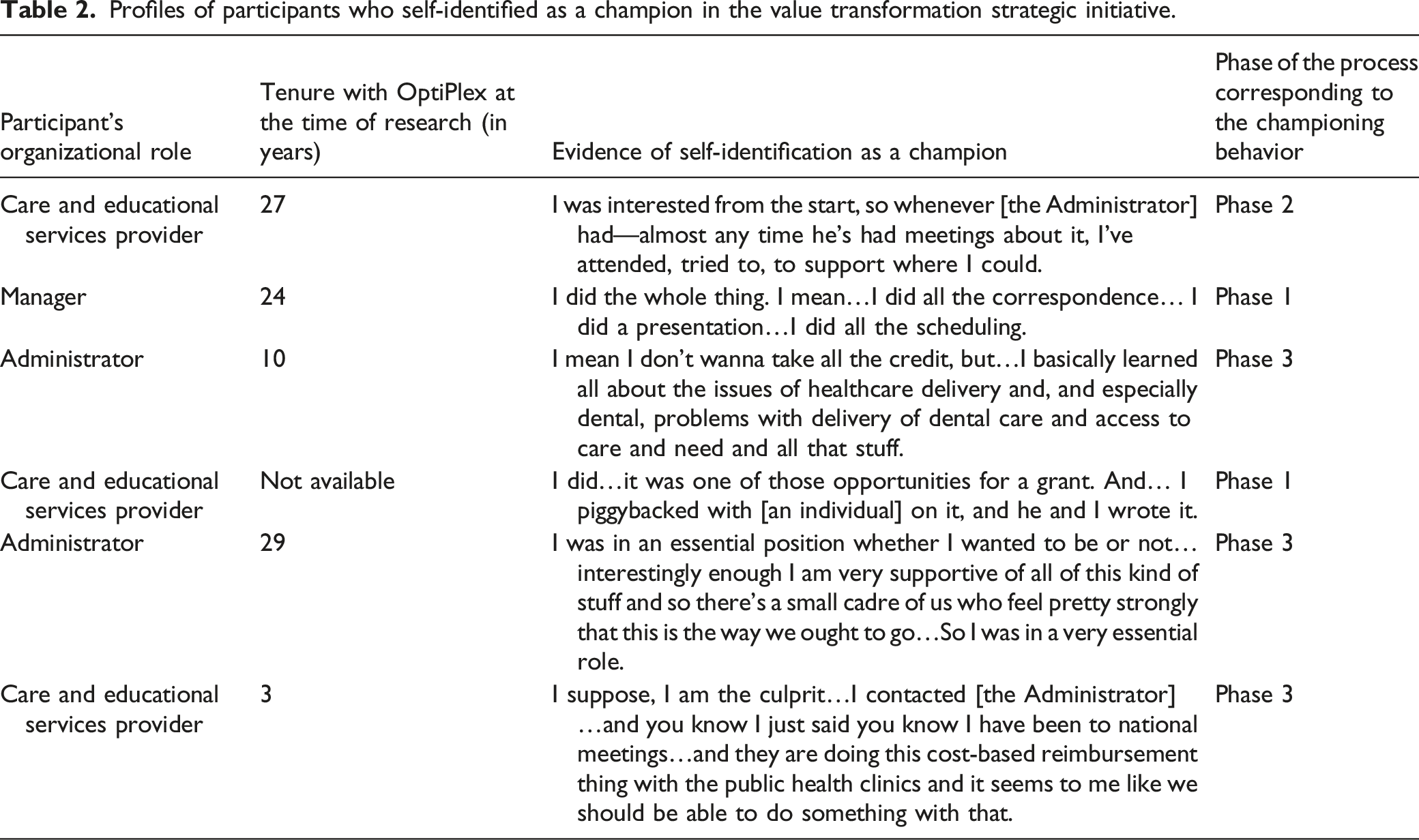
Following data collection, the second stage of data analysis involved two authors completing several close readings of the interview, observational, and archival data to understand the case’s details better. The third stage involved using MAXQDA software and lean coding to code our data identifying 29 unique codes. These unique codes described the events in the value transformation strategic initiative process and the strategic value-focused behaviors within the initiative. The fourth stage involved separating the 29 codes into 10 higher-level codes that followed the strategic initiative process across various phases from origination to formalization. In this stage, we followed process theorizing and used a temporal bracketing strategy to make sense of how the initiative developed in OptiPlex over time. 31 We also looked to identify relationships between the ten higher-level codes. This allowed us to generate the proposed framework of the value transformation strategic initiative process and the role of championing behaviors, defined as actions by individuals central to the value transformation strategic initiative.23,27,30
Findings
Leading a value transformation strategic initiative is challenging for at least two reasons. First, the strategic initiative must align with the organization’s strategy while remaining responsive to the demands of the point of care delivery. Second, the initiative must be supported by frontline providers who deliver patient care. As such, value transformation strategic initiatives that “cascade” top-down from the strategic apex of the organization without the involvement of frontline providers who are directly responsible for care delivery may not be effective. Indeed, our findings suggest that the initiative is complex and nonlinear, embodying multiple phases, each with idiosyncratic behaviors within. In OptiPlex, the initiative began with the care delivery process in mind and emerged at the frontlines, moving up and across the organization. 9
To this end, our empirical evidence points to two key differences between our study’s emerging value transformation strategic initiative and more traditional, top-down strategy models in healthcare organizations. First, the value transformation strategic initiative occurred across two phases: (1) originating and framing and (2) developing and experimenting before it was captured by the strategic leader and formalized in the organization from the top down. In other words, the initiative emerged and developed long before it was formally considered. As such, events preceding the strategic initiative’s formal implementation process (Phases 1 and 2) were critical to its ultimate success. Whereas Phase 1 describes the strategic initiative’s beginnings, Phase 2 describes how it developed at OptiPlex. Phase 3 differed from Phases 1 and 2 because it demonstrates the transition of the strategic initiative from an informal set of activities in the organization to a formal strategic initiative at OptiPlex.
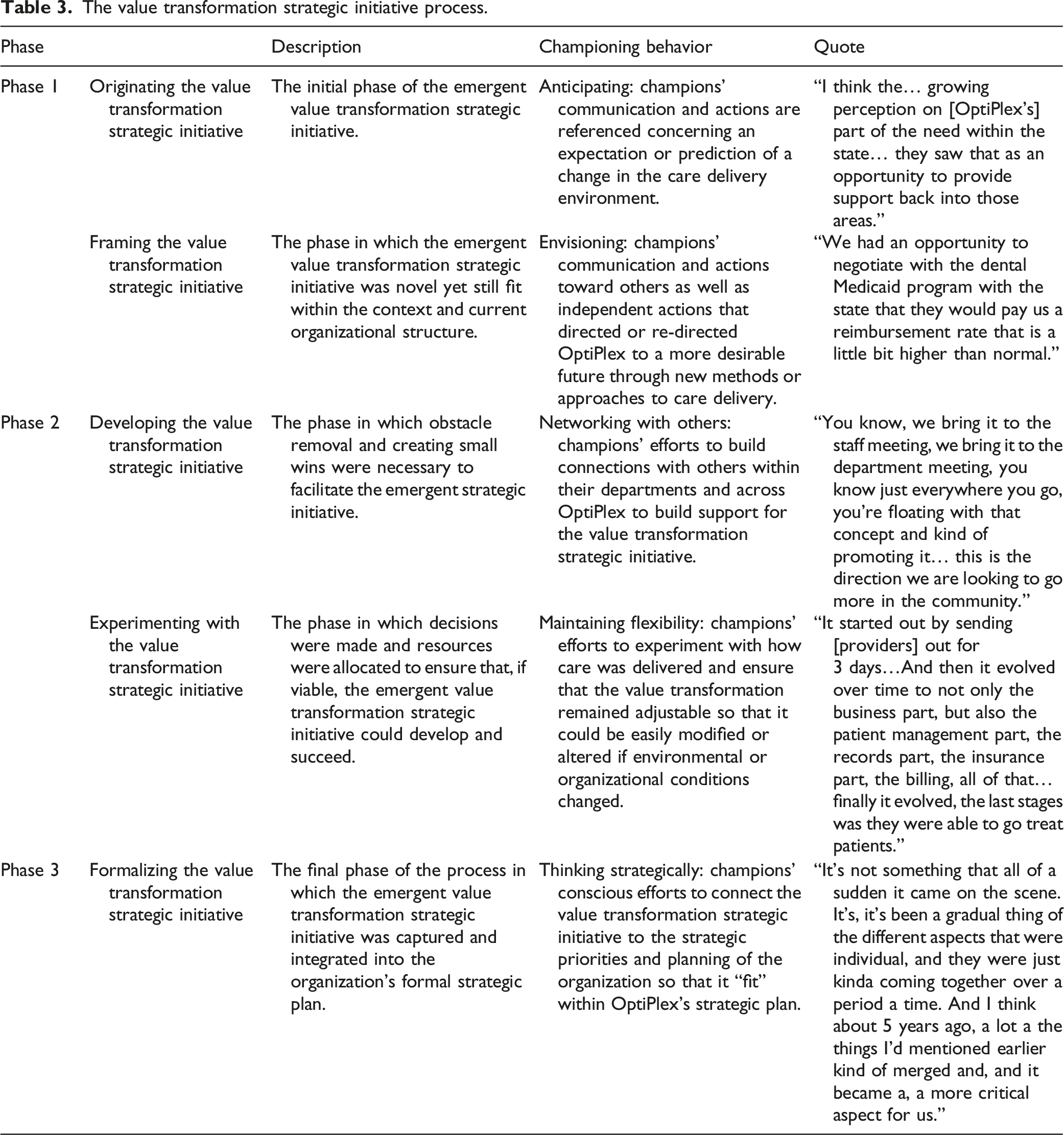
The value transformation strategic initiative process.
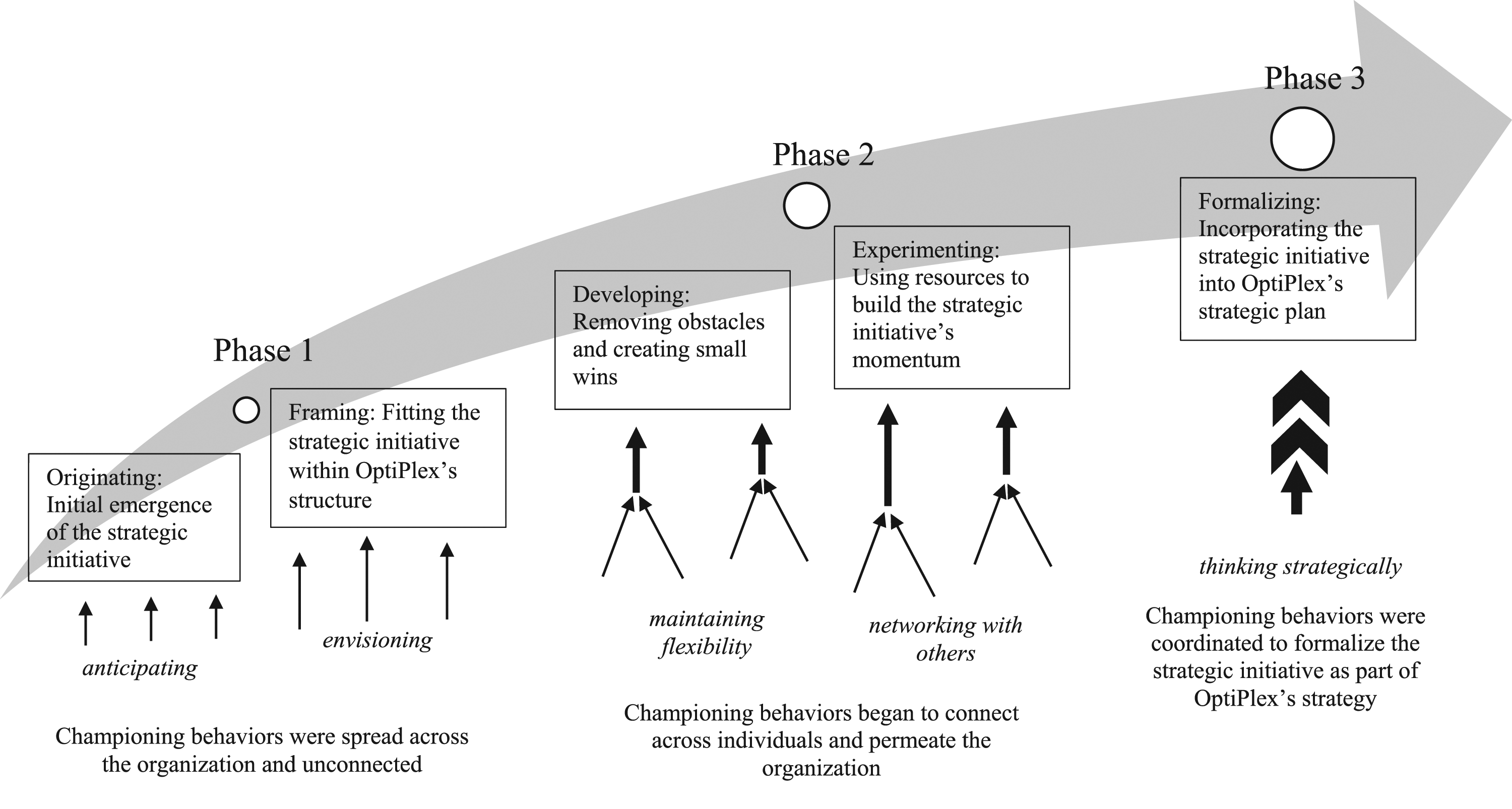
A graphical depiction of the emergent value transformation strategic initiative and championing behaviors.
Phase 1: Originating and framing the value transformation strategic iitiative
Originating
The first phase of the value transformation strategic initiative began with the growing awareness of the opportunities in the external environment (see Figure 1).2,25 At the time of the study, OptiPlex operated with a more traditional approach to care delivery with standalone clinics in major metropolitan areas and the expectation that patients would travel to these clinics for care delivery. However, external opportunities, such as funding for rural initiatives and advancing technologies, triggered several frontline providers to think differently about how OptiPlex delivered care. The dispersed awareness of these opportunities planted the seed for the value transformation strategic initiative to originate.
In response, champions across the organization began engaging in anticipating behaviors (see Table 3), such as mentioning a grant opportunity related to serving rural populations during a staff meeting. Anticipating behaviors are championing behaviors that drive action in expectation or prediction of an environmental change. Despite working in various parts of the organization, these individuals independently recognized the challenges ahead if the care delivery processes did not change: “If...you just have a [standalone] dental clinic, and that’s your total revenue cash flow… it’s a path of destruction because eventually, it’s going to fail.” In addition to recognizing the mismatch between the opportunities and the existing care delivery process, these individuals also predicted the changes that could have a more significant impact on care delivery processes: “you know, [other organizations] decided that they might be able to do more of this kind of community and service-learning types of things if they go out to the public health clinics in the state.”
Framing
Identifying problems with OptiPlex’s existing care delivery model was insufficient to facilitate a new strategic initiative. For a new value transformation strategic initiative to form, it had to be framed within what OptiPlex already offered. Framing describes the careful planning of the strategic initiative to consider the existing cultural approach to “how things are done,” as well as the organization’s structure, history, communities of practice, and communication (see Figure 1). 32 OptiPlex already participated in community outreach days and had a reputation for serving any patient who needed care within its standalone clinics. Consequently, individuals began framing the new initiative to diversify OptiPlex’s existing care delivery by partnering with clinics in rural areas and providing mobile clinics to diversify OptiPlex’s care delivery. Framing the value transformation strategic initiative as diversifying existing practices allowed it to emerge as a novel approach yet still within the context and structure of OptiPlex. In this way, the value transformation strategic initiative existed within, rather than changed, OptiPlex’s context and structure.
In this phase, champions framed the initiative through envisioning behaviors (see Table 3) to illustrate how the initiative could exist within OptiPlex’s context and structure (i.e., serving both urban and rural communities). Envisioning behaviors involve communication and action aimed at directing or re-directing the organization to a more desirable future through new methods or approaches to work processes, in this case, care delivery. 33 Individuals envisioned that the value transformation strategic initiative could “expand out service-learning in clinics” to broaden the outreach services across the state. In doing so, the value transformation strategic initiative would change the care delivery process, but in a way that was consistent with OptiPlex’s approach of excellent quality of care for all patients: “we want to be an invaluable resource to [the state]. That, to me, that sorta trumps everything…through excellence in research, patient care, and outreach to underserved populations.”
Phase 2: Developing and experimenting within the value transformation strategic initiative
Developing
The value transformation strategic initiative emerged from the providers at the frontlines of OptiPlex as they worked to actualize opportunities they perceived in the external environment through anticipation and envisioning. However, the initiative required momentum to climb up and across the organization. Consequently, it evolved from a localized idea into several small wins that elaborated on new ways to deliver patient care (see Figure 1). Small wins “concurrently [mark] progress along the way and [shift] attention and energies to the next areas of action.” 34 In the context of OptiPlex, small wins represented a successful new way of delivering patient care—such as a day of offering care to underserved children—that added to the momentum of the value transformation strategic initiative.
However, small wins were frequently accompanied by obstacles that individuals had to remove to keep the momentum. Indeed, extant research recognized that removing obstacles and creating small wins are vital for establishing new ways of working. 34 For example, individuals removed obstacles—such as not having bilingual care providers—by identifying innovative practices that could maintain the initiative’s momentum—such as using interpreters from a public health resource.
Within OptiPlex, champions also built momentum by networking with others (see Table 3), such as an individual attending a meeting they would not usually attend or a provider attending a budget meeting to offer an in-person explanation of how activities within the value transformation strategic initiative, such as serving rural communities, was a good investment for the organization. As indicated by one participant: “my role was to find the players that could help execute the vision…to get the ball rolling.” Employees built connections during the development of the value transformation strategic initiative process by amplifying “networking skills [to] build support both vertically and horizontally” at OptiPlex. 35
In this way, networking enabled transversality—or the intersection of individuals and ideas—that fueled new connections necessary for creating a viable future for OptiPlex. This included attending meetings they usually would not have or reaching out to an individual in a department they normally would not interact with. When we probed, one provider commented: “it is really important to have a small group of advocates who can clearly articulate what the idea and the concept are and even try to stay true to what you are trying to accomplish.” In this phase, individuals were not only able to identify innovative ideas and mobilize resources around them, but they also projected to others information about the idea and its potential to contribute to the organization’s overarching strategy. 36
Experimenting
To continue the momentum, the initiative required resources (see Figure 1).37,38 Organizations that experiment with new initiatives by providing resources for a particular timespan can “focus [resources on] several scenarios, thus maintaining flexibility.” 33 This was important because OptiPlex continuously faced resource constraints: “We can’t send all of our [interns] to one place, we don’t have the resources and time, we can’t accommodate them all.” Another provider echoed this sentiment: “You know, even we have to be very strategic or give up something in order to fit in these other things [associated with the value transformation strategic initiative].” Indeed, participants shared that for OptiPlex to reach the rural population, it had to make concessions in other areas, such as reducing the number of providers staffed in the standalone clinics or using some provider time to travel to the rural clinics.
The resources allocated to experiment with the value transformation strategic initiative helped sustain the momentum without overcommitting resources in case the strategic initiative turned out to be unviable. A provider recognized this: “…this is on a trial basis…we are going near the four weeks and then the five weeks, and it is very contingent upon a lot of different things being accomplished. If these things are done, then we will continue proceeding, so the deal still isn’t totally closed.”
Experimenting required champions to maintain flexibility (see Table 3) so the value transformation strategic initiative could sustain the momentum in a way that aligns with the capabilities of OptiPlex. For example, providers started scheduling time in the rural clinics but continued to schedule time in OptiPlex’s existing urban clinics. Experimenting also required these individuals to maintain flexibility regarding which resources were needed and when. For example, one individual was initially concerned about the costs associated with the value transformation strategic initiative: “my first fear was, you know, geez…we can’t just open the door for free to everybody.” However, this concern was addressed by maintaining flexibility in terms of when the clinic was available and sourcing it with community dentists who volunteered their time and services for one evening: “we tried it once in an evening just to see how it would work. Turned out I think the first night we did that we had 43 patients, most of who needed extractions…So, it was a great experience.”
Phase 3: Formalizing the value transformation strategic initiative
Formalizing
Championing behaviors in OptiPlex helped to originate, frame, develop, and experiment with the value transformation strategic initiative. However, the first two phases and accompanying behaviors were insufficient for the initiative to integrate into OptiPlex’s strategic plan officially (see Figure 1). For that to occur, the strategic initiative had to be visible to the strategic leaders. That is, although our participants recognized the value transformation strategic initiative’s viability—as stated by one participant: “the program’s developed, we have a model, and we’ve replicated it a half a dozen times”—for it to make an impact, it had to be integrated with the OptiPlex’s strategic plan.
To do so, these individuals had to consider how the value transformation strategic initiative was relevant to the strategic leaders and OptiPlex’s strategic plan. Our findings suggest that the formalizing phase required the champions in the organization—or individuals that did not necessarily hold formal leadership roles and responsibilities but still successfully influenced the value transformation strategic initiative—to work inextricably with the formal strategic leaders of the organization. To do so, champions emphasized the past success of the initiative and its fit with the existing strategic plan. Doing so affixed the initiative into the strategic plan naturally. This process was evidenced by one provider, who “went around and really talked up the idea quite a bit and it did informally and formally, so we were able to, you know, bring it to the executive committees, executive council’s attention…and then I think when [the leader] goes out…it is a part of that dog and pony show that this is the direction we are looking to go more in the community.”
Champions used both formal and informal communication (meetings, conversations, updates) to promote the value transformation strategic initiative to strategic leaders so that it could become a natural extension of OptiPlex’s strategic plan.12,39 These individuals had to think strategically, “exploring what is likely to happen… using analogies and qualitative similarities to develop creative new ideas.”
40
This championing behavior (Table 3) allowed individuals to synthesize where the organization currently is, where it hopes to be, and how the value transformation strategic initiative helped bridge the two. For example, providers who championed the value transformation strategic initiative also attended meetings and shared the strategic initiative’s successes as they related to OptiPlex’s overarching mission. As a result, one strategic leader of OptiPlex recognized the organic nature of the value transformation strategic initiative and that it “just fit” with the strategic plan that OptiPlex was already pursuing: “I look back at it and see these individuals who championed this being very opportunistic and putting together, you know, opportunities, in terms of grants and… taking advantage of the environmental factors that are coming into play. And, having the vision to look at that and say this is where we need to go.”
Discussion and conclusions
There is increasing interest from academics and practitioners in value transformation and its incorporation into strategic processes in healthcare organizations.25,37 This change from volume-driven to patient-driven care requires shifted thinking, operations, and strategy. Previous work on strategy in healthcare emphasizes how strategic initiatives cascade down the organization in a top-down fashion. Our study departs from previous work, perhaps, due to the focus on value transformation, and, as a result, was primed to emerge from the frontlines of the organization and be championed by providers from the bottom up.
Our case study of OptiPlex provides a model for how a value transformation strategic initiative can ascend and build momentum across the organization via three phases, as depicted in Figure 1. It also highlights the critical role of championing behaviors in a value transformation strategic initiative. Thus, this model has utility for academics and practitioners interested in understanding how a value transformation strategic initiative might originate, develop, and be implemented in a healthcare setting.
This research is not without limitations. First, we use an in-depth case study of one organization to explore in detail the emergence of a value transformation strategic initiative. Although this approach allowed us in-depth insight into the dynamics of the initiative’s emergence, the question of whether similar findings would result in other—perhaps structurally different—healthcare organizations remains. As such, future studies should build on our findings by employing a multiple case study format that explores differing organizations with various internal and external environments. Research along this path might ask: Does the emergence of a value transformation strategic initiative depend on the dynamism of the environment? This and other research questions could connect our findings with other paths of inquiry for this line of research. Though we believe this research lays the groundwork upon which future studies could build, we do not suggest that this study provides a complete understanding of the emergence of a value transformation strategic initiative.
Additionally, while our findings identified multiple individuals who exhibited championing behaviors, they also showed that others chose not to engage in these behaviors. A question we were not able to answer in our research is: What explains why some individuals did (and some did not) engage in championing behaviors? Can we identify individual differences associated with why individuals choose to engage or not engage in championing behaviors? Our data clearly showed that pressures (i.e., opportunities in the external environment) and timing (the phase of the emergent strategic initiative) play a key role in the emergence of the value transformation strategic initiative. Is it that individuals who exhibit championing behaviors respond differently to pressures than others—i.e., do champions have a more innate sense of timing than those who are not champions? Moreover, what role do organizational climate and structure play in enabling or inhibiting championing behaviors and the resulting emergence of the value transformation strategic initiative? These are important questions because they have key implications for healthcare organizations trying to foster more effective strategic processes.
In this vein, our research indicates that a value transformation strategic initiative results from more than just the behaviors or actions of one, or a small group, of strategic leaders at the organization’s apex. We uncover a process in which individuals who exhibited championing behaviors across the organization—particularly those who interface with patients—are critical to promoting the value transformation strategic initiative from the bottom up. Regardless of organizational role, our participants seemed to understand OptiPlex’s overarching strategy of providing care to everyone—as exemplified by serving children and adults as well as providing a range of dental services. Thus, when some of the participants recognized the opportunity to provide care to rural communities, the seed was planted to shift OptiPlex’s care delivery structure to reach this overlooked population. To this end, future research could explore the applicability of this model in healthcare organizations in which the overarching strategy might differ—for example, those that provide only specialized care services. Future research might also explore the next phase of our model—what happens to the value transformation strategic initiative after it is formalized into the strategic plan and what helps or hinders its sustainability.
Overall, our findings indicate that coupling championing behaviors in the organization with strategic leadership of the organization is necessary to enable the emergence of value transformation strategic initiatives that can create a viable future for a healthcare organization.
Footnotes
Declaration of conflicting interests
The author(s) declared no potential conflicts of interest with respect to the research, authorship, and/or publication of this article.
Funding
The author(s) received no financial support for the research, authorship, and/or publication of this article.
