



Abstract
Objectives
Developing a valid tool to measure perceived social responsibility (SR) practices towards employees and examining the impact of employee-centered SR considerations on the employees’ job satisfaction.
Methods
A cross sectional survey of employees at three private hospitals was conducted. Data was collected using a self-administered questionnaire. It consists of baseline characteristics, structured SR measuring scale, job satisfaction questionnaire and Perception of Empowerment Instrument (PEI).
Results
The questionnaire developed to measure SR towards employees showed excellent internal consistency reliability (Cronbach’s alpha is > 0.7). A considerable number of SR criteria were perceived as partially or fully met by the majority of studied employees except for rewarding, training activities, salary satisfaction and enhancement activities. Significant correlation was found between employees’ job satisfaction and all domains of SR as well as employees’ empowerment. Multiple linear regression analysis showed that significant predictors of employee’s satisfaction are fulfillment of economic and social responsibility criteria as well as the level of perceived empowerment.
Conclusions
In healthcare industry in Egypt, fulfillment of the basis for SR is one of the predictors of achieving high job satisfaction. Extra-performance rewarding and career development should be looked at while managing human resources.
Introduction
The European Commission (2001) defined corporate social responsibility (CSR) as “a concept whereby organizations integrate social and environmental concerns in their business operations and their interaction with stakeholders on a voluntary basis”. 1
The term social responsibility(SR) is more familiar than CSR because it is applicable to all types of organizations not just those in the business world. 2 The International Organization for Standardization (ISO) developed ISO 26000 standard that was launched in 2010. It was developed to provide guidance for all types of organizations regardless their activity or location to translate principles of SR into effective actions and thus contribute to sustainable environmental, social and economic development. SR is considered a proactive business strategy and an effective marketing tool to create and sustain a competitive advantage.3,4
An organization has four interest groups namely, the society in large, employees, customers and the government. Regarding employees, for whom SR policy is manifested in fairness and transparency as regards the decisions that directly affect them. 5 Fulfillment of SR principles towards the internal stakeholders represents those organizational practices related to the improvement of working conditions, including not only the betterment of the physical work environment but also the psychological working conditions. 6
Implementing socially responsible human resource management is one of the important SR organizational practices, including fair hiring practices, merit-based and non-discriminatory as well as employees’ motivation, training and development, which enable organizations to have access to and retain talent employees in order to work both effectively and efficiently. 7
Delivery of HC services, just like any other industry, should be driven in accordance with the universal ethical principles, respecting the human rights. Since few years, SR has been addressed in the context of healthcare and considered a key objective within the healthcare industry. Nevertheless, application of SR principles didn’t receive much attention in literature. Additionally, few studies examined the relationship between fulfillment of SR principles towards employees and their job satisfaction at healthcare organizations. In such studies, measuring SR towards employees depend on short scales mostly focused on promotion activities and working environment.8,9
In health care facilities, there is a need for development of a valid comprehensive and specific tool to measure fulfillment of SR principles in healthcare facilities aiming at identifying to what extent a company is viewed as socially responsible towards their staff and employees. This is currently based mainly on a group of indicators developed based on CSR models and considered as basic responsibilities that the company should accept to be considered as socially responsible towards stakeholders. 10 On the other hand, no available valid tool to measure it based on the employees’ perception. The main aim of the present study is to develop a valid tool used to identify the perceived fulfillment of SR principles towards employees at health care settings (from the perspectives of employees themselves).
Theoretical background
Employee satisfaction (also referred as job satisfaction) is defined as a positive feeling about one's job. More broadly, job satisfaction is the positive state of mind which arises as a result of individuals’ assessment of their jobs, their experiences about workplace, co-workers, supervisors, subordinates, employers’ empowerment and their salary. It is known to affect both mental and physical wellbeing of the employees. 11 Interest in job satisfaction proceeds from its relationship to other substantial organizational outcomes including absenteeism, organizational commitment, turnover rate, performance and productivity. Moreover, employees with high job satisfaction provide better customers service, resulting in customer satisfaction and loyalty, which surely has a positive impact on the financial performance of the organization. 12
Several extrinsic factors were found to be significantly associated with satisfaction among healthcare workers. These factors include work environment, supervision, salary, interpersonal relationship and organization and administration policy. Part of these factors are the core for social responsibility from the side of the organization towards employees.11,13
In healthcare industry, offering the highest quality of health-care services possible to as many people who need them is the main goal of health-care systems and organization. Achieving this goal requires a committed and high-quality workforce in health-care organizations. By creating an environment that promotes job satisfaction, a health-care manager can develop employees who are motivated, productive, and fulfilled. 14
In Egypt the current healthcare system has several disparate public and private providers. The main public providers are the Ministry of Health and Population and the Health Insurance Organization. This is in addition to services provided by other governmental agencies as teaching hospitals, ministry of defense and interior and curative care organization. Those public HC providers act as a simultaneous payer and provider of services which affects the quality of services provided. So, Egyptians who have the ability to pay utilize the private sector facilities and face catastrophic health expenditures.15,16 These factors played a major role in forcing the Egyptian government to issue law number 2 (2018) for establishment of Universal Health Insurance (UHI) system which emphasized the principle of splitting services payers from providers through engaging the private sector in providing services under the umbrella of UHI. 17
Selection of the private health facilities to be engaged in the UHI is based on its fulfillment of quality standards stated by General Authority for Healthcare Accreditation and Regulation (GAHAR). Meeting requirements for CSR in general and towards employees in particular is basically included in such standards. 18
Methods
The study was conducted at three pediatric specialized tertiary care private hospitals in Alexandria, Egypt with a capacity of 18–25 beds. They provide a wide range of services, namely, outpatient, inpatient, immunization, diagnostic laboratory and radiological services, emergency care, critical care and clinical pharmacy. Selection of the study settings was based on willingness of the managers to assess the existing CSR strategies against GAHAR standards as a step towards being enlisted among UHI providers.
Data was collected using an anonymous self-administered questionnaire developed in English and translated to Arabic by two Arabic bilingual translators to suit all types of employees. The number of working employees in the three hospitals was 140, 142 and 168 with a total of 450 employees. The questionnaires were e-mailed to all employees in the three hospitals, 381 of whom returned them completed (response rate ranging from 82% to 86%).
The questionnaire consists of four parts with an introductory section covering clarification of the CSR principles, aim and methodology of the research. The first part inquires about the employees’ baseline demographic and occupational characteristics. The second part consists of a 10 items scale developed to measure job satisfaction among employees. It was developed by the researchers based on Satisfaction of Employees in Health Care (SEHC) survey 19 after omitting items that already exist in the fourth part of the questionnaire which covers the SR principles (10 items were removed).
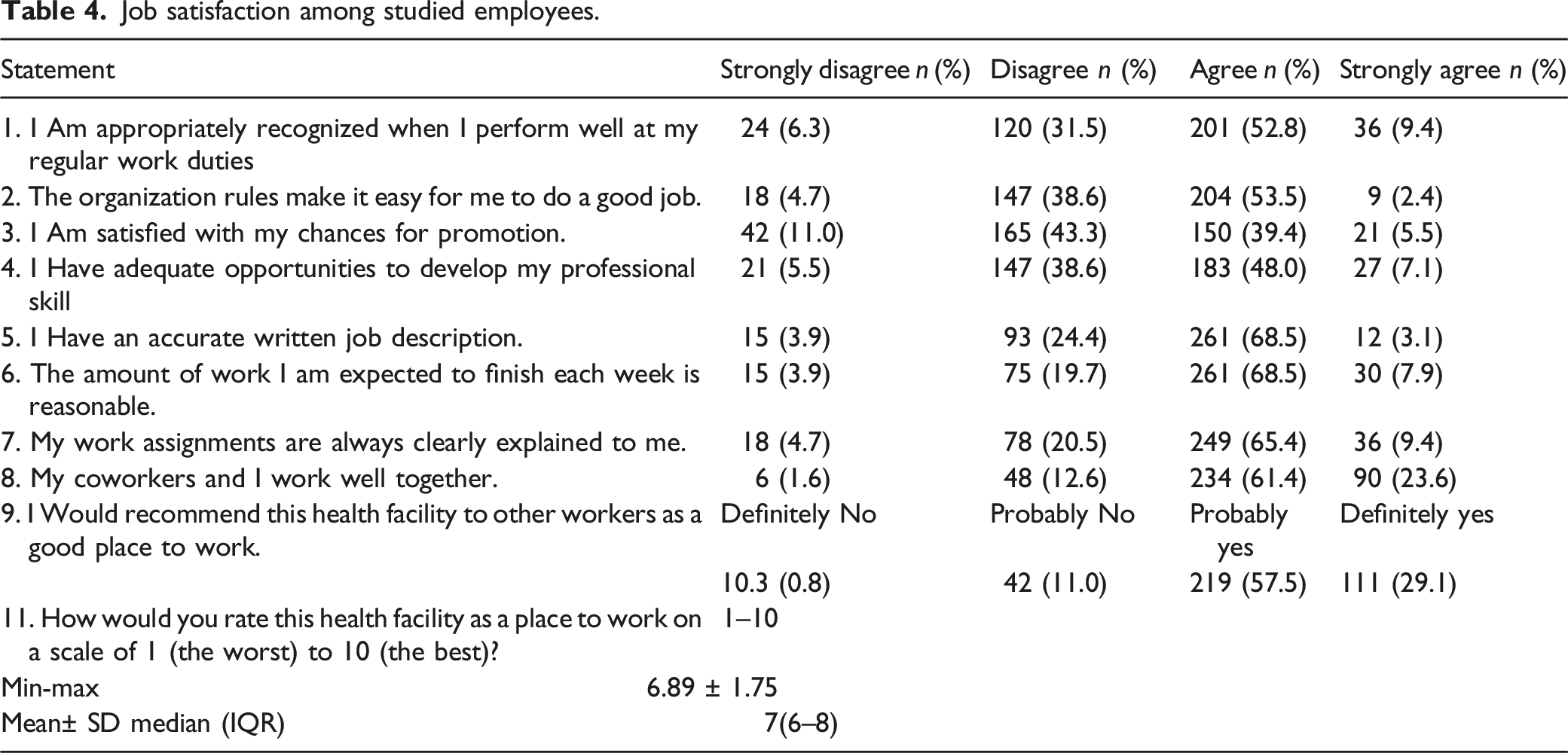
Responses for the first eight items of satisfaction questionnaire were reported on a 4-point Likert scale where one was ‘strongly disagree’ and four was ‘strongly agree’. The last two items were global staff satisfaction measures that inquire whether the respondent would recommend the health facility to other workers (item 9), and how the respondent would rate the health facility as a place to work (item 10). Item nine was on a 4-point Likert scale where one was ‘Definitely No’ and four was ‘Definitely Yes’. Item 10 was on a 10-point scale with one being worst and 10 being best.
The third part was the Perception of Empowerment Instrument (PEI). 15 The instrument is composed of 15 items measuring dimensions of autonomy (5 ITEMS), participation (6 ITEMS), and responsibility (4 ITEMS). Each participant should respond to the items in the instrument using the five-point Likert-type scoring scale (strongly agree = 5, agree = 4, neutral = 3, disagree = 2, strongly disagree = 1). The total score was calculated and then divided by the number of items to obtain the average item score with a maximum possible score equals 5. 20
The fourth part consists of a structured questionnaire developed to measure the degree of perception of employees towards fulfillment of principles of SR in their organization. The questionnaire was developed after thorough literature review. Remisova et al. (2012) provided a framework to measure employees centered SR. 10 It was used as the base to develop the tool used in the current study to measure perceived SR in which the framework classified the criteria into four dimensions namely legal, economic, ethical and SR enhancement practices. In addition, other literature including the scale developed by Park and Levy (2014) were considered. 21 Moreover, it was taken into consideration the expected level of knowledge of employees regarding the organizational policy that enable them to judge fulfillment of different criteria.
Based on that, the form used was developed. It consists of 20 items. Each item was measured at a 3-point Likert scale, namely fully met, partially met (sometimes, not exactly, to some extent) and not met at all. Each scale item was scored by “2” for fully met, “1” for partially met and “0” for not met at all or don’t know. It consists of four main dimensions: legal responsibility (6 items), economic responsibility (four items), ethical responsibility (7 items) and SR enhancement criteria (3 items).
To examine the questionnaire content validity, three independent professors, experts in the area of healthcare management and quality in healthcare were asked to report their opinion regarding, the relevance and clarity of each item in the questionnaire. They were asked to give each item a score ranged from three for highly relevant/clear to one for not relevant/not clear. The number of experts showed complete agreement was divided by 3 (the total number of experts) to obtain item content validity index (CVI). Items CVI were added and divided by 20 to obtain total CVI. 22
Data was analyzed using IBM SPSS statistics version 20. 23 Data were presented as number and percentage. For quantitative scores, minimum, maximum, mean and standard deviation were used. Cronbach alpha was calculated for SR questionnaire to measure its internal consistency reliability considering 0.7 cut of value for adequate reliability. 24 Spearman correlation between the total and domain scores was conducted for SR measuring scale. The percentage of missing responses for each statement was calculated denoting acceptability. Bivariate analysis for factors associated with job satisfaction was conducted using student t test, ANOVA and Pearson correlation. Multivariate linear regression was used to identify significant predictors of job satisfaction among employees in healthcare settings. Analysis was done at 5% level of significance.
Results
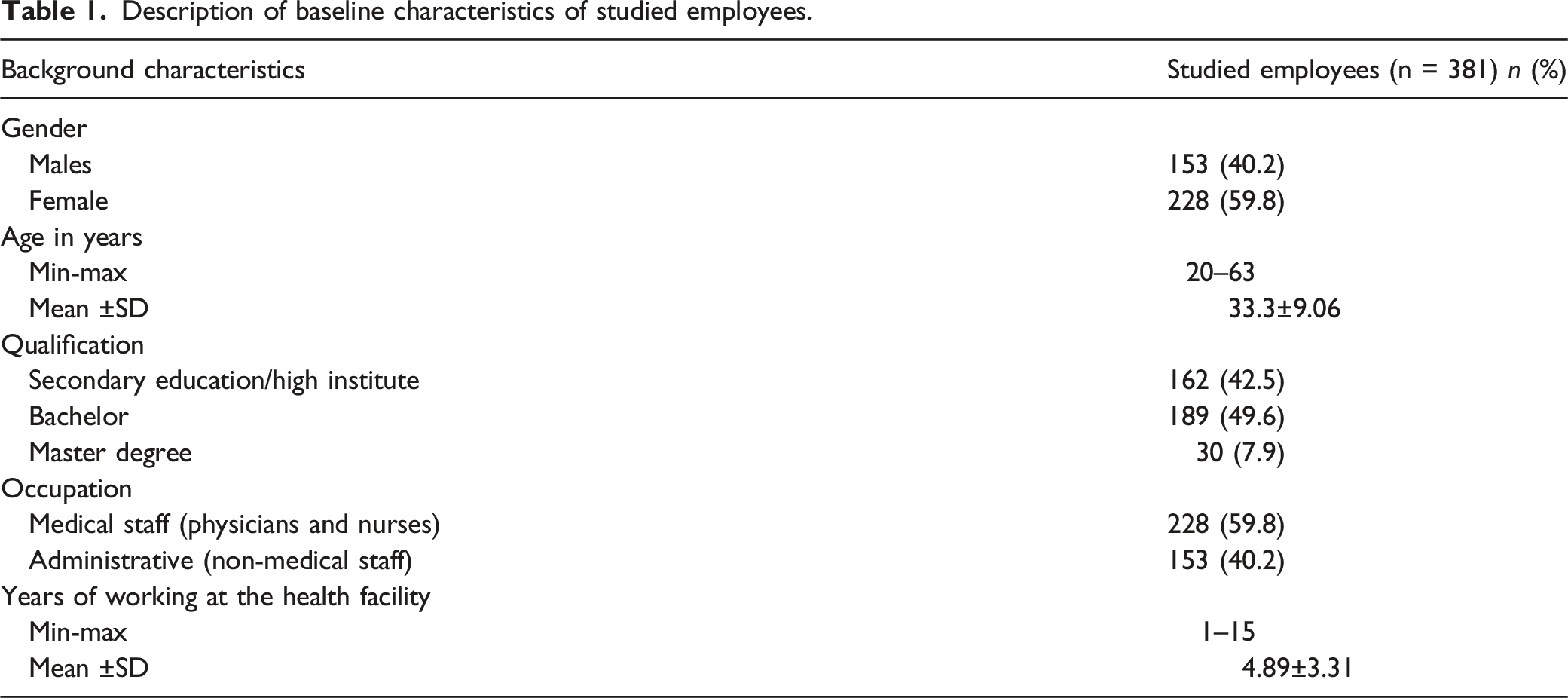
Description of baseline characteristics of studied employees.
Reliability of SR measurement scale using Cronbach’s alpha and domain to total correlation.

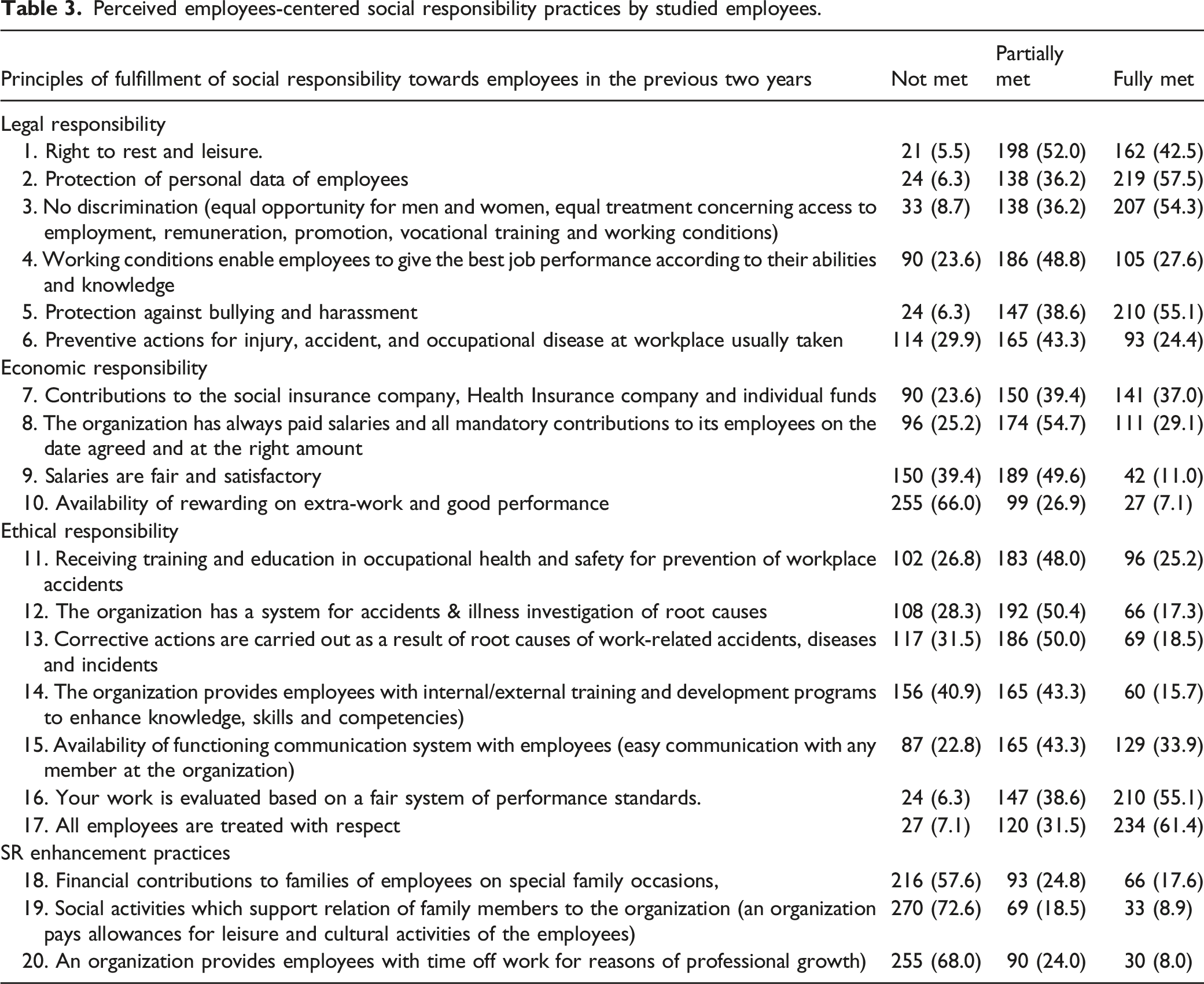
Perceived employees-centered social responsibility practices by studied employees.
Job satisfaction among studied employees.
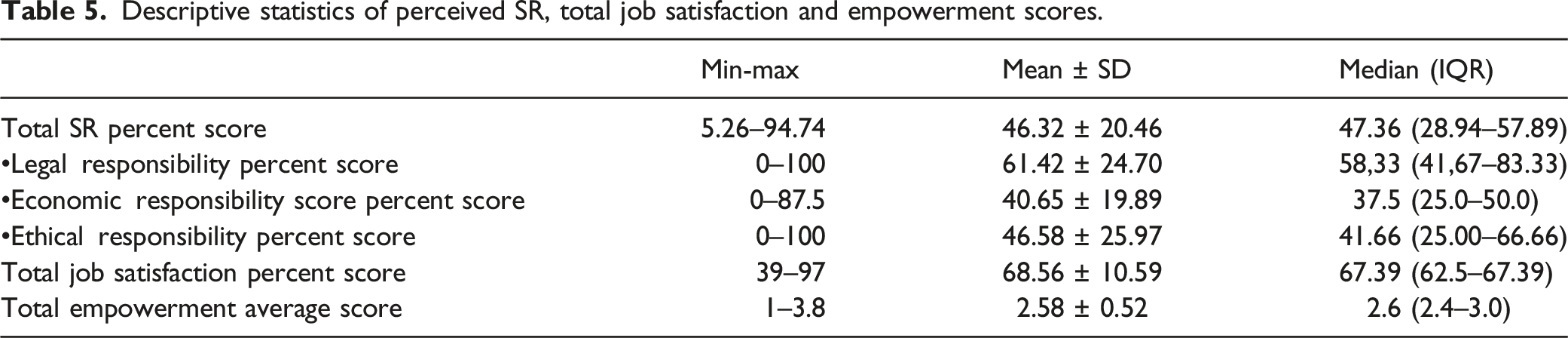
Descriptive statistics of perceived SR, total job satisfaction and empowerment scores.
Univariate analysis for independent variables associated with total satisfaction score among employees shows no significant association between any of studied baseline characteristics and the total job satisfaction score namely their sex (t = −0.152, p = 0.878), age (r = 0.193, p = 0.065), qualification (F = 1.539, p = 0.219), job (t = 0.167, p = 0.868) and the years of working at the hospital (r = 0.034, p = 0.718).
Multiple linear regression analysis for factors predict employees’ job satisfaction.

asignificant at p < 0.05.
Discussion
Access to high-quality healthcare services is a demand of people around the globe. 25 Healthcare workers’ performance represents a main determinant of the quality of service provided. Moreover, healthcare workers’ satisfaction with their job is significantly linked to their patients’ satisfaction.26,27
In the current study, the sample was representative to the employees regarding their age group, sex, years of working experience, profession and qualification.
The developed scale used in measuring perceived SR practices showed adequate content validity and acceptability. Regarding internal consistency reliability, inadequate correlation between the item concerned with salary satisfaction and other items might be due to the subjectivity of this item as it might be variable, affected by many individual factors and usually difficult to be attained.
The total score for perceived legal responsibility was high as compared to that for economic and social responsibility (mean score of 61 as compared to 40 and 46 respectively). The basis of legal responsibility represents the compliance with the laws and regulations governing the relations of an organization to a particular stakeholder and those are usually fulfilled. On the other hand, ethical responsibility represents the specification of the ethical principle “Do not harm others!” in relation to individual stakeholders. It usually needs specific procedures, process and a functioning system that works for execution of this concept. 10
The current study investigated the employees-centered SR practices in the study settings based on employees’ perception. Results revealed that practices governed by organizational laws and regulations (legal responsibility) are perceived by the majority of studied workers. On the other hand, practices offered voluntarily by the organization (financial reward on extra-work, career development and training and SR enhancement practices) are perceived by minority of studied workers. These results may reflect the misconception that the SR has a negative effect on the organizational profitability. 28 Managers are usually considered direct expenses as salaries and employees’ health insurance expenses as mandatory items in the annual organization budget. However, managers consider expenses for SR practices as extra, optional items with negative effect on organizational profitability. These concepts play a major role on managers’ acceptance of SR practices.
On studying the relation between the perceived employees-centered SR and empowerment practices and studied workers job satisfaction, the current study revealed a strong positive correlation between job satisfaction and organization’s legal responsibility, ethical responsibility, economic responsibility as well as employees’ empowerment. These are in agreement with many other studies conducted among employees from different business categories including the health sector.8,29,30 These results present an evidence for health-care managers on the importance of adopting SR practices and looking for its indirect positive effect on organizational profitability as a result of increasing job satisfaction. It was reported that job satisfaction is linked to increased loyalty, individual performance, productivity and creativity. In the healthcare sector these will be reflected on the quality of care and patient satisfaction and contribute to the continuity of care.31-33
Conclusion and recommendations
The used tool for measuring employees’ perceived SR practices is considered reliable in healthcare settings except for its economic subdomain as salary satisfaction was difficult to be attained in our context. This research was focused on the private sector due to the urge of its involvement under the UHI system. However, further research is recommended making use of the developed tool to test validity and reliability of the tool to measure SR practices in other healthcare providers’ settings in Egypt.
The findings of the current study support the suggestion that the organization’s SR practices particularly the ethical and economic ones have a strong relation with employees’ job satisfaction that in turn known to affect their performance and loyalty. It is recommended that managers in healthcare settings should pay particular attention to fostering and implementing SR policies as a business strategy likely to enhance the organization’s long-term profitability. Rewarding of employees on extra performance, career development and enhancement activities should be looked at while managing human resources in healthcare industry. Moreover, managers should regularly measure the level of perception of such practices among employees and healthcare workers and how it affects their level of satisfaction. The developed tool will help them to accomplish such missions.
Footnotes
Acknowledgements
Authors express their deep gratitude to managers at the study settings for their efforts in facilitating data collection and to all workers for their time and efforts in participation.
Declaration of conflicting interests
The author(s) declared no potential conflicts of interest with respect to the research, authorship, and/or publication of this article.
Funding
The author(s) received no financial support for the research, authorship, and/or publication of this article.
Disclosure
The questionnaire was anonymous. The employees were asked for participation after clarifying the objective of the study and the freedom to refuse participation. The study protocol was approved by the Ethics committee at Alexandria Faculty of Medicine.
