




Abstract
In democratic systems, the rich have diverse channels through which they can influence policies. In a model of taxation, I study the capacity of the rich to constrain the fiscal choice of a government by starting a costly political conflict (for example, a press campaign), which imposes a cost on the government and influences the fate of the government’s fiscal plan. I show that the government’s tax proposal depends critically on the marginal disutility of taxation for the rich. This approach provides a new rationale for the empirically documented U-shaped relationship between inequality and taxation. It also highlights a new role for opposition parties. By agreeing to bear part of the cost of a political conflict in exchange for compromise, the opposition makes Pareto-improving arrangements possible.
1. Introduction
In May 1924 in France, a coalition of left-wing parties called the Cartel des Gauches won the general election with a promise to tackle a mounting public debt problem through capital taxation. In July 1926, as demonstrations were staged in front of the French Parliament and monetary panic spread, the Cartel was replaced by a center–right coalition. During the Cartel’s tenure, the rich and the business community strongly opposed any attempt by the government to impose a capital levy. This opposition took the form of capital evasion and a massive press campaign against a capital tax, eventually swaying public opinion against the governing coalition. 1
It is well understood that the poor have the capacity to constrain the rich in autocracies (Acemoglu and Robinson, 2005). In unconsolidated democracies, the rich might exert undue influence by threatening coups or unrest (Dal Bó and Di Tella, 2003, Ellman and Wantchekon, 2000). In consolidated democracies, the rich can use contributions (e.g. Rodriguez, 2004) or independent expenditures (as the Koch brothers’ support for Governor Walker illustrates). As the example of the Cartel illustrates, the rich also have the capacity to constrain the fiscal policy of a government opposed to their interests by taking actions that hurt the party or coalition of parties in power.
In this paper, I study this last channel of influence in a stylized model of taxation. A government (referred to by the pronoun ‘he’ throughout) chooses a tax level under the threat of political conflict by the rich who dislike redistribution. A political conflict is costly to organize for the rich, and this cost is their private information (for example, it can depend on their ability to coordinate their actions). It has two effects on the government. First, it imposes a direct utility loss (for example, due to the cost of mounting a public relation campaign to defend the government’s plan or the increased risk of losing the next election). Second, with some probability, a political conflict forces the government to abandon his fiscal project (for example, it might sway public opinion against the government’s tax proposal as in the case of the Cartel des Gauches).
The government chooses his tax rate to equate the marginal gain from a higher tax rate with the marginal cost of increased risk of a political conflict. Consequently, a key variable to explain the government’s tax proposal is the marginal disutility of taxation for the rich. When the marginal disutility is low, the government proposes his ideal tax rate; when it is high, the government prefers to maintain the status quo tax rate; in the intermediate range, the government compromises with the rich.
The introduction of political conflict has two important consequences for our understanding of democracy. First, it highlights an understudied role of opposition parties. Like the rich, the opposition (referred to by the pronoun ‘she’ throughout) favors a tax rate lower than the status quo. Like the government, she does not know the cost of a political conflict to the rich. The government can form a coalition with the opposition. In this case, the opposition bears part of the cost of a political conflict in exchange for a more moderate fiscal proposal (endogenously determined). The government always chooses to form a coalition with the opposition when the marginal disutility of taxation for the rich is sufficiently high. The risk of a political conflict is high, and a reduction in its cost is advantageous for the government even if it means passing a more moderate proposal.
I show that the possibility of forming a coalition with the opposition makes Pareto-improving arrangements possible. The government is better off since he has a greater choice set. The opposition is never worse off since she would reject any fiscal proposal to form a coalition that leads to a lower expected payoff than if they were not to form a coalition. The rich are better off because the coalition leads to a more moderate tax proposal that benefits them directly.
Second, this paper explains why taxation does not necessarily increase with inequality, as has previously been empirically documented (for a review, see Alesina and Glaeser, 2004). Because of the risk of political conflict, the level of taxation decreases with the marginal disutility of taxation for the rich (with or without a government–opposition coalition). All else equal, an increase in inequality (driven by an increase in the income of the rich) has two conflicting effects on the marginal disutility of taxation. The first effect is a level effect: for a given tax rate, the amount taxed increases. This effect tends to increase the marginal disutility of taxation. The second effect is a marginal effect: as the rich become richer, the value of each additional dollar to the rich decreases. This effects tends to decrease the marginal disutility of taxation. Under certain conditions, at a low level of inequality, the level effect dominates, and the tax rate decreases with inequality. At a high level of inequality, the marginal effect dominates, and the tax rate increases with inequality. Consequently, the relationship between inequality and taxation can be U-shaped, as empirically documented by de Melo and Tiongson (2006) and Figini (1999).
2. Related literature
This paper joins a line of research investigating how the rich influence fiscal policies in democracy. Lee and Roemer (2005) and Roemer (1998) show that the rich can avoid full expropriation of their wealth by manipulating the electoral agenda. Several papers analyze how the rich can buy favorable tax policies from the government with contributions (Rodriguez, 2004), bribes (Dal Bó and Di Tella, 2003) or threats of violence (Dal Bó et al., 2006). Bénabou (2000) demonstrates how unequal participation in politics can translate into a low level of redistribution when markets are imperfect. This paper complements this literature by considering an additional channel of influence. The rich can undertake costly actions (start a political conflict) which impose a utility loss on the government and might force him to abandon his fiscal project. This new approach highlights another important variable affecting fiscal policy: the marginal disutility of taxation for the rich, which helps explain the empirically documented U-shaped relationship between inequality and the level of redistribution (de Mello and Tiongson, 2006; Figini, 1999). 2
This paper also contributes to literature that explores the role of the opposition party or challenger in democracy. In most formal models, the opposition is a passive alternative to the party or individual in power (for example, Canes-Wrone et al., 2001). Ashworth and Shotts (2014) and Dewan and Hortalla-Vallve (2013a, 2013b) show how the presence of an opposition providing information to voters about her or the government’s competence influences the government’s policy choices. Iaryczower and Oliveros (2014) show how a minority party can help broker deals between a majority party and the opposition. Dewan and Spirling (2011) analyze how an opposition party can lead to more moderate policies by imposing cohesion among its members. In the present work, the opposition has a similar effect by forming a coalition and bearing part of the cost of political conflict in exchange for a more moderate tax proposal. In addition, I find that the possibility of forming a coalition is Pareto-improving. 3
3. The baseline model
I first consider a two-player game with a government and the rich, where players have divergent preferences regarding the level of taxation. The government’s ideal tax rate is τg ∈ (τsq, 1], where τsq ≥ 0 is the status quo tax rate. The ideal tax rate of the rich is τr ∈ [0, τsq]. 4 The government proposes a tax rate b ∈ [0, 1], where 0 corresponds to no tax and 1 to full taxation. After observing the government’s fiscal proposal, the rich decide whether to start a political conflict ar ∈ {0, 1} which affects the final tax rate implemented τ. A political conflict is costly for the rich with cost cr, and this cost is their private information. However, it is common knowledge that it is drawn from a uniform distribution [0, 1]. (I assume a uniform distribution to simplify the analysis.)
A political conflict can take the form of a press campaign against the government fiscal plan (as in the case of the Cartel des Gauches described in the introduction) or a grassroots campaign (such as mobilizing partisans to send letters to their representative). It captures the efforts by the rich to activate and sway ‘latent opinion’ (Key, 1961). 5 Since public reaction is unpredictable (Key, 1961), I assume that with exogenous probability p > 0, public opinion sides with the rich and forces the government to abandon his fiscal project and uphold the status quo tax rate: τ = τsq. Otherwise, the government’s tax proposal is passed: τ = b. A political conflict also imposes a direct utility loss of k > 0 on the government. This loss captures the government’s cost of defending his proposal (for example, the opportunity cost of making speeches on the subject, having to hold press conferences, sponsoring a media campaign in favor of the fiscal proposal, or popularity loss due to the conflict with the rich). 6 To simplify the exposition, I assume that the government always has some incentive to compromise with the rich. That is, the cost of conflict satisfies: k ≥ (1 − p) (τg − τsq).
Using the simplifying assumption of linearity, the utility functions of the government and the rich are, respectively


The timing and outcome of the game are as follows:
Nature draws cr from a uniform [0, 1];
The government chooses a tax rate b ∈ [0, 1];
After observing b and cr, the rich decide whether to engage in a political conflict: ar ∈ {0, 1}.
If the rich do not start a political conflict (ar = 0), the government’s proposed tax rate is passed: τ = b;
If the rich start a political conflict (ar = 1), with probability 1 − p, the government’s proposed tax rate is passed: τ = b, and with probability p, the status quo tax rate is upheld: τ = τsq.
The equilibrium concept used in this paper is Subgame Perfect Nash Equilibrium (SPNE) which requires that at each decision node, a player chooses the action that maximizes her expected utility given the strategy of the other player. 7
Solving the model by backward induction, the rich choose to start a political conflict if and only if the expected gain from a conflict is greater than its cost: cr ≤ αp(b − τsq). The government does not know the cost of conflict to the rich, but anticipates the risk of conflict when he chooses a tax rate. The government, therefore, chooses a tax rate to equate the marginal benefit of a higher tax rate with the marginal cost of an increase in the probability of political conflict.
Consequently, the government’s tax proposal depends on the marginal disutility of taxation for the rich. When it is low, any increase in taxation is associated with a small increase in the risk of conflict. The marginal benefit of an increase in the proposed tax rate is always greater than the marginal cost, and the government proposes his ideal tax rate τg. When the marginal disutility is high, any increase in the proposed tax rate results in a high increase in the risk of political conflict, and the government upholds the status quo. In an intermediate range, there exists an interior solution b ∈ (τsq, τg), and the government compromises with the rich. Observe that the tax proposal of the government does not depend on the government’s ideal tax rate whenever the marginal disutility of taxation for the rich is sufficiently high (α >

with
4. The role of an opposition party
In this section, I extend the baseline model discussed above to include a parliamentary opposition. The government and the opposition have divergent preferences regarding taxation. The opposition’s ideal tax rate is τo ∈ [τr, τsq]. The opposition can form a coalition with the government before the latter proposes a tax rate: ao ∈ {A, R}, where ao = A denotes that the opposition agrees to form a coalition. This coalition takes the form of an agreement on a tax proposal in exchange for the opposition to bear part of the cost of a political conflict (for example, if the opposition sends some of its members to speak in favor of the proposal or agrees not to press the government on the issue during parliamentary question time, this deferred opportunity to gain political capital at the expense of the government entails an opportunity cost). I assume that if the government and opposition form a coalition, the opposition bears a proportion β ∈ (0, 1] of the cost k, with β exogenously given. 8 In addition, I suppose that the opposition might bear an additional cost z ≥ 0 if she forms a coalition and the rich engage in a political conflict. This cost can result from a loss of political support, increased risk of the rich providing financial or logistic support to a primary challenger (in the U.S.) or other parties (in countries with multiple right-wing or center–right parties such as France, Italy, Germany or the Netherlands). While the utility function of the rich is unchanged (see equation (2)), the government’s and opposition’s utility functions in this extended game are, respectively


Notice that the opposition and the rich can have similar ideal tax rates (τo = τr). However, the intensity of their preferences differs. The opposition does not have an informational advantage over the government when it comes to the cost of conflict to the rich (likely because of the lack of a credible private communication channel with the rich). As Propositions 2 and 3 show, the opposition can still play an important role even when she does not provide additional information to the government.
The timing of the extended game is:
Nature draws cr from a uniform [0, 1];
The government proposes a tax rate b C ∈ [0, 1] to form a grand coalition;
The opposition accepts or rejects the coalition offer ao ∈ {A, R};
If ao = A, the tax rate proposed is b = b C;
If ao = R, the government chooses a tax rate b ∈ [0,1];
After observing b and cr, the rich decide whether to engage in a political conflict: ar ∈ {0, 1}.
The outcomes of the game are the same as in the baseline model above. Observe that the baseline model analyzed in the previous section is a special case of the model presented here. It corresponds to the case when the opposition always rejects the government’s coalition offer (for example, because z is very high).
The equilibrium concept is still SPNE. To solve the extended game, we start with the rich’s decision of whether to start a political conflict. The rich face the same trade-off as before and therefore choose to start a political conflict if and only if cr ≤ α p(b − τsq). When the opposition rejects the offer of the government, the government faces the same trade-off as in the previous section. Consequently, after ao = R, the government chooses b * defined in Proposition 1.
When deciding whether to accept the government’s coalition proposal, the opposition anticipates the government’s tax proposal if she were to reject his offer to form a coalition. The opposition, in this scenario, also considers the probability that the rich engage in a political conflict. Therefore, the opposition accepts the coalition offer, if and only if, her expected payoff is as high in a coalition as outside of a coalition. The next lemma determines what type of offer the opposition accepts.
As long as the probability that public opinion sides with the rich is not too high, the opposition agrees to form a coalition with the government only if the government compromises by proposing a lower tax rate than the optimal tax rate without a coalition, b *. 9 In what follows, I assume that the condition on p stated in Lemma 1 holds.
The government on the contrary would rather propose a tax rate (weakly) greater than b * since the opposition bears part of the cost of a political conflict. As a result, the government faces a trade-off between reducing his cost of political conflict and passing a more moderate tax rate. To minimize the cost of compromise, the government always offers b C = bo to form a grand coalition. When the marginal disutility of taxation for the rich is low, the risk of conflict is low, and the cost of compromise is greater than the benefit from reduced cost of conflict. When the marginal disutility is high, the risk of political conflict is high, and the cost of compromise is lower than the benefit from reduced cost of conflict.
Figure 1 illustrates the optimal choice of the government for two values of z (the political cost of forming a coalition for the opposition). When z is low, the cost of compromising with the opposition is low, and a coalition is formed even when the marginal disutility of taxation for the rich is small. When z is high, the cost of compromising with the opposition is high, and a coalition is formed only if there is a high marginal disutility of taxation.

Parameters values:
I now show that having the option to form a coalition is Pareto-improving. It benefits the government because he has a greater choice set. The government is strictly better off whenever he forms a grand coalition; that is, whenever the marginal disutility of taxation for the rich is high (Proposition 2). By Lemma 1, the government proposes a more moderate tax rate whenever he forms a grand coalition. This moderation strictly benefits the rich (whose expected utility only depends on the proposed tax rate). The opposition is as well-off because she would reject any offer which does not leave her at least indifferent between accepting and rejecting the government coalition offer. 10 Notice that this improvement does not come from a reduction in the waste caused by a political conflict. In fact, the result still holds when a conflict occurs and waste increases after a coalition is formed (i.e. z > 0).
Proposition 3 highlights a novel role for the parliamentary opposition. The opposition can be seen as a force for moderation (as in Dewan and Spirling, 2011). Furthermore, she helps the government compromise in a way which is beneficial for all political actors; she makes Pareto-improving arrangements possible. 11
5. Inequality and taxation
In this section, I relate the government’s tax proposal to the level of economic inequality. I first consider the relationship between the government’s tax rate, and the marginal disutility of taxation for the rich. In line with intuition, an increase in the marginal disutility of taxation decreases the government’s tax proposal. When the government and the opposition do not form a coalition, the government compromises to avoid a political conflict. The government must propose a more moderate tax rate to form a coalition with the opposition since she bears part of the cost of conflict (see Figure 1 for an illustration).
To establish the relationship between inequality and the tax proposal, I consider a country with fixed total income W and three income classes: the rich, the middle-class, and the poor. The income of the rich satisfies wr ≥ W/3. Taxation finances redistribution, and to simplify the exposition, I assume that there is no public good or transfer to the rich, who in turn consume all their after-tax income (the ideal tax rate of the rich is thus τr = 0). I depart slightly from the linear model and assume that the utility function of the rich is u(.), increasing and concave. Using a Taylor expansion of the status quo tax rate, the utility function of the rich can be rewritten as

where K = u((1 − τsq)wr) + wr u′((1 − τsq)wr)τsq is constant in the tax rate τ and α = wr u′((1 − τsq)wr) corresponds to the marginal disutility of taxation. The effect of an increase in the income of the rich on α is then

An increase in the income of the rich has two effects. The first term on the right-hand side of equation (7) corresponds to the level effect of an increase in wr on α. For a given tax rate, the amount taxed increases as the rich become richer. This level effect increases the marginal disutility of taxation. The second term on the right-hand side of equation (7) corresponds to the marginal effect of an increase in wr on α. As the rich become richer, the value of each additional dollar decreases, as does the marginal disutility of taxation. The presence of these level and marginal effects implies that the effect of an increase in the income of the rich on their marginal disutility of taxation is ambiguous.
Given that W is assumed to be fixed, any increase in wr corresponds to an increase in inequality. Rewriting equation (7) as dα/dwr = u′((1 − τsq)wr) (1 − R((1 − τsq)wr)), where
If
If
If R′(w) > 0 and R(W/3) < 1 < R(W), the tax rate proposes by the government exhibits a U-shaped relationship with inequality.
As Proposition 4 shows, the model predicts a U-shaped relationship between taxation and inequality, as empirically documented by de Mello and Tiongson (2006) and Figini (1999), when two conditions are satisfied. First, the RRA must increase with income. This condition is confirmed by several empirical studies (Barseghyan et al., 2011; Holt and Laury, 2002; Post et al., 2008). Second, the RRA must vary around 1. Even though estimates of the RRA vary greatly, Chetty (2006) shows that estimates of the RRA based on income are close to 1 (and on average lower than 1).
Figure 2 illustrates the U-shaped relationship between inequality and taxation using the RRA estimate from Holt and Laury (2002). The utility function of the rich is
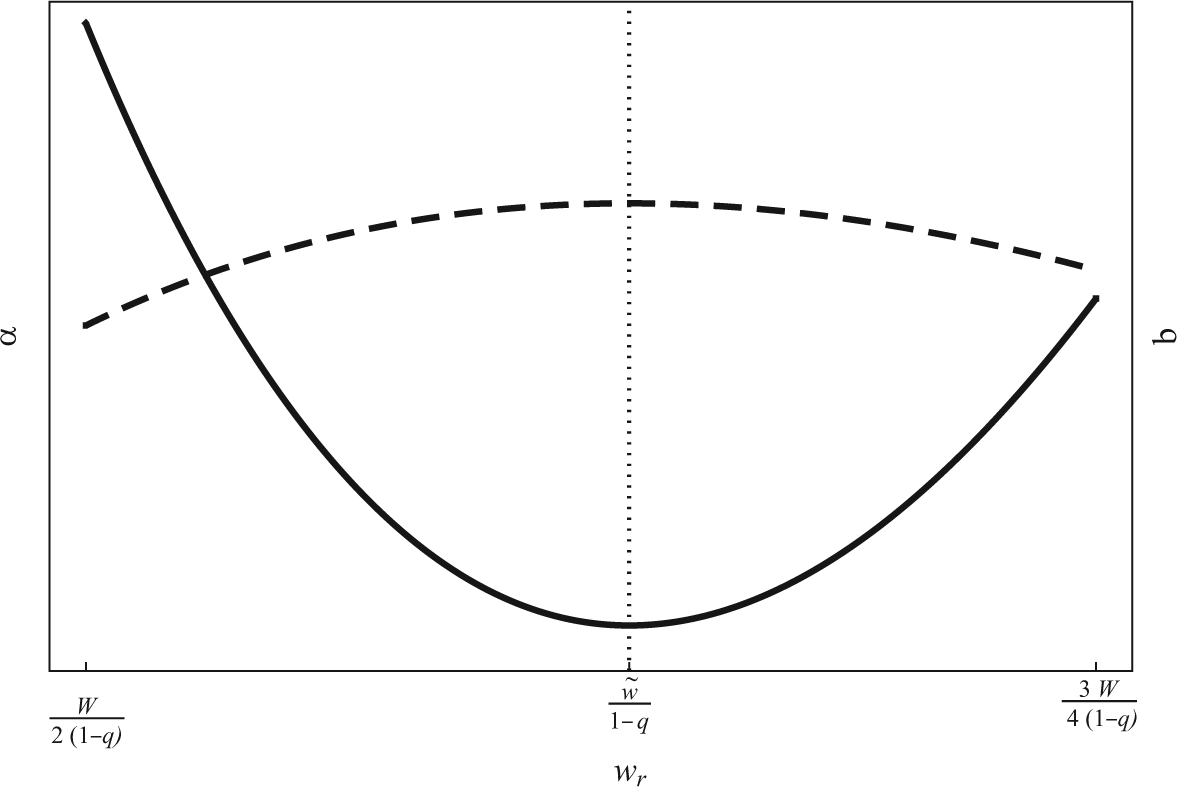
Parameters values:
The set-up studied in this paper provides an additional rationale for the empirically documented U-shaped relationship between inequality and redistribution. As in Bénabou (2000) and Rodriguez (2004), this is a consequence of a higher level of participation by the rich in the political process. 12 However, in this paper, the influence of the rich is unaffected by the (in)efficiency of taxation as in Bénabou (2000) or the availability of quid pro quo contributions or bribes as in Rodriguez (2004). It is a result of the capacity of the rich to sway public opinion and impose a cost on the government through a press campaign or grassroots mobilization. 13
6. Conclusion
This paper analyzes a government’s fiscal decision when the rich can engage in a political conflict. A political conflict is costly for the rich and the government, and it can sway public opinion and force the government to abandon his fiscal project. I show that the marginal disutility of taxation for the rich is a key variable in understanding the government’s tax proposal. When it is high, the risk of political conflict is high, and the government compromises by proposing a very moderate increase in taxes (or no change at all). When it is low, the risk of political conflict is low, and the government proposes his ideal tax policy. This model highlights a new role for a parliamentary opposition. The ability to form a coalition with the opposition is Pareto-improving. It also provides an additional rationale for the empirically documented U-shaped relationship between inequality and redistribution.
Even though the focus of this paper is on the ability of the rich to influence fiscal decisions, the mechanism highlighted might apply more generally. For example, during the debate on President Clinton’s healthcare reform in 1993, several special interest groups spent millions of dollars in advertising to influence public opinion (for example, the ‘Harry and Louise’ ad by the Health Insurance Association of America). Extending the set-up to study special interest groups’ influence more generally is left for future research.
Footnotes
Appendix
I first introduce some notation. Denote Vr (b, ar) the expected utility of the rich (over the outcome of a political conflict) as a function of the government’s tax proposal b ∈ [0, 1] and their decision to start a political conflict ar ∈ {0, 1}. Denote Vg(b,ao) and Vo(b,ao) the expected utility of the government and the opposition respectively (over the probability of a political conflict and its outcome) as a function of the government’s tax proposal and the opposition decision to accept to form a coalition. The following conditions define an SPNE in pure strategies of the extended game. 14
C1: The rich start a conflict (ar = 1) if and only if: Vr(b,1) ≥ Vr(b,0),
C2: When ao = R, the proposal chosen by the government is bR such that: bR ∈ arg max b∈[0, 1] Vg(b, R)
C3: The opposition accepts (ao = A) the government’s offer b C if and only if
C4: The government offers bC = bA ∈ arg max b∈Yo Vg(b, A) if and only if: Vg(bA ,A)≥ Vg(bR ,R); or else he proposes bB ∉Bo.
Given the timing and outcomes, the government always proposes b ≥ τsq. The expected utility of the rich is, after rearranging
When the rich start a political conflict (ar = 1), with probability p, the government is forced to abandon his fiscal proposal and the status quo tax rate is upheld. The gain from starting a political conflict is thus αp(b − τsq). The cost of a political conflict is cr. This cost is the private information of the rich. Therefore, from the government and opposition’s perspective, the probability of a political conflict as a function of b is
The expected utility of the government and the opposition are respectively.
Proof of Proposition 1: First, notice that the government never chooses b > τg since it leads to a lower payoff than b = τg and weakly increases the risk of political conflict by equation (9). Furthermore, under the assumption k ≥ (1 − p) (τg − τsq), conflict never occurs with probability 1 on the equilibrium path. We can thus rewrite equation (10) as
The function Vg (b, R) is strictly concave in b. Therefore, there exists a unique maximum in b ∈ [τsq, τg]. The result follows from taking the first order condition with respect to b.□
Proof of Lemma 1: I show that there exists
Notice that Vo(b,A) < Vo(b,R) for all b since β > 0. Furthermore, when b
* = τsq,
Consider the function f(b) = αp
2(b − τsq)2 − b. This function has a unique minimum
Suppose
The reasoning above implies that the opposition rejects any b
C such that b
C > b
* whenever
Proof: By Lemma 1 and equation (13), Vo(b,A) = αp 2(b − τsq)2 − b +τo − αp(b − τsq)(βk + z) for all b ∈ Bo. Hence, bo is the smallest solution to the quadratic equation: Vo(b,A) = Vo(b *,R).□
Proof: The government proposes b C = bo to form a coalition if and only if
From the definition of bo (Lemma 3), we know that
Plugging equation (17) into equation (16), we obtain Vg (bo,A) ≥ Vg(b *,R) ⇔αp(b* − bo) k − αp(bo − τsq) z ≥ 0□
Proof: [Proof of Proposition 2] Observe that when z = 0, then equation (15) is always satisfied since b
* ≥ bo. Furthermore, from equation (14), when b
* = τsq, then bo = τsq. Therefore, equation (15) is satisfied for all
First consider the case when α <
Suppose now that α ≥
The solution to the equation ξ(α) = 0 is equivalent to
The proof of point i. is by contradiction. Suppose ξ(
To summarize, the reasoning above implies that either 1)
Proof of Proposition 3: When the government proposes b
C∉Bo, he gets Vg (b
*, R) therefore he is as well-off as when a coalition is impossible. By Definition 1, the government is better off when he forms a grand coalition, i.e. for all α ≥ α
*(z). By the proof of Proposition 2, he is strictly better off for all
Proof of Lemma 2. b
* is weakly decreasing with α by inspection of equation (3) (strictly for
Proof of Proposition 4: The proof follows from the reasoning in the text and Lemma 2.□
Acknowledgements
I thank Scott Ashworth, Ethan Bueno de Mesquita, Jean-François Laslier, Pablo Montagnes, Richard Van Weelden, one anonymous referee, and especially Roger Myerson for their helpful comments. All remaining errors are the author’s responsibility. I wrote this paper while a graduate student at the University of Chicago.
Declaration of Conflicting Interests
The author(s) declared no potential conflicts of interest with respect to the research, authorship, and/or publication of this article.
Funding
The author(s) received no financial support for the research, authorship, and/or publication of this article.