




Abstract
When do voters win? We derive conditions under which a democracy will produce policies that favor the voter over special interests in a setting where politicians can be influenced by contributions from special interests, and are also motivated by electoral incentives. We show that increasing office holding benefits, increasing political competition, decreasing potential rents to special interests, and increasing the salience of policy imply improved policies for the representative voter. We examine panel data on the ratio of taxes paid by individuals relative to corporations in the United States and show that it is negatively correlated with political competition, office holding benefits, and policy salience, as predicted by the model.
1. Introduction
The “Occupy” movement that began in 2011, spanning six continents and over 80 countries, served to redirect attention to the potential failure of democracies to produce policies that benefit the representative voter (Rogers, 2011). The debate was framed as the “99%” versus the “1%,” and specific examples of the “1%” influencing policy at the expense of the “99%” are not hard to find. For instance, consider the recent debate surrounding minimum wages in Buffalo, New York. Voters lamented that while labor organizations can lobby for an increase in the minimum wage, their influence is small relative to the significant leverage that corporations and other lobbyists have. As such, they called for a Fair Elections system that would diminish the “‘massive influence’ that campaign contributors such as corporations and lobbyists have over public policy decisions” and “leave candidates to work on behalf of their constituents’ interests” (Williams, 2012). A similar sentiment was expressed regarding consumer protection regulations for medical devices. Venture capitalists spent tens of thousands of dollars lobbying to ease medical device rules in a way that alarmed patient advocates (Meier and Roberts, 2011).
Polls have also suggested a widely held belief that firms and special interest groups influence policies at the expense of the representative voter. Consider campaign spending, which is one type of contribution special interest groups can leverage. In the 2012 Associated Press-National Constitution Center Poll, more than 80% of Americans wanted limits on special interest election spending, fearing that special interest groups could “buy” public office (Sherman, 2012). 1 The goal of this paper is to provide the simplest model to capture the tension that can arise between voters and special interest groups to better understand conditions that affect the ability of a democracy to produce policies that benefit the representative voter.
We build on extant research examining the strategies of special interest groups in buying favorable policies. For example, Grossman and Helpman (1994) argue that firms compete to “buy” trade protection through lobbying. Absent in this body of research is the voters’ capacity to use electoral incentives to limit the influence of special interests. To fully understand under what conditions lobbying or other forms of contributions are problematic for voters, these forms of influence need to be simultaneously considered with the effect of electoral incentives. This paper addresses this research gap.
We consider a model with competing politicians who wish to be elected, the voting population, and a special interest group that can benefit from policies being distorted to its advantage. For simplicity, we consider that the special interest group is a single firm. We also consider policies such that voters’ preferences are aligned. For example, they all desire the highest quantity and quality of goods at the least cost. We thus refer to the representative voter as simply the voter. Policy is single-dimensional and set by politicians who can accept contributions from the firm, but the voter only has the vote at his disposal. The voter’s and firm’s ideal points are at opposite ends of the policy space and, to fix ideas, we say the firm desires a higher value for the policy and the voter desires a lower policy. An example is that the firm desires higher barriers to entry into its industry, while the voter seeks lower barriers to entry. A firm may also desire fewer consumer protection regulations (or more regulatory freedom), while the voter seeks regulations that offer them greater protection (or less regulatory freedom). Politicians are able to commit to policy promises made during the campaign stage, and firms are able to commit to contribution schedules set prior to the campaign stage. Voters are only influenced by campaign promises by politicians. 2
The model follows the common agency approach to policy-making studied by Bernheim and Whinston (1986). Politicians are the agents who set policy, and the firm and voter are principals who compete to influence policy set by the agents. Since voters represent a large group with diffuse benefits from policy, by Olson (1965), we can assume they will suffer from a collective action problem and have difficulty organizing to make contributions to benefit themselves; hence, the only tool at the voter’s disposal is the vote. We highlight here that the ordinary voter cannot compete in the way a firm does, but the probability of obtaining the vote acts as the voter’s contribution. The voter’s contribution is valued only so much as the elected official values holding office. The value of holding office can be measured not only by salary, but by other benefits, such as travel assistance, housing, visibility, or the prestige attached to an office. 3 These are not benefits the voter can directly influence or fine-tune, hence we say that the voter has a blunt tool relative to the firm.
This simple environment delivers a rich set of theoretical results. We consider two settings: one in which the voting decision is given by an exogenous probabilistic function and one in which the voter is strategic. They deliver the same qualitative predictions on the effects of political competition and office holding benefits on the policy — the equilibrium policy is closer to the voter’s ideal point when there is more political competition (consistent with Besley et al., 2010) and when office holding benefits are greater (consistent with Di Tella and Fisman, 2004). In addition, in the model with probabilistic voting we find an interaction between political competition and office holding benefits, suggesting that each of these two variables enhances the effect of the other in achieving policies that benefit the voter. We present a simple parameterized version of the voting function that captures the influence of policy salience. We find that the equilibrium policy is decreasing in salience, suggesting that activities such as boycotts, or demonstrations that indicate voter sensitivity, lead to policies that favor the voter. In the version with strategic voters we show that the equilibrium policy is increasing in the potential rents to the firm. Further, this model demonstrates that we should not expect all profits from firms to be dissipated through rents, as the firm needs only match the expected value of the office to the politician, and in some cases chooses to opt out as their participation constraint is not met.
A complete empirical test of the model is outside the scope of this paper, but we present interesting correlations in the data that may be explained with our theory. From the model we expect policy to be more favorable to the voter as office holding benefits, political competition, and policy salience increase. We examine office holding benefits measured by state governor salary, and we use as a measure of policies the ratio of taxes collected from wage income to taxes derived from corporate income. Given there are only two major parties, political competition in the US is measured in accordance with Besley et al. (2010), which captures the appropriate intuition if close races require greater contributions. For policy salience we use aggregate protest data by year as this may indicate how sensitive voters are in a given year. 4 We find that office holding benefits, in particular, are significantly positively correlated with policies the the voter prefers, and are robust to the inclusion of several controls. This suggests salaries of elected executives may have a significant impact on enhancing the power of the vote.
Besley and Coate (1998) were one of the first to formally articulate how political failures can arise in a democracy driven, in part, by the uncertainty of elected officials remaining in power. Besley and Coate (1998) show in a dynamic setting that economically efficient policies may not be selected by political actors. Caselli and Morelli (2004) discuss the potential for low-quality (in competence and honesty) officials to be elected. They find that low-quality citizens have a “comparative advantage” in pursuing elective office, bad politicians generate negative externalities for new ones, and there is path dependence in the quality of government. Grossman and Helpman (1996) demonstrate a political inefficiency that results when some voters are uninformed about characteristics of candidates. Baba (1997) shows that inefficient policies may result when voters have limited information on policies. In this paper we show yet another source of failure in a democracy that is driven by the inability of voters to “match” the contributions of special interest groups, simply because the only tool at their disposal is a blunt tool — to vote, or not to vote. We do this in a model that does not rely on dynamics, asymmetric information, or voter preferences for candidates to better understand the levers voters have at their disposal. We show theoretically that office holding benefits, political competition, and policy salience are potential levers voters have to bolster the value of the vote.
While the role of elected officials’ salary has been studied in previous work, its role in bolstering the effectiveness of the vote has not been documented. Besley (2004) highlights the role of salaries in the elected official’s moral hazard and adverse selection problems, while Di Tella and Fisman (2004) document the “reward for performance” role of governor salaries. In more recent work, Finan and Ferraz (2011) demonstrate the importance of financial incentives in the selection and performance of public officials, and Dal Bó et al. (2012) demonstrate that higher wages attract better candidates. One of the main contributions of this paper is to highlight the role of office holding benefits in giving the voter more power in competition with special interests. The reason it gives voters more power is because it makes the elected office more attractive. When the office is more attractive, politicians place more weight on being elected and thus value voter preferences more than contributions. Thus, once elected, these officials have a greater incentive to select policy in line with the voter’s interests. We provide a simple model that demonstrates this channel.
This paper is closest theoretically to the Grossman and Helpman (1996) framework, but we assume all voters are informed. As such, political contributions do not improve candidates’ chances of winning elections. Here parties benefit directly from political contributions, and do not care about policy per se; parties benefit from policy only to the extent that it guarantees them the vote. The model we present also builds on Besley et al. (2010), but in our model, the participation constraint of the firm to make contributions is where we derive the main results. This participation constraint is not considered in Besley et al. (2010) as they are highlighting the effects of political competition. Here the firm’s participation constraint is important in determining the ability of the firm to “outbid” the voter. Moreover, the intuition in our model for why political competition increases the likelihood of policy that benefits the voter is slightly different from Besley et al. (2010). In this paper, the existence of multiple parties (or candidates) implies that the firm must satisfy all candidates running for election, otherwise a competing candidate with no incentive to do the firm’s bidding will have an incentive to set policy closer to the voter’s ideal policy and win the election for sure. Hence more competition implies more candidates that need to be “bought” to ensure the firm achieves its ideal policy.
The model we study takes the perspective that special interest groups can buy policies with contributions. This may not necessarily be the case in practice. Indeed, Ansolabhere et al. (2003) identify a discrepancy between the volume of contributions made by firms (and other special interest groups), and what would be predicted by standard models. Bronars and Lott (1997) suggest that firms and special interest groups may contribute to a candidate that values the same things they do, not because they intend to influence policy. Bombardini and Trebbi (2011) and Wolton (2013) argue that special interest groups have multiple channels of influence. We do not assert in this paper that firms use contributions solely to influence policy. Rather, we ask, conditional on policy being influenced by contributions of firms or special interest groups (as is popularly believed), how does this channel of influence interact with the voter’s source of influence —the vote?
The remainder of the paper is outlined as follows. In Section 2 we provide a simple model of policy-making with a single voter, a firm, and K politicians. Section 3 considers the model where voting is probabilistic to capture the idea that uncertain events affect electoral outcomes. Section 4 considers that the voter acts strategically. In Section 5 we consider testable implications of the model and present state-level panel data from the United States that is consistent with our predictions. We conclude with a discussion of the results of the paper and suggest directions for future research.
2. Model
We present a stylized economy consisting of a single voter, a single firm, and K political parties. It is assumed that the voter cannot organize to make political contributions, so he only has the vote at his disposal to sway politicians to set policy in his favor. The policy is given by ρ ∈ [0, 1]. We view ρ as a policy that benefits the firm at the expense of the voter, hence ρ = 1 is the firm’s ideal policy. The voter’s utility u(ρ) is strictly decreasing in ρ, hence ρ = 0 is the voter’s ideal policy. As an example, consider that ρ is a policy that raises barriers to entry into an industry, and ρ = 1 corresponds to no other firm having the ability to enter (i.e. the firm acts as a monopoly).
Denote the firm’s net of contribution profits as Π. This is given by

where π(ρ) is the firm’s gross profits from policy ρ and Lk
is the firm’s contribution to party k. We normalize π(0) = 0 and denote
Assume the voter is not organized, and as such cannot lobby, and the firm’s vote is negligible relative to the voter’s. The interpretation is that in an economy with many voters, the policy corresponds to one in which the voters’ ideal points are close relative to the firm’s, hence all voters would vote similarly, and the number of voters is much larger than the single firm. This interpretation captures the sentiment, for example, of the recent “Occupy” movements, where the “99%” is represented by the voter, and the “1%” is represented by the firm.
Each party k maximizes

where μk
is the probability of being elected and Φ is exogenous office holding benefits. Assume that if a party campaigns on a platform ρk
, then it can commit to implementing this after the election. Let
The timing of the game is as follows. The firm chooses a contribution schedule for each party Lk (P). We assume firms can commit to their contribution promises. Each party then chooses a policy platform ρk . Contributions are made prior to elections contingent on the policy platforms ρk . Elections then take place and μk is the probability with which the voter votes for party k given the set of platforms available P. Finally, the policy of the winning candidate is enacted.
In the next section we characterize the policies arising in equilibrium assuming the voting function is exogenous and probabilistic. In Section 4 we consider that voting is strategic and show that the main results are robust.
3. Probabilistic voting
In this section we consider that there are many factors influencing the vote; hence, the probability of party k being elected is given by the exogenous voting function μk (P). 5 Party k’s probability of election depends not only on the policy platform selected by party k, but also by the platforms selected by all other parties. The voting functions satisfy the following assumptions.
twice continuously differentiable in all arguments;
strictly decreasing in ρk

strictly concave in ρk

symmetric, in the sense that if ρj
= ρk, then μk
= μj
, and
We define a subgame perfect equilibrium below.
Each party chooses a policy platform to maximize its expected payoff, hence

for all k, and all ρk , given L*(P).
L*(P) maximizes the firm’s expected profits E[Π(ρ)].
3.1. Characterization with probabilistic voting
We solve by backward induction. We consider the parties’ problem and then the firm’s problem. Party k chooses

By Assumption 1.1, voting schedules are differentiable. We focus on equilibria in which the firm chooses contribution schedules that are differentiable and such that the parties’ problems are concave. This implies that (1) is a concave optimization problem, the solution to which is unique and given by the first order condition

The first order condition conveys the simple intuition that when parties choose policy platforms they do so to ensure the marginal gain in contribution from the firm equals the marginal loss in the expected gain from office. The expected gain from office is the probability of being elected weighted by the office holding benefit Φ. Note this is the only condition parties care about when choosing policies. Hence when a firm designs contribution schedules, they internalize that this is the only condition that will influence the parties’ choices. The firm chooses contribution schedules to maximize expected profits, and hence

We focus on “truth telling” schedules as in Grossman and Helpman (1994), which implies that at the equilibrium policy, the optimal schedule satisfies the first order condition with respect to ρj

Substituting in condition (2) gives

Given that the parties’ decision does not depend on

The firm’s optimal contribution schedule will induce all parties to choose the same policy.
6
This implies that at the equilibrium policy,

Condition (3) says that at the equilibrium policy, the expected change in the firm’s profit is just equal to the expected loss in office holding benefit to the party. Voting probabilities must sum to one and the sum of the derivatives with respect to the policy ρj must be zero. That is

Substituting into (3) gives

By Assumption 1.4, voting functions are symmetric, and hence

Combined with equation (4), this gives the equilibrium policy platforms. These are summarized below in Proposition 1.

for all k = 1,…,K.
Condition (5) pins down the equilibrium policy ρ* as a function of the number of parties, the voting function, and the office holding benefits. The equilibrium policy is such that the marginal increase in the firm’s profit is just equal to the marginal decrease in a single party’s expected office holding benefit, which depends on the total number of parties running for election. In the next section we provide some comparative statics.
3.2. Comparative statics
We wish to know how the equilibrium policy behaves with respect to the office holding benefits Φ and number of parties K. The first proposition gives these relationships.
the equilibrium policy is decreasing with office holding benefitsΦ
the equilibrium policy is decreasing with number of parties K;
the interaction between office holding benefits and political competition is negative in the sense that

Henceforth, all proofs are in the Appendix. Intuitively, Proposition 2 parts a and b state that an increase in K (which can be interpreted as an increase in political competition) leads to policies that benefit the voter. Perhaps a little more surprising is that an increase in office holding benefits Φ also results in policies that benefit the voter. However, this too is intuitive, since increasing the parties’ desire for office increases their willingness to make policies in favor of the voter to guarantee being elected.
How do office holding benefits affect the impact of political competition on equilibrium policy? In other words, what is the interaction between political competition and office holding benefits? Part c of Proposition 2 says that the cross partial derivative of political competition and office holding benefits is negative. When there is more of one factor (office holding benefits or political competition), an increase in the second factor leads to a larger decrease in equilibrium policy (and hence a larger increase in voter utility). In other words, this means that greater political competition increases the effectiveness of office holding benefits in giving the voter power.
The final theoretical result is regarding salience of the policy, or the sensitivity of the vote to changes in policy. 7 Consider the voting function given in Assumption 2.

with 0 < s < 1.
Notice this voting function satisfies Assumption 1. Furthermore, given the equilibrium policy is the same for all parties, we have
The intuition is that if there is a policy that voters are sensitive to, they are likely to shift a greater probability of their vote toward other candidates if these other candidates deviate from the equilibrium policy. This implies that the firm’s contributions must overcome this increased effect, hence diminishing the impact of the firm’s lobbying. In equilibrium, when salience is higher, the policy is closer to the voter’s ideal. This suggests a channel through which activism has an impact. If policy-makers and firms interpret greater activism as greater salience, activism implies better policies for voters.
We now present the model with strategic voting and show that the comparative statics with strategic voting are consistent with Proposition 2.
4. Strategic voting
This section assumes that the voting function is endogenous and determined by the voter’s strategy. We present this strategic voting model to demonstrate the robustness of the results for the model with an exogenous probabilistic voting function.
The term μ*(P) maximizes the voter’s expected utility, E[u(ρ)], where

Each party chooses a policy platform to maximize its expected payoff, hence

for all k and all ρk , given L*(P) and μ*(P).
The term L*(P) maximizes the firm’s expected profits, E[Π(ρ)], given μ*(P).
We characterize subgame perfect equilibria by backward induction. We begin with the voter’s strategy. Voters wish to maximize Eμ [u(ρ)]. Since u(ρ) is strictly decreasing in ρ, in equilibrium, voters vote for politicians that minimize the distance between their ideal policy, ρ = 0, and the policy platform ρk . Denote the electable candidate set κ as the set of parties whose optimal policy platforms are an element of the set of minimum policy platforms. So

The following lemma states that the voter will place probability zero on any candidate who is not a member of the electable candidate set.

The proof is straightforward. The equilibrium voting schedules for parties in the electable set will depend on the tie-break rule. Here we will allow for any tie-break rule, hence the results are robust to the voter being biased towards a particular party in the electable set. The voter’s equilibrium voting schedule can be summarized as

Given the voting strategies, we now characterize the parties’ strategies. Party k chooses policy ρk
to maximize its objective Gk
(ρk
, ρ
−k
). Given μ* characterized above, party k’s payoff is

for all other ρk . Party k’s equilibrium policy will depend on the firm’s contribution schedules, which are characterized next.
The firm will make contributions to maximize expected profits, given a party’s probability of being elected. Expected profits are given by

To maximize expected profits the firm will not contribute to parties that are outside the electable set. Given Lemma 1, the firm knows that any candidate in the electable set has the same policy,

for any



Lemma 2 demonstrates that if the firm contributes, the value of the firm’s contribution is not related to potential rents the firm can extract from the policy,
Given that parties do not value policies directly, the firm maximizes its payoff by setting

Combining the contribution value from (12) and the firm’s participation constraint in (13) gives a condition that must hold for the firm to set its ideal policy in equilibrium. This is

We fully characterize the set of equilibria below in Proposition 4.
Voting strategies satisfy

All parties select

If

The proof follows from the construction above. The equilibrium strategies predict that if
Proposition 4 is illustrated in Figure 1. As the figure illustrates, the equilibrium policy is decreasing in the number of parties K and decreasing in office holding benefits Φ, consistent with Proposition 2. Furthermore the equilibrium policy is increasing in the potential rents from the policy
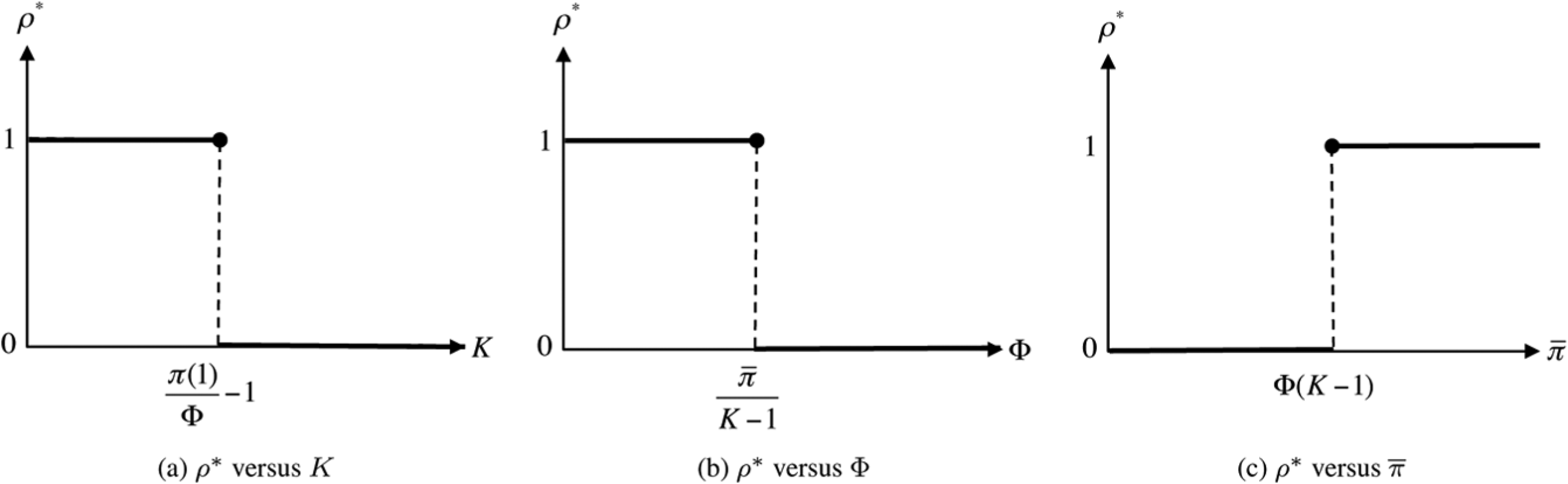
Equilibrium policies, ρ*.
The models we have presented highlight the role of office holding benefits, and political competition in bolstering the effectiveness of the vote. It is possible to test these predictions. Deterministic voting generates very stark predictions about the policy not consistent with observations. We therefore rely on Propositions 2 and 3 to guide our data inquiry.
5. Testable implications
The key predictions of Proposition 2 are that if politicians are responsive to contributions, then an increase in office holding benefits and an increase in political competition result in policies that provide more benefits to the voter. Proposition 3 says that an increase in policy salience will also result in policies that provide more benefits to the voter. These results are testable, and in this section we provide some suggestive evidence that these implications are borne out in the data. However, a complete empirical analysis is outside the scope of this paper given the lack of direct measures of office holding benefits, political salience, and policy. 10
Our key dependent variable is a policy that voters care about, generally have the same preferences over, and for which the voters’ preferences are not aligned with the firm’s. As one proxy of such a policy, we use the ratio of taxes collected from income to taxes collected from corporations. We assume businesses are able to effectively organize and lobby for special tax breaks that lower their overall tax burden, whereas individuals cannot do so in the same way. Hence, this measure captures the policy that does not benefit the representative voter relative to the firm. These relative tax burdens are likely the result of a basket of policies that can be thought of as the tax mix. We can reasonably expect firms’ and voters’ ideals to be opposed, with firms preferring that their tax burden relative to that of voters is lower and voters preferring that their tax burden relative to that of firms is lower. A nice feature of this measure is that it is a ratio, so it is easy to interpret.
Our main independent variable of interest is office holding benefit. We use state governor salaries as our measure of office holding benefits. The model reflects the importance of holding office relative to taking some other form of employment, thus we normalize governor salary by state per capita income. The ratio of governor salary to state income per capita is not a comprehensive measure of office holding benefits, as it does not consider non-salary benefits such as prestige or housing subsidies; nevertheless, it acts as an indicator of the importance of the office in the state. 11 Governor salaries (and salary increases) are often set by the legislature for a number of years. Hence governor salary in a given year is not likely influenced by the policy measure in that year, which is a good feature of this measure.
Other independent variables of interest in the model are political competition and policy salience. Political competition in the model is given by the number of parties. The United States has only two dominating parties, thus it is not possible to use variation in the number of political parties to measure political competition. We use a measure of political competition in the United States by Besley et al. (2010) that captures relative vote shares of the parties. This is an imperfect measure of political competition as modeled, but captures the model’s intuition — whether an election is competitive and requires more contributions. To measure policy salience we use an aggregate measure of protest data. We expect activities such as boycotts, or demonstrations on a given issue area, to indicate voter sensitivity, which reflects the intuition of our model; however, we are not able to disaggregate the protest data to be policy-specific, which makes this a crude measure of salience at best. A more complete empirical test would use data that more accurately reflects the model variables. However, analyses with these proxy measures provide some initial evidence supporting the model’s first order predictions.
As a first step we examine the time trend of the tax ratio and governor salaries. As can be seen from Figure 2, from the 1950s to the mid 1990s, governor salary as a fraction of state income per capita has been decreasing over time, and during that same time the share of taxes derived from income versus corporate taxes has been increasing. In other words, while our measure for office holding benefit has been declining, policy has over time become more favorable to firms with regards to tax burden.

Time trend of tax ratio and office holding benefits.
We test whether these variables have the predicted negative correlation in the panel. We estimate the following panel regression with state (αi ) and year (ζt ) fixed effects, where i denotes the state, t denotes year, and Γ it denotes relevant control variables:

We include a control for total taxes, income per capita, and the following political controls: (1) whether the state legislature is controlled by the Republican party, Democratic party, or neither; and (2) whether the Governor is a Republican, Democrat, or neither. 12 We also consider demographic controls: population, unemployment, the proportion of the state that is Black, and the state’s age make-up. 13 Per the finding in Besley et al. (2010) that large-scale changes in political competition in the US South have been strongly associated with other major economic and social changes in the South, which could be correlated with policy choices, we include a dummy for the 16 southern states as defined by the US Census alongside interactions between the time indicators and the southern states. For all analyses, we cluster standard errors at the state level, thereby correcting for correlation between the disturbances of observations within states.
5.1. Data sources
Data on state taxes collected from income and state taxes collected from corporations are drawn from the Statistical Abstract of the United States. Analyses using the tax ratio are based on data from 44 states, between 1950 and 1988. 14 For political variables we draw from two existing datasets – Besley et al. (2010) and Di Tella and Fisman (2004). As a measure of political competition, we draw from Besley et al. (2010). Governor salary data is drawn from the Book of States. We use the methodology described in Gillion and Soule (2012) to aggregate data on protests to develop an “annual salience score,” and use this score as our measure for policy salience. As the score aggregates protest activity across a broad spectrum of issues rather than our outcome measures of interest around taxation, we do not expect the aggregated protest data to be significantly influenced by our policy measure, and expect only a modest relationship. 15 However, as noted by Gillion and Soule (2012), protests can proxy for issue salience, as protests draw citizens’ attention to issues. A detailed description of each measure is provided in Online Appendix C, and Table 1 provides summary statistics.
Descriptive statistics.
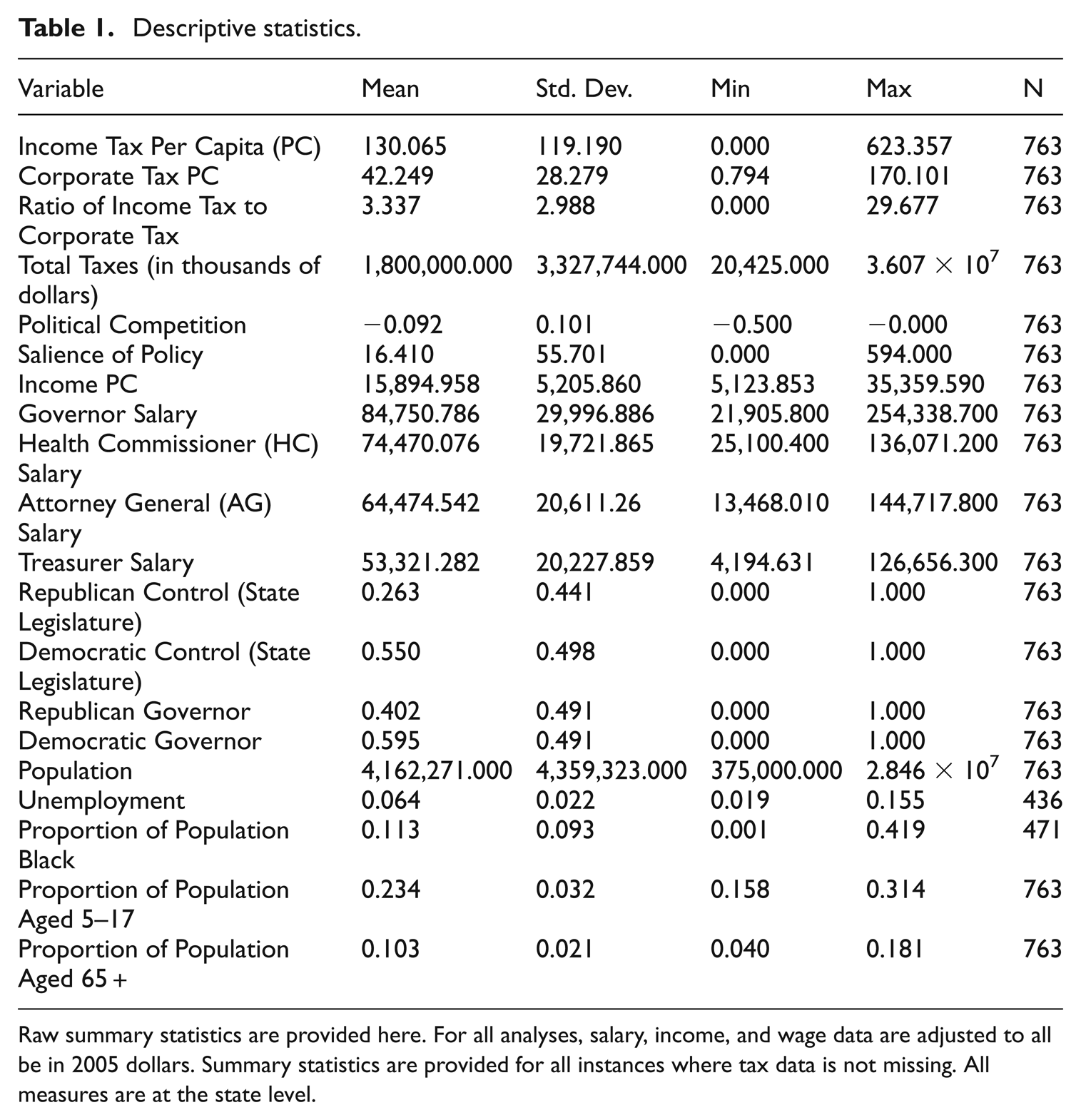
Raw summary statistics are provided here. For all analyses, salary, income, and wage data are adjusted to all be in 2005 dollars. Summary statistics are provided for all instances where tax data is not missing. All measures are at the state level.
5.2. Results
The data provides evidence in the expected direction. The Governor has a hand in setting state income and state corporate tax rates. As such, the model predicts that an increase in office holding benefits measured by governor salary would reduce the likelihood of seeing an increase in income tax per capita relative to corporate tax per capita. 16 In fact, we see that an increase in office holding benefits, measured by governor salary relative to the state income per capita, is associated with a decline in the tax ratio (β = −0.218, p = 0.04; see column (1) in Table 2). Furthermore, an increase in political competition is significantly positively correlated with a lower relative tax burden for income earners. We see that an increase in political competition is associated with a decline in the tax ratio (β = −2.940, p = 0.08; see column (1) in Table 2).
Panel regression predicting ratio of income tax to corporate tax. Dependent variable: Ratio of income tax to corporate tax.
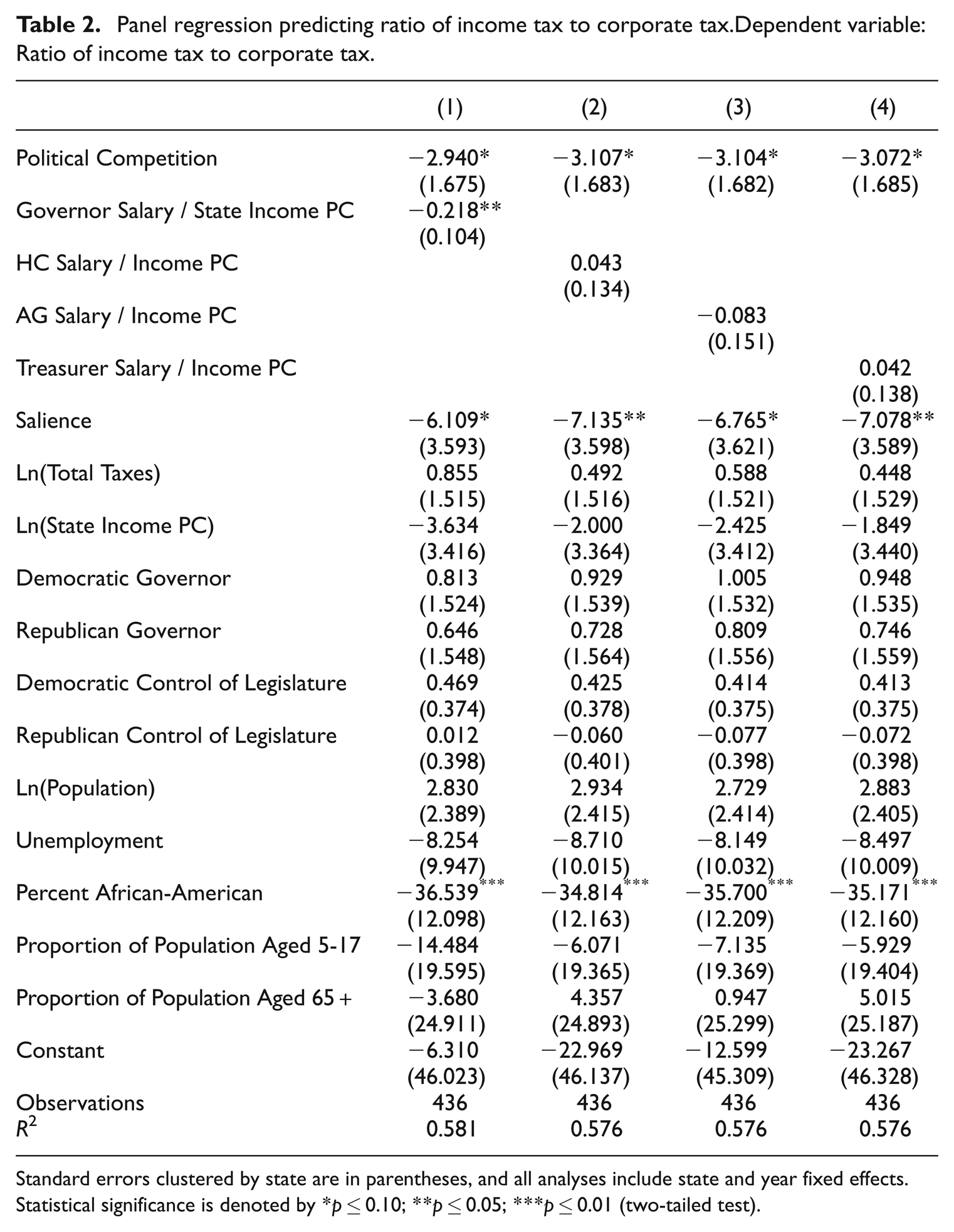
Standard errors clustered by state are in parentheses, and all analyses include state and year fixed effects. Statistical significance is denoted by *p ≤ 0.10; **p ≤ 0.05; ***p ≤ 0.01 (two-tailed test).
As a placebo check, we assessed whether office holding benefits of an elected official that would not be lobbied on the policy of interest by special interest groups predict the tax ratio. It is clear that the state Health Commissioner has no role in setting state tax rates, both income and corporate. Moreover, no voter or special interest group would mistakenly perceive that the Health Commissioner has such a role. As such, while the model would predict that the office holding benefits of the Governor would predict an effect on the tax ratio, the model would predict that the office holding benefits of the Health Commissioner would have no effect at all on the tax ratio. In fact, we see that while the salary of the Governor has an effect on the tax ratio, the salary of the Health Commissioner has no effect on the tax ratio (see columns (1) and (2) in Table 2). The effect of office holding benefits for the Health Commissioner remains insignificant with the inclusion of the political controls and demographic controls (see column (2) in Table 2). Similar results hold for the Attorney General’s salary (see column (3) in Table 2) and the state Treasurer’s salary (see column (4) in Table 2). Office holding benefits for the Health Commissioner, Attorney General, and Treasurer are never meaningful predictors of the tax ratio.
Finally, empirical analyses point to the importance of the salience of policy. 17 As protest places issues on the political agenda and makes certain issues salient, we use protest to develop a saliency score, and find that high salience stemming from political activism within a state is positively correlated with more “favorable” policies for the voter: lower relative tax burden (β = −7.135 to −6.109, p = 0.05 to 0.09; see columns (1)–(4) in Table 2).
5.3. Alternate explanations
The data on the tax ratio is consistent with our theory, but other explanations may be possible. For example, more liberal states may tax corporations relatively more and simultaneously pay governors more. If this explained the pattern in the data we might expect all government employees to be paid more, including Health Commissioner, Attorney General and Treasurer, but we do not see this effect, making this explanation less likely.
However, we have not ruled out the possibility that a lower relative tax burden, from the perspective of the voter, leads voters to be more amenable to greater office holding benefits (e.g., increases in governor salaries) as in Di Tella and Fisman (2004). That is, reverse causality concerns have not been fully addressed in the current analysis. Reverse causality is less of a concern with the political competition variable as we do not expect a lower relative tax burden to increase the competitiveness of elections. Omitted variables bias is also a possibility, but we have mitigated this to some extent with the controls used.
Finding policy instruments that can be measured and are generally supported by voters is challenging, and we acknowledge that further empirical exploration is important. The data employed in this paper are at best noisy and indirect measures of variables we are interested in, and we have a relatively small number of observations. These limitations can be addressed in future work with a dedicated data collection exercise. For example, further verification with different policies may be explored. Moreover, future research should examine a setting where there are truly multiple parties, rather than relying on relative party strength.
6. Conclusion
Extant research examining the strategies of special interest groups to influence policy outcomes miss a blunt but critical tool, the vote. This paper addresses this research gap by presenting a simple model of how a voter, a firm, and multiple political candidates all interact to produce policies. We show that increasing office holding benefits, increasing political competition, decreasing potential rents to firms and increasing the salience of policy implies improved policies for the representative voter. Moreover, there is an interaction between political competition and office holding benefits.
Examining panel data on the ratio of taxes paid by individuals relative to corporations from the United States, we find suggestive empirical evidence that support the model’s first order claims about the effect of political competition, office holding benefits, and policy salience on the policy outcome. However, we must interpret the empirical evidence with caution and future work may consider data that more directly reflect the variables of interest.
We believe this paper suggests a number of directions for future theoretical research. The model can be extended in several directions. One could consider the impact of multiple firms and assess if they help or improve the policy of the voter. One could also imagine a multi-dimensional policy, where policy makers trade off one policy for another. Finally, how does asymmetric information enter the analysis? What sort of asymmetric information improves the policy for the voter? What sort of asymmetric information hurts relative to the base-line model? This asymmetric information may be the result of institutional features.
This work adds to the discussion on “markets for policies,” with voters and firms demanding policy, and parties or elected officials supplying policy. As with markets for goods, understanding the drivers of supply and demand gives insight into understanding the efficiency of policy markets in democracies. The “Occupy” movement demonstrates that understanding how democracy works to benefit more than the “1%” is crucial for economic and political stability. We hope that researchers continue to take up these important questions.
Footnotes
Acknowledgements
We wish to thank David Baron, Jonathan Bendor, John Rapley, James Robinson, Ken Shotts, Romain Wacziarg, and conference participants at the Annual Meeting of the Midwest Political Science Association for helpful comments and suggestions. The authors are solely responsible for any errors or omissions.
Declaration of conflicting interests
The author(s) declared no potential conflicts of interest with respect to the research, authorship, and/or publication of this article.
Funding
The author(s) received no financial support for the research, authorship, and/or publication of this article.