




Abstract
For the bargaining model of war, in the absence of incomplete information and commitment problems, war is irrational. But this finding rests on a simple and rarely discussed assumption, that bargaining is between exactly two participants. When we relax this assumption, in a three-player bargaining game, war is an equilibrium. Thus, a key finding of the bargaining model, that there is always an agreement that all states prefer war, is an artifact of dyadic analysis. By removing this limitation, we can find new factors that affect the risk of war: the number of actors, divergence in state preferences, alliance dynamics, and the issue being bargained over.
1. Introduction
1.1. Motivation
In recent years, a number of international conflicts have been particularly intractable because they involve many parties. It has been difficult for the United States to achieve its aims in Syria’s civil war partially because of Syria’s close ties to Russia. The struggle over Iran’s nuclear program has been particularly fraught for the Obama administration, trying to avoid an Israeli attack on Iran on the one hand, and Iranian acquisition of nuclear weapons on the other. Militarized interstate disputes involving more than two actors are about seven times as likely (0.15 probability of war) to escalate to war as purely dyadic cases (0.02 probability) (Ghosn et al., 2004). 1 Yet despite the proliferation of cases in which multiple actors exert an effect on the outcome, our frame of analysis in international relations is predominantly dyadic. 2 There has been some discussion of the problematic statistical property of dyads, 3 but there has been less discussion of the fact that our theories of interstate conflict are dyadic.
The current dominant explanations for conflict are generated from the bargaining model of war. This model has been used to motivate empirical work on the onset, duration and recurrence of interstate and civil war; to show how factors such as economic interdependence and foreign support for insurgency lead to war; and even to explain non-conflictual phenomena such as sanctions and the international criminal court Drezner, 2003; Fortna, 2003; Gartzke et al., 2001; Polachek and Xiang, 2010; Schultz, 2010; Simmons and Danner, 2010; Walter, 1999, 2009; Werner and Yuen, 2005). A major insight of the bargaining model is that war is ex post irrational for both states; in this model, if there is conflict, either incomplete information has obscured a mutually beneficial settlement, or states are unable to credibly commit to abide by it. 4
I find that this key finding of the bargaining model, that there is always that agreement all states prefer war, an artifact of limiting the analysis to two players. 5 When there are more than two players, the players’ preferences regarding the issue will sometimes be so disparate that there is no way to reach an agreement that will dissuade all of them from fighting. In the rest of this paper I briefly discuss the bargaining model of war, I model a simple three-player bargaining game, discuss the main findings of this game, examine the equilibria of the game to show how war is possible, and discuss comparative statics generated by simulation.
1.2. Current bargaining models
The use of the bargaining model in the study of conflict has pointed toward two important explanations for war: incomplete information and commitment problems. These results have generally held as explanations for war whether bargaining is conceptualized as a state making a take it or leave it offer, as in Fearon (1995), or as a set of alternating offers, as in Powell (1999).
When there is a commitment problems, a bargain that may be beneficial to all players presently will become unacceptable to one player in the future. The shadow of the future renders conflict preferable to such an agreement (Powell, 2006). Informational asymmetry occurs because states may be poorly informed about their opponent’s capabilities or resolve (Fearon, 1995). As stronger, more resolved states receive a better outcome in a settlement, there is incentive for misrepresentation. States face a risk/reward trade-off: if the state is sufficiently accommodating, the dispute will be resolved peacefully, but occasionally, the state can do better by making a smaller offer, which will lead to war if they face an unexpectedly resolute foe.
There have been some models which expand bargaining beyond the dyad. Most of this work operates under the framework of incomplete information: they examine how additional players modify informational requirements for peace or endogenously change the games informational content. Many of these models focus on domestic constituencies affecting bargaining leverage, and the incorporation of a domestic actor generally has been found to help a state reveal their resolve, get a larger slice of the pie, and avoid war (Fearon, 1994; Putnam, 1988; Schultz, 1998). Similarly, third-party mediators are seen as ameliorating incomplete information (Kydd, 2006).
This paper steps back and examines the effect of an additional player on the simplest and most peace-prone model: a model with complete information and an absence of commitment problems. This paper’s findings stand in contrast with those of most of these models. 6 examination of the relationship between the number of rebel groups and civil war termination. Where this paper differs from Cunningham’s work is that the model in this paper concerns war onset, applies to contexts beyond intrastate war, and provides an explicit means of determining how different factors affect the likelihood of war as the number of players changes.
2. The model
2.1. Players
In this three-player bargaining model, there is a policy dispute that can be settled through either peaceful negotiation or war. Each player in the model is a state with both an interest in the disputed issue and the ability to fight to see its preferred outcome enacted. In this model, each of these states has three relevant characteristics: a preference over the disputed issue, military capabilities, and the cost associated with going to war.
In this model, in contrast to many two-player bargaining models, states are bargaining over the preferred outcome of a policy issue rather than purely distributional concerns. In two-player bargaining, the decision does not matter; in fact, the two choices are isomorphic. In Reiter’s (2003) review of bargaining models of war, he treated the two in tandem, discussing “disagreement over resource allocation and/or policy choice”. When we add in any number of additional players, the concepts diverge.
7
Each state has a preferred policy outcome, or ideal point, which I represent as a point in a one-dimensional issue space.
8
Without loss of generality, we order the states such that the ideal point for state 1,
If states choose to fight rather than to successfully negotiate, the outcome of war is a costly lottery, with the odds determined by the states? capabilities.
9
. Each state i has a capability
2.2. Sequence of play
The sequence of play is represented by the game tree in Figure 1. The game has three main stages: the generation of a policy offer, acceptance or rejection of that offer, and the decision by any non-belligerent players to join a conflict or abstain from joining the conflict.

Sequential form for three-player bargaining. The information sets represent the simultaneous decision to accept an offer or attack another player. The terminal nodes are labeled with the number of players involved in the final conflict or
A key distinction between the sequence of play in this model, and in most two-player bargaining models, is that I do not assign one of the states the responsibility of choosing the negotiated settlement offer. Rather, I exogenously generate an offer by using a decision rule chosen to maximize the likelihood of peace. Such a rule is used to prevent the results of the model from being driven by the choice in bargaining protocol. 11 In particular, the initial bargaining offer follows two rules.
If there is an offer that satisfies all three players and that leads to a peaceful outcome, choose the median of these successful offers.
If no offer exists that satisfies all three players, offer a policy equivalent to the median player’s ideal point (
We could think of this as the offer being made by an unbiased mediator whose only interest is to avoid war. Alternatively, one could think of this as being analogous to the role of the auctioneer in a Walrasian market equilibrium, a player whose only interest is to maximize the efficiency of the outcome.
Once the initial offer is made, each state simultaneously chooses whether to accept the offer and remain peaceful or to reject the offer by attacking one of the other players. If each player chooses to accept the offer, the game has a peaceful and efficient outcome and each player receives utility based on the distance between the initial offer x and the respective ideal point. Thus, for state i, the utility from accepting x is

If the offer is rejected by at least one player, the outcome of the game will be war. In particular, the game will end in a war involving all states that either attacked another player or were attacked. If all three states are participants in the war (for example, because states 1 and 2 both attacked state 3 or because state 1 attacked state 2, which attacked state 3), then state 1 (for example) will receive the following utility from a conflict involving all players:

or unity less the distance between state 1’s ideal point and the other states’, weighted by the probability that each other state will triumph, less the cost of war to state 1.
If all three states are involved in war, the game terminates; similarly, the game ends if all players accept the initial offer. However, if only two players are involved in conflict, the third player can choose to either join the conflict or stay out of it. I allow for this additional decision to allow for potential dynamics of deterrence in the model. For example, if the United States is willing to accept an offer concerning the Taiwan Strait rather than fight but if China would prefer a dyadic war with Taiwan, I would like the model to be able to capture the ability of the United States to deter China with the threat of a three-party war. Given that joining a conflict is an additional decision, states can include calculations about the actions of a third player when deciding whether they prefer war to the proffered settlement. If the third state joins, the outcome is as discussed above, that is, a general three-player war, whereas if this state stays aloof and refuses to join, the outcome will be a dyadic war. The utility for a participant in the dyadic war (between state i and j) is as follows:

While the excluded player does not fight, it is still affected by the outcome because of its concern in the disputed policy. The utility for the uninvolved state (player l) is

Three assumptions merit discussion for the sequence of play in this game: the informational environment, the commitment technology used, and the possibility of alliance dynamics if all three players are involved in conflict.
This game is one of complete information: players are fully informed of every other player’s capability, preference, and cost of conflict. This assumption is not made because of any belief that informational issues do not matter. In fact, one could argue, as Cunningham (2006) and Esteban and Ray (2001) do, that the severity of informational issues increases as the number of players increases. Rather, I assume perfect information to demonstrate that even when the normal mechanisms for war are gone, we can still have conflict in three-player bargaining. Similarly, I attempt to minimize the role of commitment problems. In this game, there is no shadow of the future affecting the players’ decisions, and they are blessed with perfect commitment technology: if the players are able to agree to a compromise, this compromise will take place with perfect enforcement. Now, it is true that when viewed through a dyadic lens, there may be mutually agreeable settlements that two states cannot commit to, but this is less because either state has an incentive to renege on the agreement and more because the third party may attack and spoil the agreement.
If all three states are involved in a war, the war will be modeled as one of “all against all”. Each state will have an independent probability of triumph and associated utility. One could argue that the model ignores coalition dynamics: two states with similar preferences might decide to work together to ensure a mutually beneficial outcome. This is less of an issue precisely because of the decision to model bargaining as the determination of a policy on a policy space. If two players have very similar preferences, they effectively form an endogenous alliance: if either of them were to win, they would set the policy to their ideal point, and both members of this pseudo-alliance thus would be happy. However, alliances may actually be more effective than they appear just from looking at their combined capabilities. Thus, I also examine an extension to the model in which states formally choose sides and members of the two-state alliance have an additional likelihood of defeating their lone opponent. This model is somewhat more complicated, but I can show that unless the added benefit of fighting in an alliance is particularly large, the allianceless model’s main results will hold.
3. Some findings from three-player bargaining
In a two-player bargaining game with perfect information and an absence of commitment problems, the core result is quite simple: both players will always accept a peaceful settlement. The results of three-player bargaining are not so simple. In particular, there are three major results that warrant discussion: the existence of cases where no possible settlement is preferable to dyadic conflict, the existence of cases where dyadic war is the outcome and the third actor chooses not to intervene, and the existence of equilibria where all players fight.
3.1. Offers, dissatisfaction, and dyadic war
In this three-player bargaining game, states are confronted with an initial choice: accept a compromise, or fight a dyadic war. In canonical two-player bargaining games, offers that causes all players to reject violence and settle peacefully will always exist. This remains true in this model if you simply remove one of the three players. In the two-player variant of this model, state 1 will accept an offer if it preferable to her outside option and thus

implying that
When we introduce a third player, each player gains an additional target for attack and, thus, an additional outside option. The introduction of a third player renders it more difficult for an offer to be preferable to dyadic war. State 1 will prefer to accept an offer x rather than fighting states 2 and 3 if and only if

and

Therefore, player 1 will accept x only if

We denote the set of values of x that can satisfy equation (8) as

The range of values for x in equation (9) is denoted

which is henceforth referred to as
For notational purposes, we denote the set
It is not possible to satisfy the minimal demands of all three players for some parameter configurations. In these cases, the equilibrium outcome will be war. This proposition does not necessarily imply that war will be the outcome of the game; the utility of war will be conditioned on whether the excluded player (the player who is not attacked by the dissatisfied paper) intervenes. What the proposition does show, however, is that there will not always be a negotiated settlement that is jointly preferable to particular dyadic wars.
We prove existence here by demonstrating one case where the three constraints cannot hold simultaneously. For a more complete list of cases, see Section 1 in the technical appendix.
Consider a conflict between equation (8) and equation (9) and, in particular, consider the cases where player 1 is considering attacking player 2 and player 3 is considering attacking player 1. In other words that
For certain values of

This will hold, implying existence for Proposition 1.1 if
Of course, this does not mean that compromise will always be inferior to dyadic conflict. For many values of
Proposition 1.2 is the complement of Proposition 1.1, showing that for some constellations of parameters we can satisfy the minimal demands of each player and avoid war. Proving Proposition 1.2 requires that I find a set of values such that constraint (11) does not hold, and this only involves sufficiently large values of
3.2. Entering a dyadic war
In those cases where we there is a set of parameters such that no offer is jointly preferable to dyadic war, we then want to examine whether such a war is a possible equilibrium outcome. We would like to know whether the excluded player will enter a dyadic war (making it a general war) or abstain, causing it to remain dyadic.
If player 1 and player 2 were fighting, player 3 would enter the conflict if and only if

which can be rewritten as

To understand the dynamics of bargaining, we are primarily interested in the players’ choices to enter the conflict when rejecting an offer is rational and when they are on the equilibrium path, that is, when
This proposition shows that in some cases, the equilibrium of the game will be such that two players fight, and the third player does not. To demonstrate existence, we again turn to the case where

and for player 3, the inequality is described in equation (13). We are therefore looking for a set

To show that values of

Thus, existence is proved for Proposition 2. Further, we have proved the existence of equilibria for
3.3. Joiners, deterrence, and general wars
We finally consider the set of cases where a player would be willing to enter a dyadic conflict, and determine whether the willingness of the third player to enter a conflict will always lead to successful deterrence and peaceful equilibria or whether it will allow for equilibria in which all three players are involved in conflict.
When

but if player 3 would play join in this circumstance, player 1 will accept any offer x such that

We call the range of values acceptable to player i if player j would play join
14
This proposition posits the existence of constellations of parameters such that all three players will end up involved in conflict in equilibrium. To prove existence, we again return to our case where

There exist sets of parameters



These constraints can be satisfied,
15
and thus we have shown existence for Proposition 3. Nature offers
We complete the set of possible outcomes with Proposition 3.2, which concerns the existence of equilibria where no offer is preferable to dyadic war but the willingness of players to join the conflict ensures that the final outcome is peaceful.
This proposition will hold in the case above whenever constraint (11) is satisfied, but constraint (22) is not or when

The precise algebra needed to reduce these constraints is involved, but one can ascertain that the set of values for
These propositions lead to four possible types of equilibria, which can all exist depending on the value of
3.4. Extension: formal alliances
In the model of bargaining presented in this paper, if all three players fight, they each fight independently. I believe that this has been a defensible decision because similar preferences would in effect create endogenous alliances. However, alliances might offer benefits that make them more than the sum of their parts. Thus, we could model a conflict with all three players as a potential conflict between two alliances. In this section, I modify the final stage of the game to give an advantage to states that are fighting together and a disadvantage to the state fighting on its own. In particular, if all three players choose to fight in the first stage and if two players choose to attack the third player, they are in a de facto alliance and have an advantage in their probability of victory. Similarly, if only two players are involved in conflict in the first stage, in the final stage of the game, the excluded player may choose to do nothing (leading to a dyadic war), to enter as an independent state (leading to a war of all against all) or to enter by attacking either player (leading to a war of one state against an alliance).
The only difference in utility functions in this model is encapsulated by the term
When
If most of the benefits of an alliance are simply the additional material capabilities that can be brought to bear against a common foe, then
In the next section, I discuss the equilibria more substantively and then examine comparative statics through simulations helping to explain when the outcome will be violent or peaceful.
4. Equilibrium analysis
If this model involved two players bargaining over a disputed issue, there would be a unique equilibrium: peace. The inclusion of a third player substantially increases the variety and violence of possible outcomes. In the game with three players, there are four types of equilibria: peace due to agreement on the policy or successful deterrence and wars due to sufficiently divergent preferences where deterrence is absent or fails. In this section, I examine each equilibrium once I introduce a third player. Then, I discuss the comparative statics and takeaways from this model.
4.1. Equilibrium 1: peace through similar interests
A key difference between two-player bargaining and bargaining with additional players is the proliferation of outside options. In the two-player game, there is only one target to attack if a proposal is rejected; if one adds an additional player is added to the bargaining process, an additional potential war is possible. Furthermore, there are two other players who each have two such options. Thus, instead of two inequalities to satisfy, there are six. Whereas the policy range that players 1 and 2 found acceptable in the two-player game shared the same center, the expected policy outcome of a war between players 1 and 2, there may be no equivalent point of overlap in the range of policies that player 1 prefers to attacking player 2 and the values that player 3 prefers to attacking player 1.
Yet, just because a peaceful overlap of preferences is not guaranteed in a three-player bargaining game does not mean that it cannot exist. The existence of this type of equilibrium was shown in Proposition 1.2.
We see an example of this type of equilibrium in Figure 2. Here, a range of policies preferable to any possible war exists. The key difference between this equilibrium and the equivalent one in the two-player game is that this zone of agreement is not assured, and when it exists, it is significantly smaller and more constrained. When the cost of war is sufficiently high or when player preferences are sufficiently similar, we will see peace because each player finds a given compromise less painful than fighting for a better one. We might see an example of this equilibrium when we look at policy disputes among allies: Germany and France might have a markedly different ideal policy concerning spying by the NSA on foreign governments than does the United States, but the importance of this issue is subsumed by their desire to keep reasonably good relations with their ally. Thus, the cost of war would dwarf any potential benefits of achieving better espionage policies.

Bargaining space in a three-player game where harmony is possible: each line indicates the bargaining space of one player with another player. The player prefers war to the gray areas on the bargaining space, and prefers the black areas to war. The red area is the point of overlap between the six bargaining spaces. Note that this assumes no player will intervene in a conflict. Also note that these bargaining spaces are results of the following set of parameters:
4.2. Equilibrium 2: war due to disparate preferences, lack of deterrence
Our second equilibrium is a violent one. The intuition here is that the distribution of preferences makes it impossible to satisfy everyone. We could view this as the bargaining space becoming endogenously indivisible: any bargain that would satisfy two of the three players is worse than war for the third player and is thus unrealizable. In this equilibrium, the excluded player also prefers not to join the conflict. The range of policies each player prefers to dyadic conflict is disjoint, and once a dyadic conflict begins, the conflict does not grow larger. The existence of this type of equilibrium is stated in Proposition 2.
An example of this type of equilibrium is displayed in Figure 3(a). In this figure, I display only the two ranges that are disjoint and driving the conflict. Even if all four other policy ranges are perfectly peace prone and well behaved, the lack of overlap between two policy ranges guarantees that the equilibria are driven by violence. In the two-player game, peace was incentive compatible, but when we have three players with divergent preferences, finding a bargain that is mutually preferable to war is sometimes impossible for states. As an example of this type of equilibrium, consider the situation facing the Prime Minister of Pakistan trying to address both the United States and the Pakistani Taliban. If Pakistan cooperates with the United States in the war on terror, it will face serious threats of additional improvised explosive devices (IEDs) and suicide bombings, whereas if Pakistan tries to avoid conflict with the Taliban by ignoring the United States’ demands for cooperation, the risk of drone strikes will increase substantially. 19 Whereas if they try to avoid conflict with the Taliban by ignoring the United States’ demands for cooperation, the risk of drone strikes will increase substantially. 20
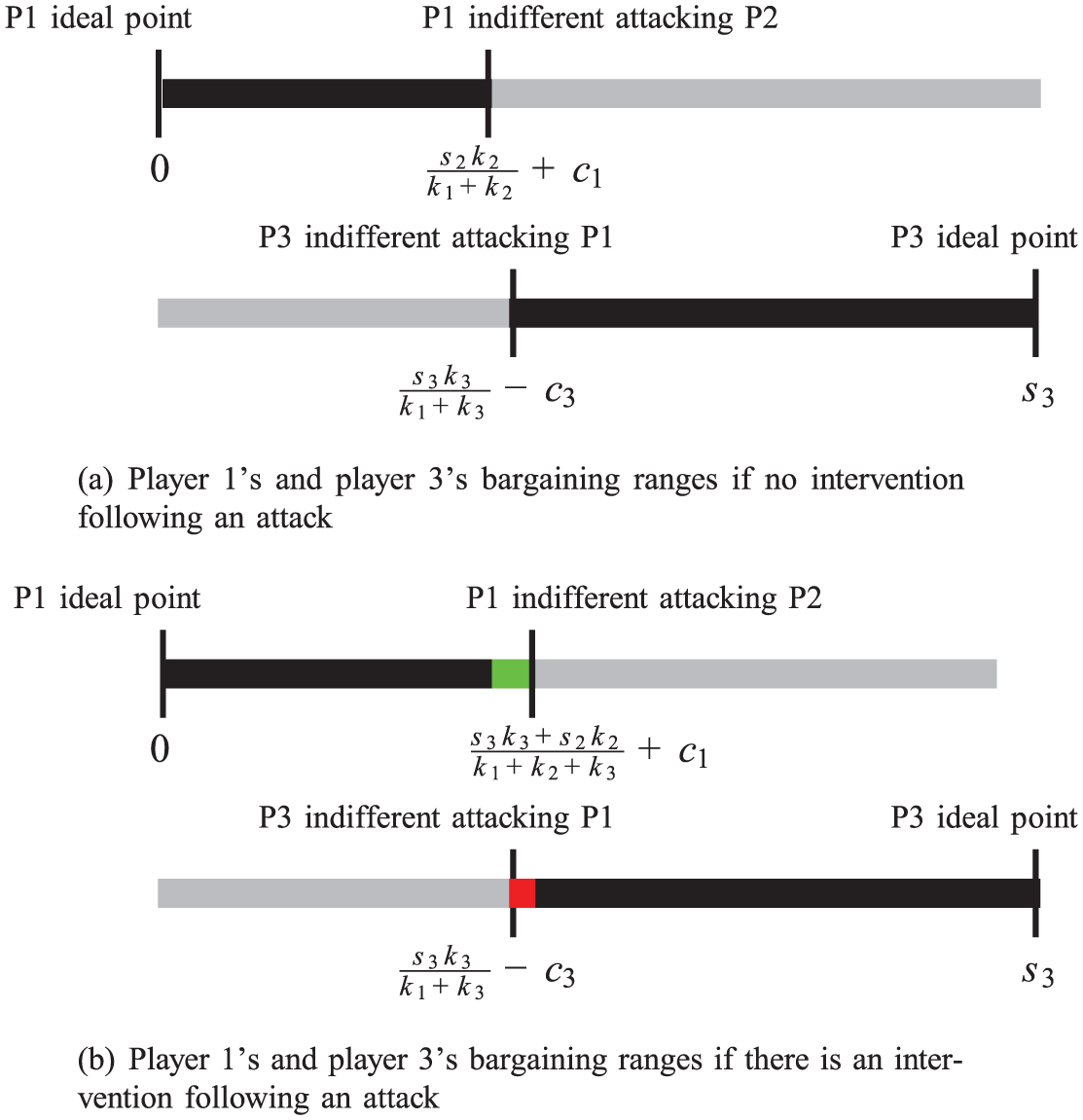
How intervention effects bargaining in the three-player game: each line indicates the bargaining space of one player with another player. The player prefers war to the gray areas on the bargaining space, and prefers the black areas to war. The red area is the point of overlap between the six bargaining spaces: note that in (a) there is no red space. The green space in (b) indicates how player 1’s bargaining range is extended if player 3 intervenes in a conflict between player 1 and player 2. Also note that these bargaining spaces are the results of the following set of parameters:
4.3. Equilibrium 3: successful deterrence
The introduction of a third player in bargaining has two countervailing effects. Until now, I have focused the discussion on the first effect: third parties create regions in the bargaining space where peaceful agreement is impossible, thus potentially eliminating the prospects for peace. However, third parties can also have deterrent effects. When a player in this game chooses war, the excluded party has an opportunity to join the fray. The addition of this player can significantly reduce the benefits of war for the attacking player such that they would rather have accepted the proffered bargain. Where war and violence were (in the two-player game) strictly dominated by peaceful negotiation, in the three-player game, the threat of violence may be the only way to preserve peace. The existence of this equilibrium is stated in Proposition 3.2.
We see this potential equilibrium in Figure 3(b). The original policy ranges are the same as in Section 4.2; there is no overlap between the bargains that player 1 prefers to attacking player 2 and those that player 3 prefers to attacking player 1. Yet, in one of those cases, the bargaining range is extended by the addition of player 3 to a war between player 1 and 2 down the game tree, which deters player 1.
We see this dynamic at play in a number of cases, where two of the states are great powers and the third is one of their clients. For example, in the Taiwan strait, there is no overlap between the policies that China would prefer to attacking Taiwan, assuming that the United States would not intervene, and the policies that are acceptable to Taiwan and the United States. Yet, China does not believe that it would be able to invade Taiwan without US intervention, so moderate policies become tolerable and peace in the strait endures.
4.4. Equilibrium 4: deterrence fails, general war
The final equilibrium of the game shares many similarities with the previous two equilibria. As in the second type of equilibrium, there are sufficiently diverse policy preferences to make harmony impossible, and as in the third type of equilibrium, we see that the willingness of excluded players to join the conflict expands the range of acceptable bargains. This deterrent effect is insufficient, and the larger bargaining ranges still fail to overlap, which may be due to the weakness of the potential intervener or the initial belligerents’ resolve with or divergence in their preferences. Given that deterrence is attempted but unsuccessful, we may see general conflict in which all three players are involved (depending on the initial offer). This equilibrium’s existence is detailed in Proposition 3.2. An example is illustrated in Figure 4. Note that the threatened intervention of a third party expands the range of acceptable bargains, but there is still no possible bargain that all sides will prefer to war.
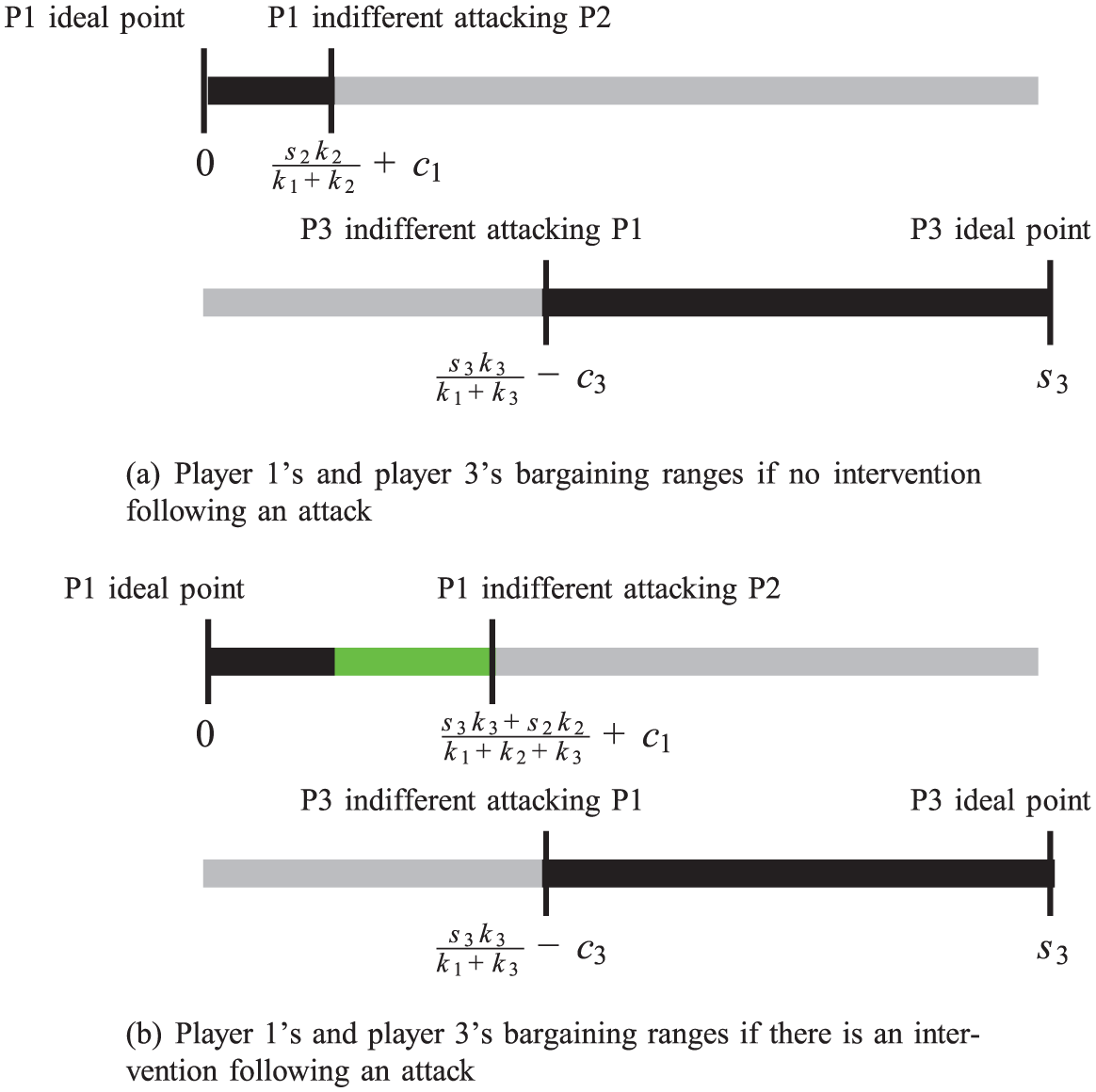
How intervention fails effect bargaining in the three-player game: each line indicates the bargaining space of one player with another player. The player prefers war to the gray areas on the bargaining space, and prefers the black areas to war. The red area is the point of overlap between the six bargaining spaces: note that in both subfigures there is no red space. The green space in (b) indicates how player 1’s bargaining range is extended if player 3 intervenes in a conflict between player 1 and player 2. Also note that these bargaining spaces are the results of the following set of parameters:
An example of this equilibrium is the invasion of Lebanon by Israel in 1982. Israel strove to replace Lebanon’s government with a friendly one, evict the PLO and isolate Syria, while Syria wanted Lebanon to remain a pliable client state (Maoz, 1988, 2006). There was no compromise which could satisfy both Israel and Syria, and Syria could neither successfully deter Israel, or allow Israel to invade Lebanon without a response. As Patrick Seale described the conflict, in his biography of the Syrian leader, “Asad and Begin, champions of irreconcilable visions, came to blows, as they were bound some time to do, over Lebanon in what was to be the goriest engagement in the struggle for the Middle East” (Seale, 1988: p. 366).
4.5. Comparative statics
While it is useful to understand that war occurs in some cases in equilibrium, the factors that drive war and peace are also quite relevant. I look at simulated results of the model for different values of each of the parameters, and show how certain summary statistics drive higher or lower likelihoods of war.
21
In particular, I look each combination of
There is a consistent positive link between variance in preferences and higher incidence of war. In Figure 5(a) the variance in s1; s2 and s3 is plotted against the proportion of cases where the equilibrium is war. At the same time, there are negative second-order effects in the middle of the range of values, where increasing the spread of preference somewhat decreases the risk of war. This might occur when an increase in the spread of preferences nudges a borderline deterrer into action. We can also observe, from these comparative statics, that while larger spreads in preference are associated with higher risk of war, we can still see violent conflict when the variance in ideal points is small, demonstrating that these results are not driven solely by the fact that these ideal points are unbounded. While there are some areas where the effect is non-monotonic, on the whole disputes with more closely clustered preferences are much less likely to end in violence.
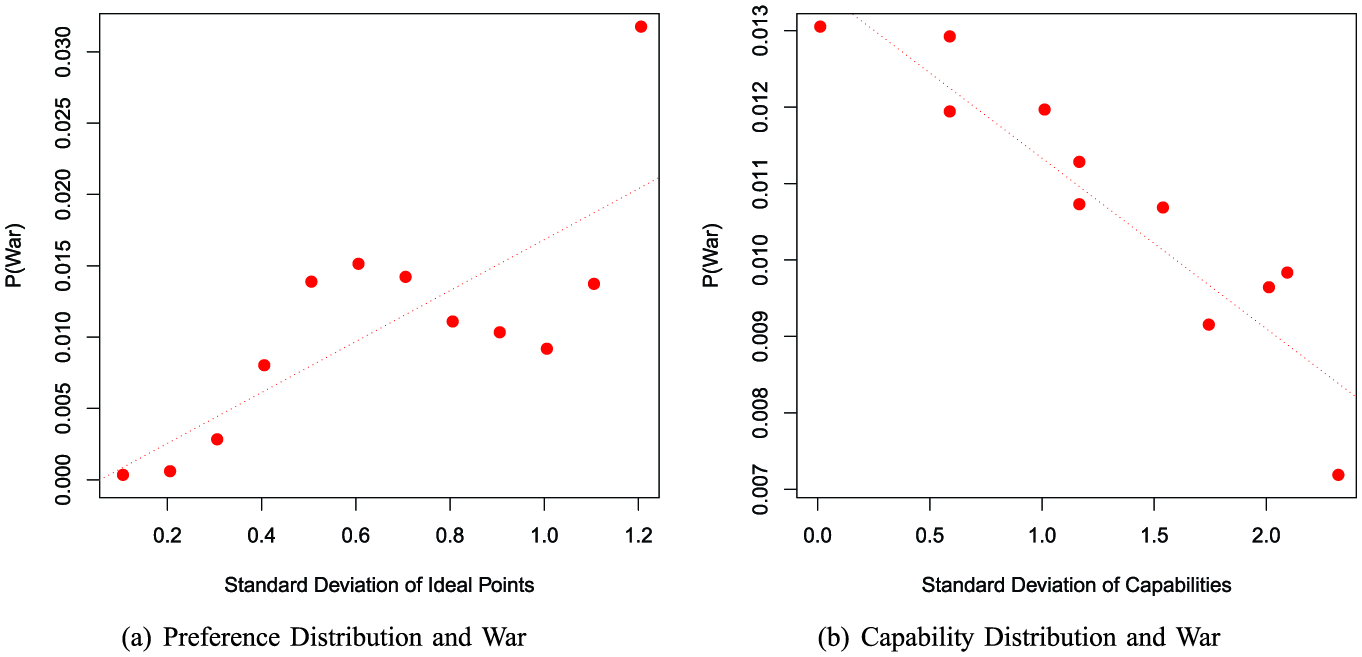
In each of the above plots, the x-axis indicates the standard deviation of an important parameter, and the y-axis represents the proportion of equilibrium which are violent where the parameter has those values. The points represent the mean value for those cases where the standard deviation is less than or equal to the point on the x-axis, and greater than that of the previous point–for example, for ideal points the first is the mean level of conflict for cases with standard deviation between 0 and 0.1, the second between 0.1 and 0.2, and so forth. Each line of fit is significant beyond the 0.001 level.
As shown in Figure 5(b), the relationship between capabilities and the incidence of war is consistently negative. The relationship also gains some credence as it comports with the findings of a number of other theoretical and empirical studies (Filson and Werner, 2002; Reed, 2003; Smith and Stam, 2004).
4.6. Model implications
A major finding of the bargaining model of war has been the general irrationality of war, and this finding is diminished by three-player models. When two players are bargaining over a disputed good or issue, we can generate a bargaining range around the expected outcome of war and peacefully resolve the dispute. Incomplete information might hinder our ability to identify that range, or commitment problems might make agreeing to such a bargain difficult or impossible. However, excluding those exceptions, the bargaining model finds that war is irrational. This happy and peaceful state of affairs is partly an artifact of focusing on only two disputants. The expected outcome of a war between any two players will necessarily be better than war for each of them, but this is not so for a third party. In three-player bargaining, finding bargains that satisfy all three players is more difficult and, in certain situations, impossible (despite complete information and no commitment problems). Thus, war is a rational recourse.
Now, this finding may have interesting implications for the role of incomplete information in generating conflict. If peace is the only possible outcome when states are completely informed, then informational asymmetries either do nothing or cause war. Yet, in some three-player conflict situations, incomplete information might be the only hope for peace. If the parameters are distributed such that there is no bargain that all three players would prefer to war, then there might be a better outcome if a state overestimates the strength of moderate forces or sees its opponents as more extreme than they actually are. In this way, introducing a third party into bargaining model provides insights that are more in line with models of extended deterrence, where uncertainty is often used to create successful deterrence or to incorporate claims about the virtues of strategic ambiguity.
The model has also given us some insight into the effects of certain state characteristics on the likelihood of war. Where state capabilities are concerned, three-player bargaining can provide an additional way in which balances of power are more dangerous than preponderances.
5. Conclusion
Understanding bargaining with multiple participants has major implications for our understanding of international relations theory, empirical studies of conflict, and the conduct of peacekeeping and mediation. The model presented in this paper has demonstrated an important and little discussed scope condition for the bargaining model of war: these models have valuable insights under a dyadic framework, but if we relax the two-party assumption, a major finding of the models, the basic irrationality of war, vanishes.
By examining three-player bargaining, we are able to see a novel explanation for war based on neither incomplete information nor commitment failures. If there are more than two actors involved in a conflict, some configurations of preferences, capabilities, and resolve render successful bargaining impossible. If states have very divergent preferences, deriving an offer that satisfies all parties may be impossible, and war will become inevitable. These findings have pessimistic implications for policymakers seeking to avoid war. Incomplete information can be ameliorated with repeated interaction, third-party mediation, or iterated bargaining.
Commitment problems can be avoided through institutional design or third-party guarantors. When war is driven by incommensurable state preferences, avoiding war becomes impossible unless peacekeepers seek to alter the domestic preferences and policy of the disputants or are willing to risk war themselves in the name of deterrence.
Footnotes
Appendices
Declaration of Conflicting Interests
The author(s) declared no potential conflicts of interest with respect to the research, authorship, and/or publication of this article.
Funding
The author(s) received no financial support for the research, authorship, and/or publication of this article.