This paper presents a model in which people sort between two districts based on economic and ideological preferences. People are either ideologues who prefer redistribution over a public good or non-ideologues who prefer a public good that benefits everyone equally. Individuals differ in their productivity with the distribution of productivities the same for both ideologues and non-ideologues. Ideologues back their ideology by working harder when there is redistribution even when not recipients, and non-ideologues work harder when the public good is provided. The tax rate in each district is chosen by majority rule with the median voter theorem identifying the winner. In the focal equilibrium, high productivity ideologues and non-ideologues locate together in a low tax district, and low productivity non-ideologues and ideologues locate together in a high tax district to benefit from redistribution. Middle-income individuals separate with non-ideologues locating in the low tax district and ideologues locating in the high tax district. Ideology thus results in a polarization interval in the middle of the income distribution. If ideology leads to partisanship and a strong party government that chooses the tax rate based on the party median, partisanship widens the polarization interval.
In the past few decades, people locating near the Pacific Ocean have turned California, Oregon, and Washington into deep blue states. Recently, residents of seven rural eastern Oregon counties voted in non-binding referenda to move the Oregon-Idaho border so that the counties would be in greater Idaho (www.greateridaho.org) rather than in Oregon. In the second phase of the movement, two northern counties of California and southwestern counties in Oregon would be invited to join greater Idaho. Mike McCarter, president of Citizens for Greater Idaho, explained, “It has been talked about for many years how eastern Oregon and southern Oregon are more like Idaho than they are to northwest Oregon. Their lifestyles, their attachment to their lands—those traditional values of people who live out in space, in open lands, feel that they’re more aligned with the people in Idaho.”1
People locate for a variety of reasons including job opportunities, housing prices, educational opportunities, weather, family, taxes, and so on. This paper examines the effect of ideology pertaining to the priorities of government on the location choices of people. Those choices can result in political jurisdictions that are relatively homogeneous and polarized across jurisdictions. Economic and ideological sorting affects tax rates, redistribution, and the provision of public goods, as well as representation. Sorting also affects the pool of candidates in a district, which can become more homogeneous because of ideological sorting, contributing to polarization. This is consistent with Hall’s (2019) argument that much of the increase in polarization in Congress is explained by who runs for office and who runs depends on the pool of potential candidates in a district.
All individuals in the model are good willed, but some believe in a political system (have an ideology) that provides direct redistribution to benefit low-income people. Others believe in a political system that provides public goods that benefit everyone equally. The public goods considered are not factors of production and simply benefit each individual, as in the case of education, roads, and security provided by police and fire fighters. The theory identifies how individuals locate based on their preferences for economic well-being and on for their ideology. The model is also used to consider the effects of ideological homophile, affect, and altruism.
Individuals work and their income is taxed by their district with the tax revenue allocated between redistribution and the public good. High productivity individuals prefer a lower tax rate than do low productivity individuals. Politics is at the district level with the electorate directly choosing both the tax rate and the allocation of tax revenue.
Ideology is a preference for redistribution even when not a recipient. Ideology is both tangible and actionable. It is tangible because it matters to a person only if tax revenue is actually redistributed. It is actionable because when redistribution is provided ideologues work harder the stronger their ideology. Redistribution funds a welfare system that reduces work by recipients and attracts low-income self-interested individuals.
Ideology could more broadly be interpreted as spending on a cultural or social issue that is valued differently by groups. Bonomi et al. (2021) consider groups that differ in identification with income segments (or classes) versus cultural groups formed around social identity based on views about issues such as “immigration, race relations, and abortions.” In their model government allocates tax revenue to a public good viewed as redistribution and also chooses “cultural policy” that appeals to an identity group. They do not consider preferences for location among political districts. Voting with one’s feet is a principal component of the model considered here.
Ideology could also pertain to the environment with the income tax replaced by a use tax and tax revenue spent on environmental regulation and enforcement or on a public good. One motivation for the Greater Idaho movement is to avoid the strict environmental and land use regulations imposed by those in Eugene and Portland.
Initially, the composition of each district is assumed to be identical, and then individuals have an opportunity to locate in either district. As a result of economic and ideological sorting, districts are represented by individuals with different ideologies and different tax rates and spending preferences. In the focal equilibrium, one district is represented by a self-interested person who chooses a low tax rate and funds the public good, and the other district is represented by an ideologue who chooses a high tax rate and allocates tax revenue to redistribution.
In the absence of ideology, economic sorting results in one district with a low tax rate and composed of higher income individuals and the other district with a high tax rate and composed of lower income individuals. The districts thus differ in income and the corresponding preferences for tax rates but otherwise are completely heterogeneous. Ideological sorting occurs along with economic sorting and results in high-income ideologues and self-interested persons locating in the low tax district, low-income ideologues and self-interested persons locating in the high tax district, and middle-income individuals separating with ideologues locating in the high tax district providing redistribution and self-interested persons locating in the low tax district providing the public good. Ideological sorting thus results in a polarization interval in the middle of the income distribution, and middle-income individuals are the ones decisive for choosing policy.
Stronger ideology makes the district that redistributes more attractive to ideologues, so fewer high-income individuals locate in the low-tax district. If tax revenue increases because of the higher taxable income, more low-income self-interested persons locate in the high tax rate district that provides welfare. Agersnap et al. (2020) study the effect of Denmark’s welfare program for non-residents and find a location elasticity of 1, i.e., a 50% increase in welfare payments increases the number of recipients by 50%. A more beneficial public good makes the low tax rate district more attractive, resulting in more high-income ideologues locating there and fewer low-income self-interested persons locating in the district that redistributes.
The economic effects of sorting are reinforced by two political effects. When high-income individuals locate to benefit from a lower tax rate, the median voter has higher income, which lowers the tax rate and attracts additional high-income individuals. The second political effect is that when ideologues locate together the district has a median voter with lower income which results in a higher tax rate and strengthens the incentive for high-income ideologues to locate in the low tax district. The ideological district also has a lower population when high-income individuals leave, which reduces tax revenue and redistribution making it less attractive to ideologues and to low-income self-interested persons.
The basic model includes a government without parties or partisanship, so the median voter in each district effectively chooses the tax rate and the allocation of tax revenue. If parties form and partisanship develops, a strong government led by a majority party could result. If the strong party is democratic, the median party member effectively chooses the tax rate and the allocation of tax revenue. The party median in the high tax district is higher than the district median, so a strong government has a lower tax rate and lower tax revenue. In the low tax district the party median is lower than the district median resulting in a higher tax rate and higher tax revenue. Both districts become more homogeneous because of partisanship, mixing is reduced, and the polarization interval in the middle of the income distribution widens. Partisanship and a strong party thus reduce ideological sorting and increase polarization.
Ideology in the model is not affect. Iyengar et al. (2012) argue that affect is the principal cause of mass political polarization. In the model, people have a preference type and a productivity but no preference for identity. They also have no animosity toward others. Baron (2021) considers the effect of ideological hatred on legislative bargaining, where ideological hatred arises from differences in policy preferences. Ideological hatred can result in bargaining failure and unilateral executive action rather than legislation.
The model is in the spirit of Meltzer and Richard (1981) who considered a model in which individuals work given a linear tax rate that funds lump-sum redistribution to everyone.2 The tax rate is chosen in an election in which high-income individuals prefer a lower tax rate and lower income individuals prefer a higher tax rate. The equilibrium tax rate is the median voter’s ideal tax rate. The model does not include the choice of location or of redistribution targeted to income groups.
Epple and Romer (1991) study a model of location and redistribution in local economies in which housing prices are taxed to provide lump-sum redistribution to everyone and moving among communities is costless. The tax rate in a community is chosen by majority rule, and people locate into communities based on housing prices, taxation, and redistribution as in the economic sorting considered here. Epple et al. (2001) view individuals as taking into account the movement of households in response to their vote on the provision of public goods. In the model considered here individuals in their location decisions anticipate the subsequent voting on tax rates and the funding of redistribution and public goods.
Tiebout (1956) initiated the study of location choices by positing that people locate in response to the provision of local public goods. Models in this tradition focus on economics and not politics. Banzhaf and Walsh (2008) provide an empirical test of a Tiebout-style model of location based on the provision of local public goods but without endogenous taxation. They identify significant movement among neighborhoods as a function of toxic emissions.
Eeckhout et al. (2014) study spacial sorting based on complementarities in production among high-skill individuals who locate in large cities together with low-skill individuals as workers with average skill workers locating across the distribution of city sizes. Sorting in the model considered here has high productivity individuals locating together and low productivity individuals locating together but in different districts with middle productivity individuals locating in different districts based on ideology. Behrens et al. (2014) explain the higher per capita income in large cities using a Tiebout model incorporating agglomeration economies and selection. Individuals differ in talent and high talent individuals locate together in cities with the most successful winning. Similarly, De La Roca and Puga (2017) find that learning through experience in large cities provides an explanation for the higher income in large cities as individuals sort. The present model has an agglomeration feature with respect to the provision of the public good.
A related line of research focuses on the break-up and consolidation of countries. Bolton and Roland (1997) use a Meltzer-Romer style model to consider the incentive for regions to consolidate or for nations to dissolve. Their model uses a linear tax rate and lump-sum redistribution with tax rates chosen collectively. The focus is on differences in taxes and public goods provision between independent regimes and unification with a single tax rate. Olofsgärd (2003) studies the mobility of ethnic groups among two regimes with differing characteristics where the regimes can supply nationalistic policies that appeal to a particular group. The focus is on a comparison between two separate regions or consolidation of the two regimes in a single country. This comparison focuses on the difference between two medians and a single median. Section 6 illustrates this in the context of a system with strong parties.
Location and the characteristics of a district and its residents can also affect the preferences for private and public goods as well as for public policies. Cantoni and Pons (2022) empirically examine changes in political behavior such as voter turnout when people move among states. For example, they find that location explains 37 percent of the difference in turnout when people move from one state to another. In the present model preferences are independent of location, but if preferences are influenced by location, sorting is increased.
Martin and Webster (2020) study location choices using data on people who moved within a state and conclude that partisanship measured by party registration explains only a small but significant portion of location choices with economic factors explaining most of those choices. In the model presented here the partisanship effect is the difference in location choices caused by the difference between the party median and the district median. Economic factors cause mixing among high-income individuals and among low-income individuals, and ideology causes separation between middle-income individuals who are the ones determining policy.
The following section introduces the model, and Section 3 characterizes the economic conduct in the model. Political preferences for tax rates are identified in Section 4, and political equilibria are characterized in Section 4.4. Economic and ideological sorting are characterized in Section 5, and partisanship is considered in Section 6. Extensions of the model are considered in Section 7, and conclusions are offered in the final section.
The model
The model incorporates both economics and politics with individuals choosing their work and collectively choosing the tax rate and the allocation of tax revenue. People are of two types and that differ only in their ideology, where ideology could be morally based or warm glow. Each type has an identical distribution of economic opportunity, gender, age, race, and all other characteristics. Individuals reside in one of two districts and each of which is initially composed of half s and half s. Each individual has a productivity , and the continuous distribution of productivity is the same for both types and in both districts. The set of persons initially living in a district is assumed to have measure . So as not to concentrate political power, the distributions of productivities are assumed to be uniform. Individuals are equal in the model in the sense that each has the same economic opportunities and the same political rights. Initially, there are neither parties nor coalitions. In Section 6 strong parties are considered. Each district has the same capability to provide a public good, so each district is equivalent economically. Information is assumed to be complete and perfect, so a person’s productivity and ideology are known to everyone.
Each district elects a governor, who chooses the tax rate and allocates tax revenue , between redistribution and the public good.3 To focus the post-sorting analysis, the two districts are conjectured to have different types of governor. District is conjectured to have an governor, and district is conjectured to have a governor. Initially, the districts are identical, and then each individual locates in one of the two districts, so post-sorting districts need not be identical. There are no moving costs, and individuals act independently in their location choices.
Ideology pertains to redistribution in the form of a welfare program. An individual of type has ideology that provides satisfaction for each dollar of tax revenue allocated to redistribution in the individual’s district, regardless of whether the individual is a recipient of the redistribution.4 This component of preferences is other-regarding. Redistribution in district is denoted and equals the tax revenue allocated to it. Tax revenue not allocated to redistribution funds a pure public good. The public good is district specific and provides to every person in the district a benefit per tax dollar allocated. The public good could be schools, roads, and police and fire protection, and its benefit could be eduction, mobility, and security. An has strong ideological preferences for redistribution relative to the public good, , whereas a has weak ideological preferences for redistribution relative to the public good, . To simplify the notation, let . Both ideological satisfaction and the public good benefit exhibit increasing returns because taxable income is increasing in the population in an district.
Individual with productivity in district has income , where is work. People are economically independent in the sense that they produce and consume their own production. After-tax income plus any welfare received can be spent on housing, education, dining and entertainment, and amenities in addition to funding the public good through taxes. Associated with work is a cost or disutility . Income is taxed at a rate in district , so the gain from work is , and taxes are . Each individual understands that their taxes fund either the public good or redistribution, so, for example, an individual in a district that provides the public good receives benefits . Neither the benefits from the public good, the satisfaction from redistribution, nor welfare received is taxed.
Redistribution funds a welfare program that provides a payment proportional to the difference between a target income and an individual’s before tax income. The welfare program has a means test that supplements the income of eligible individuals with a payment for income no greater than , where is the portion of the income shortfall paid to the individual. The after-tax income of a person on welfare thus is . The share is assumed to be set a priori, and is determined by the allocation of tax revenue to redistribution. The utility of with productivity located in district is
In the model economic behavior is individualistic and political behavior is collective. Individuals take into account the effect of their work on the benefits or satisfaction they receive from their own taxes. Politics is collective in the sense that the individual elected chooses a tax rate that applies to everyone in the district.
Each individual residing in a district is part of the electorate of that district. The electorate chooses under simple majority rule the income tax rate through an election in which each member of the electorate proposes a tax rate. No one can commit to future actions, so a person cannot credibly propose a tax rate that she would not choose if elected. The elected governor implements the tax rate and subsequently allocates the tax revenue between redistribution and the public good.
The timing in the model is as follows. At time 0 each individual locates in one of the two districts based on the anticipated subsequent economics and politics. No person nor district is able to either impede or encourage movement from one district to another. The electorate of a district then chooses the governor and the tax rate. Individuals then work, pay the tax, and retain the rest. Then the governor allocates the tax revenue between the public good and redistribution. In the final stage individuals consume their after-tax income plus any welfare received. The equilibrium concept is subgame perfect Nash in which no one changes location nor economic and political choices, given the choices of others.
People locate, work, and vote to maximize their utility consistent with a conjectured equilibrium in which no individual has an incentive to relocate given the individual’s understanding of the subsequent economic and politics. In the final stage of the game given the tax rates and locations of individuals the governors allocate the tax revenue between redistribution and the public good to maximize her utility. In the penultimate stage, individuals work to maximize their own utility. In the previous stage individuals in each district vote optimally in the election to select a governor and hence a tax rate given the voting strategies of others. In the initial stage individuals anticipate the subgame equilibria and locate to maximize their utility taking the location choices of others as given. Individuals are assumed to form conjectures about the profile of locations, and an equilibrium requires that no one deviate from the conjectures. An individual is infinitesimally small and takes as given the subsequent economics and politics.
The focus is on a conjectured equilibrium in which district has a higher tax rate than district . The ideal tax rates of people are decreasing in , and high productivity s with locate in with all other s locating in . Low productivity s with locate in to receive welfare, and all other s locate in . Even though has a lower tax rate than , the tax revenue can be greater than in if taxable income is greater. Also, the per capita benefit from the public good can be greater than the per capita satisfaction from redistribution because of population differences in the two districts.
Economics and redistribution
The allocation of tax revenue
In the final stage the governor in each district , allocates tax revenue between the provision of the public good and redistribution. An governor who values redistribution over the public good allocates all tax revenue to redistribution. A governor who values the public good over redistribution allocates all tax revenue to the public good.5 The equilibrium is given by the following allocation rule for a governor of type .
Work
Individuals of type with productivity residing in district choose work to maximize utility in (1) that includes taxable income , the benefit from the public good or the ideological satisfaction from redistribution as funded by the taxes they and others pay, and any welfare received. In the conjectured equilibrium in which district provides redistribution and district provides the public good the optimal work for individuals not receiving welfare is
For those on welfare in district work is
Work is decreasing in the tax rate and increasing in the benefit in district and in ideology in . Work is also decreasing in the welfare fraction , so those on welfare work less than if they were not on welfare. Welfare thus creates a moral hazard problem.
The properties of the optimal work are presented in the following proposition.
Work by an is increasing in in district and in in district and if on welfare is decreasing in . Work by a in is independent of and , in is increasing in , and on welfare is decreasing in . In an works more than a with the same productivity, and they work the same in . An works more in than in , and a works more in than in . A on welfare works less than an on welfare, and if , does not work. An on welfare does not work if . Income is a strictly increasing and strictly convex function of for all .
s back their ideology by working harder the stronger their ideology and work more than s with the same productivity when redistribution is provided. s work more in than in because the public good is not provided in . Income is thus greater when a person is in a district with a governor of the same type.
Both redistribution and the public good are funded by tax revenue, which depends on work and the tax rate. s in work more the higher is because they benefit from their own tax payment . s similarly gain satisfaction from their own tax payment that funds redistribution. An individual thus does not fully free-ride on the provision of the public good or redistribution but does not take into account the effect on others. The public good and redistribution thus are undersupplied.
Welfare
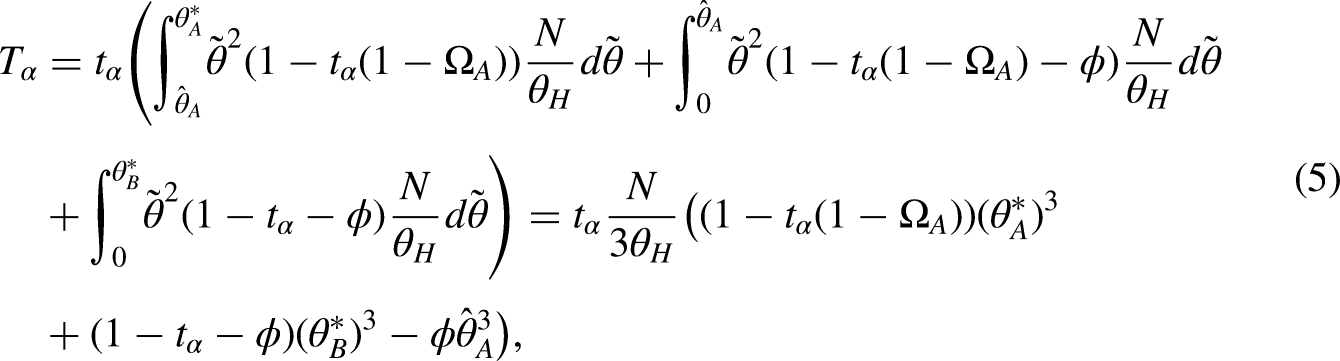
All individuals in with income less than receive a welfare payment, where depends on the tax revenue. In the conjectured sorting equilibrium tax revenue in is given by
where is the highest productivity on welfare and is aggregate taxable income.6
Individuals are eligible for welfare if their income is no greater than , so for s the productivity bound is
which is increasing in and decreasing . Similarly, the productivity bound for s is
Not all s with low productivity who are eligible for welfare, however, locate in because doing so forgoes the benefits from the public good provided in . Those locating in have productivity , where is characterized in Section 5.
The spending on welfare when is
which is increasing the tax rate because those receiving welfare work less and hence have lower income when the tax rate is higher. For a given , the means test is determined from using (6). Following the literature, individuals are assumed to take the welfare system as given when choosing their work but recognize that when voting for tax rates the eligibility limit depends on the tax rate.
The utility of a person with work in district who in the conjectured equilibrium does not receive welfare is
where tax revenue in is and is aggregate taxable income. Utility is increasing in , so utility is greater for higher productivity than for lower productivity individuals.
If welfare is received in in the conjectured equilibrium, utility is
and is
Utility is increasing in for s and s and is increasing in when work is positive.
Politics
Ideal tax rates
In choosing their work individuals take into account only the benefits or satisfaction they receive from the taxes they pay. In contrast individuals recognize that the selection of a tax rate is collective in three senses. First, the choice is governed by majority rule where every resident of the district votes. Second, the tax rates chosen apply to everyone, and third the choice affects tax revenue that funds redistribution and the public good. This section characterizes an individual’s ideal tax rate and identifies its comparative statics. It also examines the applicability of the median voter theorem, identifies the political equilibrium, and examines how changes in the electorate (as from sorting) affect the identity of the median voter.
After individuals have located, each member of the electorate in a district proposes a tax rate. In the conjectured equilibrium the electorate in district is composed of s with productivity and s with productivity . Because the public good is provided in and s and s value the public good equally, they have the same preferences for the tax rate and hence the same ideal tax rate . The ideal tax rate maximizes in (7), and the first-order condition for an or a with productivity is
The second-order condition is satisfied if .
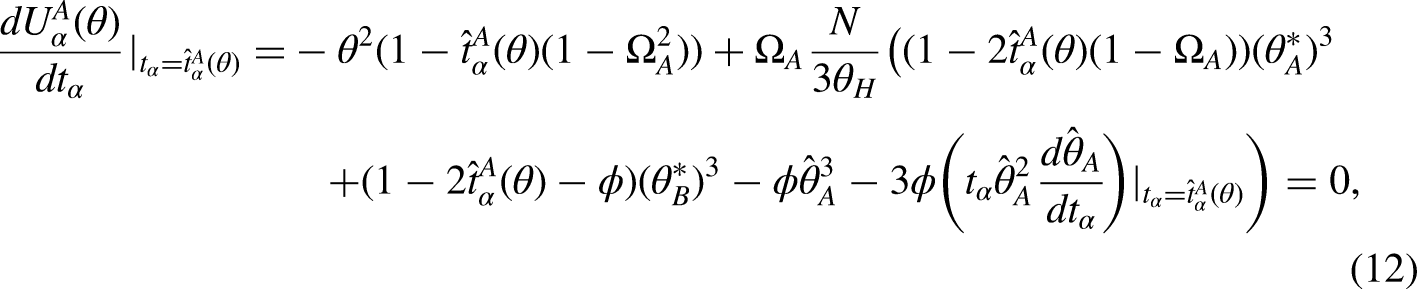
The first term in (10) is the individualistic component and represents the impact of the tax rate on work and income. The second term is a collective component and represents the marginal benefit from the public good due to a higher tax rate. The individualistic component is negative, and the collective component is positive. When positive the ideal tax rate is given by
In the conjectured equilibrium the median voter in is an who is not on welfare. An has an ideal tax rate that maximizes in (7) and satisfies the first-order condtion7
Individuals on welfare have a weaker incentive to work and their welfare payment depends on the tax rate through the means test . For an on welfare the first-order condition for the ideal tax rate that maximizes in (8) is
where the equality holds if the ideal tax rate is positive.
The ideal tax rate of a in on welfare maximizes in (9), and the first-order condition is
where the equality holds if the ideal tax rate is positive. A on welfare prefers a positive tax rate if the means test is increasing sufficiently in the tax rate to outweigh the negative effect of the tax rate on work and income.
Higher productivity individuals prefer a lower tax rate than do lower productivity individuals as established in the following proposition.
The ideal tax rates of s and s in and in are decreasing in .
Differentiating (11) for an or in yields after simplification
For an in who is not on welfare, differentiating (12) with respect to yields , which is negative from (12). This implies that is decreasing in . The proofs for s and s on welfare follow that for s in and not on welfare. ▪
Higher productivity individuals prefer a lower tax rate than do lower productivity individuals because their work and income are distorted more by taxation. This implies that individuals on welfare prefer a higher tax rate than s in not on welfare prefer.
Comparative statics
Changes in the parameters and affect the tax rates in the districts, and the anticipation of the tax rates affects location. The focus is on the conjectured equilibrium in which high productivity s () locate in because of a lower tax rate, lower productivity s () locate in , low productivity s () locate in to receive welfare, and higher productivity s () locate in .
A more beneficial public good increases the attractiveness of district and increases the ideal tax rate of a .
If a more beneficial public good increases the location of high productivity s in and reduces the location of low productivity s in , (i) the ideal tax rate of an individual in (when positive) is strictly increasing in , and (ii) the greater population in contributes to a higher ideal tax rate (when positive).
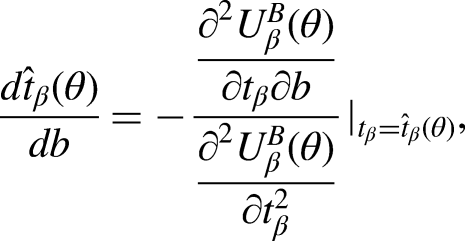
(i) For such that the ideal tax rate is positive, (implicit) differentiation of the first-order condition in (10) yields
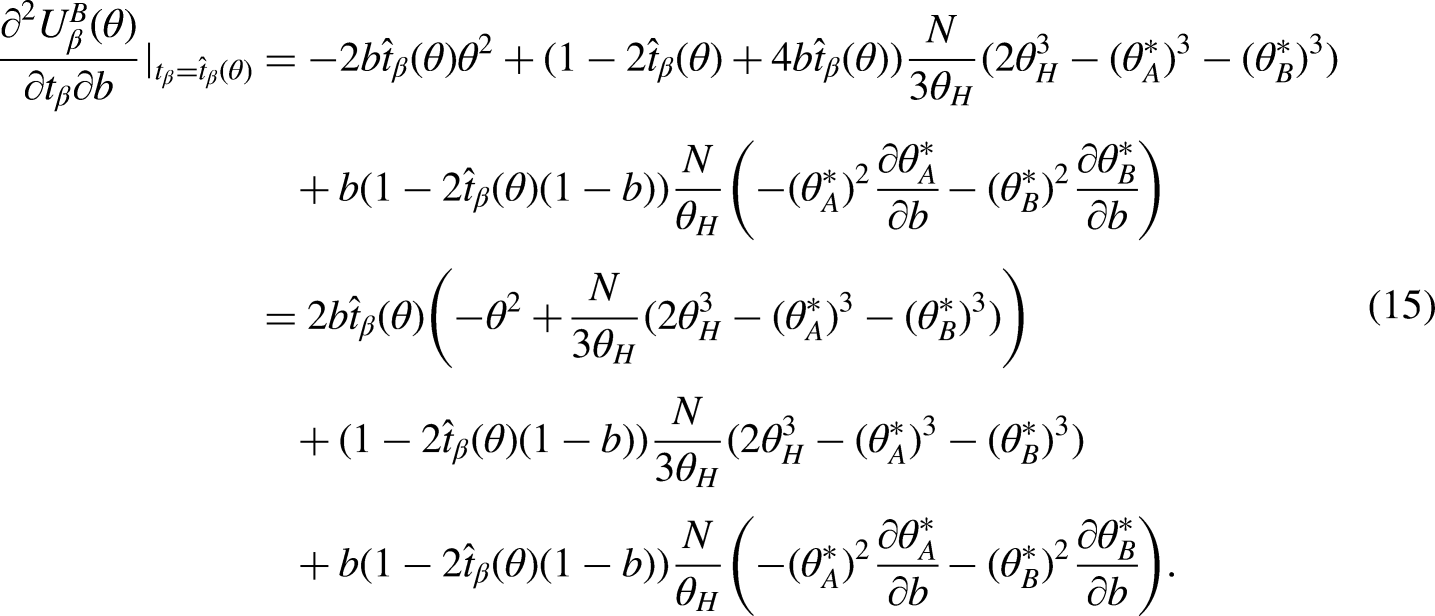
where is the second-order condition which is negative when is positive. The numerator is
The first-order condition in (10) implies . The second-order condition implies , and adding and subtracting in (15) yields
From the second-order condition , so the first two terms in (15) are positive and by hypothesis and , so the third term is positive establishing (i) and (ii). ▪
The effect of a higher on the ideal tax rate of an in cannot be signed in general because of the effect on the marginal means test. Stronger ideology provides a direct incentive to increase redistribution and tax revenue, and as shown in Proposition 4 tax revenue is increasing in the tax rate. The direct effect thus is to increase the ideal tax rate of an . Stronger ideology increases work and taxable income of s, which increases redistribution and . Stronger ideology also increases the attractiveness of to s which results in fewer high productivity s locating in . Taxable income is higher, as is tax revenue, and redistribution. The increased redistribution attracts more low productivity s, and they contribute to greater aggregate taxable income in .
The public good exhibits increasing returns to population because each dollar of tax revenue benefits everyone in the district. Size is exogenous, but and are determined in an ideological sorting equilibrium. If more people locate in , the taxable income is higher which has an effect on the tax rate analogous to that of a higher . From (10) a greater population in corresponds to a higher before tax income and to a higher ideal tax rate.
Tax revenue
Tax revenue and hence spending on redistribution and the public good depend on the tax rate and taxable income in a district. The following proposition shows that tax revenues in and in the conjectured equilibrium are increasing in their respective tax rates when evaluated at an individual’s ideal tax rate, so tax revenue is on the increasing portion of the Laffer curve.
Tax revenues and are strictly increasing in their respective (positive) tax rates when evaluated at an individual’s (positive) ideal tax rate.
The derivative of the tax revenue evaluated at is
where from the first-order condition in (10), so is increasing in the tax rate. Differentiating and evaluating at yields
The median productivity in a district depends on sorting, which changes the equilibrium tax rate and tax revenue. From Proposition 2 ideal tax rates are decreasing in , so Proposition 4 implies that tax revenue is lower the higher is the median productivity.
Tax revenue depends on aggregate income in a district, and aggregate income depends on the population in a district and on its composition. A higher or results in a higher population in and a lower population in , which contributes to a higher tax rate in and a lower tax rate in . Tax revenue is then higher in and lower in .
As shown in Section 4.4 the equilibrium tax rates in the districts are the ideal tax rates of the individual with the median productivity in the district. In a higher corresponds to a larger population and a higher median productivity, so the median productivity effect and the population effect are opposing. In a higher corresponds to a lower population and a lower median productivity provided is high relative to , so the population and the median productivity effects are also opposing. A higher corresponds to a higher population in and a lower median productivity provided is high relative to , so the population and median productivity effects are reinforcing. In the effect of a lower population and higher median productivity are also reinforcing.
Tax revenues in the two districts depend on the tax rates, the productivities of residents, and the populations. In the conjectured equilibrium has the higher tax rate but lower income residents. The population in is greater (less) than in if . Which district has the greater tax revenue depends on the parameters of the model.
Political equilibrium
Individuals cannot commit to their future actions, so candidates in the election are identified by their ideal tax rates and their type. The inability to commit means that an winner allocates all tax revenue to redistribution and a winner allocates all tax revenue to the public good as in (2). All s thus prefer a candidate with productivity to an candidate with productivity , and all s prefer an candidate to a candidate with the same productivity. Voters have single-peaked preferences for the tax rate and vote for the candidate with an ideal tax rate that yields them the highest utility, provided the candidate is of their type.
An candidate cannot win the election in , so s in understand that the public good will be provided. The s and s value the public good identically, so they vote the same. Conditional on the public good being provided, the election winner is a with the median productivity in .
The median productivity is
The median is strictly increasing in for two reasons. First, as more low productivity s locate in , the distribution of productivity of the remaining s in is higher. Second, the population in is lower, so the remaining higher productivity s represent a higher portion of the population. The median is not monotone in , however. For a given the median is increasing (decreasing) in for with a minimum of . A higher means that fewer high productivity s locate in which contributes to a lower median productivity, but the population in is lower, so the remaining high productivity individuals represent a higher proportion of the electorate. When is relatively high (), the former effect outweighs the latter effect, but when is relatively low (), the latter effect outweighs the former effect and the median increases.
The utility of an in with an governor is higher than with a governor because redistribution is valued more highly than is the public good. A in has a high ideal tax rate because their productivity is low and because receives welfare. The median is conjectured to be among the s not on welfare, so the elected governor with the median productivity in is an . The productivity of the median voter in in the conjectured equilibrium is
The median productivity is strictly increasing in because more high productivity s are in and they represent a higher share of the population. The median productivity is strictly increasing (decreasing) in for and has a maximum of . A higher means more low productivity s locate in , which increases the population and lowers the distribution of productivity. When is low (), this decreases the median productivity, but if is high () the additional s increase the median productivity.
The median has a minimum of and has a maximum of , which implies the following proposition.
The median productivity in is at least as great as the median productivity in and is strictly greater if or .
If either some high productivity s locate in or some low productivity s locate in , the median productivity is higher in than in . In the conjectured equilibrium the higher median productivity in contributes to a lower tax rate in that district, and the lower median productivity in contributes to a higher tax rate. Because and , the tax rates satisfy . Both strengthen sorting motivated by economics.
Sorting
Individuals are small and correspondingly do not take into account the effect of their location choice on the choices of others. At time 0 each individual chooses a district in which to locate. When , s and s make the same choices, and sorting is based only on economics—the tax rate and public good provision. When sorting is motivated by both economics and ideology. A sorting equilibrium is a collection of locations for each individual such that no one has an incentive to move, understanding the subsequent economics and politics. Section 5.1 considers economic sorting as a referent for ideological sorting, Section 5.2 considers economic and ideological sorting, and Section 5.3 considers district composition.
Economic sorting
Economic sorting has a political dimension because policies in the two districts depend on the productivity of the median voter in each district, and the median productivities depend on the compositions of the electorates. In the conjectured equilibrium higher productivity individuals locate in a low tax district, and lower productivity individuals locate in a high tax district. The median voter in the low tax district has higher productivity and chooses a lower tax rate than is chosen in the high tax district. The political effect thus strengthens the conjectured economic incentives to sort.
If the low tax district has only residents with , the median productivities are and . The tax rates are given in (11). An economic sorting equilibrium is a cutpoint such that all individuals locate in the low tax district and all individuals locate in the high tax district, and no one has an incentive to move.9
The cutpoint is determined in an economic sorting equilibrium, but it is useful to identify how the tax rates in the two districts change as changes. A higher is associated with two effects. First, the median productivity in each district is higher, and second, the population in is higher and the population in is lower, which affects taxable income and the funding of the public goods in the districts. The greater population in results in a higher ideal tax rate in and a lower tax rate in . In the population effect and the median productivity effect are reinforcing as both lower the tax rate. In the population and median productivity effects are also reinforcing as both raise the tax rate.
If an or with productivity locates in district , utility in (7) for a district that provides the public good can be written as
where is district tax revenue less the tax payment by the individual with productivity and evaluated at the equilibrium tax rate . The following proposition characterizes economic sorting.
If , the individual with productivity who is indifferent between locating in and locating in is given by , where if . Given the conjectured equilibrium with , individuals with locate in and individuals with locate in . If or , all individuals locate in the same district.
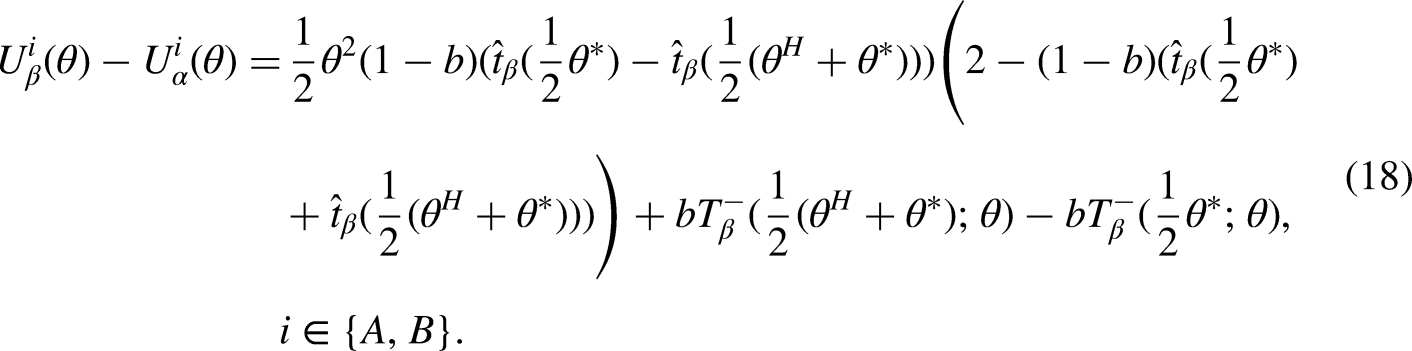
The utility difference for an or with productivity is after simplification
In (18) and , so the utility difference is strictly increasing in . Then, if , which is satisfied because , ideal tax rates are decreasing in , and tax revenue is increasing in the tax rate. The productivity of the individual indifferent between locating in and locating in then exists and satisfies . An individual with prefers locating in to locating in , and an individual with prefers locating in . ▪
When is low, equilibria with economic sorting do not exist because the public good is not sufficiently beneficial to warrant a positive tax rate. Then, there can be other equilibria referred to as agglomeration equilibria in which all individuals locate in one district to take advantage of the population effect on the financing of the public good.
Ideological sorting
In the absence of ideology, s and s with the same productivity behave in the same manner, so districts remain heterogeneous in types. Ideology changes the nature of sorting and results in less heterogeneous districts. Intuition suggests that with some high productivity s who otherwise would have located in when ideology is weak () locate in because of redistribution. Middle-income individuals separate with s locating in because of redistribution and s locating in because of the public good. Low income s locate in because of both welfare and ideology, and some low productivity s locate in to obtain welfare. Ideology thus encourages mixing by high productivity individuals and by low productivity individuals and stimulates sorting by everyone else. For very high productivity individuals () and for very low productivity individuals () economics trumps ideology but not for middle productivity individuals.
High productivity s who locate in receive the benefit from the public good but lose the ideological satisfaction from redistribution. The who is indifferent between the two districts has productivity given by . The utility difference for an ineligible for welfare is
The following proposition identifies and which s locate in and which locate in .
(i) The cutpoint is given by . If , the utility difference is strictly decreasing (increasing) in . Monotonicity in implies that s with and ineligible for welfare locate in , and s with locate in . (ii) If and , then . If and , then , and all s ineligible for welfare locate in ().
The utility difference can be written as
where . If , (a) the utility difference is strictly decreasing (increasing) in , and (b) if and , and satisfies the implicit expression
Then, locate in and locate in . Otherwise, and all s not on welfare locate in or and all s not on welfare locate in . If and , . If and , . ▪
If stronger ideology makes more attractive to s (increases ), more high productivity s locate in despite the higher tax rate, resulting in a higher . This increases the median productivity in the district which contributes to a lower tax rate, but higher taxable income can result in higher tax revenue. The population in is higher, which contributes to a higher tax rate, higher tax revenue, and higher welfare payments. Higher welfare payments attract more low productivity s, lowering the median productivity and contributing to a higher tax rate.
A higher makes more attractive to s, resulting in a lower . The median productivity in then is lower and when the median productivity in is higher resulting in a higher tax rate in and a lower tax rate in . The political effect of the changes in the medians strengthens the incentive for high productivity s to locate in and lower productivity s to locate in . The populations in the two districts also change with a lower corresponding to a higher population in and a lower population in , which contributes to a higher tax rate in and a lower tax rate in . The population effect thus is in opposition to the political effect. If , the median productivity in is lower. The tax rate in is then higher which mitigates the effect of a higher , as does the population effect.
All s not on welfare locate in because of the public good and the lower tax rate. The utility is
and the utility from locating in is given in (7). The utility difference between locating in and is
The term is positive, so all s not on welfare locate in .
A low productivity who locates in and receives welfare has utility in (9). The productivity of the who is indifferent between locating in and receiving welfare and locating in is given by . The utility difference is
The following proposition establishes sorting by s.
In the conjectured ideological sorting equilibrium, (i) is necessary for , (ii) all s with productivity locate in and all s with locate in and receive welfare, and (iii) a more beneficial public good that increases results in a lower .
For a on welfare who works, the difference can be written as
Then, implies when works, so is strictly increasing in . If , then and all s locate in , establishing (i). If , then and all s with who work locate in and s with locate in , establishing (ii).
If a on welfare does not work, , which is constant in . Utility is increasing in , so the utility difference in (19) is increasing in . Then, only if .
A higher increases and tax revenue is increasing in the tax rate, so is higher. Fewer low income s then locate in when , establishing (iii). ▪
An argument analogous to that establishing Proposition 8 for s eligible for welfare shows that all s eligible for welfare () prefer to locate in .
If a low productivity locates in because of welfare, there are three economic effects. First, the s are not ideological and the public good is not provided, so they work less than an on welfare with the same productivity. Second, the tax rate is higher which causes them to work even less. Third, welfare is a decreasing function of income, which provides an incentive to work less. The location of additional s in also has a political effect. It results in a lower (higher) median productivity if (), which results in a higher (lower) tax rate. The absence of low productivity s in increases the median productivity which lowers the tax rate.
The perfect equilibrium characterized in Sections 3 and 4 for the subgames given the locations is unique. The optimal allocation of tax revenue in (2) is defined for all tax rates, work choices, and locations. Work characterized in (3) and (4) for an individual is optimal because utility if strictly concave in work for all tax rates. The choice of a tax rate given the location choices depends on the ideal tax rates of individuals and on the identity of the median voter. The ideal tax rates of individuals are unique because utility in (7), (8), and (9) are strictly concave in the tax rate. The median voter is determined uniquely by the sorting. In the location choices in the first stage individuals are small, so an individual’s location does not affect the identity of the median voter. Sorting choices are binary and hence are unique.
District population, composition, and polarization
Economic sorting results in populations and in the two districts, where denotes economic sorting, so the population in is greater than the population in if . The composition , of types in a district is defined as and similarly, , both of which equal , so the composition of types in the two districts is identical and maximally heterogeneously. Economic sorting results in districts that are maximally heterogeneous in type but not in income.
Ideological sorting affects the population in the districts with the population of given by and the population of given by , so the population of is greater than the population of if and only if . Stronger ideology increases the number of low-income ’s locating in and decreases the number of high-income s locating in , so population shifts from to with stronger ideology.
Ideology also affects the composition of districts. The majority type composition of is , which is increasing in and decreasing in . The majority type composition of is , which is increasing in and decreasing in . In all individuals with are s, so is homogeneous in type except for those on welfare. The majority type composition of those on welfare is because , so welfare recipients are heterogeneous in type but not maximally so. In individuals with are maximally heterogeneous in type, and those with are maximally homogeneous. The majority type composition in is greater than in if and only if the population in is less than the population in .
The model explains both where polarization is located in the income distribution and where types are concentrated. Polarization is located on the interval of the productivity distribution with all s in and all s in . District is maximally heterogeneous for low productivity () individuals, and is maximally heterogeneous for high productivity () individuals. The districts thus separate in the middle and are heterogenous among high-income individuals in and among low-income individuals in . Stronger ideology increases separation among high-income individuals and reduces separation among low-income individuals on welfare. Stronger ideology that attracts more high-income s and low-income s to results in a population increase in and decrease in .
Partisanship
For partisanship to have meaning in the model it must affect the equilibrium. The basic model can be thought of as a weak party model in the sense that no party coordinates electoral behavior among individuals. In a partisan or strong party system political parties coordinate the behavior of their members through leadership, party loyalty, and discipline. The source of partisanship in the model is preferences, and hence partisanship is based on ideology, or the absence of it, and the policies that result from it. Parties are then composed of individuals with the same ideology.
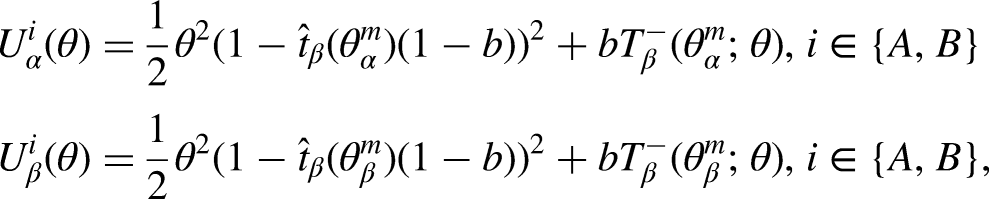
Parties are district specific because there are no cross-district policies. If s tend to locate in and s tend to locate in , then it is natural to think of party as the majority party in and party as the majority party in .10 A strong party that is democratic chooses policy through majority rule among its members, so a party policy is the ideal tax rate of its median member. The tax rate for the district is chosen by all voters in the district, and the strong party asks its members to vote for the party median ideal tax rate, and as partisans the members do so.11 The political equilibrium in the district then is the ideal tax rate of the party median.
Partisanship arises from preferences and does not affect preferences, so the ideal tax rate of a partisan is the same as in a weak party system. That is, a partisan receives satisfaction from providing welfare to low-income s in but does not give them voice. Similarly, in partisan s provide the public good to high income s and takes them into account in identifying ideal tax rates but does not give them voice. Consequently, a partisan has an ideal tax rate , and a partisan has an ideal tax rate . The median party member, however, differs from the district median, and sorting is affected by partisanship.
The party median in is , where is the highest productivity in when parties are strong. Similarly, in the party median is , where is the lowest productivity in . The party median in is higher than the district median with a weak party, so the ideal tax rate of the party median is lower than with a weak party. Tax revenue and redistribution then are lower. In the party median is lower than the district median, so the ideal tax rate of the party median is higher than that of the district median. Strong parties thus result in a lower tax rate in and a higher tax rate in . The lower tax rate in and higher tax rate in induce fewer high income s to locate in , so and in induces fewer low income s to locate in to obtain welfare, so . Districts and are more homogenous at both high and low-income levels, so the polarization interval in the middle is larger.12 Strong parties thus accentuates the ideological sorting that occurs with weak parties, and partisanship results in a larger polarization interval.
Extensions
Ideological homophile
Homophile differs from ideology because the latter must be backed by redistribution to be realized and the former is about association, i.e., I like having people around me who have preferences like mine. An example of ideological homophile is provided by the experiment by Iyengar et al. (2012) in which subjects revealed that they would not like their son or daughter to marry a person from a political party different from their own. In the model ideological homophile does not affect economics or politics, but instead simply represents a preference for being around other ideologues. To be specific, suppose that people in a district encounter other people at random and obtain a utility if the individual they encounter is of their type.13 The probability that an ideologue in encounters another ideologue is , and the probability that an ideologue in encounters another ideologue is . The expected utility from homophile in district thus is . The probability and hence the utility from homophile is increasing in the proportion of ideologues in a district.
Although ideological homophile does not directly affect work, the tax rate, or redistribution, it does affect location. Ideological homophile makes more attractive to s, which causes some high productivity s not to locate in , resulting in a higher . Higher taxable income in increases tax revenue and hence redistribution, which attracts more low-income s seeking welfare. The population in is then higher, which contributes to higher ideal tax rates. The median productivity in , however, can be higher, which then contributes to a lower tax rate. Although not included in the model, it could create resentment of the s in whose presence reduces their expected utility from ideological homophile.
Ideological homophile provides motivation for s to locate in the same district. Homophile affects the strength of that motivation and competes with economic incentives for an attracted by the lower tax rate in . If fewer high productivity s locate in , the median productivity in is lower and hence the tax rate is higher. If the tax rate increases in and decreases in , homophile weakens the economic incentive to locate in .
Affect
Affect is founded on social identity and “in group-out group” evaluations, which are not features of the basic model. Iyengar et al. (2012) argue and present evidence that mass polarization is better understood by focusing on social identity represented by party affiliation than by ideology or policy. Individuals have positive evaluations of their own group and negative evaluations of out groups. Affect based on type can be incorporated into the model in the form of a positive lump-sum utility associated with the person’s own type and negative utility for the other type. This utility is presumably incurred by association with own type and with the other type, so affect is like homophile. As a formalization, suppose an in receives utility from an encounter with another and a negative utility from an encounter with a . The aggregate effect is . The difference between homophile and affect may simply be that the former is sociology based and the latter social psychology based.
Baron (2021) presents a legislative bargaining theory of U.S. policymaking in a polarized legislature that incorporates executive action as a recourse to legislative failure. Despite the polarization, bargaining theory predicts that a bargain will be struck resulting in legislation. In recent years bargaining, however, has failed to produce legislation, resulting in presidents using executive action to advance their agendas. Baron explains legislative failure as a result of bargaining costs arising from ideological hatred of the other party. Ideological hatred is like affect.
Altruism
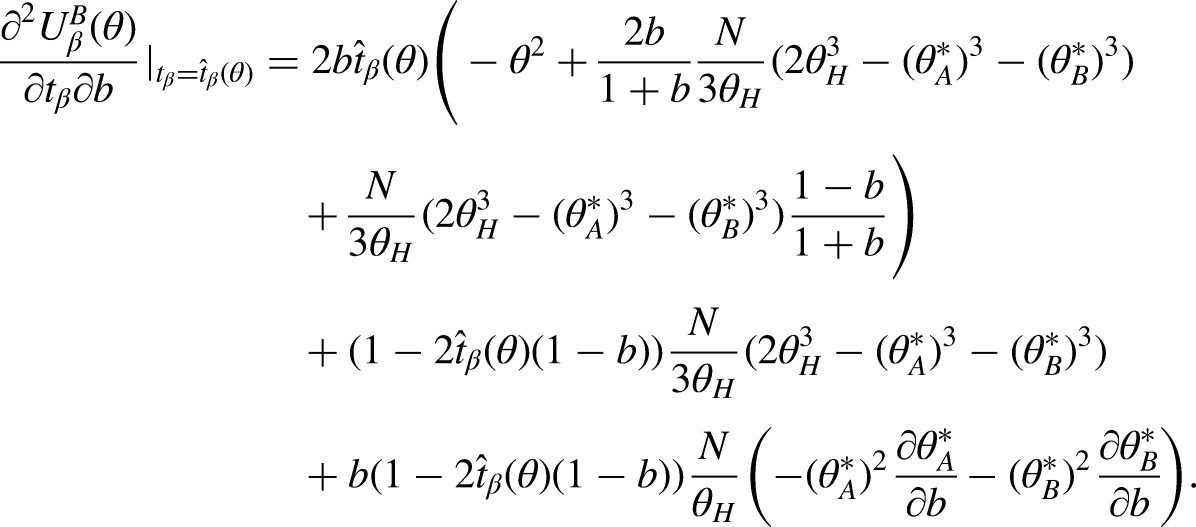
The public good is undersupplied relative to an aggregate welfare measure, and altruistic preferences mitigate the undersupply. Altruism could be a “sense of community” and give rise to a utility for providing good to others regardless of their type. Altruism (weakly) increases the supply of the public good in but has no direct effect in if the public good is not supplied. Altruism by those in could mean that some public goods are provided that would otherwise not be provided, in which case altruism muffles ideology and reduces redistribution. A model in which both the public good and redistribution are provided in is presented in Section 7.5.
Suppose people have altruistic preferences in the form of caring about the good they cause in addition to what they receive. Let the good caused by a person be where is the number of people in district and is the degree of altruism with . Work by an altruist in is , so an altruist works harder than a non-altruist. The good provided by the altruist is , and the aggregate public good is . Altruists in thus have higher ideal tax rates.
Altruism actuated by the provision of the public good makes a more attractive location for everyone. s have a stronger incentive to locate in , which corresponds to a lower . Similarly, fewer s locate in , so is lower. The population in increases and the population in decreases. Altruism offsets some of the effect of ideology on location choice. Altruism also affects tax rates where the larger population has a lower median productivity if is not high (), in which case altruism can result in a higher or lower equilibrium tax rate depending on the parameters of the model.
Agglomeration
Agglomeration is one explanation for the higher productivity in cities than outside cities (Behrens et al., 2014). Cities attract talented people who join with other talented people to provide higher output than if they were dispersed. This then affects sorting. Agglomeration can be modeled in a variety of manners, but a natural model is for individuals with productivity to have output , where is the increase in productivity for interacting with other high productivity individuals. The agglomeration factor could be a function of the number of individuals with high productivity in a district. For example, in an ideological sorting equilibrium the lower tax rate in attracts high productivity individuals, and the number of high talent individuals in is and the number of high talent individuals in is .
Agglomeration in attracted by the lower tax rate results in higher output and decreases the ideal tax rate of the high productivity () individuals, but if the median productivity in is lower than , a high talent individual does not set the tax rate. The greater productivity of the high talent individuals, however, increases the scale of public good provision making tax revenue more valuable. This increases the tax rate in . The tax rate in is unaffected if and otherwise is increased. Individuals then sort as in the absence of agglomeration.
The public good and redistribution
A district can provide both the public good and redistribute. For example, some public goods can be more beneficial than others. Suppose the benefits from a public good such as roads are , where , and suppose that the benefits are fully exhausted by funding in . The optimal allocation of tax revenue to redistribution is
If , tax revenue is allocated to the public good with the remaining tax revenue allocated to redistribution. The governor in the previous sections can be thought of as on the portion of the function where all tax revenue above is allocated to redistribution.
Conclusions
Economic sorting provides the baseline for assessing the effect of ideology on location and economic performance. With weak ideology () high-income people locate together in a low-tax district, and all others locate in the high-tax district to benefit from greater public goods provision. Weak ideologues and the self-interested thus locate together based on economic considerations. Economic sorting results in districts that are maximally heterogeneous in type but not income.
The effects of ideology on sorting are more nuanced. With strong ideology (), ideologues with productivity locate in the district that redistributes, whereas because of the lower tax rate higher income ideologues locate in the district with a low tax rate that provides the public good. Economics outweighs ideology for high-income individuals, and they locate together, but the stronger is ideology fewer high-income ideologues locate in the low tax district. Low-income ideologues who are eligible for welfare locate in the district that redistributes for both the welfare payments and the ideological satisfaction from redistribution. Low-income self-interested individuals also locate there because of welfare, so low-income ideologues and self-interested individuals locate together. Again economics outweighs ideology. The high tax district thus is heterogeneous in preferences at the bottom of the income distribution. The low tax district is heterogeneous among high-income individuals.
Middle-income individuals separate with ideologues in the district that redistributes and the self-interested in the district that provides the public good. The locations of middle-income individuals thus are driven more by ideology than economics. In both districts middle-income individuals prevail in the election and choose policy, but the median productivity in the district that redistributes is lower than the median productivity in the district that provides the public good.
Ideology results in relatively homogenous districts except for low-income people on welfare and high-income people seeking a low tax rate. Ideology causes polarization in the middle. The stronger is ideology the more individuals separate by type at the high end of the income distribution and fewer separate at the low end of the income distribution. The polarization interval in the middle then is wider. Policy is set by medians in the model, and medians have middle income, so policies in the districts are sharply different. The ideological district chooses to redistribute and sets a high tax rate to fund the redistribution. The self-interested district chooses to provide the public good and funds it with a low tax rate, but the tax rate is applied by residents with a higher taxable income than in the other district.
Partisanship is relevant if it affects policy. If it results in strong parties governed by the interests of their members, policy is set by the partisan with the median productivity among party members. The party median differs from the district median, resulting in a wider polarization interval in the middle of the income distribution.
Ideology in the model is different from both ideological homophile and affect, both of which reinforce polarization from ideology. More high-income s locate in the district that redistributes and fewer low-income s locate in the district that provides the public good, so both districts are more homogeneous when preferences include ideological homophile or affect. Altruism can offset some of the effects of ideology on sorting.
Footnotes
Declaration of conflicting interests
The author declares no potential conflicts of interest with respect to the research, authorship, and/or publication of this article.
Funding
The author received no financial support for the research, authorship, and/or publication of this article.
ORCID iD
David P. Baron
Notes
References
1.
AgersnapOJensenAKlevenH (2020) The welfare magnet hypothesis: Evidence from an immigrant welfare scheme in Denmark. American Economic Review: Insights2(4): 527–542.
2.
BanzhafHSWalshRP (2008) Do people vote with their feet? an empirical test of Tiebout’s Mechanism. American Economic Review98: 843–863.
3.
BaronDP (2021) Contemporary U.S. Policymaking. Quarterly Journal of Political Science16: 429–465.
4.
BehrensKDurantonGRobert-NicoudF (2014) Productive cities: Sorting, selection, and agglomeration. Journal of Political Economy122: 507–553.
5.
BoltonPRolandG (1997) The breakup of nations: A political economy analysis. Quarterly Journal of Economics112: 1057–1090.
6.
BonomiGGennaioliNTabelliniG (2021) Identity, beliefs, and political conflict. Quarterly Journal of Economics136: 2371–2411.
CanenNKendallCTrebbiF (2021) Political Parties as Drivers of U.S. Polarization: 1927-2018. Working paper, University of California–Berkeley.
9.
CantoniEPonsV (2022) Does context outweigh individual characteristics in driving voting behavior? evidence from relocation within the United States. American Economic Review112: 1226–1272.
10.
De La RocaJPugaD (2017) Learning by working in large cities. Review of Economic Studies84: 106–141.
11.
EeckhoutJPinheiroRSchmidheinyK (2014) Spatial sorting. Journal of Political Economy122: 544–620.
12.
EppleDRomerT (1991) Mobility and redistribution. Journal of Political Economy99: 828–858.
13.
EppleDRomerTSiegH (2001) Interjurisdictional sorting and majority rule: An empirical analysis. Econometrica69: 1437–1465.
14.
HallAB (2019) Who Wants to Run?Chicago: University of Chicago Press.
15.
IyengarSSoodGLelkeY (2012) Affect, not ideology: A social identity perspective on polarization. The Public Opinion Quarterly76: 405–431.
16.
MartinGJWebsterSW (2020) Does residential sorting explain geographic polarization?Political Science Research and Methods8: 215–231.
17.
MeltzerAHRichardSF (1981) A rational theory of the size of government. Journal of Political Economy89: 914–927.
18.
OlofsgärdA (2003) Incentives for succession in the presence of mobile ethnic groups. Journal of Public Economics87: 2105–2128.
19.
RomerT (1975) Individual welfare, majority voting, and the properties of a linear tax rate. Journal of Public Economics49: 103–155.
20.
TieboutC (1956) A pure theory of local expenditures. Journal of Political Economy64: 416–424.