



Abstract
Ruling elites commonly concede institutional reforms such as expanding the franchise. In existing models, sharing power in this manner enables ruling elites to credibly commit to perpetual redistribution. In ‘Power Sharing with Weak Institutions,’ Powell (2024) explains why the commitment problem runs deeper: When institutions are weak, elites are likely to block the implementation of promised institutional concessions. I provide new insights into three foundational premises of Powell (2024) and related models. First, I identify a necessary condition for a common result: Ruling elites always minimize permanent power-sharing concessions vis-à-vis temporary concessions, subject to preventing revolt. However, unless reforming institutions is somehow costly, these two tools are perfect substitutes. Second, I discuss how to conceptualize institutional strength within this class of models. Third, in weak institutional environments, I suggest how scholars can model credible commitments to share power or democratize.
Introduction
Authoritarian elites face a commitment problem (Acemoglu and Robinson, 2006b; Castañeda Dower et al., 2018). During emergency times in which the opposition poses a threat of rebellion, ruling elites see the writing on the wall and offer temporary concessions that redistribute spoils. However, the opposition’s threat is inherently transitory; an opposition group who has mobilized a high threat today may fail to do so tomorrow. During normal times in which the opposition poses no threat, ruling elites lack an incentive to deliver spoils or implement policies desired by the opposition. Recognizing that ruling elites cannot commit to future redistribution, a forward-looking opposition might reject any temporary co-optation measures proposed during a fleeting moment in the sun. Thus, pacifying a temporarily strong opposition movement might require permanent institutional reforms. Expanding the franchise or sharing power (e.g., cabinet positions, local councils) solves the commitment problem by enabling the opposition to directly set policy or to permanently increase redistribution by other means—even when they lack a coercive threat. 1
Powell (2024) challenges the idea that reforming institutions necessarily solves the commitment problem. Instead, the implementation of permanent concessions entails its own commitment problem. Elites announce their intent to share power at times in which the opposition is organized to revolt, but institutional reforms are not implemented immediately. Furthermore, the opposition’s threat does not last forever—this is, in fact, the precise source of the commitment problem highlighted in Acemoglu and Robinson (2006b) and Castañeda Dower et al. (2018). After the immediate threat has passed, elites can exert costly effort to block the implementation of the promised power-sharing deal. For example, elites might promise to hold elections at some point in the future, but in the meantime strengthen their coercive position and repress the opposition before ever holding the elections. Weak institutions raise the marginal return to trying to block a power-sharing agreement, which undermines the commitment power of promised institutional reforms.
In this comment, I provide new insights into three foundational premises and results of Powell (2024) and related models. First, in the aforementioned models, elites strictly prefer to minimize the extent of permanent institutional concessions, and instead favor temporary transfers as needed to pacify the opposition. This result is, seemingly, intuitive because it confirms the widespread premise in studies of authoritarian politics that ruling elites seek to concentrate as much power in their hands as possible. But what drives this result? Suppose elites make overly generous institutional concessions—for example, conceding substantial legislative autonomy to a body in which the opposition controls a large number of seats, where ‘substantial’ and ‘large’ are relative to the opposition’s prospects for succeeding in a revolt. This power-sharing deal permanently redistributes a large amount of spoils to the opposition, which detracts from the ruler’s consumption. However, what prevents the opposition from fully compensating elites in the present for the skewed distribution of future rents? If this were possible, why would elites care about the exact mixture of permanent and temporary concessions?
Confirming the intuition suggested by these questions, elites are in fact indifferent about the exact mixture of permanent institutional changes and temporary transfers, absent an additional friction. I derive this result by analyzing a special case of Powell’s model in which institutional concessions are fully credible. Recovering the conventional intuition requires an additional assumption that institutional reform is costly, in the sense of destroying surplus akin to the foundational results on incentives to avoid costly conflict (Fearon, 1995; Powell, 2004, 2006). In Powell (2024), this occurs because elites pay endogenous effort costs to renege on a power-sharing deal, whereas Acemoglu and Robinson (2006b) and Castañeda Dower et al. (2018) impose distinct assumptions to yield a qualitatively similar result. However, raising questions for future research, ‘top-down’ models of institutional reform suggest how permanent institutional concessions can in fact improve efficiency vis-à-vis temporary transfers.
Second, Powell’s model initiates, but does not end, a fruitful discussion about how to conceptualize strong versus weak political institutions, within this class of models. His conceptualization of institutional strength captures the stickiness of constitutional amendment procedures; once promised, how easy is it for the ruling elites to block implementation of the reform? But it is also intuitive to conceptualize the contemporaneous commitment to redistribution as a manifestation of institutional strength (a la North and Weingast 1989), separate from the ease of changing this arrangement in the future.
Third, in weak institutional environments, I suggest how scholars can model credible commitments to share power or democratize. Powell proposes one, a smoother path of shocks. Others lie outside his model: Persistent opposition mobilization, coercive enforcement of power-sharing deals, and ruling elites stepping down from power. Collectively, this discussion yields numerous suggestions for future research.
Indifference over extent of institutional reform
A common result in models of commitment problems and institutional reform is that ruling elites strictly prefer to concede temporary redistributive transfers rather than permanent institutional reforms. In Acemoglu and Robinson (2006b), if temporary redistribution suffices to prevent the opposition (the ‘masses’) from revolting, then elites will not expand the franchise—which would enable the opposition to set policies in every period. In Castañeda Dower et al. (2018), elites choose which fraction of periods to allow the opposition (the ‘majority’) to set policies; in equilibrium, they choose the minimum fraction of periods sufficient to prevent revolt. This also means that elites transfer all contemporaneous spoils to the opposition in any period that elites set policy and the majority poses a revolutionary threat—starkly highlighting elites’ preferences for temporary transfers over permanent institutional concessions. In Powell (2024), institutional reform entails choosing a fraction of an asset to permanently transfer to the opposition, thus creating a basement level of spoils. 2 In equilibrium, elites propose the smallest level of this basement that suffices to prevent revolt. However, because institutional weakness creates leeway for elites to block implementation, imperfect institutional enforcement requires elites to share a larger fraction of the asset—compared to a baseline with perfectly credible institutional concessions. 3
These results formalize a widespread intuition in studies of authoritarian politics: ruling elites prefer to concentrate as much power in their hands as possible. However, the microfoundations are not well understood. To make progress on this front, I examine a special case of Powell’s model in which any promise to implement institutional reforms is perfectly credible. Powell conceptualizes the strength of institutions with a parameter
Modified version of Powell’s model: Setup
Other than setting
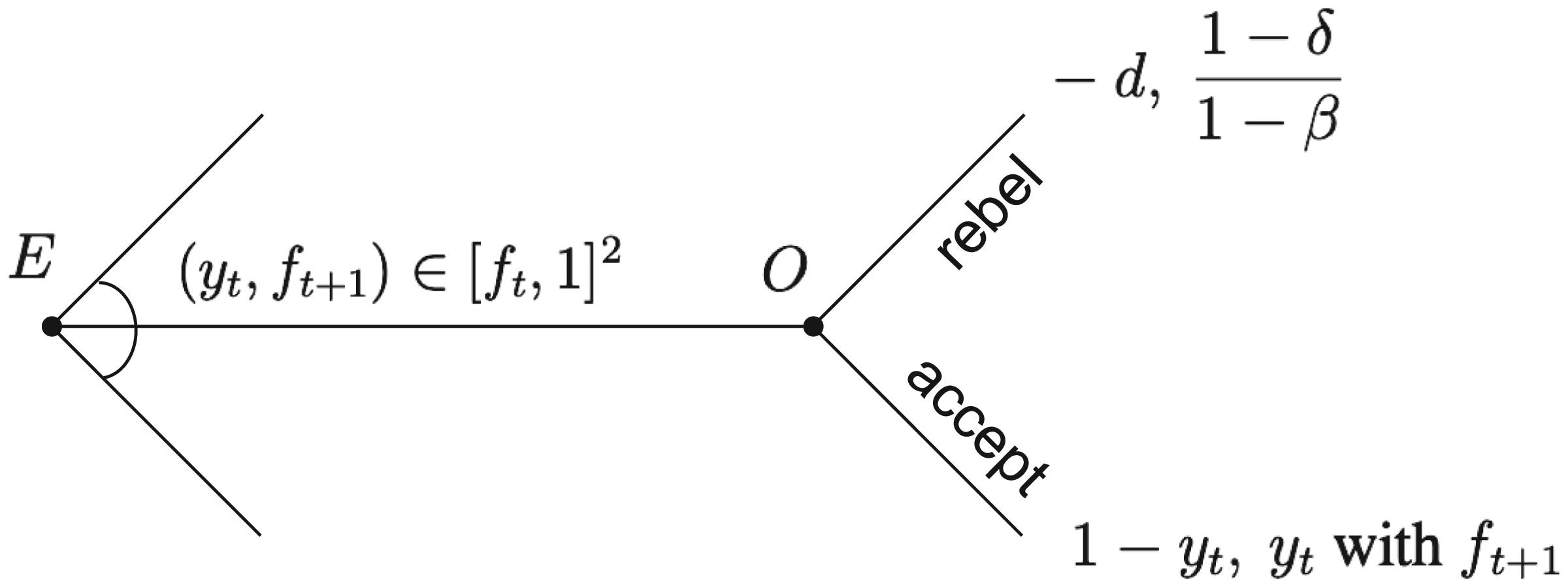
Stage game when the division of power is
Proposition 1 presents the main result: elites are indifferent about exactly how much power they share, conditional on sharing enough to prevent revolt and not sharing so much that the opposition permanently consumes more than its reservation value to revolting.
(Indifference over institutional reform.)
Assume

Appendix A.1 presents and proves a proposition that characterizes the continuum of equilibria strategy profiles that yield these paths of play. Here, I present the core expressions that explain why elites are indifferent about the exact level of institutional concessions.
To avoid revolt, elites must share power beyond the initial level

Raising
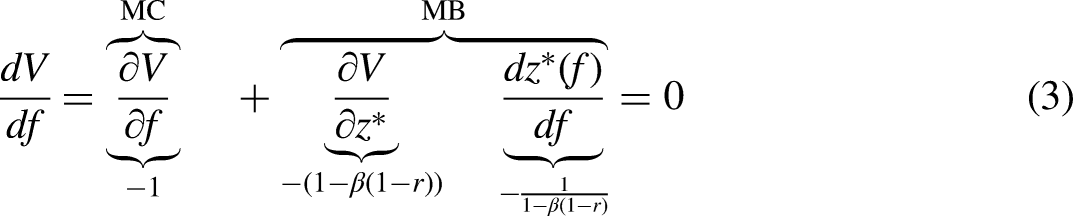
Permanent and temporary concessions are perfect substitutes because the elites and opposition discount the stream of transfers in an identical manner. Elites make their power-sharing choice in a high-threat period, and the opposition chooses whether to accept proposals in high-threat periods. Thus, when each actor contemplates its respective decisions, it expects to pay (or receive) the temporary transfer in the current period and a fraction
Consequently, elites are indifferent about the exact choice of
Absent a source of friction, smaller temporary transfers perfectly offset a higher basement level of spoils for the opposition. This substitution effect raises a puzzle about the aforementioned models—what produces their respective findings that ruling elites strictly prefer temporary transfers over permanent concessions?
In the full model in Powell (2024), elites invest positive effort in undermining a proposed power-sharing deal whenever
In Acemoglu and Robinson (2006b), elites strictly prefer to buy off the masses with temporary transfers only, for two reasons. First, the menu of institutional reform options is discrete; either full franchise expansion in which the opposition sets policies in every period, or no reform. Consequently, reforming institutions yields a permanent payoff that strictly satisfies the masses’ no-revolt constraint, which prevents elites from fully recouping their losses with lower temporary transfers. 10 Thus, a continuous space for institutional reforms (in addition to a continuous space for temporary transfers, which is common across all these models) is needed for Proposition 1. Second, total surplus is lower when the masses set policy. As opposed to Powell’s setup in which elites distribute linear transfers from a budget normalized to 1, Acemoglu and Robinson incorporate a more detailed political economy setup. Each actor has a wealth endowment, and the policy choice determines per-capita taxation; and state revenues are redistributed as a lump sum to every member of society. Higher tax rates (which the masses prefer) create greater deadweight loss, and therefore total surplus is lower when the masses determine policy.
In Castañeda Dower et al. (2018), ruling elites strictly prefer temporary transfers over permanent concessions for a more subtle reason. The menu of possible institutional reforms is continuous, as in Powell, but reforming institutions does not create a direct cost. The key to the proof of my Proposition 1 is that, with probability 1, elites set policy in the period that institutional reform occurs. Consequently, elites and the opposition discount the equilibrium transfer in an identical manner, as discussed earlier. In Castañeda Dower et al. (2018), by contrast, the institutional reform is enacted immediately. This means that the majority will, with positive probability, make the policy choice in the period in which institutional reform occurs. If this contingency arises, then elites cannot offset the higher permanent concession with a lower temporary transfer today—which lowers their marginal benefit to institutional reform. This is best interpreted as a friction that prevents efficient contracting, as opposed to a concrete cost of institutional reform; the tension arises because the opposition cannot commit to fully compensate elites for the (already conceded) higher level of institutional concessions. However, if their model was altered such that elites surely set policy in the period of the institutional reform, then a modified version of Proposition 1 would apply, and elites would be indifferent about the exact level of institutional reform. I present this result formally in Appendix A.3.
Which concessions are costly?
Existing models assume, through different mechanisms, that institutional reform is costly whereas temporary transfers are not. However, such assumptions are not applicable in all circumstances. For example, autocratic governance weakens protections for property rights (Ansell and Samuels, 2014). Insecure property rights discourage producers from making investments that would expand the tax base, which legislative representation (Gailmard, 2017) or institutionalized parties (Gehlbach and Keefer, 2011) could protect. Alternatively, corruption might distort the political system, which a broader franchise would alleviate (Lizzeri and Persico, 2004). Finally, certain government programs are inherently inefficient if not secured over the long term, such as mass education systems, social security programs, and central banks. Therefore, permanent rather than temporary versions of these programs bolster surplus. 11
These observations relate to long-standing debates about the bottom-up versus top-down nature of political transitions. In Acemoglu and Robinson (2006b), Castañeda Dower et al. (2018), and Powell (2024), transitions are driven purely by bottom-up pressures. By contrast, these alternative ideas highlight various sources of top-down pressure for reform. A core idea in top-down theories is that authoritarian institutions are inherently inefficient, which can spur reforms even absent pressure from below. 12
Conceptualizing institutional strength
Powell (2024) focuses on the strength of institutions, and how institutional strength affects prospects for political reforms. In his model, the object of contention is an asset that yields a flow of spoils across time. The ruling elites possess this asset initially, and stronger institutions correspond with more credible promises to give away part of the asset. The microfoundations for credibility are that elites pay a sunk cost to block the implementation of a promised reform, and the marginal returns to this effort (that is, its probability of blocking implementation) decrease in a parameter
Credibility of constitutional amendment procedures
Powell’s parameter
Divergent outcomes in the UK and Sudan also relate to an observation in Dahl (1971) about pathways to democratic consolidation. Dahl distinguishes between contestation, the extent to which elections are free and fair; and participation, the scope of who can participate in politics. Dahl contends that establishing electoral competition among a small and cohesive elite followed later by mass franchise expansion should provide a favorable path to establishing full democracy. In such countries, ‘the rule, the practices, and the culture of competitive politics developed first among a small elite. …Later, as additional social strata were admitted into politics they were more easily socialized into the norms and practices of competitive politics already developed among the elites’ (p. 36). He mentions the English case when discussing this pathway to democracy, whereas cases like Sudan in 2019 lacked a foundation of competitive politics. Hence, Powell’s conceptualization of
Alternative conceptualizations of institutional strength
Powell’s conceptualization does not capture all aspects of institutional strength, an inherently multi-faceted idea. The parameter
In Acemoglu and Robinson (2006b), authoritarian elites cannot credibly commit to promises of temporary redistribution. Thus, using Powell’s notation,
Conversely, many circumstances of high
However, high
The putty-clay assumption
The notable ‘cheat’ in Powell’s model is a putty-clay assumption: institutions are assumed to be very strong in the sense that power-sharing deals, once implemented, cannot subsequently be reversed. The value-added of Powell’s model is a richer structure for endogenous reneging; because this is a continuous choice, the probability of implementation is a smooth, fully endogenous characterization of the deeper parameters. The drawback of this machinery, though, is that allowing the elites to unwind a deal that has already been implemented would be restrictively complicated (see his footnote 17). By contrast, other models with a simpler structure for reneging can generate richer dynamic patterns, such as cycling over time between democratization episodes and autocratic reversions in Acemoglu and Robinson’s (2006b) extension with coups. 17 Thus, Powell’s model focuses solely on the difficulty of conceding power in the first place, as opposed to undermining a deal already in place.
The putty-clay assumption about delivering a permanent basement level of spoils for the opposition has more verisimilitude in some contexts than others. This approach makes sense in the context of regional autonomy deals, in which it is indeed difficult for a government to re-establish its position after pulling troops out of a region (that is, after initially implementing the deal). 18 Similarly, this approach makes sense for explaining why rulers would allow an initial election. However, it does not adequately capture repeated elections over time, in which the electoral winners have to perpetually agree to contend in the next election. In this scenario, the initial concession does not facilitate a permanent basement level of spoils. 19 Overall, given the novelty of Powell’s (2024) approach (although see also the setup in Powell 2019), the relative value-added of modeling continuous effort and putty-clay institutions versus a simpler reneging option that facilitates richer dynamics remains to be determined.
Sharing power despite weak institutions
Very weak institutions undermine the possibility of an equilibrium with power sharing in Powell (2024), which he describes as his first main contribution (see also his Proposition 2). When institutions are weak (high
Smoother distribution of shocks
A smoother path of shocks can mitigate the problem of weak institutions. In Powell’s baseline model, the opposition fluctuates between high-threat periods (wins a revolt with probability 1) and low-threat periods (wins with probability 0). In an extension, Powell adds a third, intermediate-threat period in which the opposition’s probability of winning lies in between these extremes.
The extension resembles the baseline model in one sense—very weak institutions disable elites from buying off the opposition in a high-threat period, assuming no institutional reform has occurred previously. However, if Nature draws one or several intermediate shocks prior the first high-threat period, then elites have an opportunity to build a stock of institutional concessions prior to the first high-threat period. Accumulating a large enough stock enables elites to buy off the opposition in the first high-threat period. Having an institutional stock reduces the stakes of undermining an agreement, which bolsters the credibility of a power-sharing proposal. Consequently, a smoother distribution of shocks substitutes for weak institutions to prevent conflict. 20
The main problem with this extension is its analytic complexity. The associated section of the paper lacks a formal proposition, and Powell presents a numerical example in the appendix to establish existence. A simpler setup would be one in which elites pay no direct cost to changing institutions, but cannot raise the opposition’s basement level of spoils in a single period by more than an exogenously determined upper bound (call it
Persistent anti-regime mobilization
Powell highlights an unrecognized tension in existing models, which presume institutional reforms are perfectly credible. On the one hand, within a period in which reforms occur, these models implicitly assume that the opposition remains mobilized against the regime for long enough to ensure the institutional concession is implemented. On the other hand, institutional concessions are necessary in the first place only because the opposition can seldom mobilize a high threat. As Powell summarizes this tension, ‘the opposition must be strong (in expectation) for long enough to enforce the agreement but not long enough to eliminate the commitment problem.’ In his stage game, Powell assumes the opposition cannot coercively enforce the deal; at the node in which the elite decides how hard to undermine the deal, the opposition has already forgone its contemporaneous revolt option.
But Powell’s commentary also suggests that the opposition, upon sustaining mobilization for long enough, should be able to enforce a deal—even if institutions are weak. Assume an alternative setup in which following the power-sharing promise, the opposition probabilistically remains strong throughout the transition. If this occurs, the institutional concession goes through for sure. If not, then elites have an opportunity to renege, as in Powell’s model. The theoretical intuition here is straightforward, and making progress on this consideration might ultimately be an empirical question: What tactics generally succeed at enabling opposition actors to remain organized and vigilant during tenuous transition periods?
Coercive enforcement of power-sharing deals
In Powell’s model, power-sharing deals entail elites sharing spoils with the opposition, but without shifting the distribution of power between the two actors. The distribution of threats is unaffected by the opposition’s permanent share of spoils: A revolt succeeds with probability 1 in a fraction
However, in weak institutional environments, ruling elites can tie their hands by providing the opposition with coercive means to defend their concessions. For example, a ruler can allow actors besides his cronies to control various branches of the security sector; or, amid a civil war, offer ceasefires or peace treaties that either permit rebels to keep their arms, or integrate them into the state military. Generalizing these examples, Meng et al. (2023) distinguish between two ideal-type means of enforcing a power-sharing deal: institutional (captured by Powell’s model) and coercive (captured by the present examples).
Coercive enforcement mechanisms, despite providing a possible means to bolster the credibility of promises in weak institutional environments, may fail to prevent conflict because the opposition faces a commitment problem. Emboldened by the power-sharing deal, opposition leaders can renege by leveraging their favored position to seize the throne for themselves. Thus, coercive enforcement mechanisms can, inadvertently, enable the opposition to go on the offensive, contrary to their intended rationale of enabling the opposition to defend its control over a share of spoils. 21
In Paine (2022), I isolate a core trade off entailed in coercive enforcement. Sharing power increases both (a) the frequency with which the opposition poses a high threat, which ensures that elites redistribute more (commitment effect); and (b) the opposition’s probability of winning in high-threat periods, which makes the opposition more difficult to buy off (threat-enhancing effect). This approach differs in two important ways from the main models discussed throughout this comment.
First, sharing power can either stabilize or destabilize the regime—depending on whether the commitment or threat-enhancing effect is larger in magnitude. By contrast, in the models discussed throughout this comment, sharing more power necessarily relaxes the opposition’s no-revolt constraint; there is no countervailing threat-enhancing effect.
Second, the frequency of high-threat periods and the probability with which the opposition wins in high-threat periods are positively correlated, which relaxes the standard assumption that the latter probability is fixed at 1 (see also Little and Paine 2024, who model a continuous distribution of threats). These correlated parameters imply that prospects for conflict are not maximized when the opposition rarely poses a high threat, contrary to existing models. Instead, an infrequent maximum threat covaries with a lower value of the maximum threat, and the latter effect diminishes prospects for conflict. For this reason, the inverted U-shaped relationship that Powell characterizes between institutional strength and power sharing (Powell describes this as the third main result of his model; see Proposition 3iii) is not robust to altering the distribution of threats as modeled in Paine (2022) or Little and Paine (2024). 22
Stepping down
Powell discusses the example of Sudan’s negotiated transition that began in 2019 as a case of non-credible promises amid an environment of weak institutions. Political institutions are undoubtedly weak in Sudan, a country with a history of frequent coups and civil wars. Nonetheless, its leaders failed to take actions, such as immediately stepping down, that could have made their promises of institutional reform more credible. This possibility lies outside the scope of options modeled by Powell.
Following months of protests, the military deposed president Omar al-Bashir in 2019, and the newly formed Transitional Military Council promised to hold elections at the end of a 39-month transition period. Yet the military officers, who had participated in governing the country alongside al-Bashir since 1989, remained in positions of power. A coup in October 2021 derailed the original timeline, and in April 2023, fighting between rival military factions broke out in the capital, which has further blocked progress toward a transition to more democratic institutions.
Returning to 2019, how could the military have made its promises more credible, despite a weak institutional environment? Powell’s model lacks an option for ruling elites to simply stand down from power. This could, conceivably, be modeled as an exogenously determined option value for elites to instantaneously relinquish power. The value of this option would reflect their electoral viability, ability to retain means of coercion, and expectations of punishment for human rights abuses or other violations. 23 Short of the last-resort option of stepping down entirely, elites have agency to make promises of electoral power sharing more credible. Sudan’s military leaders could have granted the main positions in the government to opposition leaders at the outset of the transition, promised to hold elections within a shorter time frame, or agreed to not participate in the elections. Such actions are not foolproof, but can bolster the credibility of electoral concessions in countries that lack a long-standing history of competitive elections. Future models could consider a richer array of institutional reform options.
Conclusion
Sharing political power is inherently difficult. Weak institutional environments can make this problem intractable, as Powell (2024) explains. In personal correspondence, Bob conveyed his belief that political actors usually have a hard time making credible commitments to each other. This is what he aimed to capture by modeling endogenous effort to block the implementation of concessions, a novel element for conflict bargaining models; and interpreting the feasibility of such subversion attempts as the strength of the institutional environment. Bob contemplated this issue for decades. In an early article, Acemoglu et al. (2004: 163) assert, ‘A study of the political economy of [kleptocratic] regimes must depart from the standard presumptions of most research in economics and political science, which assume that rulers make choices within strongly institutionalized polities.’ The footnote accompanying this sentence states, ‘We owe this terminology and the distinction between strongly and weakly institutionalized polities to Robert Powell.’ Bob’s last completed paper offers an important contribution to this critical topic, and also raises numerous important issues that scholars can productively analyze in future research.
Footnotes
Declaration of conflicting interests
The author(s) declared no potential conflicts of interest with respect to the research, authorship, and/or publication of this article.
Funding
The author(s) received no financial support for the research, authorship, and/or publication of this article.
