




Abstract
This article examines the characterization of Lot in Jubilees and considers how it relates to the centrality of covenant in the book. The article suggests that the author of Jubilees systematically reworked the Genesis account so as to remove any possibility of interpreting Lot positively, and argues that a wholly negative portrayal of Lot was important to uphold the strict bifurcation between covenant and non-covenant peoples. A comparison with other Second Temple period works serves to demonstrate further the particular choices and emphases of the author of Jubilees.
Introduction
Covenant is a central—one might even say the central—theme in Jubilees. 1 In general, characters who are within the covenant (i.e. Abraham, Isaac, Jacob, and Jacob's descendants)—or the trajectory toward covenant (i.e. the ancestral line leading to Abraham)—are embellished in ways that present them more positively than in Genesis. 2 Correspondingly, Jubilees has a keen interest in delineating the full genealogy of this covenantal line, including not only the males, but also the names of their wives, in order to show that the line is pure (see esp. Jub. 4). 3 On the flip side, characters who are not included in the covenant (or the trajectory toward covenant) are often given reduced roles of importance or are molded into more negative portrayals than in Genesis. We see this especially with characters like Haran (Jub. 12.10–14) and Esau (e.g. Jub. 35.13–17). 4
Yet, there are exceptions to the rule. For example, Michael Francis has shown how Ishmael receives surprisingly positive treatment in Jubilees despite the fact that he is not a necessary part of the line leading to Jacob. 5 Another exception might be Terah, who—despite being Abram's father—is depicted somewhat negatively. True, Jubilees adds a narrative where Terah confesses his faith in the one true God, but this confession is made in private, and only to Abram. In it, Terah presents himself as a slave (or at least a subordinate) who lacks the power and conviction to stand up to those he serves and denounce the idolatry he knows to be wrong. Even more, he counsels Abram to do likewise. Terah is a far cry from the righteous Abram (see Jub. 12.1–8).
What about Lot? 6 Neither a direct ancestor nor a direct descendant of Abram, Lot is even farther removed from the promise than Terah or Ishmael. Moreover, given that he separated from Abram before the command of circumcision, Lot could not have borne the sign of the covenant. Nevertheless, Jubilees consistently portrays Lot as close to Abram, and at one point it is even suggested that he be treated as Abram's son (see Jub. 12.30). It is in part based on these details that Jacques T.A.G.M. van Ruiten finds the depiction of Lot in Jubilees to be ‘somewhat ambivalent’. 7 Yet, while it is true that Genesis includes quite a bit of ambiguity—and even ambivalence—in its characterization of Lot, I find that this assessment does not hold for Jubilees. 8 Instead, in my analysis, I find that the author of Jubilees carefully reworks the narrative every step of the way so as to remove any possibility of interpreting Lot positively. In order to demonstrate this point, I will trace the depiction of Lot in Jubilees in each episode in which he appears:
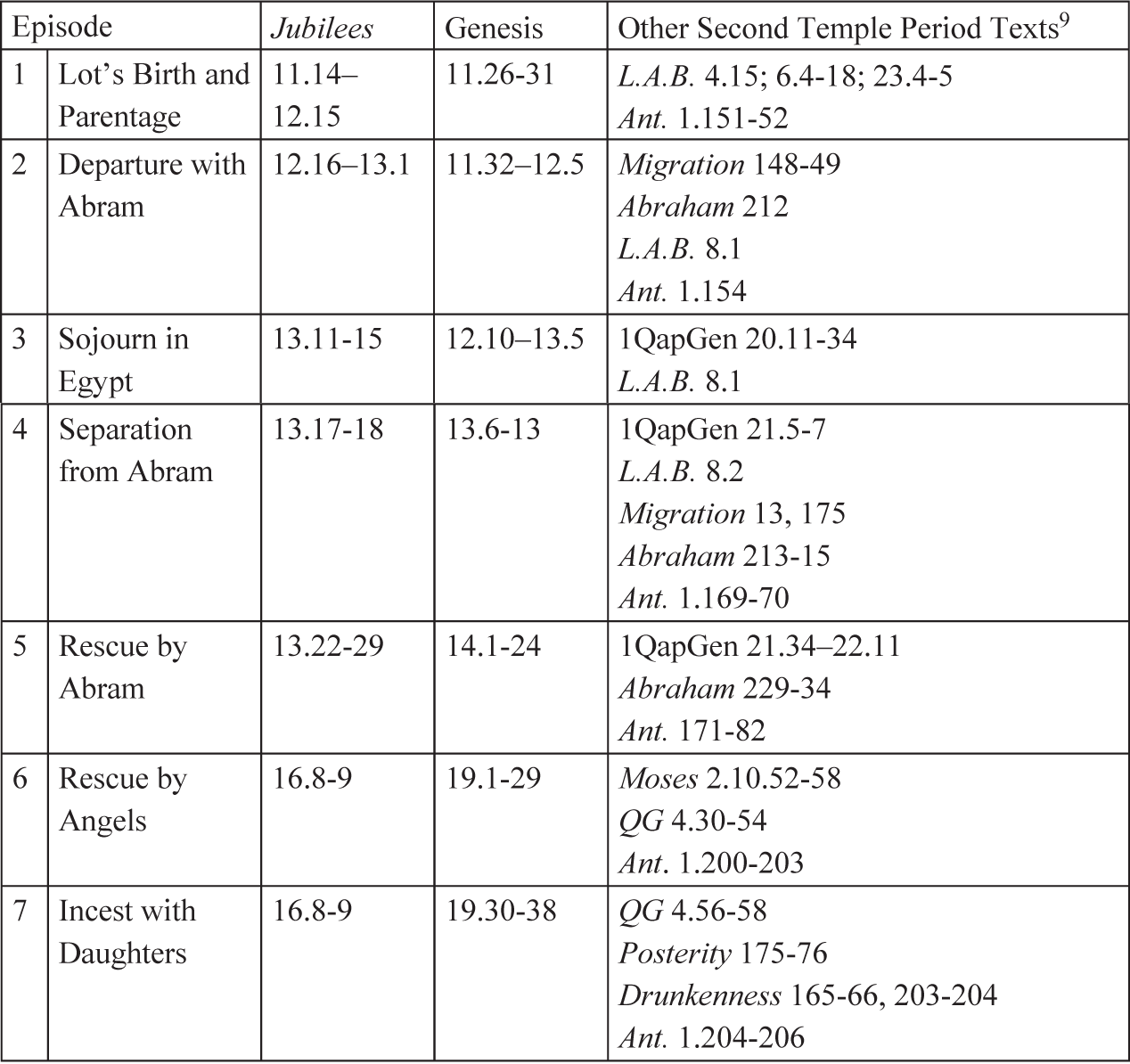
In each section, I begin with Genesis, commenting only on aspects that are relevant for the discussion of Lot in Jubilees. Then, when I turn to Jubilees, I pay special attention to differences—first noting ‘what’ is different and then turning to ‘why’. Finally, I consider the depiction of Lot in other Second Temple period works, focusing particularly on contrasts that bring the choices of the author of Jubilees—choices that continually depict Lot in a negative light—into sharper relief. 10
1. Lot's Birth and Parentage: Jubilees 11.14–12.15 (//Gen. 11.26–31; L.A.B. 4.15; 6.4–18; 23.4–5; Ant. 1.151–52)
Genesis
Though Lot is the only grandchild of Terah reported in this passage, the text tells us little about him except that he was born to Terah's third son, Haran, and that his father died before his grandfather (Gen. 11.27–28). 11 However, if the text answers very few questions about Lot, the peculiar wording and order of presentation raises several: Why is the report of Lot's birth moved prior to reports of Terah's first two sons marrying? How long did Haran live after the birth of his son? What does it mean that Haran died ‘before Terah, his father’ (ויבא חרת ינפ לע, Gen. 11.28)? Is this merely a chronological designation, or did Haran actually die while his father was looking on? Moreover, why the double specification about where Haran died: both ‘in the place of his birth’ (ותדלומ ץראב) and ‘in Ur of the Chaldeans’ (םידשכ רואב) (Gen. 11.28)? Does the second communicate something more than or different from the first? Is it significant that Haran's marriage is never reported, or that Sarah's genealogical details are not given? 12 Jubilees addresses these questions in its own rendition of the story.
Jubilees
Jubilees includes significant expansions of the biblical narrative. In fact, whereas Genesis spends a mere five verses covering this section, Jubilees spreads the story over two chapters: Jub. 11.14–12.15. Most of the additional material concerns Abram, depicting him as uniquely righteous and obedient to God from very early on (Jub. 11.14–12.9). Abram is clearly the protagonist of this story. However, the extended narrations also provide added details about Haran and, by extension, Lot.
In Jubilees’ depiction, Abram is perfectly righteous, and the righteousness of everyone else is measured in contrast to him. By the time of Lot's introduction in Jub. 12.10, Abram has already set himself apart from his father and brothers by recognizing the one, true God and denouncing the worship of idols (Jub. 12.1–8). Abram's father, Terah, is somewhat righteous; he agrees with Abram that it is not right to worship idols, but lacks the boldness to declare such an unpopular position (Jub. 12.6–7). Abram's brothers, in contrast, are not at all righteous; they become angry with Abram for his position against idolatry (Jub. 12.8). It is into this context that Lot is born; he is the son of a man driven to anger by the mere suggestion that the worship of idols is wrong.
Several changes in the reports of the births and marriages of Terah's sons and the birth of Lot (Jub. 11.15; 12.9–11; cf. Gen. 11.26–30) draw attention to Abram as the protagonist of the story and to Lot as a person of questionable moral character. First, of Terah's three named sons, Abram's birth is the only one that receives direct mention (Jub. 11.15). Second, though all three marriage reports appear, the report of Abram's marriage is moved to the head, and a chronological marker is provided to show that, indeed, Abram was the first of the sons to marry. Third, both the name and genealogy of Abram's wife are provided (Jub. 12.9). She, too, is a child of Terah, and thus makes a suitable wife for the father of the covenant. Only after establishing Abram's proper marriage does the author of Jubilees turn to Haran. Here, it is reported that Haran married ‘a woman’—her name and genealogy are not given—and that she gave birth to a son, Lot (Jub. 12.10). 13 Both of these events also receive chronological markers; Haran married three years after Abram, and Lot was born four years after that. Finally, Nahor's marriage is reported in the briefest way possible, with no chronological marker and no reference to the woman he married (Jub. 12.11).
In van Ruiten's analysis of this material, he points to the added details surrounding Lot's birth—the report of Haran's marriage and the chronological marker for the birth of Lot—and argues that these added details suggest ‘a positive appreciation’ of Lot. 14 While van Ruiten also notes that the lack of a genealogy for Lot's mother and the depiction of his father as an idolater indicate disapproval of Lot, he maintains that the overall depiction of Lot in this section is ambivalent: positive in the extra details provided, but negative in the content of those details. In my view, the added details do not indicate a positive appreciation precisely because the content of those details draws attention to a negative appraisal. Indeed, in raising our suspicion about Lot's character, they are our earliest indication that Lot is and will be an unrighteous outsider.
Also in contrast to van Ruiten, I do not think that the rearrangement—with Abram's marriage reported first, followed by the birth of Lot and the death of his father—necessarily makes it ‘easier to view Lot as the surrogate son of Abram and Sarai’. 15 We might say it foreshadows the question—raised more directly by Terah in the following episode—of whether it is possible for Lot to become Abram's son by adoption. However, there is no suggestion that we answer that question in the affirmative. Instead, the placement of Haran's marriage to ‘a woman’ right after the proper marriage of Abram and Sarai draws attention to the fact that Lot's mother lacks both a name and genealogy. For Jubilees—a book strongly concerned with the purity of the genealogical line of God's covenant people—the lack of a mother with a name and the proper genealogy is decisive. Even more, as Betsy Halpern-Amaru cogently demonstrates, in the book of Jubilees, the genealogical credentials of the woman determine ‘the moral quality of the heir’. 16 Thus, for Lot, the question of his mother's genealogical credentials is not only a question of genealogical purity; it is also a question of moral uprightness.
Suspicions raised by the lack of information regarding Lot's mother are confirmed by the added details describing the death of his father (Jub. 12.12–15). Like the prior expansion concerning Abram and his brothers (Jub. 12.8), this expansion serves to contrast the righteous Abram with his idol-loving brother. In this story, Abram gets up at night and sets fire to the temple full of idols (Jub. 12.12). Everyone wants to save the idols (Jub. 12.13), but Haran is the most zealous of all: he dashes in and, in a fruitless effort to rescue the idols, is consumed by the fire (Jub. 12.14). In addition to offering an exegetical interpretation for the apparent double specification in Gen. 11.28—reading ‘in Ur of the Chaldeans’ (םידשכ רואב) as ‘in the fire of the Chaldeans’ 17 —this story furthers the contrast between the righteous Abram and the unrighteous brother, setting up the strict bifurcation between the ‘in group’ (Abram and his descendants through the line of Jacob) and the ‘out group’ (everybody else). Since Lot is the son of Haran, he too will be a part of this ‘out group’.
Finally, whereas Genesis lifts up Lot explicitly as among those whom Terah took when he left Ur and settled in Haran—and even emphasizes his relationship to Terah by describing him as ‘the son of his son’ (Gen. 11.31)—Jubilees ignores his presence. Instead, Jubilees simply states that Terah went with ‘his sons’ (Jub. 12.15). Not only does this generic designation now apparently include Nahor—who was omitted from these travels in Genesis—but it also renders silent the inclusion of Lot and Sarai. Even more, where Genesis uses a plural verb to indicate that ‘they’ (presumably referring to Terah, Abram, Lot, and Sarai) settled in Haran, Jubilees switches to the singular: ‘he [Terah] settled in Haran’ and then adds ‘and Abram lived with his father for two weeks of years’ (Jub. 12.15). So, whereas Genesis gives equal attention (even if the priority of Abram is indicated by order) to Abram, Lot, and Sarai, Jubilees shifts all attention to Abram, to the point of omitting Lot completely. Since Lot later appears to be living in Haran (see Jub. 12.30), he must have been a part of this journey. His presence was simply too unimportant to mention.
Pseudo-Philo and Josephus
Two examples from other Second Temple period texts that engage this Genesis material serve to illustrate the extent to which it was possible to interpret Lot (and his father) more positively. First, Pseudo-Philo tells a story about a fire that, instead of denigrating Lot as the son of an idol worshiper, portrays him as basically righteous, even if not quite fearless (L.A.B. 6.4–18). The story is set in the city of Babel, just before the tower is built. The Babelites desire to bake bricks with their names on them, but Abram, Nahor, Lot, and nine other righteous men refuse (L.A.B. 6.4).
18
When questioned about their refusal, all twelve cite their belief in ‘the one L
Josephus' narration—which likewise includes no story about Haran dying in a fire to save idols—also lacks this sharp distinction between Abram and his brothers; moreover, Josephus even includes two details that allow for a positive appreciation of Haran. First, Josephus adds to the notice of Haran's death that his monument remains ‘to this day’ (Ant. 1.151). 20 Second, Josephus draws attention to Terah's grief over his son's death, claiming that it was Terah's intense sadness for Haran that caused him to move his family from Ur of the Chaldeans (Ant. 1.152). In both Genesis and Jubilees, Terah moves his family from Ur toward Canaan (Gen. 11.31; Jub. 12.15). However, neither of these texts suggests any motive for the move. Having Terah mourn the death of Haran creates sympathy for Haran's character. This stands in sharp contrast to Jubilees where presentation of Haran is overtly negative. Even more, these changes also have a dramatic effect on Lot's introduction. Where Jubilees depicts Lot as the son of an idolater, destined to be trouble from the beginning, Josephus depicts him as one of the family, who tragically loses his father at a young age.
2. Departure with Abram: Jubilees 12.16–13.1 (//Gen. 11.32–12.5; Migration 148–49; Abraham 212; L.A.B. 8.1; Ant. 1.154)
Genesis
Lot next appears in the narrative—of both Genesis and Jubilees—when he accompanies Abram on his God-given journey, departing Haran for an unknown land. In Genesis, the mention of Lot comes as a bit of a surprise. Immediately after the report of the death of Terah (Gen. 11.32), 21 God commands Abram to leave his land, his kindred, and his father's house (Gen. 12.1). God then makes great promises to Abram, promising to bless him and to make him into a great nation (Gen. 12.2–3), and Abram fulfills the command: ‘And Abram went just as Yhwh commanded him’ (Gen. 12.4). So far, so good. However, the verse continues: ‘and [but?] Lot went with him’. The waw conjunction is ambiguous. Is Lot's accompanying of Abram a continuation of Abram's obedience, or does it stand in disjunction with it? The text is unclear, but certainly it is possible to read Lot's presence as a potential problem. 22
The next verse, Gen. 12.5, only confuses matters further. Whereas in Gen. 12.4, Lot is the subject of the verb (‘Lot went with him’), Gen. 12.5 makes Lot the object (‘Abram took Lot’). Which is it? Was it, as Gen. 12.4 suggests, Lot's decision to accompany Abram? If so, it might be counted as righteous. Surely it is a good thing for Lot to choose Abram's company—and we cannot fault Lot for following or not following a command that was not addressed to him and that he did not hear. Or, was it, as Gen. 12.5 suggests, Abram's decision to bring Lot along, in which case we might fault Abram for not being wholly obedient to the command to leave his kindred behind?
Jubilees
Rather than depicting Lot as righteous or Abram as unrighteous, the author of Jubilees finds a third way. No decision-making is attributed to Lot, who is only an object and never a subject in this episode. However, the decision was not Abram's either. It was Terah's. In order to accomplish this change, Jubilees omits the report of Terah's death prior to God's command to Abram. This subtle change creates a new problem—and opportunity—for the author of Jubilees. The problem is that God now seems to be asking Abram to abandon his duty to care for his father in his old age. To solve this problem, Jubilees inserts a new narrative where Abram discusses his plans with his father and receives his blessing. Moreover, Abram says that he is not planning to leave for good, but that he will go to Canaan and then return (Jub. 12.28–31). 23
So, the author of Jubilees both creates and solves this problem of Abram's fidelity to his father quite easily; but to what end? There are reasons to think that these changes are less about concern for Terah and more about the characterization of Abram and Lot. Genesis leaves open the possibility that Abram is not wholly obedient to God's command to leave his family since he takes Lot with him. In Jubilees, this newly added conversation between Abram and his father becomes the perfect opportunity to relieve Abram of any guilt. It is Terah who suggests to Abram that he take Lot on the journey (Jub. 12.30). Only then does Abram leave his father, taking Lot with him (Jub. 13.1). Thus, the Abram of Jubilees is doubly obedient, obeying God's command to leave his family, and obeying his father's command to take Lot with him. 24
One further point requires attention, and that is the suggestion that Abram take Lot ‘as a son’ (Jub. 12.30). 25 Jubilees names the recipients of the promise quite specifically as Abram, his son, his grandson, and all of his descendants (Jub. 12.24; cf. Gen. 12.1–3, where the promise is thus far directed only to Abram). 26 At this point in the narrative, it is not yet clear which son and grandson are to be included; indeed, Abram does not yet have a son. Thus, when Terah suggests that Abram take Lot ‘as a son’, the author of Jubilees introduces an intriguing option. Can Lot, by virtue of adoption, move from the ‘out’ group to the ‘in’ group? Can Lot, the son of an idolater, be ‘saved’ by his relation to Abram? At this point in the narrative, the verdict is still out.
3. Sojourn in Egypt: Jubilees 13.11–15 (//Gen. 12.10–13.5; 1QapGen 20.11–34; L.A.B. 8.1)
Genesis
During the entire episode of Abram and Sarai departing for and sojourning in Egypt (Gen. 12.10–20), Lot is never mentioned. He does not appear until Abram and Sarai are leaving Egypt (Gen. 13.1), and even here he seems to be added in as an afterthought. 27 In fact, if Lot is removed completely, the narrative reads much more smoothly. Right after the mention that Abram brought all of his possessions with him (Gen. 13.1) comes a description of Abram's great wealth (Gen. 13.2). Then, his travels are narrated, with singular verbs and no reference to his nephew (Gen. 13.3–4). When Lot does reappear (along with a list of his possessions) in Gen. 13.5—a verse that parallels and might more naturally follow the notice of Abram's many possessions in Gen. 13.2—he again seems out of place. The verse tells us nothing about his role in the narrative, but simply informs us that he had property. Thus, in the story's final form, Lot's presence in Egypt is wholly superficial. He has no role to play. He is merely present, yet even his presence goes unmentioned until the journey home.
Jubilees
Since Jubilees often smooths over inconsistencies in its biblical source texts, we might expect it here to fill in the gap named above by indicating that Lot traveled with Abram to Egypt, and perhaps by changing the singular verbs describing Abram's travel to plural verbs so as to account for both men. But Jubilees does no such thing. In fact, if Jubilees attempts to smooth over these inconsistencies at all, it does so by further removing Lot from the story. All of the verbs remain in the singular and, in Jubilees, Lot is neither mentioned as accompanying Abram into Egypt nor as accompanying him on the journey back home.
The only mention of Lot during the episode in Egypt is the notice that Lot, like Abram, had property (Jub. 13.14). Given the lack of any mention of Lot elsewhere in this portion of the narrative, the notice that he has property seems entirely out of place—perhaps even more so than in the parallel notice in Genesis, where he is at least mentioned as accompanying Abram and Sarai out of Egypt. Yet, by comparing this statement to its source in Genesis, we can learn more about how and why Jubilees is reworking the inherited tradition.
Jubilees 13.14, which reports the property of both Abram and Lot together in one verse, is essentially a restatement of information already provided in Genesis; however, the placement of the data creates a very different effect. In Genesis, the information is spread across three verses in three different contexts: Gen. 12.16; 13.2, and 13.5. The first two are reports of Abram's property: the first, while he is still in Egypt; the second, after the journey out of Egypt. The third is a report of Lot's property.
The two lists reporting Abram's property are different; in particular, silver and gold only appear in the second list. This difference might lead the reader to understand that Abram acquired these valuables subsequent to the last report of his possessions, in which case the most logical explanation might be that he received them from Pharaoh as a gift of good riddance. 28 Jubilees' retelling alters the narrative to rule out such an interpretation. In Jubilees, the two reports of Abram's wealth are combined, and the report is given before Pharaoh sends Abram away (Jub. 13.14). 29
The second change concerns the report of Lot's wealth (Gen. 13.5). Rather than separating the report of Lot's wealth from that of Abram's as in Genesis, the author of Jubilees places the reports side by side. The lack of specificity regarding Lot's wealth in Jubilees is striking. Not only does it follow the very detailed list of Abram's great wealth, but it also condenses the little detail that had been provided in Genesis (see Jub. 13.14 and Gen. 13.5). 30 The message is clear: in comparison to Abram, Lot does not stack up well. Even his list of property is less impressive and less worthy of note. Even more, Jubilees replaces the potentially positive description of Lot as ‘the one who went with Abram’ with a reminder of Lot's troublesome genealogy: he is the son of Abram's brother. In these subtle ways, Jubilees once again asserts its preference for Abram. Finally—and perhaps most importantly—by moving the lists of property earlier in the narrative, the author of Jubilees severs any connection between the property and the decision for Lot and Abram to separate. 31
Genesis Apocryphon
Whereas Jubilees compresses this episode, the Genesis Apocryphon expands it, filling several gaps in the Genesis story and giving Lot a significant role to play. First, after Sarai has been forcibly taken from Abram, Lot joins Abram in weeping for her (1QapGen 20.11). 32 Then, Genesis Apocryphon gives Lot the role of telling Pharaoh who Sarai really is (1QapGen 20.22–23). Here, Genesis Apocryphon is filling a gap in Genesis. In Gen. 12.17, God afflicts Pharaoh. The reader knows that God caused the afflictions on account of Sarai, but no one tells Pharaoh. Yet, in Gen. 12.18, Pharaoh knows who Sarai really is and confronts Abram about his lie. How did Pharaoh find out? According to Genesis Apocryphon, it was from Lot. Even more striking, the words attributed to Lot are highly reminiscent of words spoken by God in the second wife-sister story (see Gen. 20.7 and 1QapGen 20.23), almost as if the very words of God have been inserted into Lot's mouth. The Lot depicted here is confident and assertive, speaking with authority to Pharaoh's messenger. That such a positive image of Lot is possible brings the negative portrayal of Lot in Jubilees into even sharper relief.
4. Separation from Abram: Jubilees 13.17–18 (//Gen. 13.6–13; 1QapGen 21.5–7; Migration 13, 175; Abraham 213–15; L.A.B. 8.2; Ant. 1.169–70)
Genesis
According to Genesis, the great wealth of Abram and Lot becomes the cause of their separation. The cause is twofold. First, their possessions are so great the land cannot sustain them living in one place (Gen. 13.6). Second, those charged with tending the animals are quarrelling (Gen. 13.7). So, the problem is not that Lot and Abram are unable to get along; it is their herders. Still, one might interpret this as a slight against Abram. Is the great patriarch Abram unable to keep even his herders in check? 33
Responding to this situation, Abram suggests that Lot separate from him; he also gives Lot his choice of the land; Lot can choose either half of the land that is before them, and Abram will take the other half (Gen. 13.9). Here, Abram is presented in a positive light, generously offering Lot the first choice of land so as to avoid conflict. However, there is also a problem. God has promised this land to Abram and his descendants. Does Abram have the right to give it away to a mere nephew?
Lot takes his uncle up on his offer, surveys the land, and chooses the plain of the Jordan for his portion. Genesis even offers Lot's rationale: he chooses that land because it is so well-watered and bountiful, ‘like the garden of Yhwh [and] like the land of Egypt’ (Gen. 13.10). There is no explicit negative characterization of Lot here. 34 One might argue that he is being selfish to take advantage of his uncle's generosity in giving him his choice of land. 35 However, his choice might just as easily be described as prudent. Genesis offers no clear opinion on the matter. Furthermore, any hint of negativity conveyed by the analogy to the land of Egypt is canceled out by the parallel reference to the garden of Yhwh.
Lot's ominous future is not suggested until the end of this passage when we are told that Lot ‘pitched his tent as far as Sodom’ (Gen. 13.12). As the next verse indicates, the people of Sodom were evil and sinned greatly against Yhwh (Gen. 13.13). Why would Lot choose to pitch his tent so close to such people? Should we see in Lot's physical journey from the righteous Abram ‘as far as’ the wicked Sodomites a mirror of Lot's character's own demise into wickedness? Moreover, the preposition ‘as far as’ (דע) is enigmatic here. Did Lot pitch his tent in Sodom or simply near Sodom?
Jubilees
Although Jubilees narrates a separation between Lot and Abram, Jubilees alters the account so as to shift blame away from Abram and on to Lot. First, Jubilees removes any hint of a rationale for the separation, mentioning neither the problem with the land nor that with the herders. Then, Jubilees leaves out the entire narrative of Abram suggesting the separation and then giving Lot the choice of land. Instead, Jubilees simply reports that Lot separated from Abram and settled in Sodom. Note here, too, the change from the neutral ‘they separated, each from the other [lit. “his brother”]’ (לעמ שתא ודרפיו ויחא) to ‘Lot separated from him’ (see Gen. 13.11 and Jub. 13.17). 36 Finally, Jubilees adds narrative not included in Genesis: in particular, Jubilees reports that Abram was brokenhearted over the separation ‘for he had no children’ (Jub. 13.18). 37
Jubilees places the blame for the separation entirely on Lot. 38 Lot is rarely the subject of an active verb in Jubilees. In fact, while he is the subject of no fewer than forty active verbs in Genesis, 39 he is only a subject six times in Jubilees. 40 Even more striking, four refer to the separation from Abram (Jub. 13.17, 18, 19; 17.3) and one to his subsequent settlement in Sodom (Jub. 13.17). Clearly, it was important to the author of Jubilees to depict Lot as the instigator in this episode.
Moreover, Jubilees emphasizes that the separation was a bad idea. This emphasis happens in at least two ways. First, Jubilees offers no reason that might justify the need for a separation. Second, Jubilees follows the report of the separation with its negative consequences, listed in rapid succession: Lot settles in a city full of sinners (Jub. 13.17); Abram becomes broken-hearted (Jub. 13.18); and, that very same year, Lot is taken captive (Jub. 13.19). Taken together, these changes serve to present Lot in a wholly negative light.
Even more, Abram's grief is not really at the loss of the relationship with his nephew—which might have painted Lot in a positive light—but at the mere fact that he has no children. 41 Recall that Terah had suggested that Abram take Lot with him ‘as a son’ (Jub. 12.30). With Lot's departure, Abram's childlessness is once again brought to the fore. Jubilees never says explicitly whether Lot would have been counted among Abram's sons had he not separated from him. However, for Jubilees, the separation is decisive—so decisive, in fact, that it is referenced four times (Jub. 13.17, 18, 19; and 17.3). 42
Genesis Apocryphon and Josephus
Like Jubilees, Genesis Apocryphon also narrates Abram's emotional response to Lot's departure; however, unlike Jubilees, Genesis Apocryphon leaves open the possibility of interpreting Lot positively (i.e. as one for whom Abram has great affinity). In Genesis Apocryphon, Abram says, ‘It was disturbing to me that Lot, my brother's son, had parted from me’ (1QapGen 21.7). 43 Quite significantly, Genesis Apocryphon lacks the rationale provided in Jubilees, which emphasizes that Abram's distress is due to the reminder of his childlessness (‘for he had no children’, Jub. 13.18). If—as Kugel and White Crawford have argued 44 —Genesis Apocryphon used Jubilees as a source, we have here an intentional omission, likely aimed to improve Lot's reputation. 45 However, even without the direction of dependence, the lack of this explanation in Genesis Apocryphon makes its presence in Jubilees stand out even more. Unlike the author of Genesis Apocryphon, the author of Jubilees is clearly interested in removing any possibility of interpreting Lot positively.
Another significant part of Lot's negative portrayal in Jubilees is his choice to live in Sodom. However, as Josephus' retelling demonstrates, Lot's connection to Sodom need not have been interpreted negatively. Josephus puts distance between Lot's settling near Sodom and the evil of Sodom that caused its destruction. Both Genesis and Jubilees declare the sinfulness of Sodom immediately after reporting Lot's choice to settle there, making it seem as if the city was sinful at the time Lot chose to live there. Josephus withholds that assessment. 46 Instead, he offers that Sodom was ‘prosperous’ (ἀγαλος, Ant. 1.170). In Josephus' retelling, the Sodomites were not always sinful. They only became sinful later (Ant. 1.194) and that is when God decided to punish them (Ant. 1.195). For Josephus, this change solves the problem of why God did not destroy Sodom earlier: if Sodom had always been sinful, why did God wait to destroy it? It also removes any negative interpretation of Lot's decision to move there. If Sodom was not a sinful city when Lot settled there, then the choice to settle in Sodom does not reflect badly on Lot.
5. The Rescue of Lot by Abram: Jubilees 13.22–29 (//Gen. 14.1–24; 1QapGen 21.23–22.26; Ant. 171–82)
Genesis
Lot is not a major character in this episode—in Genesis or Jubilees. In Genesis, he appears three times, but never as more than a passive object: he is captured along with the Sodomites (Gen. 14.12), news of his capture is reported to Abram (Gen. 14.14), and Abram rescues him (Gen. 14.16). 47 Given the recent portrayal of Lot as actively pursuing his own best interest in choosing to settle in the plain of the Jordan, the ultra-passive portrayal of Lot in this war is striking. Moreover, Lot's failure to act stands in contrast with Abram's decisive action. Whereas Lot is captured without a fight, Abram quickly mobilizes 318 men, pursues the invading kings, and reclaims all that had been taken, including Lot. Lot does not even say ‘thank you’. Clearly, the narrator is not interested in telling Lot's story here. This is a story about Abram—as a military leader and as a patriarch concerned with his kin. Still, the episode is informative. Particularly in combination with the next rescue of Lot, it depicts Lot as someone who gets into trouble and needs to be saved. 48
Jubilees
Though Jubilees significantly shortens the episode, it basically maintains the depiction of Lot as passive. However, there is one oddity in the text where Lot might reasonably be taken as the subject of a verb. The statement in Jub. 13.23, ‘he went as far as Dan’, is somewhat enigmatic. Who is ‘he’? In the previous sentence, the subject was ‘they’, referring to the invading kings who captured ‘Lot, the son of Abram's brother’ (Jub. 13.23). Since the singular ‘he’ certainly cannot refer to the plural kings, the next most likely option is that it refers to Lot, though presumably Abram and Haran are also options since they, too, are mentioned. In truth, none of the three fit smoothly in context. Moreover, the fact that Abram is the subject of the verb in the parallel passage in Gen. 14.14 is not determinative for the text of Jubilees, which has significantly shortened and reworked the account. If we do read Lot as the subject, then—grammatically—he is not wholly passive in this episode. However, given that he has just been captured, it is unlikely that any travels to Dan were taken under his initiative. Indeed, though James C. VanderKam and van Ruiten both argue for Lot as the subject here, they each take it to mean that Lot and his captors went as far as Dan. 49 In other words, even if we read Lot as the subject of the verb, we should understand that it was his captors who brought him as far as Dan. 50
To the extent that the story shows an interest in Lot, it works to disparage his decision to move to Sodom. The author of Jubilees strengthens the connection between these two events by placing them close together textually (Jub. 13.17 and 19; cf. Gen. 13.12 and 14.12) and by emphasizing that they occurred in the same year (Jub. 13.19). However, aside from making this connection, Jubilees gives little attention to Lot, failing even to include any specific mention of his rescue (see Jub. 13.25; cf. Gen. 14.16). If Genesis is generally uninterested in narrating Lot's story at this point, Jubilees is even less interested.
Genesis Apocryphon and Josephus
Genesis Apocryphon and Josephus' Antiquities both add details that serve to cast Lot (and Sodom) in a more positive light. Genesis Apocryphon continues the depiction of Lot as passive, but portrays him as a character for whom we might feel sympathy by emphasizing Abram's emotional connection to Lot. Upon hearing the news of his capture, Abram weeps for Lot and has to collect himself before he can arise to defend his nephew (1QapGen 22.5). Josephus includes a similar notice of Abram responding to the news of Lot's capture with emotion. According to Josephus, Abram was afraid for Lot (Ant. 1.176). Even more, Josephus breaks from the pattern of depicting Lot passively; whereas Genesis and Jubilees both read as if Lot was simply in the wrong place at the wrong time, Josephus tells that Lot chose to go to the Sodomites' aid, much like Abraham chose to come to his aid (Ant. 1.175). Moreover, Josephus goes out of his way to depict the Sodomites positively when he narrates that Abram had ‘compassion’ for the Sodomites, ‘his friends and neighbors’ (Ant. 1.176). A major part of the negative portrayal of Lot in Genesis and Jubilees is his connection to Sodom. Genesis Apocryphon omits any such negative characterization of Sodomites. Here, Josephus goes even further. By adding a positive description of the Sodomites, Josephus removes any collateral condemnation of Lot for having settled there.
6. The Rescue of Lot by the Angels: Jubilees 16.5–7 (//Gen. 19.1–29; Moses 2.10.52–58; QG 4.30–54; Ant. 1.200–203)
Genesis
The most remembered and discussed episode concerning Lot in Genesis is his rescue by the angels in Sodom; this is also the episode where Lot takes on his most active role: in addition to being the subject of numerous active verbs, quite a bit of dialog is attributed to him. 51 In a scene reminiscent of Abram's welcoming of these same angels one chapter prior, Lot extends hospitality to God's messengers (Gen. 19.1–3; cf. Gen. 18.1–8). 52 Conflict arises when the men of the city surround Lot's house (Gen. 19.4–5), but Lot reacts proactively to protect the angelic visitors, first putting himself in harm's way (Gen. 19.6), then offering his own daughters as substitutes for the guests (Gen. 19.7–8). When the angels inform Lot of God's plans, he goes to his sons-in-law in an attempt to convince them to flee.
But why was Lot saved? Genesis is not entirely clear. Genesis 19.29 might indicate that Lot was saved because God remembered Abraham. However, the causal relationship between God remembering Abraham and God saving Lot is not the only possible reading. The two statements are juxtaposed with a simple waw: ‘God remembered Abraham’ waw ‘God sent Lot out from the midst of the overthrow’. As in the above discussion of Gen. 12.4, the waw can be interpreted in a number of ways, only one of which is that Lot was saved because God remembered Abraham. 53 Other evidence might suggest that Lot's own righteousness was the cause of his salvation. For example, Abraham's concern that God not ‘sweep away the righteous with the wicked’ (Gen. 18.23) in the prior chapter might be understood to indicate that Lot was saved because he was righteous (as opposed to his wife, his sons-in-law, and the others in the city who were not). The detailed depictions of Lot's hospitality might also support such a conclusion. Even if the most straightforward reading of Gen. 19.29 is that Lot was saved because God remembered Abraham, the biblical evidence allows for multiple interpretations. 54
Jubilees
Any ambiguity in Genesis is eliminated in Jubilees, where Lot is not at all righteous and is saved only for the sake of Abraham. To make this point, Jubilees shortens the episode significantly, skipping all of the parts of the Genesis narrative where Lot might be said to act righteously. 55 In fact, the entire narrative of the angels visiting Lot is omitted. The only possible allusions to the familiar story are found in the angel's statement that ‘we’ went about rescuing Lot (Jub. 16.7) and in reports about Sodom's sin, which included ‘sexual sins’ (Jub. 16.5). 56 Moreover, Jub. 16.7 rewrites Gen. 19.29, switching the order of the clauses (so the clause about rescuing Lot now appears before that about remembering Abraham) and inserting a stronger conjunction. In place of the waw conjunction in Gen. 19.29 (for which we might expect the Ethiopic conjunction wa), Ethiopic Jubilees has ʾesma, likely a translation of the Hebrew יכ. 57 These changes work together to remove any possible ambiguity. The only reason Lot is rescued is that God remembered Abraham.
Yet, by Jubilees' own logic, it seems inappropriate for Lot, an unrighteous man, to be saved. As the text makes clear, all those who ‘commit the same sort of impure actions as Sodom’ will suffer the same fate (Jub. 16.6). Lot lived in Sodom and chose to align himself with them when he separated from his uncle. As such, according to the logic of Jubilees, he should have suffered the same consequences for his actions. Yet he is saved on account of his righteous uncle. Still, in Jubilees ‘ narration, Lot does (eventually) receive his just reward. As becomes apparent in the next and final episode (Jub. 16.8–9), Lot's continued acts of unrighteousness quickly cause his downfall. 58
Philo and Josephus
Against Jubilees’ interpretation that Lot is saved only due to the righteousness of Abraham, Philo and Josephus both indicate that Lot's own righteousness may have had a role to play. Josephus is clearest on the matter. In his description of Lot's hospitality toward the angels, Josephus describes Lot as ‘kindly to strangers’ and as having learned such kindness from Abraham (Ant. 1.200). So, rather than contrasting Lot's lack of righteousness with Abraham's righteousness, Josephus likens Lot to Abraham, thus depicting the two of them together as righteous.
Philo's depiction of Lot is not quite so rosy, but it is still significantly more positive than what we find in Jubilees. For Philo, Lot is neither wholly righteous nor wholly unrighteous. If Lot learned his hospitality from Abraham (which Philo does not indicate), the copy was not as good as the original. In Questions and Answers on Genesis, Philo compares the hospitality of Abraham toward the angels in Genesis 18 with Lot's hospitality in Genesis 19. Where differences occur, Philo ascribes the difference to inadequacies in Lot: Abraham sees three angels, while Lot only sees two; the angels appear to Abraham during the day, but to Lot only at night; and Abraham's offer of hospitality is accepted immediately, while Lot's is initially refused (QG 4.30, 33). Still, Philo does not claim that Lot is wholly unrighteous; instead, he describes Lot as somewhere in between righteous and unrighteous (QG 4.47). 59 So, even though Lot was saved primarily on account of the righteousness of Abraham (QG 4.54), Philo also suggests that Lot was saved because he ‘had shown no liking for any of the misdeeds of the country’ (Moses 2.58). 60
7. Incest with Daughters: Jubilees 16.8–9 (//Gen. 19.30–38; QG 4.56–58; Ant. 1.204–206)
Genesis
In the final episode concerning Lot, we find Lot and his daughters—the sole survivors from the destruction at Sodom—living alone in a cave. The elder daughter acts first. Recognizing their precarious situation, she speaks to her younger sister: ‘Our father is old, and there is no man in the land to come to us according to the way of the world’ (Gen. 19.31). She then devises a plan: they will give Lot wine and then lie with him in order to continue the line (Gen. 19.32). The daughters carry out the plan on two consecutive nights: the first night, the elder daughter sleeps with Lot; the second night, the younger daughter follows suit (Gen. 19.33–35). The text is careful to indicate that Lot ‘did not know’ what was happening on either night (Gen. 19.33, 35). In the end, the plan succeeds: both daughters become pregnant and each bears a son, the first becoming the ancestor to the Moabites, and the second becoming the ancestor to the Ammonites (Gen. 19.36–38).
Jubilees
Jubilees summarizes the entire episode in one verse: ‘He [Lot] and his daughters committed a sin on the earth which had not occurred on the earth from the time of Adam until his time because the man lay with his daughter’ (Jub. 16.8). This shortened summary shifts blame from the daughters onto Lot. Whereas Genesis is careful to show that the daughters were the instigators, and indeed that Lot was drunk and had no idea what was going on, Jubilees makes Lot together with his daughters the subject of the act (‘He and his daughters committed a sin’). Moreover, if anyone is more to blame, it is Lot. Lot is named first and he is the primary actor: whereas Genesis had the daughters as the subject ‘she lay with her father/him’ (Gen. 19.30, 33), Jubilees describes the act in the reverse ‘the man lay with his daughter’ (Jub. 16.8).
Additionally, Jubilees directly condemns the act as a sin, something Genesis does not do. The comment that such (i.e. a father sleeping with his daughter) has not occurred from the time of Adam until now only serves to heighten the severity of the sin. It might seem obvious to the modern reader that Lot sleeping with his daughters is sinful; however, with all of the biblical injunctions against various forms of incest (see Lev. 18; 20; Deut. 22), the Bible never expressly prohibits a man lying with his own daughter. To avoid confusion, Jubilees makes it clear: this is a sin, the likes of which had yet to occur in the whole history of the world.
Finally, Jubilees takes it one step further: as a result of this horrendous sin, Lot's line will be utterly wiped out. Indeed, the judgment on Lot's descendants will be ‘just like the judgment of Sodom’ (Jub. 16.9). Jubilees was never comfortable with Lot's escape from the destruction of Sodom. Here, Jubilees rectifies the situation. Lot and his daughters may have been spared temporarily, but their unrighteous behavior brings upon them, or at least their descendants, their just reward. In the end, Jubilees has the final word on Lot and that final word is one of punishment and eternal destruction, just like at Sodom.
Philo and Josephus
A look at the treatments of this episode by Philo and Josephus again shows that more positive interpretations of Lot were possible. As we have seen, Josephus is the ancient witness who most wants to present Lot in a positive light. To help the reader understand how such an act might have occurred, Josephus first paints a picture of how desperate and lonely Lot must have been dwelling alone with his daughters in a cave without company or provisions (Ant. 1.204). So as not to portray Lot as a hapless drunk, he omits the wine from the story, though somehow still maintaining that the daughters acted without their father's knowledge. Moreover, he defends even the daughters' behavior. Interpreting ‘the land’ in Gen. 19.31 as meaning the whole earth, Josephus claims that the daughters only did what they did because they believed themselves to be the last living inhabitants in the entire world (Ant. 1.205). Thus, their act was necessary to prevent the extinction of the human race. This stands in sharp contrast to Jubilees, which carefully omits any possible justification for the act.
Like Josephus, Philo also gives the daughters the benefit of the doubt, allowing that they believed themselves to be the last ones alive in all the world. However, he does not condone their behavior. In fact, he interprets the elder daughter's choice of name for her son—Moab, ‘from the father’—as a sign that she was proud of the incestuous relationship and did not see it as a reproachable act that ought to be concealed (QG 4.56–57). By comparison, Philo interprets Lot rather positively, applauding his decision to move from Zoar and settle in the mountains as a sign that Lot increased his own purity in separating even more from the guilty (QG 4.55) and brushing over his role in the incestuous act by focusing on the activity of the daughters (QG 4.56–58).
Conclusion
As the foregoing analysis has demonstrated, Jubilees consistently offers a negative portrayal of the character Lot. Through all seven episodes discussed, the omissions, reorganizations, and additions work together to present a clear image of an unrighteous Lot who is decidedly outside of the covenant. Of the many strategies identified in the analysis above, one of the most persistent is the tendency to depict Lot as passive. The Lot of Jubilees is taken (Jub. 12.30; 13.1), captured (Jub. 13.19, 23), and saved (Jub. 13.25; 16.7). He is only clearly presented as the subject of an active verb on three occasions: when he separates from Abram (Jub. 13.17; see also Jub. 13.18, 19 and 17.3), settles in Sodom (Jub. 13.17), and sins with his daughters (Jub. 16.8). In other words, he is only presented as active when he is doing something wrong. Contrast this to Genesis, where he is presented as the subject of no fewer than forty active verbs, including his active pursuits of offering hospitality to the angelic visitors (Gen. 19.1–3, 6–8), and to Genesis Apocryphon, where new narratives are inserted that depict Lot actively behaving in ways that are righteous (see 1QapGen 20.11, 22–23). Even if we take Lot as the subject of the verb in Jub. 13.23 (as the ‘he’ who ‘went as far as Dan’), this one example does not change the general trend that the author of Jubilees tends to avoid depicting Lot as a subject, except when he is doing something wrong.
The only place where we might question that Lot is depicted uniformly negatively in Jubilees is when it is suggested that Abram adopt Lot ‘as a son’ (Jub. 12.30). However, even here, we must remember that the suggestion came from Terah, not God. Moreover, even if the author of Jubilees considered Lot's adoption by Abram a viable possibility—which seems unlikely given Lot's lack of proper genealogical credentials—the separation from Abram is decisive. Lot is not Abram's son. As Jubilees reminds us again and again, Lot is the son of Haran (see Jub. 12.30; 13.1, 14, 18, 23, 24) and Haran was an unrighteous idolater who senselessly lost his life rushing in to save a heap of idols from the flames (Jub. 12.14).
As far as Jubilees is concerned, the apple does not fall far from the tree. Lot is nothing but trouble, and he finally gets his just reward (Jub. 16.9). The significance of Lot's final demise cannot be emphasized enough. In a text that places such emphasis on lineage, there can be no stronger punishment, nor could his exclusion from the covenant be any more definitive. Still, as definitive as Jubilees' final judgment is, the decision against Lot was determined well before Jub. 16.9. Jubilees decided against Lot every step of the way. Indeed, one might even say that the wholly negative portrayal of Lot was predetermined from the very beginning, when his genealogy was reported without the name or lineage of his mother.
Finally, as we have seen, Lot's negative portrayal goes hand in hand with an ultra-positive portrayal of Abraham. Where Genesis is ambiguous or multivocal, Jubilees streamlines the message, always making choices that elevate Abraham and vilify Lot. So, full blame for the separation between Lot and Abram is placed on Lot and the credit for Lot's rescue from Sodom is given entirely to Abraham. Jubilees' preference for Abraham over Lot is also seen where the author devotes attention. Whereas Jubilees frequently includes expansions for the character Abraham, more often than not the episodes that feature Lot are truncated. This contrast reinforces Jubilees' strict bifurcation between covenant and non-covenant peoples, which in turn serves to bolster the argument to the second-century BCE Judean audience that, as God's covenant people, God has always and will always remain faithful to them.
Footnotes
1.
Following the work of James C. VanderKam and others, I take Jubilees to be a book written in the middle of the second century BCE to a Judean audience in a world dominated by Hellenism. In this context, the author of Jubilees sought to reaffirm Judean identity as a chosen people set apart from the beginning of time. For discussions of the date and audience of the book, see James C. VanderKam, Textual and Historical Studies in the Book of Jubilees (HSM, 14; Missoula, MT: Scholars Press, 1977), along with his more recent discussions in ‘The Origins and Purposes of the Book of Jubilees’, in Matthias Albani, Jörg Frey, and Armin Lange (eds.), Studies in the Book of Jubilees (Tübingen: Mohr Siebeck, 1997), pp. 19–22, and ‘Recent Scholarship on the Book of Jubilees’, Currents in Biblical Research 6 (2008), pp. 407–09. On the importance of covenant in Jubilees, see William K. Gilders, ‘The Concept of Covenant in Jubilees’, in Gabriele Boccaccini and Giovanni Ibba (eds.), Enoch and the Mosaic Torah: The Evidence of Jubilees (Grand Rapids: Eerdmans, 2009), pp. 178–92, where Gilders argues that ‘Jubilees is fundamentally a covenantal document’ (p. 178).
2.
For discussions of this general trend and its corollary, see Michael Francis, ‘Defining the Excluded Middle: The Case of Ishmael in Jubilees’, JSP 21 (2012), pp. 259–83.
3.
For a detailed discussion of the tendency to include the names of these wives along with a thorough study of all of the women in Jubilees, see Betsy Halpern-Amaru, The Empowerment of Women in the Book of Jubilees (Supplements to the Journal for the Study of Judaism, 60; Leiden: Brill, 1999), esp. pp. 18–19.
4.
On the negative characterization of Haran, see Jacques T.A.G.M. van Ruiten, Abraham in the Book of Jubilees: The Rewriting of Genesis 11:26–25:10 in the Book of Jubilees 11:14–23:8 (Leiden: Brill, 2012), pp. 36–38. For the negative depiction of Esau, see James L. Kugel, A Walk through Jubilees: Studies in the Book of Jubilees and the World of Its Creation (Supplements to the Journal for the Study of Judaism, 156; Leiden: Brill, 2012), esp. p. 169; and Francis, ‘Defining the Excluded Middle’, pp. 262–63. Cf. Roger Syrén, ‘Ishmael and Esau in the Book of Jubilees and Targum Pseudo-Jonathan’, in M.J. McNamara and D.R.G. Beattie (eds.), The Aramaic Bible: Targums in Their Historical Context (JSOTSup, 166; Sheffield: JSOT Press, 1994), pp. 310–15. Syrén attempts to argue for some ambivalence in the depiction of Esau in Jubilees, but the evidence for his case is meager at best. The strongest evidence is when Esau admits to his father that he has sold his birthright and so is not entitled to the larger share of the firstborn (see Jub. 36.14). While Syrén is correct to note that this addition may be interpreted as a credit to Esau—at least Esau was honest!—it is not enough to overturn the negative depiction of Esau in the book. Indeed, it might even be read as drawing further attention to the legitimacy of Jacob (and thus the illegitimacy of Esau). See also Francis' negative assessment of Syrén's argument in ‘Defining the Excluded Middle’, p. 263 n. 11.
5.
Francis, ‘Defining the Excluded Middle’. See also Doron Mendels, The Land of Israel as a Political Concept in Hasmonean Literature (Texte und Studien zum Antiken Juddentum 15; Tübingen: Mohr Siebeck, 1987), p. 150, who takes the argument even further, finding ‘an extremely positive’ presentation of an Ishmael who is ‘part and parcel of the Jewish family’.
6.
Other studies related to depictions of Lot in Second Temple period literature include: Michael Avioz, ‘Josephus’ Portrayal of Lot and His Family', JSP 16 (2006), pp. 3–13; James L. Kugel, ‘Lot and Lot's Wife’, in Traditions of the Bible: A Guide to the Bible as it Was at the Start of the Common Era (Cambridge, MA: Harvard University Press, 1998), pp. 328–50; J.A. Loader, A Tale of Two Cities: Sodom and Gomorrah in the Old Testament, Early Jewish and Early Christian Traditions (Kampen: J.H. Kok Publishing House, 1990); and Judith H. Newman, ‘Lot in Sodom: The Post-Mortem of a City and the Afterlife of a Biblical Text’, in Craig A. Evans and James A. Sanders (eds.), The Function of Scripture in Early Jewish and Christian Tradition (JSNTSup, 154; Sheffield: Sheffield Academic Press, 1998), pp. 34–44.
7.
See van Ruiten, Abraham in the Book of Jubilees, p. 36. See also his earlier work, ‘Lot Verses Abraham: The Interpretation of Genesis 18:1–19:38 in Jubilees 16:1-9’, in Ed Noort and Eibert Tigchelaar (eds.), Sodom's Sin: Genesis 18–19 and its Interpretations (Leiden: Brill, 2004), pp. 29–46, where he reaches a similar conclusion.
8.
The ambiguity regarding Lot's character in Genesis is well established in biblical scholarship. See, e.g., R. Christopher Heard, ‘A Lot to Talk About’, in Dynamics of Diselection: Ambiguity in Genesis 12–36 and Ethnic Boundaries in Post-Exilic Judah (Semeia Studies, 39; Atlanta: Society of Biblical Literature, 2001), pp. 25–61; Laurence A. Turner, ‘Lot as Jekyll and Hyde: A Reading of Genesis 18–19’, in David J. A. Clines, Stephen E. Fowl, and Stanley E. Porter (eds.), The Bible in Three Dimensions: Essays in Celebration of Forty Years of Biblical Studies in the University of Sheffield (JSOTSup, 87; Sheffield: Sheffield Academic Press, 1990), pp. 85–101; Kugel, ‘Lot and Lot's Wife’, pp. 328–29; and Avioz, ‘Josephus’ Portrayal of Lot and His Family', p. 4.
9.
This chart includes a comprehensive list of the texts I identified in my research. However, I do not treat them all here. Instead, I lift up examples from these texts only where those examples serve to highlight alternative options for interpreting Genesis. The point is not to offer a comprehensive study of all Second Temple period texts, but to offer a comprehensive study of Jubilees. In referencing other Second Temple period texts, I merely hope to show that the author of Jubilees could have made different choices in its retelling of the biblical narrative. Texts that largely agree with the interpretation in Jubilees are not relevant for this purpose.
10.
Since I hold Jubilees to be the oldest of all of these sources, the comparisons serve only to highlight the choices Jubilees made in relation to other, exegetically possible choices exemplified by these other texts. So, for example, Josephus seems to be careful not to present Lot in a negative light. While it is clear that Josephus is not a source for Jubilees, the fact that Josephus is able to present Lot so positively demonstrates the point that the author of Jubilees could have chosen to depict Lot differently.
On dating, the one text that is sometimes thought to be older than Jubilees is the Genesis Apocryphon. The chronological relationship between these two texts is highly debated and remains unsettled in scholarly discussion. See, e.g., the review of scholarship on the issue in Daniel A. Machiela, The Dead Sea Genesis Apocryphon: A New Text and Translation with Introduction and Special Treatment of Columns 13–17 (Leiden: Brill, 2009), p. 17. In fact, the question of the direction of dependence between these two sources has been so tricky that many—including Machiela and, more recently, van Ruiten (Abraham in the Book of Jubilees, pp. 55 n. 55 and 117–18)—have posited a third solution, that neither text depends directly on the other but, rather, that both depend on a common, unknown source/tradition. However, like Kugel, I am wary of positing the existence of unknown sources unless absolutely necessary. Instead, I find Kugel's argument for the priority of Jubilees convincing. See Kugel, ‘Which is Older, Jubilees or the Genesis Apocryphon?’, in A Walk through Jubilees, pp. 305–42. For an alternative discussion of this same material, see Michael Segal, ‘The Literary Relationship between the Genesis Apocryphon and Jubilees: The Chronology of Abram's Descent to Egypt’, Aramaic Studies 8 (2010), pp. 71–88.
11.
Genesis is not explicit that Haran is the third child born chronologically. However, when the sons are listed, his name appears last both times (see Gen. 11.26–27).
12.
Some interpreters have read the genealogical details describing Milcah as ‘the daughter of Haran, the father of Milcah and the father of Iscah’ (הכלמ־יבא ןרה־תב הכסי־יבאו, Gen. 11.29) as describing not only Milcah (and Iscah), but Sarah as well (who is then identified as Iscah). For this interpretation, see L.A.B. 23.4; Ant. 1.151; Tg. Ps.-J. Gen. 11.29; b. Meg. 14a; b. Sanh. 69b, and Gen. Rab. 38.14. See also Halpern-Amaru, The Empowerment of Women, p. 35; and van Ruiten, Abraham in the Book of Jubilees, p. 35.
13.
All quotations of Jubilees follow James C. VanderKam's English translation in The Book of Jubilees: A Critical Text, II (CSCO, 511; Scriptores Aethiopici, 88; Leuven: Peeters, 1989).
14.
See van Ruiten, Abraham in the Book of Jubilees, p. 36. See also idem, ‘Lot vs. Abraham’, p. 45.
15.
See van Ruiten, Abraham in the Book of Jubilees, p. 56.
16.
See Halpern-Amaru, Empowerment of Women, p. 4, where she discusses what she calls the ‘moral matrilineal principle’. See also her earlier article on the subject: ‘The First Woman, Wives and Mothers in Jubilees’, JBL 113 (1994), pp. 609–26.
17.
A parallel exegetical move has also led to numerous stories about Abram being saved from a fire. The phrase םידשכ רוא also occurs in Gen. 11.31; Gen. 15.7, and Neh 9.7—only in these verses the reference is to Abram. Genesis 11.31 narrates that Abram ‘went out’ (אצי, G stem) ‘from Ur/the fire of the Chaldeans’; Gen. 15.7 and Neh 9.7 then refer back to this event, though they change the agency from Abram to God, who ‘brought out’ (אצי, C stem) Abram ‘from Ur/the fire of the Chaldeans’. For discussions of these stories—which can be found in Pseudo-Philo, Genesis Rabbah, etc.—see Kugel, Traditions of the Bible, pp. 252–54. For a discussion of the example in Pseudo-Philo and its connection to another fiery furnace in Dan. 3.19–23, see Phillip Michael Sherman, Babel's Tower Translated: Genesis 11 and Ancient Jewish Interpretation (Biblical Interpretation Series, 117; Leiden: Brill, 2013), pp. 133–34.
18.
Haran is not mentioned in this story; presumably he has already died.
19.
All quotations of Pseudo-Philo's Biblical Antiquities follow D.J. Harrington's English translation in ‘Pseudo-Philo: A New Translation and Introduction’, in OTP, II, pp. 297–377.
20.
All quotations from Jewish Antiquities follow H. St. J. Thackeray's English translation in the Loeb series (vol. 242).
21.
Note, however, that following the chronology presented in the MT (Gen. 11.26, 32, and 12.4), Terah must have still been alive when Abram set out from Haran; indeed, he must have lived some sixty years after Abram's departure. The Samaritan Pentateuch, however, preserves a different reading, indicating that Terah died at the age of 145 (see Gen. 11.32) and thus that he must have died just before (or at the same time as) Abram's departure.
22.
For others who acknowledge the possibility that Lot's presence poses a problem for Abram's obedience, see Heard, ‘A Lot to Talk About’, pp. 28–30; Turner, ‘Lot as Jekyll and Hyde’, p. 86; and Philip R. Davies, Whose Bible Is It Anyway? (JSOTSup, 204; Sheffield: Sheffield Academic Press, 2nd edn, 1995), p. 97. See also Gerhard von Rad, Genesis: A Commentary (OTL; trans. John H. Marks; Philadelphia: Westminster Press, rev. edn, 1972), p. 162, who acknowledges but then dismisses this interpretation of Genesis.
23.
Presumably, since God said to ‘go’ but not ‘go and never return’, Abram is still being obedient to God's command.
24.
It is also possible to read Terah's command as being in conflict with God's command, so that Abram is not doubly obedient, but rather must choose between obeying his father and obeying God. However, even if we read the text in this way, the inclusion of Terah's command softens any negativity associated with Abram. Moreover, while this reading would taint the depiction of Abram in this scene, it does nothing to improve the portrayal of Lot.
25.
The idea of Abram taking Lot as a son is not unique to Jubilees; we also find it in Josephus' Antiquities (1.154). Whether Josephus got this idea from Jubilees (directly or indirectly) is impossible to tell. In either case, Josephus takes the idea further than does Jubilees. In Jubilees, the idea is placed in the mouth of Terah, and there is no direct statement indicating that Abram followed through. Yes, Abram does ‘take Lot’ in the next verse, but it does not explicitly say that he takes Lot ‘as a son’ (see Jub. 13.1). Quite the contrary, Jubilees reasserts here and later that Lot is ‘the son of his brother Haran’ (see Jub. 13.1, 14, 18, 23 and 24). Josephus, on the other hand, does explicitly state that Abram ‘adopts’ Lot (Ant. 1.154). Moreover, while Josephus does here remind the reader that Lot is Haran's son (and Sarai's brother), he does not emphasize or repeat this fact later in the narrative. He does twice refer to Lot as Abram's ‘kinsman’ (συγγενής) (Ant. 1.176, 179), but never explicitly (again) as the son of Haran.
26.
The singular ‘son’ and ‘grandson’ are particularly striking. The ‘in’ and the ‘out’ groups are becoming even more clearly defined. Only one of Abram's sons and one of his grandsons will be included in this divine promise. Although some Ethiopic manuscripts have the plural ‘sons’ and ‘grandsons’, I follow VanderKam's suggestion that the singular is the best reading for both. The covenant does not apply to all of Abram's sons and grandsons, as Jubilees itself makes very clear. Only one of Abram's sons (Isaac) and one of his grandsons (Jacob) will be included in this promise. Ishmael and Esau are both made into great nations, but they will not be included in God's special covenant with all of the descendants of Jacob. See VanderKam, The Book of Jubilees, II, p. 73.
27.
Genesis 13.1 might be compared to Gen. 12.5. In both verses, Abram leaves a place and brings people and possessions with him. Lot appears in both lists. In Gen. 12.5, Lot logically appears second in the list: after Sarai but before the possessions. In Gen. 13.1, Lot appears last, after both Sarai and the possessions. The order is awkward, and it makes the addition of Lot stand out as apparently secondary.
28.
Indeed, in the second wife–sister story narrated in Gen. 20, we are told explicitly that King Abimelech gave Abraham many possessions (see Gen. 20.14–16). This second story is not included in Jubilees.
29.
Without access to the original Hebrew, it is impossible to compare the lists of animals exactly. However, both lists include five types of animals, so it is likely that the author of Jubilees simply copied the same five animals. If this is the case, the author still made one change to the list: moving the male and female servants to the end, after the list of animals is complete. In Gen. 12.16, the order of the list is odd, placing the male and female servants in the middle of the list, between male donkeys and female donkeys. While it would be too much to argue from this example that the author of Jubilees considered the servants as anything other than property, the author does smooth over an oddity in the source text.
30.
Whereas Genesis had attributed to Lot a list of three types of property—sheep, cattle, and tents (Gen. 13.5)—Jubilees simply states that Lot had ‘property’ (Jub. 13.14).
31.
Cf. van Ruiten, Abraham in the Book of Jubilees, p. 78 n. 30, who suggests that the mention of Lot's property in Jubilees ‘anticipates the coming separation of Lot from Abram’. While I agree with his assessment in relation to the narrative in Genesis, I find that the reworking in Jubilees—moving the report of the property earlier in the narrative so that it no longer directly precedes the separation and removing any reference to the property as the cause of the separation—prohibits any such connection.
32.
See Sidnie White Crawford, Rewriting Scripture in Second Temple Times (Grand Rapids: Eerdmans, 2008), p. 12, for a discussion of the emotion in this episode, which she calls ‘typical of late Second Temple narrative literature’.
33.
One might compare this episode to that in Gen. 26.20–22, where the herders of Gerar quarrel with Isaac's herders. Here, the author of Jubilees does not seem concerned that the quarreling portrays Isaac negatively in any way. Indeed, the Jubilees narrates this story with very little alteration (see Jub. 24.19–20). My thanks to Anke Dorman (personal communication) for this observation. Still, there are differences between the quarreling with the herders of Gerar and that between the herders of Abram and Lot (e.g. the herders of Gerar are foreigners, and they instigate the problems). In my view, these differences help explain why the author of Jubilees seems to be uncomfortable with the quarreling in one instance, but not in the other.
34.
For a detailed discussion of the separation and Lot's choice of land, see Heard, ‘A Lot to Talk About’, pp. 30–38. Heard surveys a variety of interpretive options, even suggesting that Lot's choice of land might be an act of generosity toward Abram.
35.
Indeed, many have. See, e.g., Turner, ‘Lot as Jekyll and Hyde’, p. 87.
36.
That Genesis later recalls that ‘Lot had separated from him’ (ומעמ טול־דרפה, Gen. 13.14)—the same basic wording as Jub. 13.17—does not negate the distinction between Genesis' original description of the event as Jubilees' persistent emphasis that Lot is the one who separated (see discussion below).
37.
One might find additional evidence in the apparent change from Gen. 13.12, where Lot settles ‘as far as’ (דע) Sodom, to Jub. 13.17, where Lot is said to settle ‘in’ (westa) Sodom. However, this particular change more likely reflects an issue of translation from Hebrew to Ethiopic. The Ethiopic translation of Gen. 13.12 also uses the preposition westa, even though in this case we know the Hebrew being translated was דע. Cf. LXX, which also translates ‘as far as’ (דע) with ‘in’ (ἐν).
38.
Here, van Ruiten draws the same conclusion. See idem, Abraham in the Book of Jubilees, p. 84.
39.
For these occurrences, see Gen. 11.31; 12.4–5; 13.5–6, 10–12; 14.12; 19.1–3, 6–7, 14, 16, 18, 23, 29, 30, 33, and 35.
40.
Or seven. See the discussion below about the possibility that Lot is the subject of a verb in Jub. 13.23.
41.
It should be noted that van Ruiten comes to a different conclusion; he points to Abram's emotional reaction as evidence for ‘a certain affinity between Abram and Lot’ (Abraham in the Book of Jubilees, p. 82) and even claims that ‘The text suggests that Abram loved his nephew very much’ (p. 184).
42.
Cf. Genesis, where it is only referenced twice (Gen. 13.11, 14).
43.
All quotations from Genesis Apocryphon follow Machiela's English translation in The Dead Sea Genesis Apocryphon.
44.
See Kugel, ‘Which is Older, Jubilees or the Genesis Apocryphon?’; White Crawford, Rewriting Scripture, p. 106.
45.
The theme of Abram experiencing emotional distress on behalf of his nephew also appears later in Genesis Apocryphon, when Abram weeps after hearing of Lot's capture. Here, it is stated quite specifically that ‘Abram wept over his brother's son Lot’ (1QapGen. 22.5).
46.
Genesis Apocryphon likewise withholds any mention of Sodom's sinfulness in this episode (and elsewhere, for that matter). So, even though Genesis Apocryphon does follow Jubilees in narrating that Lot settled ‘in Sodom’ (1QapGen 21.6; see also 21.34–22.1), this fact need not be interpreted negatively in Genesis Apocryphon, even though it is decidedly negative in Jubilees, where his settling in Sodom is followed immediately by a report of Sodom's sinfulness (Jub. 13.17).
47.
Gen. 14.12 also includes the statement that Lot ‘was living in Sodom’ (םדסב בשי אוהו), but this statement describes past fact (i.e. he was living in Sodom before they carried him off as a prisoner) and so does not change the fact that he is presented only as a passive object in the events of this episode.
48.
A non-biblical story in Pseudo-Philo adds to this characterization of Lot as one in need of rescue. As discussed above, Pseudo-Philo narrates a story where Lot is one of twelve men imprisoned and sentenced to death by fire for refusing to make bricks with their names on them. When Joktan takes action to save these men from their plight, Lot and the others (all but Abram) respond, ‘Your servants have found favor in your eyes’ (L.A.B. 6.10), a phrase reminiscent of Lot's words to the angels in Gen. 19.19. In contrast to Lot's passive acceptance of Joktan's aid, Abram actively faces the fire and is redeemed through God's miraculous intervention.
49.
VanderKam, The Book of Jubilees, II, p. 80; and van Ruiten, Abraham in the Book of Jubilees, p. 92.
50.
It is also possible that the text is simply corrupted at this point, a possibility that seems even more likely given the well-documented difficulties just two verses later in Jub. 13.25. See VanderKam, The Book of Jubilees, pp. 80–81. If Jubilees does contain a tradition whereby Lot travels as far as Dan, this tradition is not picked up by either Genesis Apocryphon or Josephus, both of which include reference to Dan, but only in relation to Abram's pursuit of the captors (1QapGen 22.7; Ant. 1.177).
51.
For the active verbs, see n. 39 above. For the dialog, see Gen. 19.2, 7–8, 14, and 18–20.
52.
For a discussion of Lot's hospitality in relation to that of Abraham, see T. Desmond Alexander, ‘Lot's Hospitality: A Clue to His Righteousness’, JBL 104 (1985), pp. 289–91. The theme is also one taken up with some frequency in rabbinic literature.
53.
Granted, the causal relationship seems most likely here. Still, it is not the only possible reading. See Bill T. Arnold and John H. Choi, A Guide to Biblical Hebrew Syntax (Cambridge: Cambridge University Press, 2003), §3.5.1.a-e, 84–87, and Bruce K. Waltke and M. O'Connor, An Introduction to Biblical Hebrew Syntax (Winona Lake: Eisenbrauns, 1990), §33.2.1–4, 547–54.
54.
The fact that the biblical evidence affords multiple interpretations on this point is clearly demonstrated by a quick look at the wide variety of ways post-biblical interpreters have decided the issue. See, e.g., Tg. Ps.-J. on Gen. 19.29, Gen. Rab. 51.6, Philo's QG 4.54, and 1 Clem. 11.1.
55.
One effect of shortening this section so significantly is that all of Lot's speech from Genesis is omitted in Jubilees. Whereas the Lot in Genesis speaks multiple times, and sometimes quite eloquently (see Gen. 19.2, 7–8, 14, and 18–20), the Lot in Jubilees never speaks at all.
56.
According to VanderKam's translation, the verse states that God burned the cities ‘in accord with what I have now told you about all their actions’ (Jub. 16.5). This statement is curious and might be intended as a reference to the original story in Gen. 19. However, the most straight-forward reading would be that the angel is referring to previous statements in this particular treatise. If this is the case, though, the only relevant prior statement would have been Jub. 13.17 when the angel reported that the men of Sodom were great sinners. The additional explanation given here that the men of Sodom ‘would defile themselves, commit sexual sins in their flesh, and do what is impure on the earth’ (Jub. 16.5) are all new and might best be read as an interpretation of their acts in Gen. 19.
57.
Unfortunately, the Hebrew of Jub. 16.7 is not extant, so this remains conjecture. However, a comparison of Ethiopic Jubilees with the fragments of Hebrew Jubilees that are extant (excluding reconstructions) shows that ʾesma often translates יכ (see Jub. 1.9; 4.7; 21.18; 33.12, 13, 14; 35.9 [×2]; 36.17, 23). While there are places where ʾesma appears to translate other Hebrew constructions (ןעמל in Jub. 2.27 and by לע רשא in Jub. 27.6 and 35.12), I found no occurrences where ʾesma translated the simple conjunction waw.
58.
A comparable example might be found in Jubilees' treatment of Cain. In Genesis, Cain seems to get off pretty lightly after murdering his brother, Abel. Jubilees is not comfortable with this fact and so adds a story where Cain does indeed receive his just reward: the stones of his house fall on him and kill him—so, just as he had killed his brother with stones, Cain is killed by stones (Jub. 4.32).
59.
In Philo, the distinction is between illness and health, but these are metaphors for unrighteousness and righteousness.
60.
Following F.H. Colson's English translation in the Loeb series (vol. 289).