



Abstract
Public sector modernization has focused on achieving greater efficiency within the institutions and agencies of the state. In comparison, the relationship between citizen and state as a basis for service improvement has received less attention. This paper describes a study that helps to redress this balance by exploring the role that trust can play as a mechanism of accountability of the state to the citizen and, as a consequence, improving their mutual cooperation. This poses a challenge for the state – to be trusted by the citizen requires being trustworthy in the eyes of the citizen. Establishing the citizen's view of the characteristics of the trustworthy state, and how this differs from the norm of trust currently in use within the state, is the subject of the research. The question is addressed through a process of dialogic action research with users and frontline staff of two public services (a housing benefit service and a primary health care general practice). The output of the study is a relational diagnostic, applicable across the public sector, derived from a synthesis of the tests applied by the citizen as they assess the trustworthiness of a public service.
Introduction
The dominant discourse of public sector modernization of the last decades has concerned reforms aimed to make the state more efficient in generating collective social benefits. It has primarily involved importing management techniques from the private sector to streamline state institutions and agencies (Hood, 1991; Kernaghan, 2000).
By contrast, the premise underpinning this paper is that the relationship between state and citizens should be an equal focus of reform. It reports on a study investigating the proposition that a stronger form of trust – defined as a mode of social coordination particularly suited to the governance of relationships of voluntary cooperation – can provide an effective mechanism of accountability and coordination between citizen and state. It contributes to a growing debate on the changing role of citizens from a range of perspectives, including public policy (The Behavioural Insights Team, 2015), academic discussions of themes such as the relational state (Muir, 2014), and community-based models of participation and citizenship (Barnes et al., 2009).
This paper makes four contributions, linking theory and practice, to this debate. The first is analytic; creating a model of the citizen/state relationship that defines the scope for the research in investigating the dynamics of their interaction and highlights the potential for trust to play a bigger role in encouraging mutual cooperation. This poses a challenge; to be trusted by citizens, the state needs to be trustworthy in the eyes of citizens. How citizens assess this and whether this understanding can be used to improve the relationship were the questions addressed by the research.
The second contribution is theoretic; investigating the dimensions of these questions in the literature on trust and the trustworthy state. Contemporary evidence is suggestive that the state is operating to a more limited and traditional norm of trust than that being adopted by citizens. This hypothesis was tested in the course of the research by developing and using a three-dimensional typography of forms of trust.
The third contribution is methodological; it describes the research challenge in accessing relational knowledge and the process of action research (AR) involving service users and frontline staff adopted in response. This method was deployed with a housing benefit (HB) service (providing rent support to qualifying citizens) and with a city-based general practice (GP) surgery providing primary health care.
The final contribution is practical; the results of the study confirmed major differences between the citizen's view of state trustworthiness and that in use within the state. The factors important to citizens are synthesized into a set of diagnostic tests used for assessing the trustworthiness of public services. Satisfying these tests has profound structural consequences for state activities. The conclusion assesses the implications and value of this insight.
Citizen trust and the co-creation of public value
This section defines the scope and objectives for the study by analysing the citizen/state relationship from the perspective of the contribution citizens make to the co-creation of public value, enacted within an intersubjective ‘zone of interaction’. This provides the context for the research in investigating the potential for trust to supplement the workings of voice and choice in encouraging more cooperative interactions.
A public value relational model
From a relational perspective, a key shortcoming of traditional approaches to the modernization of the state is that they fail to conceptualize the contribution of citizens adequately. A ‘producer’ perspective tends to conceive public services as the output of a ‘Taylorist’ (Doray, 1988) process of sequential mass production, with the role of citizens confined to one of passive consumption. Such a limited view of the role of citizens inevitably limits thinking on the citizen/state relationship and how to improve it.
The literature on public value (Moore, 1995) provides a more suitable framework for understanding the reality and dynamic of the relationship from the perspective of citizens. Defining public value as the extent to which a service achieves its existential purpose (Kelly et al., 2002) offers an analytic basis for assessing the contribution that citizens make to this value in cooperation with the state. This adapts the framework, which was originally conceived as guidance for public sector managers in showing how they operated within a ‘strategic triangle’ of factors that determine their ability to create public value. The same three factors help scope the citizen contribution.
The first is the strategic goals of a state activity – the aims against which the value it produces should be measured. Moore himself argues that it is citizens who define the nature of public goals ‘Partly in terms of the satisfaction of individuals who enjoy desirable outcomes… and partly in terms of the satisfaction of citizens who have seen a collective need, fashioned a public response to that need, and thereby participated in the construction of a community’ (Moore, 1995: 45). Others point out that social norms play a significant part in delivering these goals (Kelly et al., 2002). The second factor stimulating public value is the authorizing environment – the importance of gaining support for action from all relevant stakeholders. Moore lists a number of relevant groups including staff and politicians; however, once again the role of citizens in conferring legitimacy and funding is preeminent.
The contribution of citizens to the third factor of public value – the operational capability to deploy resources – is more underrated and contentious. From a relational perspective, citizens contribute two types of value in this respect. Firstly, in the successful consumption of a service. This emphasizes the experience of the service user in generating value. For example, social care that abuses and distresses clients destroys rather than creates value. As Grönroos observes from the perspective of service management theory, ‘Value-in-use means that value for the user is created or emerges during usage, which is a process of which the customer as user is in charge…’ (Grönroos, 2011: 287). Crucially, citizens not only create ‘usage value’ for themselves, but they also contribute to that of others by providing feedback on the success of the service.
Secondly, most public services require citizens to contribute value intrinsic to the process of production, whether by providing information, accessing and following service processes or participating in the service itself. This perspective of ‘joint production’ is compatible with the literature on co-production (Boyle and Harris, 2009; Ostrom, 1990), though the latter tends to conceptualize the role of citizens as additive rather than inherent. However, what both perspectives share is the analysis of the value citizens can bring to the process of production, including ownership, effort and intelligence. Figure 1 illustrates this analysis of the three dimensions of the citizen contribution to public value.
The citizen contributions to public value.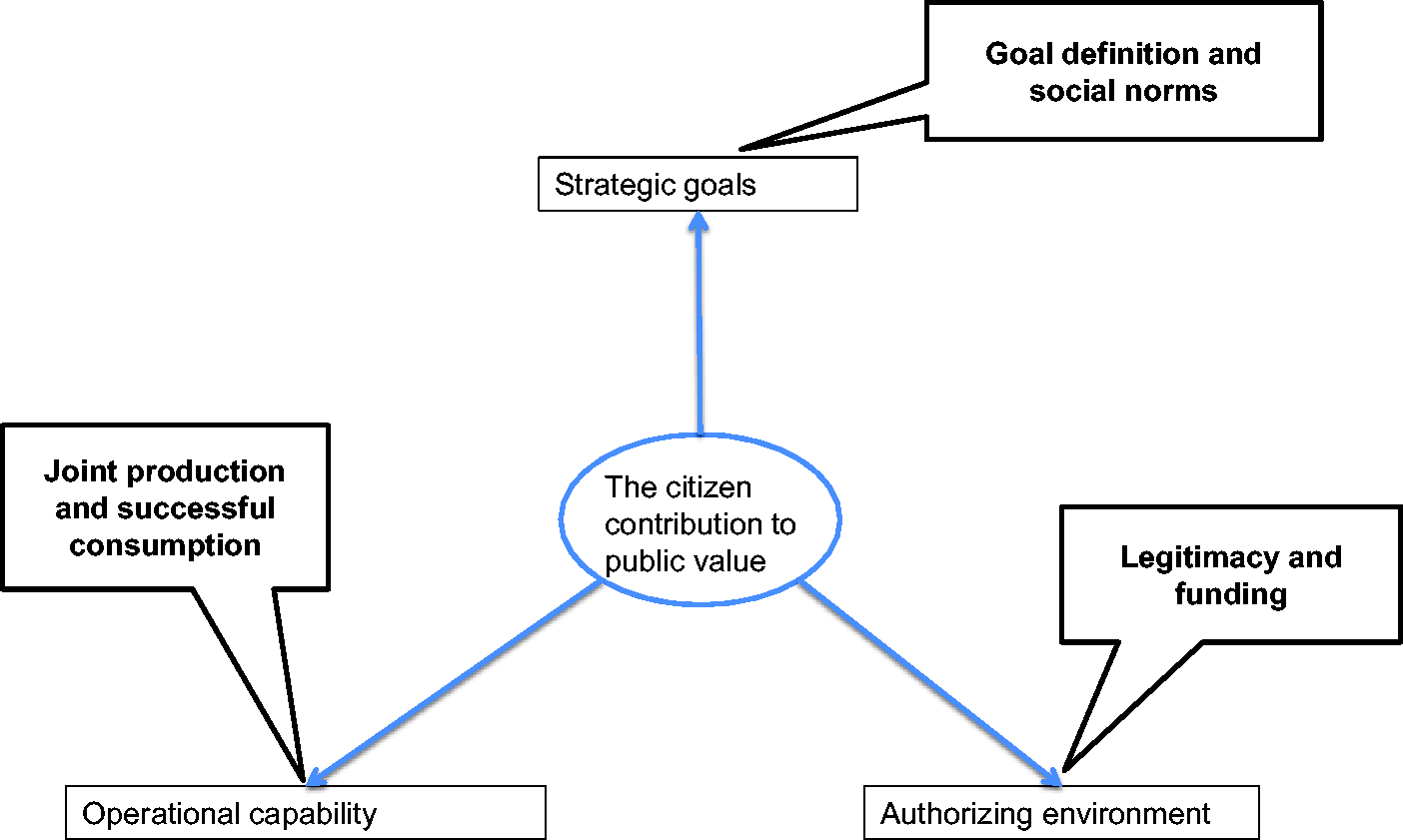
Public services and the co-creation of public value
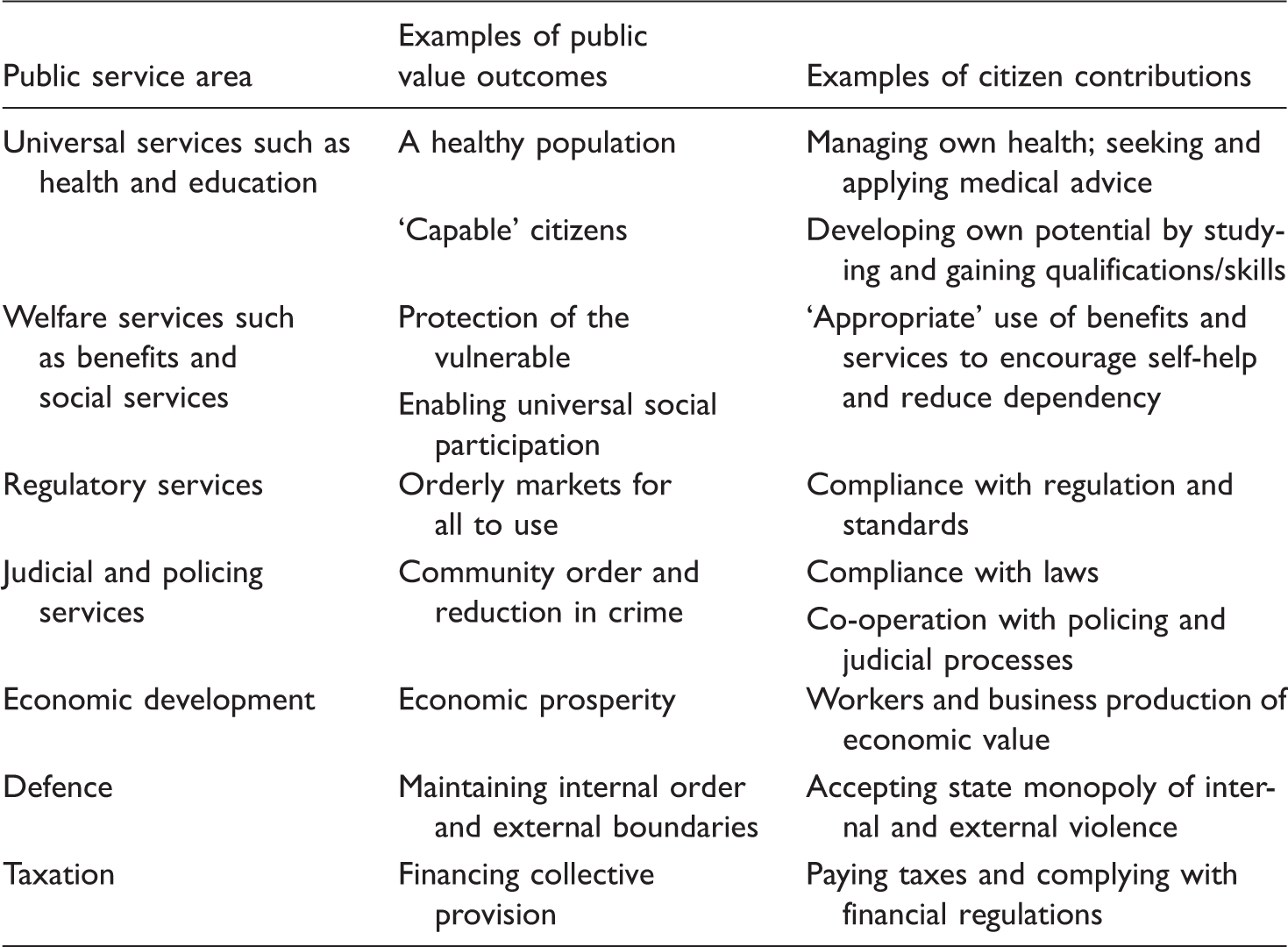
This analysis demonstrates the need to understand the relationship as more dynamic and symbiotic than the traditional view. In each case, the public value outcome is crystalized through the interaction of citizens and state in the functioning of a state activity. Better cooperation in the interaction can enhance public value, whilst conflict, non-compliance or nugatory usage value reduces it (Osborne et al., 2016).
Figure 2 distills this analysis into a generic model for the citizen/state relationship. It is framed by the reciprocal relationship between citizens on the one hand (whether individually or collectively in communities or enterprises) and the state on the other (embracing the variety of service types listed in Table 1). The co-creation of value described above occurs within a ‘zone of interaction’ as experienced by citizens. This interaction will typically flow through a number of stages as the citizen seeks a solution to a need and navigates access processes and eligibility criteria, before participating in and consuming a service.
A public value relational model.
This conceptualization makes the case for investigating and improving citizen/state cooperation. It also has methodological importance in defining the scope of the study. It focuses the research on the intersubjective and reciprocal relational dynamics within the ‘zone of interaction’ as citizen and state participate in the actuality of the co-creation of public value (Benjamin, 2006; Stolorow and Atwood, 2002).
Governing the relationship – voice, choice, silence and trust
From a relational perspective, the question that follows concerns the means for citizens to influence the governance of these relational dynamics. As context, modern sociology points to three distinct mechanisms for coordinating a social interaction – in which an actor (A) seeks to influence an actor (B) to pursue some specific course of action (C). These are: power (the use of authority or force to motivate action), exchange (the use of market incentives and agreements to motivate action) and thirdly trust (Bradach and Eccles, 1989; Bachmann, 2001; Luhmann, 1979; Möllering, 2014; Zucker, 1986). This latter perspective is a relatively new aspect of the study of trust and requires a little explanation.
The Oxford English Dictionary defines trust as the ‘firm belief in the reliability, truth or ability of someone or something…’ (OED Online, December 2015). Beneath this apparently benign description lurks a complex psychosocial regulatory instrument. It reflects the tripartite nature of a social interaction defined above in that it is a relationship between a trustor (A) who anticipates the support of a trustee (B) in the pursuit of some joint issue or enterprise (C) (Blackburn, 1998). 1 Trust can prompt profound sensitivities because the trustor necessarily accepts vulnerability in taking the risk of whether the trustee honors this expectation (Möllering, 2001). Thus trust is particularly relevant to relationships of voluntary cooperation because its currency is consent (the trustor's willingness voluntarily to accept vulnerability) offered in the expectation of reciprocity (the satisfactory resolution of the vulnerability).
Viewing the governance of the ‘zone of interaction’ through the lens of citizen/state cooperation and trust suggests that the current mechanisms for coordinating the relationship are sub-optimal. The dominant public policy framework is derived from Hirschman's conceptualization of ‘voice’ (Hirschman, 1970), as a ‘bottom up’ means for citizens to influence public ‘producers’. Voice can be seen as an attempt to harness power to enhance the role of the citizen and was an important challenge to the prevailing orthodoxy that the market mechanism of ‘exit’ (taking your custom elsewhere) was the only effective response to an unsatisfactory situation. The instruments that support voice (Rowe and Frewer, 2005), and the growth of associated citizen ‘discourses’ (Barnes et al., 2009), have developed since Hirschman's original formulation; however, adoption by policymakers has remained fragmentary and, in the main, unenthusiastic.
A key development since Hirschman has been the greater use of citizen ‘choice’ and markets to co-ordinate and control public service delivery. The market options usually remain publicly funded so this should be understood as internal choice, as distinct from exit. The most prevalent form is between different providers of the same state-ordained service, such as in health and education. This can support cooperation. Proponents argue that it gives citizens some market power, transferring to them a role and rights that demand greater respect from state providers. However, choice can also drive competitive behavior at odds with cooperation, and more broadly, it is inappropriate to many state services due to constraints such as regulation or geography.
There are also interactions immune to both voice and choice. Arguably, the mechanism that governs these is best described as ‘silence’. This is an insight from the Exit, Voice, Loyalty and Neglect (EVLN) framework (Lyons et al., 1992). Silence can denote acquiescence; the service or interaction proceeds without great upset, along standardized lines. However, silence can also denote domination. Citizens may be unhappy or distrustful of the interaction but are either ignored or lack the means to secure change. The Francis Inquiry identified one of the main contributory factors to the catastrophic service failures at the South Staffordshire NHS Trust as ‘Trust management had no culture of listening to patients’ (Francis, 2013: 44).
The implication of this brief analysis is that despite the reforms of the last decades, the current paradigm of the citizen/state relationship remains one of securing citizen compliance rather than cooperation. The question for this study is whether the mechanism of trust can be configured to improve this dynamic. This would require trust to be both present in the relationship and effective in structuring mutual behavior. The evidence of much contemporary research is that neither condition is currently achieved. Notwithstanding the modernization described above, studies tell a consistent story of a gradual but inexorable decline in trust in public institutions over the last four decades, 2 leading some commentators to talk of a ‘delivery paradox’ (Coats and Passmore, 2008).
This analysis of the citizen/state relationship, and the ‘trust gap’ within it, provides the focus for the research questions addressed by this study. If trust requires reciprocity, then the key to enhancing trust is for the trustee to be trustworthy. Moreover, it is only sensible to trust if this is the case. To trust the untrustworthy – particularly if they are more powerful – is to open the door to exploitation and domination (Hardin, 2006). Whether the state is trustworthy is assessed by the subjective judgment of the citizen as trustor. This observation shaped the two research questions for the study fieldwork. These were to investigate the citizen perspective on the characteristics of the trustworthy state and secondly assess whether they could be used to help structure a more cooperative relationship. Figure 3 illustrates how these questions align with the three-part definition of trust applied to the relational model.
A trust version of the relational model and the research questions.
Trust in the ‘trustworthy’ state
This section provides the theoretical context for addressing these questions. Firstly, by discussing the challenges of applying the concept of trust to the state. Secondly, by describing a typology of forms of trust designed to test the hypothesis that one reason for the long-term decline in public trust is that the state is operating to a different and more passive norm of trust to that applied by the citizen.
The challenge of state trustworthiness
Much political philosophy finds the topic of trust in the state problematic. Neo-liberals, Marxists and some post-structuralists all find reasons for distrust. Perhaps the most profound skepticism may be found in Foucault's analysis of ‘governmentality’, critiquing the logic and means by which the state exercises power (Foucault et al., [1977–1978] 2009). For Foucault, a defining feature of modern states are techniques of control derived from the ‘disciplinary’ use of liberalism. The modern state exercises its potentially dominatory authority through the internalized sense of individual responsibility derived from the liberal conception of autonomous individuals. State power is legitimized and enhanced when citizens voluntarily adopt the fiction of active citizenship. This is what enables the modern state to ‘govern at a distance’ (Rose, 1996), operating in the interests of current power formations.
The common thread this critique shares with Neo-liberals and Marxists is pessimism in the ability of the state to act in a trustworthy manner because it will be captured by privileged interests (such as bureaucrats, the ruling class or the dominant prevailing disciplinary discourses). These are challenging arguments, but they predominantly turn on the practical unlikeliness of the state being capable of being trustworthy, rather than principled opposition to the goal itself. The question for this study's fieldwork was whether such pessimism could be challenged by a form of trust that could empower citizens to enforce a more equitable relationship.
Contemporary research also offers empirical evidence that the state is working toward a different agenda to that of the citizen. The dominant response from politicians and policy makers to the decline of public trust has been critiqued as the ‘performance’ model of trust, summarized as: ‘… better performing public services will lead to increased satisfaction among their users, and this, in turn, will lead to more trust in government’. (Van de Walle and Bouckaert, 2007: 892)
Others have cast this gap in terms of a difference between affect and cognition (Hoggett, 2000). Taylor-Gooby's (2008) statistical analysis of trust in the NHS using the 2001 British Social Attitudes Survey revealed two independent factors associated with trust. The first was broadly cognitive in assessing the ‘quality of service provision’ and the second represented more affective reasoning summarized as ‘Values: care and respect’. His explanation of the latter factor points to the growth of what he terms ‘critical trust’, linking the decline in trust in public institutions to the erosion of traditional values of deference.
A typology of forms of trust helps analyse different norms in use
In order to assess the reality and extent of differences in norms of trust in use by the state and citizen, the fieldwork for the study was underpinned by a typology of forms of trust derived from the academic literature. This provided a structured and replicable means for identifying key differences. The typology reflects the distinction between performance and the more relational factors described above. It also addresses the variable nature of the relationship of trust with power. These considerations give rise to three separate but intertwined dimensions that collectively expose the main variables in the structure of a trust transaction.
The first dimension addresses the reasons that participants in a trust transaction might have to trust the other party, including examining the mutual ‘interest’ at stake and the different rationales for trustors to have faith in trustees. This is defined as a continuum between social and instrumental trust (Blau, 1964; Braithwaite, 1998; Cook et al., 2005; Tyler, 1998). Social trust finds reasons for trusting the trustee in social bonds and affective relationships. Instrumental trust relies on a more cognitive process of predicting the competency and aligned interests of the trustee.
The second dimension of trust examines the psychic basis of the act of trust, the reflexivity and commitment invested by trustor and trustee. This is defined as a continuum between passive and active trust (Giddens, 1994; Möllering, 2006; Scholz and Pinney, 1998; Zucker, 1986). Active trust is reflexive and chosen, passive trust may be more unconscious and derived from habit and beliefs rather than the result of a decision.
These first two dimensions help understand the attitudes citizens and state bring to an act of trust. The third dimension is qualitatively different in focusing on the intersubjective dynamics of trust as a reciprocal mechanism of mutual coordination and governance. This is defined as a continuum between dependent and interdependent trust (Bachmann, 2001; Bradach and Eccles, 1989; Bijlsma-Frankema and Costa, 2005; Dasgupta, 2009; Fehr and Gächter, 2000; Luhmann, 1979). Dependent trust reflects relationships in which the trustor has little influence on the success or otherwise of the transaction. Interdependent trust requires the active participation of both parties for the results to be successful.
Applying this typology to the empirical evidence described above suggests a hypothesis that the legacy of bureaucracy has left the state operating to a norm of trust more instrumental, passive and dependent than that applied by citizens of today. The structure of the typography and this hypothesis can be illustrated using the public value relational model. The first two dimensions are pictured as the relational terrain in which the citizen and state are variously situated, and within which the interaction is enacted. The third dimension resides within the ‘zone of interaction’ itself, manifest in participant perceptions of the reciprocal dynamics of the exchange. Figure 4 illustrates this logic.
Illustration of citizen and state operating to different norms of trust.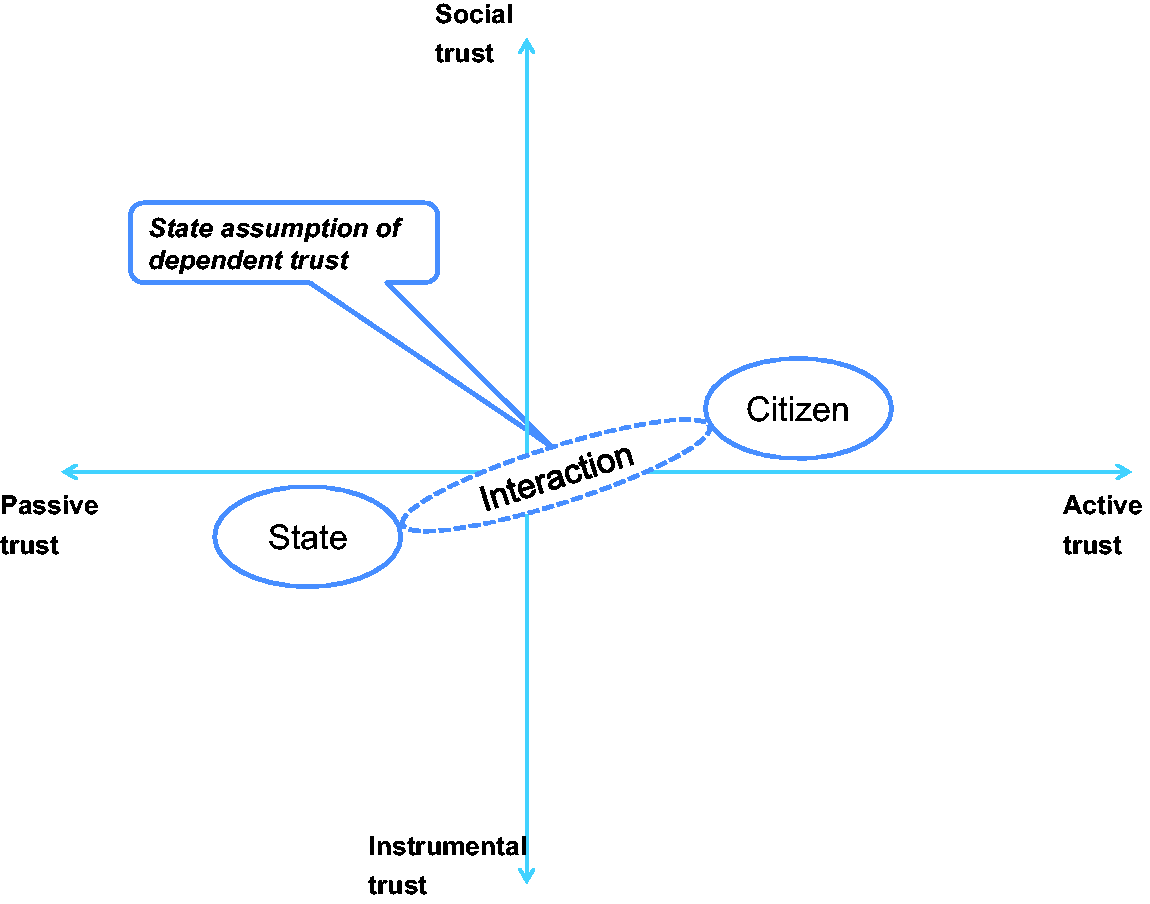
The research method for the fieldwork was designed to explore the validity of this hypothesis.
A relational and deliberative research method
This section describes the research method and process. It starts by discussing the importance and challenge of accessing subjective and intersubjective knowledge and then describes the dialogic AR method designed for the task, and the rationale for the choice of case studies.
There were a number of considerations in the design of an appropriate research method. The relational model combined with the analysis of trust identified the scope of the research questions as being both subjective (the views of citizens and state agents on what is important to trustworthiness) and intersubjective (how those views were modified by the reality of an interaction). One way of conceptualizing the challenge (Park, 1999) was that the study had to access ‘representational’ knowledge (individual and interpretive), ‘relational’ knowledge (residing ‘in the thick of the relationship itself’) and thirdly, ‘reflective’ knowledge (guiding action). A second consideration was to design a research method that was applicable and repeatable across as wide a range of citizen/state interactions as possible, adding rigor by enabling others to challenge and develop findings (Checkland and Holwell, 1998).
Fulfilling these requirements required a structured approach that assessed the opinions of both citizens and agents of the state and was deliberative in attempting to come to a settled view between them. The result was a customized form of AR designed to create a purposive dialogue between the two groups (Brydon-Miller, 1997; Coleman et al., 2014; Gaventa and Cornwell, 2006; Heron, 2014; Montoya and Kent, 2011; Shotter, 2010). In practice this meant working with a state activity or service, bringing together groups of citizens and state agents involved in the production and consumption of that service, and taking them through a sequential and collaborative analysis of their relationship and what would improve it.
A number of design principles were important. Citizen participants were recruited with a goal of ensuring a broad spread of views on the relationship. Staff representatives were drawn only from the frontline of service delivery – excluding management with little user contact kept the focus on citizen rather than institutional imperatives and helped staff to voice opinions more freely. Finally, a key part of the process was for each group – staff and service user – to generate a sense of shared identity by meeting separately prior to entering into the dialogue. Figure 5 illustrates the key stages of the method.
Key steps in the process of dialogic action research.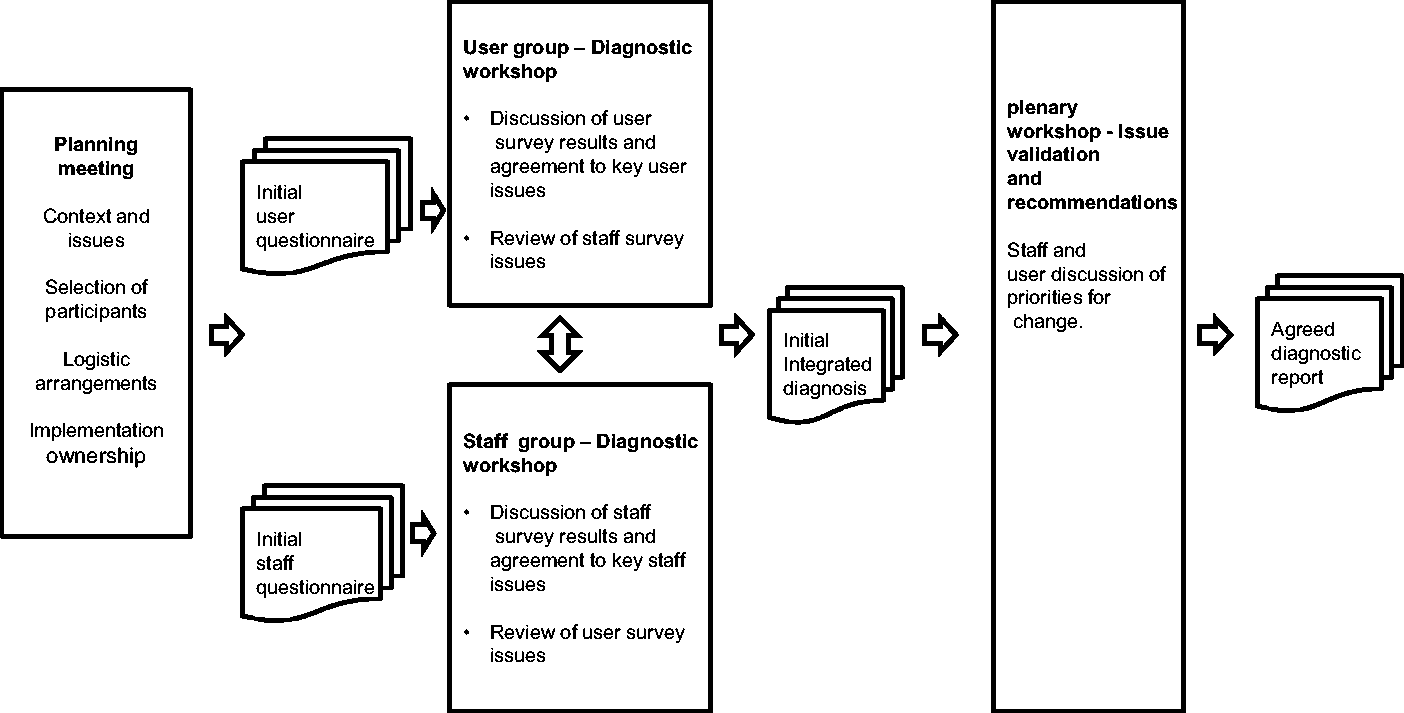
Unlike other research methods common in this field, such as surveys of citizen opinion, this approach enabled a deliberative process producing considered recommendations. Moreover, it embodied the research scope and questions in being situated directly within a ‘zone of interaction’. It involved the two groups who constitute the ‘lived experience’ of a service, and who were able therefore to discuss with authority and understanding the forms of trust in use in the actuality of the service delivery (Reason, 2006).
University Research Committee ethical approval was given for two cycles of the AR method. The first in a busy urban HB service (working with seven users and eight staff) and the second in an urban primary health care GP practice (seven patients and seven staff). These sites were chosen pragmatically to provide a mix of the most important types of citizen relationships as outlined in Table 1. HB offered both a welfare (provision of benefit) and regulatory (refusal to provide benefit) user relationship in a relatively contested area of public policy, whilst the GP practice was representative of a universal service, and one which traditionally starts from a higher base of trust (Mori, 2016). The research process stimulated an engaged debate in both case studies and produced a wealth of data. In each case, the most significant output was a report providing the recommendations of the combined group. In addition, the discussions were recorded, transcribed, and coded for additional evidence of the underlying relational dynamics within the recommendations.
The heuristic tests by which citizens assess state trustworthiness
The two cycles of AR produced an interesting coherence in the factors identified by citizens as important to their trust in a state activity, and where the norm in use by the state diverged. The overarching finding was that citizen trust was strongly influenced by the emotional as well as transactional quality of the relationship. This tension was often evident to the frontline staff as well as service users. The response of one of the HB officials to a user complaint about bureaucratic ‘facelessness’ was both honest and indicative of the impact of cultural norms within state services and systems:
S3: ‘… and I was thinking about that and thinking why, what makes people like me that go into the Council and work for them, with all the best intentions suddenly become this – kind of give this impression that we don't care’.
The participants in both case studies also readily accepted the practical relevance of improving their mutual trust and cooperation. For example, the shared conclusion of the HB study was that users would be likely to offer more accurate and timely information on their circumstances if the service was trusted to maximize legitimate take-up of HB.
The findings from both case studies were assembled into a number of recurring themes and underpinning diagnostic tests articulated from the perspective of citizens. This presentation of the results in the form of a diagnostic was adopted as the most faithful in reflecting the heuristic approach of the citizen, and because it demonstrates how these factors can be used in practice to assess the health of a citizen/state relationship (in conjunction with the replicable AR method described above). The themes and tests were generated empirically from the data but can also be grouped into the three-fold structure of a citizen/state trust transaction. Thus, one theme reflects the importance to citizens as trustor of understanding their identity within an interaction and in particular the importance of being respected. A second concerns the citizens’ wish, as trustors, for a sense of responsibility from the state, as trustee. The third theme of consent responds to the evidence that citizens expect more traction in the governance of an interaction. Figure 6 illustrates the logic of this formulation and the headings of the underpinning tests, mapped to the trust version of the relational model used in figure 3. These are described more fully below.
The themes and tests of state trustworthiness mapped to the trust version of the relational model.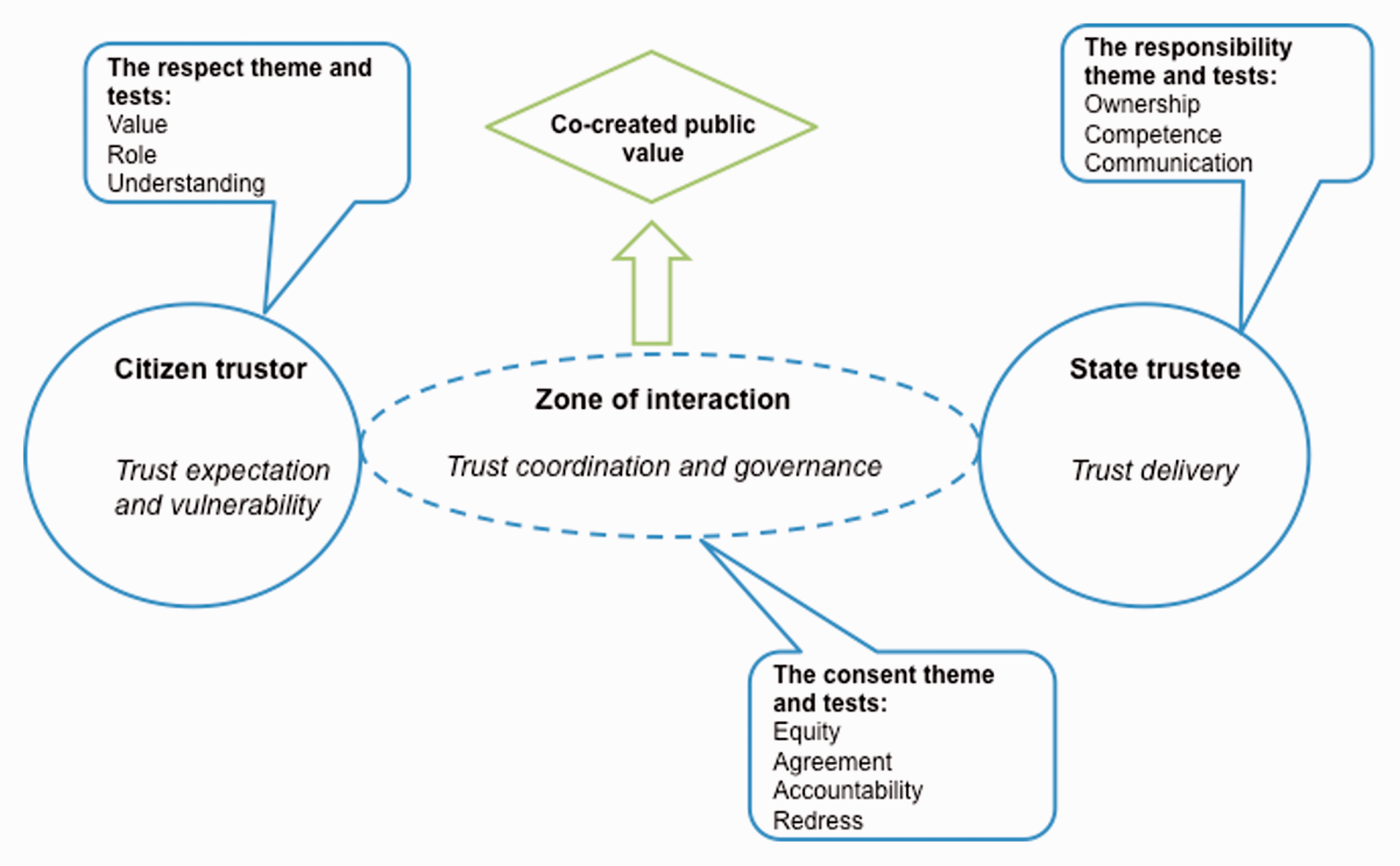
The theme and tests of respect
Much of the discourse and formal recommendations from the AR concerned the citizen perception of their position and identity in the relationship with the state activity. The overriding normative theme that emerged from both case studies was the citizen requirement for respect. For example, one of the formal recommendations from the HB study was for ‘a more direct and respectful relationship’, including removing the implicit starting assumption that users were not telling the truth. The theme was also important within the GP case study with patients emphasizing the value of the respect they felt from doctors, contrasted against the perception of a colder, more impersonal attitude from the reception staff.
The analysis points to the importance of citizens of having a ‘presence’ in the relationship. This accords with citizens aspiring to a more social form of trust in comparison to an instrumental norm within the state. Rather than passive consumers, citizens see themselves as members of the state with rights and entitlements derived from paying taxes and complying with regulations. The evidence suggests that this is assessed by a number of commonsense but demanding tests used by citizens to understand the identity conferred on them by the state. The main ones identified in the course of this study were:
Whether citizens feel valued as a participant in the relationship; treated as an individual with sensitivities and capabilities rather than a burden on the state. Whether citizens feel they have an acknowledged role in the relationship; with voice and contribution encouraged. Whether citizens feel properly understood; that there was a non-judgmental ‘practical empathy’ in assessing their needs.
The theme and tests of responsibility
Another common area of recommendations and discussion concerned the qualities of the state as trustee, with the normative theme of ‘responsibility’ – the importance of the state demonstrating commitment as well as competence in a service interaction – emerging as significant from both case studies. For example, a powerfully argued recommendation from the HB study was for a ‘more joined up service’ as a response to passionate complaints about how service fragmentation and complexity undermined trust by diffusing responsibility. Both studies provided ample evidence that a cornerstone of citizen trust was dealing with an empowered frontline – as one participant put it ‘someone you can do business with’. The efforts of the surgery to maintain as much continuity as possible between patients and doctors was one of the principal explanations given by patients for the positive nature of their mutual relationship.
The comparative importance to the citizen perception of state trustworthiness for taking responsibility for the success of the user relationship suggests a more active form of trust than that typically in use within the state; one in which commitments are reflexive, understood and owned. This is a challenging demand for public bureaucracies more used to being assessed (and funded) on the integrity of processes rather than successful outcomes. The main underpinning tests derived from the case studies in respect of this theme were:
Whether citizens feel state agents and service systems are fully committed to an interaction; evident, for example, in whether there was a sense that people would follow up on commitments. Whether citizens feel state agents and service systems are competent; a powerful source of citizen distrust was demonstrable inefficiency in a service process, seen as indicative of an underlying lack of care. Whether citizens feel that a state activity or service attempts to communicate all relevant information; language that could not be understood was taken as ready evidence of the irrelevance of the citizen.
The theme and tests of consent
A third area of issues raised in the recommendations and discourse from the case studies related to the citizen perception of their influence within the governance of the trust relationship. This is summarized within the theme of ‘consent’, aligning with the voluntary mechanism at the heart of trust. Here too there were a number of interesting commonalities across both case studies, with both offering compelling evidence that a key to citizen trust was willingness by the state to recognize and resolve dissent. The critical metaphor adopted by both users and staff of the HB study was of a service akin to an ‘open prison’ with only the illusion of user autonomy. The language from the patients and staff of the GP surgery was less dramatic, but there was a related discussion of the standards it was appropriate for patients to expect and mechanisms for complaint if unhappy. In both case studies, participants came to the same formal recommendation that the service should publish a statement of mutual expectations by which the user and service could be judged.
In the context of the trust typology, the form of consent these considerations describe is a significant step from dependency to interdependency, but one specific to the public sector. The realm of influence to which citizens aspire – in these case studies at least – is less about formal mechanisms for providing agreement than a more nuanced aspiration for transparency and accountability in decision-making such that the state can be challenged in the event of distrust. The tests employed by citizens in this regard within the case studies were:
Whether citizens feel a service is acting equitably; participants were surprisingly willing to accept decisions counter to their self-interest, but were passionate about wanting to be sure such decisions were fair. Whether citizens feel their agreement to decisions is important to the service; evident in whether it would recognize and act on dissent. Whether citizens feel the service demonstrates a sense of accountability for decisions; for example in being prepared to explain the reasoning behind them. Whether citizens believe the service is prepared to offer meaningful redress in the event of error; a potent source of distrust was sanctions for a citizen fault more draconian than those applied by a public service to itself.
Conclusion and discussion
These findings provide a clear if emergent response to both research questions. Firstly, the evidence described above highlights the importance to the citizen's assessment of state trustworthiness of the relational qualities of ‘respect’ and ‘consent’ as well as the state taking ‘responsibility’ for service delivery. These themes represent a major conceptual step beyond the current dominant ‘performance model’ (Van de Walle and Bouckaert, 2007) of trust within the public sector – a more impersonal and instrumental norm that primarily associates trust with procedural integrity and competence. Citizen trust is unlikely to improve while citizen and state norms diverge in this way. That these differences resonate with the dimensions of the trust typology also supports the theoretic contribution of this study in viewing trust as a variable and contingent phenomenon.
Secondly, articulating the findings as diagnostic tests that can be used within a standardized process of AR demonstrates that they can be deployed in practice both to assess and redesign a service relationship. Moreover, the mechanism of ‘consent’ – working alongside ‘voice’ and ‘choice’ and given weight by rights for independent consideration of citizen dissent or complaint – provides a means for embedding trust (by resolving distrust) within the fabric of public service delivery. It also offers a conduit for feedback on the ‘consumption value’ being achieved, or not, by the state. Listening to dissent may have enabled earlier action to prevent such service failures as South Staffordshire NHS Trust or the Grenfell fire amongst many others.
The study opens lines of inquiry but more work is needed. Whether the themes and tests derived from the investigation of the two services within this study are comprehensive of all state activities will only be demonstrated by applying the diagnostic across a wider range of public services. Work is also needed on the nature of the structural implications and associated costs and benefits, of organizing for trustworthiness. This requires a research project working through a full cycle of diagnosis, service redesign, implementation and subsequent evaluation of the quantitative and qualitative benefits.
The challenge is considerable, but so is the potential prize in enhancing citizen cooperation and reducing operational waste. In the longer term, the argument may be even more basic. Being trusted by citizens is likely to be the price the state has to pay for continuation of sufficient levels of public funding for the collective provision it currently offers.
Footnotes
Declaration of conflicting interests
The author(s) declared no potential conflicts of interest with respect to the research, authorship, and/or publication of this article.
Funding
The author(s) received no financial support for the research, authorship, and/or publication of this article.