




Abstract
Drawing on an original and unique survey data set of 243 medium- and big-sized firms operating in five sectors (energy, telecommunications, railways, airlines and postal services) and across 29 European countries, we analyse what incentivizes firms to interact with and influence multiple regulators. In so doing, we map the regulatory opportunity structure and scrutinize firms’ venue shopping logics. The study shows that firms can clearly identify where the locus of political and regulatory competence lies and that they concentrate their activities at this level. In particular, the data show that the national level is still the most important target level for regulatory representation. Regulatory venue shopping, the study illustrates, occurs when issues are highly salient, highly technical and when high stakes are involved. Notably, we show that firms tend to address more regulators in sectors characterized by higher international competitiveness to mitigate uncertainty when operating in multiple markets and facing rivalry from international competitors.
Introduction
Over recent decades, many regulatory agencies have been created in order to facilitate the integration of markets across national borders and correct market failures. A large body of literature analyses the emergence, institutional design and functioning of these independent regulatory authorities (Gilardi, 2008; Guardiancich and Guidi, 2016; Jordana and Levi-Faur, 2004; Levi-Faur, 2005). How firms navigate this new complex landscape of regulatory agencies or what logic drives their activity remains unclear despite its potential implications for regulatory decisions and outcomes. Which level (national, supranational) prevails? Do firms normally address multiple regulators? Which sectoral, firm-specific, or issue-specific factors lead them to diversify regulatory venues? Answering these questions is important to learn how firms use the current regulatory landscape, if this is consistent and useful to them, and if there are risks of an opportunistic use of this variety of venues: Do firm choose regulators depending on the kind of outcome they expect? Do they play regulators against each other?
Given multiple regulators, and the often cited risk of business venue shopping, it is surprising how few empirical studies of business regulatory activity or models of business political logics exist. In this article, we explore why firms interact with specific regulators drawing on the theories of venue shopping and regulatory governance. More specifically, we map the regulatory opportunity structure available to business by assessing the multiple levels at which business operates and scrutinize firms’ motives to interact with particular regulators. For the purpose, we build on and add to the broader theoretical literature on venue shopping by applying it to study firms’ choices of regulators in a multi-level regulatory setting. Indeed, venue shopping has so far been generally conceptualized as an activity linked to policy-making, not to regulation, and most research in the public policy and political science literature has focused on venue shopping carried out by interest groups, lobbyists or NGOs rather than individual businesses (Binderkrantz et al., 2015; Buffardi et al., 2015; Halpin and Fraussen, 2017; Jourdain et al., 2017).
To assess this, we build a regulatory venue shopping model based on the perceived economic and political costs and benefits of regulatory interaction. We assume that firms are strategic political actors and economic maximizers with incomplete information on regulators’ preferences and the outcomes of potential regulatory decisions, playing multiple horizontal (sectoral and cross-sectoral regulators) and vertical (national, European and international) venues to obtain the best outcome. Subsequently, we hypothesize that firms’ activity, or their venue shopping behaviour, is driven by the technical complexity, the saliency and the expected economic costs of regulatory decisions. We test our hypotheses using original survey data on 243 big- and medium-sized firms in five sectors (energy, telecom, railway, postal services and airlines) across 29 European countries. By focussing on network firms, we can study sectors in which regulatory decisions and interactions are regular and frequent, and, therefore, in which regulatory venue shopping is most likely to occur. Our results indicate that uncertainty is the main driver of regulatory venue shopping, and that firms “use” regulators to acquire information that minimizes their expected costs.
Theoretical framework
The rationale of regulatory venue shopping: Opportunities
This article seeks to explore firms’ motives for dealing with particular regulators when confronted with multiple sectoral and cross-sectoral regulators at the national, European and international levels. A vast body of political science literature using principal–agent theory deals with the conditions of delegation to independent regulatory authorities (Gilardi, 2008). Consequently, we know a great deal about the motives underlying delegation, such as the need for expertise and lack of capacity, political uncertainty, political credibility and blame shifting. However, this focus on delegation has been at the expense of exploring the firms’ motivation for engaging with regulators after delegation. Unfortunately, there is far less empirical or theoretical work exploring firms’ perceptions of regulatory authorities or how firms navigate the complex, multiple regulatory venues at the national, European Union (EU) and international levels. In fact business-government studies have tended to focus on the structural power of business in the political system at the expense of developing micro-political theories of the firm. In filling this gap, we map out the opportunity structure of firms’ horizontal and vertical regulatory activity, exploring how far competence, capacity and expertise, saliency and economic costs influence the behaviour of business in selecting a regulator if they can choose among regulators. Having identified the levels and potential interactions, we explore the actual phenomenon of regulatory venue shopping.
In the case of intensely regulated sectors such as energy, telecommunications, railways, airlines and postal services, there has been an explosion of horizontal delegations to new national sectorial regulatory authorities (NRAs) with potentially overlapping competencies with national cross-sectoral competition authorities and national ministries in the 1990s (Coen and Héritier, 2005; Gilardi, 2008; Levi-Faur, 2005). This has also coincided with the emergence of potential vertical venue shopping opportunities at the EU level, with delegation of authority for the single market to the European Commission (Prince and Kerremans, 2008; Thatcher, 2007), and the increasing primacy of EU competition policy (Cini and McGowan, 2009). The level of venue shopping complexity, however, increased dramatically with the potential “double delegation” to European networks of regulators and the emergence of European regulatory authorities (Coen and Thatcher, 2008; Maggetti and Gilardi, 2011).
The situation is no less complex at the international level, with the emergence of global governance and regulatory networks (Slaughter, 2004). With the recent global crises in climate, and financial markets, there has been a recognition of the concept of global public goods and an increasing willingness of nation states to delegate to international bodies (Bachman and Newman, 2014), increased co-ordination of international organizations (Abbott et al., 2015; Abbott and Snidal, 2009; De Bièvre et al., 2014; Jupille et al., 2011) and acceptance of business self-regulation (Mattli and Buthe, 2003).
Under these increased complexities, what motivates and incentivizes firms to play different venues? This article is interested in how these new capacities and authorities are reflected in a firm’s decision to address a particular regulator or, indeed, several regulators in the evolving multi-level regulatory environment.
The rationale of regulator/regulatee interaction
In assessing the question “under which conditions do we encounter ‘regulatory venue shopping’?” the broader literature linking policy-making and lobbying identifies several possible answers. First, the logic of national level venue shopping has often been described as a process of “trial and error”, where lobbyist/regulatees learn to manage the policy process, reinforcing messages or regrouping to block policy debates that they have lost in new venues (Baumgartner and Jones, 1993; Constantelos, 2010; Pralle, 2003). Thus, for some interests venue shopping is an insurance policy to positively reinforce policy wins and navigate regulation along the policy cycle (Brasher and Lowery, 2006), but for others it is a veto playing activity where change or blockage is the objective (Baumgartner et al., 2009). How successful business actors are in choosing the venue(s) that would bring them most favourable outcome is often a function of the resources mobilized and experience they bring to the policy process. Over time, interests learn what venues work for them in terms of outputs and what access goods they must provide to join the policy debate (Broschied and Coen, 2003; Bouwen, 2002; Hall and Deardroff, 2006).
Second, drawing on principal–agent insights, we assert that businesses are boundedly rational actors that wish to maximize their political returns and minimize their uncertainty (Miller, 2005). To achieve these aims, we expect firms to seek out venues that they perceive to have primary competence, expertise to make “good” policy, and in which they have established long-term confidence to deliver on policy (Carpenter, 2010). While firms may not expect the regulator to have as much expertise as themselves on the specifics of production and marketing processes, they may reasonably expect that a specialized sector regulator will have considerable knowledge and well-informed judgment on questions of market access, market operation and market correction – certainly at a much higher level of expertise than politicians or cross-sector regulators. Accordingly, when addressing a regulator, the firm expects to be granted a decision that is substantively well founded based on expertise as well as – and importantly so – the necessary formal and substantive capacity to undertake this decision. Similarly, on trans-border questions (such as competition, mergers and acquisitions, interconnection and trans-border infrastructure), we expect to see that firms address regulators with trans-boundary competences as opposed to national regulators, especially if we accept that regulators at supranational level are created by political principals because they themselves lack (coordinative) capacity in trans-border issues (Abbott et al., 2015).
Model and hypotheses
To develop our model, we first define our dependent variable, i.e. regulatory venue shopping. We are primarily interested in the businesses’ attempts to get involved in the regulatory process. In this respect, we define regulatory venue shopping as comprising one of two distinct activities: the first one consists of regularly addressing more than one regulator at the same time, in order (1) to acquire as much as information as possible on their orientation and preferences as well as on the positions and strategies of competitors and/or (2) to influence regulatory decisions. While the first is aimed at minimizing uncertainty and risks, the second is aimed at influencing the decision of regulators at multiple levels. As far as Europe is concerned, the two levels that matter most are the national and the EU one.
Our model relies on a set of assumptions. First, on the micro-side, we assume that firms are boundedly rational actors that know the structure of multiple venues around them and seek to use them in view of maximizing their expected material and immaterial gains and minimizing their expected losses. Second, and more specifically, we assume that firms have incomplete information on regulators’ preferences as well as the potential outcomes of different regulatory decisions. This leads to our general expectation that, to minimize the uncertainty related to decision-making, firms seek to acquire information from multiple regulators (though not exclusively from them).
Third, as regards the macro-side (i.e. the regulatory environment or opportunity structure), we assume that there may be overlapping competences of agencies across levels and sectors (Jupille et al., 2011). So, there are multiple agencies to be addressed by firms and these regulatory agencies themselves may be in competition with each other for affirming their competence or extending their influence in a certain policy field. This means that, if there are overlapping competences between them, regulatory agencies may have an incentive to meet the firms’ needs to establish or increase their regulatory competence, or to challenge the competence of another regulator. Hence, it makes sense for a firm to address several regulators in order to increase the chances of a favourable decision. Alternatively, firms may ask regulators to cooperate in order to get a regulatory decision.
We now turn to formulating our hypotheses. The first and most obvious cost that firms want to minimize (or benefit that they want to maximize) is the monetary impact of a regulatory decision on their budget. The potential cost (or benefit) that a decision is likely to have on the firm’s budget raises the stakes and, thus, firms’ incentives to decrease the degree of uncertainty they face on a certain issue. Therefore, it is reasonable to expect that, when a firm has a lot to gain or to lose from a decision, the tendency to engage in venue shopping will increase (Jupille et al., 2011; Miller, 2005): H1: The greater the cost of regulation, the higher the likelihood that a firm will engage in regulatory venue shopping. H2: The higher the saliency of a regulatory issue, the higher the likelihood that a firm will engage in regulatory venue shopping. H3: The higher the technical complexity of a regulatory issue, the higher the likelihood that a firm will engage in regulatory venue shopping. H4: The higher the competitiveness of a sector, the higher the likelihood that a firm will engage in regulatory venue shopping. H5: The stronger the firm’s perception that regulatory competences are located at European level, the higher the likelihood that a firm will engage in regulatory venue shopping.
Multi-level venue shopping: Data and descriptive statistics (mapping the opportunity structure)
To empirically test our hypotheses, we conducted an online survey of big- and medium-sized firms operating across all the EU member states (except Croatia which acceded to the EU only in 2013), Switzerland and Norway. The survey was sent out in three ways: November 2009, February 2010 and June 2010. The survey methodology is rather common in studies on venue shopping (e.g. Binderkrantz et al., 2015; Holyoke et al., 2012; Varone et al., 2017). Alternative methods (Jourdain et al., 2017: 128–131) are used when the range of activities is limited in time and/or in space (for instance, lobbying on a specific issue in a specific country or state). Our study differs from these analyses in that it attempts to carry out a mapping exercise, which covers many countries and many possible venues. Therefore, the survey methodology seems the most appropriate. The sampled companies operate in the energy (140 companies), telecommunication (128), railway transportation (96), postal services (30) and airlines (64) sectors. These sectors are characterized by a relatively low number of actors and by a limited or monopolistic access to infrastructures, which result in an imperfect market competition that requires continuous and sustained regulatory effort. Firms in these markets rely on regulatory policies more heavily than firms in more competitive markets. For this reason, they should be more prone to seek interactions with regulators.
To identify our sample, we used a three-step strategy. First, we identified industry associations and companies using the booklets European Agenda. 1 Second, we consulted the websites of European-level agencies operating in the industry sectors we targeted for information on their membership, contacting them personally where necessary. We then used the Amadeus European Company Database 2 to complete our sample and exclude smaller firms based on their national market share. 3 We thus arrived at our final sample of 458 firms. The survey was sent via email to those directors and officials dealing with regulatory and legal affairs. We contacted all the relevant respondents we identified, resulting in more than one response per firm in some cases. To motivate honest responses, we guaranteed anonymity. The overall company response rate is 53.1%. It is highest in the postal services (70%) and energy (65%) sectors, followed by telecommunications (52.3%) and airlines (45.3%) sectors, and, finally, railways (36.5%) (see online Appendix 1 for more details). This original survey is the first firm-level study to provide detailed behavioural information on regulatory shopping. It not only offers comparative evidence on a wide range of regulatory issues facing companies but it also covers firms in five different sectors across 29 countries.
We complemented our survey data with additional information on company turnover, national market share and number of employees drawing on the Amadeus industrial database; perceived regulatory quality of the countries covered by our analysis using the World Bank’s Worldwide Governance Indicators 4 and the degree of competitiveness of the sectors surveyed in the OECD’s Product Market Regulation database. 5
Before turning to the empirical test of our hypotheses, we examine the data to gather information about general patterns of firms’ behaviour and the opportunity structure. While we expect that all regulatory levels are utilized by firms, it is interesting to analyse how the combination of interactions at different levels varies across sectors. In Figure 1, the bulk of firms’ interactions with regulators occur at the national level. This holds for all sectors except aviation, where interactions with European regulators are more important than interactions with national regulators. In other words, in spite of the liberalization and re-regulation of the network industries, the national regulatory authorities are still the most relevant for firms in the postal services, energy, telecom and railways sectors. The rationale for the dominance of these NRAs could be explained by the status quo, location, proximity, scale and resources of NRAs, understanding of local markets and expertise, or clarity of competencies and mandates.
Percentage of companies’ regulatory activities at different levels, per sector.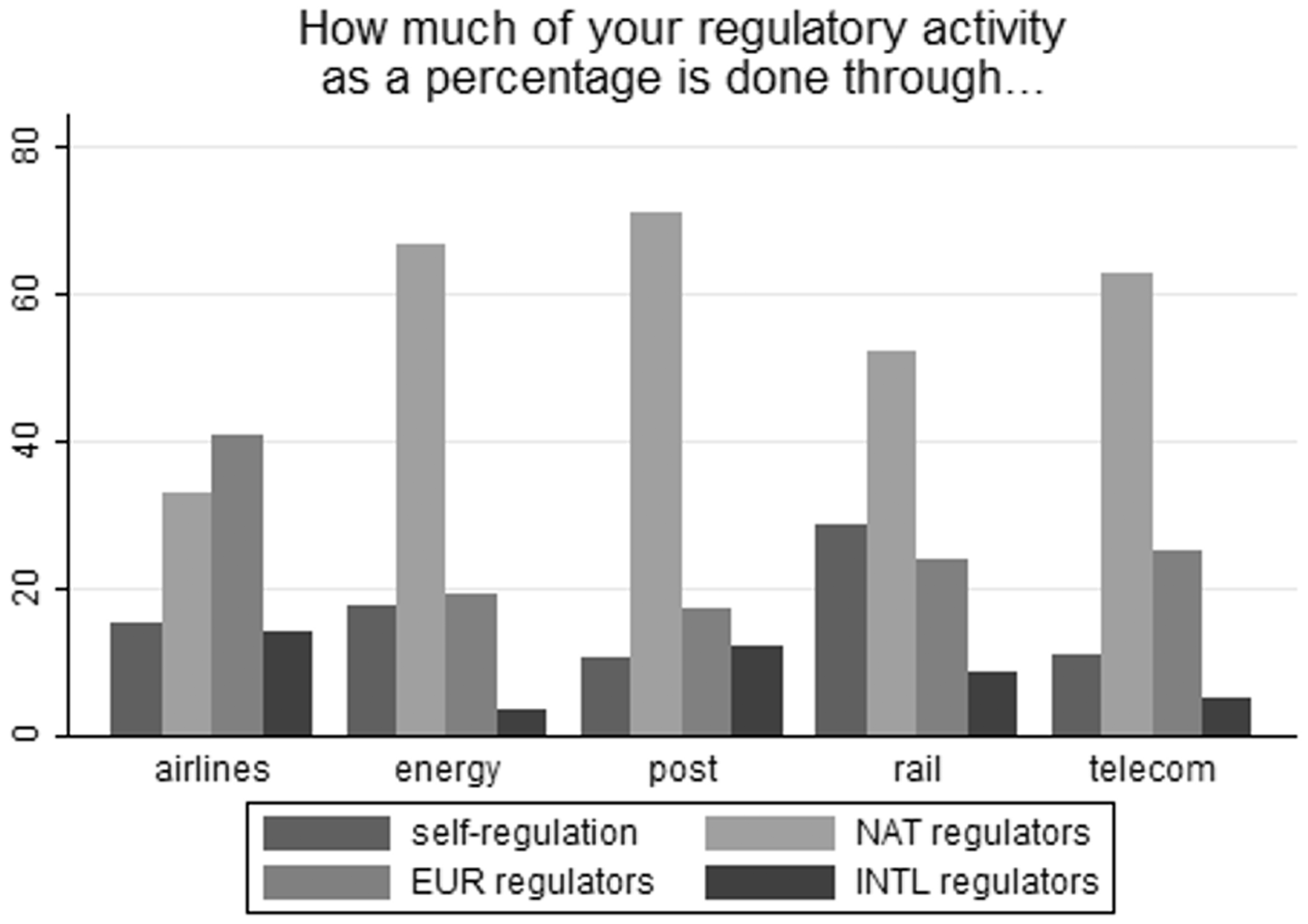
Exploring the differences between sectors, Figure 2 shows the number of firms which frequently address regulators according to sectors and levels. Overall, there is significant variation across and within sectors. On average, airline firms regularly address multiple regulators at all three levels – national, European and international. Energy firms on average regularly address multiple national regulators, but not multiple European and international regulators. For postal firms, national regulators are of great importance, whereas European and international regulators are of limited significance. For railways, national regulators are also viewed as the most important, European regulators less so and international regulators rank lowest. Finally, for telecoms firms, national regulators are of considerable importance, followed by European regulators and international regulators as a distant third. In summary, on average firms in all sectors regularly address more than one national regulator; firm in the airlines, railway and telecom sectors address frequently more than one European regulator and only airlines address on a regular basis more than one international regulator. This fits with our main assumption that, given a choice between regulators, firms will address several regulators when seeking a decision (see online Appendix 2 for a summary across sectors).
Average number of regulators at the national, European and international level that firms report addressing regularly, per sector.
Overall, what emerges from this descriptive analysis is that regulatory venue shopping is not a dichotomous concept (i.e. it is either present or not present) but a phenomenon with different degrees of intensity across sectors and levels.
The logic of regulatory venue shopping: An analysis
To examine our H1–H3, we rely on firms’ responses to three matrix questions asking which type of regulator a firm would contact if concerned with, respectively: (1) problems in which they have a lot to gain or lose versus problem in which there is not much at stake for them; (2) publicly contested problems versus problems of little interest to the public; (3) highly technical problems versus technically simple problems. Respondents were then allowed to choose as many as applicable from six types of regulator, namely national cross-sectoral, national sectoral, European cross-sectoral, European sectoral, international cross-sectoral and international sectoral regulators (see online Appendix 3). Based on responses to these three questions, we constructed two types of dependent variables.
Paired-sample t-test comparing the mean number of regulator types that firms report they would contact regarding pairs of issue types.

Note. Significance levels: *<0.01, †<0.1
McNemar Test comparing the proportions of firms indicating they would contact supranational regulators besides national ones regarding pairs of issue types.

Note. Significance levels: *<0.01.
Additional analyses focusing on sectoral regulators only, whom firms tend to address more frequently, shows in line with H1 that firms address such regulators at significantly more levels – national, European and international (so min = 0 and max = 3) – when a lot is riding on the decision (mean = 2.0) than when they have little to lose or gain (mean = 0.94). (A paired-sample t-test indicates that these results are significant at p < 0.01, two-tailed with t = 13.7.) Regarding H2, we find that when salient issues are concerned, on average firms address sectoral regulators at 1.74 levels, while this number is significantly smaller when problems of little interest to the public are concerned and lies at 1.23 (t = 6.2; p < 0.01, two-tailed). Turning to H3, we find that regarding highly technical issues firms address on average sectoral regulators at 1.69 levels, while again this number is significantly smaller regarding technically simple issues – 1.23 (t = 5.7, p < 0.01, two-tailed).
Overall, the three analyses, using various operationalizations, of venue shopping offer strong support for H1 (cost of regulation) and H2 (saliency of regulatory issues). As regards H3, technical complexity has an impact on the firms’ tendency to address sectoral regulators, but has less of an impact on the number of regulators addressed and on vertical venue shopping. Therefore, we can conclude that regulatory venue shopping is a strategy often adopted by firms seeking the most favourable outcome in high stake situations – be it due to the economic or the political costs of regulation.
In contrast to the previous three explanations, H4 and H5 shift the attention from explaining within-firm variation in regulatory venue shopping depending on the regulatory issue at hand to explaining between-firm variation. The independence of cases, or firms, predisposes moving away from the univariate analysis used to test H1–H3 and employing multivariate regression analysis.
For robustness’ sake, we again rely on two distinct, but complementary, operationalizations of the dependent variable (regulatory venue shopping). The first operationalization we use is a count variable, namely the answer firms gave to the question: “How many regulators do you regularly address?”. 6 The second is the level at which companies report to address regulators, a binary variable with value 0 if firms report to address regulators only at national level, and 1 if they report to address regulators also at supranational (EU and international) level. 7 For the first dependent variable, we employ a Poisson regression model, 8 while for the second we use logistic regression. In both types of models, we compute country-level random intercepts to take into account the nested structure of our data.
Regarding the two explanatory variables for these hypotheses, sector competitiveness is operationalized with data from the OECD’s Product Market Regulation Database (OECD, 2011). 9 Two different indicators of sector competitiveness have been calculated: the first one is a proxy for the competitiveness of each sector in each country; the second one is the mean of the competitiveness of each sector across all countries. 10 With these two indicators, we aim to capture both the level of competition that a firm faces in the internal market and the level of “international” competition it is confronted with, which is relevant for companies that operate across different countries. Both variables range from 0 (no competitiveness) to 6 (maximum competitiveness). The minimum value the first indicator assumes in our data is 0.7 (railway transportation in Finland) and the maximum value is 6 (airlines in Germany and Belgium). According to the second indicator, the least competitive sector is railway transportation (2.26) and the most competitive is air transport (4.50). 11 The explanatory variable that we use to test H5, i.e. perception that regulatory issues are located at European level, is operationalized with the firms’ responses to questions asking whether, for six different issues, 12 companies perceive that the competence lies at national level (0), European level (2) or it is equally shared (1). The explanatory variable is obtained by summing the responses given by firms in all issues, the maximum value (12) being that of a firm perceiving European competence in all issues and the minimum value (0) that of a firm perceiving national competence in all issues.
Several indicators are employed as control variable in our analysis. The firm’s operating revenue (in billions of Euros), market share and number of employees 13 help us control for the size of the company, under the assumption that a bigger company will have more markets to take care of, will be more likely to engage in regulatory activities at multiple levels and will have more at stake in general. We then use an indicator for the regulatory quality of a country in which the firm is based 14 as a proxy of the tendency of the company to rely on agencies for collecting useful and trustworthy information; our assumption is that if a country’s regulators have a bad reputation, firms will be less likely to address them. 15 Finally, we also control for the firm’s tendency to engage in self-regulation, 16 assuming that if a company tends to make great use of self-regulation, it will be less likely to engage in regulatory venue shopping. Regarding survey responses, whenever more than one respondent per company filled in our questionnaire we ran into the problem of violating the independence of cases assumption. In such cases, we use the weighted average response per company. Furthermore, to deal with the missing data problem inherent to survey data, we imputed missing values. 17
The results of the regression analysis (see Table 3) confirm both H4 and H5. Regarding H4, we can see that cross-country sector competitiveness significantly affects both the number of regularly addressed regulators and the level at which companies interact with regulators. The relationship is positive as hypothesized and statistically significant in all models. In contrast, within-country sector competitiveness does not have any significant impact on the two dependent variables. From this analysis, it seems that the tendency to address more regulators is related to the level of international competitiveness of the sector, rather than on national sector competitiveness. Even when internal competition is low, companies operating in sectors that are, on average, more competitive in other countries tend to address several regulators, either because they expect that their internal market might become more competitive or because they operate (or wish to operate) in countries where there is greater competition. As shown in Figure 3, the model predicts that companies in the most competitive sector (air transport) will regularly address, on average, 0.77 regulators more than firms in the least competitive sector (railway transport). As concerns the probability that companies will address regulators at supranational level, the empirical analysis shows that international sector competitiveness has a decisive impact: such probability is on average 19% for a railway firm and 68% for an airline.
Impact of cross-country sector competitiveness and perception of EU regulatory competences on the predicted number of regularly addressed regulators and on the probability of addressing agencies at supranational level (graphs based on Models 1 and 4). Multi-level regression models of the number (Poisson Models 1–3) and level (logistic regression Models 4–6) of addressed regulators. Note: Models 1, 2 and 3 are Poisson regressions with country-level random intercepts. Models 4, 5 and 6 are logistic regressions with country-level random intercepts. N = 356. Significance levels: *<0.1, **<0.05, ***<0.01.
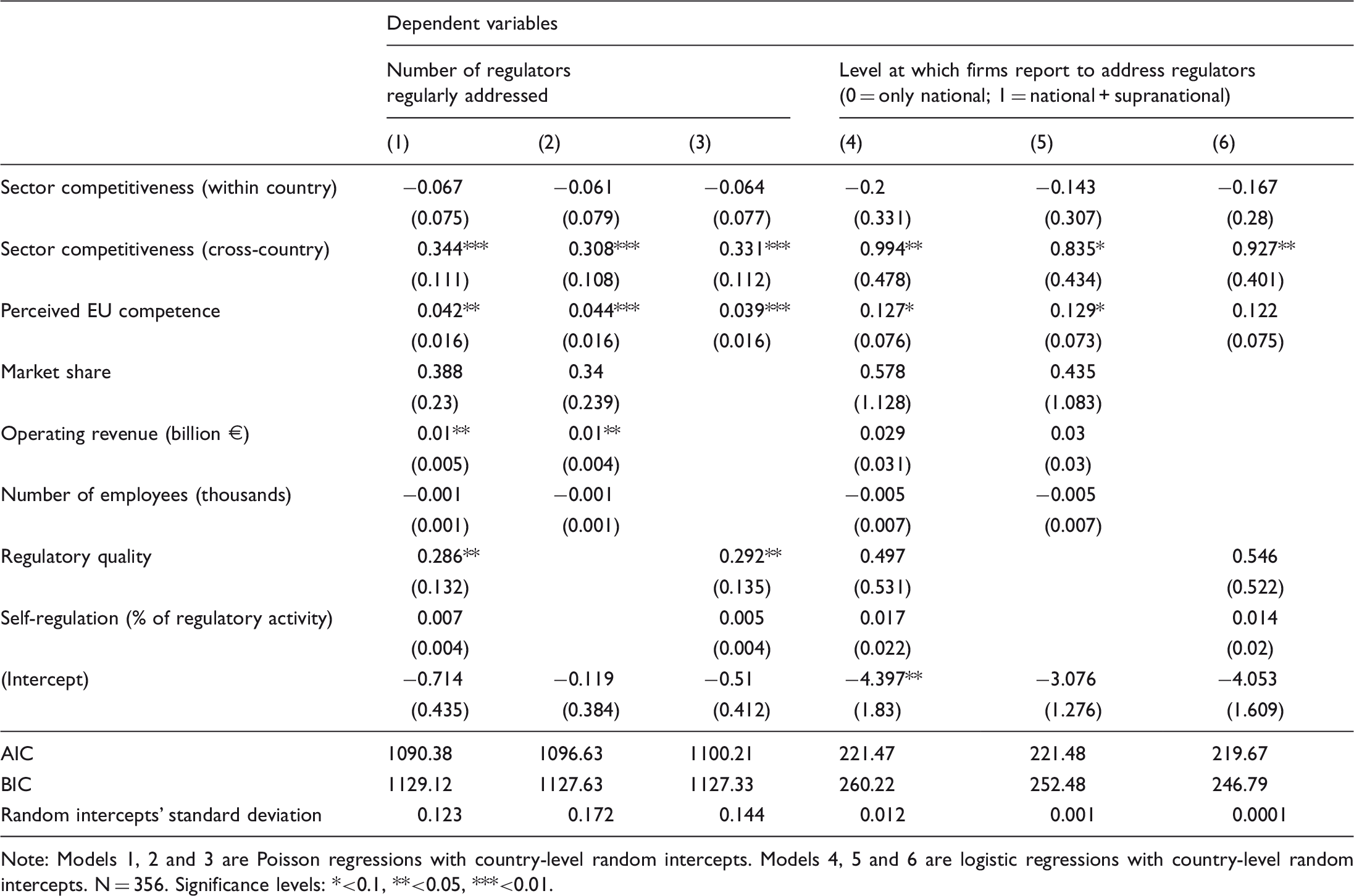
Concerning H5, the models in Table 3 show that the more firms perceive that competences on regulatory issues are located at European level, the more they tend to engage with agencies at the supranational level and the more regulators they address overall – although the evidence for the first effect is weaker. Figure 3 is once again useful to identify the impact of the selected predictors on both the dependent variables. H5 is confirmed in the first operationalization, as the average number of regulators regularly addressed by companies not identifying any issues under EU competence is 0.93, while, all else equal, the number grows to 1.43 for companies perceiving all their regulatory issues as involving a primary European competence. Turning to the second operationalization, as we can observe in Table 3, the Perceived EU competence variable is statistically significant only at 0.1 level in the first two models (Models 4 and 5) and it is not significant in Model 6. This is reflected in the weaker effect identifiable in Figure 3 for this variable. Although we still have an increase in predicted probabilities of addressing supranational regulators when moving from the lowest (43% probability) to the highest value (78%), the 95% confidence interval is wider than for the sector competitiveness variable and suggests to interpret this result with more caution.
Among the controls, the operating revenue and regulatory quality indicators are positively related to the first dependent variable, as expected, while market share, number of employees and the tendency to engage in self-regulation do not affect a firm’s venue shopping activity.
Discussion of results and conclusion
Drawing on an original survey of 243 firms’ attitudes to venue shopping, our study provides a number of interesting findings. Our hypotheses, which were mainly drawn from the previous literature on venue shopping, were supported by the empirical analysis. Significantly, the data show the robustness of the national level, even in sectors where multi-level opportunities exist. What is clear from our analysis is that there is a limited incentive to by-pass national regulators. This also implies that we can expect national “varieties of capitalism” to shape distinct “varieties of regulatory capitalism” (Guardiancich and Guidi, 2015; Levi-Faur, 2005). The resilience of the nation-state in regulatory policies, despite increasing economic interdependence and globalization, is an aspect that, we believe, deserves closer attention.
That said, we found that firms do engage in regulatory venue shopping, and the study clearly illustrates that they use a multi-regulatory and multi-level strategy. While a large proportion of firms reported that they regularly address multiple regulators, we did observe significant variation across sectors. Thus, at the horizontal level, energy, telecommunication and airline firms regularly address several national regulators, while railway and postal firms do so less, being more nationally embedded and having less regulatory venues. At the vertical level, airlines are the most internationalized and address several European regulators, followed by telecommunication and energy firms who, while primarily focused on NRAs, are also dealing with European networks of regulators and the Commission. Again, postal and railway firms are nationally embedded and resort to the EU level sparingly.
In terms of the logic of regulatory venue shopping, this happens when issues are highly salient, highly technical and when the stakes for the individual firm are high. Companies tend to address more regulators in sectors characterized by higher international competitiveness, as a means to mitigate uncertainty when operating in multiple markets and facing rivalry from international competitors. We also found that regulatory venue shopping is positively affected by the companies’ perceptions regarding regulatory competences: the more they perceive them to be located at the EU level, the more they venue shop. Thus, while the national level remains predominant, the growth of supra-national regulation pushes firms to diversify their strategies.
The robustness of the nation state can be rationalized as a consequence of the evolution of the regulator/regulatee relationship over time – that is, of the firms’ previous experience with national regulators. This could be due to the stronger formal and de facto independence of national agencies. As independence is meant to increase the consistency and stability of regulatory decisions, we could expect it to have a positive effect on the choice to address regulators. In addition, the longevity of business/regulators interactions may increase the confidence and certainty of obtaining sympathetic outcomes. We do not systematically analyse these processes in the article, but they are factors which future research in this field could incorporate. The creation of European networks might also have strengthened rather than weakened national regulators. Studying the effects of the emergence of European regulatory solutions on domestic business/regulators relationships is another potentially fruitful avenue to explore.
Overall, this is the first large-N study to look at individual firm’s venue shopping in regulation. We have focused on network firms operating in sectors that are characterized by frequent interactions and regulatory decisions, where regulatory venue shopping should be most likely to occur. It remains to be seen whether our findings would also pertain to other more competitive sectors. While we have explored firms’ individual venue-shopping behaviour, venue shopping may be also shaped by group strategy. In particular, the role of employer associations in coordinating the choice of regulatory venues is worth investigating further.
Supplemental Material
PPA814900 Supplemental Material - Supplemental material for The logic of regulatory venue shopping: A firm’s perspective
Supplemental material, PPA814900 Supplemental Material for The logic of regulatory venue shopping: A firm’s perspective by David Coen, Mattia Guidi, Nikoleta Yordanova and Adrienne Héritier in Public Policy and Administration
Footnotes
Declaration of conflicting interests
The author(s) declared no potential conflicts of interest with respect to the research, authorship, and/or publication of this article.
Funding
The author(s) disclosed receipt of the following financial support for the research, authorship, and/or publication of this article: The authors gratefully acknowledge the financial support of the European Commission for the project “Politics, Economics and Global Governance: the European Dimensions” (Project ID: 217559) funded under the Framework Programme 7 (call for proposal: FP7-SSH-2007-1).

Supplemental Material
Supplemental material for this article is available online.
Notes
References
Supplementary Material
Please find the following supplemental material available below.
For Open Access articles published under a Creative Commons License, all supplemental material carries the same license as the article it is associated with.
For non-Open Access articles published, all supplemental material carries a non-exclusive license, and permission requests for re-use of supplemental material or any part of supplemental material shall be sent directly to the copyright owner as specified in the copyright notice associated with the article.
