



Abstract
A basic insight in public administration research is that career officials play an important role in public policy development as well as in its implementation. Surprisingly, however, despite being an enduring theme on the research agenda, the jury still seems to be out regarding how to account for bureaucrats’ actual decision behaviour, a fact reflected in the numerous competing theories and perspectives available. By applying a novel large-N questionnaire survey as well as an alternative method, this article sheds new light on this highly contested area of research. We find that government bureaucrats’ (formal) organizational position is by far the most important explanatory factor, while classical demographic factors like geographical background, gender and age play a rather minor role. Among officials’ many early experiences, only their educational background and former job experience really count. The political attitudes of officials do not matter. The crucial role of bureaucrats’ organizational position for understanding their behaviour does not depend on intra-organizational socialization. Importantly, the key role of factors that may be relatively subject to deliberate change, such as organization structure and the former job experience and educational background of those recruited, entails a considerable potential for organizational design.
Keywords
Understanding bureaucratic behaviour: An enduring theme
Explaining and understanding the behaviour of government officials is a persistent topic in the study of public administration, governance and public policy. There are, arguably, two reasons for this. First, the basic insight that bureaucrats tend to play an important role with regard to both policy formulation and policy implementation (see e.g. Page and Jenkins, 2005) makes it crucial to understand why they act as they do. Second, despite considerable research efforts, the jury still seems to be largely out concerning the relative importance of various explanatory factors (for overviews of the literature on the role of organizational and demographic variables, see e.g. Egeberg, 2012; Egeberg and Trondal, 2018; Meier and Capers, 2012). The aim of this article is to contribute to this scholarly debate by presenting novel large-N data which measure how bureaucrats assess what explains their role behaviour and priorities, and further: under which conditions – related to the bureaucrats’ organizational and demographic characteristics – various explanations are important. We have collected the responses of 4285 central governments officials on how important they deem their organizational position, background and political attitudes to be, in order to understand their own behaviour and priorities in the current job situation. While the common approach so far has been to analyse the relationship between, on the one hand, organizational and demographic factors and, on the other, behavioural patterns, our approach is to ask the officials about their own assessment of what actually causes their behaviour. We do not at all consider this method superior to the common approach (see Method section below); however, in a highly contested area of research, we think studies applying different methods may complement each other. Thus, if studies built on different methods produce similar results, these findings stand out as particularly robust.
We also include the political attitudes of officials and their former job experiences on a par with organizational and traditional demographic variables. As far as we know, analyses on this topic have not usually included these factors. Job experience is relevant because it relates to socialization dynamics. The political attitudes of bureaucrats are expected to be a minor predictor of bureaucrats’ behaviour in administrations practising merit-based recruitment, but under certain conditions, this factor may show relevant. In the second part of our analysis, this question is explored, as we in a multivariate analysis probe into the conditions under which organizational position, background and political attitudes are considered important in order to understand one’s own job-related behaviour. For instance, do women find gender more important for their job-related behaviour than men do? Does length of service influence the assessments of the various factors? Thus, our research question is, first, to investigate the relative importance of bureaucrats’ current organizational position, their backgrounds and political attitudes for their actual behaviour in the job situation, and, second, to explore under which conditions these explanatory factors matter.
To the extent that factors like officials’ organizational position, former job experience and educational background do matter significantly in terms of actual decision behaviour, they, in addition, stand out as potential design tools since such factors are relatively amenable to deliberate change. Our research shows that organizational position, former job experience and educational background stand out as the overwhelmingly most important factors in order to understand government officials’ actual behaviour and priorities in the job situation. According to the officials’ own assessment, organizational position ranks clearly above the others, while classic demographic background factors such as gender and age seem to be of rather minor importance. The same holds for the officials’ political attitudes. Organizational socialization does not seem to be a prerequisite for bureaucratic role compliance, nor for weakening the impact of early (‘extra-organizational’) socialization.
Hence, the added value of this article is that it, within a highly contested area of research, provides new, large-N data, launches an alternative method, brings in new variables, analyses scope conditions of the behaviour-shaping variables and points to potential design implications of the findings.
Contending theories of bureaucrats’ behaviour
If one’s point of departure is the theoretical literature in the field, the key role of the (formal) organizational position in shaping bureaucrats’ behaviour is far from obvious. Largely competing explanations of organizational behaviour are derivable from three ‘classical’ theoretical perspectives: organizations as rational systems, organizations as natural systems and organizations as open systems. Although the three are historical products, they are at the same time not just of historical interest: ‘Each has shown great resilience and has been invented and reinvented over time so that each has persisted as an identifiable analytic model’ (Scott and Davis, 2016: 33; see also Christensen et al., 2007; March and Olsen, 2006). The main expectation from the rational system perspective is that a decision-maker’s (formal) organizational position constitutes the most important explanation of his or her actual decision behaviour. Seen from a natural system perspective, on the other hand, informal norms and values (organizational culture) play a dominant role in shaping organizational behaviour. The two perspectives are currently more often labelled the ‘organizational/instrumental perspective’ and the ‘cultural/institutional perspective’ respectively (Christensen et al., 2007; Egeberg et al., 2016). Arguably, the perception of organizations as natural systems also shares some commonalities with what Fukuyama denotes as ‘natural modes of sociability’, characterized by the importance of kinship, friendship and personal ties for social interaction (Fukuyama, 2014: 88).
Through the lens of the open system perspective, organizational structures and processes are shaped primarily through forces external to the organization. For example, in the demographic version of this perspective, participants arrive pre-socialized and ‘pre-packed’ via their social origin, thus bringing particular beliefs, attitudes and worldviews with them into the organization (Hooghe, 2005; Pfeffer, 1982). The empirical theory of representative bureaucracy similarly holds that the resulting demographic composition of the organization (‘passive representation’) may translate into ‘active representation’, meaning that organizational behaviour comes to reflect characteristics of the demographic profile rather than the formal organizational structure (for an overview of the literature, see Meier and Capers, 2012). Finally, according to the ‘institutionalized environments-school’, formal organization structures mainly tend to play the role as legitimating facades, mirroring current organizational fad and fashion, but being relatively de-coupled from actual behaviour within organizations (Meyer and Rowan, 1977).
Complementing these three historic, but enduring and largely competing explanations of organizational behaviour, there is at least one more distinct theoretical approach that deserves attention. We find the assumptions drawn from public choice theory on the (personal) utility-maximizing or shirking bureaucrat (Niskanen, 1971) to be at odds with the assumptions listed above, and particularly so, when it comes to the explanatory power of bureaucrats’ formal organizational position. This does not at all mean that bureaucrats’ private interests, such as promotion and salary increase, in general tend to counteract organizational role compliance. However, if the bureaucrat tries to increase his or her salary by shaping public policy, e.g. the way Niskanen’s budget-maximizing bureaucrat does, this is not role compliance. Although there seems to be limited empirical support for the arguments (Blais and Dion, 1991; Brehm and Gates, 1997), this approach has, nevertheless, been considered as one of the dominant strands in public administration research during the last 30 years (Peters and Pierre, 2017). Nor the argument about ‘bureau shaping’, set forward by one of Niskanen’s critics, Patrick Dunleavy (1991), should be understood as role compliance.
Thus, to sum up the main expectations. From a rational system or organizational perspective, we expect actual behaviour to be explained by the bureaucrat’s (formal) organizational position. The natural system or cultural perspective on the other hand predicts that behaviour is driven by informal norms and values in the organization. If, however, the point of departure is the open system or demographic perspective, officials are seen to be pre-packed with extra-organizational socialization experiences that actually come to shape their bureaucratic behaviour. Given a public choice approach, the private interests of officials will encroach upon the public interests they are supposed to pursue as officials. Since the civil servants covered in our study were not asked to assess the importance of organizational culture for their behaviour, the natural system, or cultural perspective, is not put to an empirical test.
Next, we will discuss conditions under which the various behaviour-shaping factors are deemed more or less important. Concerning the importance of bureaucrats’ own position, a common assumption is that intra-organizational socialization, alongside rewards, punishments and hierarchical control, is a key pre-condition for role-playing to take place (e.g. Lægreid and Olsen, 1984). Socialization, commonly understood as internalization of the norms and values of a collective, usually takes time. Thus, the expectation is that how important one considers one’s own position to be in order to understand one’s behaviour is positively associated with length of service. As regards how important one deems one’s own educational background to be in this respect, we expect that this depends on the kind of education one has: those who have a background in typical professions or disciplines marked by explicit paradigms may come to assign relative more weight to their education as an explanatory factor than those with other educational backgrounds. We also expect that agency personnel put more emphasis on their formal training than their colleagues in the ministries do, since work within agencies may require more specialized expertise. On the other hand, those in leader positions, due to having more general tasks, may claim that their educational background counts less than what is the case among their subordinates. Moreover, while in-house socialization is expected to strengthen the role of organizational position, length of service is at the same time thought to dilute the impact of all background factors alike. Concerning the extent to which one’s own political attitudes may explain some of one’s behaviour and priorities in the job situation we expect party membership to have a say. Party membership indicates strong party ties, and thus a strong political conviction.
Method
Descriptive statistics.

When investigating the relative importance of officials’ backgrounds and their current organizational affiliation one usually correlates these independent variables with various dependent variables tapping attitudes and actual behaviour. However, cross-sectional analyses of this kind have obvious weaknesses as regards ascertaining causality. For example, applicants for job in the civil service may wish to match their political preferences with their choice of job (‘self-selection’). Thus, one might question whether their priorities in the job situation reflect organizational role expectations or the concerns they had before entering the organization. In this article, we introduce a different method in order to approach the same phenomenon: we have asked the officials about their own assessment of how important their current (formal) organizational position, former job experience, educational background, geographical background, gender, age and own political attitudes are for their actual behaviour and priorities in the job situation. This take also has its obvious weaknesses, e.g. it relies on the respondents’ perceptions on what causes their behaviour in the job situation. Thus, our argument is not that this approach is better than the one described above, or not even as good as the one described above for that sake. The point is that this method may complement the former studies in a highly contested field of research. Arguably, possibly identical findings stemming from studies that build on quite different methods stand out as particularly solid.
‘Organizational position’ serves as an operationalization of the rational system (organizational) perspective’s ‘formal structure’. The job description will typically specify the task or policy area the role incumbent is supposed to deal with, with whom he or she is expected to relate, etc. The open system perspective is represented by the demographic background factors mentioned above. As far as we know, ‘former job experience’ has usually not been included in the existing literature. It may also be interesting to consider the importance of bureaucrats’ political attitudes for their decision behaviour. This variable has obvious shortcomings when it comes to tap all aspects of the (private) utility-maximizing bureaucrat, but, arguably, it may cover some aspects of this role. Although respondents are guaranteed full anonymity, one could of course doubt whether they would be willing to answer a question that most probably is perceived as highly controversial among career civil servants. However, the number of missing value-cases on this variable does not exceed that on the other variables.
Next, we investigate to what extent the perceived importance of one’s own organizational position, social origin and political attitudes for one’s own behaviour might depend on certain individual attributes characterising the respondent (see theory section). ‘In-house socialization’ is measured only indirectly along three alternative variables: length of service in current position (‘tenure 1’); length of service in current ministry/agency (‘tenure 2’) and length of service in ministries/central government administration in general (‘tenure 3’). Arguably, in-house socialization understood as internalization of organizational core values has to take some time. This said, we are aware that although some length of service can usually be seen as a prerequisite for organizational socialization, such socialization does not necessarily occur. Since the length of service-variables is strongly correlated, only one of them is entered at a time pr. regression analysis (see Table 4). ‘Tenure 1’ seems most relevant in relation to the importance of own position and former job experience, ‘tenure 3’ in relation to the remaining dependent variables. We have run the regression analysis on the importance of own position as well as former job experience with all three length of service variables used alternatively. Table 1 on descriptive statistics specifies how the values on the various variables are defined.
Several cells in Table 4 (regression analyses) are not filled in because we have found no reason why geographical background, gender and age should condition the weight officials assign to various behaviour-shaping variables. However, we have checked whether women tend to put more emphasis on gender as a behaviour-shaping factor than men. In a similar vein, we have checked whether geographical origin (capital or outside capital) matters for the weight assigned to geographical background as a behaviour-shaping variable. Likewise, we have investigated whether the respondents’ age matters with regard to how they deem age as an explanatory factor. Since the purpose of Table 4 is to uncover whether there are circumstances under which officials consider certain behaviour-shaping factors as more or less important, the size of the squared R is of minor importance in this analysis.
Results
The bureaucrats’ assessment of the importance of various factors for own behaviour and priorities as bureaucrat (Percentages).
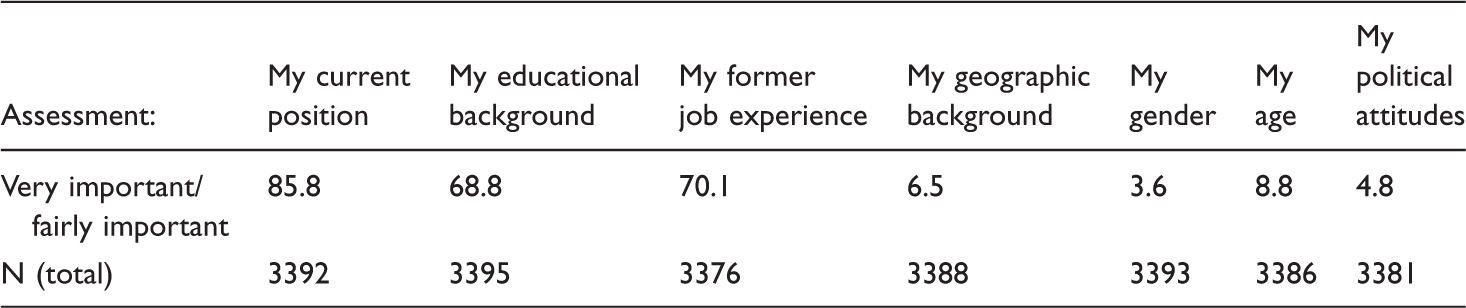
Question: ‘How important are the following factors in order to understand your own behaviour, priorities etc. in the job situation?’
While an overwhelming majority of the bureaucrats consider the three first-mentioned factors as important for understanding their actual behaviour and priorities in the current job situation, less than 9% say the same about the latter. The importance of one’s own (formal) organizational position ranks clearly above the others in this respect (86%).
Correlations between factors that may explain own behaviour in the job situation (Pearson’s r).

**p < .001.
The three most important factors for understanding own behaviour, own position, former job experience and education, are all clearly associated. The less important factors, such as gender, age, geographic background and political attitudes, are also indeed strongly interrelated. However, since these factors seem to be of minor importance, we will not elaborate further on them.
How individual institutional, demographic and political attributes affect the perceived importance of various behaviour-shaping factors (regression analyses, standardized coefficients (b)).
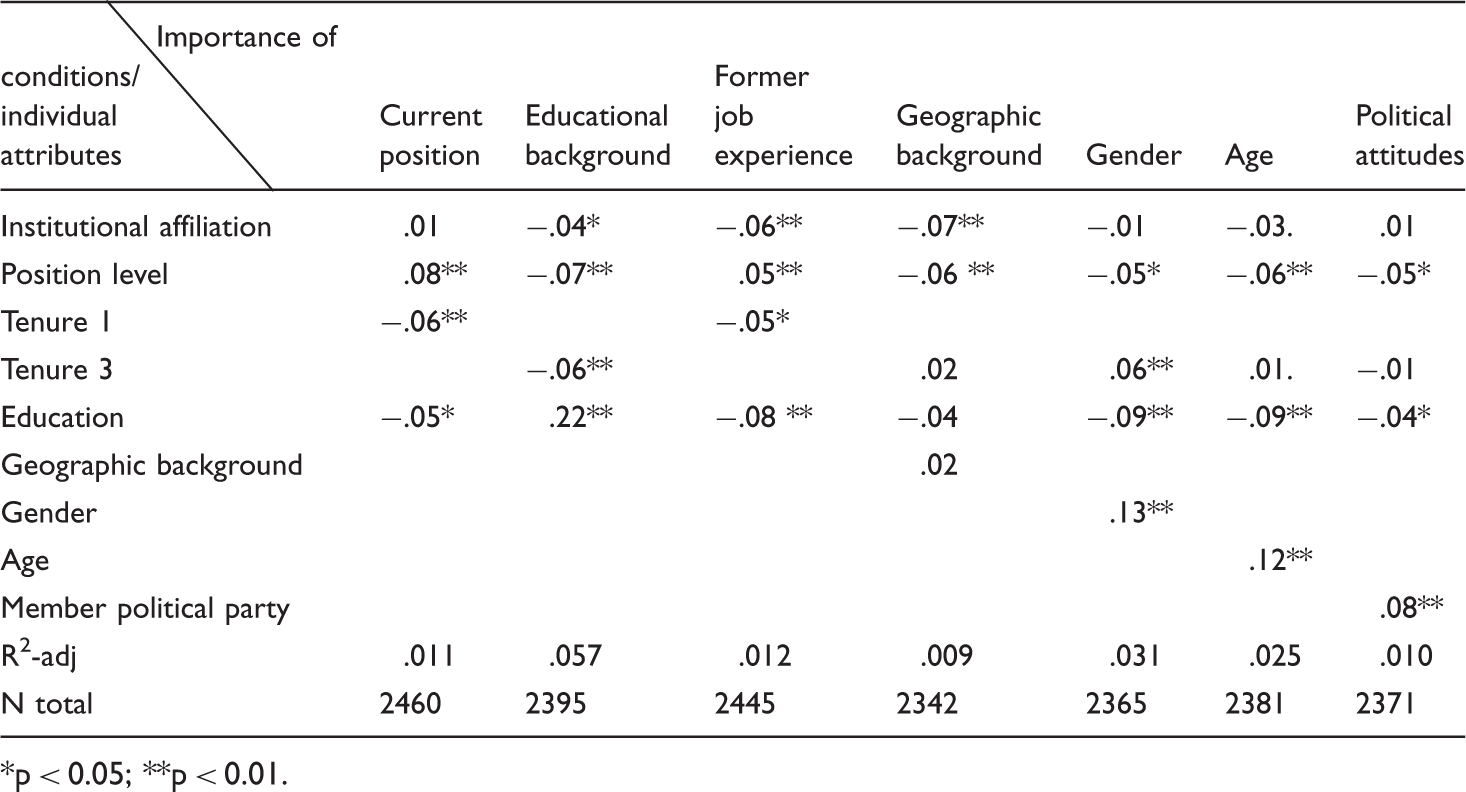
p < 0.05; **p < 0.01.
Table 4 reveals that the officials’ assessment of the importance of one’s own position for one’s behaviour is only marginally dependent upon intra-organizational socialization. And, contrary to the expectation, in-house experience tends to decrease the relevance of position. All three measures of length of service (see Method section) have been entered one at a time in the regression analyses with the same result. The impact of tenure 2 is not shown since it is considered to be less relevant in this context (see Method section).
Furthermore, although the effect is quite marginal, those trained in ‘professional’ or natural sciences tend to put less emphasis on their organizational position. On the other hand, those on higher echelons of the hierarchy tend to perceive their position as a more important explanatory factor than their subordinates do. From Table 4, we also observe that the type of education clearly affects how important one considers one’s education to be for one’s behaviour: As expected, those within the professions and sciences assign more weight to their training in this respect. The same holds for agency bureaucrats, although quite marginally. On the other hand, those in leader positions and those who have served longer consider their educational background less important, although quite marginally so.
Moreover, Table 4 shows that agency officials and leaders tend to put slightly more emphasis on the importance of former job experience than ministry officials and the ‘rank and file’. Opposite, bureaucrats trained in profession-related disciplines and natural sciences assign somewhat less weight to the behaviour-shaping role of former job experience. In-house socialization also seems to dilute marginally the impact of former job experience. However, when factoring in alternative measures of length of service (see Method section), results become slightly inconsistent, so we will not make a point out of this.
Concerning the factors that are deemed clearly less important when it comes to understanding own behaviour (i.e. own geographical background, gender, age and political attitudes), it seems as if those in leader positions and those trained in the professions and sciences are even less inclined to emphasize the behaviour-shaping role of these factors. Once more, in-house socialization does not show the expected effects: Those who have served for a long time do not perceive their background to be less important for understanding their own behaviour. Table 4 also reveals that women are more inclined than men to stress the relevance of gender, and those of higher age the relevance of age as a behaviour-shaping variable. Finally, officials who are or have been members of a political party emphasize the role of own political attitudes more than non-members. The squared Rs in Table 4 are very low. However, as explained in the Method section, this does not matter since the purpose here is only to identify conditions under which the various behaviour-shaping variables are deemed more or less important.
Discussion
Our findings highlighting the key role of officials’ organizational position and educational background for understanding their actual behaviour, and the minor role of demographic factors like geographical background, gender and age, support several earlier studies in the area (Christensen and Lægreid, 2009; Lægreid and Olsen, 1978, 1984; Meier and Nigro, 1976; Stigen, 1989; Trondal et al., 2010). However, given the many contending theories and perspectives in the area, such results should not at all be taken for given. Moreover, we have applied a different method: Instead of analysing the controlled relationships between organizational and demographic variables on the one hand and behavioural variables on the other, we have used the officials’ self-assessment of the importance of various behaviour-shaping factors. As said, we do not consider this approach to be superior to the more conventional way of doing analysis in this area. However, our take supplements the other method, and where findings show identical patterns across approaches, as in this case, these results should be considered particularly robust. In addition, we have documented the high relevance of former job experience and the low relevance of bureaucrats’ political attitudes in this respect. To our knowledge, the latter have not been included in this kind of studies so far (see though de Graaf, 2011).
Our findings seem to be partly at odds with much of the representative bureaucracy literature emphasizing the explanatory power of background factors (Bradbury and Kellough, 2008; Meier and Capers, 2012; Selden, 1997). One reason could be that the background factors focused on in the studies referred to; in particular ethnicity and race, harbour identities that are sufficiently robust to avoid being ‘overruled’ by organizational role expectations. Nevertheless, studies have shown that a comparable attribute such as nationality has rather modest impact on bureaucrats’ actual behaviour in international organizations (Kassim et al., 2013; Suvarierol, 2008; Trondal et al., 2010). Still, race may be an even ‘harder case’ and, for example in the study by Selden, in which minority officials handled low-interest housing loans to low-income persons, the fact that a ‘representational linkage’ occurred seems quite plausible (Selden, 1997).
In sum, our observations are compatible with expectations drawn from the rational system (organizational) perspective while partly incompatible with those derived from the open system perspective and the (personal) utility-maximizing bureaucrat perspective. However, concerning the open system perspective, this conclusion holds only as regards ‘classic’ demographic factors like geographical background, gender and age. When it comes to educational background and former job experience, also attributes that bureaucrats bring with them from outside into the government organization, our findings are in accordance with the open system perspective.
We have argued that there might be conditions – related to the bureaucrats’ individual attributes – under which the potentially behaviour-shaping factors are deemed more or less important. In general, our analyses reveal weak controlled associations. The only conditioning factor that shows a relatively strong impact is the kind of educational background officials have: those trained in the professions or natural sciences deem their education as more important for their actual behaviour than those trained in less paradigmatic disciplines.
However, even weak or virtually non-existent relationships may deserve attention, and particularly so when clear relationships could be expected. Thus, the fact that the importance of one’s own organizational position does not seem to depend on in-house socialization is noteworthy. However, although the importance of one’s position does not in general depend on intra-organizational socialization, it could still be that such socialization matters in other respects: For example, it has been shown that those who have served for a long time tend to identify more strongly with one’s own organization (see e.g. Christensen and Lægreid, 2009). As a result they may, arguably, come to act as more eager defenders of their organization in times of crisis. The weak associations between in-house socialization on the on hand and the importance attached to the various background factors on the other are also remarkable. However, our findings are highly consistent with former studies that have documented that even temporary bureaucratic personnel (for whom the re-socialization potential by necessity has to be low) tend to act primarily in accordance with (formal) role expectations (Trondal et al., 2008).
Finally, we should mention that our key observation on the superior role of the (formal) organizational position as a behaviour-shaping variable may be contingent upon certain broader societal characteristics. Arguably, the pattern we have described is commonly associated with Western cultural traits marked by a prevalent reliance on impersonal values and relations in public life, as opposed to a patrimonial system very much based on kinship and friendship (e.g. Fukuyama, 2014). Also, the minor role ascribed to bureaucrats’ political attitudes in our study may reflect the fact that the Norwegian central government, from where the data stems, constitutes a basically merit-recruited civil service with a clear separation between the political level and the administrative (career bureaucrat) level as far as recruitment is concerned (Allern, 2012; Askim and Bach, 2018; Lægreid et al., 2013). The fact that we focus on merit-recruited career bureaucrats rather than political appointees may then explain the minor weight assigned to one’s own political attitudes as a behaviour-shaping factor.
Design implications and conclusions
Given these cautions, our findings do not only complement the existing literature in important respects; they also contribute to substantiate the knowledge basis for organizational design. As pointed to in the Introduction section, organization structure has a great potential as an instrument for deliberately shaping governance processes (Egeberg, 2012; Egeberg and Trondal, 2018; Meier, 2010; Olsen, 1997). By structuring ministries and agencies in particular ways, governance processes may become systematically biased and shaped in accordance with predetermined goals. For example, by creating positions in charge of a particular policy area, one can expect systematic attention to be paid to policy concerns within this particular area. By clustering positions and drawing organizational borders between such clusters, it becomes more likely that certain interests are coordinated, while others are left uncoordinated. By drawing these borders according to, e.g. sector or territory, we expect decision-makers to focus attention along particular lines of conflict and cooperation, thus influencing the distribution of power in a given political-administrative space. By transferring positions from a ministerial department to an agency outside the ministry, officials are expected to assign more weight to expert concerns and the interests of client groups. And, by creating positions at different levels of government, such as supranational, national, regional or local, role incumbents tend to become defenders of the interests associated with the level to which they are affiliated, thus perceiving the need for, e.g. supranational harmonization, national sovereignty or local autonomy differently. That bureaucratic role compliance does not seem to depend on intra-organizational socialization substantiates the importance of formal structure as a design factor.
Moreover, the design option holds for the recruitment of personnel with particular educational backgrounds and job experiences as well. Not only do the bureaucrats consider their educational background important for understanding their actual behaviour and priorities. Our analysis also showed that the educational background of the officials has a clear impact on their assessment. Officials from the professions and sciences especially emphasize the importance of their educational background. Thus, like organization structure, education in particular disciplines enables action, but at the same time it creates predictable biases in attention and problem solving. Hence, personnel composition in terms of professional profiles stands out as a crucial design factor.
Concerning the importance of former job experiences, a potential design implication could be to establish a personnel mobility system that encompasses the departments and agencies with whom coordination is deemed to be particularly crucial. In this way, the concerns of the most affected partner institutions would to some extent become internalized within each partner institution through regulated exchange of officials.
The fact that background factors like geographical origin, gender and age do not matter much for actual organizational behaviour does not imply that such factors are irrelevant from a design perspective: Studies have revealed that the presence of various social groups in public administration (‘passive representation’) may strengthen citizens’ trust in government as well as providing job opportunities for disadvantaged groups (Meier and Capers, 2012). And although few hold gender as important, it is still an interesting finding – even from a design perspective – that women are more inclined than men to stress the importance of gender.
Finally, if the political attitudes of officials had been deemed important for understanding their priorities in the job situation, some politicization of recruitment and appointment processes could be seen as a reasonable and legitimate alternative to a purely merit-based system. However, as expected, we find that bureaucrats’ political attitudes play a minor role in explaining bureaucrats’ behaviour. Hence, our study provides no argument for politicizing appointment processes in an already merit-based recruitment system.
Altogether, our findings clearly underscore the crucial importance of (formal) organization structure, former job experience and educational background, not only for understanding bureaucrats’ behaviour, but also as potential design variables.
Footnotes
Acknowledgements
Previous versions of this article were presented at the NEON conference, Bodø, November 2017 and at the Norwegian Political Science Conference, Bergen, January 2018. The authors acknowledge comments from Jacob Aars, Dag I. Jacobsen, Bjørn-Tore Blindheim, and anonymous reviewers.
Declaration of conflicting interests
The author(s) declared no potential conflicts of interest with respect to the research, authorship, and/or publication of this article.
Funding
The author(s) received no external financial support for the research, authorship, and/or publication of this article.