




Abstract
Policy design undertakes to develop effective policies and hence must understand whether and how effective policies can be formulated and implemented. However, very often policy design has failed to focus on the causal chain that represents the actual driver of policy effects and thus misconstrues the potential effectiveness of a policy design. A mechanistic perspective is extremely helpful for conceptualising and pinpointing such causal chains, as it focuses on the real processes that must be activated by policy-makers in implementing policy designs. This article identifies the main steps to be taken when adopting such a mechanistic approach to policy design.
Keywords
Introduction
In this paper, we reflect on the usefulness of adopting a mechanistic perspective for the creation and analysis of policy designs. A mechanistic perspective focuses on the ways the elements of a policy design can advance its goals, namely by better understanding how the behaviour of both implementers and the targets of the design are altered by policy instruments in order to better achieve desired policy outputs and outcomes. As is argued below, a mechanistic perspective can enhance the technical design capacities of decision-makers by making it clear which behaviours are likely to be altered by any given policy intervention and why this expectation is a reasonable one.
From a mechanistic perspective, policy solutions are comprised of policy instruments whose adoption is expected to be conducive to a desired outcome, with a policy design in turn composed of a mix of such tools expected to more or less comprehensively attain a set of goals.
Policy-makers thus need a realistic causal theory about what occurs when policy tools are deployed and how it occurs if they want to design something that will actually happen more often than not, and to escape the trap of poorly conceived and related tacit knowledge, experience and heuristics. To date, however, many policy designs have been based on anecdotal or co-variational logics of expected outcomes from instrument deployment, without necessarily understanding the precise mechanisms which cause these outcomes to occur. In a sense then, much existing policy design thinking jumps from a proposed solution to an outcome, bypassing the ‘black box’ of behavioural and organisational change and target behaviour which generate outputs which allow this outcome to come to pass (Astbury and Leeuw, 2010)
Too often in the field of policy design, as in policy sciences and public policy more generally, explanations of ‘what works when’ are based on weak causation or a ‘heuristic’ framework, an often acknowledged to be unrealistic set of assumptions about irrational/rational behaviour, or a set of correlations between government actions and outcomes which are often mistaken for causes. Or, they can be based on a causation ‘derived,’ from “what works” approaches, based on counterfactual estimates (Goertz and Mahoney, 2012; Heckman, 2005).
Overall, an actual focus on realistic causation is often absent. Thus, one of the most important questions for policy design remains highly problematic for policy designers: how does a policy design encourage, constrain and otherwise structure policy targets' behaviour to achieve desired outcomes; and how can the box of policy tools available to policy-makers be organised in an effective (implementable) way to achieve desired behavioural changes?
A mechanistic approach to design addresses these issues but requires careful reasoning both in terms of the kinds of processes and interactions that can be activated by a policy instrument and how policy development can occur to help these happen (Moynihan and Soss, 2014; Pierson, 1993, 2000a, 2000b; Schneider and Sydney, 2009). Such a mechanistic perspective potentially not only reinforces existing analyses and explanations of how design works, but it can also show how the policy capacity of government can be strengthened. That is, a mechanistic approach to policy design strengthens decision-makers’ analytical capacity by making it clearer what should be analysed and why. This approach then allows appropriate policy tools to be chosen to ‘fit the job’ and helps inform the calibration 1 of those tools to ensure their effectiveness.
This article addresses this topic as follows. In the next section, we discuss in more detail the problem of causation in the logic of policy design. In ‘A mechanistic perspective for policy design’, we summarise current thinking on the concept of mechanisms and present a mechanism-based approach to policy design which distinguishes among three main elements of the mechanistic chain: the activators, first-order mechanisms and second-order ones. In ‘Tools and mechanisms in policy design: Activating first- and second-order effects’ section, a detailed discussion of first- and second-order mechanisms is presented.
The mission of contemporary policy design and the problem of causation
Although policy design as a field of scholarly research has itself experienced highs and lows in the last few decades, in the wake of prominent government failures such as the global financial crisis, it is currently experiencing a promising resurgence (Howlett, 2011, 2014; Howlett and Lejano, 2013). This includes a wide range of recent studies of design phenomenon in the policy world which have led to efforts to better understand and codify the often tacit knowledge of formulation processes and the policy target behaviour which occurs in response to government tool deployment (Capano and Woo, 2018; Howlett, 2018; Howlett and Mukherjee, 2018; Peters, 2018; Peters et al., 2018)
The endeavour of policy design involves a deliberate commitment to altering public policy by anticipating the possible effects of governmental decisions and articulating specific courses of action that are expected to effectively achieve government goals (Dryzek, 1983). In general, any policy design has to address two main issues: the political and the technical dimensions of policy-making and policy formulation (Capano et al., 2016; Howlett and Mukherjee, 2017). The political dimension refers to the institutional and partisan nature of the context in which policies are decided, whereas the technical dimension refers to the knowledge-driven capacities of the policy-makers with respect to their knowledge of the characteristics of policy tools and their impact on policy target populations (Capano, 2018; Howlett and Mukherjee, 2017; Radaelli and Dunlop, 2013; Sidney, 2007).
Policy design can thus be considered a knowledge- and information-based activity through which, in a specific context, policy-makers and stakeholders try to formulate solutions for collective problems (Alexander, 1982; Howlett, 2011).
Following Elster (1989) such an activity needs to specify the social ‘cogs and wheels’ involved in the relationship between input and outcome, so that good policy design is based on better understanding the mechanisms through which design interventions lead to expected outcomes. Paraphrasing Weick (1989), policy analysis should craft explicit hypotheses about the linkages between the input (design choices) and the output, including especially the specification of the process (the mechanistic causal chain) through which a policy design is expected to lead to a specific outcome.
Viewed from this perspective, policy design is a contemporary way to pursue the historic mission of the policy sciences, that is to improve ‘the concrete content of the information and the interpretations available to policy-makers’ as they go about crafting policy decisions and programmes (Lasswell, 1951: 3). The hoped-for outcome of better policy design, as seen by policy-makers as well as scholars, is more effective policy (Peters et al., 2018).
In order to achieve this, the content of policy design should conform to the characteristics of good decision-making, which according to Lasswell and Kaplan (1950) holds that ‘decision making is forward looking, formulating alternative courses of action extending into the future, and selecting among the alternatives by expectations of how things will turn out’ (193). In anticipating future behaviour and the impact of their actions upon it, decision-makers draw on their existing knowledge, empirical evidence and external advice to strengthen their ability to design efficient and effective policies (Bobrow, 2006; Bobrow and Dryzek, 1987; Howlett and Rayner, 2017). Such experiential knowledge, however, is only sometimes accurate but often not, leading to a chequered history of both successful and unsuccessful policy designs and of the application of design thinking to policy-making.
That is, good policy design implies that policy-makers possess a proper ‘causal’ theory upon which possible solutions and mixes of policy tools can be based. Due to the nature of this heuristic and experiential approach, existing analytical efforts are often more successful at shedding light on what is needed for good policy design in terms of best practices, than at explaining how good policy design works in terms of the types of processes it can activate to achieve the expected outcomes.
According to Lasswell (1971), ‘knowledge of the decision process is achieved by systematic, empirical studies of how policies are made and put into effect’ (1). This position is still valid and suggests that a solid theory of causation is needed to order and to explain policy dynamics and to understand, for example not only ‘what works and why’ (Goertz and Mahoney, 2012; Heckman, 2005; Jarvis, 2011) but also why a specific policy design, and indeed a specific policy instrument, might ‘work’ in one specific policy context but not in another.
Indeed, we know little about how different policy solutions trigger and drive the achievement of desired outcomes or, to put it another way, what happens when governments engage actors in the policy process and how that engagement operates to result in certain kinds of behavioural modifications and outcomes rather than others. This is the subject of a mechanistic theory of policy design as set out below.
A mechanistic perspective for policy design
A mechanistic view of policy behaviour is a promising basis for strengthening both the explanatory and prescriptive commitment of policy design studies. Over the past few decades, many social sciences have moved in a mechanistic direction as a result of dissatisfaction with both legalistic and statistical explanations. Starting with Elster (1989), studies have sought to apply mechanistic explanatory logic to both political science and sociology, for example including Abbott (2007), Gerring (2007), Gross (2009), Hedström (2008), Hedström and Swedberg (1998), Mahoney (2001), Mayntz (2004), Schmidt (2006), and Tilly (2001).
There is broad agreement in this literature that a mechanism, being ‘theoretical propositions about causal tendencies’ (Hedström, 2005: 108) and thus middle range theories (Mayntz, 2004; Pawson, 2000), are sets of entities and activities organised to produce a regular series of changes from a beginning state to an end one (Darden, 2006; Machamer et al., 2000). These mechanisms are constructs that allow us to understand what really occurs inside the ‘black box’ of social processes, including policy target behaviour.
A mechanism is a ‘causal structure that explains the empirical outcome’ (Bygstad et al., 2016: 83). These mechanisms differ from ‘intervening’ variables because they are part of a different perception of causation than the correlation logic commonly found in the field which defines ‘dependent’, ‘independent’ and ‘intervening’ variables (Hedström and Swedberg, 1998). Although in general difficult to observe directly, they indicate precisely how X actually produces Y under specific conditions rather than simply chronicle the co-appearance of Y whenever X is present. 2
Thus, the adoption of a mechanistic perspective means theorising about the ‘system that produces outcomes through the interactions of a series of parts that transmit causal forces from X to Y’ (Beach and Pedersen, 2013: 176). Such mechanisms can span micro-level (individual) and macro-level (structural) phenomena as well as the meso or group level (Falleti and Lynch, 2008).
Inspired by Coleman (1990) and Hedström and Swedberg (1998), a macro-meso-micro dynamic can be distinguished in three general types of mechanisms (see Figure 1): ‘situational’ mechanisms which (on the basis of existing structural and environmental forces) constrain individuals’ actions or shape their beliefs, ‘action-formation’ mechanisms which link individual activities or behaviour to individuals’ actions and ‘transformational’ mechanisms which generate intended and unintended outcomes (meso-level). The persistence or institutionalisation of the outcomes of transformative mechanisms then generates a new situation, in which these ‘first-order’ and other ‘second-order’ mechanisms such as learning and feedback again occur.
The micro-meso-macro mechanistic process. Source: Adapted from Coleman (1990) and Hedström and Swedberg (1998).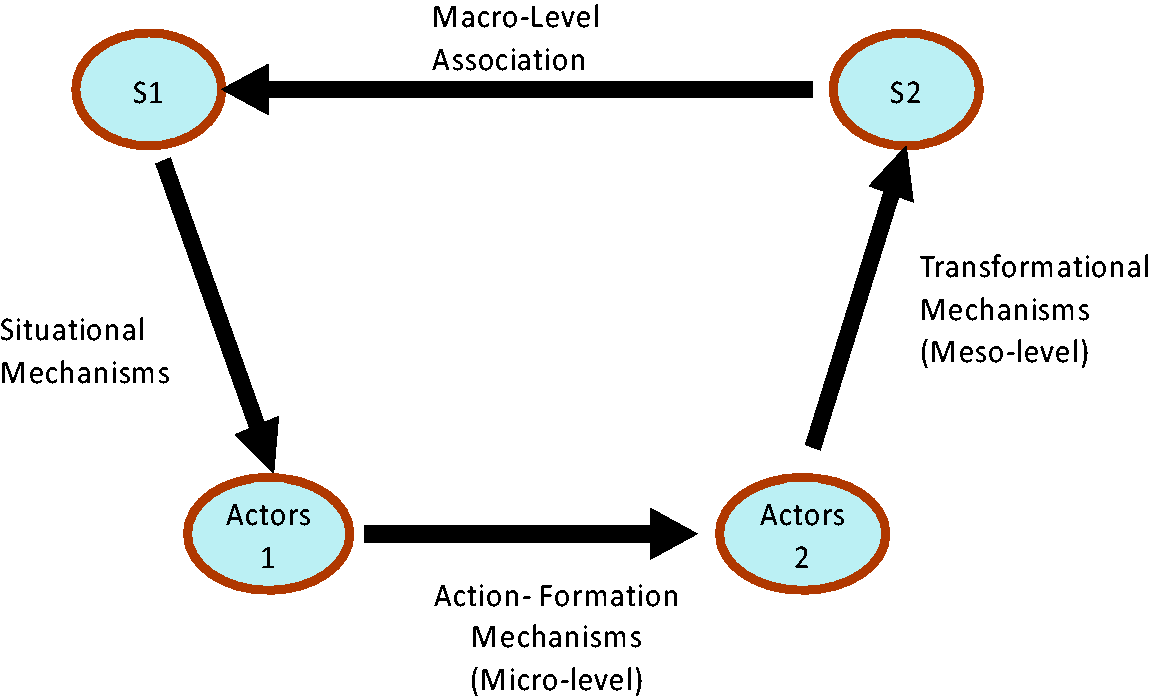
This view, common in sociology, however, assumes that there is no direct influence between the micro and the macro (emergent) levels (Bhaskar, 2008) and is hence less useful in the policy realm where structural or system-level relationships are also important. Hence we propose a mechanistic sequence for policy-making composed of three components: ‘activators’, ‘first-order mechanisms’ and ‘second-order mechanisms’.
‘Activators’ are not mechanisms, rather they are ‘events’ or activities which trigger mechanisms, activating the first-order and second-order mechanisms through which the behaviour of individuals, groups and subsystems is altered in order to achieve a specific outcome. From a policy design perspective, activators are policy instruments through which decision-makers set up their policies to impact on the reality they want to maintain or to change. These instruments, of course, can be calibrated or tuned more precisely to attain government goals, for example when a subsidy is adjusted upwards in the expectation that it will be utilised by more participants and enhance compliance rates with government initiatives.
First-order mechanisms are those which are triggered by the tool's application of state resources in order to affect the behaviour of individuals, groups and structures and can be applied in a specific fashion in order to achieve a specific outcome. In the policy realm, these mechanisms exist at the individual level whereby actions like the provision of subsidies are expected to change individual savings behaviour; at the group level whereby, for example, the provision of tax credits for charitable donations affects group membership and behaviour; and at the system or subsystem level whereby adding or removing new actors and ideas, or reinforcing existing ones, through activities such as creating authoritative policy advisory boards and commissions, providing access to information and other kinds of tools, affects system structure and behaviour. These different levels of mechanisms interact with each other, as for example occurs when a tax credit for charities changes individual behaviour, which can affect the group's behaviour and, ultimately the nature of a policy subsystem.
Second-order mechanisms are those which are used to inform the use of activators by observation of the reaction of individual, group and system behaviour to the previous deployment of activators. In the policy realm, these second-order mechanisms are those which promote reflexive governance and include various kinds of activities such as policy learning, diffusion and transfer, both with respect to lessons learned about individual behaviour and collective or structural effects. They also include counter-causal mechanisms (counter-mobilisation; negative framing; resistance) that can impede expected outcomes from first-order tools (Dunlop, 2017; Weaver, 2010).
Application to policy design
Figure 2 presents an elaboration of this arrangement. A mechanistic policy design perspective is primarily interested in understanding what specific first- and second-order mechanisms can be triggered by the deployment of policy tools to affect actors' behaviour in predictable directions and in what contexts. That is, first- and second-order mechanisms work in a context that varies according to the type of policy and which can affect the ability of tools to alter behaviour in expected ways depending on factors such as resource availability, capacity, implementation barriers and counteracting pulls on individual, group and subsystem activity and behaviour.
The mechanistic process from a policy design perspective.
This mechanistic perspective helps us understand the various dimensions of policy designs. The focus on ‘activators’, the design tools/choices through which an intervention operates, for example, helps to distinguish between the content of the design in terms of adopted policy tools or the strategy for an intervention and the mechanisms that they are capable of activating. The focus on ‘first-order mechanisms’ in turn requires an awareness of the types of mechanisms that are activated through policy design in order to address targets’ behaviour in such a way that their related behaviour produces the expected outcome. And the focus on second-order mechanisms helps us understand what occurs when a designed policy is implemented and thus improves the understanding of how a better policy design can be achieved. When a government decides to change how its education system functions, for example, if it has the requisite capacity to do so, it can activate first-order mechanisms, such as school competition or enhanced institutional accountability in order to improve the performance of schools, by activating second-order mechanisms like learning which is expected to do the same, or in some combination. Introducing vouchers or a combination of choice and national testing, for example, can activate competition and institutional accountability.
Tools and mechanisms in policy design: Activating first- and second-order effects
When a mechanistic perspective is applied to policy design, the key questions are how and why certain tools activate specific mechanisms? Below we deepen the analysis of first- and second-order mechanisms in order to help understand this relationship.
Activating first-order mechanisms
As set out in Figure 3, the mechanistic approach to policy-making and policy dynamics centres around the idea that the use of policy tools activates certain propensities on the part of policy actors leading to policy outputs resulting from more or less predictable changes in target behaviour and ultimately policy outcomes. This is a process which involves complex causal chains centred around existing policy behaviours and policy-making contexts, and policy interventions which trigger – intentionally, consciously or not – policy mechanisms which affecting ‘target’ behaviour, changing it in some new direction (Falleti and Lynch, 2009; Hedström and Swedberg, 1996, 1998; Hedström and Ylikoski, 2010).
The behavioural expectations of policy design.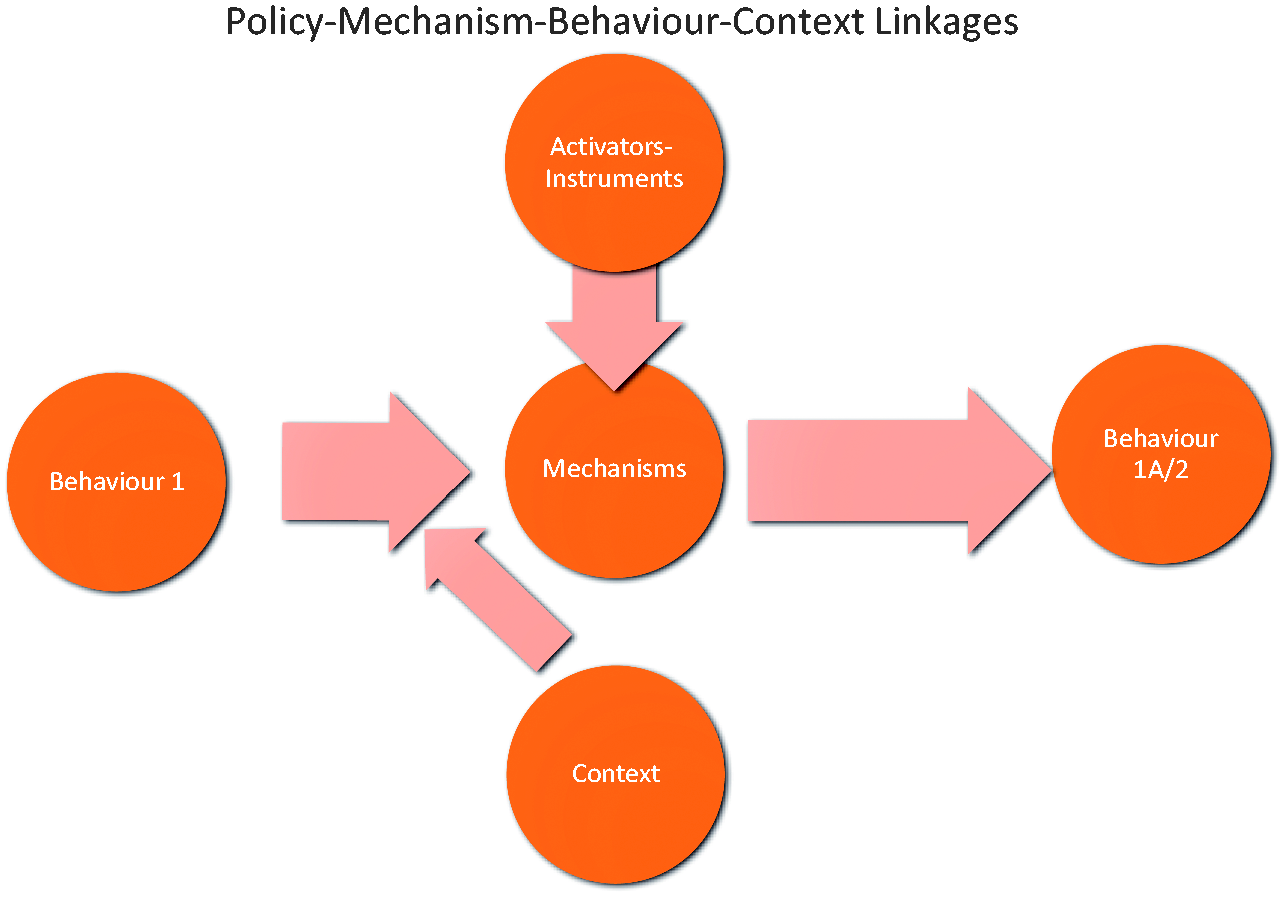
The linkages between policy instrument invocation and behavioural or policy change are very rich. As Figure 3 shows, a mechanistic process of behavioural change involves at least four linkages, all of which are affected by contextual aspects present at the exact moment at which instruments are invoked and mechanisms triggered. These are:
(1) the link between tools and the governing resources present at any moment in time (2) the link between resources and the mechanisms which tools activate (3) the link between the mechanisms and the actual behavioural changes which occurs post-activation and (4) the link between changes in behaviour and changes in policy outputs and outcomes.
This approach thus views policy-making as largely about affecting behavioural changes in target populations, with policy instruments used as a means to influence a shift from an existing behaviour (‘behaviour 1’) to a reformed or new one (‘Behaviour 1A or 2’) (Balch, 1980), a shift which is moderated by the context in which the tool is deployed and the manner in which the tool is calibrated.
Context is important because all four of these linkages – instrument choices, mechanism activation, reception and impact – are susceptible to various barriers and impediments linked to factors such as the number and type of targets, the availability (or not) of adequate resources or capacities on the part of state actors, and the like (Howlett and Rayner, 2013a, 2013b). As Figure 4 shows, in general each link in a mechanistic chain is affected by contextual factors which can serve to block or make the linkages across the tools-output chain problematic, that is making a design outcome more difficult to predict and control (Falleti and Lynch, 2009).
Examples of specific context-related mechanism constraints.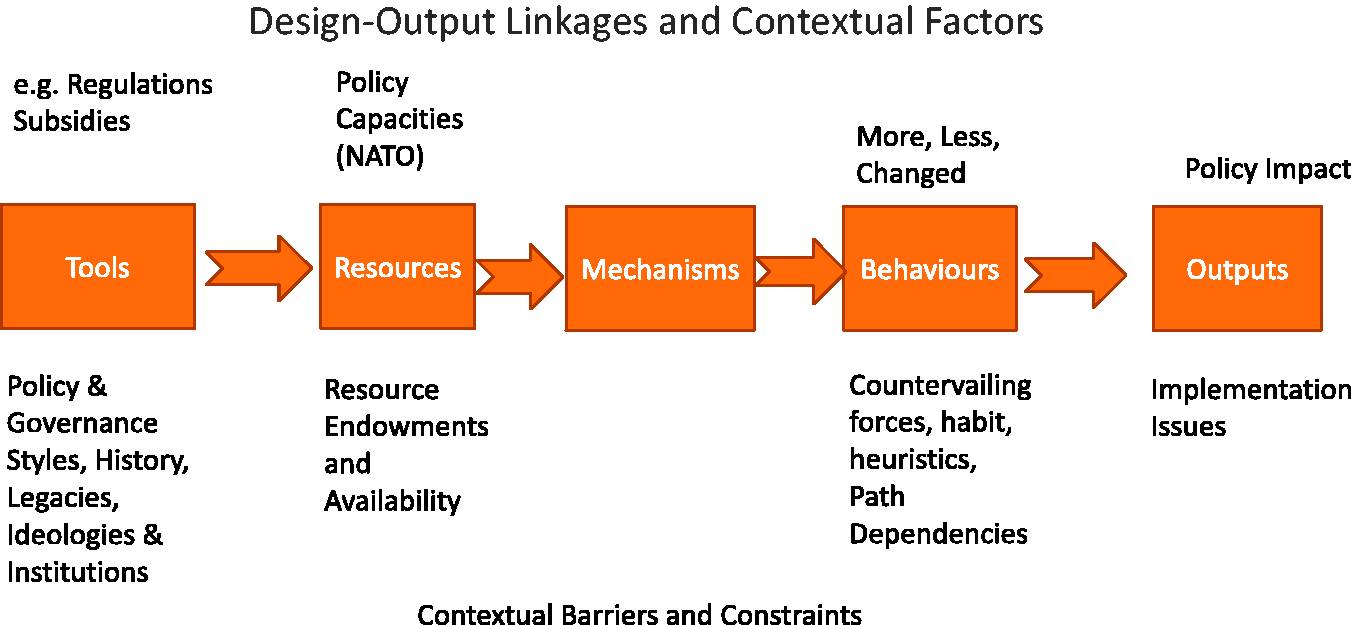
There are many such barriers and factors, which include such factors as the preferred policy style and governance mode which can affect preferences for certain tools over others; the various resource (‘Nodality’, ‘Authority’. ‘Treasure’ and ‘Organization’ or NATO (Hood, 1986)) endowments enjoyed by a government which can limit its capability to use particular tools or how they are calibrated, or eliminate them altogether (Wu et al., 2015); possible countervailing demands and constraints on behavioural change which can undermine the effect and impact of a mechanism on subsequent behavioural change (Howlett, 2018; Weaver, 2014, 2015); as well as various kinds of implementation and other issues which can lessen, or enhance, policy outputs (Hupe and Hill, 2016; Lindqvist, 2019).
Moreover, different temporal dimensions, for example, also exist in these relationships such as the tempo, duration, time-frame, and timing of interventions and responses (Adam, 2004). Some mechanistic causal chains need time to develop (duration) an outcome and if the designers do not take this into account they may design in a very ineffective way. And some mechanistic chains can have a different timing with respect to other related or linked dynamics such as a low synchronisation rate between first-order mechanism activation and second-order learning or diffusion: this temporal misalignment can be the bearer of unexpected outcomes with respect to designers' goals. In other words, mechanisms can be activated in different ways and induce expected behaviours in an intense way or more loosely and at a slower pace.
Of course this discussion continues to beg the question of what is in the ‘black box’ at the centre of the analysis. In the following section, we elaborate upon the first- and second-order mechanisms which comprise that box.
Individual- and group-level behavioural mechanisms
First-order mechanisms are those psychological and structural characteristics of policy actors which directly affect their behaviour and reaction to policy cues. Although a great deal of the extant policy literature deals with individual-level behaviour, these mechanisms exist not only at the ‘individual’ level but also at the ‘group’ and ‘structural’ ones (Falleti and Lynch, 2008).
Most of the literature on causal mechanisms in general, and dealing with policy mechanisms in particular, has focussed on the individual level. At this level both individual-level ‘micro’ mechanisms (affecting either ‘system 1’ unconscious or semi-conscious psychological propensities) and ‘system 2’ conscious or more ‘rational’ ones compose a key set of mechanisms which many policy tools are expected to activate (Kahneman, 2013).
Until recently, most studies focussed on so-called system 1 mechanisms, that is those which appealed to the more rational bases of human cognition, such as the ability to accurately assess the costs and benefits of specific proposed courses of action and decide upon a maximising or optimal strategy (Elster, 2009).
As Strassheim (this special issue) has observed, in recent years, under the sway of behavioural economists and others, however, many works dealing with ‘system 2’ or automatic less ‘rational’ motivations and cognitive strategies have increasingly been added to this design and policy-making lexicon (Ariely, 2010; Shafir, 2013; Shafir et al., 1993; Sunstein et al., 2001). Examples of these are found in Figure 5.
Examples of individual- and group-level first-order mechanisms.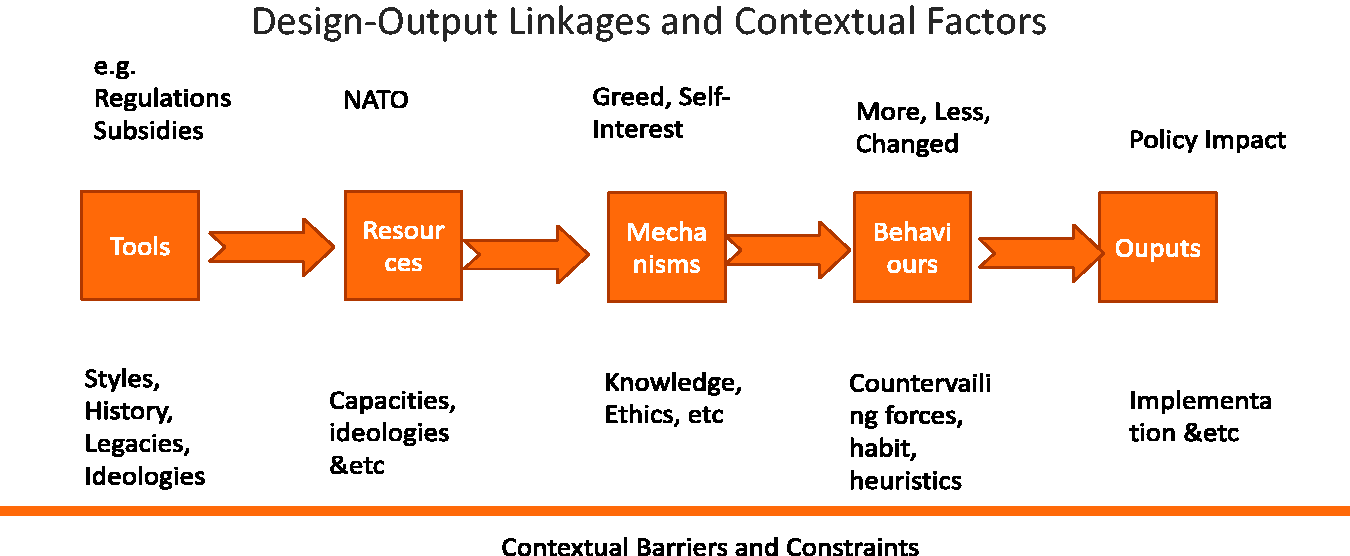
In this view, at the individual level the mechanisms activated by policy instruments in order to trigger policy change are characteristics of human behaviour such as greed, fear, risk aversion, or the use of heuristics and other less rational ways of thinking which affect the logics of calculation and appropriateness individuals take towards such issues as whether or not to perform a crime or quit smoking or invest in a pension fund or donate to a charity (March and Olsen, 2004).
A resource-based taxonomy of procedural and substantive policy instruments (cells provide examples of instruments in each category)

Source: Adapted from Howlett (2000).
Thus, information-based instruments, for example, can both facilitate the provision of information as well as suppress it and can involve the release of misleading as well as accurate information (Goodin, 1980) both of which can affect human cognitive and emotional response mechanisms, for example, concerning whether and how many supplies to stockpile in the face of a natural disaster or threat. These tools can be calibrated or applied at different levels of intensity, affecting the degree or speed to which a mechanism is activated.
One of the main reasons such tools might be deployed is supply oriented: that is a government may utilise specific kinds of tools which deploy the kinds of resources it has in ample supply or which could be easily replenished (Hood, 1983). But in addition to ‘supply-side’ capacity issues, ‘demand-side’ considerations are also very significant in such choices. That is, in general, each category of tool involves the use of a specific governing resource expected to trigger or lever a specific characteristic or receptor in a target, inducing a certain behavioural response. Thus, the effectiveness of the deployment of such tools is linked not just to resource availability – a precondition of their use – but also to the existence of different ‘receptors’ on the part of policy targets which make them respond in a predictable way to the use of this resource when deployed, and to the level of knowledge policy-makers have concerning those propensities.
Behavioural needs for resource effectiveness
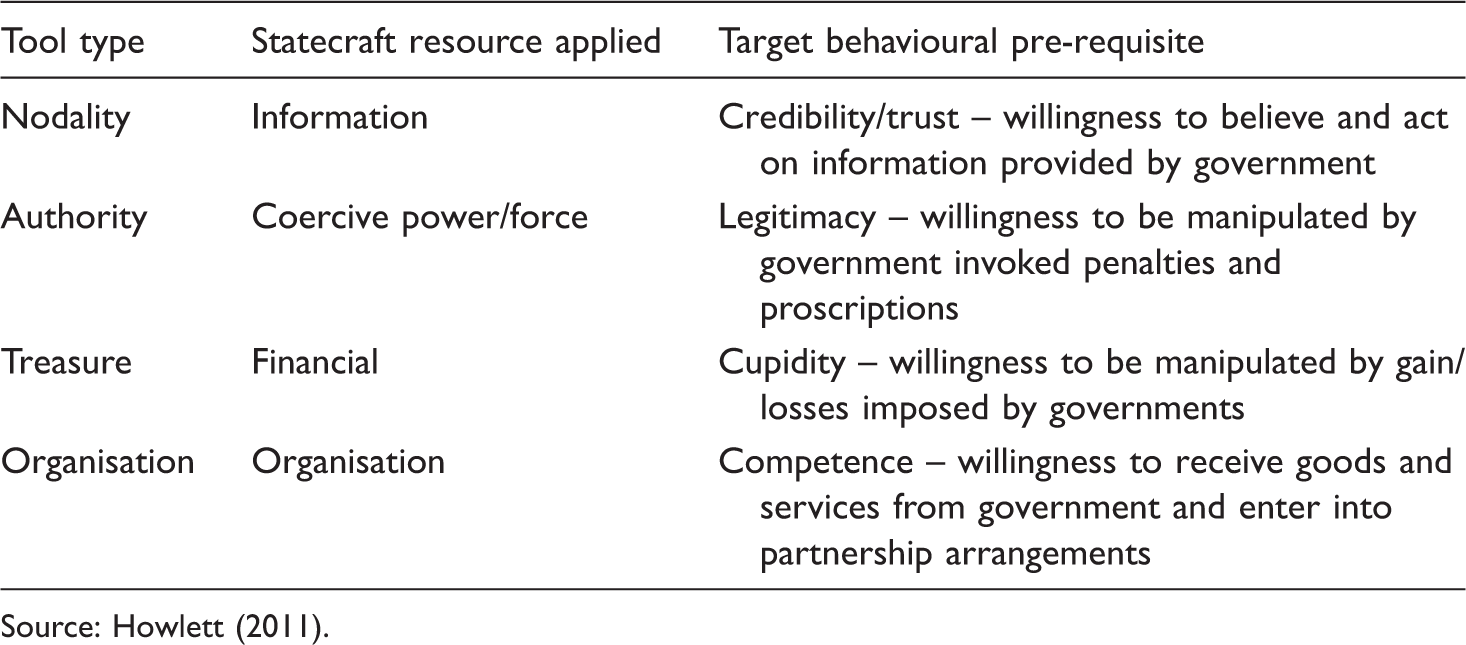
Source: Howlett (2011).
In the case of information use, for example, tool effectiveness relies both on the availability of knowledge and reliable data and the means to distribute it (‘resources’) and also upon the target's belief in the accuracy of the messages being purveyed, or their credibility (‘receptor’). Similarly, the effectiveness of the use of authoritative tools depends not just upon the availability of coercive mechanisms and their enforcement, but also upon target perceptions of government legitimacy or the firmness and justice of the use of force or its threat. Similarly, the effective use of treasure resources depends not just on the availability of government funding, but also on target group financial need and especially their receptivity to government funding or their cupidity. Likewise, the effective use of organisational tools depends both on the existence of personnel and other organisational resource but also upon target group perceptions of government competence in the deployment and training of personnel to provide services and rules.
These are important considerations in policy design and especially in the calibration of policy tools, considerations which are highlighted by a mechanistic perspective. Thus, the use of authority-based tools such as laws and regulations, for example, involves considerations of legitimacy on the part of targets and must not over-reach or over-burden the extent of legitimacy which a government enjoys (Hanberger, 2003; Suchman, 1995). If a policy measure does so it most assuredly will require much monitoring and enforcement activity in order to be even minimally effective, involving large administrative costs and burdens which may well undermine its own efficiency and effectiveness considerations, as has occurred in the past in many countries in areas such as marijuana or alcohol prohibition (Issalys, 2005). The exact manner in which a tool is calibrated is affected by a variety of implementation issues, ranging from the level of resources available to governments – such as the nature of financial constraints upon subsidy levels – as well as their knowledge of the degree to which different levels of resource use affect the intensity of mechanism activation.
Group-level mechanisms
Although often pitched purely at the level of individuals, many of these same mechanisms also operate at the more collective or group level (Buchanan and Tullock, 1980; Olson, 1965; Riker, 1986) (see also Figure 5). That is, this same basic logic can be applied to groups or collections of individuals who enter into coalitions or act independently in order to pursue collective aims and goals including to influence the behaviour of government towards them.
Such groups are sometimes viewed as mere aggregates of individual preferences with no interests or aims beyond those of their members (Olson, 1965) although more careful study has shown many more complex motivations and proclivities exist at the collective or organisational level which are not reducible in such a fashion (Halpin and Binderkrantz, 2011). These mechanisms include the propensities of groups to search for new issues or retain existing issue orientations, whether they prefer to specialise or generalise in issue orientations and the nature of their membership appeals (Halpin et al., 2018; Nownes and Neeley, 1996).
Structural or subsystem-level mechanisms
A third set of mechanisms is that which concerns the structure of policy subsystems and how they change. This set of mechanisms is quite different from the individual- or group-level ones, which are the typical subjects of mechanistic analysis.
This third set of mechanisms is activated by policy tools, especially ‘procedural’ ones which affect the manner in which individual and groups act and interact in attempting to affect policy outcomes (Howlett, 2000, 2011). A sizeable literature in the policy sciences has noted the importance to policy outputs and processes of two aspects of subsystem structure, namely the number of types of actor arrayed in a subsystem or network, and especially their ability to block off or close off entry of new types of actor, as well as the nature of the ideas which circulate within such subsystems.
That is, changes in the ends of policies, be they conceptual or practical, require new ideas to be incorporated into policy-making processes (Blyth, 1997; Campbell, 1998; Hall, 1993; Sabatier, 1999), meaning such ideas have to be able to penetrate into the policy communities and networks which control or dominate policy discourses. Similarly, another sizeable body of policy research links changes in the conceptual aspects of policy-making simply to the ability of actors in policy subsystems to achieve and retain ‘monopoly’ or hegemonic status within them (Baumgartner and Jones, 1993; Hoberg, 1996; Jacobsen 1995; Pontusson, 1995).
Like any kind of networks, policy subsystems are composed of nodes and links. Manipulating nodes and links – adding, subtracting and changing them – thus constitutes a set of triggers which activate a variety of mechanisms at this network level including the willingness of policy actors to enter into relationships with other, proximate, actors in the network (rather than more distant ones) or their desire to act as leaders, entrepreneurs or brokers, between other actors and governments.
Hence there is a third major type of policy behaviour, with a specific set of mechanisms, which policy-makers can, and do, activate, which are structural ones (see Figure 6).
Links in the design chain – structural level.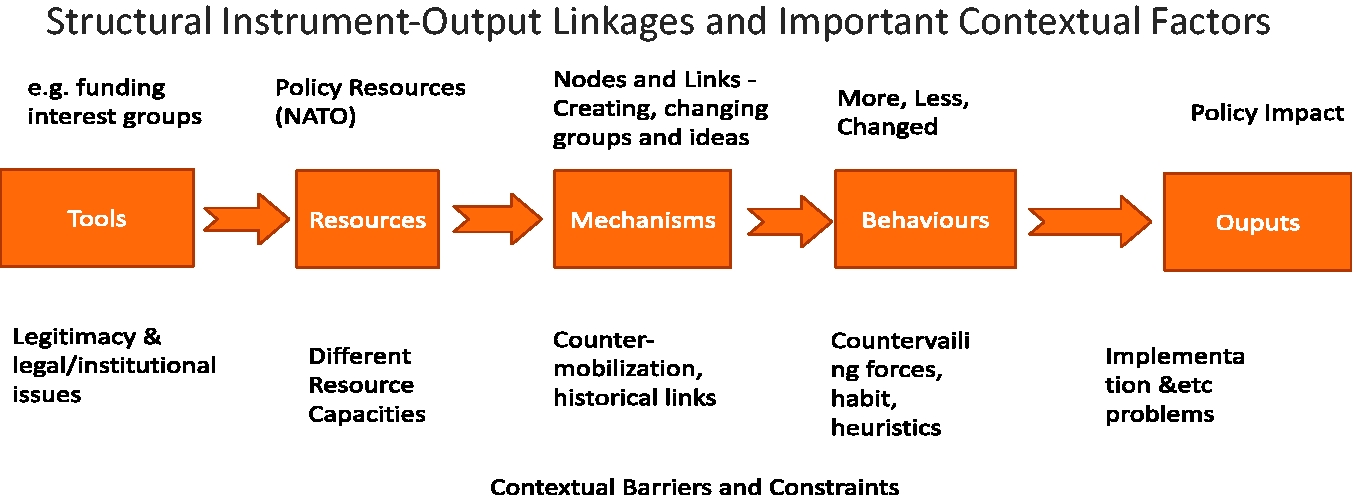
Second-order mechanisms: The family of policy feedback
All of the abovementioned mechanisms are ‘first-order’ ones which directly affect actor or system behaviour. But there are also policy mechanisms activated by policy designs which do not directly produce effects at the aggregate level but rather involve feedback processes affecting further tool choices and policy efforts. These effects require the activation of other types of mechanisms, which can be defined as ‘second-order’ mechanisms.
Policy feedback, for example, is a temporal concept that specifies a diachronic process through which an outcome is reached in terms of its effects on a policy equilibrium (Béland, 2010). Classic works in the field of political science have discussed these effects. Schattschneider (1935), for example, underlined how processes of mobilisation and counter-mobilisation characterise much policy-making. In recent years, however, the concept of policy feedback has acquired a more specific theoretical role to explain general patterns of policy stability and change (Baumgartner and Jones, 1993).
Policy feedback processes can be either positive (reinforcing existing behaviours) or negative (altering them). Positive policy feedback effects often develop lock-in effects over time through an increasing return mechanism that both freezes the elements of a specific policy and stabilises them on a specific path to be followed (North, 1990; Pierson, 2004). Thus, they can be considered self-reinforcing. Negative feedback avoids the expected outcomes and can advance self-undermining policy reform and change processes (Weaver, 2010).
Policy feedback is an inclusive concept that contains all of those factors through which the effects of the previous policy design are channelled towards influencing both policy and political development. This means that policy feedback itself cannot be considered a mechanism, although it clearly requires mechanisms to deliver its ‘positive’ or ‘negative’ effects. Thus, from a mechanistic perspective, policy feedback-based mechanisms should be considered a ‘family’ of second-order mechanisms that cause future political and policy developments. Then, for example, if a new design activates those mechanisms that – consistent with the pursued goals – needed to be activated, positive second-order mechanisms can be activated to reinforce the process and re-produce the expected outcome over time. If the new design is not well suited for the task, then negative second-order mechanisms can be activated, and the situation t2 (see Figure 2) will be characterised by a negative outcome that is contrary to the designers’ expectations but can also lead to policy change and re-design.
For example, in higher education policy, the introduction of national research standards to measure the quality of university research is a design intervention through which policy-makers pursue improvements in research quality by activating the mechanism of institutional competition. This mechanism is supposed to be quite strong and a significant amount of public funding is allocated through this type of exercise. Theoretically, positive feedback would imply that through competition, the overall national quality of research should increase in the medium run and consequently through a variety of second-order mechanisms, such as learning or blame avoidance, institutions should act as expected and thus contribute to a self-reinforcing policy (Schneider and Ingram, 1997).
Negative second-order mechanisms are activated as ‘consequences of policy that tend to undermine rather than reinforce the political, fiscal, or social sustainability of a particular set of policies’ (Weaver, 2010: 137). Therefore, negative second-order mechanisms are activated in the medium-long run and produce negative policy feedback, as indicated by a large body of literature in the field of comparative public policy, especially with respect to health and welfare (Bonoli and Palier, 2007; Esping-Andersen, 1996; Fernández and Jaime-Castillo, 2013; Hacker, 2004, 2010; Starr, 2011; Weaver, 2010). This type of negative policy feedback effect can be attributed to self-undermining dynamics that can be explained through second-order mechanisms such as increasing costs/emergent losses, counter-mobilisation, shifts in ideas and discourses, emergent losses, losses in mass cognition and menu expansion (Jacobs and Weaver, 2015).
Applying a mechanistic logic to policy design: The content of the special issue
When focusing on a mechanistic approach to policy design, different and intriguing theoretical and empirical research streams are open. The content of this special issue offers only a small sample of the richness of this analytical approach.
First, Jeroen Van der Heijden, Johanna Kuhlmann, Evert Lindquist and Adam Wellstead in their review of five selected theories of the policy process underline that that there has been limited application of causal mechanisms, and suggest that further research informed by causal-mechanism approaches could point to a new generation of inquiry across different policy process theoretical frameworks. They show how a mechanistic perspective not only can improve the causal relevance of these frameworks but can represent a bridge among them.
Holger Strassheim deals with behavioural approaches to policy design by adopting a mechanistic perspective in analysing the real impact of ‘nudges’ in terms of success or failure of policy design. All in all, he shows how the lack of consideration of second-order mechanisms can be considered one of the main causes of failure of behavioural instruments.
Caner Bakir then presents an empirical test of applying a mechanistic approach to policy design. He focuses on mainly structural-level macroprudential instruments in financial policies and shows that they are effective when they are capable of triggering causal mechanisms which operate within the appropriate contexts.
All in all, many lessons emerge from these applications of the proposed mechanistic approach to policy design. By focusing on the underlying mechanisms, policy design can be explanatory without the need for overreaching theories while providing a deeper understanding in terms of answers to why and how questions rather than the simple establishment of correlations. A mechanistic approach can help policy design open the ‘black box’ of policy behaviour and compliance and intervene in it. From this point of view, a mechanistic approach to policy design can facilitate both generalisation and prediction and thus the better design of more effective policies.
Indeed, such a mechanistic approach is needed in order for policy design to be more ‘realistic’ and more effective from both the explanatory, theoretical and applied, practical, point of view.
Footnotes
Declaration of conflicting interests
The author(s) declared no potential conflicts of interest with respect to the research, authorship, and/or publication of this article.
Funding
The author(s) received no financial support for the research, authorship, and/or publication of this article.