



Abstract
Chinese central government in the past few years has embraced the expansion of various sharing economy initiatives. However, the expansion of these initiatives has given rise to public concerns. Central government in turn has adopted different strategies to address them. In this article, we investigate the question of how central government in China governed the two most popular sharing economy initiatives: ridesharing and bike sharing. An analytic framework is constructed, consisting of three government strategies: monitoring, developing frameworks, and managing processes, and two governance styles: go-alone and collaborative. Our study has found that central government generally applied two different strategies, namely, monitoring and developing frameworks, to govern these two sharing economy initiatives. Moreover, a go-alone governance style dominated the processes of governing ridesharing, whereas a collaborative governance style dominated the processes of governing bike sharing. We also found that four conditions, namely, the influence on incumbent industries, market structure, investment model, and time difference, are important in explaining the emergence of different governance styles in governing these two initiatives.
Introduction
In the past few years, the sharing economy has expanded quickly around China. It has been reported that the scale of the sharing economy increased more than 75% in 2016, and that the sharing economy will account for 20% of China’s gross domestic product (GDP) by 2025. Furthermore, about 600 million Chinese citizens used services provided by sharing economy companies in 2016. However, the sharing economy poses considerable challenges to Chinese governments because of its disruptiveness. The expansion of ridesharing led to protests by taxi drivers for instance. In addition, numerous reports have shown that bike sharing has resulted in negative consequences for cities’ traffic situations. There are about 1.5 million shared bikes in Shanghai, implying that, on average, 16 residents share a bike. Random parking of these bikes has led to considerable complaints from citizens. How to govern the sharing economy is therefore an urgent issue for Chinese governments.
Debates on the sharing economy have arisen around the world. Its proponents argue that we are now witnessing the rise of a pro-sharing movement, and that the sharing economy has the potential to transform the existing business model toward a more open, transparent, and fair one (Frenken and Schor, 2017). Also, it arguably results in many social benefits, such as increasing citizens’ income, reducing ecological footprints, and increasing social capital (Botsman and Rogers, 2010). More and more companies are therefore willing to label themselves as sharing companies.
However, some governments and citizens have started to express their concerns about the sharing economy (Li et al., 2018; Scholz, 2016). They argue that many sharing economy companies seek profits under the pretext of sharing. These companies do not meet their promise of achieving a fair and inclusive business model. Evidence has even shown that the sharing economy has led to more serious social inequalities (Slee, 2015). Furthermore, the sharing economy is categorized as a disruptive innovation, implying that it could instantly destroy existing dominant industries (Christensen, 2006). Also, the quick expansion of the sharing economy has raised other issues, such as safety, labor exploitation, accountability, and privacy (Benkler, 2006; Interian, 2016).
The current governance and sharing economy literature are not explicit about how to govern the sharing economy (see Katz, 2015; Wu, 2011). In this contribution, we bridge this gap through answering the following research question: how does the Chinese state respond to sharing economy initiatives, and how do sharing economy initiatives respond to government interventions? To answer this question, we report a comparative case study about two hotly contested sharing economy initiatives: ridesharing and bike sharing. Our study adds building blocks to current governance literature by elaborating the question of how to govern self-organizing initiatives.
The remainder of this contribution is structured as follows. In the Analytic framework section, the analytic framework is elaborated. In the Method section, the method used is introduced, and the two cases are described and analyzed in The governance of ridesharing and bike sharing in China section. In the Case comparison section, the cases are compared, and conclusions and discussions are presented in the final section.
Analytic framework
The sharing economy initiative concept is first defined in Sharing economy initiatives section. In Strategies and styles for governing sharing economy initiatives section, three governance strategies and two governance styles for governing sharing economy initiatives are elaborated.
Sharing economy initiatives
A sharing economy initiative, characterized as collaborative consumption, means that underutilized goods, such as bicycles, cars, books, rooms, boats, or food are temporarily accessed by strangers through innovative technologies (Benkler, 2006; Botsman and Rogers, 2010; Schor, 2014). Different from the traditional business-to-peer (B2P) economic model, the sharing economy uses digital platforms to facilitate direct interactions among consumers (or between users and renters) (Frenken and Schor, 2017).
In this study, we are mostly interested in for-profit sharing economy initiatives. Different from some nonprofit sharing economy platforms, such as Time Banks and Food Swaps, the profit-seeking platforms are often established by individual enterprises viewed as micro-entrepreneurs (Frenken and Schor, 2017). Often, these platforms are heavily reliant on private venture capital. Airbnb, for instance, was established by two graduate students, who later received financial support from private venture capitalists. In the remainder of this article, the sharing economy concept refers to for-profit sharing economy initiatives.
Strategies and styles for governing sharing economy initiatives
The sharing economy is regarded as entailing regulatory disruption; this means that new products or technologies in an agency’s jurisdiction do not match existing governing frameworks (Cortez, 2014). In addition, the involved actors (such as users, sharing economy platforms, traditional industries, and regulators at various levels) have different opinions regarding the best practices for governing the sharing economy. They all adopt strategies with the aim of anticipating an influence on governance processes (Li and Ma, 2018).
Some governance and policy scholars have discussed the governance of self-organizing or self-governing initiatives (Edelenbos et al., 2018; Jessop, 1997; Klijn and Koppenjan, 2016; Kooiman, 1993; Nederhand et al., 2016; Sorensen and Torfing, 2007). This is called metagovernance, which essentially concerns how decision makers guide and facilitate self-organizing initiatives through formal rules, institutional arrangements, and/or other strategies (Jessop, 1997). Sharing economy initiatives are essentially self-organizing because they adapt their behavior without, or with little, government intervention. A well-known sharing economy platform, Airbnb, for instance, allows guests and hosts to come together and share advice with the aim of influencing government policy in relation to governing short-term rentals (Schor, 2014). Also, some sharing economy platforms set self-regulation rules to manage users’ interactions. Uber, for example, has a reputation-rating mechanism, functioning as a self-organizing enforcement platform, which allows both drivers and passengers to post their comments on each other (Katz, 2015). In governing self-organizing initiatives, the public sector often plays the role of metagovernor, and it is preferable for it to remain at a distance and leave more freedom for the self-organizing initiatives to develop, decide, and implement their own plans and projects (Pierre and Peters, 2000). According to the governance and policy literature, metagovernors adopt three different strategies in governing self-organizing initiatives: monitoring, developing frameworks, and managing processes (Edelenbos et al., 2018; Jessop, 1997; Kooiman, 1993; Nederhand et al., 2016). Monitoring: this means that metagovernors supervise or have oversight of the development and expansion of self-organizing initiatives (Whitehead, 2003). One example is regulators establishing complaint hotlines for citizens to report the misbehaviors of guests in short-term rentals (Katz, 2015). Another example is about the governance of ridesharing in Hong Kong. Although taxi drivers continuously organized collective actions to put pressure on government to impose regulations on ridesharing companies, the Hong Kong government just closely supervised the operation of ridesharing and did not intervene. Ridesharing in Hong Kong finally is neither legal nor outlawed. Furthermore, monitoring means that government is present, and it might interfere if the monitoring gives reasons to do so. This is in line with the notion of “playing with fear,” which means that metagovernors threaten to take certain actions if the other actors do not comply with current regulations or policies (Nederhand et al., 2016). Some scholars view this as agency threat, implying that regulators make threats rather than rules in governing processes (Wu, 2011). Metagovernors’ coercion can be rather threatening if they own crucial resources. In governing Airbnb, the Singapore government occasionally emphasized the illegality of short-term rentals and warned local citizens that, if they rented out their rooms or apartments for less than six months, their units would be repossessed. This strategy is characterized as monitoring the operation of self-organizing initiatives, or eliciting public opinion before intervening. Developing frameworks: this means that metagovernors change the institutional infrastructure to govern self-organizing initiatives (Klijn and Koppenjan, 2016). Often, regulators establish permit systems with the aim of limiting the (wild) expansion of sharing economy initiatives. One example is the local government in South California ruling that Uber drivers have to obtain operating licenses before delivering ridesharing services. Another example relates to the governance of short-term rentals. Local governments in Amsterdam, Florida, and New York issued policies regarding the duration of renting per occasion, the number of rental days per year, and the number of people in one unit (Gottlieb, 2013). This strategy is characterized as setting rules or establishing policies to regulate self-organizing initiatives. Managing processes: this means that metagovernors resolve conflicts or broker compromises with the aim of enabling the development and expansion of self-organizing initiatives (Edelenbos et al., 2018; Klijn and Koppenjan, 2016). Many governance scholars have recognized that the emergence and expansion of the sharing economy have resulted in complaints from incumbent industries (Frenken and Schor, 2017). Metagovernors have to reconcile different stakeholders’ interests. In governing home sharing, the Singapore government functioned as a facilitator to enable the interactions of various stakeholders, including the traditional accommodation industry, tourist agencies, users, and home sharing platforms, with the aim of achieving a jointly acceptable solution. This strategy is characterized as the establishment of platforms for interactions, the orchestration of different stakeholders’ actions, and the resolution of various actors’ conflicts in governing self-organizing initiatives.
Scholars have recognized that two different styles can be identified for governing self-organizing initiatives: go-alone and collaborative (Voets et al., 2015). The go-alone governance style means that the governance process is dominated by governments, which often make decisions based on coercion or authority. For the governance of sharing economy initiatives, this style implies that governments govern them without, or with little, engagement by other stakeholders. In governing short-term rentals, San Francisco’s local government ruled that hosts must occupy their residence for no less than 275 days (Katz, 2015). This regulation was made without the participation of the other stakeholders, and most citizens complained that it was difficult to meet. Moreover, this governance style implies that different stakeholders involved in governance processes insist on their own goals and do not take others’ interests seriously (Li, 2018). In the governance of home sharing, the platforms sometimes do not carefully implement the background check policy issued by local governments. This indicates the use of a go-alone governance style in governing the sharing economy platforms.
A collaborative style implies that metagovernors share governing responsibilities with the other actors (Sorensen and Torfing, 2007). It corresponds with the collaborative governance paradigm, which means that different actors involved in the process of complex problem-solving bargain and negotiate with one another in order to find common ground with the aim of achieving a jointly acceptable outcome (Edelenbos et al., 2018). It also shares a common perspective with the concept of interactive governance, which means that different stakeholders have mutual dialogues with one another and achieve a win–win solution (Kooiman, 1993; Li, 2019). In Amsterdam, Airbnb sends notifications to hosts about local rental policies and removes listings of hosts found to be in breach of local regulations. In governing ridesharing, Uber asks users to post responsible comments in order to improve service quality. Many scholars have concluded that a collaborative style enables different stakeholders to engage in governance processes and coproduce governance outcomes (Voets et al., 2015).
In this study, we use the above analytic framework consisting of three government strategies and two governance styles to investigate the question of how Chinese central government addresses two different sharing economy initiatives, namely, ridesharing and bike sharing.
Method
Our main interest in this study is to investigate the types of strategies and styles adopted by Chinese central government to govern ridesharing and biking sharing. A case study approach is appropriate to answer our research question (Yin, 2008). We chose these two initiatives, ridesharing and biking sharing, for three reasons. First, they have both resulted in substantial concerns for regulators and citizens. The wide adoption of ridesharing has led to concerns on the part of taxi drivers, who sometimes took to the streets to express their opposition. This has occasionally resulted in violent confrontations. As regards bike sharing, random parking of the shared bikes negatively influenced citizens’ daily journeys. It is thus urgent for central government to develop an appropriate approach to govern them. Second, these two types of sharing economy initiatives emerged earlier than other types, and this made it possible to conduct empirical studies. Ridesharing emerged in China in 2012 and bike sharing in 2016. In 2016, many other types of sharing economy platforms, such as basketball sharing, book sharing, umbrella sharing, and mobile phone charger sharing, were mushrooming around China. Because central government issued policies for regulating ridesharing and bike sharing, it was possible for us to investigate how they were governed over time. Third, ridesharing and bike sharing are the two most popular and influential sharing economy initiatives in China. They have been adopted in many cities and influence the daily lives of millions of citizens. Didi, for instance, provides ridesharing services in over 400 cities around China. In June 2016, Mobike had 100 million registered users worldwide, and Ofo had more than 100 million users and over 2 billion rides since 2015. Thus, it is interesting for us to focus on these two crucially relevant initiatives.
Regarding data collection, we first collected secondary data from the websites of mainstream media, including China Daily, Sina, Netease, Phoenix, Finance China, China News Net, and the official website of the sharing economy companies (like Mobike). Detailed information about media reports is shown in online Appendix 1. From these news reports, we were able to reconstruct the processes regarding the governance of ridesharing and bike sharing. We also conducted 10 interviews from September 2017 to May 2018. We interviewed two government officials from the transport management bureau in the police bureau, and a staff from the street office who is responsible for managing the parking of shared bikes. In addition, we interviewed a taxi driver, a user of bike sharing and ridesharing, and three private-hire car drivers. Finally, we conducted telephone interviews with an expert on the sharing economy and a researcher in a ridesharing company. Detailed information on these respondents is presented in online Appendix 2. Moreover, we had short casual conversations with over 20 private-hire car drivers, taxi drivers, and users of the shared bikes in order to gain more insights regarding central government’s strategies for regulating ridesharing and bikes sharing and the sharing economy companies’ responses to government interventions.
The governance of ridesharing and bike sharing in China
In The governance of ridesharing in China section, we describe how ridesharing was governed by Chinese central government and how ridesharing companies responded to government regulations. In The governance of bike sharing in China section, following the same format as the ridesharing case, we present the bike-sharing case.
The governance of ridesharing in China
Case description
The case regarding the governance of ridesharing in China is divided into three phases. They are elaborated below.
Phase 1: Wild expansion without regulation (2012–February 2015)
In 2012, Didi Dache and Kuaidi Dache launched in China. The former was financially supported by Tencent Holdings Ltd and the latter was supported by Alibaba Group Holdings Ltd. 1 After their establishment, they started a price war; they spent over 2.5 billion yuan to compete for market share between January and August 2014. They both promised that the passengers who took taxis using their apps would receive a 10 yuan discount. iResearch, an internet consultancy, found that the two companies controlled over 99% of the ridesharing market in 2014. 2 In February 2014, Uber, a US based company, entered China.
In January 2015, the Ministry of Transport (MOT) publicly stated that private cars were not allowed to deliver ridesharing services through digital platforms. Also, it encouraged ridesharing companies to prioritize the provision of tailor-made and high-end services and to avoid competition with traditional taxi companies. Some media reported that the MOT invited the managers of Didi Kuaiche to have face-to-face talks and persuaded them to avoid competition with taxi companies. Afterwards, the CEO of Didi refused to confirm this and stated that it was a pity that government did not allow private car drivers to deliver ridesharing services. 3 Didi Dache and Kuaidi Dache realized that their competition based on subsidies was unsustainable and that this might provide an opportunity for Uber to dominate the market. In February 2015, they merged into one company, Didi. 4 At the same time, some other ridesharing platforms, such as YiDao and Caocao, entered the market.
Phase 2: Eliciting public opinion and starting regulation (October 2015–July 2016)
In October 2015, the MOT released two proposals, Guidelines on Deepening Reform and Further Promoting the Healthy Development of the Taxi Industry (Draft for Comment) and Interim Measures for the Management of Taxis Services through Internet Booking (Draft for Comment). The public were asked to give their views on these two proposals. By 9 November, the MOT had received 5008 comments from the public. Three weeks later, on 29 November, the MOT published a report that analyzed the comments received from the public. Its analysis showed that most public attention centered on two issues: the regulation of private-hire car drivers and the regulation of ridesharing platforms. 5
With the mushrooming of ridesharing platforms around China, many taxi drivers actively expressed their discontent. They argued that private-hire car drivers competed with them on an unfair playing field. Violent confrontations occurred in some cities, such as Nanjing, Qingdao, and Xi’an. 6 These came to the attention of Chinese central government, and it decided to intervene. On 28 July 2016, the MOT and six other ministries legalized ridesharing, and media reported that China was the first country in the world to legalize ridesharing. In addition, the ministries issued a set of guidelines. It was ruled that ridesharing companies should develop their self-governing rules. It was also ruled that private-hire cars should have at least seven seats and meet all safety standards. Private-hire car drivers were required to have driving licenses for at least three years and have no violent crime records, drug records, and drink driving records. Clearly, the regulations on ridesharing are similar to those of traditional taxi services. It has been widely reported that Chinese central government attempted to use the same strategies that it uses to regulate taxis to manage ridesharing services.
Although central government has stated that ridesharing should be encouraged around China, many municipalities, such as Beijing, Shanghai, Tianjian, and Jinan have developed rather strict policies to regulate ridesharing. For instance, Beijing municipality ruled that only residents with a local hokou (registered residence, rather difficult to obtain for ordinary citizens) are allowed to work as private-hire car divers in Beijing. This means that the policies of central government are not comprehensively implemented by local governments (Ma and Li, 2018).
Phase 3: Further regulation (August 2016–now)
In August 2016, Uber China, the regional subsidiary of Uber in the USA, merged with its biggest rival in China, Didi. 7 This raised the concern of central government, and the Ministry of Commerce (MOC) started an investigation into Didi’s market monopoly. One report by CNIT Research shows that Didi had 85.3% market share before the merger. Thereafter, it had 93.1% market share. In addition, other concerns about ridesharing arose. Users complained that it was becoming increasingly difficult for them to pick up a car through the platform. Also, the part-time private-hire car drivers maintained that Didi started employing full-time drivers and that they did not have as many bookings as in the past. In addition, the subsidies offered by Didi to its drivers were reduced substantially, and many drivers stopping providing services through ridesharing platforms. Furthermore, it has been reported that the implementation of government regulations faced resistance from the ridesharing platforms. The platforms still allowed private cars that were not registered with the local administration to undertake ridesharing services, and they refused to provide on-time data to governments. 8 In July 2017, a spokesman from the MOC indicated that it was carrying out an investigation into Didi’s market monopoly, 9 and that it would build a unified platform to supervise the operation of ridesharing companies. 10
Case analysis
In this case, Chinese central government adopted mainly two strategies to cope with ridesharing: monitoring and developing frameworks. Firstly, a monitoring strategy was adopted. The ridesharing service emerged in 2012, but central government did not issue any regulatory policies until 2015. In addition, when the MOT recognized that the wild expansion of ridesharing had resulted in public concerns, it started eliciting public opinion. These actions indicate the adoption of a monitoring strategy by central government. Secondly, a strategy of developing frameworks was adopted. In 2015, Didi monopolized the ridesharing market, and this caused central government to take action and to start investigating it. In addition, the wild expansion of ridesharing was a cause of concern for taxi drivers, who occasionally took to the streets to voice their complaints, and violent confrontation took place. Afterward, central government issued guidelines to govern ridesharing. The issuing of guidelines indicates the application of the strategy of developing frameworks.
In this case, the ridesharing companies also took actions to cope with the interventions of central government. First, ridesharing companies publicly showed their disagreement with governance strategies adopted by central government. The MOT stated that private cars were not allowed to provide ridesharing services through digital platforms, and that ridesharing companies should prioritize the provision of tailor-made services. Whereupon, the Didi managers expressed their disagreement and suggested that private-hire car drivers should be allowed to provide ridesharing services. Second, the ridesharing companies established self-governing rules to manage ridesharing. Didi established a reputation-rating system, which allowed both drivers and passengers to comment on each other, and its platform would remove the driver listings if they were found to harass passengers. Third, the ridesharing platforms refused to implement policies issued by central government. Didi, for example, did not carefully check the background of private-hire car drivers, which resulted in safety concerns.
Regarding governance style, a go-alone governance-style dominated. Over time, central government was the key player in governance processes, and it issued guidelines to regulate ridesharing. It attempted to elicit public opinion, but it is unclear whether public opinion really influenced the decisions made by central government. Also, other actors, such as ridesharing companies and users, did not actively engage in governance processes. In short, the other stakeholders—ridesharing companies, users, and taxi companies—did not assume responsibility, and most responsibility for mitigating negative externalities still lies in the government’s hands. A go-alone governance style thus dominated in governing ridesharing.
The governance of bike sharing in China
Case description
The case regarding the governance of bike sharing in China is divided into three phases. They are elaborated below.
Phase 1: Wild spreading without interventions (January 2015–December 2016)
In January 2015, Mobike was the first bike-sharing company to be established in China, and it launched its bike-sharing program on 22 April 2016. In 2016, over 25 companies, such as Youbai, Hellobike, Xiaolan, Ofo, and Xiaoming, entered the market and undertook bike-sharing services. When users register on bike sharing platforms, they are allowed to rent a bike at a rather low price through apps on their mobile phones. 11 The bike-sharing companies use an intellectual lock with positioning functions, and users can open the lock by scanning the Quick Response (QR) code. 12 Bike sharing mostly helps users to undertake short journeys, and the fees are charged automatically by the platforms. The bike-sharing companies provide bike rental services without docking stations, and users can park the shared bikes anywhere that is designated by cities for bike parking.
Mobike and Ofo are the two most famous giant bike-sharing companies in China, and they facilitate 50 million rides every day. To compete for market share, they put a large number of bikes in cities. Consequently, some issues arose in relation to bike sharing, such as random parking, high malfunction rate of bikes, Jeeves, the QR code scam, and the nontransparent use of deposits. 13 In response, some bike-sharing companies tried to resolve these concerns. Mobike, for instance, brought in a credit-scoring system, which rewards users who follow bike-sharing rules, and publishes the names of those who violate rules (such as random parking). Every user starts with 100 Mobike credits and then, if their credits go below 80 (e.g., points deducted for misbehavior), their rental rate increases. Also, Mobike asked users to report the misbehaviors of other users and broken bikes. If users do this, they are rewarded with Mobike credits (Lan et al., 2017).
Phase 2: Initial regulation (March 2017–August 2017)
On 26 March 2017, an 11-year-old boy died when he was riding a shared bike. This resulted in hot debates around China on bike sharing, 14 with many citizens stating that bike sharing companies should take more responsibility for regulating bike sharing. Then, Mobike made a pronouncement that stated that children under 12 years of age should not be allowed to use shared bikes. 15 In addition, some bike-sharing companies collaborated with municipalities to establish smart parking zones, which use positioning information to monitor whether the shared bikes are appropriately parked. If users do not park their bikes properly, they are not able to lock their bikes, and this ultimately increases their costs. 16 In April 2017, Mobike had established over 4000 smart parking areas around China, and the users who park bikes in these areas receive coupons. 17 On 18 May, Mobike, collaborating with Dongcheng district government and Xicheng district government in Beijing, started a pilot program that designated specific zones for parking shared bikes. 18 This smart parking policy led to mixed responses from citizens. Some argue that this policy allows citizens to park bikes in an ordered way, thereby reducing random parking. However, some argue that the popularity of bike sharing is attributable mainly to the fact that users can park bikes anywhere they like. If they had to spend a lot of time finding a parking place, they would find it inconvenient and ultimately be discouraged from bike sharing.
On 22 May, the MOT issued draft guidelines to regulate bike sharing, and over 780 comments were received. 19 Mobike stated that issuing guidelines showed the Chinese central government’s openness to bike sharing. 20 In July 2017, it was reported that there were over 160 million shared bikes around China. A report published by Gaode Maps, Chinese Academy of Transportation Science, and Tsinghua-Daimler Center for Sustainable Transportation showed that bike sharing helped many Chinese cities in relieving their traffic congestion problem. 21 On 24 July, Mobike made a pronouncement that called all users to use bikes in a civilized way, and all bike-sharing companies to strengthen their regulations on bike sharing. 22 It also claimed that new technologies had been adopted to accurately identify the locations and status of the shared bikes, and, as already stated, it offered coupons to users who parked the shared bikes in designated areas.
Phase 3: Further regulation (August 2017–now)
On 2 August 2017, the MOT, together with nine other ministries, jointly issued guidelines on encouraging and regulating bike sharing around China. These guidelines demanded individual cities to formulate their own frameworks to govern bike sharing. Subsequently, many municipalities developed policies in order to mitigate the potential externalities resulting from bike sharing. Nanjing municipality, for instance, required a license to be obtained from the transportation bureau for any shared bikes before they could enter the local market. This implies that central government and local governments established a general consensus for regulating bike sharing: bike sharing could be developed, but its externalities had to be effectively mitigated. More importantly, they proposed that users and bike-sharing companies should also assume responsibility for mitigating the negative externalities resulting from bike sharing. 23 All bike-sharing companies were asked to register with government agencies and provide insurance for users. And the guidelines proposed that bike sharing companies should use electric defense technology to manage the random parking issue. In general, it implicitly showed that central government encouraged the expansion of bike sharing given its potentially positive effects on resolving the public’s last mile problem and mitigating transportation pressures in urban regions. 24 On 29 August, Mobike established a strategic partnership with the United Nations Environment Program (UNEP), and they jointly initiated the first World Bicycle Day. Mobike called for citizens around the world to act in order to advance sustainability by cycling. 25
Case analysis
In this case, Chinese central government adopted two different strategies in governing bike sharing: developing frameworks and monitoring. Firstly, a monitoring strategy was adopted. In the first stage of this case, bike sharing expanded wildly around China, and central government did not make any regulations. The death of a boy who was using a shared bike led to hot debates among citizens regarding the expansion of bike sharing. Afterward, central government decided to intervene. Before the MOT finalized its guidelines, it elicited public opinion. Central government’s noninterference and collection of views indicate its application of a monitoring strategy. Secondly, a strategy of developing frameworks was adopted. In this case, central government issued guidelines on encouraging and regulating the bike-sharing platforms. The establishment of rules by central government indicates its application of a developing frameworks strategy.
The bike sharing companies made the following three responses. First, they developed self-governing rules to manage bike sharing. Bike-sharing companies established a credit-scoring system, and adopted e-defense technologies for instance to better address the random parking issue. Second, the bike-sharing companies framed bike sharing as a useful strategy toward sustainability. Mobike, for instance, initiated a bicycle day program, which asked citizens to make more journeys by bike to reduce their ecological footprint. Third, the bike-sharing companies engaged actively in governance processes. Some bike-sharing companies established partnerships with municipalities to develop smart parking zones and they asked all users to share bikes in a civilized way. These actions show the bike sharing companies’ intention to address public concerns, and their willingness to assume responsibility in governing processes.
Regarding governance style, a collaborative style dominated. Central government was open to the development and expansion of bike sharing, and framed it as an exemplar of innovation and sustainability. The bike-sharing companies learned to collaborate with the other stakeholders in the governance processes. In addition, many users voluntarily report the damaged bikes to the ridesharing platforms. Thus, different stakeholders, such as users, platforms, and governments, cocreate values for governing bike sharing (Lan et al., 2017). One consequence of the collaborative governance style is that negative externalities have been effectively mitigated. Apparently, the e-defense technology adopted by the bike-sharing companies to manage bike parking has resulted in a considerable reduction in random parking.
Case comparison
In both cases, Chinese central government generally adopted two different governance strategies in governing the two sharing economy initiatives: monitoring and developing frameworks. At the start of the two cases, central government closely oversaw the expansion of ridesharing and bike sharing, and did not intervene. Over time, when it realized that these initiatives might result in negative externalities, it started issuing regulations.
Details regarding government interventions and the responses of the sharing economy platforms to them in two cases

UNEP: United Nations Environment Program.
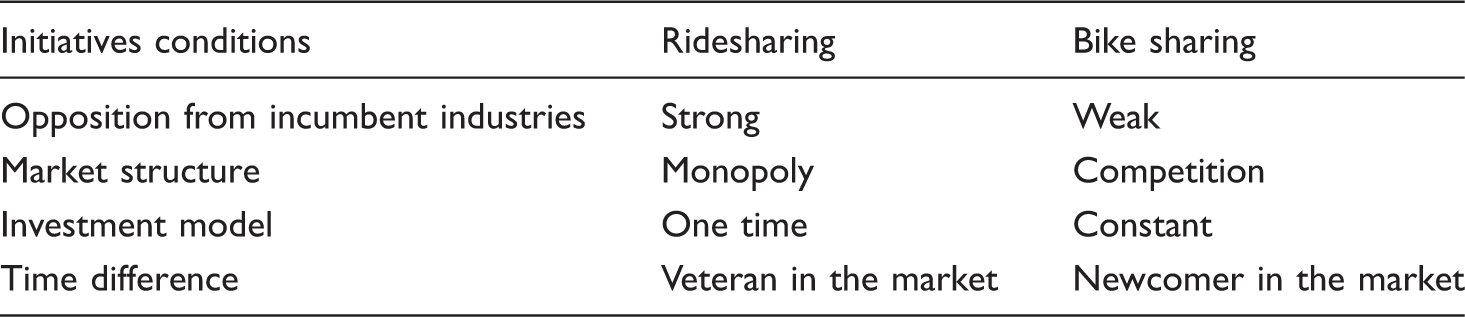
In general, four conditions might be crucially important in explaining the emergence of these two different governance styles in the two cases.
The first condition relates to the influence of sharing economy initiatives on incumbent industries. Cycling is no longer a popular transportation mode for Chinese citizens. Around the 1990s, China was the world-renowned “bicycle kingdom,” and cycling was the dominant transportation mode for citizens. It has been estimated that the number of bicycles reached 500 million, implying an average of three persons owning one bicycle. However, the situation has changed recently. 26 Although China is still the country with the largest number of bicycles in the world, its number of bicycles per capita is 0.4, lower than some European countries, such as the Netherlands, Germany, Norway, and Sweden. Moreover, a report by the Beijing Municipal Commission of Transport has shown that only 20% of residents in Beijing used bicycles as their transportation tool for daily travelling in 2012, and this percentage was decreasing by between 2% and 4% annually. 27 A rise in the popularity of bike sharing therefore does not lead to strong opposition from incumbent industries. An interviewed bike sharing user argued that the strongest opposition to bike sharing is not from the bike companies. Rather, it is from citizen complaints about random parking (respondent 8). Moreover, bike-sharing companies have established a collaboration relationship with traditional bicycle manufacturers. These companies use their production line to produce shared bikes for bike-sharing companies, thereby gaining considerable economic benefits. Thus, it is relatively easier for key stakeholders to accept the expansion and development of bike sharing. 28 Consequently, there is a higher chance that a collaborative governance style will emerge. Different from bike sharing, the ridesharing companies met with strong opposition from taxi companies, and violent confrontations between taxi drivers and private-hire car drivers took place in some cities. As one of our respondents from a ridesharing company argued, the serious tension between the traditional taxi companies and the ridesharing companies made it difficult for them to formulate a cooperative relationship (respondent 5). It can be concluded that the different influence of sharing economy initiatives on incumbent industries might be an important condition for shaping the emergence of different governance styles.
The second condition relates to market structure. In the ridesharing case, Didi was the only dominant player in the ridesharing market. An interviewed taxi driver mentioned that Didi did not believe that central government would ban the expansion of ridesharing because, if so, the number of taxis would be substantially reduced, and citizens would have difficulties in finding taxis. This is a situation that central government would wish to avoid (respondent 3). Therefore, ridesharing companies tend not to treat the policies of central government seriously. Didi’s monopoly might be another reason for the difficulty in formulating a collaborative relationship among the involved stakeholders. In the bike sharing case, there are two dominant platforms, namely Ofo and Mobike. They jointly monopolize over 95% of the bike sharing market, and they compete with each other for market share. A sharing economy expert interviewed claimed that each bike-sharing company had to establish alliances with the other in order to survive better in the market (respondent 9). Therefore, it can be concluded that market structure might be a condition that explains the emergence of different governance styles.
The third condition relates to investment model. Ridesharing companies require substantial financial investment to establish digital platforms. When platforms are established, little or no additional funding is needed. In short, ridesharing is a one-time investment to some degree. A sharing economy expert interviewed commented that ridesharing is essentially a peer-to-peer (P2P) platform, in which the platform functions primarily as a facilitator to allow users to establish connections (respondent 9). Thus, the ridesharing platforms can make profits without sustained financial investment. As a taxi driver interviewed stated, because the ridesharing companies are able to make money without, or with few, investments, they have little incentive to be attentive to other actors’ concerns (respondent 3). Different from the ridesharing platforms, the bike-sharing platforms need constant financial investment. A sharing economy expert interviewed stated that bike sharing is a B2P platform, which means that it owns the shared bikes and rents them to users (respondent 9). For bike-sharing companies, it is not only the establishment of platforms that requires funding, bike maintenance also needs considerable funding in later operation stages. One respondent who is responsible for maintaining the order of the shared bikes on behalf of local government mentioned that bike-sharing companies employed many staff to address the random parking issue. When government officials informed them of the random parking in some places, they would go there to resolve it (respondent 6). Because the financial investment is constant, the bike-sharing companies must be cautious in dealing with relationships with other stakeholders. They consequently tend to treat other stakeholders’ concerns seriously. Therefore, it can be concluded that investment model could be a key condition influencing the emergence of different governance styles.
The four conditions that explain the emergence of two governance styles
Conclusion and discussions
In this article, we reported a tale of two sharing economy initiatives, namely, ridesharing and bike sharing in the Chinese context. We examined how central government governed them, and how they responded to government interventions. In general, central government governed the two initiatives primarily through two strategies, namely, monitoring and developing frameworks. The ridesharing companies responded by developing self-governing rules to govern users’ interactions and expressed their disagreement with government policies through media. Overall, central government is the key player, and the other stakeholders have not learned to assume (many) responsibilities in governance processes. So, a go-alone style dominated in governance processes. In the bike-sharing case, stakeholders such as the bike sharing companies (establishing self-governance rules and smart parking zones), local governments (establishing smart parking zones), and users (reporting damaged bikes) took responsibility for managing bike sharing. A collaborative style dominated in this case. We found that four conditions, namely, the influences on incumbent industries, market structure, investment model, and learning/time difference, are important in explaining the emergence of the two different governance styles. Nowadays, many governments are seeking the best strategies in order to achieve a satisfactory outcome. The two governance styles identified in this study have their own merits for governing the sharing economy platforms. Chinese central government could apply a go-alone governance style to unilaterally limit the number of shared bikes to prevent their wild expansion, finally mitigating their potentially negative externalities instantly. In short, our study could not draw a concrete conclusion that a collaborative governance style is a superior option for metagovernors to govern sharing economy platforms.
Regarding the case studies, we treat the cases as a whole and compare them on an aggregated level. This approach made it possible for us to compare two cases and draw concrete conclusions. However, the dynamic relationships between regulators and the sharing economy platforms may have been lost. So, the governance style regarding the regulation of ridesharing might experience changes over time. In our ridesharing case, there was a gap between the declared policy of central government and its emergent policy. Central government decided to regulate ridesharing and publicly declared that ridesharing platforms should follow its issued policies. Didi as a monopolizing sharing platform was sometimes free to develop its business as it liked and did not implement these policies. In an authoritarian context, like China, this gap is not common. We need more contextualized information in order to better understand this. Currently, Chinese central government has established innovation as its national development strategy, and it would be embarrassing to prohibit the expansion and development of ridesharing. In addition, the implementation of central government’s policies often lies in the hands of local governments. Sometimes, local governments have their own considerations in managing ridesharing, such as local employment situations, traffic situations, public transport situations, and pressures from local taxi drivers (Ma and Li, 2018). These different considerations shape various local governance scenarios in governing ridesharing. Recently, central government recognized this gap after two girls were killed when they used the ridesharing service. It has dispatched a group of officials to stay in Didi and monitor its daily operation. Also, it ordered Didi to share data with it. Now, Didi has expressed its willingness to collaborate with central government to jointly address the public’s safety concerns. It still remains to be seen whether the relationships between Didi and central government will change in the future.
Moreover, we reflect on three aspects of the analytic framework constructed in this contribution. First, three different strategies have been identified to govern sharing economy initiatives, namely, managing processes, developing frameworks, and monitoring. The strategies identified in this framework do not necessarily cover all possible options for metagovernors in governing sharing economy initiatives. Instead, we view our framework as a heuristic device to help scholars in making analyses. Recently, it has been reported that some bike-sharing companies in China have gone bankrupt, and the gigantic bike-sharing platform, Ofo, faced serious debt problem. Many citizens have pessimistically pointed out that bike sharing will disappear around China in the near future. Bike sharing’s potential to facilitate citizens’ daily journals has not been fully exploited. It would be a pity for such a promising initiative to be short-lived. It might be necessary for regulators to function as promotors to provide necessary resources in order to foster a more entrepreneurial initiative. Our analytic framework might be further improved if more empirical studies were undertaken at the next stage.
Second, this contribution has found that four conditions might be crucially important in explaining the emergence of two different governance styles to govern sharing economy initiatives. It is noted that our findings could be used to understand the governance of sharing economy initiatives only in a Chinese context. It might be problematic to directly apply our conclusions to other categories of shared economy or beyond a Chinese context. In the governance of the sharing economy initiatives, three features of the Chinese context need to be noted. The first is that China has an authoritarian regime, and local governments always follow priorities established by central government. As central government has decided to encourage the development of the sharing economy, local governments tend to provide a more or less loose environment for it. Different from many other countries, Chinese central government has established relatively complete regulatory frameworks for the sharing economy. This has substantially reduced institutional uncertainties and facilitated the development and expansion of the sharing economy in Chinese cities. The second is that China is the country with the most netizens in the world. In 2017, its number of netizens reached 0.77 billion. 29 Such a huge number of netizens implies a promising sharing market, which has attracted substantial private capital. This could partially explain the wild mushrooming of sharing economy companies around China. The third is that the Chinese favor saving, and sharing is widely regarded as a virtue to be recommended. It is thus relatively easy for them to accept the idea of sharing. This might explain why so many Chinese are enthusiastic about sharing practices. It is imperative to note these specific features in order to better understand the governance of the sharing economy in China. Governments in other countries might have a different political structure, sharing market scale, and sharing culture. They consequently might adopt different strategies in governing the sharing economy.
Finally, this study examined primarily the governance styles of Chinese central government in regulating two different sharing economy platforms. Strategies adopted by municipalities are not well examined here. An increasing number of municipalities have issued their own policies for governing sharing economy platforms. In addition, scholars have found that different municipalities have adopted dissimilar strategies in governing sharing economy initiatives (Ma and Li, 2018). In the next stage, researchers could study the question of how sharing economy platforms are governed by different municipalities, and how to explain their similarities/differences in strategies.
Supplemental Material
supplemental material for Governing the sharing economy smartly: A tale of two initiatives in China
supplemental material for Governing the sharing economy smartly: A tale of two initiatives in China by Yanwei Li 12534 Nanjing Normal University, Nanjing, China in Public Policy and Administration
Footnotes
Declaration of conflicting interests
The author declared no potential conflicts of interest with respect to the research, authorship, and/or publication of this article.
Funding
The author received financial support for the research, authorship, and/or publication of this article: This work was supported by The Education Department of Jiangsu Province: [grant number 111360B31701]; The Talent Office of Jiangsu Province: [grant number 164080H018].

Notes
References
Supplementary Material
Please find the following supplemental material available below.
For Open Access articles published under a Creative Commons License, all supplemental material carries the same license as the article it is associated with.
For non-Open Access articles published, all supplemental material carries a non-exclusive license, and permission requests for re-use of supplemental material or any part of supplemental material shall be sent directly to the copyright owner as specified in the copyright notice associated with the article.
