



Abstract
This article asks whether the strengthened, institutionalised role that some European agencies play in delegated decision-making endangers their actual independence. In some particular sensitive policy domains, such as pharmaceuticals security, financial markets and energy, European agencies exist which are formal agenda-setters in delegated decision-making, meaning that the European Commission can either accept or reject their proposals but is hardly allowed to change them. These procedures were established to guarantee particularly expert-based decision-making. However, the article argues that under these conditions, the Commission will be eager to interfere with the agencies’ proposal preparation to ensure that the proposal is in line with its position, thereby weakening the de facto independence of agencies. Such procedures come, therefore, with unexpected effects in practice. However, the article demonstrates that these effects vary with organisational resources on the agencies’ and the Commission’ side and the expected constraining effects of the decisions taken.
Introduction
The question, which role agencies play in regulatory decision-making, is one that has been researched on the national as well as on the European level for quite a while (e.g.; Bach et al., 2015; Littoz‐Monnet, 2014; Verschuere, 2009). Usually, agencies gain influence in decision-making if they are able to provide the government on national levels or the Commission on the European level with indispensable expertise in policy preparation, thereby persuading the actors or the core executive to follow their advice. In the last years, we see, however, the development of a new path of influence on the European level, one that has only been rarely walked along before: In the field of financial services and energy the Commission is now bound to the recommendations of newly created agencies in decision-making procedures below ordinary legislation (such as non-legislative measures according to Art. 290 of the Treaty on the Functioning of the European Union (TFEU), comitology procedures, etc.). In these procedures, the Commission can – according to the formal rules – either accept or reject but hardly change the proposals. This is an exceptionally strong form of institutionalised commitment to agency advice, and on the EU level only known from the field of pharmaceuticals regulation where the European Medicines Agency (EMA) is responsible for risk assessment. The institutionalisation of such strong forms of commitment to agency advice has also been a response to crises: in the field of pharmaceuticals to avoid the recurrence of fatal incidences such as the thalidomide crisis, leading to the malformation of babies whose mothers took thalidomide during pregnancy (Krapohl, 2008), in the financial sector as a learning out of the financial crisis starting in 2007 (Busuioc, 2013) and in the energy sector as one of the last fields where the Commission was not able to establish a common market until the early 2000s (Eberlein, 2008). The procedure could, therefore, be a model for future agency reforms in particular sensitive or crisis prone policy domains.
Theoretically speaking, the European agencies in the fields of energy, financial services and pharmaceuticals are now formal agenda-setters in the terminology of Pollack (1997). Pollack defines a formal agenda-setter as an entity with the ability to set a decision-maker’s ‘formal or procedural agenda by placing before it provisions that it can more easily adopt than amend, thus structuring the choices [of this actor]’ (Pollack, 1997: 121). This article asks whether the strengthened, institutionalised role these European agencies play in delegated decision-making endangers their actual independence. The main theoretical argument of this article is that in such procedures European agencies face a trade-off between de facto independence and influence, two dimensions of agency autonomy. Binding the Commission to an agency proposal will arguably make the agency more influential in policy-making. At the same time, the Commission is left with a take it or leave it offer by the agency, inducing it to interfere with the agency’s proposal preparation process to ensure that the agency proposal is in line with its preferences, thereby diminishing the agency’s independence. This diminishing is of particular severity as independence is often seen as one of the main characteristics of agencies for ensuring sound regulation (Koop and Hanretty, 2018; Majone, 2000). The article argues that all agencies being formal agenda-setters face such a trade-off. However, there may be factors on the side of the agency and of the Commission mitigating this trade-off.
The article proceeds in three steps: In the first part, the central concepts of de facto independence and influence are defined and the theoretical framework of the article is developed. The second part examines whether the European Medicines Agency (EMA), the Agency for the Cooperation of European Energy Regulators (ACER) and the European Securities and Markets Authority (ESMA) face a trade-off between de facto independence and de facto influence and whether and how this is mitigated by factors on the Agencies’ as well as on the Commission’s side. The case selection thereby follows in principle the logic of a full survey of formal agenda-setters, although three agencies exist in the financial market sector – involved in analogue decision-making procedures – of which only one has been chosen for analysis. A third part compares the three agencies with the goal of identifying factors that alleviate or aggravate the trade-off between agencies’ influence and independence. In addition to document analysis, interviews with agency staff and employees of the Commission were conducted, and short questionnaires were sent to officials engaged in Commission–agency relations.
As a result, the article reveals that although all agencies are formal agenda-setters in the analysed decision-making procedures, they face different degrees of trade-offs between influence and independence, whereas EMA is the agency with the most organisational resources (also because it heavily relies on the resources of national pharmaceutical regulators) and the most clearly expertise-focussed tasks and is highly influential and independent in practice, ESMA in the financial sector faces the strongest trade-off: Although most of its advices are converted into binding decisions by the Commission, the Commission at the same time feels inclined to take part in the agency’s day-to-day decision-making. ACER takes an intermediate position, with the Commission being less involved in day-to-day decision-making. This reduced involvement is also caused by the fact that in contrast to ESMA’s advices, ACER’s framework guidelines are not legally binding (despite being formally adopted by the Commission), meaning that less is at stake for the Commission in these decision-making procedures.
Agencies’ independence and influence
Agencies independence and influence in decision-making are long-standing research topics. In this discussion, the differentiation between formal and de facto independence and influence is crucial (e.g. Ennser-Jedenastik, 2015; Hanretty and Koop, 2013), whereas formal independence is usually defined as the amount of independence granted to an agency by institutional design and formal rules (Hanretty and Koop, 2013; Yesilkagit and Christensen, 2009) de facto independence means the amount of independence an agency enjoys in its day-to-day decision-making (Maggetti, 2007). Following Maggetti (2007), in this article, de facto independence is conceptualised as comprising on the one hand the agency’s ability to self-determine its preferences and on the other hand its independence in the use of its regulatory competences (p. 272). Empirical research reveals that agencies’ formal independence and de facto independence do easily fall apart (Hanretty and Koop, 2013; Maggetti, 2007), which is why it is important to analyse whether agencies are independent not only on paper but also in practice.
With regard to influence, it is important to note that although European agencies gain more and more decision-making competences on their own, they usually depend on the European Commission (and a Comitology Committee) to make binding decisions. Therefore, the question is whether these agencies’ decision-making proposals are reflected in binding decisions in practice. If agencies have only limited competences to make decisions on their own, how influential they are in day-to-day decision-making is equally as important as how independent they are in practice. Only if agencies are independent and influential de facto, expertise based decision-making is ensured.
Under the assumption that the provision of sound and credible expertise is one of the main reasons why decision preparation is delegated to European agencies (Majone, 2000), the agency has no incentives to take into account the Commission’s preferences because this would spoil its credibility (Gehring and Krapohl, 2007). On the other hand, the Commission has no incentive to interfere with internal agency processes if it is in need of unbiased expertise and would generate monitoring and steering costs (Majone, 2000). However, this is only true if the agency just ‘advises’ the Commission, meaning that it develops proposals which can be changed by the Commission ad libitum, as it is usually the case for example in Comitology procedures. However, this situation changes fundamentally if agencies become formal agenda-setters.
The main theoretical argument of this article is that agencies, which are formal agenda-setters in European decision-making processes, face a trade-off between independence and influence. The concept of formal agenda-setting was initially applied to European decision-making by Pollack to analyse the relationship between the supranational actors – in particular the Commission – and the EU member states (Pollack, 1997). His focus lied thereby on the ‘the power of agenda setters like the Commission to influence policy outputs even when the power to take the final decision lies elsewhere’ (Pollack, 1997: 121). Pollack argued that the Commission became much more influential with the introduction of qualified majority voting in the Council, put into effect by the Single European Act in 1986. In the newly introduced legislative procedures, the Commission could propose any legislation able to get a qualified majority, whereas amendments had to be adopted by unanimity (Pollack, 1997: 122). However, in Pollack’s scenario, the member states have only a limited set of instruments to control the Commission, in particular mandating, overruling, budget cuts, and the option to dismiss the Commission. The use of these control instruments is however encumbered by institutional hurdles. In addition, the member states form heterogeneous multiple principals, hampering any form of sanctioning.
Transferring Pollack’s approach to the relationship between the Commission and European agencies, the situation is different. Although the Commission is not the principal of European agencies in the strict and formal sense – as the delegation act is usually adopted by the European Parliament and the Council (Buess, 2015) – it has often far-reaching competences in monitoring and controlling them. First of all, the Commission is typically part of the agency’s management board, taking part, for example in decisions on agency head appointments, work programs and the use of budget (Busuioc, 2012; Groenleer, 2009). In ordinary legislative or Comitology procedures, the Commission controls the agency in addition by a police patrol mechanism, as the agencies' proposals are usually only tabled in the European Parliament, Council or Comitology Committee if the Commission agrees with the proposal. In doing so, it is usually free to change the agency’s proposal.
This ability to control agencies and affect their internal decision-making is of increased importance, if an agency is a formal agenda-setter: If the Commission is only allowed to accept or to reject an agency’s proposal (or can make changes only facing very high hurdles), costs for rejection of a proposal become very high. In case of rejection, the proposal would have to be sent back to the agency and the whole process might end up in a cumbersome revise-and-resubmit loop. In Pollack’s scenario, it depends on the ‘patience’ of both actors how this scenario ends up (Pollack, 1997). If the Commission has a high interest in getting a decision – to further market integration, prevent regulatory crises or something else – it either has to accept proposals which are distant to its own ideal point or to make sure, that the proposal is in line with its preferences by influencing the agency in its proposal preparation process. If the Commission disposes of suitable means and instruments to influence the agency’s proposal, the second option is certainly more appealing. The agency becomes more influential in being a formal agenda-setter, but at the same time, the Commission becomes more inclined to interfere with internal agency processes thereby diminishing the agency’s independence. Therefore, the procedure might be prone to a trade-off between influence and independence. Becoming more influential might result in the loss of de facto independence for European agencies.
However, the trade-off might be mitigated by factors on the agency’s as well as on the Commission's side. On the agency’s side, organisational resources and expertise asymmetries strengthen the agencies’ ‘defensive forces’, if the Commission tries to interfere with internal processes. As Groenleer puts it, ‘The more obscure the knowledge in terms of how it is generated and presented, the less laypersons will be able to master it, the more autonomy professionals will have’ (Groenleer, 2009: 49). On the Commission’s side, the Directorates General (DGs) responsible for the respective policy domain might dispose of varying organisational resources and expertise, too, and therefore vary in their ability to get involved in the agencies' internal processes. In addition, it is plausible to assume, that the Commission will be the more inclined to interfere with the agencies’ decision preparation process, the more it will be constrained by the prospected decisions.
Starting with a discussion of the mitigating factors on the agency’s side, the independence bolstering effects of organisational factors are well known from empirical research. These factors can refer to structural characteristics (particularly to size), organisational culture (ascribing an important role to agency age) and task characteristics (e.g. observability, salience and the need for expertise) (Maggetti, 2012; Pollitt et al., 2004; Verhoest et al., 2010).
Agency size is often discussed as a measure of structural capacity. Agencies with more staff have more resources to perform their tasks and to develop expertise, thereby nurturing their de facto independence from their principals (Maggetti and Verhoest, 2014). Agency age is found to have a similar effect. Older agencies are assumed to be more experienced in doing things in an organisation-specific way, an experience that ‘seems to be an important resource in securing discretion in policy matters from superior bodies or shielding such discretion from intervention from above’ (Verhoest and Lægreid, 2010: 257). This experience can, therefore, ensure the agency’s de facto independence in decision-making. Turning to task effects on de facto independence, agencies that perform regulatory tasks are often expected to be particularly independent since ministries are assumed to refrain from intervening in regulatory agencies in order to preserve the credibility of regulation vis-à-vis market participants (Bach et al., 2015). However, all of the agencies that are examined in this study are regulatory agencies. Nevertheless, regulatory agencies might differ with regard to the expertise needed to fulfill their regulatory functions. That information asymmetry between the principal and the agent increases and agent’s independence is a standard assumption that can be derived from principal-agent theory. Research on these factors delivers mixed results (Maggetti and Verhoest, 2014). However, it is plausible to assume that European agencies with larger organisational capacities (particularly staff), a well-established organisational culture and genuine way of doing things, and an expertise-demanding task structure are more shielded from principals’ attempts of interference than are agencies without these organisational characteristics.
Regarding agencies' de facto influence, a bureaucratic politics perspective assumes that agencies might well have an interest in influencing the decisions of the European Commission. Although agencies might use all types of strategies in individual policy-decisions, such as framing, building alliances with other regulators actors or venue shifts (Bach and Ruffing, 2018; Littoz‐Monnet, 2014), explaining agencies ability to influence decisions has to rely more on structural factors. Regulatory agencies are often seen as providing a host of expertise necessary for decision-making, meaning that ‘agencies can only have influence if they manage to persuade politicians through knowledge’ (Groenleer, 2009: 48) as European agencies have only very limited competences to make decisions on their own. So, agencies will be the more influential, the more the Commission is dependent on their expertise.
On the Commission’s side, organisational resources might play a role, too. Empirical research demonstrates that more staff, more expertise and specialisation increase the principal’s control over the agent (Egeberg et al., 2015; Vestlund, 2015). However, the Commission’s incentives to intervene in intra-agency processes might vary according to the constraining effect of the prospected decision. If the decision is going to be hard law, it pays off for the Commission to invest more resources into monitoring and influencing intra-agency decision-preparation processes, than if the decision is only going to be soft law. In addition, decisions can be particularly dense (containing many details) or stringent (reducing the room for manoeuvre extensively) (Knill et al., 2012), in which cases the Commission is of particular importance to ensure that the agency proposal is in line with its preferences.
To sum up, this article assumes that agencies which are formal agenda-setters in European decision-making face a trade-off between de facto independence an influence. However, the extent to which agencies suffer from this trade-off will vary according to their and the Commission’s organisational resources and the constraining effects of prospected decisions on the Commission.
Research design and operationalisation
Only a very limited number of European agencies are formal agenda-setters in delegated decision-making, which are however active in very societal and economic relevant policy domains. The empirical basis is, therefore, a kind of a full survey of European agencies being formal agenda-setters and analyses the three agencies EMA, ESMA and ACER. In principle, two more large agencies of that kind exist – the European Banking Authority and the European Insurance and Occupational Pensions Authority – which are, however, equivalent to ESMA in their organisational structure and regarding the formal decision-making procedures they are involved in and would hardly add analytical leverage to the study. EMA, ESMA and ACER vary however with regard to their organisational resources and the type of decisions they are involved in. The research design therefore allows to analyse whether formal agenda-setters face a trade-off between independence and influence and to examine the effects of organisational resources and decision type on this trade-off.
To examine the de facto independence and influence of the three chosen agencies and a possible trade-off between them, de facto independence and influence first have to be operationalised. This article follows Maggetti’s (2007) approach and operationalises de facto independence via two subdimensions: independence in preferences and independence in decision-making. Independence in preferences is operationalised via the frequency of contact between the agency and the Commission. A high frequency of contact indicates that the agency is not independent in its preferences and instead develops them in close cooperation with the European Commission. Empirically, this element was measured by a short questionnaire sent to officials in the agencies and the respective DG in the Commission that asked about the frequency of contact between both organisations, complemented by ten interviews with agency staff and Commission officials. The interview partners were selected by focussing on persons regularly involved in the decision-making processes under consideration. Independence in decision-making was examined via a document analysis of the minutes of the agencies’ decision-making bodies, which were systematically scanned for evidence that the Commission had influenced the agencies’ decision-making. For ACER, the minutes of the main decision-making body, the Board or Regulators have been analysed scanning for conflicts between the Commission and the committee members. This analysis has been complemented by interviews with Commission and ACER officials. For ESMA, an analogue design had been chosen, analysing the minutes of the Board of Supervisors meetings. As EMA is running since 1995, not all minutes of the relevant committee, the Committee for Medicinal Products for Human use could be analysed. Instead, the analysis focussed on the years 2017 and 2018. The analysis was complemented by interviews with committee members and Commission staff.
Measuring an agency’s de facto influence is quite uncomplicated in a procedure, in which the Commission is not allowed to deviate from the agency’s proposal. If the proposal is accepted, the agency’s de facto influence is high and the final decision reflects the agency proposal in full; if it is rejected, the influence is low. To ensure that the Commission in fact sticks to this obligation, two ESMA proposals were compared with the final decision enacted by the European Commission – one very contested and one more consensual proposal – and no differences with regard to substance could be found. For ACER proposals, this checking was dispensable as the Commission merely accepts or rejects the proposals; if they are accepted, the Commission does not issue an own document but instead refers to the ACER document. As EMA is only a formal agenda-setter in pharmaceutical authorisation, which boils down to a dichotomous decision (authorisation or non-authorisation), the article refers to EMA reports and statistical data on whether the Commission accepted or rejected a recommendation.
The analysis of each case will proceed in two steps: First, the organisational resources and expertise on the agencies’ and the Commission side will be outlined, as well as the constraining effect of the decisions taken. Second, the agencies’ de facto independence and influence will be analysed. A third comparative part discusses to what extent the agencies face a trade-off between these two dimensions.
EMA’s role in pharmaceutical regulation
The European Medicines Agency was created in 1995 and has far-reaching competences, particularly with regard to pharmaceutical authorisation. In the centralised authorisation procedure, the agency develops scientific opinions on the authorisation application and sends them to the Commission. The Commission may then either accept the scientific opinion and forward it to a Comitology Committee that has the final say in an examination procedure (one of the two standard Comitology procedures) or send it back to EMA for revision. If the Commission wants to change EMA’s proposal, it has to give detailed reasons for its decision (Krapohl, 2008: 93). EMA is, therefore, a formal agenda-setter in the central authorisation procedure. Figure 1 gives an overview of the procedure.

Central authorisation procedure.
Since 2010, EMA has also maintained important competences in the post-market control of pharmaceuticals (pharmacovigilance) (Directive 2010/84/EU and 2012/26/EU). Furthermore, EMA is very active in the development of so-called guidelines that are not legally binding and advises the Commission with regard to delegated acts implementing European directives. EMA is, however, not a formal agenda-setter in these procedures.
With regard to organisational resources, EMA is certainly the strongest of the three agencies under examination in this article. EMA was created during the second wave of agencification in the 1990s and is, therefore, the oldest of the three agencies. Furthermore, with around 900 staff members, it is one of the largest European agencies. In addition – and this might be one of the most important points – EMA decisions are de facto prepared in a very decentralised way: One national expert takes over the so-called rapporteurship, which means that she or he writes a report on the drug using the resources of her or his ‘home’ pharmaceutical regulator. All in all, around 4,500 national experts work with EMA. 1 Therefore, EMA not only clearly outnumbers the pharmaceutical unit in DG SANTE of the Commission, with only 32 staff members, 2 but in addition borrows organisational resources from the national regulators to a great extent. The Commission extended its organisational resources by splitting up pharmaceuticals and medical products into two units, shortly after the transfer of the competence for pharmaceuticals from DG ENTERPRISE to DG SANTE (Vestlund, 2015) changing the proportion between agency and Commission staff however only mildly. Regarding expertise, there is a great gap between EMA and the Commission in pharmaceutical authorisation (Gehring and Krapohl, 2007; Ossege, 2015). This gap is also acknowledged by the European Commission which feels according to one interviewee ‘neither competent nor equipped to conduct scientific assessments’ (Interview #1). In addition, authorisation decisions are very stringent, as legal acts which bind all actors involved for the future. However, they are of course only valid for the medicine under consideration; therefore, their constraining effect is limited.
As the central authorisation procedure is the only procedure in which EMA is a formal agenda-setter, the following analysis concentrates on this procedure, analysing first the influence EMA exerts on authorization decisions. Whereas the empirical analysis for the energy and finance sector can evaluate all decisions made by ACER and ESMA by now in detail, such a detailed evaluation is not possible for EMA, which began in 1995. However, according to a Commission document issued in 2001, the Commission did not deviate from EMA’s proposal in a single decision, and almost all decisions were made unanimously by the Comitology Committee and in a written procedure (COM 2001 [404] final: 8–9). That the written procedure still dominates the authorisation process and that the adoption of EMA’s proposals is as uncontroversial as such decisions can be is observable in the fact that the average time from EMA proposal to final adoption is only 53 days (for medicines for human use) 3 even though the Comitology Committee meets only twice a year. Members of the Commission as well as of EMA’s scientific committee for medicinal products for humans use report congruently that EMA opinions are almost always accepted by the Commission and the Comitology Committee and that deviations or rejections occur only on very rare occasions (Interview #1; Interview #2).
Of these rare cases, the highly contentious Orphacol case stands out, which began in 2011 (see for discussion Vestlund, 2015). In this case, the Commission did not authorise the orphan drug Orphacol, although EMA had recommended the authorisation in its scientific opinion. The conflict around Orphacol (and its rival product, Kolbam 4 ) became the subject of several lawsuits before the European Court of Justice. After the Court had annulled the Commission’s initial decision to deny market authorisation to Orphacol, authorisation was finally granted in 2013. All in all, EMA has a very significant de facto influence in pharmaceutical regulation.
However, exactly how independent EMA is in the development of its recommendations is another empirical question. In this article, de facto independence is operationalised via two sub-dimensions: independence in preferences (operationalised via the frequency of contact between the agency and the Commission) and independence in decision-making (operationalised via attempts by the Commission to influence decision-making in the agency as seen in the minutes (supported by interviews). However, the rapporteur system results in the fact that much of the work is completed by member states’ agencies using their own personnel and administrative resources. The reports developed by the rapporteur-teams are then discussed in the respective EMA committee, decided on, and then forwarded to the Commission. Therefore, in addition to the question of how frequent contact is between the Commission and EMA, it is also necessary to examine whether there are contacts between the rapporteur and the Commission. Recent research has revealed that the Commission is in more-or-less daily contact with EMA agency staff, asks for clarifications of opinions and tries to ensure close cooperation in the procedure (Vestlund, 2015). An important aim of the EMA secretariat in these processes is to make sure that the EMA opinions are not a challenge to the Commission or cause any issues (Vestlund, 2015). However, a questionnaire sent to the German pharmaceutical authorisation agency (BfArM) – which is the most active rapporteur along with the British authorisation agency – reveals that national agency officials involved in EMA actually preparing the assessment have only very occasionally contact with the Commission. The Commission is present in EMA committees, but according to committee members, it does not actively take part in the discussion (Interview #3). Also, from the Commission’s side, its role in the scientific committee is described as the role of an ‘observer’ (Interview #1). In addition, a systematic scan of the minutes of the Committee for Medicinal Products for Human Use, EMA’s most important committee for pharmaceutical authorisation, reveals no attempts by the Commission to influence decision-making in EMA. 5 Altogether, data collected from the European Commission, the national regulators and EMA indicate that EMA also displays a high degree of de facto independence, which is in line with earlier studies that have shown that EMA has had a high de facto autonomy from the very beginning (Gehring and Krapohl, 2007; Groenleer, 2014). Therefore, the strong formal role of EMA is also reflected in its de facto role. The following analysis of ESMA’s and ACER’s role reveals whether we can also expect such a strong de facto role for other agencies that act as formal agenda-setters in European decision-making.
ESMA’s role in securities regulation
With the ESMA, a formally entirely independent agency was established that has replaced the former Committee of European Securities Regulators (CESR) and ‘shall neither seek nor take instructions from Union institutions or bodies, from any government of a Member State or from any other public or private body’ (Art. 42, Regulation 1095/2010/EU). Like its two sister agencies, the European Banking Authority and the European Insurance and Occupational Pensions Authority, ESMA was born out of the financial crisis. Its establishment resulted from the insight that the national supervisors had failed to cooperate adequately in CESR and were, therefore, not able to fight the rising turmoil on the financial markets. 6 Therefore, one of the most important new functions of ESMA is that of securing a close cooperation between national regulators in supervision.
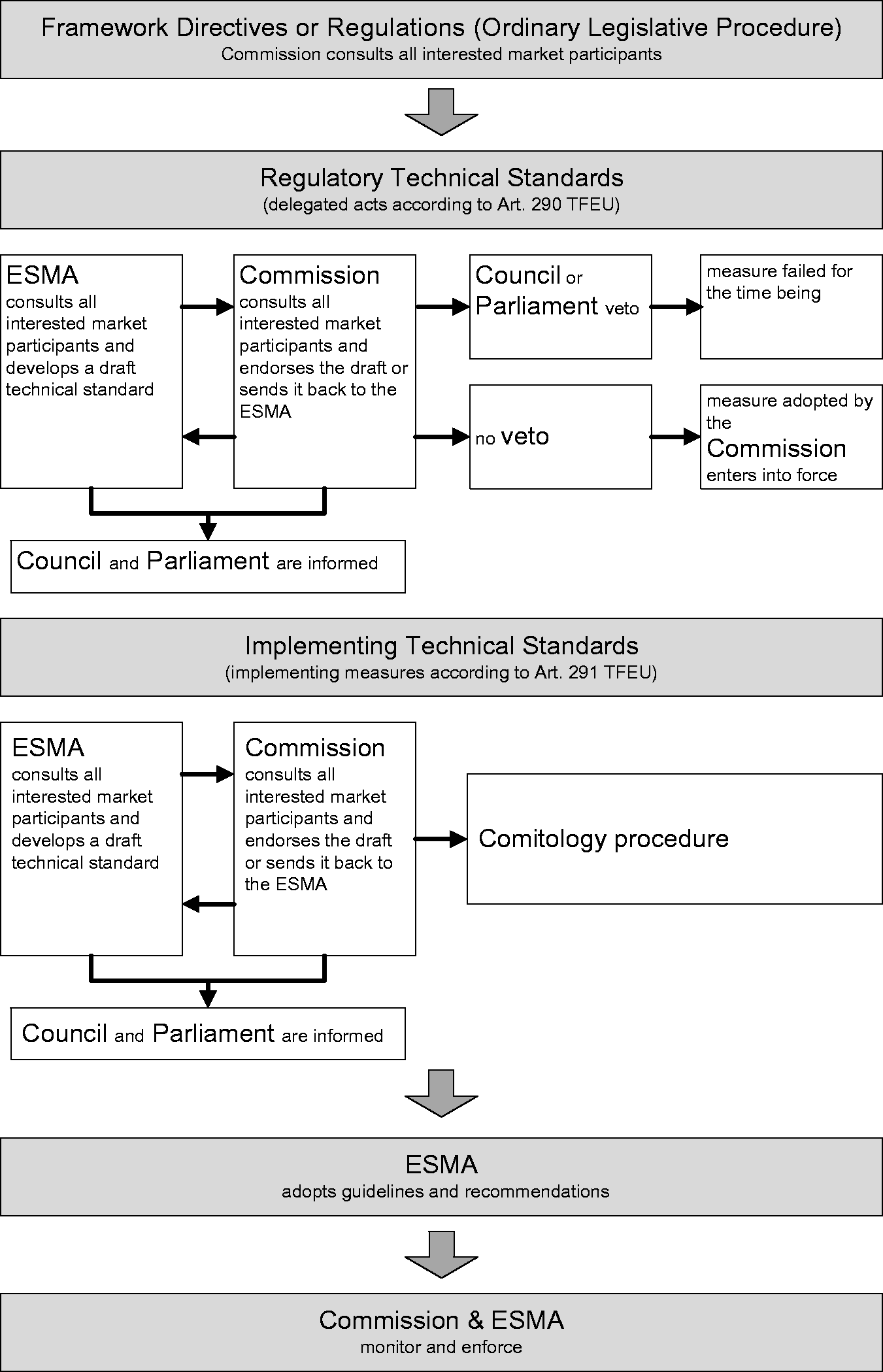
In financial market regulation, the decision-making procedure consists of four levels (Ruffing, 2011): On level one, a framework directive or regulation is adopted in the co-decision respectively ordinary procedure. On level two, four subtypes of procedure exist, with ESMA being formally involved in two of them. The first subtype is the procedure for the adoption of regulatory technical standards (RTS), a special kind of delegated act according to Art. 290 of the TFEU (see for this type of legal acts Hofmann, 2009). ESMA has a strong formal role within this procedure. First, it is obligatory for ESMA to develop a proposal (for discussion also Busuioc, 2013). The Commission then either endorses the draft or sends it back to ESMA. 7 In so doing, the Commission substantiates its reasons for not or only partially endorsing the draft. In these cases, ESMA may revise and resubmit the draft taking into account the Commission’s amendment proposals. The Commission can adopt the measure if neither the European Parliament nor the Council veto the measure. According to a declaration accompanying the TFEU, the Commission consults experts from the member states who are in practice members of the Comitology committee. This procedure clearly arose from the regulatory procedure with scrutiny (Kaeding and Hardacre, 2010). The second procedure is that for the adoption of implementing technical standards (ITS), which is a Comitology procedure on the basis of Art. 291 TFEU. In this procedure, ESMA is a formal agenda-setter, much as it is in the RTS-procedure.
On the third and the fourth levels of the decision-making procedure, ESMA has been granted additional supervisory and enforcement power. Figure 2 provides a short overview of the procedure (on level two, it focusses only on the two procedures in which ESMA is formally involved).
ESMA's role in securities regulation.
With regard to organisational resources, ESMA is much weaker than EMA. 8 First of all, ESMA only began operation in 2011 and is a much younger agency. Secondly, employing only 204 staff members, ESMA is a much smaller agency. 9 Most of these staff members (136) are so-called temporary agents who are hired for a maximum period of six years. 10 In addition, although ESMA might use the decentral resources of national security agencies in enforcement (Van Rijsbergen and Foster, 2017), its regulatory work is in practice much more centralised than is EMA’s work. Referring to the need for expertise in securities regulation, it is uncontroversial that the regulation of complex financial instruments and the supervision of highly intertwined market participants calls for advanced expertise of agency staff (Busuioc, 2013); however, in contrast to pharmaceutical regulation, securities regulation is not a question of life and limb. If compared to pharmaceuticals regulation, also the Commissions disposes of smaller organisational resources: The securities markets unit of the Commission is only staffed by 16 persons. 11 Assessing the constraining effects of the decisions taken, RTS and ITS procedures end up by legally binding decisions, as it is in pharmaceuticals authorisation. However, whereas pharmaceuticals authorisation is only binding for the medicine under consideration, ITS and RTS are usually applied to a multitude of products and services.
To assess the de facto influence of ESMA, all decisions made thus far in the RTS and ITS procedure have been checked with regard to whether ESMA’s proposals have been accepted or rejected by the Commission. Up to now, ESMA has proposed 103 RTS and 38 ITS. 12 Of these 141 technical standards, 7 have been rejected by the European Commission and 14 are awaiting a decision. Although this is a quite high success rate, ESMA is a bit less influential than EMA.
In addition, in the ESMA procedure, the legislators might play a role. The European Parliament threatened to veto two of the RTSs endorsed by the Commission (149/2013/EU & 153/2013/EU). 13 According to the records of the parliamentary debate, this threat was at least in part caused by the parliament’s displeasure with the Commission’s information policy during the RTS procedures. The respective parliamentary motion was withdrawn after the Commission’s assertion that the Parliament’s information rights needed to be respected. However, an interview with a Commission Official revealed that the motion had been initiated by parliamentarians who were not politically satisfied with the content of the two standards (Interview #4). An additional RTS was rejected by the European Parliament, which argued that it was not in line with the consumer protection requirements of the framework regulation. 14 All in all, ESMA has been very influential in the technical standards procedures thus far and therefore ranks high on the dimension of de facto influence, although it ranks lower than EMA.
The second question concerns exactly how independent ESMA was in the development of its proposals using again the operationalisation via two sub-dimensions: independence in preferences (operationalised via the frequency of contacts between ESMA and the Commission) and independence in decision-making (operationalised via attempts by the Commission to affect decision-making in ESMA as seen in the minutes, complemented by interviews). With regard to the frequency of contacts, all officials who filled in the questionnaire reported daily contact between ESMA and the European Commission. Furthermore, according to the minutes of the Board of Supervisor’s meetings (ESMA’s decision-making body), the Commission was present and took part in the discussion in all these meetings. 15 In addition, ESMA’s senior management is in close contact with the European Parliament. Therefore, de facto independence in preferences was clearly lower than that of EMA.
Independence in decision-making is low, too, if compared with EMA: According to the minutes of the Board of Supervisors’ meeting, the Commission regularly argues that ESMA proposals are not in line with European law and can therefore not be endorsed by the European Commission. 16 These minutes also show that the Commission usually performs a so-called early legal review and informs the Board of the results. However, the results are certainly contested. Interviews with national regulatory agency staff involved in ESMA reveal that the Commission is in practice in a position to make its legal interpretation the only one that counts (Interview #5). Furthermore, according to a Commission official (Interview #4), ESMA’s legal service is seriously understaffed. According to the Annual Report 2015, 16 people work in the department for legal, enforcement, and convergence issues. 17 Therefore, the department is hardly able to challenge the Commission’s view. On the one hand, it is the Commission’s prerogative to act as the guardian of the treaties. On the other hand, even in the case of a formal rejection of a technical standard by the Commission, there has not always been consent that ESMA’s proposal is not in line with European law. ESMA in some cases insists on its original interpretation (Interview #6) and changes its resubmission only under pressure exerted by the Commission. 18
The fact that the Commission is quite eager to be present in ESMA meetings and to sound out whether ESMA’s opinions are in line with its preferences is also visible in a statement by a Commission Official regarding the role of ESMA’s predecessor, CESR. This official stated that the Commission was much less involved in CESR’s decision-making processes as it ‘had only 14 people in the Commission [involved in securities regulation] and no priority to go to Paris’ (Interview #4), where CESR was located. This observation was substantiated by the comment that these members ‘could do what [they] want[ed]’ with CESR’s advice, a situation that is now ‘fundamentally different’ (Interview #4).
All in all, ESMA’s influence, which is operationalised as congruence between the ESMA proposals and the final decision, is quite high. However, the Commission intervenes quite consistently in the preparation of these decisions. Nevertheless, the members of the Board of Supervisors (the main decision-making body of ESMA) do not accept the Commission’s position without resistance, which is obvious in the fact that the Commission sometimes rejects ESMA proposals, meaning that the Commission is at least not entirely successful at influencing the drafting process, and that ESMA sometimes insists on the text of rejected drafts.
The role of ACER in energy regulation
The liberalisation and integration of the European energy market has been at the top of the European Commission’s agenda since the 1990s (Eberlein, 2008; Vasconcelos, 2005), and the creation of an internal market in energy was part of the Lisbon strategy, which aimed to make Europe the most competitive economic area in the world. In 2003, a legislative package was adopted at the European level to ensure non-discriminatory access to gas and electricity networks for all energy producers (Ruffing, 2014). With the subsequent Third Liberalisation Package in 2009, far-reaching competencies for the regulation of the energy market were shifted to the European level (e.g. competencies regarding the preparation of so-called network codes and trans-border infrastructures). This legislative package was intended to ensure the integration of grids for gas and electricity.
To reach this goal, a close cooperation between national energy regulators seemed necessary, and ACER was established (Ermacora, 2010), which succeeded its predecessor, ERGEG (European Regulator’s Group for Electricity and Gas) (Maggetti, 2014).
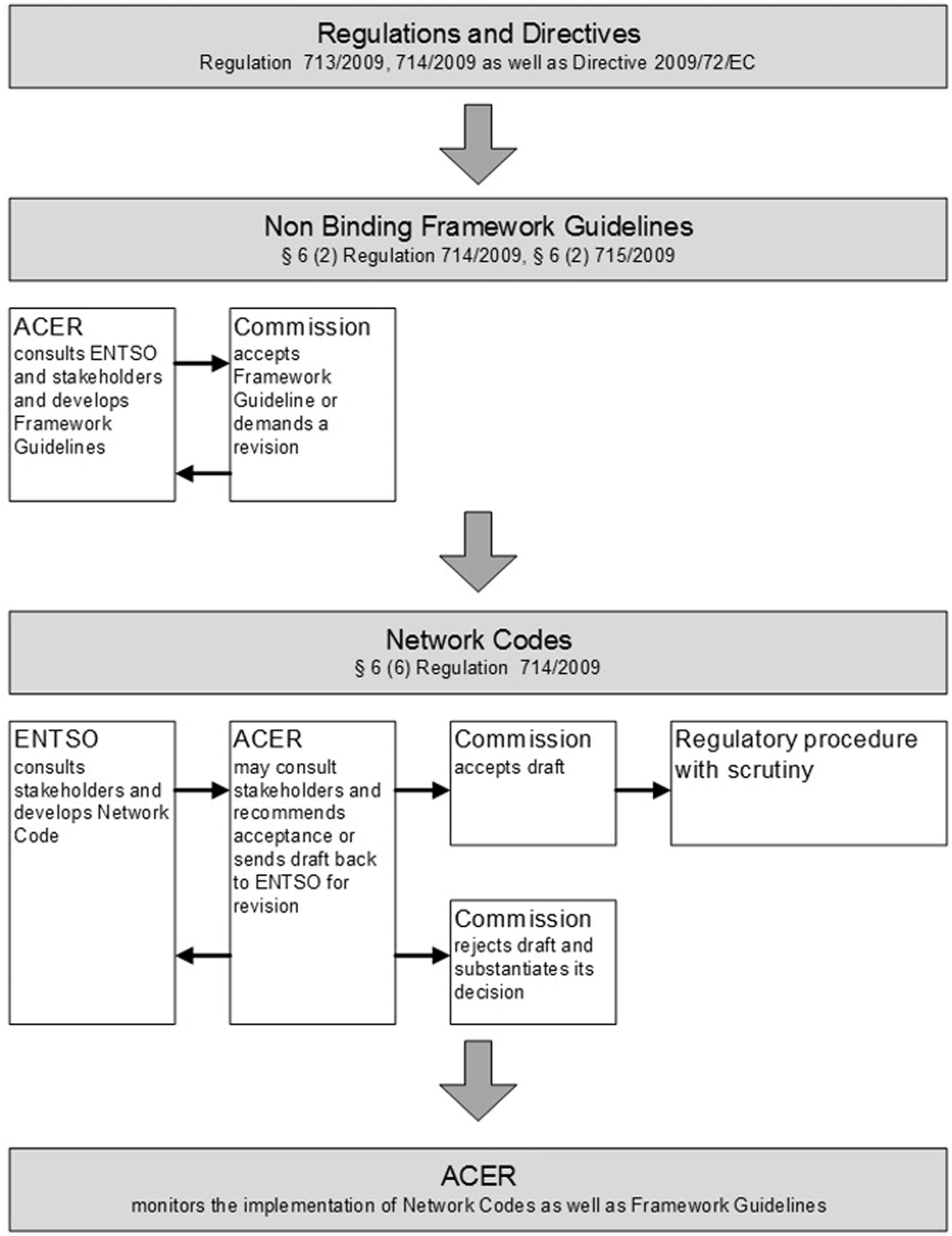
ACER is formally involved in two kinds of decision-making procedures: the procedure for the adoption of framework guidelines and for the adoption of network codes. In addition to these procedures, ACER also has the competence of adopting certain kinds of single-case decisions (e.g. with regard to trans-border grid connections) and of overseeing the development of the so-called Ten-Year Network Development Plans. This article focusses on the procedure for framework guidelines as only in this procedure is ACER a formal agenda-setter.
Framework guidelines are not legally binding decisions and set the framework for the development of network codes. These framework guidelines are drafted by ACER and then submitted to the Commission, which has to review them and might reject them if they do not ‘contribute to non-discrimination, effective competition and the efficient functioning of the market’ (714/2009/EU, Art. 6 (4)). In this case, ACER has to review the guideline and to resubmit it to the Commission, meaning that ACER is a formal agenda-setter in this procedure. However, to obtain a comprehensive picture of the relevance of framework guidelines, it is also necessary to look at the network codes procedure. With the creation of ACER, two additional bodies (which consist of private actors) were created: the European Networks of Transmission System Operators for Gas and Electricity (ENTSO-G and ENTSO-E). These networks are formally involved in the procedure for the adoption of network codes and tasked with drafting these codes in the first place and submitting them to ACER. ACER evaluates these drafts against the framework guidelines and either sends them back to ENTSO for revision or recommends their adoption to the Commission, which then feeds these drafts into a Comitology procedure, meaning that the framework guidelines are first and foremost an instrument for controlling the ENTSOs in the decision-making process (Interview #8) (Figure 3).
ACER's role in energy regulation.
Starting with the organisational resources, ACER is quite comparable with ESMA. ACER also began operations in 2011; however, it currently employs only 112 staff members, 60 of whom are temporary agents. 19 ACER is also based on a decentral network of national energy regulators. The main decision-making body is a Board of Regulators staffed by senior officials from the national regulatory agencies. However, ACER borrows only limited organisational resources from national regulators in contrast to EMA, which has decentralised working routines. In relation to the small staff population of ACER, the respective Commission unit is comparatively well staffed comprising 20 officials. 20 The expertise gap between the Commission and ACER is comparatively small as ACER (as well as the Commission) is to some extent dependent on the expertise of the network operators. Regarding the constraining effect of the decisions, one has to take into account that framework guidelines are much less constraining than EMA authorisation decisions or ESMA technical standards, as they are not legally binding in a strict sense. However, as they are the basis for the following network procedure, they nevertheless substantially narrow the room for manoeuvre for the Commission and the other actors involved. All in all, in comparison to EMA and ESMA the asymmetry in organisational resources and expertise is the smallest and ACER framework guidelines also have the least constraining effects for the Commission.
The analysis of the de facto influence of ACER reveals that of the eight Framework Guidelines developed thus far, none has been rejected by the Commission. Therefore, the de facto influence of ACER on Framework Guidelines is definitely very high. With regard to independence, the questionnaire described above was sent to ACER and Commission officials, who univocally answered that there is daily contact between ACER and Commission Officials. Commission officials indicated that the framework guidelines are commented and discussed by the Commission before they are officially proposed by ACER (Interview #9; Interview #10). Furthermore, the Commission takes part in ACER’s board of regulators as well as in ACER working groups. Therefore, the de facto independence with regard to preferences is actually low. The interviews additionally revealed that there is a very close cooperation between the Commission, ACER, and the ENTSOs in all kinds of decision-making procedures, meaning that they ‘sit down together on a very regular basis’ (Interview #8).
However, whereas the ESMA minutes bear testimony to a power struggle between ESMA and the Commission in which the Commission is clearly in a stronger position, a systematic check of the ACER minutes reveals only one situation in which a Commission official tried to exert influence in much the same way as is common in ESMA. With regard to the discussion on the Framework Guidelines on Gas Balancing in Transmission Systems, ‘Ms Bernaerts [commission official] reminded the Commission’s right to review a framework guideline after its adoption. The Commission has every intention to intervene into the process early enough and preferred to indicate their comments before the formal adoption of the ACER FG’ (ACER minutes 2011, 14th BOR session, p.6). Because the right to review a draft in fact means that the Commission may reject it, this is an obvious attempt to exert pressure on ACER. As minutes may not reflect the actual level of conflict, the kind of working relation between the Commission and ACER was also addressed in the interviews. Whereas the power struggle seen in the ESMA minutes was also reflected in the interviews with Commission and ESMA staff, the interviews in the energy sector provided no insights into such struggles. In contrast, ACER as well as Commission officials referred to the fact that ACER develops a certain sense of independence and that the working relations are characterised by a very cooperative spirit (Interview #8; Interview #9; Interview #10).
Agencies’ de facto influence and independence in comparison
The theoretical part of this article argued, that all three agencies should face a trade-off between de facto independence and influence in European decisions-making, meaning that they have to pay for their increased influence as formal agenda-setters by stronger attempts on the Commission’s side to interfere with internal agency decisions-making processes. However, stronger organisational resources on the agency’s side might protect it from such attempts and a weak constraining effect of the decisions under consideration diminish the Commission's inclination to impinge on the agency’s decision-making.
Comparing all three agencies, EMA is the one with the strongest organisational resources – not at least because it borrows organisational resources from national agencies to a large extent. EMA is also the only one of the three agencies active in risk regulation with a huge demand in expertise and a strong expertise gap between the agency and the Commission. Regarding organisational resources and expertise gap ESMA takes a middle-position, whereas ACER is the smallest agency controlled by a comparatively large Commission unit. In comparison, ACER’s framework guidelines have also the least constraining effect on the Commission, as they are not legally binding in a strict sense, in contrast to EMA’s authorisation decisions and ESMA’s technical standards. Therefore, the Commission should be more inclined to get involved in EMA’s and ESMA’s than in ACER’s internal decision-making. On the other hand, EMA should be in the best position to repel such an encroachment, leaving ESMA in a position where the Commission has strong incentives to influence decision-preparation and ESMA having weak resources to prevent the Commission from doing so.
In fact, the analysis reveals, that ESMA faces the strongest trade-off between de facto independence and influence: Whereas EMA and ACER have a very high de facto influence, and almost all agency proposals within the time period under research were adopted by the European Commission as proposed, ESMA had to accept some rejections of its prepared technical standards. In addition, in ESMA, we see the strongest impingement of the Commission into internal processes. Minutes of the Board meetings as well as interviews with Commission and ESMA officials show that there are sturdy conflicts between the Commission and the agency. In these conflicts, the Commission argues in particular with reference to its interpretations of the European law, an argumentation that can hardly be challenged by the ESMA, also because of lacking organisational resources and its small legal unit. As has been demonstrated above, the Commission’s eagerness to make sure that ESMA's decisions are in line with its preferences is also substantiated by the binding character of the ESMA proposals (and set in contrast to the Commission's relationship with ESMA’s predecessor CESR, which proposals had a non-binding character).
EMA is more protected from the Commission's interference. Although in particular Vestlund (2015) demonstrated that the Commission is in regular contact with EMA and works towards EMA opinions which do not challenge its position – a strategy that has even been strengthened since the pharmaceuticals unit moved from DG ENTERPRISE to DG SANTE and gained more personnel there – the decentralised character of EMA protect it from strong Commission involvement in the scientific assessment of pharmaceuticals. Whereas the Commission is in regular contact with EMA officials, it is not with national agency officials, who do the actual assessment using their home agencies resources. Also the Commission takes only a modest role in EMA committees where national agencies officials meet to discuss the scientific opinions.
Although ACER has to accept some intervention by the Commission, too, the analysis revealed hardly any incidences where the Commission tried to force its position upon ACER regarding framework guidelines. This result cannot be explained by a large gap in expertise or organisational resources between ACER and the Commission – a gap which is certainly massively smaller than for example the one in the pharmaceuticals sector. Instead, this result is in line with the assumption that the Commission has less incentives to interfere the smaller the constraining effect of the decisions in the procedure under consideration is.
Conclusion
This article demonstrated that reforms strengthening the formal role of European agencies in regulatory decision-making come with unexpected consequences: If the Commission is bound to agencies’ proposals – a procedure that is meant to ensure that the Commission’s decisions are based on sound and unbiased expertise – this endangers de facto the independence of the agencies. Instead of waiting for the agencies’ proposal the Commission tries to influence the internal decision-making processes in particular of EMA and ESMA to ensure that the proposals are in line with its position. The procedure therefore spoils the functional differentiation between risk assessment and expertise based decision-preparation on the one hand and actual decision-making in delegated rule-making, for example in Comitology procedures, on the other hand. Whereas ESMA faces the full trade-off between independence and influence and the Commission is less inclined to engage in ACER’s preparation of framework guidelines as they are not legally binding, EMA is to some extent shielded from the Commission attempts to interfere with internal processes. EMA’s ‘defensive forces’ are however not only being one of the largest and most expertise driven agencies in the EU, but even more importantly the fact that EMA has a very decentralised risk assessment procedure with the actual reports being prepared by national agencies. For the Commission, these national agencies are still at arm’s length. Although one might argue that the stronger involvement of the Commission increases the political accountability of European agencies, this was most likely not the aim of reforms binding the Commission to agency proposals. In future institutional design, these results should be taken into account. Furthermore, as only European agencies were under consideration in this article, a future research question is whether the developed theoretical mechanism can also be found for national agencies involved in procedures where they are formal agenda-setters. This research would add an important dimension to the vibrant debate on agency autonomy.
Footnotes
Acknowledgements
I thank the editors of the special issue, two anonymous reviewers and the participants of the workshop “National Regulatory Agencies in a Multi-Level Setting”, Osservatorio AIR, Rome, 31 March 2017 for their very fruitful comments on earlier versions of this article.
Author's Note
Eva Ruffing is now affiliated with Department of Administration and Organization Theory, University of Bergen, Norway.
Declaration of conflicting interests
The author(s) declared no potential conflicts of interest with respect to the research, authorship, and/or publication of this article.
Funding
The author(s) received no financial support for the research, authorship, and/or publication of this article.