



Abstract
The aim of this article is to examine the impact of informal governance on democratic legitimacy. It draws on the literatures on informal governance and decentred theory to examine how governance mechanisms that are un-written, un-codified and non-institutional impact on democratic legitimacy in governance networks. Drawing on a case study of English devolution in the United Kingdom, this article explores how informal governance impacts on different dimensions of legitimacy – input, throughout and output. It does so by drawing on the narratives and stories of central government officials directly involved in English devolution between 2015 and 2018. Findings reveal that even when formal structures are weak, democratic legitimacy can be secured, especially in promoting effective decision making and problem solving – throughput legitimacy. Nonetheless, a decentred analysis has shown a high level of selectivity and differentiation in central-local relationships that undermine legitimation based on input (inclusiveness) and outcome (results) legitimacy. This assessment provides important new insights into how governance networks characterized by high levels of informality can promote democratic legitimacy in ways that reflect the nuances of political decision making in highly complex environments. The challenge for politicians and policy makers moving forward is to actively manage the inevitable trade-offs generated through the use of informality if accusations of a democratic deficit are to be averted.
Introduction
The issue of informality in policy making is particularly timely as actors from state, market and civil society work together to manage complex problems within contested environments (Turnbull, 2018). This has prompted a growing interest in questions about democratic legitimacy in governance networks (Sorensen, 2016). Reflecting the subjectivity of the topic, a number of different definitions of informal governance are identified in the literature. This article takes the position of informality as the absence of written rules. Christiansen et al. (2003: 6), for example, define governance as informal ‘when participation in the decision making processes is not or cannot be codified and publicly enforced’. Informal governance includes, therefore, structures and processes that are un-codified, un-documented and have no trace beyond the recollection and perceptions of the actors involved. By contrast, formal governance ‘is regulated by rules that have been instituted according to procedures recognized as legal in clearly defined contexts. Normally, formal rules are written down and recognized as binding on behaviour under defined circumstances’ (Brie and Stolting, 2013: 19). Both types are evident in all political systems and may complement, support, impede or paralyse each other.
Attention to informal institutions and processes is not new to political science. Nevertheless, informal governance has remained at the margins of this analysis. ‘Indeed, much current literature assumes that actors’ incentives and expectations are shaped, primarily, if not exclusively, by formal rules’ (Helmke and Levitsky, 2013: 85). Such a narrow focus can be problematic, for it risks missing much of what drives policy making and underplays the social construction of political decision making. Informality is often recognized in the governance literature, but rarely holds centre stage in empirical analysis (Peters, 2007). Indeed, because of the methodological challenges of analysing the ‘invisible’, there is little empirical research on the role of informality in policy-making (Jitske van and Buuren van, 2016). It is usually a by-product or add-on to broader, more formal institutional analysis. Moreover, most work on informal governance has focused on policy making in the European Union (Kleine, 2013) and international organizations and ‘there is thus far a lacunae when it comes to observing and accounting for the practice of informal governance more generally across the globe and within different policy domains’ (Christiansen and Neuhold, 2013: 2). This article seeks to bridge this gap by moving beyond functionalist accounts to offer a rich, empirical analysis of how informality shapes one of the fundamental principles of contemporary policy making: democratic legitimacy. In doing so, it makes an original contribution to the informal governance literature by exploring this phenomenon at a national state level where there has been comparatively little empirical work.
The impact of informal governance on democratic legitimacy will be examined through a case study of English devolution in the UK. This area of policy is highly suited to analyse the impact of informal governance on democratic legitimacy for the following reasons. First, English devolution involves actors from state, market and civil society operating at multi-governance levels. Second, the policy has attracted a lot of political attention via commitments to devolve powers and budgets to boost local growth in England (Lupton et al., 2018). However, there has been very little formal guidance shaping the scope and direction of the policy (Sandford, 2017). Third, informality is pertinent to English devolution as the Government has negotiated a range of ‘devolution deals’ with localities, each of which individually brokered. Finally, the policy has led to much criticism from academics (Prosser et al., 2017) and practitioners (DCLG, 2016) who have labelled the process secretive, exclusionary, undemocratic and lacking legitimacy. English devolution, therefore, provides a timely case study to explore the impact of informal governance on democratic legitimacy in a network where formal structures are weak.
The analysis is from a central government perspective and is based on 32 in-depth, semi-structured interviews with senior Whitehall officials charged with negotiating and appraising the devolution deals between 2015 and 2018. This article is structured as follows. The next section outlines the literature review and theoretical framework. Section ‘Policy context’ provides a brief account of the English devolution policy context. Then the article’s methodological approach is described. Then the research findings are presented. The article concludes by reflecting on how this body of evidence can be utilized to appraise the impact of informal governance based on three dimensions of legitimacy that account for the nuances of complex networks – input, throughput and output legitimacy (Kleine, 2018). The central argument of this article is that in an increasingly fragmented, fluid and informal policy landscape, scholars and policy makers need to think about democratic legitimacy in a more nuanced way. Traditional conceptions based on accountability and transparency may not be the only sources of legitimation. Informal governance offers fruitful avenues to enhance democratic legitimacy at a nation state level under certain circumstances. However, policy makers need to actively manage the inevitable trade-offs generated through the use of informality if accusations of a democratic deficit are to be averted.
Literature review
Governance networks and democratic legitimacy
Over the recent years, there has been a growing interest in questions about democratic legitimacy in governance networks (Kort and Klijn, 2012). Networks are the result of a pragmatic search for means of effective and proactive governance. Yet, they cannot be legitimized merely by reference to their outputs. There needs to be some form of democratic control and accountability. Sorensen and Torfing (2018) argue that governance networks can have a democratizing effect by tying political leaders more closely to local stakeholders and citizens. They argue that governance networks provide an essential ingredient in promoting integrative, participatory and deliberative forms of democracy as a supplement to aggregative, representative and majoritarian forms of democracy that frequently fail to meet citizens’ demands for more active and direct participation. (303) A commonly accepted grammar of democratic conduct; A competent and critical citizenry capable of scrutinizing and judging the decision-making process; The represented constituencies affected by the policy; and Elected politicians and government officials capable of steering the network (Torfing et al., 2012).
These types of democratic anchorage do not, however, happen automatically. Stoker (2018), for example, makes a compelling argument that the focus in the governance paradigm on technical statecraft and problem solving has overlooked the need to ensure democratic anchorage, leading to a disillusioned public and a rise in populism. The transition to governance has, for example, raised citizens’ expectations about their potential involvement and the prospect of ‘doing democracy that break from the over-reliance on the traditional instruments of representative democracy’ (Stoker, 2018: 6). However, the reality of networked governance often fails to meet this rhetoric. For Papadopolous (2007: 470) the democratic ‘deficit mainly stems from four properties of network governance: the weak presence of citizen representatives in networks; the lack of visibility and uncoupling from the democratic circuit; the multilevel aspect; and the prevalence of “peer” forms of accountability’.
Stoker (2018: 11) argues that populists can exploit each of these four properties and that ‘a lack of visibility provides a breeding ground for suspicion about governance arrangements’. In particular, he argues that accountability ‘within networks is driven more by peer pressures and expressed through the building of trust within the network rather that the external form of accountability…to the people’ (p.12). Stoker argues that one should be wary of using policy efficiency as a justification for a failure to deliver democratic legitimacy: Arguing that important incremental gains can be made through innovative governance arrangements might pale in impact when met by claims of moral failure (profits before people), corruption (dodgy deals) and injustices (only the few benefit) in the lines of attack open to populists with respect to these governance practices. (p.13)
Informal governance and democratic legitimacy
An increasingly important question in contemporary policy making is, can informal governance can ever be legitimate? One view is that informal governance will inevitably lead to negative traits such as exclusiveness, marginalization or illegality (Klinke, 2016). By contrast, Kleine (2018: 2) argues that, under certain circumstances, informal governance has the ‘capacity to stabilize the political order’ and can even ‘strengthen its legitimacy’. Drawing on a sociological perspective, Kleine distinguishes between: input, throughout and output legitimation mechanisms, with input referring to the participatory quality, throughput to the procedural quality, and output to the problem-solving quality of a political order. (2018: 7)
Throughput legitimacy is concerned with the quality of the decision making process itself. For Kleine (2018: 9) it is also ‘the process of decision making that strengthens the belief in the appropriateness and bindingness of the resulting rule, independently of whether or not it reflects one’s interests’. The first component of throughput legitimacy in systems of representative democracy is accountability, which implies that democratic bodies and the citizenry have the right to hold others to a set of standards, judge whether they have met those standards and to impose sanctions if the standards have not been met (Mabillard and Zumofen, 2017). This might include, for example, an opportunity to question decision makers about their procedures or public scrutiny of decisions and outcomes (Sorensen and Torfing, 2018). A prerequisite of accountability in parliamentary democracies is transparency and this is where all forms of informal governance have a weakness. In mainstream democratic theory, democratic rule depends upon formal institutions where procedures are transparent and accountable, which legitimizes the policy process (Klinke, 2016). By contrast, informal processes avoid accountability requirements – they are not officially coded, making it difficult to provide assurances of transparency, accountability and legitimacy. Informal governance might, however, be employed as a tool to complement formal institutional arrangements and rules – essentially ‘greasing the wheels’ of the formal bureaucracy. In these instances it could serve to enhance legitimacy by promoting efficiency. In their work exploring policy making in the EU, Christiansen et al. (2003) acknowledge that informal governance can play a role in promoting creativity and innovation in the short term. However, they argue that without mechanisms of transparency and accountability, effective policy making is difficult to maintain over the longer term.
A second component of throughput legitimacy is the quality of the decision making process. Proponents of deliberative democracy suggest ‘that processes that systematically allow for arguing, reason-giving and mutual learning rather than bargaining will have a substantially improved chance of leading to better outcomes’ (Kleine, 2018: 10). Informality can strengthen this process by acting as a tool to break down the barriers associated with differences in professional languages, values and objectives, thus promoting greater inclusion and diversity in policy making (Klijn, 2014). Helmke and Levitsky (2004) also argue that informal working can improve the problem-solving capacity and efficiency of institutions. For example, informality can help to manage complexity and uncertainty in complex networks and promote collaborative innovation (Sorensen et al., 2017).
Output legitimacy is concerned with delivering results. ‘Citizens are believed to support a political order when it improves their situation, independent of whether or not they have been included in the decision or approve of the way in which it was taken’ (Kleine, 2018: 10). Indeed, given a lack of transparency and blurred lines of accountability in governance networks, it could make sense to focus on demonstrating legitimacy through a focus on outcomes. Informal working can serve to promote effectiveness in governance networks. For example, it can help to build interpersonal and inter-organizational trust, which has shown to be a valuable asset in achieving network objectives in devolved contexts (Morphet and Clifford, 2018). Indeed, if the network performs well, the argument is made that informal structures and procedures can be defended as legitimate as they are in the best interests of the affected parties. Nonetheless, Stoker’s (2018) view above reminds one of the perils of this.
This framework offers an appropriate way to explore the impact of informal governance on democratic legitimacy as it accounts for the nuances and political realities of complex networks (McConnell, 2018). However, this framework needs to be combined with an approach to capture informal practices in politically sensitive environments. This is where decentred theory (Bevir, 2013) makes a noteworthy a contribution.
Decentred theory as a way to analyse the ‘informal’
Decentred theory offers a way to access the informal, day-to-day realities of policy making by a drawing on the subjective interpretations of subjects’ perceptions and beliefs in a particular context (Rhodes, 2011). Bevir (2013: 1) argues that Decentered theory emphasizes the diversity of governing practices and the importance of historical explanations of these practices. Governance is seen as a set of diverse practices that people are constantly creating and recreating through their concrete activity. Governance is explained by the narratives that the relevant actors first inherit as historical traditions and then revise in response to dilemmas.
To undertake decentred theory, Bevir and Rhodes (2016: 1) challenge scholars to ‘rethink governance’ as the outcome of different and competing traditions that inform contestable practices. They suggest that governance consists of ‘diverse practices of ruling, inspired by competing rationalities, and confronting plural forms of resistance: the 3Rs’ (Bevir and Rhodes, 2016: 2). This article will examine the impact of informal governance on democratic legitimacy by exploring policy making through the ‘3Rs: ruling, rationalities and resistance’ (Bevir and Rhodes, 2016: 6).
Ruling: Decentred theory suggests that social scientists should pay more attention to ‘the traditions, the backcloth, against which elites construct their world views’ (Bevir and Rhodes, 2016: 7). This backcloth or tradition can encompass features like a propensity for privatization (Raco, 2016) and concentration of elite power (Bradbury, 2016).
Rationalities: Within the overarching historical traditions that shape political action rest wide variations across individual policy arenas. These rationalities vary across time, space and sector and can be conflicting. Rationalities ‘refer here to the social scientific beliefs and associated technologies that govern conduct’ (Bevir and Rhodes, 2016: 10). Rationalities capture the ways in which governments and other social actors draw on knowledge to construct policies, actions and practices.
Resistance: ‘Policies are sites of struggles not just between strategic elites but between all kinds of actors with different views and ideals, against the backdrop of different traditions’ (Bevir and Rhodes, 2016: 12). Competing historical traditions and rationalities can cause elites to resist one another. Moreover, subordinate actors can resist the intensions and policies of elites by consuming them in ways that draw on their local traditions and reasoning.
The position taken here is that the literatures on informal governance and decentred theory are natural bedfellows. Both draw attention to the importance of situated actors in shaping public action. Decentred theory advocates social scientists listening to the narratives and stories of those they study to construct their own narratives ‘as an insightful way of analysing governance’ (Bevir, 2013: 8). Likewise, the literature on informal governance argues that much can be learned about ways to improve policy by understanding what happens, based on the perceptions of actors involved (Ayres, 2017, 2019). These literatures complement one another to offer a highly suitable framework to analyse informal forms of governance and are, therefore, used to structure the ‘Findings’ section. The following section provides a brief overview of the policy context shaping English devolution.
Policy context
The UK is one of the most centralized countries of its size in the developed world and English local government has the most circumscribed powers of any equivalent tier internationally (Beer et al., 2019). Decentralization has the potential to boost economic growth, allow for variation and innovation in public services and enhance local democracy. Indeed, the recent drive towards localism has been framed as more than a simple rescaling of governance institutions. Buser (2013: 3) argues that is has presented a: re-conceptualization of citizen engagement in which individuals, the private sector and third sector groups are set to gain a variety of responsibilities for the management of civic space…At the fore of this re-conceptualization is the promise of civic empowerment and democratic renewal.
The government set a deadline of 4 September 2015 for submissions to be considered and a total of 38 bids were submitted (DCLG, 2015). The data presented in this article focusses on the process of negotiating these deals and appraising the deal making process in key Whitehall departments. This article will not discuss the details of individual localities or specific deals as this could jeopardize confidentiality agreements. Instead, it will identify patterns of responses in the beliefs, perceptions and behaviours of senior Whitehall officials. To date, eight areas in England have secured a devolution deal and seven have a directly elected mayor in place (Table 1). The North of Tyne deal has been the area to most recently negotiate its deal and held its mayoral election in May 2019.
Areas in England with a devolution deal.
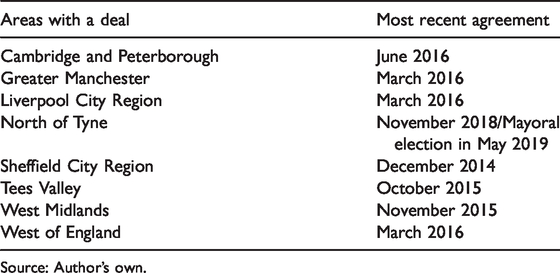
Source: Author’s own.
Sandford (2016: 18) describes the devolution deals as, ‘consisting of a menu with specials. A number of items have been made available to most areas, but each deal also contains a few unique elements or specials’. Many of the deals so far cover areas such as further education, business support, unemployment services, EU Structural Funds, fiscal powers, integrated transport plans, local planning and land use. However, there is differentiation. For example, because of its history of productive local partnership working, the Greater Manchester Combined Authority is viewed by Government as the model of best practice regards the deals. It has, therefore, been granted control over policy areas not previously devolved in England, including the ability to integrate health, social care and children’s services (Sandford, 2018).
However, despite the initial euphoria surrounding the potential for a reimagined localism, many commentators have expressed concerns about the ability of the current devolution deal process to meet key objectives, not least around democratic engagement. For example, Blunkett et al. (2016: 553) note that ‘while each proposed deal is different, there is one thing that they all have in common – a lack of public consultation prior to being announced – which may present a real threat to this new policy taking root’. They go on to contend that: although the government’s devolution agenda may well offer significant opportunities in terms of economic growth, employment and market innovation, how will the “revolution in devolution” develop democratic roots so that it can take hold and be sustained? (Blunkett et al., 2016: 554)
One explanation for this perceived shortsightedness lies in an inherent propensity for top down elitist control in British politics. Wills (2016: 2), for example, notes that a historical disposition to centralism in the UK ‘imposes on our ability to imagine other ways of organizing the state and enacting citizenship…growing up in a centralized polity has limited our ability to develop an alternative geographical imagination about the operation of political power’. Wills describes a path dependent pathology built into the ruling and rationalities of Westminster and Whitehall officials that permeates the political system. This sense of the ‘way things are done around here’ also impacts on the aspirations and expectations of local actors and citizens. One way of addressing this is to develop new ‘imaginaries’ about political decision making and to renew practices of democratic engagement outside Westminster (Healey, 2018). A key question for this article is whether informal forms of governance can be utilized as a tool to facilitate new imaginaries – as opposed to the widely held view that high levels of informality have led to a form of strategic statecraft geared towards perpetuating the top down characteristics of the British Political Tradition.
Methodology
This study adopts an in-depth qualitative methodology aimed at providing narratives about the day-to-day practices guiding political actions (Rhodes, 2013). This interpretivist approach has been selected to generate ‘thick descriptions’ (Geetz, 1983) of where, how and between whom informal governance operates. In his study of Everyday Life in British Government (2011) Rhodes used storytelling to provide a compelling insight into the world of ministers and senior civil servants by exploring the beliefs, practices and rituals that govern everyday life. He refers to ‘storytelling’ as collecting individual voices and increasing the voices heard through the development of engaging narratives. Rhodes argues that this decentred form of inquiry has much to offer theoretically and methodologically by drawing attention to deeper principles of organization that are not visible to empiricist or positivist approaches.
The empirical work is based on two rounds of interviews. The first was conducted between September 2015 and January 2016 with 22 senior Whitehall officials charged with negotiating devolution deals. Respondents were identified through established professional contacts, a search of departmental websites and snowballing. Interviews were conducted with officials working in the Treasury, Cabinet Office and the Departments for Business, Innovation and Skills (BIS); Communities and Local Government (DCLG) and Transport (DfT). Respondents were asked a series of questions about formal and informal procedures for negotiating devolution deals. These included, whether they recognized the use of informality in the process, their motivations for using informal governance, their perceptions on the advantages and disadvantages of informal working and the impact of informal governance on the policy process.
The second round of interviews was conducted between April and June 2018 with 10 Whitehall officials charged with managing and appraising the ongoing devolution deal process. These interviews were conducted with officials in the Ministry of Housing, Communities and Local Government (MHCLG) and the Department for Business, Energy and Industrial Strategy (BEIS). It is worth noting that these departments represent a reorganization of Whitehall but include many of the staff positions and functions of the Departments interviewed in 2016. This round of interviews focused on retrospective perceptions of the deal making process, ongoing devolution deals and how informal working had impacted on inter-governmental relationships. Representing the propensity for the continual movement of senior staff in Whitehall, none of the 10 officials interviewed in 2018 were interviewed in the first round.
Undertaking two rounds of interviews at critical points in the devolution deal process has a number of advantages. The first round provides an opportunity for those directly involved to tell their own story about their rationales and motivations for using more informal ways of working. The second round offers scope for critical reflection on this process with the benefit of hindsight. This approach allows for a temporal analysis of Whitehall perceptions regards the use and feasibility of informal governance. Interviews were conducted under ‘Chatham House Rules’ and lasted between 30 and 70 minutes. They were digitally recorded, professionally transcribed and manually coded to elicit findings.
This methodology has both strengths and acknowledged limitations. Generating insights through storytelling and narratives has allowed central government respondents to articulate the day-to-day activities of informal governance in their own words (Bevir and Rhodes, 2016). This has generated a rich and illuminating data set for exploration that complements existing academic work that has judged the democratic legitimacy of the devolution process from the perspective of local officials and non-governmental actors. Judgements have been made about the impact of informal governance on democratic legitimacy based on the perceptions of critical actors in the network. These perceptions have been supplemented by desk-based evidence on network outcomes where possible, by triangulating empirical findings with observations derived from governmental and academic commentaries. This is an acknowledged and much used methodology in network research (Koppenjan and Klijn, 2004). The analysis presented in the article does, however, have a number of acknowledged weaknesses. First, it is based solely on the views and perceptions of central government officials. Future work might complement this analysis by looking specifically at how local actors and citizens have viewed the use of informal governance in the devolution process.
Second, actor ‘perceptions’ of informal governance and democratic legitimacy are subjective and likely to ebb and flow over time. Although beyond the scope of this project, it might be beneficial to identify a set of metric-based indicators of network outcomes (output legitimacy) and seek to track the impact of informal governance in achieving specific outcomes. Third, the sample for interviews in the second round in 2018 was not as large or as representative of a broader range of government departments as was planned. The looming prospect of Brexit and the challenges of preparing for it in a highly politicized policy environment made it difficult to source senior officials willing to speak about constitutional reform at that time. Nonetheless, these interviewees do represent individuals working at the heart of Whitehall on English devolution and offer an illuminating reflection of the process. Future work might seek to ensure a broader representation of views when (or if) policy making in Whitehall resumes to normality in a post Brexit world. The following section presents the findings and is structured under the headings of ruling, rationalities and resistance.
Findings
Ruling: How have historic traditions shaped the informal actions of situated agents?
In this article, the tradition of the ‘Westminster Model’ is drawn upon to provide a backcloth for how situated actors ‘do business’. Bevir (2013: 68) states, British civil servants are socialized into the broad notions of the Westminster model, such as ministerial responsibility, as well as the specific ways of doing things around here. They are socialized into the idea of a profession, and they learn the framework of the acceptable. We are bound by a civil service code. That way of doing things must be followed but within that one has a degree of discretion in how to operate. Working informally or “off the grid” is an important aspect of the civil servants’ toolkit. The degree to which one draws on it is dependent on circumstance. The devolution deals are an area of policy where it is required. It’s appropriate and frankly it’s the only way to get the job done. We are in a different world to the height of Osborne and Clark-ism. That era was one of experimentation, characterized by a high degree of flexibility and discretion in how we managed central-local relationships. It was also driven by a clear ministerial agenda to devolve power where the best case was made locally.
As a consequence, what emerged was a group of highly skilled senior civil servants, linked by an increasingly dense and more frequent layer of informal relationships. They were involved in high level negotiations and had senior positions within their respective departments, making them ideally placed to use informal processes, as a DCLG official described, I’m a true civil servant to Greg Clark. I really dislike formalized processes. We had what we needed to make devolution happen, which was a wealth of ideas generated from discussions between central and local actors, political momentum and clear articulation from the Chancellor and Greg Clark that they wanted to do this. It was the perfect timing and the right set of conditions to make things happen in a way that was not possible before.
Interestingly, by 2018, the Ministers and many of the civil servants had been replaced and a reassertion of more traditional forms of inter-governmental relationships reemerged. An official in MHCLG commented, We are still a place in Whitehall that gets things done…But our activities are shaped more now by a formal institutional context so we are less of a maverick brigade. The deal making process was a moment in time, appropriate to task. Now there is a little more hierarchy and structure.
Rationalities: How have scientific beliefs and knowledge shaped the informal actions of situated agents?
This article draws upon a number of rationalities that have shaped decision making around English devolution. The first is a growing body of evidence that claims that decentralization can boost economic productivity and growth (Hooghe et al., 2016). This is purported to be the UK Government’s motive for the devolution deals, as an MHCLG official stated, ‘there was a philosophical drive towards devolving power that led to a political drive to devolve power’. Second, a strategy of ‘unashamed diversity’ was accepted in Whitehall as different deals were brokered across England. In short, it was not deemed necessary to include all areas in the initiative (Lupton et al., 2018). However, this rationality clashes with arguments from local actors and commentators that devolution should include ‘the forgotten areas’ – including rural and coastal towns – if spatial equity and social justice is to be maintained (Jennings et al., 2017).
In 2016, Whitehall officials referred to a government genuinely committed to devolution, which was seen ‘in stark contrast to efforts under previous governments’ (DCLG official). In response to managing the ‘dilemma’ (Bevir, 2013) of English devolution, Whitehall officials had modified their actions to produce new patterns of public action. Pivotal to this was the idea (or rationality) that devolution can assist with economic growth and productivity – a narrative particularly appealing in an era of austerity. Taking a reflexive view, a BEIS official opined, You didn’t have a detailed process, but you had two things. One was a real willingness centrally for senior people to meet with local areas to get serious about devolving power. The second were deadlines set high up that had to be met. That was the driving force at the time.
Indeed, Whitehall faced a particular challenge in developing high-quality and inter-personal relationships with all localities due to huge variations in institutional arrangements and local governance capacity. Recent research by the Political Studies Association (2016) suggests that Whitehall has its ‘preferred’ places to work with. The Greater Manchester conurbation was often referred to as ‘the best practice model…a lot of political energy and time have been devoted within Whitehall to develop devolution there’ (HM Treasury official). However, other localities in England did not have the same history of local partnership working or the positive relationships with the Centre to cultivate devolution in the same way. Moreover, the Centre did not have the human resources to invest equally in other local areas. This resulted in a high degree of differentiation in both the process (throughput legitimacy) governing central-local relations and the outcomes (output legitimacy) in terms of devolution agreements, raising questions about spatial equity and social justice in the system (Sandford, 2017).
This situation chimes with Borzel and Panke’s (2012) argument that it is often hard to balance efficient decision making and inclusiveness in governance networks. Indeed, in this case, central government officials appeared to prioritize throughput and output legitimacy over input legitimacy as a source of legitimation. Getting the job done and making difficult decisions in key areas were prioritized over the inclusion of all Localities and the public, leading an MHCLG official to comment in April 2018, ‘one wonders if the process had been more formal if some of the difficult discussions would have been resolved and some of the failed bids would have survived’. While informality proved effective for some, it was clearly not for others, suggesting a degree of variability in meeting Kleine’s (2018) three dimensions of democratic legitimacy. Moreover, a BEIS official reflected that ‘the devolution negotiations were bruising encounters for some and we want to get away from that’. The solution for this official at least has been to (re)introduce systems and processes to ensure more consistent (and formal) central-local relationships.
Resistance: How has central and local resistance shaped the informal actions of situated agents?
Resistance to devolution can be found horizontally between different elites in Whitehall and vertically between central and local actors. For example, Whitehall departments have variable levels of enthusiasm for decentralization, which has prevented a coherent approach to devolving power in the past (Ayres and Stafford, 2014). Research evidence indicates that this disposition is enduring, reflective of the ruling traditions of the system (Bevir, 2013). Indeed, there was a perception amongst a number of respondents that the big delivery departments – health, education and welfare – ‘remain quietly cautious about decentralizing budgets and functions locally and this has led to resistance between those supportive of devolution and those who are not’ (DCLG official).
This variation in Whitehall commitment was a key element shaping the deal process. Informal negotiations were viewed by Whitehall officials as effective in helping to resolve some of these horizontal tensions – promoting throughput legitimacy and input legitimacy. An HM Treasury official indicated that ‘informal discussions about devolution between departments were often more productive as you can leave some of the politics at the door and explore possibilities that you might not be able to formally’. This supports Christiansen and Neuhold’s (2013) finding that informality promotes deliberation between elites. However, the ‘silo’ mentality of Whitehall often proved persistent with commitment ebbing and flowing over time. More recently, an MHCLG official noted that the task of persuading reluctant departments to get involved had been made more challenging due to the fact this ‘this Prime Minister is not as pro devolution as her predecessor so devolution for devolution’s sake is no longer on the agenda’. This demonstrates how the formal state apparatus – or institutional Westminster resilience – significantly shaped the environment for doing business (Diamond, 2019). The first round of devolution deals in 2015 were shaped by a very particular set of factors that made a high degree of informality possible – i.e. a new and challenging ‘dilemma’, strong political momentum, looming timescales, maverick elected leaders and willing civil servants. Without this combination of factors, the propensity for informality and innovation in the system has waned.
With regards vertical resistance, the rationale behind devolution is often purported to be about bringing decision making closer to the people. Nonetheless, this is at odds with the devolution deal process itself, which has been criticized as top town, elitist and exclusionary (Prosser et al., 2017). For a policy that concerns the relationship between governors and the governed, this disjuncture has demonstrably jarred with local stakeholders and public opinion. Indeed, mechanisms through which relevant stakeholders or the public could hold decision makers to account were noticeable by their absence. The devolution deal process served to highlight that informal governance can also exclude groups from decision making – undermining input, throughput and outputs legitimacy. Bailey et al. (2015) suggest that many local stakeholders felt ignored by the process, leaving them feeling ill-informed and disconnected from decisions. Members of the public were, not surprisingly, far less impressed with a process that operated through a set of informal, secretive, elite-to-elite relationships.
Indeed, few attempts were made either to engage the public directly or to assert that the new structures would improve democratic engagement. A process of deliberation should include interested parties affected by the decisions (Kleine, 2018) but in the case of the devolution deals this did not happen. Only a handful of local leaders have participated in deal negotiations, with no information becoming available to other stakeholders until the deal was concluded and published (Tomaney, 2016). The small number of local representatives were viewed by government ‘as adequate in representing the interests of affected local areas’ (BIS official), although clearly local stakeholders did not agree. At the time of negotiating the deals, Whitehall officials indicated strongly that broader consultation and engagement would have been a real challenge given the timescales, political sensitivities of the bids and the speed of developments. In essence, they felt it would have undermined throughput and output legitimacy – a position confirmed by a number of local government and non-governmental insiders involved in the deal making process in research conducted by Kenealy (2016) and the Political Studies Association (2016). Central government respondents on the whole felt that ‘elected Council Leaders should lead the local negotiation process’ (BIS official). The same official went on to say, We feel that we are in quite a permissive place without there being a prescriptive set of things that stakeholders want. This has allowed us to explore imaginative outcomes. But, this is about devolution so it needs to be driven by what local people want. But, it’s the job of local leaders to get that right, not ours.
Conclusions
This article has examined how the decentred aspects of ruling, rationalities and resistance have shaped the governance network associated with English devolution policy. It has examined how a series of contingent factors have shaped the informal behaviours of situated central government actors by combining a decentred analysis with Kleine’s (2018) criteria of input, throughput and output legitimacy. A number of key observations are made:
First, the historical and enduring legacy of the Westminster model undoubtedly shaped the ruling of senior civil servants charged with managing devolution (Diamond, 2019). High-profile Ministers were instrumental in shaping the scope and direction of the policy and for sanctioning civil servants to go ‘off script’ and adopt more informal and relational approaches to managing central-local relationships. Situated actors had the capacity to shape their own environments in response to a new dilemma to momentarily change the traditional working practices of the system. Clear lines of accountability to Ministers provide a source of throughput legitimacy in the system – which is one of Kleine’s (2018) components for this type of legitimation. Nonetheless, accountability to democratic bodies outside the core elite of decision makers was left wanting, raising questions about the longevity and sustainability of the devolution project (Blunkett et al., 2016). This issue was acknowledged by Whitehall officials charged with appraising the deal process in 2018, leading to the possibility of promoting greater accountability to external actors in the future. Indeed, those charged with future negotiations will be operating in a political environment where the devolution ‘genie is out of the bottle’ (Cox, 2016: 565). Greater public consultation may, therefore, be in their gift in a way that was not possible for their counterparts in 2015 who faced a huge hurdle in simple getting the agenda started.
A second component of Kleine’s throughput legitimacy is the quality of the decision-making process. Here to there is evidence of legitimation. More informal ways of working were generally viewed as highly productive by those involved in both promoting deliberation between critical actors horizontally and vertically. Evidence shows that informal decision making has not undermined the formal rules of the Westminster system. To some extent is has complimented it by managing a high degree of complexity and uncertainty and securing progress in an area of policy historically prone to shortcomings. Given these outcomes, the policy has performed reasonably well across Kleine’s (2018) criteria for throughput legitimacy.
Second, senior Ministers also played a central role in cultivating and promoting a narrative (or rationality) around the benefits of devolution. This served to galvanize political energy and enthusiasm across parts of Whitehall and in some local territories. Inter-personal and relational approaches were viewed as an effective form of statecraft (Ayres et al., 2018) to implement this agenda. However, concerns about a lack of parity in both opportunity and outcome across local areas were seen to undermine spatial equity and social justice. Moreover, not all localities were afforded equal opportunity for quality deliberation with the centre, leading to local winners and losers (Lupton et al., 2018). This aspect undermines claims of universal throughput legitimacy and impacts on output legitimacy in some parts of England. Indeed, these findings echo work on informal governance at an international (Helmke and Levitsky, 2004) and European level (Christiansen et al., 2003) that show that informal governance is particularly effective for promoting innovation and creativity in the short term. However, without mechanisms of transparency and accountability, effective policy making is hard to maintain over the long term as critical partners become disillusioned with the process.
Third, while informality was viewed as useful in beginning to address Whitehall’s propensity for centralism and promoting innovation in central-local relations, it seems that the ‘backcloth’ (Bevir, 2013) of a silo and centralized mentality was too strong in persuading all departments to devolve power. While deliberation may have improved across departments in general, an informal approach to negotiations has not delivered in terms of overcoming the formal resistance in parts of Whitehall to devolution. On the one hand, traditional democratic theorists (Klinke, 2016) will be heartened by the fact that informal governance was ineffective in undermining more traditional, formal positions, structures and processes. On the other, the inability to orchestrate a joined-up and coherent approach to English devolution undermines the output legitimacy of the policy. Indeed, this remains an almost predictable, path dependent feature of constitutional reform in the UK, underlining the influence of historical tendencies in contemporary policy making and the challenges in creating new ‘imaginaries’ for localism (Healey, 2018). The evidence presented here shows that ruling tendencies revert to type once unorthodox mavericks motivated by innovative rationalities are replaced by ‘business as usual’ politics.
Finally, arguably the biggest democratic issue to resolve are the high levels of public mistrust and apathy for English devolution (Prosser et al., 2017). Indeed, negotiations behind closed doors perpetuated feelings of alienation, undermining input legitimacy. Stoker (2018) suggests that one way to resolve this dilemma is for governance networks to respond ‘more politically’. Instead of escaping into technical statecraft, governance networks need to bring the politics and political tension to the fore to reignite citizens’ sense of belonging and engagement. However, in a policy area as turbulent and conflictual as English devolution, this could be a risky strategy – but perhaps one worth taking if a lack of public support looks to derail the agenda in the future. Findings do show, however, evidence of a repositioning of government thinking on this, which could serve to address resistance by some local stakeholders and citizens to the policy. This resistance threatens to undermine the implementation and ultimate success of the deals in some areas, making it harder to demonstrate output legitimacy in some areas.
This article has presented a decentred and more nuanced evaluation of the democratic credentials of recent initiatives to promote English devolution. It complements existing work that has been largely critical of the democratic legitimacy of the process. A decentred analysis has revealed shortcomings, most notably in the failure to engage the public and the highly differentiated approach to devolution across England. However, as Sandford (2017) notes, it is unfair to judge a policy against credentials it was never designed to achieve. Research findings show that due Westminster process was the driving force behind the initiative and that central government actors sought legitimation through clear lines of accountability to Ministers, quality deliberation and securing outcomes. While this provides evidence of legitimation for Kleine (2018), other governance scholars champion a more comprehensive approach to citizen engagement, even when faced with the difficulties of managing complex networks (Papadopolous, 2007; Sorensen and Torfing, 2018). The challenge for politicians and policy makers moving forward is to harness the positive aspects of informality, while seeking to redress some of the negative aspects identified in this decentred analysis. The argument made here is that a decentred understanding of the way that informal governance operates can provide critical insights into providing assurances of democratic legitimacy in more nuanced ways than that traditionally offered by mainstream democratic theory.
Footnotes
Declaration of conflicting interests
The author(s) declared no potential conflicts of interest with respect to the research, authorship, and/or publication of this article.
Funding
The author(s) received no financial support for the research, authorship, and/or publication of this article.
