



Abstract
This study investigates the institutionalization of e-participation initiatives in six European countries—Estonia, France, Germany, the Netherlands, Scotland, and Spain—using a multiple case study. The following research questions are addressed: How have recently established e-participation initiatives been institutionalized in public administrations? What are the formal and informal aspects of their institutionalization? It is concluded that the adoption of a digital solution does not in itself trigger a change in the policy-making process because the institutionalization of e-participation is not a linear process. The formal institutionalization increases the sustainability, transparency, and throughput legitimacy of e-participation and allows citizen proposals to be handled in a standardized way. Although the formal institutionalization of e-participation is key for an institutional change towards deliberative democracy, it needs to be accompanied by informal institutionalization through the supporting ideas, values, and preferences of politicians and public officials who have the power to change public institutions.
Introduction
Academic research on e-participation has been dominated by forward-looking techno-optimistic visions of technological solutions that are assumed to lead to citizen-centric government. Compared with traditional “offline” participation, e-participation has been regarded as a way to broaden public participation and involve a much wider audience in the policy process (Macintosh, 2004; Tambouris et al., 2012), increase public trust (Warren et al., 2014; Wirtz et al., 2018), enhance the legitimacy of democratic processes (Prosser, 2012), and improve the quality and success of policies (Tambouris et al., 2012; Wirtz et al., 2018). In general, researchers have been more interested in the potential of digitalization and the benefits that digital technology is expected to produce for open government rather than studying the actual implementation of e-participation initiatives (Norris, 2010). This has left its footprint on e-participation literature, which is often plagued by a normative bias and tendency to present the positive and transformational impacts of digital technology on participatory democracy as a given (Lutz and Hoffmann, 2017; Norris, 2010; Susha and Grönlund, 2012).
Recently, more balanced studies have emerged that have critically reviewed the impact of technology on democratic participation and deemed many claims about e-participation premature and unfounded. Studies refer to a general weakness of e-participation initiatives to deliver expected outcomes (Chun and Cho, 2012; Kubicek and Aichholzer, 2016; Prosser, 2012), mobilize a sufficient number of active users (Epstein et al., 2014) and fulfill the democratic promise of engaging disengaged segments of society (Karlsson, 2012). Drawbacks in implementing e-participation are often argued to relate to societal, administrative, and institutional factors rather than technical aspects (Chadwick, 2011; Zheng et al., 2014). Although societal characteristics such as the number of Internet users (e.g., Åström et al., 2012), digital divide (e.g., Min, 2010), trust in e-participation (e.g., Scherer and Wimmer, 2014), and the socio-economic background of the population (e.g., Medaglia, 2007; Williams et al., 2013) are related to the adoption of e-participation, this paper approaches e-participation from an angle of public administration. This is motivated by influential studies (Chadwick, 2011; Norris, 2010; Porwol et al., 2013) that emphasize the importance of giving due consideration to the complex mix of barriers that exist in the institutional context in which technology is implemented.
The paper will take a closer look at the institutionalization of e-participation. One of the key reasons e-participation initiatives have not achieved the expected impact is their weak integration into existing decision-making processes and routines (Freeman and Quirke, 2013; Panopoulou et al., 2010). In order for digital innovations to transform public governance, they need to become institutionalized, that is, become incorporated in organizational structures and processes (Weerakkody et al., 2016). Institutionalization refers to the process through which e-participation becomes a recognized, routinized, and sustainable activity. However, a recent literature review on the diffusion of e-participation in public administrations argues that existing empirical research has concentrated on the adoption and implementation of e-participation with only a limited focus on institutionalization (Steinbach et al., 2019; see also De Vries et al., 2016 for a similar conclusion in the public-sector innovation literature). Unlike in traditional participatory processes, the development of ICT solutions requires major investments, which implies there is a tendency that the adoption of a new technical solution is seen as a major achievement, which may leave its institutionalization process in the shadow (both by academics and government practitioners). In order to contribute to the existing research, the study at hand addresses the following research questions: How have recently established e-participation initiatives been institutionalized in public administrations? What are the formal and informal aspects of their institutionalization?
Using institutional theory as a basis and synthesizing it with e-participation research, this paper draws on six recent cases from Estonia, France, Germany, the Netherlands, Scotland, and Spain. The focus is on e-participation platforms that have been set up to foster long-term collaboration between citizens, civil society organizations, and the government. It is concluded that the formal institutionalization of e-participation is key for institutional change towards deliberative democracy; however, sustainable and effective e-participation platforms also require the accompanying informal institutionalization through the supporting ideas and values of politicians and public officials.
Theoretical background
Institutions are defined as relatively stable collections of structures, arrangements, resources, processes, and formal and informal norms that influence the perceptions, preferences, and behavior of social actors (Lowndes, 1996; March and Olsen, 2006). Through institutionalization, digital solutions become integrated into organizational processes and structures and will ultimately reach a state of unquestioned repetition (Norris, 2003). Institutions are made of regulative and cultural-cognitive pillars that provide support to the systems in the institutions as well as act as the roots in developing and sustaining institutionalized behavior. The regulative pillar relates to formal institutionalization (e.g., regulations and legal constraints, standardized structures, and processes) (Weerakkody et al., 2016), whereas the cultural-cognitive pillar forms the informal side of institutionalization (e.g., informal values, preferences and norms, organizational culture, and power relations). Aligned pillars result in strength and stability, whereas misaligned pillars can cause organizational imbalance and a state of illegitimacy, thus motivating different choices and actions to be taken by institutional actors (Scott, 2014).
Formal institutionalization
It is well-established in academic literature that citizen participation in policy-making must be reiterated over time and supported by institutional rules, norms, and procedures in order to have a positive effect on the participants in terms of increasing political empowerment, mutual learning, and integrating interests and ideas into innovative and sustainable solutions (Koppenjan and Klijn, 2004). Skelcher and Torfing (2010) argue that one-off participation will not produce any such effects as only institutional forms of participation with a certain extension in time and space can provide a sustainable basis for citizen engagement. Formally organized institutions are conceived as collections of rules and standard operating procedures, pre-defined patterns of thought and action, including legal rules and procedures, as well as structures and resources that are relatively invariant in the face of the turnover of individuals and changing external circumstances (March and Olsen, 2006). Constitutions, treaties, laws, and institution- and profession-specific rules, based on a logic of appropriateness and a sense of obligations and rights, are seen as carriers of accumulated knowledge which prescribe appropriate behavior for specific actors in specific situations. Formal institutionalization enables to systematically address not only the conditions for democratic participation (e.g., right to participate, safeguards for participants) but also issues associated foremost with digital participation such as privacy of information, accuracy of information, property and ownership of information, and access to technology and information (Mergel and Bretschneider, 2013; Toots, 2019).
Institutionalization affects the rate of change through the ways in which institutions adapt their internal structures and processes, by creating actors and providing them with premises for action (Olsen, 2009). For example, the institutionalization of innovative digital practices may include the creation of new organizational roles that could be fulfilled either by existing or new positions and/or specialized units (Mergel and Bretschneider, 2013). Institutionalization is particularly important in complex situations that require coordinated action by a number of individuals, organizations, technologies, and resources (Olsen, 2009), which is often the case with e-participation where the larger number and heterogeneity of actors (compared to traditional participation) adds to the complexity of organizational design and further blurs accountability relations (Randma-Liiv and Lember, 2022). Formal institutionalization implies an increasing clarity on the allocation of formal authority whereas standardization and formalization reduce uncertainty and conflict concerning who does what and when and how. Compromises and victories in political battles are “frozen” in institutions through formal structures and processes, thereby sustaining a lasting legacy (Thelen, 1999). An important characteristic of institutionalization is routinization which is reached when digital innovation is no longer seen as new, but as part of the standard operating procedures, and is absorbed in organizational structures and processes (Mergel and Bretschneider, 2013).
Resources are tied to rules and structures, empowering and constraining actors differently and making them more or less capable of acting (Olsen, 2009). Institutions are characterized by standard procedures through which they allocate resources and which determine how resources, authority and power are internally redistributed. It is expected that the supply of resources required to act in accordance with prescriptions becomes routinized and “taken as a given.” Institutions, however, are “to varying degrees vulnerable to external changes in available resources, generating budgetary bonanzas or enduring austerity where expectations and demands are excessive compared with available resources” (Olsen, 2009: 16).
Formal regulations may sometimes generate constraints on systems of digital governance (Sarantis et al., 2010), existing rules and regulations may mitigate the extent of acceptance of new technology (Kraemer and King, 2006), diminish flexibility, and trigger a slower rate of change and reduced experimentation (Mergel and Bretschneider, 2013). However, institutional norms and rules constitute a much-needed reference point for the inclusion of participants (Koppenjan and Klijn, 2004; Skelcher and Torfing, 2010), coordinated action by multiple actors (Olsen, 2009; Randma-Liiv and Lember, 2022) access to information (Mergel and Bretschneider, 2013; Toots, 2019), the advancement of legitimate claims and arguments (March and Olsen, 2006; Olsen, 2009), and sustained interaction among social and political actors (Skelcher and Torfing, 2010). For this particular study, the following dimensions of formal institutionalization are explored: the presence of regulatory acts guiding the actors and processes of e-participation, voluntary versus mandatory consideration of citizens’ input in policy-making, embeddedness of e-participation in organizational structures and processes, and the sufficiency and stability of financial resources for maintenance and further development of the platforms.
Informal institutionalization
The “objective conditions” provided by formal rules, processes and structures are not sufficient to explain institutionalization, in fact, the same formal institutions may have different effects in different settings. Not even the proponents of rational choice consider human decision-making perfectly rational—more often the literature refers to “bounded rationality,” which involves human cognitive limits (Simon, 1991). Public organizations are shaped not only by the rules and norms imposed on them but also by the behaviors of their internal systems and the cognitive patterns of their inhabitants (Klievink et al., 2015). As argued by Dembski and Salet (2010: 618): “Legislation, for instance, while formalized through a distinct decree, takes shape gradually, within evolving patterns of social expectations. Moreover, the formal act of commencement must be followed by practices of validation in social interaction.” Without this taking place, without impacting the behavior of those they target, formal rules are not institutions, but simply “a collection of words on paper” (Buitelaar et al., 2017).
Consequently, recent institutionalist theory tends to emphasize informal factors next to formal institutionalization (Köning, 2016). The informal, cultural-cognitive dimension of institutionalization centers on sense-making, including the belief systems that organizational members construct and use for everyday practice. “Culture is entrenched in knowledge and practices that are commonly understood, acted upon, disseminated and sediment in the organization” (Weerakkody et al., 2016: 660). Lowndes (1996: 195) has argued that “norm-driven behaviour is a key force in sustaining institutional rules over time.” This is seconded by Buitelaar et al. (2017), who claim that when rules genuinely affect actors so that their behavior shows repetition and imitation, and becomes predictable to some extent, those rules can be said to have become institutions.
Institutions are actively shaped, created, and maintained by the actions of individuals, meaning that individual actors have a transformative capacity (March and Olsen, 1989). There is no shortcut from the adoption of a novel (digital) initiative to its institutionalization—in order for change to happen, powerful actors need to perceive the change as desirable and actively support it (Köning, 2016). According to Köning, the institutionalization of change happens through a process involving two important elements: (1) ideational change within the actors internal to the institution and (2) changes in the preferences of powerful actors (i.e., whether those who have the power to change the institution—its formal and informal leaders—consider institutional change to be in their interests). Such powerful actors are, first of all, politicians and public managers whose backing is necessary for developing e-participation initiatives (Panopoulou et al., 2014; Toots, 2019). Without trust and support from elected officials, decisions based on citizen input are likely to be delayed, and consensus and changes are less likely to occur; strong support by politicians brings funding, organizational stability, and agency autonomy, which are argued to facilitate better participation outcomes (Yang and Pandey, 2009).
However, people’s habits of mind, including their beliefs in legitimate political organization and rules, may be more difficult to change than formal rules and incentives (Olsen, 2009). Public officials’ beliefs and norms often act as barriers to public-sector innovation—many of the barriers stem from officials’ fears that the change would challenge the existing power balance and status quo (Meijer, 2015). The process of e-participation is regarded as more complex than other e-government processes such as online service provision (Chadwick, 2011; Kornberger et al., 2017; Reddick and Norris, 2013). In their excellent analysis of Open Government, Kornberger et al. (2017) bring into focus the undertheorized problem of how bureaucratic organization copes with external collaborators that fundamentally interferes with the Weberian ethos of bureaucracy. E-democracy studies have outlined the presence of a “middleman paradox,” where decision-makers responsible for democratic engagement tend to oppose citizen participation (Mahrer and Krimmer, 2005). This is argued to be due to fears of redistribution of power and loss of status and control (Bovaird and Loeffler, 2012). This supports the conclusion of Kraemer and King (2006), who believe that digital transformation has not been able to change organizations because ICT tends to reinforce existing power relationships rather than change them. For the informal institutionalization of e-participation initiatives, change agents need to be backed up by the actual willingness of the organizational leadership to hold a government-citizen dialogue.
Method
As the research questions were derived from the encounter between the bureaucratic organization and open government, a qualitative approach was deemed appropriate. This responds to the call by Sørensen and Torfing (2011: 862) who identified a need for qualitative studies “to fully understand the complex processes and causalities in the production of collaborative innovation and to appreciate the role of the social and political actors’ different interpretations of the collaborative and innovative processes, outputs, and outcomes.”
Using comparative case analysis, this research follows the recommendation by Reddick and Norris (2013), who suggest that scholars who undertake further studies on e-participation should consider the use of qualitative methods, such as case studies, to tease out some of the more subtle nuances of the real-life functioning of e-participation initiatives. The case study method has a well-established tradition in the digitalization research as it enables the study of systems in their natural context (Walsham, 1995) and acquiring a meaningful and realistic understanding of problems (Sauer, 1993).
In the first stage of the research project, following Sauer’s (1993) suggestion to construct rich descriptions of the cases by mapping the key actors, events, and problems in the platforms’ histories, in-depth single-country case studies were conducted in 2019 with the aim of providing thick empirical descriptions on how e-participation initiatives were adopted and institutionalized (for single case studies, see Randma-Liiv and Lember, 2022). In the second stage, the main findings of the single-country case studies were synthesized and systematized with the aim of identifying patterns and challenges of various aspects of institutionalization across cases.
The study employs an exploratory approach to investigate the institutionalization of e-participation initiatives in six European countries—Estonia, France, Germany, the Netherlands, Scotland, and Spain. It is acknowledged that the selected countries represent different administrative traditions (Painter and Peters, 2010) which may have an effect on both formal and informal institutionalization. This is a heterogeneous set of cases as also illustrated in Table 1. Local academics within the Horizon 2020 TROPICO project were involved in case selection, data collection and analysis in each of the countries. The criteria for case selection, outlined in the common Case Selection Strategy, were the following: 1. Initiatives which connect stakeholders with the public sector via an open and transparent online platform. 2. Cases which were designed for long-term or permanent collaboration and which have been in operation for at least 1 year. 3. Cases which were (co)administered by a branch of the government. 4. Cases which aimed at including citizens’ input into the policy-making (rather than service delivery) process. Selected e-participation platforms.

All partners prepared in-depth single-country case studies based on the common analytical model provided in the Case Study Protocol. The case studies relied on information collected through desk research and interviews in order to probe the stakeholder (Sauer, 1993; Walsham, 1995) and “insider” views (Chadwick, 2011) more deeply. The mix of interviews and secondary documents allowed an adequate level of data triangulation to be maintained, which was deemed important in tracking the variation between primary and secondary data and thus improving the accuracy, interpretation, and analysis of the collected data (Mingers et al., 2013). The desk research involved the exploration of the following sources: the website of the e-participation initiative and their publications; the respective laws and secondary legislation; governmental policy documents; statistics available on e-participation in general; and the selected e-participation platform, in particular. Between eight and thirteen interviews were conducted for each case. The interviewees included the following groups: the initiators of the platform, people who are formally involved with the maintenance and/or moderation of the platform, a senior manager of the public-sector organization where the e-participation initiative is administered, representatives of important governmental and non-governmental partners who are actively involved in running the platform, representatives of policy-makers who have used the e-participation platform as an input in the policy-making process and stakeholders who have been engaged in the selected platform. The anonymous semi-structured interviews followed a detailed Case Study Protocol and lasted for one to one and a half hours. All interviews were recorded and transcribed.
The single case studies formed a foundation for identifying and systematizing characteristics related to the institutionalization of e-participation platforms. In analyzing the case studies, a double-step approach for content analysis was used. First, the single case studies were scrutinized and their descriptive content was classified into specific thematic codes, such as legislation and formal rules guiding the initiatives, changes in organizational structures and processes, human and financial resources, political and top management support and resistance to change. Second, the analytical/explanatory parts of the case studies were examined and ordered through the interpretative codes. Next, the information gathered through thematic and interpretative codes was integrated and compared.
Comparative case analysis aims at systematic and contextualized comparison (Mahoney and Rueschemeyer, 2003). When conducting the analysis, it was acknowledged that the effects of electronic tools were highly dependent on their heterogeneous context. Although the cases were carefully selected on the basis of a Case Selection Strategy, they do not represent a coherent set of participatory tools: the selected e-participation platforms were implemented in different national and institutional contexts, they were in different development stages, they represented different levels of government and they were targeted to either legislative or executive branches of government. Such a complex mix of characteristics reflects the multi-dimensional nature of (e-)participation. The great variety of e-participation practices makes it impossible to identify a “typical” e-participation initiative that would symbolize a trend towards digital governance. It is thus acknowledged that although the selected cases are unable to reveal generalizable statistical patterns, they can offer insights to inform theory and causal linkages (Walsham, 1995; Yin, 2003), and give guidance to practitioners (Sauer, 1993). Although the variety among the cases does not enable robust comparison, the inductive approach allows certain patterns and challenges to be detected in the institutionalization of e-participation, and lessons to be drawn for the practitioners who want to develop effective and sustainable e-participation initiatives.
Description of e-participation cases
A brief overview of the launch and institutionalization of the selected e-participation platforms is given below.
Estonian citizens’ Initiative Portal, Estonia
The Estonian Citizens’ Initiative Portal is an e-participatory instrument allowing individuals to collectively propose new ideas or changes for laws and policies to the parliament. The portal was launched in 2016 as a collaborative effort by the Estonian Cooperation Assembly (a quasi-governmental organization affiliated with the Office of the President of Estonia), the CitizenOS Foundation and the Chancellery of the Riigikogu (Parliament of Estonia). The Estonian Citizens’ Initiative Portal is formally institutionalized through a cluster of laws and regulations addressing the processes pertaining to the platform, thus making it procedurally binding for the parliament. The “Collective Addresses Act,” along with adjunct laws, stipulates that when a proposal put forth by any individual gathers 1000 or more signatures, the parliament should formally address the proposal. Several ways of further processing any given initiative are listed in the Riigikogu Rules of Procedure and Internal Rules Act. The platform is lightweight both in terms of financial as well as human resources as there is only one employee at the Cooperation Assembly who takes care of most of the duties in running the platform. The Chancellery of the Riigikogu has not shown any serious interest in promoting the initiative, sharing the costs or contributing to the further development of the platform as it is mainly considered a bottom-up initiative. 246 proposals have been started on the platform, 54 of which have been forwarded to the parliament in 2016-2020. (Vooglaid and Randma-Liiv, 2022)
Parlement et Citoyens, France
Parlement et Citoyens offers two e-participation instruments to connect French citizens and politicians at the national level. First, individual (or a group of) MPs or senators can submit a draft law for citizens and non-governmental organizations for comments. Second, citizens and organizations can launch petitions on the website (in practice, the latter tool is very rarely used). This platform is a private initiative as Parlement et Citoyens was originally initiated by a group of committed citizens led by Cyril Lage. Because of the “bottom-up” setup, and in contrast with the Napoleonic administrative tradition (Painter and Peters, 2010), the platform has been managed in a very informal way. Although the Parlement et Citoyens initiative was adopted in 2013, it had no legal status until April 2017, when it was established as a Parlement et Citoyens NGO, which formally became the owner of the website and the e-participation initiative. The NGO has no staff and the platform is managed by the Cap Collectif—a for-profit civic tech start-up also founded by Cyril Lage. Parlement et Citoyens is thus dependent on the work of the staff of Cap Collectif and on the voluntary involvement of the parliamentary assistants of MPs and senators conducting consultations and providing feedback to citizens. The lack of permanent staff within the Parlement et Citoyens NGO causes concern about the workload for parliamentary assistants and the staff members of Cap Collectif and provides a rather unstable environment for supporting the e-participation initiative. The e-participatory process is neither formalized nor standardized, and the implementation of the initiative depends largely on the enthusiasm of individual MPs and senators. 17 Senators and MPs have conducted 24 consultations in 2013-2019. (Defacqz and Dupuy, 2022)
meinBerlin, Germany
The meinBerlin platform was adopted in 2015 under the supervision of the State Chancellery, which is primarily responsible for citizen participation in the state of Berlin. Characteristic to a “top-down” approach, the formal proprietor of the portal is the Governing Mayor of Berlin and the State Chancellery. Although the platform was established at the same time as the general e-government legislation, no binding measures were included in the law, and the eGovernment Act only contains a declaration of intent to promote e-participation. Various types of e-participation can be conducted on the platform, including participatory budgeting, public surveys, open debates, open idea collections, and statements on development plan processes. The topics for consultation are determined by the administration, and citizens cannot initiate their own proposals. In contrast to the Germanic administrative tradition (Painter and Peters, 2010), the administration of the participatory process is not formalized and is handled in a decentralized manner, implying that the creation, moderation and evaluation of participatory processes is a voluntary task of the 44 administrative units, including the Berlin State Chancellery, the various State Departments, the district administrations, the subordinate authorities of the districts, and state-owned companies. There is no standardized approach as to how e-participation is organized in these administrative units. In the majority of units, the same employees who are responsible for the respective policy subject in general are also responsible for carrying out the participatory processes. The platform is centrally financed by the budget of the Senate Chancellery but the support varies across administrative units. The use of e-participation depends substantially on the individual engagement of officials in district and state administrations. meinBerlin is only weakly institutionalized in the Berlin administration since online participation continues to be a voluntary task of the administrative units, out of which many use it rarely or not at all. The platform is not well known; however, there are over 9000 registered users who have contributed more than 19,000 proposals and comments by 2020. (Pruin, 2022)
De Stem van West, The Netherlands
Although established by the neighborhood council of Amsterdam-West in 2014, the ownership of De Stem van West is best placed in the civil society sphere, as only the citizens of Amsterdam-West determine what is discussed on the digital platform and they are involved throughout the policy cycle. It took around 3 years’ time to work towards a digital tool that could be optimally incorporated in the neighborhood administration’s policy-making processes. De Stem van West is formally incorporated in the policy design process through the internal regulations of the neighborhood council. If an idea on the platform surpasses the threshold of 100 positive votes within 3 months, the proposal will be put on the monthly agenda of the neighborhood council and its further deliberation is specified in detail. The neighborhood council meeting will decide whether the citizen’s idea will be executed and, if so, in what way. The portal is administered by the Digital Unit of the Amsterdam-West administration, which employs four freelance experts to maintain the portal. Special collaboration teams, including citizens, politicians and civil servants, are established to monitor the implementation and execution of each citizens’ proposal. The establishment and implementation of De Stem van West has been strongly supported and personally led by the neighborhood alderman and managed by a capable coordinator. They have invested a lot of effort in keeping in touch with influential community leaders, civil society organizations and private companies, but also political representatives, in order to promote the platform and ensure that De Stem van West is properly embedded in the neighborhood dynamics. The tool has been actively used by the inhabitants of Amsterdam-West as, in 1 year time, over 28,900 unique visitors participated on the platform and more than 70 citizen proposals were launched. (Stevens, 2019)
We asked, you said, we did, Scotland
In Scotland, interaction between citizens and policy-makers at the national level has been organized on the platform We asked, you said, we did since 2014. The Scottish government adopted the Scotland Community Empowerment Act in 2015 and, since then, the We asked, you said, we did initiative has been used on a mandatory basis for every consultation organized by the Scottish government. The platform is a feature of Citizen Space, a cloud-based software for managing, publicizing and archiving all consultation activity in one place that is integrated within the Scottish government website. The responsibility for running a specific participatory process is delegated to each policy team. Once the consultation is closed, each policy team collects the responses and reports the conclusions back to government ministers. We asked, you said, we did provides a concise overview of how citizens’ responses (You said) to the consultation (We asked) are considered in the policy-making process (We did). There are numerous policy teams spanning the whole remit of government who are involved in the consultation process. There are also a team of analysts, and a group of social researchers that work to redraft the best practice guidance for consultations. There is corporate support and a common motivation to engage with citizens as well as widespread use of We asked, you said, we did in order to run all government e-consultations. Until 2020, over 550 proposals had been discussed on the platform. (Bellò and Downe, 2022)
Decide Madrid, Spain
In 2015, the Madrid city council created Decide Madrid, which enables citizen participation through five modes: debates, proposals, polls, processes, and participatory budgeting. The General Directorate of Citizen Participation of the City Council is in charge of the day-to-day management of the platform. The participation of citizens is regulated by the Organic Regulation of Citizen Participation of the City Council of Madrid. In 2016, a municipal directive established that a public consultation in Decide Madrid must be carried out before the approval of a new municipal regulation, thereby making the consultation process mandatory. Detailed regulations of the City Council, characteristic more generally to a high degree of legal formalism in Spain (Painter and Peters, 2010), support the operation of this platform, thereby referring to a high degree of formal institutionalization of the initiative. The implementation and coverage of the operational costs of Decide Madrid are the responsibility of the City Council, and financial sustainability is guaranteed. Decide Madrid enjoys wide political support and is enthusiastically promoted by the Mayor of Madrid. The e-participatory processes are incorporated in the organizational culture, as all areas and administrative units of the city council collaborate by proposing topics for consultations and evaluating proposals made by citizens. More than 27,300 proposals have been made and over 5700 debates started by the beginning of 2020. (Pina et al., 2022)
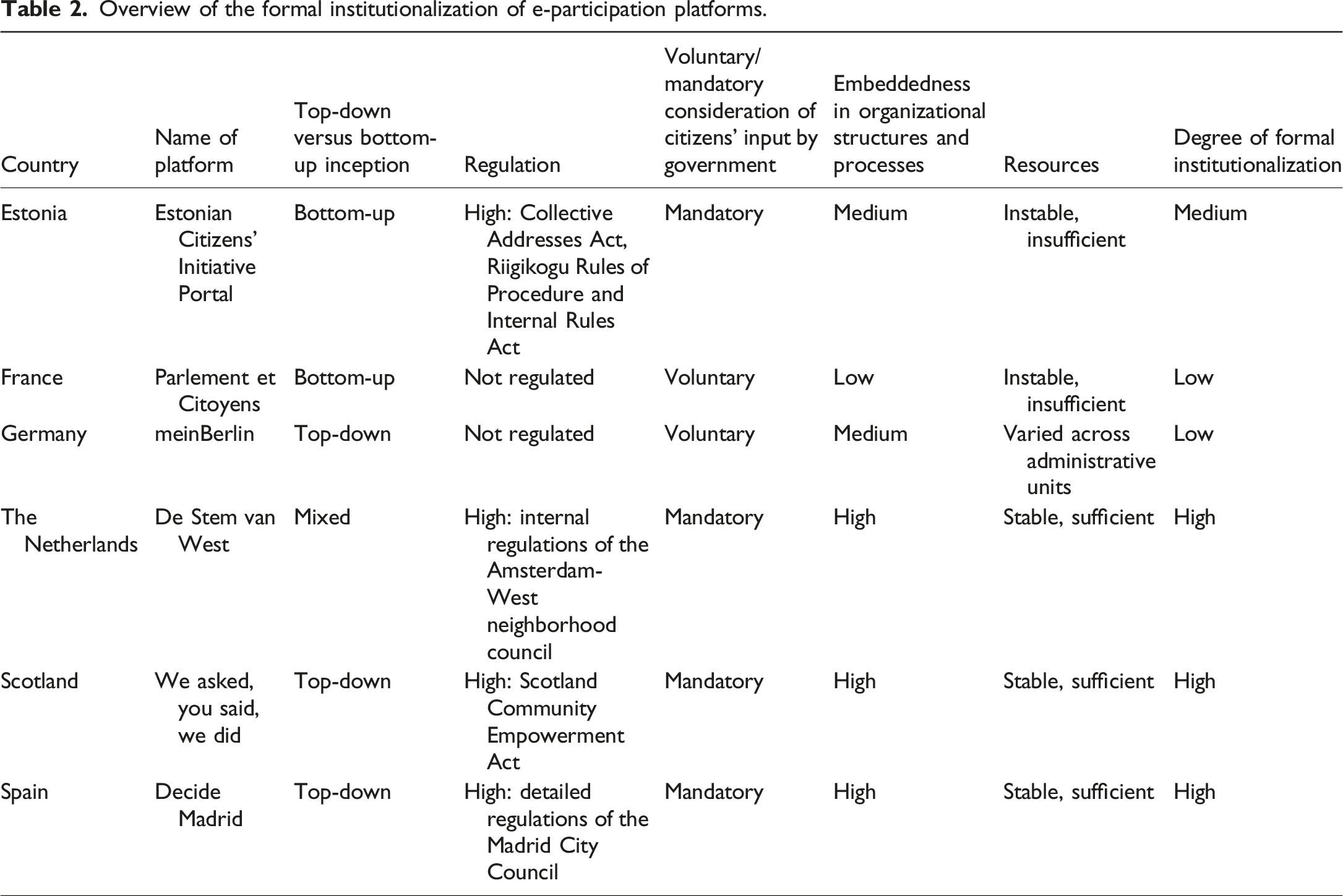
Overview of the formal institutionalization of e-participation platforms.
Comparative findings and discussion
The following section discusses the findings and their consequences by taking a continuum of high-low institutionalization as a basis. This allows to draw readers’ attention to factors which, on the one hand, contribute to a high or low degree of institutionalization, and on the other hand, to discuss consequences of a high or low degree of institutionalization.
Formal institutionalization
The cases indicate varying degrees of formal institutionalization of e-participatory processes, ranging from highly institutionalized to rather informal collaboration between government and citizens. Some e-participation initiatives were launched by the government in a top-down mode using a centralized approach and formal regulation by that contributing to a higher degree of formal institutionalization. This is best exemplified in the Scottish and Spanish cases. A low degree of formal institutionalization occurs in both the French and German cases, where the formal regulation is missing and the decision-makers’ consideration of citizen input is voluntary. In the rest of the cases, decision-makers are obliged to further handle citizen input if it is above a certain threshold based on the number of signatures. In the French case, the low degree of formal institutionalization is related to the bottom-up establishment of the e-participation platform. Another bottom-up platform, the Estonian one, however, follows a highly formalized process cemented in the law.
In most cases, the input side of citizen participation (i.e., how citizens’ proposals are formed and submitted to government) is formalized, whereas the output side of the participatory process (i.e., whether and how government provides feedback) remains insufficiently formalized. This indicates that in their institutionalization efforts, governments do not pay enough attention to the feedback and deliberation which, however, are integral (if not the most important) parts of the participatory process.
In the cases with a high degree of formal institutionalization (Dutch, Scottish and Spanish), the rules and processes of e-participation have been made clear and transparent. This facilitates their adoption by both citizens and decision-makers by increasing the throughput legitimacy of the participatory processes. Formal institutionalization ensures that the way citizen proposals are formed and handled by the government is transparent and independent of the discretion of decision-makers. This can be contrasted by cases where procedurally non-binding petitions are forwarded to decision-makers, who may simply decide to ignore citizen input because no procedural rules exist to structure the whole participatory process. The less formalized cases in the current study—French and German—indicate a high level of variation in the use of e-participation tools by MPs and Senators in the French case and by various administrative units in the German case. Formal institutionalization of the rest of the platforms enables citizen proposals to be handled in a standardized way instead of relying on the enthusiasm of individual organizations, units, politicians, or administrators.
The cases also vary in terms of the embeddedness of e-participation initiatives in the standard operating procedures of existing organizations—while this is true in some cases (Dutch, Scottish, and Spanish), in other examples (Estonian and French), the e-participation platforms can be characterized as “beyond business as usual,” that is, the e-participation processes function separately from the existing organizational and decision-making routines. Platforms which were established bottom-up (French and Estonian) tend to delegate responsibility for the administration of the e-participation initiative to non- or quasi-governmental actors, thereby contributing to the emergence of isolated “islands” in governance routines. This brings along novel decision-making processes and new actors. Although this may grant special attention to the e-participation platform in the adoption phase, it may create artificial barriers to the functioning of the platform in the longer term. The non-governmental administrator of the platform may lack formal authority vis-à-vis governmental decision-makers and may become short on resources for running the platform. A high degree of formalization of participatory processes may somewhat alleviate this problem as demonstrated by the Estonian case. It could be argued that the long-term sustainability of the platforms would benefit from their integration and institutionalization into existing organizational structures and decision-making processes. Formal institutionalization of e-participation is thus instrumental for linking the e-participatory process to the existing system of governance.
Budget constraints and a concomitant sense of organizational instability have been outlined as very important explanations for e-participation failure (Chadwick, 2011), thereby emphasizing the importance of the stable and sufficient funding of e-participation platforms in securing their sustainability. Especially in the bottom-up cases (Estonian and French), financial resources are allocated on an ad hoc basis, leading to potential capacity problems in administering the platforms. For example, lack of resources may prevent recruitment of extra staff or lead to insufficient focus on certain functions, such as the marketing of the platform, giving feedback to citizens or the regular monitoring and evaluation of the performance of the platform. Less institutionalized platforms are particularly endangered by financial instability as they are more dependent on (potentially instable) political and top management support.
Informal institutionalization
Formal institutions interact with social norms, values, attitudes, and beliefs (March and Olsen, 2006), that is, institutions tend to transform in informal and gradual ways that are difficult to capture with an exclusive focus on formal institutionalization. The sustained interaction among public and private actors is not only regulated by formal rules and procedures, but also gives rise to jointly formulated norms, values, and perspectives of a more informal nature. Such jointly developed norms and values around e-participation are best exemplified in the Dutch case, where non-governmental community actors were actively involved in the development of participatory structures and processes, thereby building a joint ownership towards the e-participation platform and a collective willingness to change by communities and the local government. Such an informal institutional change has great potential to become sustained behavior. Next to the Dutch case, the Scottish and Spanish cases also demonstrate a high level of informal institutionalization, evidenced by the internalization of e-participation initiatives in the organizational culture.
All cases confirm that support by political and administrative leaders is a critical factor for the informal institutionalization of e-participation in public administrations. In some (exceptional) cases, such as the Dutch and Spanish, political or administrative leaders themselves have stepped into the shoes of a change agent, promoting the new e-participation initiative very actively, whereas political will is usually present during the establishment of the platform, it must be acknowledged that for e-participation platforms to be successful in the long-run, they also need to be backed by top-level support in the later phases of implementation. However, in some cases (Estonian and French), where respondents indicate the shortage of resources for running e-participation platforms, sufficient political and/or administrative commitment is missing. Ongoing support from the top is particularly important in cases where e-participation platforms have been established in a bottom-up mode (Estonian and French) and where the participatory processes are not sufficiently formalized (French and German). Moreover, in order to minimize the risk related to situations where supportive politicians and/or top managers leave, and are replaced by less enthusiastic successors, the formal institutionalization of participatory initiatives may be deemed necessary in order to ensure the smooth functioning of the platform under the potentially less favorable top leadership.
It can be argued that at the level of a local government (vis-à-vis national government), interactions are proximate and take place not only formally but also informally; in addition, both decision-makers and citizens may find it easier to establish public support and action for locally experienced problems. This is referred to in literature as “the proximity principle,” implying that citizen engagement has more potential for high informal institutionalization on the local rather than national level (Meijer et al., 2015). Although this proved true in the Dutch and Spanish cases, it did not find empirical proof in the German case, where the actual use of e-participation appeared to be dependent on single administrative units in the state of Berlin. In the Dutch and Spanish cases, introduction of e-participation was based on in-house endogenous motives, but in the German case, e-participation was mandated from a central authority. The root cause of the uneven adoption of e-participation in the German case rests with not only on the low degree of formal institutionalization of the participatory process but also on the values, attitudes, and beliefs of formal and informal leaders of single administrative units. Formal institutional compliance can be achieved in single units, but e-participation may be implemented at a basic level and/or attract very limited use due to the neutral (if not negative) attitudes of single leaders. Consequently, the diffusion of e-participation policy from central authorities should not only be seen as an issue of straightforward compliance by lower-level units but should aim to stimulate the perception of ownership, commitment and a proactive approach in decentralized settings.
Since e-participation initiatives seek to change existing power relations, they are likely to face resistance and challenges to their institutionalization due to a perceived threat to the position and power of political actors. This is dependent on the attitudes of the representative “middlemen” (Mahrer and Krimmer, 2005), describing a situation whereby those politicians who have the power to introduce and institutionalize e-participation, simultaneously (quietly) oppose such changes. Initial moves towards e-participation are likely to gain support from representatives because association with participatory democracy rhetoric can provide a “quick hit” of legitimacy. However, as the rhetoric of a novel approach fades, the survival of e-participation will depend more on their practical utility to the “middlemen” of politics—that is, the political payback from increased support and credibility to e-participation must be seen to be larger than the costs of implementation. Although such political benefit can be perceived as more dominant in the Dutch, Scottish, and Spanish cases, the Estonian and French cases present only a modest commitment by MPs, demonstrated by the insufficient and instable funding of e-participation initiatives by parliamentarians.
All in all, it can be concluded that although the formal institutionalization of e-participation is key for an institutional change towards deliberative democracy, sustainable, and effective e-participation platforms also require accompanying informal institutionalization through the supporting ideas, opinions, beliefs, preferences, and interests of politicians and public officials who have the power to change public institutions.
Conclusions
Although there is the tendency to expect technology to transform organizations and processes, digital technology is, in fact, no more than a potential driver of institutional change, not an independent agent capable of influencing policy-making processes. Therefore, it is important to distinguish between the adoption of a digital solution and its eventual institutionalization in organizational structures and policy-making processes because the institutionalization of e-participation is not a linear and stand-alone process. The adoption of e-participation initiatives has happened in public administrations all over the world at a relatively rapid pace. Compared to traditional participation, e-participation initiatives (and relevant literature) tend to focus on the adoption rather than institutionalization, partly due to the emphasis put on the development of a novel technological solution. Institutionalization of e-participation, however, is a much slower and more complicated process. Similarly, while it is possible to formally institutionalize e-participation in a “top-down” manner through legislative and structural changes, informal institutionalization through the shifts in values and beliefs of politicians and administrators requires long-term determined action and cannot be assumed to “automatically” follow formalization. This means that formal and informal institutionalization that ultimately leads to sustainable institutional change only happens if the ideas and value systems prevailing among the political and administrative actors make them open to the change and stimulate them to actively work towards implementing the change.
For the practitioners who want to develop effective and sustainable e-participation initiatives, this study can provide a few practical suggestions. First, putting a digital solution in place does not in itself trigger a fundamental change in the policy-making process. Instead, implementation of digital technology should be viewed as an integrated institutionalization process of change on an ongoing basis, rather than a narrow approach to technology implementation. To support the institutionalization of e-participation, government practitioners’ focus should shift from designing a perfect digital tool to understanding the needs, ideas and interests of politicians and public-sector managers who can influence the institutionalization of e-participation. Second, e-participation initiatives should not be conceptualized as isolated “projects” with a fixed timeframe and end result. Instead, it makes sense to regard them as processes of long-term institutional change requiring the ongoing attention and support of politicians and managers, “buy-in” by public officials, sufficient and stable funding, constant monitoring, and fine-tuning, where the adoption of the digital solution is simply the first step in a long and complicated process.
There are some limitations to the generalization of the findings of this study. First, the selected e-participation initiatives are rather recent, adopted in 2013–2016, implying that their institutionalization processes (especially informal) might not have ended by the time of data collection. Second, the institutionalization of e-participation in public administrations does not take place in a vacuum but reflects wider societal characteristics (such as development of civil society, trust in digital solutions, and development of technology) which are beyond the scope of this study. Finally, this study does not allow links to be drawn between the institutionalization and the actual performance of e-participation initiatives because of very limited public information on the use and impact of e-participation initiatives. Further research should indicate whether different levels of formal and informal institutionalization affect the quantity and quality of participation. Research should also broaden existing knowledge by addressing questions concerning the ability of politicians, civil servants, and other influential actors to influence and govern the complex institutionalization process of digital democracy.
Footnotes
Declaration of conflicting interests
The author(s) declared no potential conflicts of interest with respect to the research, authorship, and/or publication of this article.
Funding
The author(s) disclosed receipt of the following financial support for the research, authorship, and/or publication of this article: This study was supported by the European Union’s Horizon 2020 research and innovation programme under grant agreement No.726840.
