



Abstract
The writings of Bruno Latour have invigorated empirical inquiry in the social sciences and in the process helped to redefine their character. In recent years the philosophy of social science that made this inquiry possible has been deployed to a different end, namely that of rethinking the character of politics. Here I suggest that in the pursuit of this goal, inflated claims are made about that philosophy, and some basic theoretical tools are asked to do a job for which they may not be best equipped.
…when a man sits down to write a history…he knows no more than his heels what lets and hindrances he is to meet with in his way…Could a historiographer drive on history, as a muleteer drives on his mule – for instance, from Rome all the way to Loreto, without ever once turning his head aside either to the right or to the left – he might venture to foretell you to an hour when he should get to his journey’s end – but the thing is, morally speaking, impossible: For if he is a man of least spirit, he will have fifty deviations from a straight line to make with this or that party as he goes along, which he can no ways avoid. (Laurence Sterne, Tristram Shandy) For we all of us, grave or light, get our thoughts entangled in metaphors, and act fatally on the strength of them. (George Eliot, Middlemarch) They that weave networks shall be confounded. (Isaiah xix: 9)
Introduction
Taking in anything from laboratories, courts, West African colonial trading stations and South American botanical research groups to urban engineers, Berlin house keys, the reception of the message of Jesus, and medicine in late 19th-century France, the work of Bruno Latour has helped a generation of scholars to rethink their approaches to inquiry. At the same time, he has encouraged those convinced and invigorated by that work to believe that they are redefining the meaning of social science itself. Notable here are his attacks on sociology, which by appealing to an unexamined concept of ‘society’ to explain whatever it is studying, neglects the very thing that needs investigating: the ways in which society is continually being made. Much of Latour’s work – some of the best empirical and ethnographic work of the last three decades – has been just such an investigation.
Sociology badly needs to rebut these charges, and if sociologists would go and collect the key more often than they do they might find that the discipline has enough armoury in its locker to do so. Instead of doing that, here I focus on another strand of Latour’s writing, the part in which he makes his most general positive claims on behalf of the intellectual stance, or view of the world, that informs his work. He sometimes calls this ‘experimental metaphysics’. Because it has appeared more than once as the last chapter of or appendix to one of the empirical studies it might be thought of as a theoretical or methodological adjunct to them. But in recent writings it has begun to take on a life of its own, nowhere more so than in his efforts to reimagine politics. The headline terms are ‘political ecology’, ‘the politics of nature’ and ‘a parliament of things’. Here I assess those efforts. I conclude that, for all its ingenuity, Latour’s vision of a new politics is grounded less in ‘the winding path of practice’ he exhorts us to follow than in wishful thinking fostered by the misuse, or over-extension, of his theoretical tools. Chief among these are metaphors and diagrams.
Along the way I will say also something about his most widely discussed metaphysical move, the denial of a distinction between human and non-human actors. But I will not say much, because, contrary to what both fans and opponents may say, it seems to me more a useful – though not very original – device for enriching our sense of the ways in which certain sorts of world are made.
Metaphors we social scientists live by
I begin with three distinctions, because with these in place we may be better equipped to make a critical assessment of Latour’s project. They are: between metaphor at the level of discourse and at the level of words; between relative and absolute metaphors; and between metaphor as a resource for and metaphor as an object of inquiry.
Let us say with Geertz that the use of metaphor occurs when, confronted with an object we do not understand, we make use of devices that have proved their worth in the understanding of other object domains (Geertz, 1983). Such devices may be images, but they may equally be more or less coherent bodies of concepts, entire vocabularies, but used in unfamiliar settings. Let us add for good measure that in the social sciences a lot of what we call metaphor is technically synecdoche, the appeal to imagery or a body of concepts appropriate to one part of something to understand the whole: game theory is an example.
The distinction between the appeal to images and the metaphorical use of concepts is roughly equivalent to Paul Ricoeur’s distinction between metaphor at the level of words and metaphor at the level of discourse (Ricoeur, 1978). ‘Man is a wolf to man’ is a metaphor at the level of words; ‘society is a series of strategic games’ is a metaphor at the level of discourse. The former dramatizes the human situation and may or may not open up a new sensibility towards it; the latter suggests a way of conducting inquiry and a vocabulary for doing so. This distinction is important because some social scientists use metaphors mostly at the level of discourse without using them at the level of words, that is, a master metaphor, consisting of a body of concepts borrowed from ‘elsewhere’, defines their approach to inquiry as a whole, but they write without much lyricism. Both game and systems theorists are examples. Some, by contrast, use metaphors at the level of words but not at the level of discourse: Max Weber’s ‘iron cage’ is a metaphor at the level of words, a dramatic aside, an exemplary image, but Weber’s inquiry as a whole did not rely on a single master metaphor. Some use metaphors at the levels of both discourse and words: in the work of Erving Goffman, for instance, the idea of drama or frame shapes the inquiry, while the text itself is replete with metaphorical asides. Some social scientists use metaphors more skilfully than others, some treat them lightly enough to get social analysis done and to broaden social science’s imaginative possibilities, others get trapped by them: once you say society ‘is’ a system or a game or a text you commit yourself to saying so much in one particular way that you may neglect other ways of seeing.
Social scientists who use metaphors at the level of discourse in this way, far from seeking to turn inquiry into poetry or art, usually do so in the hope of placing it on a more scientific or quasi-scientific footing. Metaphors at the level of words, by contrast, can take us in two directions: on the one hand, they are dramatic asides, ways of characterizing a particular set of circumstances; on the other, they may acquire the status of, or be deliberately employed as, exemplary images of the human condition.
It was partly to make sense of such metaphors that Hans Blumenberg distinguished between relative and absolute metaphors. Relative metaphors are those that are ‘on their way’ to becoming concepts; they are provisional orienting devices for an inquiry that in its maturity will make use of concepts, or they are already concepts borrowed from elsewhere. Absolute metaphors, by contrast, ‘“answer” those apparently naïve questions that are in principle unanswerable and whose relevance consists very simply in the fact that, because we do not pose them, but find them posed in the grounds of our existence, they cannot be eliminated’ (Blumenberg, 2010: 23). The most basic of such questions is ‘What is the world?’ and many of Blumenberg’s books are about the images to which our tradition has repeatedly resorted in order to respond; those images persist, not as unchanging or time-resistant archetypes but as objects of continual reinterpretation and variation: the laughter of the maid as Thales of Miletus falls into the well; Prometheus chained to the rock; the situation of the spectator who, on firm ground, gazes out at a shipwreck; the book of nature; Plato’s cave and ways out of it (Blumenberg, 1985, 1989, 1996). We will, so to speak, return to Plato’s cave later on.
Absolute metaphors can never be reduced to conceptuality because they are responses to the most unanswerable but at the same time most basic questions of human existence. If relative metaphors are ‘on the way’ to conceptuality, absolute metaphors are, as Blumenberg puts it, an inexhaustible reservoir to which conceptuality periodically returns in order to replenish itself. And because the questions to which they are answers are posed not by us but for us, the answers they do provide are never definitive, which means that myths can never be ‘brought to an end’; if Plato’s cave or the legend of Faust or the myth of Prometheus have persisted as leitmotifs of the European cultural tradition, any effort either to provide a final, definitive version of them, or to step outside the tradition of imagery that they have built up, is bound to fail, or at least cannot be given the appearance of success by anything other than metaphysical sleight of hand. We will see later on that Latour’s more recent efforts to reimagine politics depend upon a failure to take this point into account.
A third distinction, and perhaps the most elusive, is between metaphor as an object of and as a resource for inquiry. The obvious point is that one may be interested in the way metaphors have had an influence on society or history or politics or thought without deploying metaphors oneself. Many of Blumenberg’s (numerous) histories of philosophy are histories of basic images, or absolute metaphors; but he himself does not deploy them. So in Work on Myth, his claim that ‘the 19th century understood itself in terms of the myth of Prometheus’ is not a piece of speculation, or a Lovejoyan claim about ‘unit ideas’; it is a statement about the pervasive use of an image, supported by copious documentary evidence.
By contrast, when Zygmunt Bauman says that the modern state is a ‘gardening state’, he claims to be describing a way of seeing characteristic of European public administrators; but while he offers some textual evidence that some administrators of rulers deployed such imagery, it is scanty at best. The ‘gardening state’ is instead shorthand for an attitude that Bauman thinks lay behind or beneath the practices of these administrators: it is, in an important sense, his own metaphor, but unlike Weber’s iron cage, he wants to do more with it than dramatize our modern condition; he wants us to believe that it describes a set of attitudes with causal properties. So whereas the image of Prometheus is not Blumenberg’s own but a cultural leitmotif whose fortunes he traces, and Weber’s iron cage is his own (adopted) image for his sense of his own times, Bauman’s ‘gardening state’ exists in an epistemological no man’s land where the fallacy of misplaced concreteness is usually found: having picked up the image from somewhere, he projects it onto the historical record: analytical tool and object of inquiry merge.
Metaphors Latour would like us to live by
How does Latour handle his metaphors? What do two in particular – the ‘modern constitution’ and ‘network’ – allow him to say? What do they make him say?
The thrust of We Have Never Been Modern, his most widely read book, is summed up in the following passage, of which Blumenberg himself might have approved had the word ‘always’ been replaced with ‘in many respects’: ‘we have always remained pre-Socratic, pre-Cartesian, pre-Kantian, pre-Nietzschean. No radical revolution can separate us from these pasts’ (Latour, 1993: 67). Pleas for continuity of this sort in politics and literature are familiar enough, and have been the stock-in-trade of anti-rationalist theorists of custom and tradition from Montaigne and Burke to Eliot and Oakeshott. Latour wants to go further and include science, and pleads for an approach to the study of the modern world that anthropologists, so he claims, have always taken to non-western societies: the idea here is not to consider the modern world as a single coherent cultural whole, but to think in ways that allow us to follow the threads that connect political, scientific, cultural, economic, legal and other phenomena.
This is made difficult, so he claims, by the standard social science theory of social differentiation according to which science, politics, art and economics and so on are separate powers, realms, subsystems, value-spheres, or language games, each of them with its own logic or regional ontology. It is this view that informs what he calls ‘the modern critical stance’, and which has had such a deadening effect on modern sociology; instead of displaying curiosity about the endlessly mysterious and puzzling character of the relationships that make up the worlds we have to get about in, most sociologists, so Latour claims, view all of these various realms or spheres as ‘socially constructed’, with ‘society’ as the unexamined, default explanatory position that supports their claims to know, and to know better (Dunn, 1985).
Latour presents his alternative to mainstream sociology as a response to problems that arise in the empirical study of science. In order to understand the connections, associations, or threads that keep science going, the concept of ‘society’ was worse than useless; a more supple and adaptable terminology was required. Latour’s branch of science studies is ‘made up of those who have been thoroughly shaken when trying to give a social explanation of the hard facts of science’ (Latour, 2005: 94); social scientists, and particularly sociologists, have a choice between two approaches to inquiry: either the invocation of ‘social context’ at every opportunity (the modern critical stance), or the painstaking exploration of the mystery of the social bond.
‘Thoroughly shaken’ suggests a certain modesty: the old tools just will not do the job we need them to. But it sits uneasily with the hectoring tone of We Have Never Been Modern, where we read that the modern critical stance (which depends on the separation of phenomena into distinct domains) is ‘the default position of our mental software’, the mental software of ‘ordinary actors…in the developed world’. Latour tries to describe that mental software via a metaphor; he calls it ‘the modern constitution’.
The modern constitution is said to ‘do’ what any constitution must: it establishes distinctions between domains, performs the ‘work of purification’; but it also, so it is claimed, generates hybrids, those phenomena that cannot be assigned to one domain alone. Constitution is given a capital C in order ‘to distinguish it from the political ones’ (Latour, 1993: 15) but like all good metaphors it can work only by being extendable in certain ways, that is, opening up a horizon of implication, making us think things that we could not think without it. The modern constitution may not be political in the strict sense but the constitutional vocabulary is fertile enough. It allows Latour to ‘describe in the same way how all the branches of our government are organised’ (ibid.), to talk of the modern constitution’s ‘assemblies’ and of a ‘third estate’, consisting of entities that belong neither to society nor to nature, and which may from time to time ‘invade’ those assemblies; the space in which these quasi-objects, neither human nor non-human, appear, is the ‘middle kingdom that the modern constitution cannot account for’.
Treating one sort of social activity as a source of metaphorical imagery for all others is a familiar move; Goffman’s dramaturgical sociology, game and systems theory do the same; so did the ‘society as text’ literature when it was fashionable. When Goffman says ‘the world is, in truth, a wedding’, he means that there is no area of human interaction that cannot be considered from the point of view of its ritual aspects. Elster treats strategic games as a fertile source of terminology for talking about activities that are not strategic games.
‘The modern constitution’, however, is not like this; Latour does not see it as an investigator’s device, a political metaphor that might help us conduct inquiry. The ‘modern constitution’ is more like Bauman’s ‘gardening state’: it is Latour’s own term, but a term for something that he thinks exists in the world, our mental software. He needs this term in order to talk more persuasively, but to do so about one particular topic, albeit the large topic of how we think today. He will extend the metaphor to be sure, but it is not a device for inquiry as such.
When he does extend it, he is able to say, among other things, that the modern constitution is incomplete; only two parts of it have been written, by modern science and by modern politics, operating largely in isolation from one another. The task of the anthropologist is to write the final part, make the connection between them visible, and rethink the character of the entities that make up the histories of nature and society; when we do that it will turn out that they are ‘actors endowed with the capacity to translate what they transport…the serfs have become free citizens again’ (Latour, 1993: 81). Any sense that the constitution is an analytical tool disappears when he says that ‘half of our politics is constructed in science and technology. The other half of Nature is constructed in societies. Let us patch the two back together, and the political task can begin again’ (ibid.: 144). Part of that political task is the establishment of a ‘parliament of things’, an assembly or gathering in which both human and non-human agents – or ‘actants’ – may play a part.
The act of interpreting the world, then, is itself interpreted as an act of changing it. The modern constitution accounts for much of what is wrong with the way we think about nature and society, but it is incomplete, and so we can finish the job and in the process improve it and the world. Latour is fond of rejecting ‘the modern critical stance’ with its unmasking attitude that wants to get behind appearances, but his procedure here is oddly reminiscent of the tradition of ‘immanent critique’ that used to be one of that critical stance’s favourite devices.
The new science studies was not supposed to resemble the modern critical stance, merely to forge a philosophy of social science that could: (1) make sense of the fact that scientists often treat their data and equipment as actors with agency (albeit that the agency may consist largely of a refusal to cooperate), and (2) allow the investigator to follow ‘the winding path of practice’, the threads that connect whatever it is that makes up the world scientists create and maintain. The answer to (1) was to treat all entities involved in any way in the process of science on an equal footing, to say that human beings and planets and recording equipment and animals are all ‘actants’; the answer to (2) was the metaphor of the ‘network’.
The difference between ‘the modern constitution’ and ‘network’ is that ‘network’ is Latour’s metaphor at the level of discourse, on a par with Parsons’s system or Elster’s game or Goffman’s drama; it is a device for orienting any inquiry into any case of world-making. It [network] has the same relationship with the topic at hand as a perspective grid to a traditional single point perspective painting: drawn first, the lines might allow one to project a three-dimensional object onto a flat piece of linen; but they are not what is to be painted, only what has allowed the painter to give the impression of depth before they are erased. In the same way, a network is not what is represented in the text, but what readies the text to take the relay of actors as mediators. The consequence is that you can provide an actor-network account of topics which have in no way the shape of a network – a symphony, a piece of legislation, a rock from the moon, an engraving. Conversely, you may well write about technical networks – television, emails, satellites, salesforce – without at any point providing an actor-network account. (Latour, 2005: 131)
Yet in other places the methodological status of network as device looks less secure, and Latour writes about it as though, like the modern constitution, it is a reality he has discovered: Now we cannot have it both ways. Either the networks my colleagues in science studies and I have traced do not really exist, and the critics are quite right to marginalize them or segment them into three distinct sets: fact, power, discourse; or the networks are as we have described them, and they do cross the border of the great fiefdoms of criticism: they are neither objective, nor social, nor are they effects of discourse, even though they are real and collective and discursive. (Latour, 2005: 132) …the great masses of nature and society can be compared to the cooled-down continents of plate tectonics. If we want to understand their movement, we have to go down into those searing rifts where the magma erupts and on the basis of this eruption are produced – much later and much farther off, by cooling and progressive stacking – the two continental plates on which our feet are firmly planted. Like the geophysicians, we have to go down and approach the places where the mixtures are made that will become – but only much later – aspects of nature or the social. (Latour, 1993: 87)
One wonders, as Freud himself might have done, how many sociologists picture to themselves a huge cenotaph when they think about society; in The Social Animal Runciman does say that ‘any society can be represented as an inverted pyramid’ (Runciman, 1998: 71), but it is not obvious that the language of ‘system’ or ‘organization’ depends on three-dimensional imagery. The curious thing about Latour’s apparent disdain for such imagery is that he has sung the praises of Peter Sloterdijk’s Spheres, even suggesting that the metaphor of spheres has affinities with that of network (Latour, 2010a). But the point about Sloterdijk’s uncompromising philosophical anthropology, both its glory and its frustration, is that it will never take you inside a laboratory or a law court or anywhere else to do the painstaking ethnographic work that is Latour’s strength. Indeed, one wonders why Latour would see such an affinity until one reads that ‘it’s one of the ambitions of ANT to keep the prophetic urge that has always been associated with the social sciences’ (Latour, 2005: 190).
The fruits of that urge will be examined later. For now, though, how new is the network metaphor? And how new is the idea, which has excited Latour’s followers even more than that of network, of blurring the boundaries between the agential statuses of human and non-human actors?
‘Network theory’ was developed in the 1960s by the mathematically oriented sociologist Harrison White and his followers. Understandably this is never mentioned by ANTers; yet the idea of network in the less technical sense, the one more congenial to them, has an even older pedigree. In Steven Marcus’s study of Engels, for instance, we read: …the notion of the web is to be found almost everywhere. It is prominently there in the later Dickens, it is all over the place in George Eliot, particularly in Middlemarch and it figures prominently for Darwin in The Origin of Species. It forms as it were the underlying structural conception of sociology, which regards society as a web of relations. (Marcus, 1974: 57–8)
Of course, the web of relations to which Marcus refers is a web of relations between human beings, while Latour and his ANT colleagues introduced a radically new note into the study of such relations by including non-human actors as equal partners, or actants, in the webs or networks that social inquiry ought to find interesting and important.
Nor is this idea, that human and non-human actors might be placed in the same space, that they might interact with one another in a democratic flat land, an egalitarian discworld in which nature and society are coproduced, as new as Latour thinks. At one point, for instance, he writes that it is ‘only through some continuous familiarity with literature that ANT sociologists might become less wooden, less rigid, less stiff in their definition of what sort of agencies populate the world’. The point is well taken, yet when called upon to give examples of literature that can do what the conventional social sciences cannot, all he can manage is the work of one of the most didactic novelists in North America, Richard Powers, himself the author of a gushing review of Latour’s study of the abortive French railway project, Aramis (Latour, 1996). Perhaps the reason for the thinness of his references here is that he wishes to take things into a world – the world of his non-reductionist ‘experimental metaphysics’ – where sociology’s angels fear to tread. A billiard ball hitting another one on the green felt of a billiard table might have exactly as much agency as a ‘person’ directing her ‘gaze’ to the ‘rich human world’ of another ‘meaningful face’ in the smoke-filled room of the pub where the tables have been set up. (Latour, 2005: 61) If action is limited apriori to what ‘intentional’, ‘meaningful’ humans do, it is hard to see how a hammer, a basket, a door closer, a cat, a rug, a mug, a list, or a tag could act. (Latour, 2005: 71) A needle and a pin leave the tailor’s hostel and lose their way in the dark; a piece of straw and a lump of coal try to cross the river and are drowned; a shovel and a broom, standing on the staircase, quarrel and come to blows…even drops of blood begin to speak, uttering dark and fearful words of concern and compassion. (Heine, 1982: 130)
Indeed, the analytical shortcomings of Latour’s handling of metaphor, and the more extreme claims about human and non-human objects – is it a daring move or just silliness to attribute agency to the sheep walking along the Champs Elysées in a protest by French farmers? – can be taken with a pinch of salt when reading the empirical investigations, where the material – the scientists and their equipment, the lawyers and their files, the engineers and their trains, all of them and their meetings – is itself a source of intellectual discipline.
The difficulty is that Latour wants us to take this with more than a pinch of salt. He wants his experimental metaphysics to be more than a device that can aid inquiry: he wants it to be the basis for a new vision of politics.
Reimagining politics
In Pandora’s Hope, we read: It is often said that twentieth-century people’s bodies are intoxicated by sugar, slowly poisoned by a fabulous excess of carbohydrates unfit for organisms that have evolved for eons on a sugar-poor diet. This is a good metaphor for the Body Politic, slowly poisoned by a fabulous excess of Reason. (Latour, 1999: 264)
Recall that the modern constitution both separated science and politics and allowed for the proliferation of hybrid formations that that constitution was then itself powerless to prevent or make sense of. Latour needed to explain where this constitution came from, how it was that modern human beings had come to think in this way, how they had kidded themselves that they were in fact modern. Before he took to the flat lands and the donkey trails, Latour was still looking for the source of it down below, even resorting to volcanic imagery. In The Politics of Nature he is still going down after a fashion, only now, not into flowing magma but into solid rock: it turns out that the separation between science and politics, the modern barrier to an appreciation of the fact that we have never been modern, is a result of our shared attachment, not to a modern image at all, but to one that has persisted for two and a half millennia, Plato’s myth of the cave. It is this that …allows a constitution that organizes public life into two houses. The first is the obscure room depicted by Plato, in which ignorant people find themselves in chains, unable to look directly at one another, communicating only via fictions projected onto a sort of movie screen; the second is located outside, in a world made up not of humans but of nonhumans, indifferent to our quarrels, our ignorances, and the limits of our representations and fictions. The genius of the model stems from the role played by a very small number of persons, the only ones capable of going back and forth between the two assemblies and converting the authority of the one into that of the other. Despite the fascination exerted by Ideas (even upon those who claim to be denouncing the idealism of the Platonic solution), it is not at all a question of opposing the shadow world to the real world, but of redistributing powers by inventing both a certain definition of science and a certain definition of politics. Appearance notwithstanding, idealism is not what is at issue here. The myth of the cave makes it possible to render all democracy impossible by neutralizing it; that is its only trump card. (Latour, 2004: 14)
Why has this myth persisted? ‘The reason can only be political – or religious’ (Latour, 2004: 13). Latour’s helplessness here is instructive, and might have led him to wonder whether the myth is as easily overcome as he suggests. Blumenberg did not think so, and wrote his most demanding book about it, collecting all of the major variations and reworkings of the image of ‘the exit from the cave’ that make up part of our intellectual tradition (Blumenberg, 1989). In fact, the more you read Blumenberg the more you realize that he does for intellectual history just what Latour himself is prepared to do in science studies, that is, he brings together many of the threads and connections that have gone into the making of the myth we call Plato’s myth of the cave, this matter of mythical fact that was not simply the work of one original mind but of a whole tradition of poets, playwrights, philosophers and other thinkers who make up the western intellectual tradition. The fact that Latour thinks himself able to dismiss Plato’s cave myth so easily is made all the more remarkable by his reference in one of his increasingly common prize acceptance speeches, ‘Coming out as a Philosopher’, to his own doctorate (Latour, 2009). This was about Rudolf Bultmann, one of whose projects was on the relationship between Jesus’ original message and the accumulated weight of commentary and interpretation that has gathered around it (Bultmann, 1958). Latour says that the idea of getting back to the original, authentic message of Jesus seemed absurd; the commentaries were just as much part of the Christian tradition as the original message, which was in any case a meagre one.
Yet just this is Blumenberg’s point about myths: the history of myths is the history of the work that has been done on them, the variations to which they have been subject, what Latour would call the ‘work of mediation’. But just as he is sensitive to this work of mediation when carried out by scientists in search of the truth, Latour is uninterested in the variations, the work of mediation that has been carried out on Plato’s myth of the cave: …weaker in this respect than the biblical story of the fall, the myth begins with a state of abjection whose origin it carefully refrains from revealing. Now, no original sin requires public life to begin with the age of the caves. Since enlightenment can blind us only if (political) epistemology makes us go down into the cave in the first place, there exists a much simpler means than Plato’s to get out of the cave: we need not climb down into it to begin with. (Latour, 2004: 16)
Interestingly, now that he has become a flat-earther, Latour represents the myth of the cave not via a painting or even a geological cross-section featuring heights and depths and tunnels, but through an apparently more rationalistic device, a diagrammatic table on a flat piece of paper. Putting these relationships into a diagram will make it easier for him to reformulate his and our understanding of politics.
Like metaphors, diagrams are a tool in the use of which some are more skilled than others (Turner, 2010). And as with metaphors, once you have constructed them you have also committed yourself to the way of seeing that the diagram now makes available. As Wright Mills put it in the famous last chapter of The Sociological Imagination, ‘charts, tables and diagrams of a qualitative sort are not only ways to display work already done; they are very often genuine tools of production’ (Mills, 1960: 213), ‘a pictorial work space’ (Lynch, 1991: 7). If we accept this then we can ask about the extent to which diagrams of a certain sort can be used only to make certain sorts of product. Talcott Parsons’ AGIL diagram is the most notorious example here, its square box – the system – divided into four smaller boxes – the system’s subsystems (AGIL) – each of which contained text that specified the content of the box; the logic of the diagram meant that each of those four boxes could itself be divided into four sub-subsystems, and that each would need filling with text specifying its content. At each (lower) level of abstraction a more specific set of contents would have to be entered, with, according to the logic of the diagram itself, no obvious reason why the process of concretion, of ever increasing detail, should ever stop. A device that was intended to condense and simplify, to make a complex theory manageable, turned out to be infinitely unstable. Moreover, whereas on the four-celled box diagram the four functions – adaptation (economic system), goal-attainment (political system), integration (legal system) and latency (socialization system) – look to have an equal status, Parsons had initially presented them – and still thought of them – as a list with an arrow going up the side to indicate a hierarchy of importance: the true order of significance was LIGA: socialization was the most important task for a society to fulfil, the securing of material resources the least important. The four-celled box diagram made it harder to see this hierarchy, and easier to think that they were all on the same level, the dependences between the different parts of a society being reciprocal. Among other things the box diagram makes it easier to think as a Marxian functionalist than the list does; by the same token, simply rewriting the list from bottom to top makes it easier to think as an orthodox or dogmatic Marxist.
Now Latour’s diagrams are more ad hoc affairs than this; generally they are there to depict different ways of thinking about the same relationship, usually between science and politics or between nature and society. They lack the analytical status of the classic social science pictorial work space (Mary Douglas’s neo-Cartesian ‘grid and group’ diagrams, for instance), or the fetish character that Parsons’s AGIL schema acquired for his followers. Sometimes they seem to be there largely for the purposes of illustrating an argument that could be made successfully without them. At others they take on a polemical status; they are tools of persuasion in their own right. ‘Try thinking of these relationships like this’, Latour seems to be saying, and throws down another box or Venn diagram, this time with terms reversed or displaced from one box or cell to another. In The Politics of Nature, then, we have the diagram shown below.
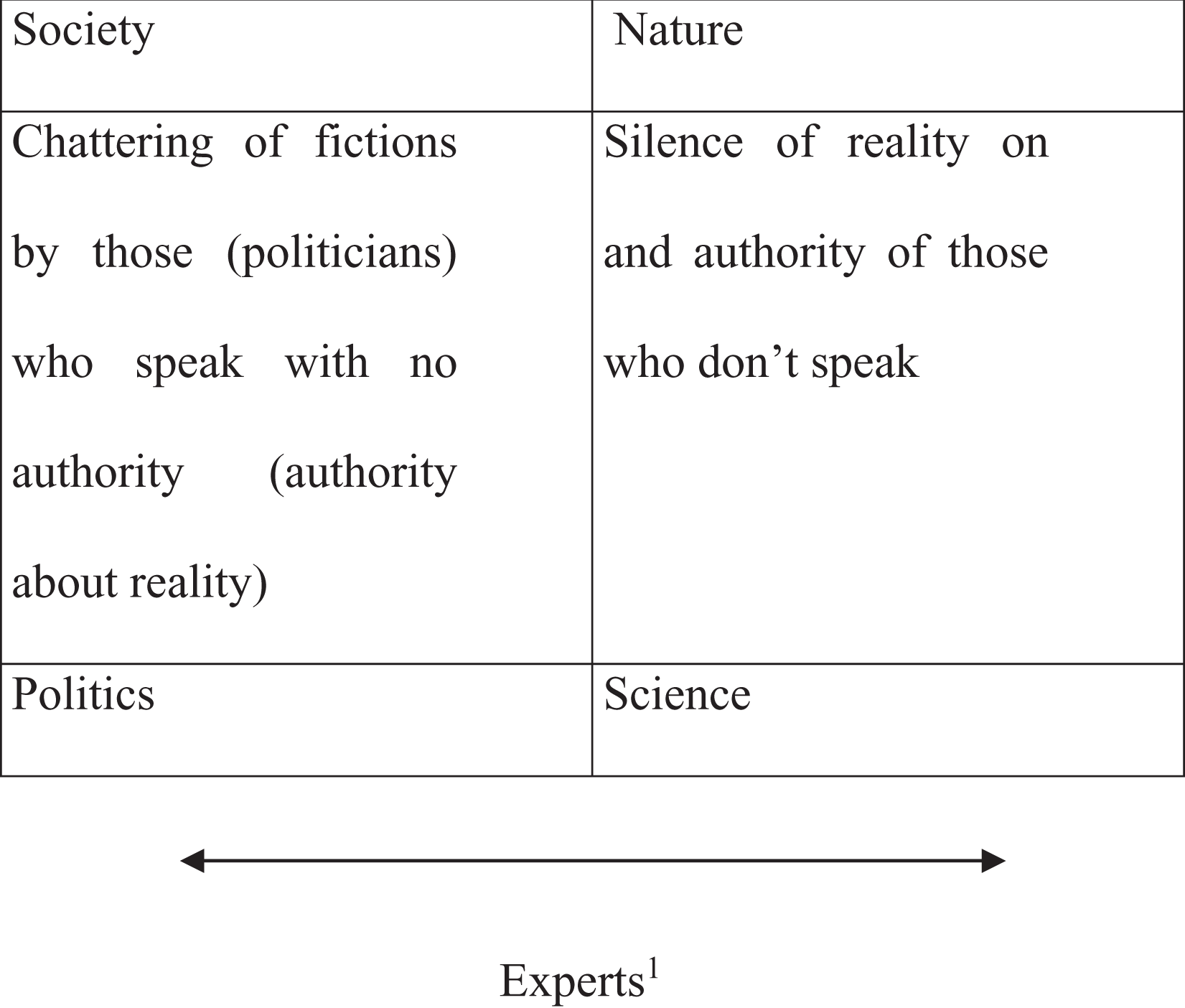
In a formulation that once again goes beyond standard anti-rationalism, Latour says that ‘western political thought has been paralysed for a long time by this threat from elsewhere’, the elsewhere being science. The appeal to this human/non-human hybrid straw man allows him to ask ‘How can we conceive of a democracy that does not live under the constant threat that would come from science?’ (Latour, 2004: 17). Elsewhere he uses a starker image of the relationship between politics and science: civil war.
So the above diagram represents his reconstruction of the dominant assumptions of the age, with politics and science in separate domains and the latter as a solution to the problems of the former. He wants to rid us of these images of science (knowledge) and politics (power), and replace them with another, ‘more realistic’ one, of the sciences as they are practised (and as Latour’s ethnographies have shown them to be practised) and of politics as it is increasingly practised.
The version of politics that fits most closely with this reconfigured image is what he calls ‘political ecology’. Political ecology, Latour suggests, is not a blueprint but a practice, something that is taking place throughout the advanced industrial democracies, and which points towards a way of thinking that will avoid the twin extremes of deep ecology on the one hand and liberal humanism on the other. The latter, afraid of science as it is of nature, does not understand that what threatens democracy is not what scientists do, but what we think it is that they do. Once we realize that what they do is the human activity laid bare in Latour’s ethnographies, we will find it easier to imagine the sciences as being part of democracy and not as the promised rationalist corrective to our political errors.
Similarly, the strength of political ecology as it is practised is not nature worship or nature protection but the dissolution of nature’s boundaries; political ecology is just as interventionist towards nature as modern science: it establishes previously unthought-of connections between humans and non-humans. Thus in environmental disputes or those about embryo research, nobody is having opinions ‘about’ nature, they are trying to work out what sort of common world they want to live in. And as long as the collectivity in which this is taking place is thought of not as a community of fate but as a web of associations, it will retain its democratic character. These public disputes are a good thing, and political ecology has contributed more to this version of democracy than other sorts of political philosophy (Latour, 2004: 24).
Political ecology, then, is the portal to a grander vision of what politics will have to look like when the modern constitution has been overthrown and politics has been redefined: ‘Not everything is political perhaps, but politics gathers everything together, so long as we agree to redefine politics as the entire set of tasks that allow the progressive composition of a common world.’ Political philosophy hitherto has focused only on human politics, leaving other questions, such as the relationship between human beings and nature, to be sorted out elsewhere.
To get us to think about that relationship he resorts to legal language, talking about the ‘illegality’ and the ‘illegitimacy’ of each side of the old constitutional divide, and of a ‘due process’ through which a new ‘collective’ can be formed that will include the ‘third estate’ that lost out to the twin evils of power (politics) and reason (science): ‘I am not proposing to replace a well-organized system with a quirky one, but to substitute two houses put together according to due process for the two illegitimate houses of the old Constitution’ (Latour, 2004: 128). His term for his new collective in which a common world will be fabricated is the old res publica, a name that if we understand it correctly brings the word ‘thing’ back to its original meaning, an assembly or gathering (as in the Icelandic/Germanic medieval parliament, the Dinggenossenschaft). ‘The empire [sic] of the modernist constitution, now on the decline, had made us tend to forget that a thing emerges before anything else as a scandal at the heart of an assembly that carries on a discussion requiring a judgment brought in common.’
The modern constitution may be on the decline, but the job of the philosopher/anthropologist/sociologist turned political theorist is to hurry it along. How can it be done? Well, once you are on the flat plain walking, or are sitting at a desk, it is much easier than when you have to clamber in and out of a cave. By constructing a diagram of the problem, including in the diagram a few cleverly worded definitions, and rotating that diagram through 90%, you can make a whole new political universe appear.
A notable feature of The Politics of Nature is how, through a curious combination of French-style theoretical verve and Parsons-like doggedness, Latour tries to rethink the fact–value distinction. When he says that ‘it is surely no longer possible to oppose the scientific world of indubitable facts to the political world of endless discussion’ (Latour, 2004: 63), he knows that there is work for the political theorist to do, that the practice of political ecology alone will not bring it about. That is why he says, as French thinkers have had to say several times before in the last two centuries, ‘I want this common world to be achieved after the new constitution has been drafted, not before’. In the old constitution the common good (value) and the common world (fact) were treated as separate; in the new constitution they must come together so that the question of the ‘good common world, of the best of possible worlds, of the cosmos’ can be raised (ibid.: 93). i. The first move in the drafting of a new constitution is to break down the meaning of ‘fact’ and of ‘value’. So: ‘fact’ refers to two entirely different procedures:(i) an entity puzzles participants in a discussion, say in the lab (perplexity); ii. discussion is brought to an end (institution).
‘Value’ also involves two procedures: iii. increasing the number of voices in a discussion (‘Have we taken these voices into account?’; iv. establishing a hierarchy – where do new propositions fit into this hierarchy of considerations?
Latour’s proposal here is that (i) and (iii) are similar (they are both part of what he calls ‘the power to take into account’) and (ii) and (iv) are similar (they are both part of what he calls ‘the power to put into order’). Now once you have broken down two categories into four, you can regroup them in a diagram. Here Latour’s claim that ‘we are only describing more concisely what the impossible fact–value distinction sought to make indescribable’ (Latour, 2004: 111) is as disingenuous as the claim that networks ‘come out of hiding’. But one can see the point when Latour uses it to describe a real world case, say that of prions and mad cow disease. Then we can say that there are two procedures involved, two stages – the power to take into account means that the voices of the president, scientific advisers, meat-eaters, prions, cows and sheep are considered relevant to the discussion; the power to put into order means that in the end some policy has to be formulated on the basis of a hierarchy of priorities, in which we ask whether mad cow disease killed anyone, and note that 8,000 are killed in traffic accidents every year. Latour suggests that breaking the issue down into ‘power to take into account’ and ‘power to put into order’ enables us to see something of the texture of public policy that the bald fact–value distinction is bound to obscure.
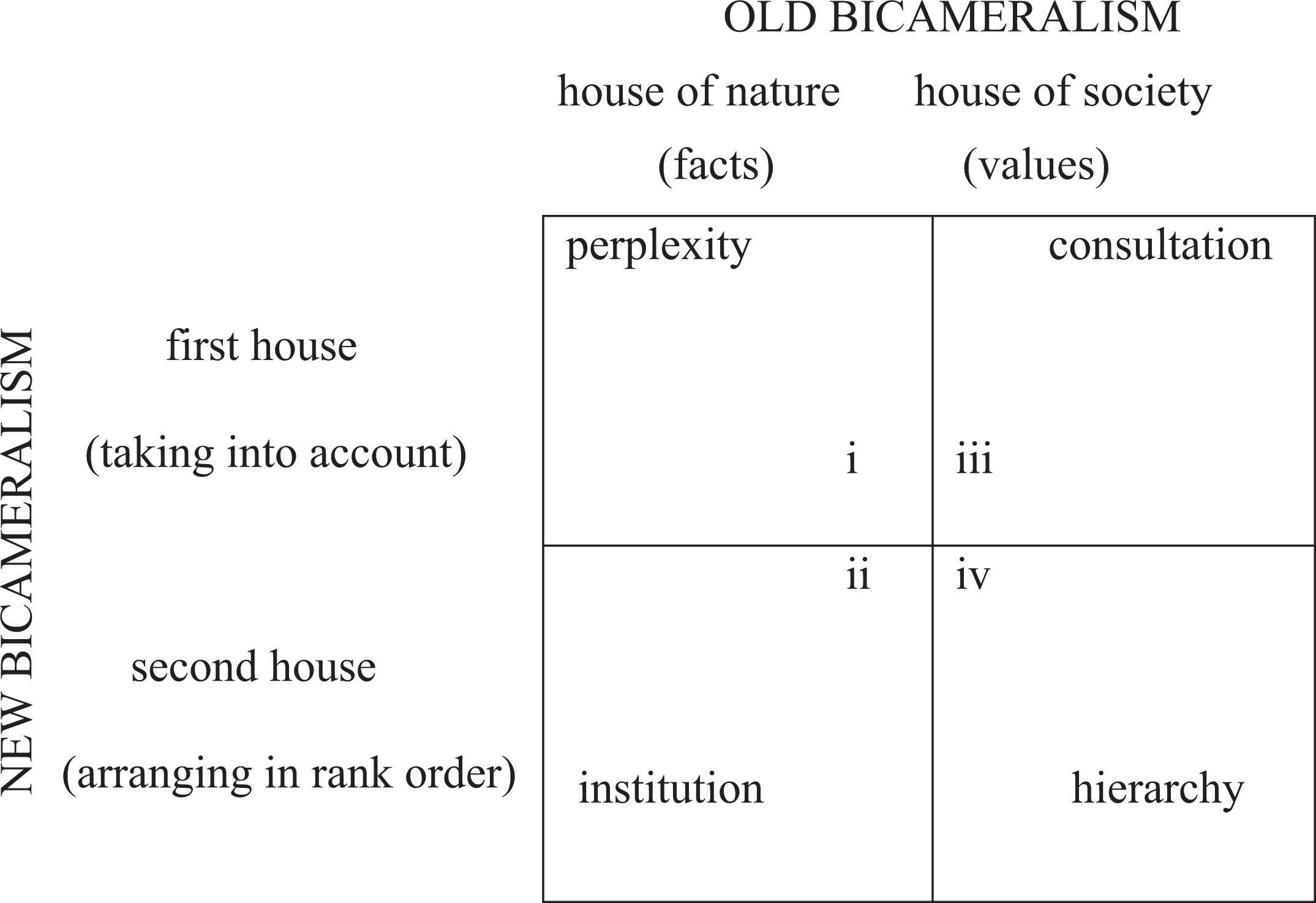
The problem is that this is followed by another move, the setting-down of a blueprint. In all the following diagrams, I will use the metaphor of lower and upper house to designate these two assemblies that re-dissect the collective unified in the previous chapter. The metaphor is a bit far-fetched I know, but I want to retain as many of the terms associated with our Western democratic tradition as possible. (Latour, 2004: 268)
Such diagrams, with their boxes demanding to be filled with words, recall those of Talcott Parsons or for that matter Jürgen Habermas (Baldamus, 1992). And when Latour adds 2 more requirements or tasks to the 4 already outlined, they sound somewhat like what Parsons called Latency, the L function in his AGIL four-function schema: v. keeping the activities of the new first house and the new second house as separate as were nature and society in the old constitution; vi. ‘scenarization of the collective in a unified whole’.
It turns out that there are three broad powers: the power to take into account, the power to put in order, and, embodied in tasks (v) and (vi), the power to govern. This power to govern is, apparently, the opposite of modernist mastery; instead it is a series of trials that makes up what Latour calls ‘a learning process’, a phrase that, though it crops up frequently in the work of Habermas and other representatives of the ‘modern critical stance’, is supposed to mean something other than a drive towards Kantian maturity, for as he says, gnomically, ‘in modernism, as we know, there was never any real feedback’ (Latour, 2004: 200).
Associated with these 6 tasks are the specific skills of specific professionals. Not that scientists should perform task number (i) and others should perform other tasks; on the contrary, scientists can bring their skills to bear on all of the tasks of the collective. So can politicians: The term ‘politician’ does not correspond to a precise profession, any more than the term ‘scientist’ does [at this point Latour indicates a diagram in which the word ‘skill (for example of politicians)’ appears at the top with a line pointing towards each task]; we are simply starting with existing callings, as good sense offers them to us. (Latour, 2004: 143) When homo economicus designated the foundation of universal anthropology, the inquiry into the composition of the world ceased at once. But if we use the term ‘global economy’ to designate a provisional version offered to the collective that will allow it to list one list of entities and reject another, then economics, like all the social sciences, plays an indispensable role: it reflexively represents the collective to itself. (Latour, 2004: 150)
The result of all this will be that ‘we no longer have a society surrounded by nature, but a collective producing a clear distinction between what it has internalized and what it has externalized’ (Latour, 2004: 124). In the example of mad cow disease and prions, mention was made of the 8,000 deaths on the roads and how these were considered not that important, or a price worth paying: ‘Even if this may appear shocking at first glance, no moral principle is superior to the procedure of the progressive composition of the common world; for the time being the rapid use of cars is “worth” much more in France than 8,000 innocent lives per year’ (ibid.), ‘representation rather than short-circuit is the goal of political ecology. As I see it there is a reserve of morality here that is much more inexhaustible and much more discriminating than the vain indignation whose goal was to prevent the contamination of values by facts or of facts by values’ (ibid.: 127).
Latour often presents his reimagination of the political landscape as a response to a set of conclusions he has drawn from the empirical study of how political disputes are conducted, how science is done, who the actors involved are, and from reflection on the ways in which this political/moral/economic/scientific reality has been persistently misdescribed by realist philosophers of science, social constructionist sociologists, or normative political theorists, and not described at all by the more talented writers from the Geisteswissenchaften. Yet it is also grounded in an ‘experimental metaphysics’, and here his effort to reconstruct the world and to see into the future looks oddly familiar to the student of the history of sociology. Indeed, of its prehistory: it turns out that there is a 7th task, described mysteriously as that of ‘following through’ on the promises and the achievements of the 6 tasks performed by our 4 select agents of a world made in common. When we are told that it is best performed by diplomats and administrators, it is hard not to hear the voice of Saint-Simon.
Conclusion
The claim that ‘with political ecology, we truly enter another world’ (Latour, 2004: 211) is something of a hostage to fortune, but Latour thinks we can do so because that world is already being made, in the dialogues and disputes and trials and negotiations that increasingly make up the political landscape, a landscape that sociology finds it difficult to see because it is either driving too fast along the motorway towards its over-hasty conclusions, or sitting behind the monoliths it has constructed and that it calls ‘society’; normative political theory cannot see it either, preoccupied as it is with the foundations of justice or the nature of evil. The ways of political world-making are there before us if we would slow down (sociology) or get moving (political theory).
When Latour presents his case as an ethnographer of science, technology and law, he is immensely persuasive. But he also presents himself as an anti-reductionist philosopher who wants us to change some of the basic ways in which we think. To the untrained ear the idea – to which Latour remains straight-facedly committed – that human and non-human objects have equal degrees of agency, will continue to sound forced, to strike a discordant note, and no amount of diagrammatic ingenuity is likely to change this. It may also strike the reader as ironic that a writer who has sought to grant agency to non-human objects should treat devices such as metaphors and diagrams as passive instruments that will bend to his theoretical will rather than as tools that, owing to their own logic if not their own agency, can only make certain things imaginable.
Doubtless the future of the human sciences – and of politics – is now more open than it once appeared to be: the collective formed by Latour’s trudging ants is unlikely to dissolve. But if ANT’s fans and practitioners believe that those ants will inherit the earth, they might reflect that even in the event of the monuments built by and the motorways used by sociology becoming ruins in a windswept desert, they may still have to share the donkey trails with the solitary walkers of the Geisteswissenchaften, with people like Blumenberg, who go up and down as well as across, zigzagging vertically as well as horizontally. Can one, in any case, retain the prophetic urge without wanting, now and again, to go up a mountain?