



Abstract
The Italian philosopher Giambattista Vico developed a theoretical framework for the study of human sciences that exerted a strong influence on psychology and other human sciences. He backed the notion of the unity of knowledge about human mind and culture, including history, linguistics, philosophy, philology, epistemology, psychology, and for the first time proposed a method for their study that he ambitiously called ‘new science’. The article presents an overview of Vico’s thought and discusses some of the main axioms of his theoretical system. His critique of Cartesianism and the alternative epistemology he outlined are put forward as a thoughtful tool for reflection on contemporary psychological science. Finally, this retrospective look at Vico's ideas provides useful insights for a programmatic view of cultural psychology.
Keywords
Introduction: Who was Giambattista Vico?
Giambattista Vico (1668–1744) was a philosopher, rhetorician, historian and jurist from the Kingdom of Naples, South Italy (Figure 1). Though Vico has exerted a tremendous influence in the social and human sciences, his name is indeed unfamiliar to psychology students nowadays. He was the first to systematically stress the cultural, genetic and linguistic dimensions in the development of both human mind and social institutions. Nevertheless, this part of Vico’s work went under the radar, while the historical, philological and juridical works received more attention (Adams, 1935; Tagliacozzo, 1981).
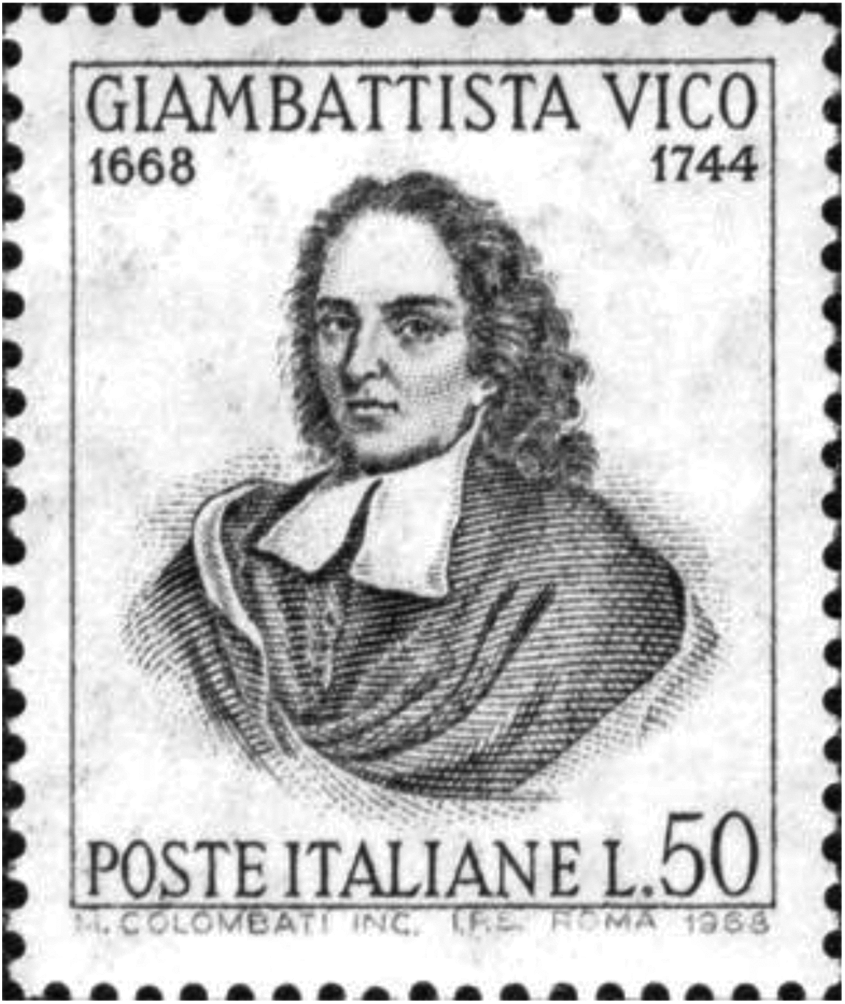
Portrait of Giambattista Vico on the Italian postage stamp issued for the 3rd centenary of his birth in 1968.
Although his ideas about the relationship between mind and culture and his epistemology have explicitly, or sometimes implicitly, inspired the work of many scholars in psychology – e.g. Wundt, Jung, Cattaneo, Bruner and Moscovici just to mention a few over different historical periods (Tateo and Iannaccone, 2011) – only uncoordinated works on specific aspects of Vico’s psychological ideas have been produced since the 1970s. A systematic presentation of his thought with special reference to psychology is still lacking. Vico’s epistemology, methods of studying cultural and psychological phenomena, theoretical concepts (e.g. imagination, common sense, laws of cultural development, language and thought, artifacts, metaphorical thinking, etc.), can be actually considered ancestors of contemporary cultural psychology. Vico can be also considered the precursor of all the systemic, genetic and historicist complexity thinking in psychology, as opposed to Cartesian dualism and other kinds of reductionism. The relevance of a systematic presentation of Vico’s ideas and his influence in psychological science is not only related to the history of knowledge but also to the current debate between biological and cultural approaches, as well as between idiographic, historical and quantitative approaches. It is one of the rare cases in which an intellectual endeavor meets the needs both of historical foundations of a discipline and of current epistemological and methodological debate.
The first relevant point that must be stressed is that Vico made a systematic elaboration of the contextual nature of the forms of knowledge and modes of thought. Vico stressed the relationship between forms of knowledge, development in time, language and social practices – an assumption that would later become a foundation stone for cultural psychology (Valsiner, 2014). Second, Vico elaborated a philosophical system ahead of his time that inspired psychology, linguistic anthropology, historiography, sociology and philosophy. In the first part of the article, I will discuss the main elements of Vico’s epistemology and present the principles of his psychological system. In the second part, I will try to elaborate on the relationship with cultural psychology and identify some future directions inspired by Vico’s ideas. This article addresses those social scientists who are not familiar with Vico’s ideas, and thus experts might find it somehow unsatisfactory. Nevertheless, I will try to provide an understanding and elaboration of his concepts that will hopefully also trigger new ideas for Vico experts.
Forms of knowledge
In Greek philosophy, as it was received by European culture, there were hierarchies in the forms of knowledge in relation to experience and to interpersonal elaboration. For Plato there are two basic modes of knowledge: episteme and doxa. They can be approximately translated as truth or true knowledge, and belief or justified belief. Plato’s idea is that everyday statements we make are inherently deficient with respect to real truth. We deal with the world according to our desires and needs, to what other people think, etc. This is a language- and experience-based mode of thought, a knowing about the particular, the individual, the sensible things that we could call idiographic. It always leads us to false generalizations about the universals, as Plato blamed Sophists for doing. Thus, doxa is a weak cognitive attitude that includes both opinions and justified true beliefs. It is based on our needs, used to respond quickly and practically to everyday matters. On the other hand, there is true knowledge, which is instead a logic- and mathematics-based mode of thought; it is about the universals and abstract ideas. When episteme replaces doxa, then we enter the realm of philosophy and true knowledge.
At the beginning of the Metaphysics, Aristotle develops Plato’s epistemology into three different types of knowledge: knowledge from experience; knowledge from art; and knowledge from science. Knowledge from experience is achieved by learning how to perform a certain task or to solve a certain problem, having tried different methods on one’s own. This is lay people’s knowledge. It is not a knowledge about how things are, just about how they work. When experiences in a certain subject matter are put together, knowledge of an ‘art’ or ‘trade’ emerges. At this point, it is not just knowledge about how to accomplish a task, but also a first type of knowledge about the reasons behind it. This is the doctor’s or craftsman’s knowledge. The third degree of knowledge, ‘scientific’ or ‘theoretical’ knowledge, is, according to Aristotle, that of sciences, philosophy and mathematics. As Aristotle says: With a view to action experience seems in no respect inferior to art, and we even see men of experience succeeding more than those who have theory without experience. The reason is that experience is knowledge of individuals, art of universals, and actions and productions are all concerned with the individual; for the physician does not cure a man, except in an incidental way, but Callias or Socrates or some other called by such an individual name, who happens to be a man. If, then, a man has theory without experience, and knows the universal but does not know the individual included in this, he will often fail to cure; for it is the individual that is to be cured. But yet we think that knowledge and understanding belong to art rather than to experience, and we suppose artists to be wiser than men of experience and this because the former know the cause, but the latter do not. (Aristotle, 1988: 256) A large field for philosophical investigation is open to speculative minds by frequenting your famous arsenal, Venetian Gentlemen, and particularly in that branch which is called mechanics, since every sort of instrument is continually put into operation there by a great number of artisans: amongst them there must be some who, through observations handed down by their predecessors as well as through those which they attentively and continually make for themselves, are very expert and capable of the most subtle reasoning. (1914[1638]: VIII, 49)
The geometric method in human sciences
While Galilei reconciled the realm of experience with the realm of mathematical and deductive reasoning in the field of physical science, the whole range of culture, language and mental phenomena was still in limbo. The mind/body problem can be stated as the simple question: How can a non-physical mind or soul interact in a causal way with a physical body? The problem is deceptively simplistic sounding. Rest assured that it is not a simple problem, and there are several hundred years of metaphysics to back this statement up. In fact, modern metaphysics, which begins with Descartes, can be well interpreted as being centrally focused on the mind/body problem, just as Ancient Greek metaphysics was focused on the problem of universals. (Davis, 2010: 80) Descartes despises fantasy and what comes to us through the senses, he discards history and tradition as a mass of popular nugacity, and believes only in the clear cold sense of the ‘honnête homme’. He builds up nature mechanically, society atomistically. That is inevitable, since he is a mechanical abstractor, a mathematical machine producing only its own symbols. Deduction is an empty game when it is not preceded by the amplest of inductions, covering all of our experience which starts with ‘fantasy’ – an induction such as Descartes’ tyrannical precepts forbid. (de Santillana, 1950: 569) …obey[ing] the laws and customs of my country, adhering firmly to the faith in which, by the grace of God, I had been educated from my childhood and regulating my conduct in every other matter according to the most moderate opinions, and the farthest removed from extremes, which should happen to be adopted in practice with general consent of the most judicious of those among whom I might be living. (Descartes, 2008[1637]: 24)
When Descartes’ view became mainstream, all human products of social and practical life that could be referred to the domain of natural language rather than of technology (e.g. arts, myths, etc.) were excluded from scientific discourse (Berlin, 1974), to the extent that they could not be understood and represented in terms of the only rigorous method of knowledge: namely mathematical. Thus, Descartes and Cartesianism rejected all the forms of knowledge related to the use of language – like rhetoric – as mere presentations and orientations of beliefs. This led also to a change in the way of viewing education, which at Vico’s time was largely based on Cartesianism and Port-Royal logic. Students had to study ‘critica’ (that is, a way of clear and certain reasoning based on mathematical and logical knowledge) instead of ‘topica’ (that is, all the subjects related to rhetoric) (Vico, 1965[1709]). The perennial conflict between civic humanism’s and natural philosophy’s irreducible epistemologies, established in modern philosophy with Cartesianism, is still at work today. In this sense, cultural psychology can be considered an heir-at-law of Vico’s philosophy to the extent that the cultural products of human activity are put in relation with the mind stressing a two-way co-constitutive process of internalization and externalization between the mental and cultural (Valsiner, 2014). In Cartesianism, mind was rather a closed system, basically working on its own principles, receiving inputs from the senses’ induction. There is an epistemological analogy with those approaches, such as cognitivism and neuro-psychology, that treat brain as a closed system working with its own principles, that treat social and cultural dimensions as inputs and outputs. This analogy was already stressed by Marcel Danesi (1995), who proposed a systematic review of the research program in cognitive psychology on the basis of Vico’s ideas. Danesi claims that cognitive science’s enterprise, deriving from Cartesianism, ‘attempt[s] to take the study of mind out of the body, so as to be able to study it more objectively in a computer’ (1995: 43–4). Just like Descartes’, the attempt was to purify the language for the study of mind from all the ambiguities of natural language, in search of more profound and basic structures and processes of cognition, closer to the hardware language of psychophysiology, with which the encounter was sooner or later unavoidable. Danesi’s argument is to reverse the relationship between deep and surface levels of understanding psychological processes. In the Cartesian view, indeed, the surface level was that of polysemic language and image, while the deep structure was basically logic and rationality. According to his reading of Vico, Danesi instead proposes to consider the deep level to be ‘where the sense impressions that the brain converts into images are subsequently transformed into iconic signs and mnemonically-usable percepts by the imagination’ (ibid.: 61). The metaphorical process represents the connection between the deep, imaginative level of cognition and the superficial level through the cultural framework, which is, according to Danesi, that of language and conceptualization: ‘through the workings of the metaphorical capacity, a surface form of cognition eventually crystallizes’ (ibid.: 80). This is a total reversal of any computationalist-rationalist approach to the study of mind. ‘Deep-level sense-making gives pattern and continuity to human experience. Surface-level syntax gives pattern and stability to concepts’ (ibid.: 80–1). Vico’s theory of the human psyche identifies the distinctive characteristic of mind in its capacity of imagination, the main symbolic capability. In his own words, imagination ‘is nothing but the springing up again of reminiscences, and ingenuity or invention is nothing but the working over of what is remembered’ (Vico, 1948[1744]: 236). It is a progressive distancing from the senses through the creation of images that allow for the construction of abstract concepts. Imaginative capability is based on three fundamental functions of the mind: fantasia, the capability to imitate and change; ingegno, the capability to create correspondence between things; and memoria, that is, the capability to remember. Nevertheless, there is a fundamental anthropological difference between the primitive men, who own these capabilities as a result of the divine providence’s far-sightedness, and contemporary human beings. In the course of historical civilization, humans develop the function of rational thinking. Now, since the human mind at the time we are considering had not been refined by any art of writing nor spiritualized by any practice of reckoning or reasoning, and had not developed its powers of abstraction by the many abstract terms in which languages now abound, as we said above in the Method, it exercised all its force in these three excellent faculties which came to it from the body. All three appertain to the primary operation of the mind whose regulating art is topics, just as the regulating art of the second operation of the mind is criticism; and as the latter is the art of judging, so the former is the art of inventing, as has been said above in the last Corollaries of the Poetic Logic. And since naturally the discovery or invention of things comes before criticism of them, it was fitting that the infancy of the world should concern itself with the first operation of the human mind, for the world then had need of all inventions for the necessities and utilities of life, all of which had been provided before the philosophers appeared. (Vico, 1948[1744]: 236) …(a) that human nature and society are not fixed or stationary, but rather are in a state of continuous change; (b) that the changes occur in evolutionary cycles influenced by human events; (c) that despite epistemological limitations, it is scientifically possible to investigate social behavior across eras in order to reveal events that influence the recursive evolution of society, as well as the genesis of theories of human behavior and society. (Rosnow, 1978: 1322)
Bacon was 30 years senior to Descartes. Though later in the 17th century his position became somehow that of a minority with respect to the Cartesian mainstream, he attempted to develop a systematic epistemological and methodological system able to account also for the products of human civil activity. To be able to demonstrate knowledge of causes requires having undertaken an active initiative investigation of them. As the famous third aphorism of the New Organon puts it, ‘Human knowledge and human power meet in one…that which in contemplation is as the cause is in operation as the rule’. Bacon affirms the position that ‘true knowledge is knowledge by causes’, and asserts that the important causes are not the immediate efficient and material causes, but what he misleadingly calls ‘formal causes’ or ‘forms’: ‘For though in nature nothing really exists besides individual bodies, performing pure individual acts according to a fixed law, yet in philosophy this very law, and the investigation, discovery, and explanation of it, is the foundation as well of knowledge as of operation. And it is this law with its clauses that I mean when I speak of forms’. Interpretation of Bacon has suffered from general ignorance, or ignoring, of the rational element of his logic of science grounded in operatio. (Barnouw, 1980: 611)
From Bacon’s system Vico drew some basic ideas. The first one was the objective of building an epistemological system more geometrico [in a geometric way] for studying the product of human social activity, culture and history. The second point was that the ‘adaptation of the ancients’ correlation of topica with invention as a preliminary to judgment (critica) was taken over by Vico, who suggested that topical (positive, given) and critical (rational, truth-oriented) were interrelated elements within every branch of science’ (Barnouw, 1980: 611). The third idea was the relationship between knowing and making. For Bacon, to attain knowledge implies mastering reality. Knowledge is a form of power over reality because it is related to the capability of humans to make things. This implies that knowledge and human reality are in a cycle of continuous creation and re-creation: as long as we make, we know, by knowing we make different things, and so on and so forth. Thus, there is no ultimate knowledge, only a development of knowledge. Such a development of knowledge can be achieved only through the correct method and epistemology.
This scientific enterprise was possible because the object of the ‘new science’ is made by humans themselves. ‘Now, as geometry, when it constructs the world of quantity out of its elements, or contemplates that world, is creating it for itself, just so does our Science, but with a reality greater by just so much as the institutions having to do with human affairs are more real than points, lines, surfaces, and figures are’ (Vico, 1948[1744]: 104–5).
Verum and certum
Giambattista Vico was an academic outsider. He succeeded in achieving an academic professorship in ‘Eloquence’ at the University of Naples in 1699. He sought for a professorship in law. Because the mainstream was dominated by Cartesianism and Vico was opposing it, he spent his whole life trying to get official recognition for his innovative ideas, but his work was almost ignored when he was alive. As professor of rhetoric, Vico was asked to give 7 times the inaugural speech in Latin of the academic year at the University of Naples. In his 7th speech, which was given in 1708 and published in 1709 with the title ‘De nostri temporis studiorum ratione’ [On the Methods of Study of Our Times], Vico (1965[1709]) outlines his theory of the specificity of human sciences, creating a polemic with Cartesianism-based education. The two main claims of Vico in this work are that human thought is based on several dimensions, not just on logical and rational thought. This implies that an education which is aimed at developing only the ‘critica’, in Descartes’ sense of analysis, will nurture students that are not able to play an active, constructive and leading role in civil society. In De nostri temporis studiorum ratione Vico compares the methodological orientations of the classical and the modern intellectual world, explicitly extending and modifying Bacon’s survey. He is particularly concerned to see what advantages of the ancients’ system of arts and sciences might have been sacrificed in the progress of modern science, and whether these might be recovered or compensated for without detriment to the modern critica. (Barnouw, 1980: 614)
The first point in ‘De nostri temporis’ is the interdependence of the empirical and rational. The theoretical and practical dimensions of knowledge are always related. In this sense, geometry is an example of fully developed science. The geometrical method was applied, for instance, to physics, producing significant advancements. But geometry is also a product of human activity and for this reason is a good example of the verum ipsum factum principle. Knowledge is made of understanding things as they came to be as they are at present. Human cognition is limited in its capability to know the real world; only God has the full understanding of phenomena and their causes, as He made them and knows the whole history. ‘But this contrast also implies a parallel. God knows (cognoscit) because he creates and disposes; man knows (novit) because he makes and composes. The active component of human knowing is the key to man’s participation in the divine form of cognition, intelligere’ (Barnouw, 1980: 616). As Vico says in his famous passage: ‘We demonstrate geometry because we make it; if we could demonstrate physics, we would make it’ (Vico, 1965[1709]). Opposing Descartes, Vico claims that we cannot know our mind only by observing from ‘within’ the system’s logic, because the system was made by God. We can know mind only in relationship to its products. This is the second point: every product of human activity is worth being an object of science. We can study culture because we made it and we can genetically reconstruct the whole process of creation and development. In this sense, the knowledge of ancient cultures is relevant because they hold a relationship of continuity and discontinuity with the current ideas. Through the study of the past, we can understand the genesis and development of the present. This knowledge can be specifically attained through the study of language. As in Vico, language and thought are inseparable; the study of etymology and metaphors reveals not only the historical conditions of their creation but also the psychological conditions and reactions to them.
The third point is that the origin of culture is exactly the solution human beings found to overcome their cognitive finitude: ‘since man is not capable of grasping the natural elements from which things derive their reality, he creates for himself the elements of words, from which ideas are called forth without controversy’ (Barnouw, 1980: 617). Thus, culture is nothing but the ‘cultural’ solution lay people developed to account for natural phenomena they cannot understand from their causes. This wide-range solution is made possible not by the ‘cogito’, which is a self-evident but tautological process, but by the human capability of anticipating and innovating through imagination. ‘The occasion for the progressive development of this cause is the actualization of a sequence of desires, beginning with a desire for the necessities of life, followed by a desire for what is useful, then for what is comfortable, and so on, which belongs to man by nature’ (Pompa, 2002: xxv).
We have known all the elements of the complex theory of knowledge elaborated by Vico (Figure 2), that he will fully develop in the third edition of the ‘New Science’: there are different kinds of truth: (1) the ‘Truth’ [verum], which pertains only to God; (2) the ‘common sense’ [verum certum] which is the practical knowledge and belief achieved through practices and consent; and (3) the ‘truth through making’ [verum factum], which is the scientific knowledge about all the products of human activity.
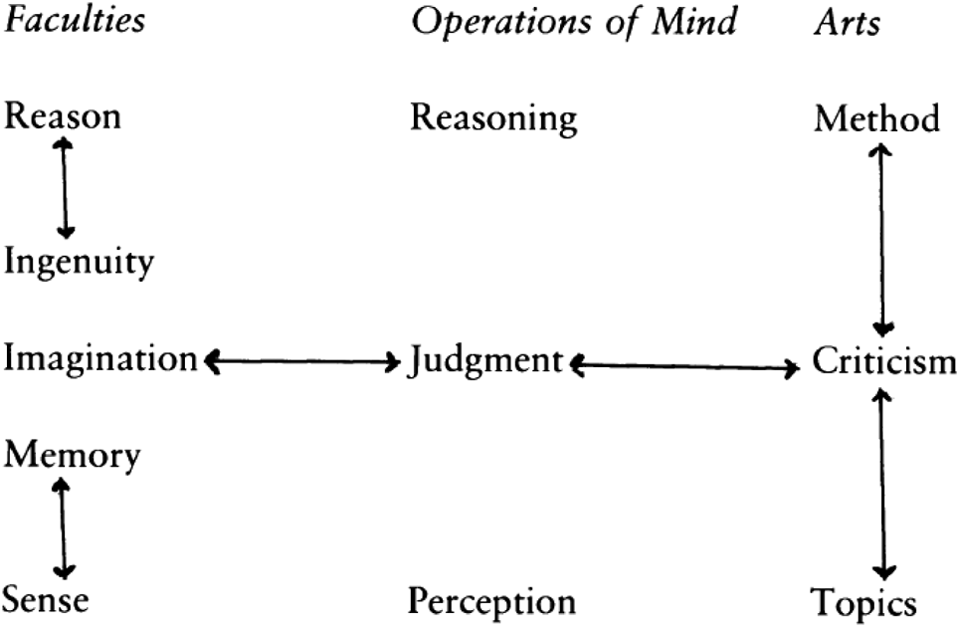
Elements in the production and assessment of knowledge in Vico (Tristram, 1988: 360).
Knowledge originates from the faculty of sense, which at a psychological level corresponds to the elaboration of perception. This first material, which is elaborated at the pragmatic level of language, constitutes the experiential fuel for the mind’s faculties of fantasia, ingegno and memoria. The human mind is naturally inclined by the senses to see itself externally in the body, and only with great difficulty does it come to attend to itself by means of reflection. This axiom gives us the universal principle of etymology in all languages: words are carried over from bodies and from the properties of bodies to express the things of the mind and spirit. (Vico, 1948[1744]: 70) Men at first feel without observing, then they observe with a troubled and agitated spirit, finally they reflect with a clear mind. This axiom is the principle of the poetic sentences, which are formed with senses of passions and affections, in contrast with philosophic sentences, which are formed by reflection and reasoning. The more the latter rise toward universals, the closer they approach the truth; the more the former take hold of particulars, the more certain they become. (Vico, 1948[1744]: 67–8) Human choice, by its nature most uncertain, is made certain and determined by the common sense of men with respect to human needs or utilities, which are the two origins of the natural law of nations…‘Common sense is judgment without reflection, shared by an entire class, an entire people, an entire nation, or the whole human race’. (Vico, 1948[1744]: 57)
‘Vico finds the underlying basis of this pattern in a metaphysics of the human mind’ (Pompa, 2002: xxvi), promoting a …communal essence of mind that Vico’s Science can claim to be a philosophy of humanity, i.e. human nature. Since no previous thinker has reached such a conception, he believes, it follows that nobody has been in a position to provide a coherent and defensible basis for the governing ideas, i.e. both the causes and the occasions, used in their interpretations of the nature and history of different nations. (ibid., 2002: xxvi)
The axioms of the new science
In the previous sections, I have tried to sketch the context and the pathway that led Vico to the elaboration of his innovative philosophical system, presented in his masterwork the ‘New Science’ (Figure 3). Vico aimed at developing an epistemological and methodological framework that could serve the study of the products of human culture and the understanding of human mind and human activity, according to the criteria of science he first outlined in ‘De nostri temporis’. In this sense, the ideas that Vico elaborated can be considered the ancestors of the epistemological principles of cultural psychology.
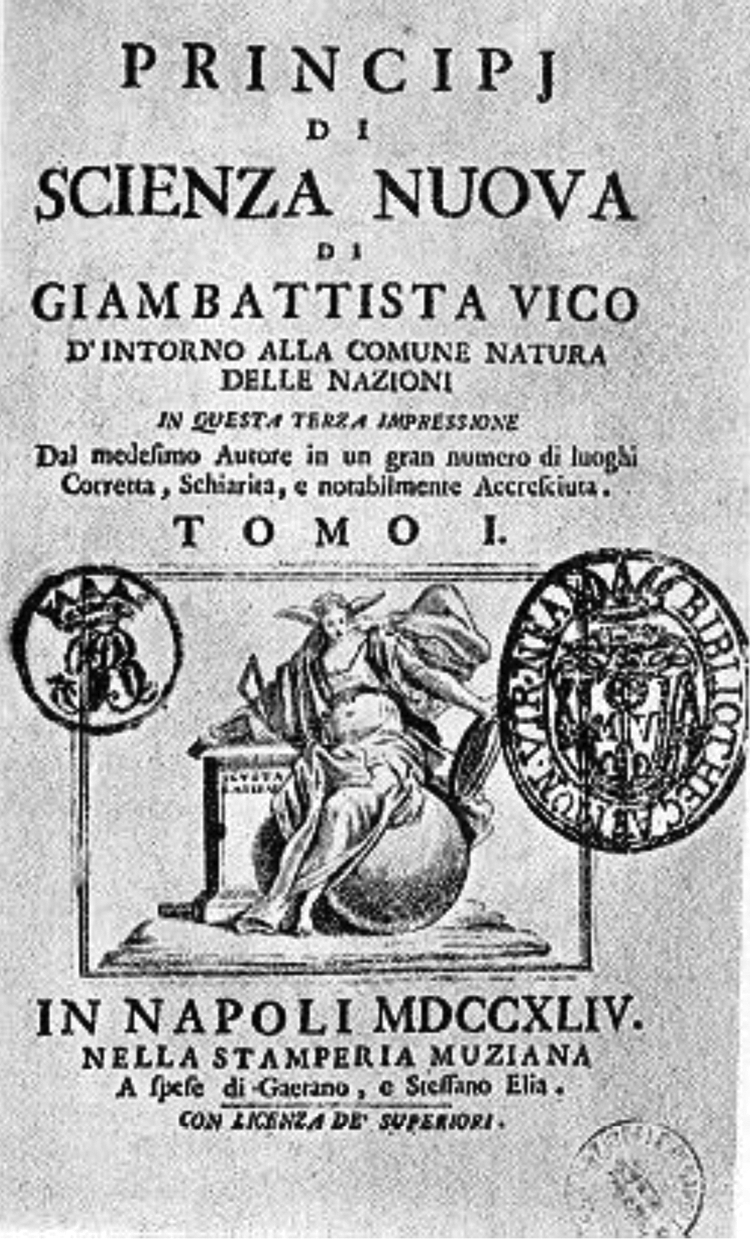
The frontispiece of the 3rd edition of Scienza Nuova, published in 1744.
Vico’s philosophical system had first of all to be ‘geometrical’, that is, a system made of axioms that generate deductively a set of rules to be applied to the study of phenomena. It had to be able to account for the whole history of human development of civilization as well as the full range of human products, arts, laws, customs, languages, institutions, etc. Vico introduces a fundamental principle in philosophical anthropology. In fact, he describes the history of civilization as progressive development of the relationship between will and intellect, with the latter taking over the former. Vico argues that the distinctive feature of human nature has been the capability of creating products of civilization – namely divinity worship, marriage and burials – as self-regulatory systems that were able to act ‘on the bestial passions’ of primitive men and ‘transformed them into human passions’ (Vico, 1948[1744]: 90).
The third and final edition of the New Science is organized in 5 books. The first book is about the principles of the new science, and contains the system of axioms, principles, and methods of study of civilizations. The second book is about the concept of poetic wisdom, that is, the primeval form of human knowledge, a mythological thinking that generated its own metaphysics, logic, physics, ethics, politics, geography and astronomy. Vico discusses all these forms of culture, arguing that they originated in a system of ‘poetic universals’. These are the first forms of collective culture that the different primitive agents elaborated through an imaginative, metaphorical and practical mode of thought. A central point in Vico’s theory of universals is that these forms are common to different civilizations because they are founded on the basic psychological processes of imaginative thought. All the primitive civilizations had to explain, he claims, natural phenomena, e.g. thunder. His explanation was based on the creation of anthropomorphic and powerful universal figures, like Zeus, that we can find in every culture. Poetic universals are real ‘archetypes’ (Jung, 1981) that must be studied in order to understand the past mentality; they, however, contain a spark of truth. Finally, the last three books are devoted to the reconstruction of the story of civilization, by applying the principles of the new science.
For the sake of this introductory article, I will focus on the system of axioms (called ‘Degnità’) that Vico develops as starting points of the new system. I will argue that these theoretical principles represent the first systematic and comprehensive formulation of the ideas that will be later developed by cultural psychology. Vico elaborates 114 axioms derived from the discussion of the development of ancient cultures, which he will use in return to analyse the whole chronology of civilization. I will discuss some of the most relevant axioms as specimens of Vico’s system. Axioms are the ‘ties that bind’ human things into a history, a pattern of providence and human making that one can address eloquently – that is, comprehensively – as a whole…Axioms, like the loci of the ancient memory systems, remind us of things we should know in narrating an eloquent whole…In this way the axioms become pisteis, means of persuasion, by which we come to understand the realities of our situation. (Goetsch, 1995: 127)
Axiom I opens with: ‘Because of the indefinite nature of the human mind, wherever it is lost in ignorance, man makes himself the measure of all things’ (Vico, 1948[1744]: 54). It is stated that human knowledge is primarily anthropomorphic. What is unknown and far from direct experience also requires to be explained by larger causes. It is the basis for the development of imaginative universals and poetic wisdom, in which the causes of natural phenomena that do not have a direct explanation are attributed to anthropomorphic figures with immense powers. The anthropomorphic principle can be understood also in another way. Indeed, the original form of knowledge is also based on the bodily and affective dimensions in the process of sense-making (Danesi, 1995).
Axiom II is: ‘It is another property of the human mind that whenever men can form no idea of distant and unknown things, they judge them by what is familiar and at hand’ (Vico, 1948[1744]: 54). We could define this as the principle of ‘anchoring’ and ‘objectivation’ as understood by Moscovici (2007). As the symbolic resources for explanation and imagery are provided by culture, this axiom can also be considered as the idea of inertia in cultural innovation. ‘Because the human mind was at first unable to form abstractions, it used metaphors involving the body and the senses. Because of this, Vico held that the first perceptions of all cultures were structurally consistent, a means of thinking through things (bricolage, as the anthropologist Claude Lévi-Strauss would call it)’ (Kunze, 2012: viii). Axioms III and IV deal with cultural continuity and ethnocentrism. ‘Every nation, according to him, whether Greek or barbarian, has had the same conceit that it before all other nations invented the comforts of human life and that its remembered history goes back to the very beginning of the world.’ And ‘To this conceit of the nations there may be added that of the scholars, who will have it that whatever they know is as old as the world’ (Vico, 1948[1744]: 55). Culture looks backward in order to explain and plan. The sense of cultural continuity is essentially related to the past. At the same time, Vico stresses the essential ethnocentric nature of any civilization. This paves the way to a relativistic approach to the study of cultures that must be understood according to their own stage of development and their point of view (Leach, 1976).
Axioms VII and VIII are about the relationship between nature and civilization: Legislation considers man as he is in order to turn him to good uses in human society. Out of ferocity, avarice and ambition, the three vices which run throughout the human race, it creates the military, merchant and governing classes, and thus the strength, riches and wisdom of commonwealths. Out of these three great vices, which could certainly destroy all mankind on the face of the earth, it makes civil happiness.
Axiom IX says: ‘Men who do not know the truth of things try to reach certainty about them, so that, if they cannot satisfy their intellects by science, their wills at least may rest on conscience’ (Vico, 1948[1744]: 56). Here is outlined the idea of common-sense knowledge or certum. There is a scientific knowledge qualitatively different from beliefs or values. The former requires a scientific method to be ascertained, the latter is based on consensual and ethical relationships. This is also a criticism of Descartes, whose cogito was for Vico a process of self-consciousness rather than an absolute epistemological principle of knowledge validity. Common-sense knowledge is true to the extent that it is instrumental and useful in acting within a community. Then, in axiom X, Vico defines the domains of knowledge with respect to verum and certum: Philosophy contemplates reason, whence comes knowledge of the true; philology observes the authority of human choice, whence comes consciousness of the certain. This axiom by its second part defines as philologians all the grammarians, historians, critics, who have occupied themselves with the study of the languages and deeds of peoples: both their domestic affairs, such as customs and laws, and their external affairs, such as wars, peaces, alliances, travels and commerce. This same axiom shows how philosophers failed in not giving certainty to their reasoning by appeal to the authority of the philologians, and likewise how the latter failed by half in not taking care to give their authority the sanction of truth by appeal to the reasoning of the philosophers. If they had both done this they would have been more useful to their commonwealths and they would have anticipated us in conceiving this Science. (Vico, 1948[1744]: 56–7)
The combination of axioms XI, XII and XIII specifies the fundamental idea of common sense. ‘Human choice, by its nature most uncertain, is made certain and determined by the common sense of men with respect to human needs or utilities, which are the two origins of the natural law of nations’ (Vico, 1948[1744]: 57). ‘Common sense is judgment without reflection, shared by an entire class, an entire people, an entire nation, or the whole human race’ (ibid.). And ‘Uniform ideas originating among entire peoples unknown to each other must have a common ground of truth. This axiom is a great principle which establishes the common sense of the human race as the criterion taught to the nations by divine providence to define what is certain in the natural law of nations’ (ibid.). In these statements, Vico provides a definition of a mode of thought which is based on the anticipation of judgement, on the consensual validation and the existence of ‘cultural constants’ (Rogoff, 2003). What is relevant for cultural psychology is that for the first time in history, common-sense knowledge is not understood as a lower way of cognition, as a cognitive bias, but as a specific mode of thought which has its own rules and usefulness in social life.
In axioms XIV and XV, Vico introduces the fundamental principle of the historical and genetic method. I am maybe reading too much into the text by using these terms that belong to a modern way of thinking. I do that to stress the anticipatory character of Vico’s system, which has indeed influenced the development of human sciences. Axiom XIV is: ‘The nature of things is nothing but their coming into being [nascimento] at certain times and in certain fashions. Whenever the time and fashion is thus and so, such and not otherwise are the things that come into being’ (Vico, 1948[1744]: 58). Axiom XV instead is: ‘The inseparable properties of things must be due to the mode or fashion in which they are born. By these properties we may therefore tell that the nature or birth [natura o nascimento] was thus and not otherwise’ (ibid.). To understand phenomena it is thus necessary to investigate both the historical conditions of their origin and the genetic process of their development. Isaiah Berlin, who saw in Vico an anticipator of 19th-century philosophy, credited him with being the first to outline the ‘method of understanding’ as will be later defined, for instance, by Dilthey and Weber (Berlin, 1976).
Another fundamental principle is the relationship between language, culture and mind. Language, thought and vision of the reality are strictly related. In axioms XVI, XVII and XVIII, Vico states that processes are crystallized in language, which is the vehicle of cultural continuity. It is also the primary object of investigation for an historical and developmental science of civilization. Vulgar traditions must have had public grounds of truth, by virtue of which they came into being and were preserved by entire peoples over long periods of time. It will be another great labor of this Science to recover these grounds of truth which, in the passage of years and the changes in languages and customs, has come down to us enveloped in falsehood. (Vico, 1948[1744]: 58)
The last relevant point is the relationship between culture and the different dimensions of mental activity. The famous axiom LIII states: Men at first feel without observing, then they observe with a troubled and agitated spirit, finally they reflect with a clear mind. This axiom is the principle of the poetic sentences, which are formed with senses of passions and affections, in contrast with philosophic sentences, which are formed by reflection and reasoning. The more the latter rise toward universals, the closer they approach the truth; the more the former take hold of particulars, the more certain they become. (Vico, 1948[1744]: 67–8) The human mind is naturally inclined by the senses to see itself externally in the body, and only with great difficulty does it come to attend to itself by means of reflection. This axiom gives us the universal principle of etymology in all languages: words are carried over from bodies and from the properties of bodies to express the things of the mind and spirit. (Vico, 1948[1744]: 70)
I will not go on discussing the whole system of axioms, as my purpose is to illustrate some examples of the innovation that Vico brought to human sciences and some of his ideas that can be considered as precursors of cultural psychology. I will now offer some reflections about the lesson learnt as a cultural psychologist from reading Vico.
Genetic, generative and generated: The roots of cultural psychology
Giambattista Vico was the first philosopher who systematically explored the relationship between mind and culture. From the philosophical point of view, Vico was a kind of boundary thinker, at the crossroads between humanism, empiricism and the Enlightenment. His theories about culture and human development anticipated those of Hegel, Spengler, Toynbee, Marx, Piaget, and even Freud and Lacan. His use of optical metaphors emphasized the psychological function of dimensionality in the construction of knowledge. This method opens the way to combine literature, poetry, architecture, the arts, and the study of landscape into a single humanistic project. Vico’s theory of culture is, fundamentally, a theory of the signifier, extended to account for socio-cultural, environmental, psychological, political, linguistic, and historic phenomena. As such, it promises much to those who seek a comprehensive and grounded theory of place. (Kunze, 2012: vii) The fragmentation of contemporary culture is the fundamental problem for the humanities and the social sciences in our time. If they cannot come to terms with this fragmentation, we are left without an intellectual center. Marx and Vico are both thinkers who provide a basis for holistic thought about culture…Both Marx and Vico are unique sources for finding the key to the unity of contemporary humanistic and social scientific thought. (Tagliacozzo, 1983: viii)
Vico’s cultural historical approach, though often undercover or even neglected, anticipated the paradigms of social and cultural psychology. As specimens of the reception and elaboration of his ideas, I will focus on two scholars: Carlo Cattaneo and Wilhelm Wundt. The former is important for being the first to use the term ‘social psychology’ as we understand it (Tateo and Iannaccone, 2011), and the latter for being conventionally acknowledged as the founder of scientific psychology.
The 19th-century Italian philosopher and politician Carlo Cattaneo explicitly drew from Vico discussing the development of culture in relation to psychological processes. He focused on the dynamics of continuity and change in society, which he identified both in endogenous social interactions within a culture and in the exogenous interaction between different cultures, that assure the creation of new ideas through the contribution of associated minds (Cattaneo, 2000[1866]). Discussing the development of civilization, similar to the one that would be later presented by Wundt (1916), Cattaneo argued that primitive ‘man’ could develop only individual and limited experience of his world. The spring of civilization and culture activated a process of social construction of knowledge that led to more articulated understandings of the reality, even those that were not directly accessible to the individual experience. Cattaneo understood with Vico the mutual evolution of individual mind and culture as a progressive expansion of the sphere of knowledge through the artifacts that were collectively constructed, accumulated and transmitted in everyday human activity. The construction of new knowledge occurs by the process of ‘antithesis’ (Cattaneo, 2000[1866]: 77). Collective life is indeed the context in which individuals confront their points of view and their opposite ideas. Contrary to Descartes’ grounding social life in individual rationalistic processes, Cattaneo claims that confrontation generates a positive conflict allowing the improvement of knowledge and by the development of the cultural and material tools – language, technology, means of transport, weapons, memory supports, etc. – allowing humans to widen the horizons of experience triggering the development of new modes of thought and new activities. Cattaneo claimed that the study of the relationship between mind and culture should be the object of a specific science that he first called psicologia sociale (social psychology) (Cattaneo, 1864), to the extent that individuals and society are co-constitutive: ‘society not only sees things, but also makes things’ (Cattaneo, 2000[1866]: 84; original emphases).
Cattaneo also stresses the relationship between individual and collective memory, already discussed by Vico as a fundamental tie between individual development and history of civilization. The work of associated minds allows the creation of trans-generational ties and feelings of common belonging which constitutes cultural unity. ‘Society is in possession of all the aids of the artificial memory’ (Cattaneo, 2000[1866]: 111) – texts, monuments, images, national symbols, etc. – enabling humans to overcome the limits of individual memory and to create a continuity between generations and a cumulative knowledge through the ‘collective memory, which is the contribution of all the individual memories’ (ibid.: 113). A similar idea is developed by Wundt (1916), who considers the collective representations ‘mental products which are created by a community of human life and are, therefore, inexplicable in terms merely of individual consciousness, since they presuppose the reciprocal action of many’ (ibid.: 3). In the middle of the 19th century, a new way of understanding the relationship between mind and culture was then emerging: ‘Vico and later Wundt’s demands to turn to culture (myths, language and traditions) and history in fact put modern, nomothetical psychology into a quandary, which Boesch (1971: 9) formulated nicely when he said “It is the dilemma of psychology that it deals with an object that creates history”’ (Eckensberger, 2011: 416).
Wundt’s account of the development of civilization is very close to those of Vico and Cattaneo. The three scholars agree on the fundamental role of symbolic forms in the relationship between mind and culture. For Wundt, the products of culture assume above all the form of alphabetic writing. Starting from the requirements of trade and law-making, the system of writing developed with the purpose of sharing laws and recording economic exchanges. ‘In this wise, the material aspects of the world culture exerted an influence upon the mental aspects, whose direct expressions are speech and writing’ (Wundt, 1916: 486). The dialectic between mind and culture is an historical process based on collective activities, related to the specific material conditions of a civilization in a particular moment of its development. Also Wundt realized that the study of the relationship between individual and collective action and between mind and civilization would require specific theories and methods, which he called Völkerpsychologie. It is not by chance that Wundt’s plan of his 10 volumes’ work contains all the topics that Vico covered in his New Science: Language, Art, Myth and Religion, Society, Right, Culture in History.
Through the elaborations of Cattaneo and Wundt, Vico’s ideas laid some of the foundations of cultural-historical approaches in psychology, providing new ways of looking at the psyche. Both Cattaneo and Wundt draw on the idea that this historical process must be studied with specific approaches that observe the most elaborated products of human activities, such as technology, arts, language. Vico introduced the idea that …this succession is intelligible, and not merely causal, since the relationship of one phase of a culture or historical development to another is not that of mechanical cause and effect, but, being due to the purposive activity of men, designed to satisfy needs, desires, ambitions (the very realization of which generates new needs, desires, ambitions), is intelligible to those who possess a sufficient degree of self-awareness, and occurs in an order which is neither fortuitous nor mechanically determined, but flows from elements and forms of life, explicable solely in terms of human goal-directed activity. (Berlin, 1976: xvii–xviii)
In conclusion, I would like to suggest some future research directions that can be triggered by a critical reading of Vico’s work. The study of his psychological theory and his influence in the history of psychology are certainly scientific tasks worth accomplishing. Nevertheless, Vico’s most relevant legacy is in the exploration and development of some principles that he outlined. In particular, I foresee some fruitful new ideas originating from the focus on higher complex psychological functions based on symbolic capability, assuming the work of ingegno as a basic unit of analysis in psychology. This focus on the whole implies that cognitive, affective and ethical dimensions must be studied in their relationships, rather than separately. Besides, Vico showed that meaning is always elaborated in linguistic and iconographic forms, so that metaphorical and imaginative thinking are always present. The field of experience that constitutes the object of psychology is then extended to the study of cultural artifacts, iconography and products of imagination, overcoming the boundaries between social and human sciences.