




Abstract
The Netherne Hospital in Surrey is perhaps the most prestigious site in the history of British art therapy, associated with the key figures Edward Adamson and Eric Cunningham Dax, whose pioneering work involved the setting-up of a large studio for psychiatric patients to create expressive paintings. What is little-known, however, is the work of the designated scientist for psychiatric research, Hungarian Jewish émigré Francis Reitman, who was charged with an overall scientific analysis of the artistic products of the studio. Schooled in the biological psychiatric tradition of Ladislas J. Meduna in Budapest prior to his exile to the Maudsley Hospital in 1938 – and committed to treatments such as leucotomy and electro-convulsive therapy (ECT) – Reitman was an unusual candidate for research into the unconscious processes behind art and psychosis. Yet he authored two highly popular and widely reviewed books on his analyses of the abundant artistic output created by patients with schizophrenic diagnoses at the Netherne. In his Psychotic Art (1950) and Insanity, Art and Culture (1954), Reitman compared such schizophrenic images with those produced by artists under the influence of mescaline and examined the artistic output of patients having undergone leucotomy. This article draws on archival materials and Reitman’s original research publications in order to reconstruct his theory of schizophrenic art within the complex context of postwar British psychiatry, negotiating as he did between biologically reductive understandings of Freudian and Jungian psychoanalytic categories, and ultimately synthesizing concepts from both. It also analyses Reitman’s implicit theory of the therapeutic mechanism of art in the treatment of psychiatric patients.
The Netherne Hospital and its creative psychotherapies
A Hungarian psychiatrist of Jewish origin, Francis Reitman arrived in the United Kingdom in 1938, after the Hungarian government, politically oriented towards Nazi Germany, made it increasingly difficult for Jews to practise medicine (Kovacs, 1994: 117). The subsequent 17 years of his life were divided between, first, the Maudsley Hospital in South London and, later, the Netherne Hospital in Coulsdon, Surrey.
Reitman was far from unknown in his own time. Having held central roles at two of the most influential centres for ‘biological’ psychiatry in the United Kingdom, he authored two monographs, the first of which was published in 1950 by the popular Routledge & Kegan Paul. Reitman’s voice reverberated beyond his medical milieu, receiving both praise and criticism from a diverse range of institutional respondents, including: The Lancet (1949), The Journal of Aesthetics and Art Criticism (Arnheim, 1951) and The Spectator (G.M.C., 1954).
By the mid-20th century, the Netherne Hospital had become an empowering space for individuals interested in the therapeutic value of artistic processes and products. Responsible for Reitman’s arrival in 1944, Eric Cunningham Dax, medical superintendent at the Netherne, also appointed Edward Adamson as the first official ‘art therapist’ in the United Kingdom, two years later (‘The Expanding Field’ Archives, MS.7913/28, Adamson, 1968).
1
It was evident to Dax that artistic activity yielded some psychotherapeutic value; however, he found himself dissatisfied with the rigour of the psychiatric profession’s evidential understanding: …no account has yet been given of the means by which creative activities may be organised, particularly under standard conditions capable of being reproduced elsewhere…Patients may attribute their recovery to the therapeutic effects of the arts, but such subjective statements can have no scientific validity until a group, for which a programme embracing one or other of the arts has been prescribed, can be shown statistically to recover more quickly or in a greater number than do a comparable series of matched controls. (Dax, 1953: 13–14)
Dax’s primary occupational concern was the establishment of formal scientific conditions for artistic activity, as a means for such products to be approached and interpreted from a biological perspective, in order to assert the value of art in psychiatry as no longer scientifically vacuous. As such, Adamson’s position, as dictated by Dax, was one not of a therapist per se: his responsibilities were, rather, to facilitate the natural course of the patient’s creative expression and refrain, wherever possible, from psychological persuasion or interference, in order for scientifically viable art to be produced for psychiatric analysis (Dax, 1953: 20–2).
In their histories of art therapy, Diane Waller and Susan Hogan portrayed the Netherne as a bastion of empiricism, dedicated to the development of a science of psychiatric art (Waller, 1991; Hogan, 2001). Although Dax’s psychiatric motivation was, indeed, to standardize appropriate experimental conditions of artistic production in order to reconcile creative activity with a scientific method, one cannot extrapolate Dax’s personal beliefs concerning the superiority of the scientific method in psychiatry as necessarily having been shared by his employees. Adamson, for one, had scornful words for the ‘mechanical exactitude’ of his scientific ‘zeitgeist’ (Mind Archives: SA/MIN/B/7: box 11). 2 For Adamson, the therapeutic processes of artistic and creative activities necessarily evaded scientific analysis. Adamson’s interest in creativity as psychotherapy was owed instead to its non-invasive and inextricably subjective nature (Adamson, 1970: 153). 3 Others at the Netherne, such as the Jungian art therapist Susan Bach and the Freudian analyst Sybil Yates, were interested less in the artistic process as therapeutic but rather in the artistic product for psychoanalytic interpretation. As such, Bach and Yates focused their psychiatric efforts on the symbolic and aesthetic interpretation of psychiatric art (Hogan, 2001: 169). 4 Further contributing to the Netherne’s intellectual eclecticism – and perhaps the most unorthodox of all – was the work being undertaken by Dax’s head of clinical research: Francis Reitman.
Francis Reitman: ‘Belligerent’ biological psychiatrist?
With respect to his colleagues at the Netherne, Reitman is noted to have enjoyed an unusual degree of intellectual and investigative independence (Waller, 1991: 29). Broadly speaking, Dax’s Netherne took an interest in the creative therapies as modes of non-interventional psychiatric techniques – as can be seen from: (1) Yates and Bach’s focus on Freudian psychoanalysis and Jungian analytical psychology; (2) Dax’s intellectual philosophizing; and (3) Adamson’s somewhat ethereal beliefs about art therapy as harmonizing the psychological faculties. Reitman, however, had no issue with physical intervention in the name of psychiatric welfare: from his arrival at the Netherne in 1944 until his death 11 years later, Reitman busied himself with the psychoactive substance mescaline and the psychosurgical operation prefrontal leucotomy.
Reitman’s interest in leucotomy as both a therapy and a biological investigation was born out of the axiom that the mental faculties responsible for observable schizophrenic symptomatology were functions of the human cerebrum and, thus, hypothetically localizable (Reitman, 1950: 1–20). His fervour for physical intervention is best understood through the lens of his intellectual upbringing, which can be traced back to his formative years working in Hungary under the eminent biological psychiatrist Ladislas J. Meduna. After Meduna received his medical degree in 1921, his early work focused on an anatomical investigation of the pineal gland; however, over the course of the late 1920s, he began turning his attention to clinical investigations and eventually psychiatry, before emigrating to the United States of America in 1939 (Meduna, 1985: 43–57).
Having studied under the neuro-pathologist Karl Schaffer at the Interacademic Institute for Brain Research in Budapest, Meduna had little doubt that ‘schizophrenia’ was a biological phenomenon: Professor Schaffer and many others [held the belief] that schizophrenia was an endogenous hereditary mental disease, characterized by a selectivity in destroying the neurons but not in affecting glia cells. My own explanation was that the same agent that had destroyed the nerve cells also devitalized the glia cells, which became unable to fulfill their normal functions. (Meduna, 1985: 53)
Reitman’s admiration for his ‘former chief’ and, indeed, the development of biological traditions of psychiatric thought across much of Europe in the early 20th century must be positioned in its contemporaneous context (Reitmann, 6 1939a: 440). Despite an eruption of psychoanalytic approaches in continental Europe in the early decades of the 20th century, there were a significant number of institutions, such as those at which Meduna, Schaffer and Reitman were based, where experimental work was undertaken into the research and development of biological therapies (Kovai, 2015). Such institutions were typically inundated with patients, many of whom were afflicted with an array of ‘incurable’ diseases and complex social issues (such as homelessness, neurological problems, syphilis and tuberculosis; ibid.). With desperately overrun asylums, it is necessary to view the biological experimentation of the 1930s alongside a broader feeling of certain psychiatrists’ beliefs about having been close to discovering potentially effective and reliable biological treatments for afflicted ‘incurables’. 7
Unconscious art, surrealist psychiatry
On publication of his Psychotic Art (1950), Reitman was cast by one respondent as ‘a neuropsychiatrist of the more belligerent sort’ (Arnheim, 1951). Certainly, his time at the Interacademic Institute for Brain Research in Budapest, the physical human cerebrum as his investigative domain, and his stream of early publications on induced convulsions and leucotomy all strengthen the argument for Reitman’s historical depiction as an orthodox biological psychiatrist. However, Reitman’s necessary engagement with art, creativity and expression and the inextricable operation of both Jungian and Freudian concepts within his theoretical framework, command the reader to question contemporaneous understandings of what it meant to be thinking and working ‘biologically’ in British postwar psychiatry.
Indications of Reitman’s turn toward an interest in the artistic products of the mentally ill can be seen as early as 1939. In a paper published in the British Journal of Mental Science on ‘Facial Expression in Schizophrenic Drawings’, Reitman focuses on ‘reproductive’ and ‘spontaneous’ drawings by schizophrenics, acknowledging the ‘invaluable assistance’ of Eric Guttman – an eminent neuro-psychiatrist working at the Maudsley with Walter Maclay on mescaline-induced cognitive disturbance (Reitmann, 1939b).
8
For Reitman, schizophrenic drawings possessed an invaluable psychological honesty and posed as authentic expressions of the individual’s underlying subconscious. Along with other psychiatrists of the period, Reitman became interested in the comparisons between the art produced by patients with psychosis and the work of the surrealists and other artistic movements:
9
In content the surrealists have explored ‘the subconscious’ instead of external reality; schizophrenics reproduce their hallucinations and the world of their own. The cubists have analysed reality in terms of geometric interrelations; schizophrenics show a tendency for geometric ornamentation in the course of their disease. Chagall painted a man walking in the clouds, depicting an exalted feeling, and so experimented with the meaning of symbols; in schizophrenics the symbol becomes identical with the meaning and is reproduced as such…The emphasis is on conscious analysis which in its turn always makes the components more obvious, so that modern art products…appear to present some degree of fragmentation. It was shown previously that in schizophrenics the basic disintegration is cognitive, leading also to fragmentation. Hence, the apparent similarities between modern and schizophrenic art. (Reitman, 1950: 115–16) Most of the surrealistic products, however, are lacking in spontaneity, are artificial and do not reflect on true mental experiences…It seems that whereas the products of known great artists reflect their subconscious mechanisms, in psychotic artists the subconscious speaks directly, and its unusualness may not bar it from being called art. (Reitman, 1947b: 61; emphases added)
Reitman’s schizophrenia
For Reitman, schizophrenic symptoms were mental and behavioural manifestations of an underlying disorder of thought. Ahead of his Psychotic Art, published in 1950, Reitman only gestured toward an articulation of the specific nature of this underlying pathology: in 1939, he wrote with Russell Fraser, an early advocate of insulin coma therapy, of the importance of obsessional thinking and depersonalization (Fraser and Reitmann, 1939: 134–5). Later, in 1947, Reitman understood ‘dereistic’ schizophrenic thought as a regression to an ‘animistic’ mental state, akin to that of ‘primitive societies’ (Reitman, 1947a: 413). On Reitman’s later view, all schizophrenics share common ‘basic disturbances’ in their mental order, which had the potential to elicit an extensive number of symptomatological permutations.
10
However, rather than attempting to formalize a strict taxonomy of schizophrenic types, Reitman chose to focus on the underlying disorder of thought, which he understood to be common to all instantiations of the condition: In recent usage ‘schizophrenic illness’ has been taken to represent a group of psychotic disorders characterized by fundamental disturbance in the relationship of the patient to reality and in his conceptual thinking or ‘concept formation’. (Reitman, 1950: 41)
Despite personally articulating no formal symptomatological taxonomy for ‘schizophrenia’, Reitman did appear to approach psychiatric phenomena categorically: the acknowledgement of such symptomatological ‘subtypes’ was a gesture toward a taxonomy of schizophrenias being hypothetically possible (1950: 22). It is important to note, however, that Reitman’s position here was much looser than some of the symptomatological taxonomies advocated at the time. Reitman’s perspective is best understood in alignment with the views of his superior, Edward Mapother – the inaugural medical superintendent of the Maudsley Hospital – who was described as having ‘had no liking for diagnostic hair-splitting’ (Lewis, 1969). This contrasted with contemporaneous challenges within European psychiatry, particularly associated with the group based at Frankfurt including Karl Kleist and Karl Leonhard, who advocated a substantial revision of the nosology of psychosis comprising multiple separate categories with highly specific diagnostic criteria (Franzek, 1990; Neumärker and Bartsch, 2003). By contrast, Reitman did little beyond merely relaying his clinical observations, outlining certain symptoms as ‘typical’ (1950: 22) of or ‘fundamental’ (ibid.: 42) to the schizophrenic condition.
In this respect, Reitman’s loose definition of schizophrenia echoed that of Kurt Schneider’s ‘first rank symptoms’ of schizophrenia, first outlined in 1939. 12 Schneider’s aim was to formulate an explicit and exhaustive list of schizophrenic symptoms, according to which the condition could have been definitively diagnosed: ‘When any of these modes of experience is undeniably present, and no basic somatic illness can be found, we may make the decisive clinical diagnosis of schizophrenia’ (Schneider [1939], cited in Mellor, 1970). Unlike Kraeplin and Bleuler, however, Schneider’s ‘first rank’ symptoms were sufficient to warrant a diagnosis of schizophrenia, not necessary. 13 Similarly, for Reitman, the presence of any ‘schizophrenic’ behaviours, such as omnipotence of thought or hallucinations (i.e. symptoms), with no other explanation, was considered sufficient for a ‘schizophrenic’ diagnosis. 14
The above Schneiderian approach to ‘schizophrenia’ as a diagnostic category, adopted by Reitman, has since been noted by Noll to have been ‘adopted in Europe and in many other parts of the world as a primary method of diagnosing schizophrenia’ (Noll, 2007: 168). Indeed, Schneider’s influence on post-Second World War psychiatric thought in Great Britain and the United States has also been emphasized by Gilman, who outlines how a Schneiderian approach to schizophrenia came to ‘[reflect] the more traditional conceptualization of the symptomatology of schizophrenia’ (2008: 468). Reitman had been aware of Schneider’s work from his previous training in Hungary, and directly quoted his symptomatology in a 1935 article in the Hungarian Psychological Review (Magyar pszichológiai szemle; Reitmann, 1935: 347). 15 Later in his Psychotic Art, Reitman’s explication of the ‘fundamental symptoms’ sufficient for a schizophrenic diagnosis further resembled that of a Schneiderian approach to the psychiatric phenomenon (Reitman, 1950: 42). 16
Throughout the 1940s and early 1950s, therefore, Reitman understood the myriad of schizophrenic symptoms as having been observable manifestations of some common underlying mental abnormality: ‘[a] fundamental disturbance in the relationship of the patient to reality and in his conceptual thinking’ (Reitman, 1950: 41). Having outlined schizophrenic symptomatology in a Schneiderian fashion, Reitman proceeded to explore his conception of the nature of schizophrenia as an underlying disintegration of selfhood.
Agency as aetiology: Ego, body-image and mescaline
For Reitman, schizophrenic art stood as a visual manifestation of the peculiar state of the individual’s agency: in schizophrenics, ‘ego’ and ‘non-ego’ boundaries were dissolved and the individual’s relationship with external reality was consequentially altered. This peculiar relationship led to ‘abnormal’ or apparently ‘irrational’ expression by the schizophrenic. In this section, I pay due attention to Reitman’s efforts to reconstruct the psychoanalytic concept of the ‘ego’ in physiological terms, as a means of epistemologically legitimating a neuro-physiological investigation.
For Reitman, the content of typical schizophrenic paintings could be understood according to the ways in which (1) the schizophrenic reality appeared to differ from normal realities (i.e. a perceptual alteration) and (2) in their ‘peculiar ways of thinking’ (i.e. a conceptual alteration). He thought these two shifts in the foundations of human thought were ultimately owed to a disintegration of the ‘ego’ from the ‘non-ego’ by a ‘noxious agent’ (1950: 48). This hypothesis was built by the 19th-century French psychiatrist Valentin Magnan, who claimed that the schizophrenic individual fails to experience ‘my’-ness, ‘now’-ness or ‘here’-ness as she or he once did or as the ‘normal’ experiences them, as a result of an erosion of her or his personality and the disappearance of the demarcation between her or his ‘ego’ and ‘non-ego’. 17 Although initially satisfied with this conceptual groundwork, Reitman soon dubbed Magnan’s stance as a hypothetical ‘generalization’ due to his failure to specify whether the said ‘ego’, ‘non-ego’ and ‘noxious agent’ were physiological or psychological in kind (ibid.).
For Reitman, the ‘imaginary’ concept of ‘the ego’ led to ‘a biological impasse’ as no legitimately scientific investigation could be devised if the object of inquiry did not exist in physical space (1950: 48). Reitman thus discussed a number of psychologists’ efforts to locate the psychogenic ‘ego’, largely via introspection or some other philosophical means. However, for Reitman, ‘the ego’, as a psychological entity, had no clear physiological counterpart. Furthermore, to extend the term ‘ego’ to ‘I’, ‘my’ or ‘self’, Reitman’s discontent only intensifies: ‘“self” is extended to include clothes, implements such as a pen or weapons such as a gun…’ (ibid.: 49). In his dissatisfaction, Reitman turns, instead, to a ‘psycho-physiological’ alternative: …this shifting point (or region) whose locality rests on such tenuous and variable introspective evidence is something quite unsuitable for objective scientific treatment. Instead one must make use of the constant component, the verifiable and observable fact; that is, the body itself…I am now led to the neuro-physiological concept of the ‘body-image’. (Reitman, 1950: 49)
By 1950, ‘body image’ had undergone a substantial degree of neurological elaboration.
18
For Reitman, many of these investigators, particularly Schilder, erroneously operated on the assumption that ‘body image’ was a pure entity. Reitman argued, however, with Robertson, that ‘body image’ was, in fact, a much more complex phenomenon.
19
In pursuit of an aetiology of schizophrenia, Reitman theorized (1950: 53–4) that the totality of an individual’s ‘body image’ was a conglomeration of four related yet distinct neurological phenomena: The total complex of sensations or percepts from the body and concerning it at a given moment… The individual’s feeling of ‘me, here, now’… The individual’s relatively permanent and static concept or schema of his own body and its parts, their spatial relations and proportions, their qualities, their abilities, disabilities and inabilities… The individual’s concept or schema of the body in general, that is, the bodies of other people, their spatial proportions, qualities, and so on.
For Reitman, these constituents of an individual’s neurological ‘body image’ operated continuously within the individual’s unconscious. However, in order to physiologically legitimate his above theoretical hypothesis, Reitman turned to mescaline – an experimental tool with which he could temporarily replicate the schizophrenic condition, in order to be able to observe its effects on the individual’s ego (or ‘body image’).
Combining his clinical observations with the published work of Guttmann (1936), Reitman observed that mescaline appeared to definitively distinguish between the above four categories of ‘body image’ in a systematic fashion. For Reitman, the above 4 constituents of ‘body image’ ‘[came] to the front only when there [was] a dysfunction in some part (or the whole)’ (1950: 55). He observed ‘that the noxious agent first operate[d] on the complex of body sensations [i.e. part I] and from there affect[ed] the other “body-image” phenomena’ (Reitman, 1950: 59). This hypothesis was strengthened, for Reitman, by schizophrenics’ tendency to ameliorate their experience by pinching themselves in order to ‘assure themselves they [were] really there, as substantial beings’ (ibid.: 56). Reitman, therefore, concluded that the peculiar nature of schizophrenic thought is ‘dependent on body-image disturbance, loss of boundaries between the body and its outer environment, and distorted time-space relations’ (ibid.: 62).
As we have seen in this subsection, Reitman can be understood to have reconstructed the psychoanalytical ‘ego’ into the neurological ‘body image’. It is important to iterate that Reitman had no epistemological objection to psychoanalysis. His priority, however, was the development of a legitimately empirical (i.e. biological) approach to psychiatric phenomena. As he outlines: The psychiatrist, by dealing with the total personality, tends to become a Jack-of-all trades…With these tendencies and criticism of them in my mind I set out to examine psychotic art from one of the psychiatric viewpoints. (Reitman, 1950: ix; emphasis added)
Visual symptomatology: Degradation, ornamentation and phylogenesis
Reitman found the schizophrenic to paint in accordance with ‘his’ abnormal relationship with the world. As such, schizophrenic art was a symptomatological manifestation of the peculiar state of the individual’s underlying ‘body image’ – a visual expression of his underlying neurological disorder: The schizophrenic paints to adjust himself to his altered reality. He recreates the world so it shall harmonise with his experience. He has no message about the real world, directed to its inhabitants; he is trying to express an altered world. Not only have his concepts broken up into pictorial fragments, his total personality has done so too. The content of his pictures is determined by his thought disturbances.
20
(Reitman, 1950: 62)
It is important to note that Reitman’s approach dictated that ‘No “diagnosis” could be made by studying one isolated painting’ (1950: 40). On the contrary, paintings could be of legitimate (i.e. scientific) value, for Reitman, only if either analysed with respect to information about the patient’s condition or when a series of chronologically significant paintings was analysed in terms of the trajectory it made manifest (ibid.). Analysis of any one painting in isolation, for Reitman, was an interpretative enterprise, which endangered the psychiatrist’s status qua scientist. On Reitman’s view, art could not diagnose schizophrenia but could aid the psychiatrist in understanding the neurologically determined symptomatological status or temporal degradation of particular schizophrenics.
One series of paintings powerfully illustrated, for Reitman, one particular patient’s ‘rapid deterioration’ (1950: 22). Reitman described the first of her drawings as ‘technically skilful’; however, her second, ‘painted a couple of months later[,] completely lack[ed] any cohesion or composition’ (ibid.). In contrast to her earlier drawings, the patient’s later pieces comprised almost entirely unintelligible thick, black strokes, which almost entirely failed to effect images in any way resemblant of the human form. For Reitman, chronological analysis of this patient’s psychotic art reflected a degeneration of her mental faculties: ‘in the rapidly progressing types of schizophrenia the personality disintegrates and so do the artistic products, as one would expect…it demonstrates that not only content but technique has deteriorated. The personality of the patient became fragmented and so did her drawings’ (1950: 23). 21
In conjunction with deterioration of form, Reitman elaborated a further hypothesis in his Psychotic Art: the schizophrenic’s tendency to express a phenomenon entitled ‘ornamentation’, which, for Reitman, was typified by ‘a needlessly over-elaborate picture, often filling every square millimetre of the available space’ (1950: 32). Reitman directed his reader to the artwork of another patient, now well known to have been Louis Wain (1860–1939), in order to illustrate how the pictorial artworks of schizophrenics often became increasingly elaborate as their cognition degenerated. At the turn of the 19th century, Wain was of note for his impressionistic reconstructions of, exclusively, cats. As his illness progressed, however, he ultimately produced what Reitman described as an ‘over-elaborated, bizarre, ornamental pattern, which suggest[ed] a cat at all only in connection with the earlier drawings’ (1950: 34; see Figures 1 and 2). 22
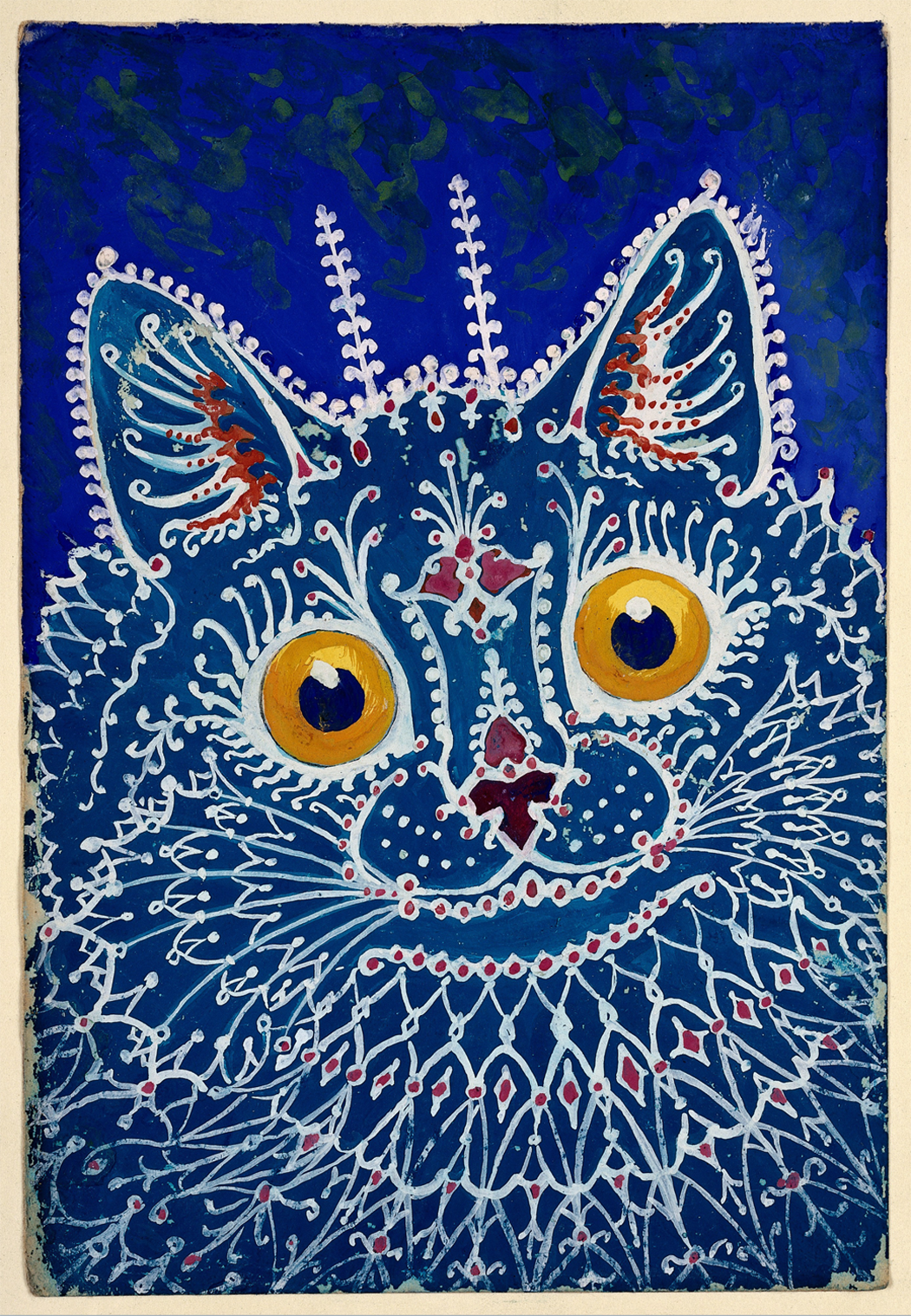
A cat in ‘Gothic’ style, Louis Wain (L0026931, Wellcome Library, London).

A cat standing on its hind legs, Louis Wain (L0026932, Wellcome Library, London).
In order to explore the physiological events underpinning such ‘ornamentation’, Reitman cited a number of neurological investigations, which aimed to explain the artistic tendency for ‘multiplication’ in terms of the artist’s ‘optic-perception’ (Kanner and Schilder, 1930). 23 Confident of an underlying neurological shift in the schizophrenic’s perception of his or her external reality, Reitman, again, turned to mescaline as a model psychosis. Having tried the drug himself, Reitman had a personal knowledge of the pharmacological power of mescaline to alter visual perception (1950: 34–5). For Reitman, the findings from neurological experimentation with mescaline corroborated his claim that a ‘strongly physiological perceptual impetus’ governed artistic expression (ibid.: 35; emphasis added). Citing Maclay’s work, on ‘normal’ subjects drawing under mescaline, shapes produced were seen to tend toward ‘[r]eduplicated zig-zag lines[,]…elongation and reduplication’ (ibid.: 35). 24 The artistic output of mescaline-induced subjects mirrored that of the schizophrenic’s tendency toward ornamentation, and thus, for Reitman, confirmed the physiological nature of the schizophrenic’s perceptual shift (ibid.: 33).
Reitman’s view that a physical event within the organic constitution of the brain is responsible for schizophrenics’ perceptual shift is reinforced by Bender’s earlier (1934) work on psychotic ramifications following brain lesions. As Reitman writes: These observations suggest a perceptual conditioning for stylization. However, the use of simplified patterns on more primitive levels, such as follows after injury to the brain, strongly supports the theory of the phylogenetic development of artistic configuration. Visual reduplication or repetition, as already stated, is the subdivision of space, just as rhythm is the subdivision of time. Both are the simplest forms of configurational activities; they are phylogenetically the first to appear in artistic creations, and when deterioration takes place they are the last to disappear. (Reitman, 1950: 33)
Conclusion
Competing conceptions of madness are portrayed in the history of psychiatry as having driven great chasms between purportedly incommensurable schools of thought: madness as divine wisdom or social vagrancy; the age of the asylum and its moral reformers; the psychoanalysts versus the biological psychiatrists. Schisms have come to dominate our historical understanding of the evolution of madness. As Shorter purports, ‘psychiatry has always been torn between two visions of mental illness’ (Shorter, 1997: 26). However, crude compartmentalization of historical figures and events into orderly ‘disciplines’ or epistemological ‘opponents’ has the potential to jeopardize historical accuracy for the sake of literary cleanliness. Francis Reitman spent his intellectual life working with a number of authoritative individuals at prestigious institutions hailed for having introduced psychiatry to science. Carelessness may, therefore, lead to his retrospective placement within a historically constructed image of pioneering biological psychiatrists, firmly opposed to psychoanalytic schools of thought. However, close analysis of Reitman’s primary texts, and the situation of his ideas within the context of those with whom he was interacting, elicits a more judicious and nuanced insight into 20th-century psychiatric thought. Although Reitman’s conception of schizophrenia may have been peculiar, this article stands to emphasize the idiosyncratic blend of contemporaneous psychiatric epistemes on which Reitman drew.
In this article, I have paid attention to the routes by which surrealism, early 20th-century conceptions of ‘ego’ and Jungian phylogenesis each informed Reitman’s ultimate view of ‘schizophrenia’ as a psychiatric object. For Reitman, schizophrenia was caused by a disorder of ‘ego’ and defined by a phylogenetic regression of thought. Crucially, Reitman did not deride the existence or value of psychoanalytical theory: he felt, however, that such hypotheses were essentially descriptive and must be, as his superior Edward Mapother felt, ‘supplemented by observations as to the effect of standard experiences under experimental conditions capable of repetition’ ([1939], cited in Lewis, 1969). Therefore, as Reitman sought to explain schizophrenia in terms of an individual’s physiological ‘body image’, he primarily conceptualized the aetiology of the individual’s condition as a disruption of the psychogenic ‘ego’.
The apparent monistic rigour of Reitman’s biological approach must be understood as having been no more than a case of methodological pragmatism. For Reitman, the advantage of an inquiry ‘which can be formulated in biological terms is that it more easily allows for experimental research both into the nature of psychosis and into the nature of art’ (1950: 63). Although Reitman restructured psychoanalytical concepts such as ‘the ego’ and ‘the unconscious’ into biological alternatives, this was in order to gain methodological (i.e. scientific) traction, and not an outright epistemological rejection of the concepts in their own right.
The sole fact that Reitman saw no need to justify a conception of schizophrenia whereby the individual regresses to ancestral modes of thought owing to a loosening of the demarcations between the ego and non-ego and, in the very same instance, was perceived as ‘a neuropsychiatrist of the more belligerent sort’, suggests that it was not unusual to accept the existence of the unconscious in Reitman’s milieu, even within ‘biological psychiatry’ (Arnheim, 1951: 176). Reitman’s case reiterates the problems with accepting polarized historical narratives that reduce 20th-century psychiatry to opposing aetiological camps: in reality, psychiatrists such as Reitman were able to employ a diverse spectrum of competing, interwoven and even contradictory hypotheses and practices.
Footnotes
Funding
The author disclosed receipt of the following financial support for the research, authorship, and/or publication of this article: Completion of this research was realized with financial support from Clare Hall at the University of Cambridge and the British Society for the History of Science.