




Abstract
In 1965, the American folklorist Alan Lomax set out on a mission: to view, code, catalogue and preserve the totality of the world’s dance traditions. Believing that dance carried otherwise inaccessible information about social structures, work practices and the history of human migration, Lomax and his collaborators gathered more than 250,000 feet of raw film footage and analyzed it using a new system of movement analysis. Lomax’s aims, however, went beyond the merely scientific. He hoped to use his ‘Choreometrics’ project as the foundation for a universally available visual and textual atlas of human movement. This article explores how Lomax’s archival ambitions supported his efforts to enact a wholesale ‘recalibration of the human perceptual apparatus’ and situates Choreometrics at the nexus of new techniques of data-gathering and the cultural ferment of the 1960s.
Keywords
In the basement of the Library of Congress – just down the hall from the aisles that house the famous recordings of Jelly Roll Morton, Lead Belly, Woody Guthrie and Muddy Waters – sit dozens of boxes filled with dusty coding sheets. The pages are, at first glance, far less exciting than their musical counterparts. They are filled with tables, graphs and diagrams rather than the vibrant sounds of American folk culture. But they too represented an attempt to capture, study and renew a cultural form that many feared was slipping away.
The American folklorist Alan Lomax is well-known, both to scholars and to the general public, because of his lifelong efforts to protect America’s musical heritage. Born in Texas in 1915, Lomax’s training started early: his father, John, himself a folklorist, took young Alan along on his trips to record the songs of the prisoners and sharecroppers of the rural south. After a peripatetic education at the University of Texas and at Harvard, Alan participated in his father’s work more formally, joining him on expeditions for the Library of Congress and co-authoring two books: American Ballads and Folk Songs in 1934 and Negro Folk Songs as Sung by Lead Belly in 1936. Alan also began embarking on solo expeditions, including a trip with Zora Neale Hurston in the summer of 1935. In 1937, he was appointed the Assistant in Charge of the Archive of Folk Song of the Library of Congress. In later years, Lomax hosted popular television and radio programs, produced folk records, recorded oral histories with jazz musicians and helped pioneer the ‘man on the street’ interview (Szwed, 2011).
Existing accounts, however, make only passing reference to the fact that music was not Lomax’s sole concern. In the 1960s, he turned his attention away from music and toward another aspect of human cultural life: dance. His goal was not mere salvage. Lomax and his collaborators believed that dance was an untapped resource for understanding humanity. Cultural and geographic variations in dance style, they proposed, revealed crucial elements of a community’s life history. As Lomax put it, it was ‘as if the body was a semaphore’, signaling the presence of certain sets of climactic conditions, productive systems and cultural values by ‘wig-wagging a special set of body parts’. 1
These signs were not the kind of stylistic differences immediately obvious to the untrained eye, but rather subtler characteristics – palm placement, force trajectories, degrees of curvature – visible only through careful recording and analysis. To reveal these elements, Lomax employed a system of written analysis that broke dance down into its constituent parts, making this heretofore ephemeral art permanent, legible, classifiable and subject to statistical analysis. With this tool in hand, Lomax believed that dance could produce evidence about human history and variation just as powerful as ‘the point on a potsherd or the edge on a handaxe’. 2
In 1965, Lomax thus set out to undertake a massive comparative study of dance patterns. He called the project ‘Choreometrics’, and it consumed him for the better part of two decades. Along with dance experts Irmgard Bartenieff and Forrestine Paulay, Lomax gathered filmed samples of dance from nearly 2000 cultural groups, carefully notating and analyzing each one. He used this information to theorize about historical migration patterns, structures of production and the mechanism of behavioral evolution. Though not an anthropologist himself, his work attracted the attention of major figures in the field, including Margaret Mead, Gregory Bateson and Ray Birdwhistell. By the project’s conclusion, Lomax had produced several films for public broadcast, an unpublished book manuscript of more than 1000 pages, an unprecedented collection of dance on film and, of course, the boxes and boxes of coding sheets that now fill the Library of Congress’ shelves. This article is the story of their production.
It is not, however, a simple account of endless acquisition: for Lomax, Choreometrics was more than a methodological means to a scholarly end. At its heart, the project was rooted in a quintessentially modernist faith in the power of the right kind of archive to remake the world. The ultimate destiny of these films, coding sheets and publications, Lomax hoped, was to engender a wholesale ‘recalibration’ of the human perceptual and kinesthetic apparatus.
In the histories of folklore, music and sound, Lomax is a figure both towering and controversial. He is as often lauded for his extraordinary efforts to preserve the music of marginalized populations as he is criticized for the ways in which his collecting depended upon the exploitation of his subjects – sometimes in a single breath (see Averill, 2008; Baron, 2012; Donaldson, 2013; Gregory, 2002; Matthews, 2016; Oforlea, 2012). As elements of the Lomax musical archive have begun to move online, scholarly discussions of the ongoing ethical ramifications of Lomax’s work has only intensified (see Clement, 2015; Svec, 2013). Lomax’s study of dance, however, has been largely relegated to footnotes, resulting in lost opportunities to further interrogate his approach to collecting, access and representation.
In the history of science, attention to practices of collection and accumulation – of information, of specimens, of experiences – has produced a rich literature. Studies by Ann Blair, Katharine Park, Lorraine Daston, James Delbourgo, Ann Fabian, Paula Findlen, Rebecca Lemov and others have demonstrated how important such work has been to the production of scientific knowledge (Blair, 2007; Daston, 2017; Daston and Park, 2001; Delbourgo, 2011; Fabian, 2010; Findlen, 1994; Lemov, 2011). Bruno Strasser has recently urged scholars to consider seemingly disparate kinds of collecting as a coherent scientific practice (Strasser, 2012). In many of these accounts, however, the imagined beneficiaries of these collections were relatively small groups of experts: early modern ‘scientists of the archive’ toiled in service of an ‘imagined community of disciplinary descendants’, while contemporary investigators like Bert Kaplan amassed data that would be available to ‘any qualified investigator at just about any library’ (Daston, 2012: 164; Lemov, 2011: 145). In contrast, the audience Lomax envisioned was much larger and less specialized: everyday citizens, not experts. Indeed, the breadth of Lomax’s intended audience – and his deep aversion to working within conventional academic structures – may help explain why he has been largely ignored by historians of the human sciences. Examining Choreometrics’ history thus provides an opportunity to consider the emergence of new kinds of archives in the mid-20th-century and to analyze the ways in which they differed from their forbearers. The archive Lomax envisioned was ‘total’ not just in terms of the quantity of materials it would house, but in its participants, its audience and in its effects on the human psyche.
This article reconstructs Choreometrics’ history, beginning with an examination of how Lomax came to understand bodily movement as a site of important anthropological data. It then continues with an account of Choreometrics on the ground: the contested process of gathering filmed dance, translating it into notation, performing statistical analysis and presenting the findings to the public. Finally, the piece concludes with an analysis of the radical motivations for Lomax’s work and considers the ways in which the dream of ‘totality’ remained elusive.
Moving bodies: Kinesics, notation, film
The contours of Lomax’s dance project were unique, but he was not alone in professing a scholarly interest in the moving body. By the 1960s, a growing contingent of anthropologists had begun to argue that language by itself could not possibly convey the kaleidoscopic complexity of culture. Visual, oral and corporeal experiences were also significant, and scholars sought new methods – including film – to capture such data (Grimshaw, 2008). This was particularly true in the new anthropological subfield of ‘kinesics’. Pioneered in large part by anthropologist Ray Birdwhistell, kinesics sought to bring attention to the messages communicated by the physical body, arguing that non-verbal behavior was patterned and analyzable in the same way as spoken language. Moreover, Birdwhistell contended that non-verbal cues not only conveyed discrete conversational information, but also helped to establish both individual and cultural identity.
Lomax met Birdwhistell in 1961 when he enrolled in Birdwhistell’s special seminar on the fundamentals of kinesic research at the Eastern Pennsylvania Psychiatric Institute. 3 The senior scholar’s work quickly impressed Lomax, and the course marked the beginning of a long and significant relationship. At the time of their first encounter, Lomax’s primary interest was in the comparative analysis of music, but he hoped to find useful insights in Birdwhistell’s general approach to non-linguistic communication. For his part, Birdwhistell was supportive of Lomax’s analytical framework, but suggested that dance might represent an even better quarry. For Birdwhistell, dance was more ‘primal and preverbal than song, and…more directly connected to everyday work and the social movements of the body’ (Szwed, 2011: 351). 4
Lomax did not abandon his project on song style, but he soon conceived a new study focused entirely on dance. 5 Dance analysis, however, required an entirely new set of methodological tools. While the metrics for evaluating music – tone, timbre, harmony, etc. – were second nature to Lomax, he was unaware of a similarly structured system for physical movement. Again, Birdwhistell provided guidance and directed him to two individuals: Irmgard Bartenieff and Forrestine Paulay.
Both Bartenieff and Paulay were former dancers with expertise in Labanotation, a system of movement notation developed by the German choreographer Rudolf Laban in the 1920s. Initially intended for the preservation of choreography and the coordination of mass dance spectacles, Labanotation and Laban-based analysis caught on in the USA in the early 1940s, where it rapidly diffused into fields including management consulting, psychiatry and psychology, physical therapy, industrial operations and copyright law. When Lomax approached Bartenieff, for example, she was using Laban principles in physical therapy and working as a research assistant to a psychiatrist at the Albert Einstein College of Medicine. 6 Laban’s work had also begun to attract interest in anthropology, and though Birdwhistell used a personal shorthand for his own research, he enthusiastically recommended Labanotation to others.
Bartenieff and Paulay were eager to get involved, though the project’s limited resources meant that their early work was only part-time.
7
Nevertheless, their contributions were significant: not only did they provide technical expertise on dance, they collaborated on nearly all other aspects of project development. Paulay recalled in an interview that, One of the other reasons why Alan wanted to look at dance is because, when he listened to song performance, he could sense in it something about the body – the physical stance that produced that kind of sound – and he wanted to see it, and he wanted to make it more than just something abstract…he wanted to put the bones and the flesh on it, literally. (Paulay, 2008; see also Lomax et al., 1968: 222)
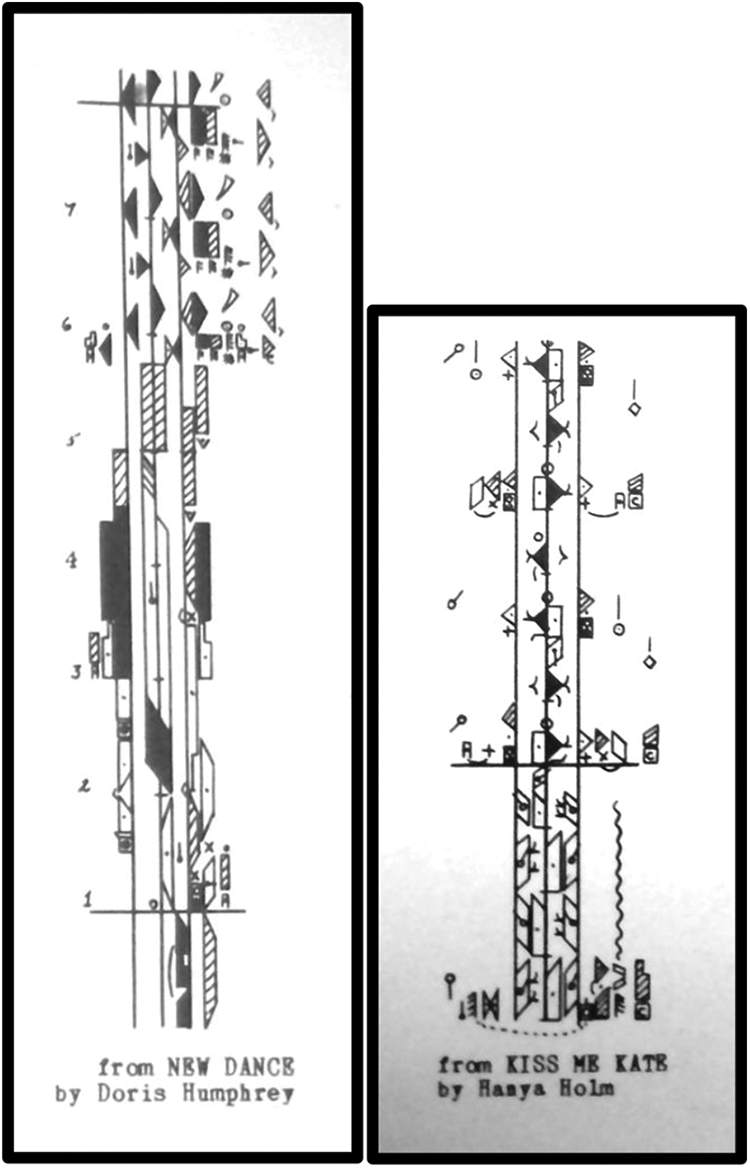
Short excerpt of notated scores for New Dance and Kiss Me Kate. From ‘Dance Notation Conversation’ (1955). Courtesy of Dance Notation Bureau.
But before any analysis could begin, the Choreometrics team needed data. Late in 1965, therefore, Lomax, Bartenieff and Paulay set out on a seemingly impossible mission: to obtain at least one sample of dance from every world culture. Using George Murdock’s Human Relations Area Files at Yale University as a guide, Lomax made an initial list of approximately 1900 distinct cultural and ethnic groups for analysis. 8 In earlier eras, this list alone would have represented an insurmountable obstacle. Lomax may have criticized previous dance scholarship for being ‘virtually empty of hypothesis’, but he later readily admitted that ‘our predecessors in this field did not have the privilege of observing the whole range of choreography’. 9 Even ‘the great Curt Sachs’, he recalled, ‘based his seminal [1937] book on world dance largely on written accounts, sculptures, paintings and photographs. He had seen little dancing with his own eyes outside of Europe and North America’. 10 Lomax and his compatriots, on the other hand, had the advantage of an increasingly large, albeit decentralized, store of global film.
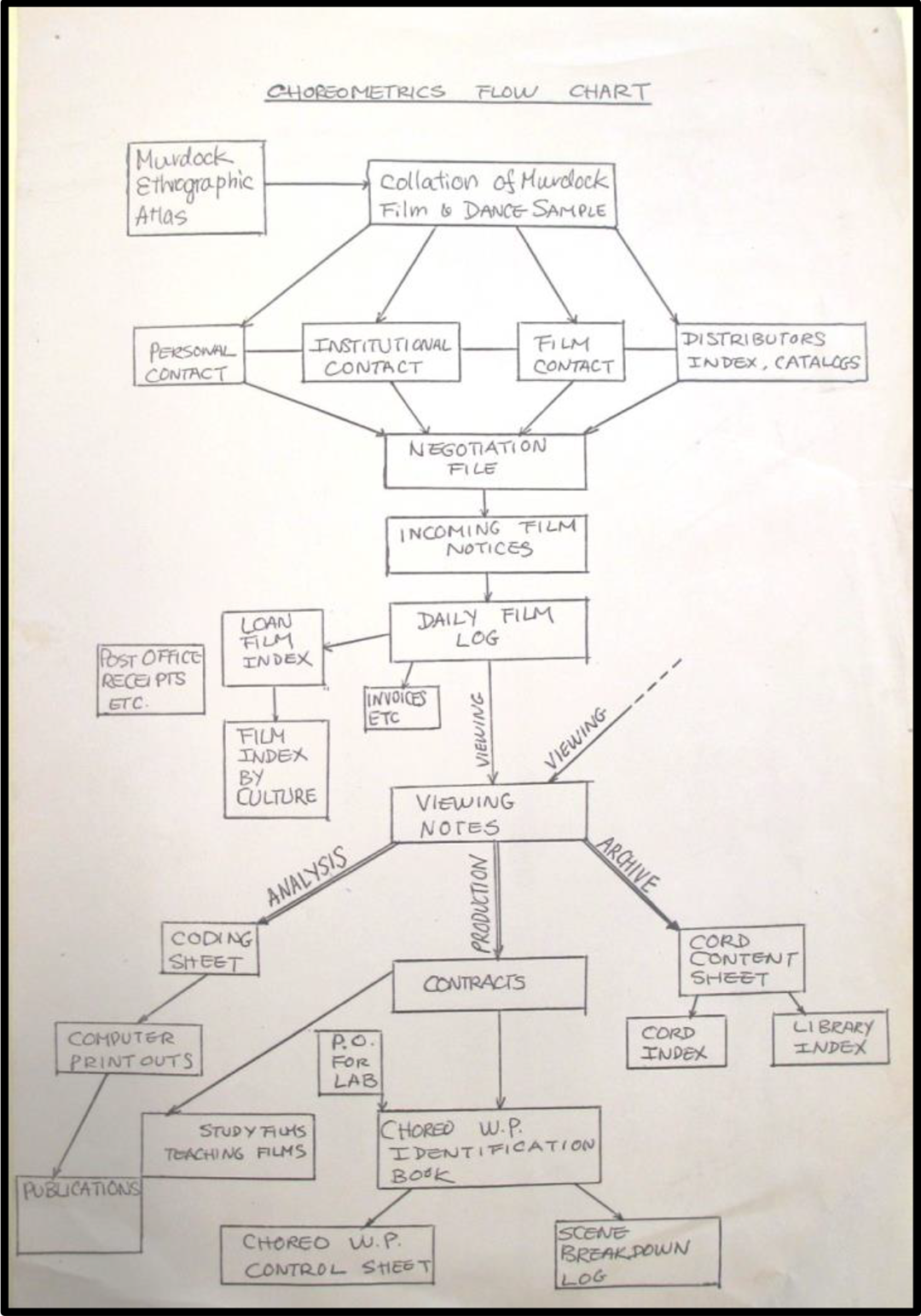
Choreometrics Organizational Chart (1968). Posted on the wall of Lomax’s office, this chart outlined the lengthy process through which the physical film samples moved through Choreometrics headquarters, beginning with their initial selection and procurement and ending with their analysis and the publication of resulting excerpts and data. Library of Congress, Alan Lomax Collection, Folder 9.1-01/3.
Lomax reached out to anyone and everyone that might have filmed dance, from anthropologist Margaret Mead to kuru-researcher Carleton Gadjusek, to a retired vascular surgeon, adventurers’ clubs and the US military. 11 The process was long and sometimes contentious: letters negotiating fees, rental arrangements and mailings fill nearly a dozen boxes of the Lomax archive. While some institutions – such as the Institute für den wissenschaftlichen Film in Göttingen – were eager to participate, others – including the Russian cultural ministry – required delicate diplomatic negotiations. Wealthy adventurers were often the most difficult to work with. As sometime collaborator Margaret Bach wrote in a letter to Lomax, ‘Some of these fellows do lecture circuits, thus realizing the “cash” value of their traveling and filming. They must be handled with kid gloves.’ The team even unsuccessfully attempted to track down fabled footage made by Roy Disney and Orson Welles.

Draft coding sheet. The coding sheet pictured here suggests the complexity of the coding process, asking raters to observe and record – among other traits – the body parts that appear most active, the degree of symmetric and asymmetrical movements, and the qualitative characteristics of transitions between movements. In many categories, raters are also required to indicate whether the traits are present in the movements of male dancers, female dancers, or both. Handwritten comments indicate potential future changes. Library of Congress, Alan Lomax Collection.

‘Dymaxion’ map of movement styles by region. Buckminster Fuller developed the Dymaxion map in 1943 to minimize the relative distortion of land masses and emphasize the connectedness of Earth’s inhabitants; Fuller’s projection represented a particularly useful visual tool for Choreometrics, as Lomax was interested in using movement signatures to track the paths of human migration across continents. From draft of ‘Dancing’, Library of Congress, Alan Lomax Collection, Folder 4/18-01.
Lomax recognized that many of the films were not intended for scholarly analysis, but he remained sanguine about their value. While an inexperienced or biased cameraman might shape the data in minor ways, Lomax believed that movement style was so profoundly entrenched in the body that its basic structure and elements could not help but emerge, even in the most poorly-made films.
12
This meant, for example, that it was entirely possible ‘for a couple of tourists who casually point their cameras as they walk past some Samoans to bring us some usable material on the Samoans’ (Lomax, 1971: 27). In fact, Lomax saw the world’s ‘vast, endlessly provocative, prejudice-laden, existing sea of documentary footage as the richest and most unequivocal storehouse of information about humanity’, far more meaningful than any written documents (Lomax et al., 1968: 263). He envisioned a great library of the visual arts, where all important cinematic documents would be stored, catalogued, and analyzed. Such a temple of knowledge would cost no more than an atomic submarine, but its influence would far outrun the famed library of Alexandria or, indeed, all the libraries that ever existed, since it would preserve a living, moving record of all human behavior.
13

Group dance in the Southern United States (1950s). Library of Congress, Alan Lomax Collection.
Ultimately, Choreometrics drew upon approximately 250,000 feet of raw footage, selected from the far larger body of film that had been collected. This collecting enterprise, however, was only the beginning. Once all the films had arrived at Lomax’s offices at Columbia University, Lomax, Bartenieff and Paulay began to watch the films and, more importantly, to code them, looking for the ‘principles that unify and differentiate the movement styles of the species’. 15
‘An endless tunnel of film’: Observing and notating movement
Lomax, Bartenieff and Paulay briefly considered using traditional Labanotation to make and record these observations. Soon, however, they realized that standard method of notation was not necessarily well-suited to their needs. In its original form, Labanotation was enormously detail-oriented, designed to record choreographic works in their entirety for future performances and for preservation. Each and every movement a dancer made was painstakingly recorded and the process was repeated for each and every dancer on stage.
The Choreometrics team, however, was more interested in the overall characteristics of movement than in specific choreography. As such, Lomax, Bartenieff and Paulay decided to draw on the analytic skills they had acquired as Labanotators, but to eschew Labanotation’s attempt to capture complete dances.
16
Even with these self-imposed limitations, however, recording dance in a way that permitted meaningful comparisons and analysis seemed overwhelming. Lomax, Bartenieff and Paulay decided, therefore, that their first task would be to begin to limit the range of movement elements under consideration. Thus, as they made a first pass at the films, they resolved to write down traits that jumped out especially forcefully, or that seemed particularly characteristic of one area. The process was both collaborative and intuitive. In ‘Dancing: A World Ethnography of Dance and Movement Styles’, an unpublished book manuscript in which Lomax and Paulay intended to present their findings, Lomax described it in this way: We looked for qualities or actions or limb use that persisted through long stretches of footage, preferably through whole films from one culture, and which were used in a clear or marked way by everyone in the scene. Our judgment about the presence of such a movement characteristic was not based on what else was known about the people or what might be surmised about the working of the muscles under the skins, but only by what all three of us agreed that the actors were doing in a particular stretch of film. In the end this meant the way that light was reflected off a certain body surface, and that these visible patterns continued and were repeated all through the scene.
17
The Coding Book was not designed for the project’s leaders, but rather for the new, untrained raters – graduate students from a variety of disciplines – enlisted to notate the remaining dance samples. Its text provides a sense of just how complex the observational processes was. Take, for example, the general instructions for coding just one variable, ‘body vertical’: Here the coder records the kind of change in and out of the vertical, if any change occurs. At the center of this line, he notes that the dancer maintains a normal upright position. At the far right, he records a violent plunging and rolling about on the earth and, on the far left, narrow and highly controlled shifts of body attitude take place in the upright position scale.
20
Continuous sectional change. In this case, controlled action takes place at one level for some time; then, there is a change and there is a long engagement in activity at that level; then another and another, etc. Smooth change. Action in which the level of verticality changes gradually and smoothly under great control: dipping, alternating change of verticality, side to side, or sagittally. The shift is marked, the vertical distance traveled being at least 6 inches. Neutral. The body held at one level as the dancer remains in place. If there is forward movement and vibration is not coded, the vertical distance traveled should be less than 2 inches. Here, a normal, smoothly controlled walk would be coded, for instance. Sporadic leap/discontinuous. Here some other kind of activity is punctuated by leaps or a by a series of leaps. Leaps/total trust. Here the mover crouches low to the ground and then, straightening his knees, leaps to his full height. This is the maximal extension possible.
21
Understandably, even with these instructions, Lomax, Bartenieff and Paulay worried about consistency, and they eventually agreed to drop 20 characteristics about which raters had difficulty agreeing. ‘We must’, they noted, ‘leave out these variables in the protocol which do not yield order, comparisons, and classification’. 22 The remaining variables, Lomax boasted, generated an average inter-rater agreement rate of 80%.
Once a dance was fully coded, technicians transferred the data from coding sheets to punch cards and fed them into Columbia University’s IBM 7094 computer. There, with the help of Columbia University statisticians, the Choreometrics team began to search for meaningful patterns, both within and across cultural communities.
Dance as the measure of man
Lomax, of course, had not gone into the project without some idea of what he hoped to find: evidence that cultural practices were not mere window-dressing on the human experience, but rather crucial to human survival. ‘The growth of systems of culture’, he contended, ‘is now seen to be man’s way of adapting to varied environments and new challenges’. While other animals depended on genetic change to produce new adaptive behaviors, human beings were constantly making those changes, revising and reorganizing all these behavioral patterns, day by day, throughout the whole span of life and of society, and passing on both the core of the accepted wisdom and its revisions to oncoming generations as parts of symbolic cultural codes, rather than as encoded in the helix of the genes.
23
In the initial pages of the ‘Dancing’ manuscript, Lomax plied his readers with literally hundreds of examples of these correlations.
24
On the subject of work, he noted connections between the distinctive hand movements of carnival dancers in a champagne-producing French village and ‘the vintners, pacing the aisles of bottles, rotating two bottles at a time with the same quick hand motion displayed in the yearly carnival dance’.
25
He understood the stooped posture and ‘deep shoulder rotation’ of West African dance to be a reflection of the widespread historical use of the short-handled grubbing hoe, arguing that, ‘here, dance movement clearly mirrors a principal subsistence act’.
26
Of contemporary dance in the USA, he wrote: The half-cocked arm position, with vaguely pumping forearms and hands bent at the wrists, brings to my mind’s eye the occupations most frequent in post-industrial America – the sales clerk wrapping packages and writing up sales slips, the bureaucrat shuffling papers, the secretary typing away at the word processor, and the driver at the wheel of a delivery van – all these and a thousand other service occupations where the arms and hands are laxly but swiftly engaged in light work, while the rest of the body remains inactive.
27
One effective way to generate heat in the extreme cold is to stiffen or clench a part of the body and then strongly apply energy; a rush of warmth immediately arises in the body. For example, Eskimos flip out of their furry beds in a whole-bodied, porpoise-like leap which brings them hotly into the chilly air of the igloo.
Still, these colorful examples belied Lomax’s more systematic aim, one deeply influenced by the emergence of ‘neo-evolutionist’ anthropology. In the late 19th and early 20th centuries, the study of the world’s cultures was inextricably intertwined with an evolutionary model of development. Founded on the premise that all societies progressed through the same series of cultural stages – from the primitive to the increasingly complex – this perspective was linked to systematic racism toward non-Western peoples. With the ascent of the Boasian school in the United States, however, mid-century anthropologists increasingly sought to understand individual cultures in all their complexity, largely eschewing notions of development or hierarchy (see Stocking, 1982, 1992).
By the 1960s, however, some believed that the flight from the scholarly study of ‘temporal change in social structure’ had gone too far, a development charted by historian Howard Brick. These ‘neo-evolutionists’ – prominent among them Leslie White and Julian Steward – believed they could reconcile Boasian cultural relativism with a renewed focus on the structural, rather than biological, determinants of cultural change. Their aim was to ‘put historical “progress” back on the agenda of social thought’ without falling prey to racial or cultural hierarchies, social Darwinism, or modernization theory (Brick, 2012: 157).
White, for example, contended that human culture could indeed be examined as a single whole, having a dynamic of change and growth quite apart from human consciousness of it, a process moving directionally toward more large-scale, organizationally encompassing forms of association and state power, paced by growing quantities per capita of physical energy in social use. (Brick, 2012: 159)
Lomax clearly drew on such approaches. In the introduction to the draft for ‘Dancing’, Lomax acknowledged that there had been a very considerable argument, pro and con, as to whether human culture has evolved or, whether, once invented, it has simply changed its shape according to circumstance, expanding or collapsing, winning and losing capabilities in the struggle to satisfy human needs in earth’s varied environment.
29
On one point there is little doubt. The productivity of human subsistence systems, for which archeology and the study of living cultures provide the record, has progressively increased from simple extractive systems to systems with an ever-increasing ability to transform large portions of the environment into food and energy.
30
This instinct seemed to be borne out in the coded data: in his early analyses, Lomax noticed a correlation between certain clusters of movement traits and particular subsistence systems: ‘Some movement features appear in cultures that represent an early stage of socio-economic development, others in the middle range, yet others in the more complex productive systems’. 32 High levels of bodily ‘articulation’, in particular, appeared characteristic of the most ‘advanced’ systems.
This data only increased Lomax’s confidence that dance was nothing less than ‘the behavioral representation of man’s increasing control of his environment through rational manipulation’. Though he admitted that his conclusions were only preliminary, it seemed more and more likely that movement style played a role in a population’s ability to ‘carry out the ever more differentiated tasks of production and social relations that support an ever-larger human population on the planet’. Like culture itself, dance evolved into increasingly complex forms, forms that Lomax now believed he could accurately track. 33
Still, like the neo-evolutionists, Lomax worked to reconcile this sense of teleological progress with a belief in the essential equality of all cultures. In part, he did so explicitly, frequently pointing out that – although some were more complex than others – all movement styles were equally adaptive. He observed, for instance, a lot of people using the shuffling step that blacks use when they dance thought this was all about laziness. But it’s not, it’s connected with the fact that blacks have always worked as hoe agriculturists, and they have a broad stance, and they moved like this when they were working….We see that all throughout the tropics.
Ultimately, however, Lomax believed that mere words could only accomplish so much. Instead, it was Choreometrics’ very structure that would most powerfully convey the message of cultural equity and reconcile the conflicting demands of neo-evolutionary theory.
Recalibrating perception, communicating culture
The instructions for raters at the beginning of the Choreometric Coding Book included the following caution: The rater is advised not to attempt to count the frequency of a feature by breaking down the action or scene into similar parts or units and then summing up his impressions in numerical terms. If a quality is not strongly and emphatically present throughout the whole scene, or else if it is not markedly emphasized in some way in the scene, it should be given a low score.
36
An integral part of Choreometrics’ methodology, however, was Lomax’s contention that the system itself would render numerical measures unnecessary. As a rater viewed more and more films, coding sheets in hand, he or she would gradually absorb the schema until it became second nature. ‘Training in Choreometrics’, the Choreometrics team contended, ‘consists, fundamentally, of the recalibration of the observer’s stands of tempo, etc. to the full human range’. 38 Raters thus participated in the project in two ways: by gathering data and by offering themselves up as early test subjects for the system’s power to alter perception. 39
The trial, it seemed, was successful. As the project went on, Lomax, Bartenieff and Paulay placed greater and greater confidence in the raters’ ability to discern movement differences. Although those working in non-verbal behavior more generally had described difficulties in teaching observers to differentiate and identify the ‘micro-units’ of individual interaction, Lomax reported that his team discovered that gross contrasts in movement style between culturally different groups were relatively easy to define and agree on. Not only that, but when we incorporated graded examples of the steps in these movement scales in teaching films, we found that students could learn to make these distinctions at the same high level of agreement which we had established among the original coders.
40
In fact, Lomax’s ultimate plan was to extend the kind of perceptual training the raters received to a massive popular audience. The earliest academic presentations and publications on Choreometrics date to the late 1960s (see, for example, Bartenieff and Paulay, 1968; Lomax et al., 1968), but much of the team’s focus was directed toward the production of films intended for a wider viewership. The first of these, Dance and Human History, was released in 1974 and eventually distributed by the Extension Media Center at the University of California-Berkeley (Lomax and Paulay, 1974). Approximately 40 minutes in length, the film presented clips of world movement and dance alongside explanations of the Choreometric system of analysis and its conclusions. Early screenings took place at the American Museum of Natural History, the Whitney Museum and the Museum of Modern Art in New York, as well as on local public broadcast television stations. In subsequent years, Lomax received a steady stream of requests for copies destined for college classrooms in media studies, anthropology and music, public high schools and scientific laboratories in both the USA and Europe; Margaret Mead included a 10-minute excerpt from Dance and Human History at her presidential address to the American Association for the Advancement of Science in 1976. 42 Three similar films followed in subsequent years: Palm Play (1977), Step Play (1977) and The Longest Trail (1984) (see Bishop, 2008). For the Choreometrics team, these movies were not afterthoughts, but a core part of the project from its earliest days. As Lomax put it in a set of undated notes from the late 1960s, Choreometrics’ central goal was to ‘depict … the stylistic resources of human movement patterns so that all of them would be understandable to any human being’, thus avoiding ‘one of the traditional errors of social science which has always been to develop a system of observation and thought, useful to the specialist, but essentially out of the reach and thus meaningless to the masses of human beings who make up society’. 43 Film seemed to be one of the most direct ways of achieving this aim, training viewers in new forms of observation with each watching and re-watching.
The second major project on Lomax’s agenda was the manuscript for ‘Dancing: A World Ethnography of Dance and Movement Styles,’ a draft of which he and Paulay had been working on since the early 1970s and finally completed in 1981. Envisioned as a strange chimera of scholarly tome and coffee-table book, Lomax pitched the work to a variety of presses, both trade and academic. 44 At 870 manuscript pages, plus front matter and extensive appendices, the book was filled to bursting, containing both chapters devoted to accessible summaries and illustrations (both verbal and visual) of Choreometric principles and detailed coding data for nearly 600 dances and 140 movement variables. 45 It also included a blank version of the Choreometric coding book and instructions for its use. In part, Lomax was making an effort to be methodologically transparent, an exercise perhaps particularly important for a liminal figure in a new field of endeavor. He also, however, envisioned the blank pages as an invitation to a kind of do-it-yourself instruction in movement observation for the everyday citizens he hoped might casually page through the text. 46 Progressing through each section of the book, the reader would find him or herself gradually inducted into a new society of movement spectators. By the text’s conclusion, perhaps even the mountains of raw data would begin to make a new kind of intuitive sense.
Lomax maintained that – via his films and books – the Choreometric coding system would be ‘understandable to anyone who wanted to use it – whether sociologist, filmmaker, or schoolboy; whether American, African, or Polynesian’ (Lomax, 1971: 24). Not everyone, however, was convinced. After a 1977 screening of Dance and Human History at the American Museum of Natural History, a Laban-trained analyst named Lynne Norris wrote to Lomax. Though sympathetic to his overall program, she was skeptical of Lomax’s optimism about the speed with which new patterns of observation could be internalized: ‘One cannot learn choreometrics in the offhand manner that you suggest’, she remarked. Even with the existence of supplementary written materials this was not, as Lomax hoped, a technique that could be ‘learned in a weekend’. 47
But Lomax pressed on, convinced that popular re-training in movement observation was a crucial method for countering the dangerous dominance of American and European culture in a progressively globalized media environment: All of us are being swept into an ocean of the visible media, whose tides and currents arise in the offices of the advertising and entertainment industries, rather than in the human community. With every passing month as passive watchers we are being moulded and remade by what we are allowed to see and hear.
Such tendencies contributed to the ‘greying of culture’ – a progressive, worldwide homogenization that might lead to the wholesale elimination of certain forms of cultural life – but they also threated individuals’ psychological well-being. Lomax charged that the contemporary media, which bite into our kinesic sub-conscious, cause human beings to lose confidence in their diverse, culturally inherited and healthy styles of bodily comportment and to spend their lives in the dubious and anxiety-filled pursuit of ways of life that are not only beyond their means and their reach, but may be demoralizing as well.
49
imposed the confiding and stiff-waisted European costume almost everywhere. The head-back, chest-out, erect posture of the North European elite is held up for universal admiration as the only way for a real human being to carry himself. Schools children and soldiers in every clime were drilled in this carriage, often with ridiculous and unfortunate consequences.
Lomax believed that once an individual was trained to analyze movement style in dance, their day-to-day experience of non-dance movement would also change, new scientific understandings demolishing old prejudices. No longer would ‘shuffling’ connote laziness; instead, it would tell a story about climatic adaptation, agricultural technologies and persistence. In fact, as Choreometrics-trained observers moved through a city, they would encounter hard evidence about the long course of human history in the body of every person they passed. A trip to the grocery store might teach as much as an afternoon at a natural history museum. Viewing daily life in this way was, Lomax promised, ‘like looking through a microscope or underwater for the first time’. 52
In his conviction that film and notation could alter the self, Lomax’s work echoes that of other Cold War figures invested in the idea that exposure to the right kinds of media could foster the development of tolerant, freethinking ‘democratic personalities’. Alongside Buckminster Fuller, Margaret Mead, Gregory Bateson and John Cage, American social scientists and psychologists of the 1950s and 60s created museum exhibitions, art installations and educational programs, all premised on the idea that multimedia environments that encouraged active involvement could psychologically orient American citizens to the ‘perception and appreciation of difference’ and serve as a bulwark against totalitarianism (Turner, 2013: 58; see also Cohen-Cole, 2014).
But Lomax’s concerns were not solely educational or political. If, as he contended, movement style was in fact a functional element of culture, its loss would put many populations in real danger. As Lomax and Paulay once put it, dance ‘concerns life – survival itself’. 53 What would a herding culture be without its ‘graduated and flowing’ style of energy? How would a hunter move on rough terrain without a deeply ingrained sense of restrained, linear movement? Indeed, how would any culture perpetuate its movement styles – and thus its lifeways more generally – if its members were constantly bombarded with the movements of the West? 54
Like many contemporaries, Lomax held a loosely cybernetic view of culture and he understood dance to be a crucial element in its regulation. 55 The best way to combat cultural greying, therefore, was to alter the surrounding feedback system. As such, Lomax was particularly keen to promote film screenings – and accompanying Choreometrics training – in places where ‘traditional’ cultures seemed threatened. He remarked often that the individuals and communities who appeared in the Choreometrics films should ‘see the footage in toto and as often as they like, both in local screenings and over local television’. If proper filming had been performed, ‘the people will rediscover in the footage the worth, the dignity, and the beauty of their way of life. There can be no question of the beneficial effect of such feedback for folk cultures in the vicinity of powerful and highly organized communication systems’. 56 Most social scientists, Lomax contended, had forgotten that ‘the principle social function of film is to reinforce the culture of which it is the product’. The Choreometrics team would not make that mistake, instead using both notation and film as tools for subverting traditional media networks and supporting minority cultures.
Writing practices, embodied history and the ironies of cultural preservation
‘All authors’, Lomax wrote, ‘have their dreams. Mine runs this way: a folk dancer, an aboriginal choreographer, a student from some place away from the overwhelming mainstream picks up this book, looks through this atlas for his or her culture area and finds a pattern that is quite familiar – coming from his home or at least from his home ground’. look at himself and his people with renewed esteem and begins to think, if he is a dancer, about what he can do with what he really knows. He has discovered that his own movement style is there, that it is composed of a special and fitting rearrangement of the same elements found in all human activity, but handled in an original style.
57
This was Lomax’s holy grail. Numbers and figures, maps and diagrams, would awaken in even the casual reader a new sense of culture, of history and even of his or her own body. While it would be impossible for the lay person to do what Lomax, Paulay and Bartenieff did – collect and view literally thousands of films – the products of Choreometrics would allow anyone to have a comparable experience. Film itself was a first step, but it was far from sufficient. Only with a clear system for evaluating and recording movement could the observer be fully retrained.
Written recording also served another, less-acknowledged purpose: it concretized and thus implicitly elevated the cultural materials of ‘non-literate’ peoples. It was no accident that Lomax emphasized that the readers of ‘Dancing’ would have ‘evidence, printed evidence, a text to support the claim that his aesthetic traditions deserve care, study, a place to live, and the means to grow [emphasis mine]’ 58 and addressed his work ‘to all people who lack written history and the sense of assurance it brings’ (Lomax, 1971: 27). Though, by the 1960s, scholars like Walter Ong and Marshall McLuhan had begun to publicly question the superiority of writing as a mode of communication, the written world still carried weight that movement alone did not (see McLuhan, 1962; Ong, 1967, 1982). 59
Choreometrics’ also drew on Americans’ eagerness to embrace the role of statistical subject. As they flocked to participate in Gallup polling, the Middletown studies and the Kinsey experiments, these surveys seemed to hold out the promise of working as a kind of ‘national glue’, revealing the country to itself while allowing individuals to conceptualize their place within it. Writing about one woman who sent in data to Kinsey unprompted, historian Sarah Igo notes that ‘Somehow, the merging of her life history with thousands of others through the “fabulous” technology of the Hollerith card puncher linked her to something almost cosmic in significance’ (Igo, 2007: 270). Choreometrics promised a similar recognition, holding out the prospect of visibility to those individuals and communities left out of more conventional representations. 60
Lomax’s aims are clear, but the success of his program is more complicated. Choreometrics did attract the attention of major anthropologists and the documentaries he produced were widely viewed; in fact, the Lomax archives include records of at least one individual who saw them writing in thanks. Shortly after Lomax’s death in 2002, the ethnographic and documentary filmmaker John Bishop credited Lomax and Choreometrics as a key influence on his shooting style: If there is a single thing that Cantometrics and Choreometrics has given me as an ethnographic filmmaker, it is the appreciation of why people move and interact differently from culture to culture, how to perceive and describe the difference, and how not to be alienated by body language that is radically different from my own…Alan made us aware that we had to adjust our camerawork away from the egocentric and culturally specific way we look, to perceive and respond to the movement and interactive style of the subject. (Bishop, 2001)
Some scholarly interlocutors, however, were less sanguine. In a pair of reviews in the newsletter for the Congress of Research on Dance in 1974, the anthropologists Joann W. Kealiinohomoku and Drid Williams savaged Choreometrics, questioning both its methodology and its conclusions. Kealiinohomoku focused on flaws in Lomax’s approach, pointing out the limitations in Choreometrics’ film sample and offering a slew of counter-examples to Lomax’s suggestive correlations. Williams attacked the project on an even more fundamental level, opening her review with the assertion that: Reading Choreometrics is like finding oneself caught in a chapter of a science fiction novel. One knows that the authors of the project are human; they have human names and they would doubtless appear very human if one were to meet them over a cup of coffee, but their ignorance of the nature of the dance – of syntactical, grammatical, spatio-linguistic and above all semantic features of dances – seems so profound as to be explainable only by assuming that their minds were taken over by members of an alien race, probably Kryptonians. (Williams, 1974)
Moreover, both Williams and Kealiinohomoku questioned the static cultural groupings upon which Choremetrics’ analysis rested. ‘Lomax’s hypothesis’, Kealiinohomoku wrote, ‘is useful only for areas that are culturally homogenous, where there has been little acculturation and minimal technological change. Surely there are few such societies today’ (Kealiinohomoku, 1974). How, for example, could Choremetrics’ model account for the creolization occasioned not by media pollution, but by the arrival of West Africans in the Americas through the slave trade? Thus, while Choreometrics’ data-obsessed accumulations seemed to be a quintessential modernist project, its fundamental architecture assumed an atomistic pre-modern world that – if it had ever existed – was surely no longer.
Lomax’s work also put him in the middle of an ongoing debate about dance, race and cultural exchange in America. To argue that African-American dancers had an inherent affinity for certain rhythmic movements provoked unease in the 1960s and 1970s, a moment in which black dancers were trying to make inroads in the traditionally ‘white’ art of classical ballet, to form their own companies and to define their dance as a conscious act of artistic creation, rather than a mere manifestation of an ingrained cultural heritage. Indeed, to many black American dancers, Lomax’s assertions were far from new. Instead, they may have smacked uncomfortably of an earlier era in which African Americans who attempted ballet were met with notes that ‘Negroes cannot be expected to do dances designed for another race’ (Martin, 1933) and ‘leaps and pas de deux…were singularly incongruous to these performers, honestly as they worked at them’ (I.K, 1937, as quoted in Emery, 1980). In fact, as late as 1963, The New York Times critic John Martin argued that African Americans were simply unsuited for ballet as its ‘wholly European outlook, history, and technical theory are alien to him culturally, temperamentally and anatomically’ (Martin, 1963).
While Lomax decried the media systems that kept ‘traditional’ African dance off the airwaves, Arthur Mitchell – the first African-American male member of the New York City Ballet – fought his own battle for media visibility. In 1957, NYCB director George Balanchine premiered the ballet Agon, which featured a pas de deux made for Mitchell and Diana Adams, a white ballerina from the American south. Though the two performed to great acclaim in New York and on world tours, Mitchell was not permitted to perform the role on commercial television until 1968. And while much of the most vocal opposition to Mitchell’s performance stemmed from the piece’s interracial pairing, the story also speaks to an ingrained cultural skepticism about the suitability of black bodies for a ‘white’ art form. 61
Thus, while many black performers and choreographers were – particularly in the 1960s – creating and publicizing new forms of dance that drew on Africanist traditions, they were also pushing back against overly simplistic or deterministic accounts of what black concert dance could be.
62
As dancer Percival Borde put it to scholar Lynne Fauley Emery in 1970, ‘there is a caricature-concept of this idea of [African-American] movement, and since this caricature is widely imitated by Americans of all ethnic backgrounds it would be impossible to detect recognizably ethnic movements if such a thing existed’ (Emery, 1980: 298). Modern dancer and choreographer Rod Rodgers similarly noted that while traditional black art is playing a vital role in the awakening of a black cultural identity, now it is equally important for black artists to discourage the crystallization of new stereotype limitations by now confining themselves to over-simplified traditional images…The myth that Afro-Americans function well only in certain predictable areas is one that white and black Americans have long been conditioned to accept and it must be dispelled. (Rodgers, 1968)
As Lomax himself acknowledged, excluded from the study’s purview were ‘the sequences of movements, the gestures, the costumes, the dramas, the themes, the functions, [and] the contexts in which particular dance sequences acquire their meanings’. 64 Lomax’s decision to elucidate the basic movement patterns of large groups, rather than the particularities of individual styles, also meant that information about the dancers upon whose labor Lomax depended was curiously absent from the record. Though they are undeniably present when watching one of Lomax’s films – it is they who compel the viewer’s gaze and their actions that are the object of study – we know little about their lives, quirks, or motivations. 65 They are static symbols, not fully realized artistic beings. 66 Tellingly, Lomax publicly thanked the ‘explorer film-makers of many countries [for] generously sharing their hard-won findings with us’, 67 but he did not thank the dancers whose groaning muscles, sweating brows and calloused feet made those films possible.
Such a tactic – highlighting one phenomenon at the expense of others – is certainly not an uncommon one in the production of knowledge. Lomax, however, found himself trapped between two competing visions of the ultimate purpose of Choreometrics’ accumulated data. On the one hand, Lomax wanted to make claims about population-level relationships between movement style, history and culture. He was interested in structures of performance, not particular performers, and his categories of analysis were thus ‘intentionally coarse’, ignoring the differences between individuals in favor of an attention to the ‘baseline movement signature’ of a given area (Lomax, 1971). On the other, Lomax hoped that the resulting collection of film excerpts, images and coding sheets could be a resource for individual self-discovery. In these imaginings, the archive – as mediated by Lomax – would act as a mirror in which a given person could recognize him or herself in all his or her particularity, generating a personal ‘sense of history, accomplishment, and self-pride’ (ibid.). This altered perception would, in turn, create new kinds of collectivities and a more tolerant, humane, diverse world.
That these aims were in conflict should not come entirely as a surprise. Archives are not neutral repositories which can be put to infinitively variable ends. Whatever a creator’s aims, the ways in which information is collected, structured and stored shapes and limits its ultimate uses. Lomax envisioned Choreometrics as an important tool both for ‘greying’ cultures at the world’s peripheries and for Western multicultural democracies like the USA. But it was precisely these latter individuals – the citizens of an increasingly multiethnic America – who articulated discomfort with the flattened, categorical portraits Choreometrics produced. The image reflected simply did not seem to be their own. In a profound irony, Choreometrics appears to have succeeded in achieving its most audacious aim: helping to alter the ‘human perceptual apparatus’ and generating a new public consciousness of the diversity and significance of human movement. The reactions to this new awareness, however, were not what Lomax anticipated: not an enthusiastic embrace of Choreometrics’ vision of ‘totality’, but a critique of its essential incompleteness.
Footnotes
Declaration of conflicting interests
The author declared no potential conflicts of interest with respect to the research, authorship and/or publication of this article.
Funding
The author received no financial support for the research, authorship and/or publication of this article.