




Abstract
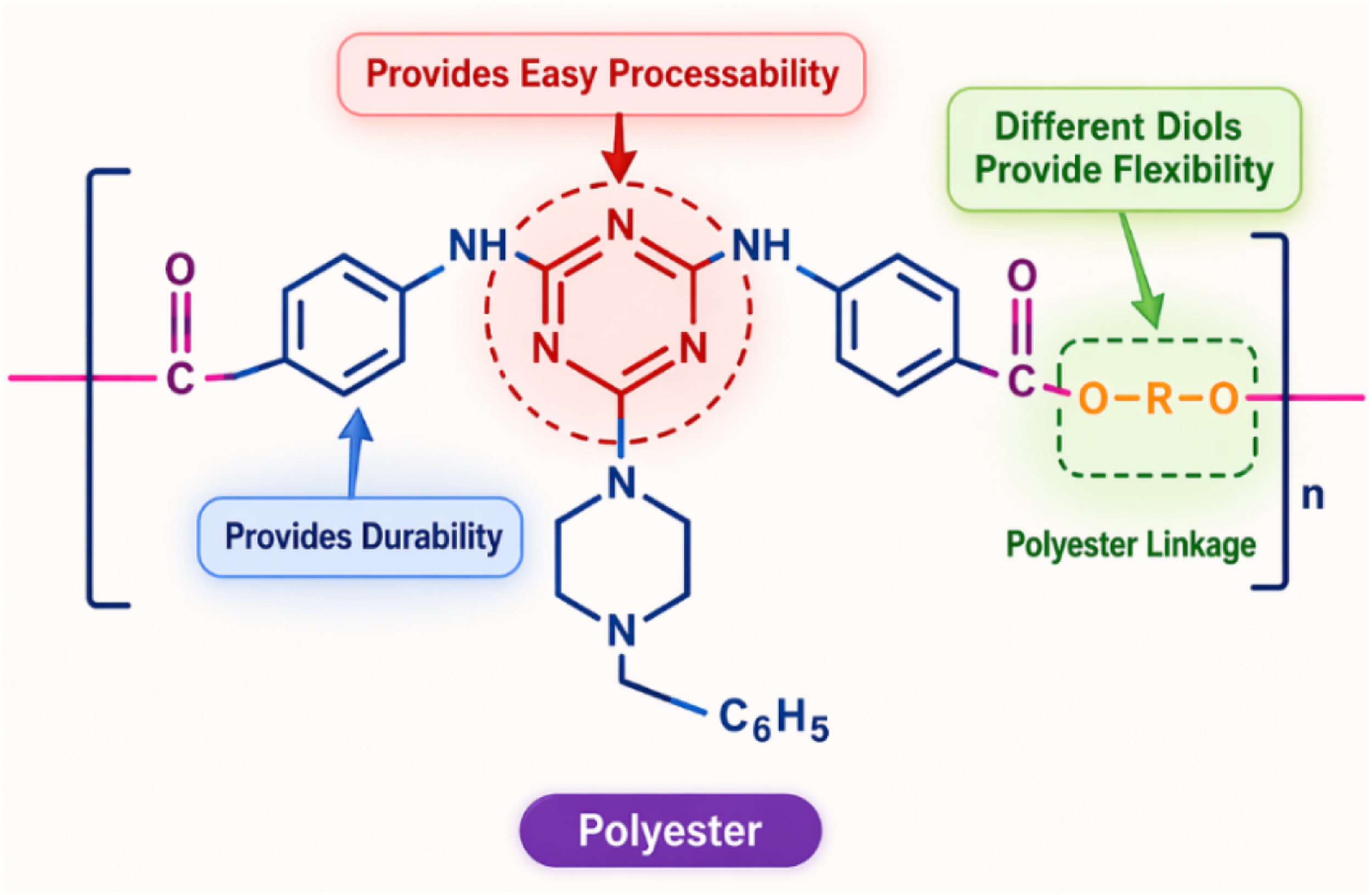
A series of s-triazine-based homopolyesters was synthesized via polycondensation of a 4,6-bis-(N-(4-(benzoylchloride)amino))-2-(N-benzyl-piperazin-1-yl)-1,3,5-triazine (monomer) with various aliphatic and aromatic diols. The structures were confirmed using FT-IR and 1H NMR spectroscopy. Physicochemical characterization revealed that polyesters containing aromatic moieties exhibited higher density, intrinsic viscosity, and improved thermal stability compared to those derived from aliphatic diols. Solubility studies indicated enhanced dissolution behaviour in polar aprotic solvents at elevated temperatures. Thermogravimetric analysis demonstrated significant thermal resistance, particularly for bisphenol-based systems. The thermal degradation kinetics were evaluated using Coats–Redfern, Horowitz–Metzger, Broido, and Chan methods, showing consistent trends with variations attributed to model assumptions. The overall degradation trends remained consistent. The combined physicochemical and thermal characteristics suggest that these s-triazine-based homopolyesters may be promising candidates for advanced materials requiring thermal resistance and structural stability.
Get full access to this article
View all access options for this article.
References
Supplementary Material
Please find the following supplemental material available below.
For Open Access articles published under a Creative Commons License, all supplemental material carries the same license as the article it is associated with.
For non-Open Access articles published, all supplemental material carries a non-exclusive license, and permission requests for re-use of supplemental material or any part of supplemental material shall be sent directly to the copyright owner as specified in the copyright notice associated with the article.
