




Abstract
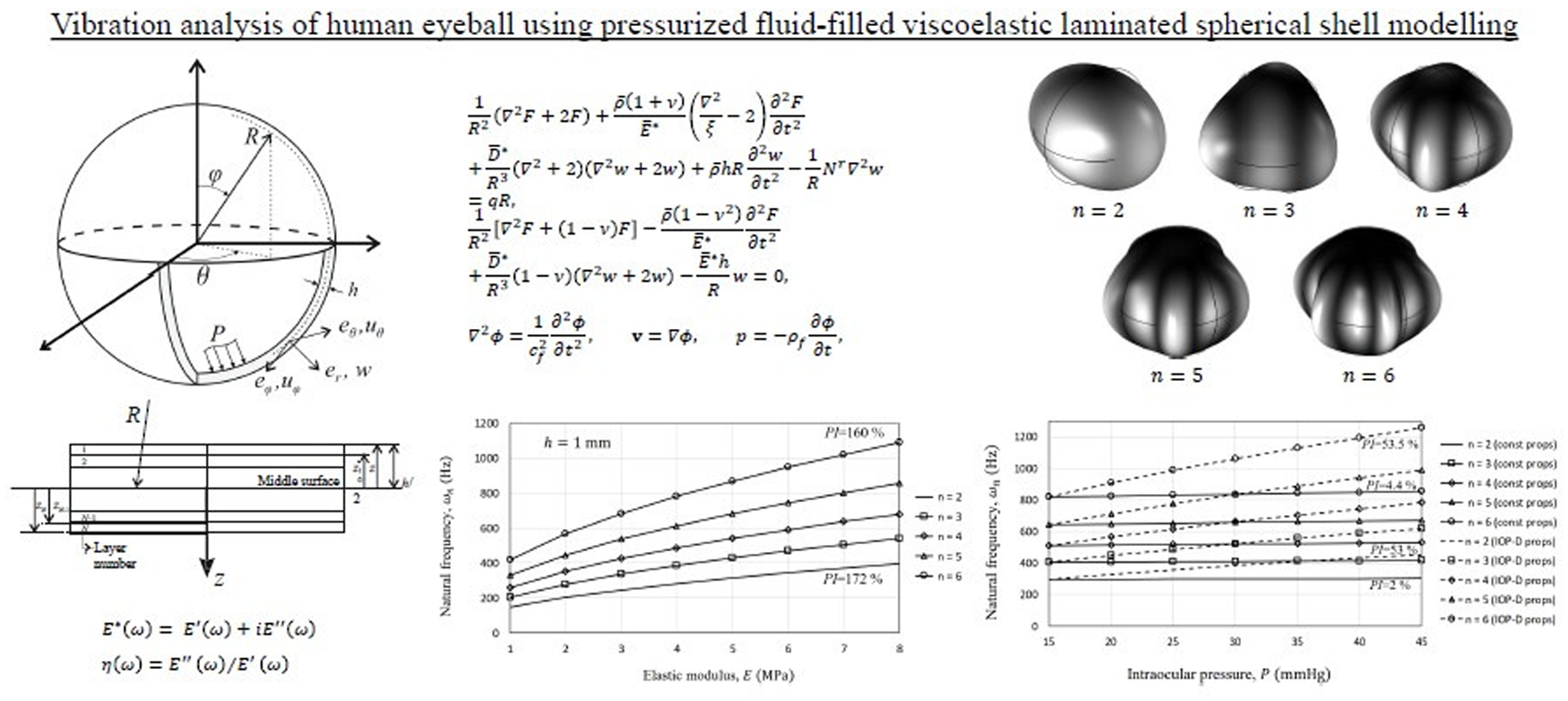
Analytical vibro-acoustic model of laminated spherical shell is developed in order to study the vibrational characteristics of human eyeball considering intraocular pressure (IOP) effect. Eyeball layers are assumed to be viscoelastic with frequency- and IOP-dependent properties, filled with compressible inviscid internal fluid. Love’s first approximation theory, along with the method of stress function, is used to formulate the governing equations of motion for a laminated spherical shell. The wave equation models the internal acoustic domain, and fluid–solid interaction is accounted for by enforcing velocity and stress continuity condition at the interface. The coupled system frequency equations are derived using the modal expansion method in conjunction with the orthogonality property of mode shapes. The analytical results are validated with the available literature and compared with the finite element simulations. The effects of different parameters including elastic modulus, eyeball thickness and radius, IOP variation, and frequency- and pressure-dependent properties on natural frequencies and damping characteristics are studied. It is observed that multi-layer modelling reduces natural frequencies slightly, whereas incorporating frequency- and IOP-dependent viscoelastic properties significantly increase them, demonstrating the critical importance of viscoelastic modelling for accurate eyeball biomechanics.
Keywords
Get full access to this article
View all access options for this article.