




Abstract
Since 2018, the Palestinian Museum in Ramallah has been digitising items from small institutions and private individuals in Palestine as part of their Digital Archive project. In 2019, a partnership was established with the British Library in London with a view to setting up the first paper conservation studio in the West Bank at the Museum. Library conservators provided training for a conservator and conservation manager from the Museum in paper conservation skills specific to the demands of digitisation projects. Initial training in London was followed up by ongoing distance mentoring as well as a visit by British Library conservators to Ramallah, in which conservation volunteers were also trained. This article details the aims of the collaboration, the challenges of putting together appropriate training programmes to be delivered in very limited time frames and the outcomes of the project thus far.
Introduction
The ongoing conflict in Palestine has significantly restricted access to the country’s historical and archival heritage, both internationally and within Palestine itself. While many archival items still exist, they are often under the ownership of multiple private individuals or institutions who do not have the resources to document or preserve them, and as such are at risk of permanent loss. The lack of access to conservation training programmes has also made it difficult for institutional staff in Palestine to build the skills and capacities required to preserve vulnerable archival items. Through the recent Digital Archive project, researchers from the Palestinian Museum have gained access to thousands of endangered collections belonging to small institutions and private individuals. Since January 2018, more than 21,000 items have been digitised through these projects following temporary loans to the Museum by their owners, with all items freely available via the Museum’s website. Collections from which items have been digitised so far include the Palestine Red Crescent Society, the Arab Women’s Union and Birzeit University. As a prerequisite for digitisation, many owners and custodians have asked that the Museum preserves their loaned items.
The Conservation for Digitisation project, a partnership project between the Palestinian Museum and the British Library, was initiated in July 2018 through funding from the Welfare Association (Taawon). The aim of the project was to enable the conservation of 3000 damaged paper-based items documenting Palestinian history and heritage from 1800 to the present day, for digitisation as part of the ongoing Digital Archive project. The deadline for conservation of these items was December 2019. The plan was to establish the first paper conservation studio in the West Bank and to train two Museum staff at the British Library in the conservation skills necessary for the purposes of digitisation. This work was facilitated by the British Library’s International Team in collaboration with their counterparts at the Palestinian Museum. A key aim of the Museum in undertaking the project has been to educate and empower the Palestinian public in relation to the protection of their cultural heritage. Therefore, the establishment of the studio and training of conservators were to be followed by a series of education and outreach activities (including lectures, workshops and educational tours of the Museum and studio) as well as the production of a mini-handbook of conservation and preservation advice.
The training was to take place in April–May 2019 and was to consist of a 6-week visit to the British Library Centre for Conservation in London by the Palestinian Museum’s conservator and a 2-week visit by the Museum’s conservation manager. In the course of this visit, the Museum staff would learn paper conservation techniques first-hand and be introduced to the British Library’s digitisation workflow and documentation procedures. This was with a view to developing related procedures tailored both to the requirements of the project’s timeframe and to the fact that all the objects to be treated would be loan items. Following the training based at the British Library, the Palestinian Museum’s conservators would return to Palestine to set up the studio at the Museum and recruit three volunteers for the project. A month later, two of the British Library’s conservators would travel to the Museum in Ramallah to undertake a mentorship visit. This return visit would take place at the end of June.
Preparation
The principal training was provided on-site at the British Library by three book and paper conservators, with additional input from specialists in preventive and photographic conservation and from the Library’s conservation scientist. The time frame for completion of the project was tight, and accordingly, the emphasis was upon designing training plans, which would be achievable, realistic, useful and applicable. Through Skype calls prior to the visit, the conservators from both institutions established priority areas to be focused on during the visit. A particular emphasis was placed upon developing the skills necessary to accurately and speedily assess the condition of items, with a view to streamlining workflow.
Shared understanding of the nature of the collection items to be digitised was essential in enabling the conservators at the British Library to put together a training plan specifically tailored to the requirements of the material. In these initial exchanges, it was established that most items were paper-based and dating from the 19th and 20th centuries, that the majority were unbound and that there was a significant proportion of photographs (Figure 1). Equally crucial to designing and delivering a practical training plan was a shared understanding of how the conservation studio at the Palestinian Museum would be set up and equipped once the Museum conservators returned. The Museum’s conservation studio is situated in a secure 61-m2 climate-controlled room on the lower floor, with a sink, hot plates and designated photography area. It was therefore feasible to provide training in preparing aqueous adhesives, but owing to the lack of air extraction facilities in the Museum’s studio, any solvent-based adhesives or consolidants were avoided. The conservators from both institutions were able to identify what conservation equipment, and resources were both accessible in the West Bank and/or possible to import, and appropriate treatments were identified accordingly (which I shall return to later).
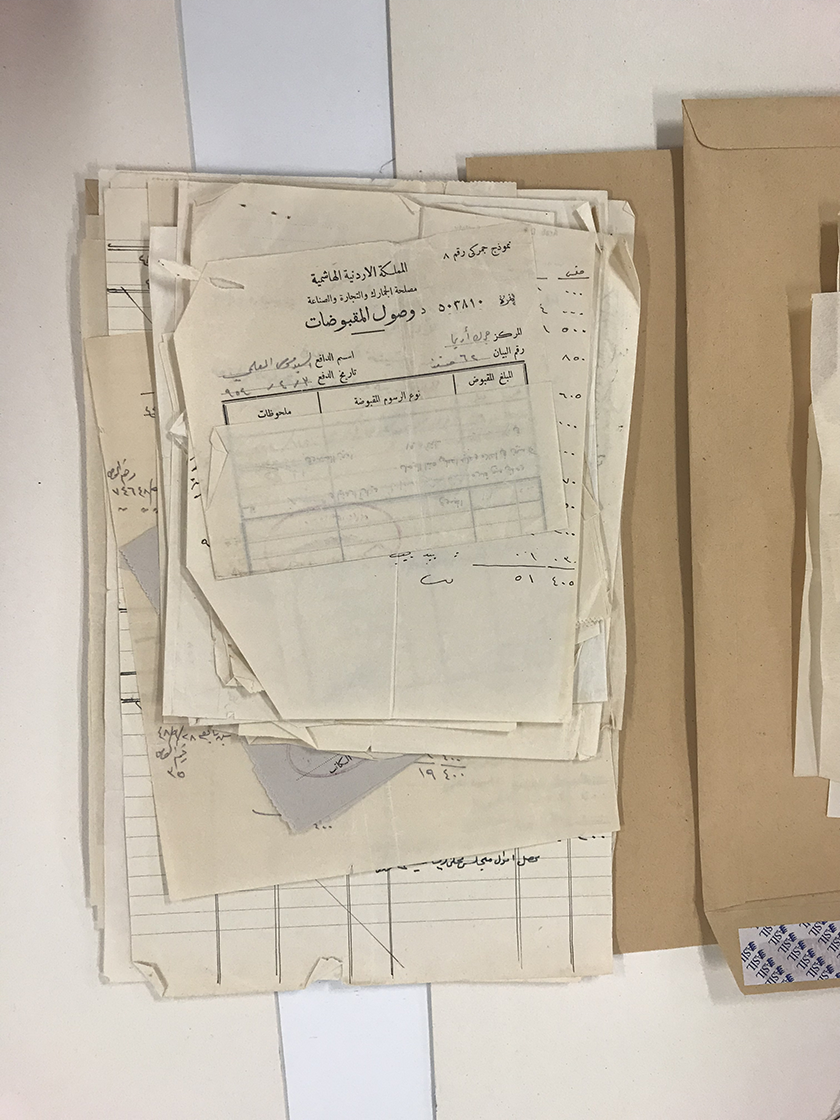
Archival material typical of the project.
In designing a training plan specific to conservation skills, the British Library’s conservators were able to draw on the increasingly rich culture of digitisation conservation in the United Kingdom, which has grown rapidly as a subfield of paper conservation in the last 10–15 years. The exponential expansion of digitisation projects within major UK libraries has led to an increase in the number of conservators employed to treat and protect paper items solely within the context of the digitisation process. Several major UK institutions, including the British Library, now have designated teams of digitisation conservators within their wider conservation departments. While following the key mainstream conservation principles of minimal intervention and reversibility, digitisation treatments are not necessarily designed to ensure the safety of items over repeated handlings in library reading rooms. They focus instead upon rendering them suitably robust to be handled with care during the process of photography or scanning and protecting them from any potential risk posed by digitisation equipment.
Having been digitised, the likelihood is then that these items will be called up for consultation less frequently (since a digital surrogate will be available), and responsible, appropriate treatments can, therefore, be designed using quicker, less robust repair methods, which will ensure the safety of the item during digitisation but not necessarily during repeated further handling by members of the public. All treatments are still tailored to the needs of individual items, but popular treatment options for the digitisation conservator may include the use of a remoistenable gelatin adhesive to repair smaller tears in paper, a method which has less longevity and strength than a more traditional repair using a starch paste, but which has an almost instantaneous drying time (since digitisation projects tend to work to inflexible deadlines, the speed of treatments is usually of paramount importance). Similarly, incapsulation in polyester may be a preferable alternative to extensive and time-consuming paper repair in the case of fragmentary flat objects. Damage to bound volumes may be consolidated and stabilised in preference to more interventive structural repairs. Within digitisation conservation, emphasis is also frequently placed on training photographers and scanners in safe handling and upon providing aids to enable this, as well as stressing the importance of asking a conservator for advice or physical assistance if an item seems to be at risk.
Conservation training
The existence of this broad framework of digitisation conservation practice was of great help in putting together a suitable training programme for the Palestinian Museum’s conservators. The fact that the techniques used tend towards less interventive and complex treatments also meant that they lent themselves very well to a situation in which useful and applicable training had to be provided, and sufficient expertise developed, in just 6 weeks. All parties involved were aware of the limitations imposed by such a short time frame and that to attempt to provide training in more complex conservation methodologies in too short a space of time would pose a risk to the items being digitised at the Museum. In terms of practical conservation skills, a plan was, therefore, to put together revolving around surface cleaning techniques and aqueous techniques for flattening and tear repair as well as the preparation of all adhesives.
Materials were selected which it was anticipated it would be possible to access or import into Palestine – since wheat starch, the stable adhesive of Western paper conservation, was difficult to access, the training focused more closely on using methyl cellulose and gelatin applied to tissue in a remoistenable form (the benefits of the latter for digitisation projects having already been noted above). During the Museum conservators’ stay in London, it was also possible to identify substitutes procurable in Ramallah for materials that could be difficult to access, for example, cosmetic removal sponges rather than the smoke sponges more commonly used in surface-cleaning paper. The training in cleaning and repair techniques took place against the background of an overview of basic paper and water chemistry and an overview of key conservation principles, in particular, those of minimal intervention and reversibility. A day’s training was also provided by the British Library’s photographic specialist, giving a grounding in photographic processes and in the distinct requirements of photographs as conservation items.
Following explanations, demonstrations and supervised practice on dummy items, the Museum’s conservator moved on to working on items from the British Library’s range of current digitisation projects, which enabled them to develop their own preferred working methods while under the advisory supervision of the Library’s team of digitisation conservators (see Figure 2). As well as interventive treatment techniques, training was also provided in mould remediation, in encapsulation of fragile items in polyester and in methods of providing handling training to non-conservators. Both the conservator and the conservation manager worked with the Library’s preventive conservation team to identify materials and systems for integrated pest management, environmental control, rehousing and handling training, which could be feasibly employed in the Palestinian Museum.
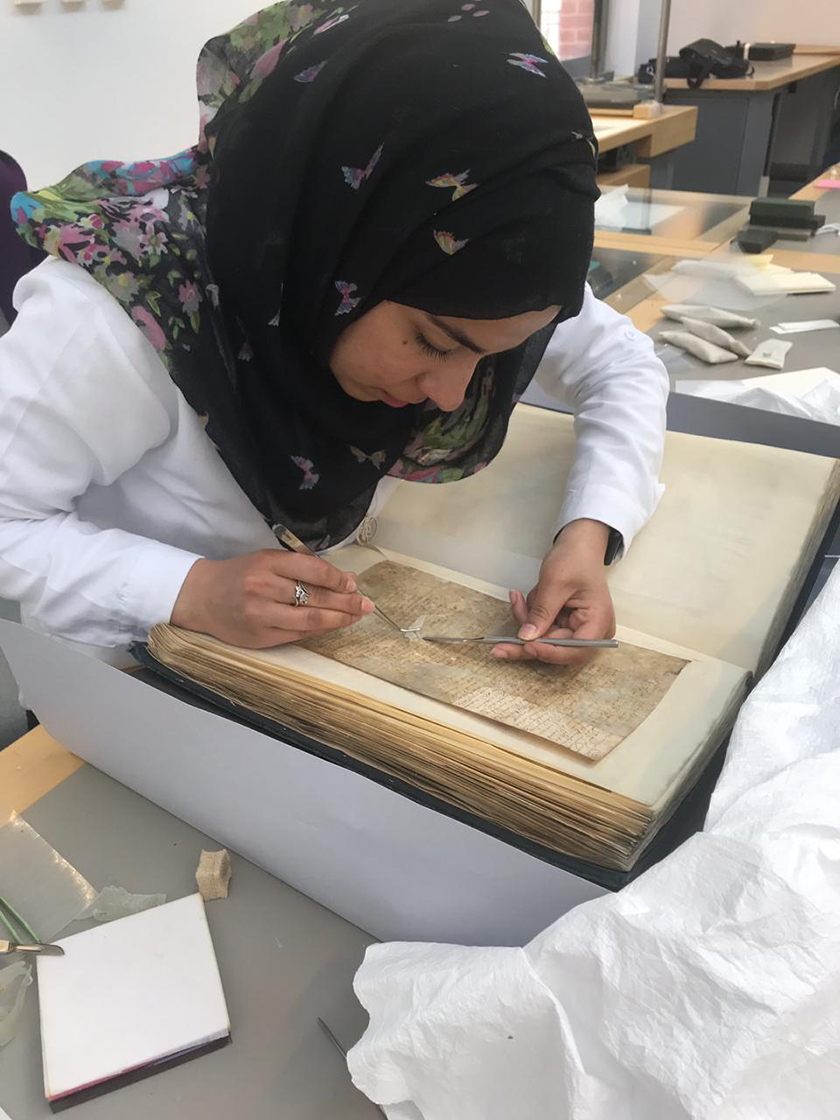
Undertaking paper repairs with gelatin-remoistenable tissue at the British Library Centre for Conservation.
Concurrent to the 6 weeks of practical training of the Museum’s conservator, the Museum’s conservation manager also undertook 2 weeks of mentoring. This consisted of project management consultations with the managers of all the British Library’s current digitisation projects, all of which operate within different parameters and with different stakeholders, as well as discussions regarding the development and tailoring of risk assessment templates to the needs of the Conservation for Digitisation project. Consultations also took place with Collection Care North staff regarding the adaptation of non-purpose-designed spaces into conservation studios, as has recently taken place at the Library’s Boston Spa Centre in Yorkshire.
Assessment and documentation
Alongside practical conservation skills, the Conservation for Digitisation Project also sought to develop awareness of the types of pre-existing damage likely to pose risk to paper items and, accordingly, of which items should be referred for conservation treatment. Since the project had the aim of conserving 3000 items between the return of the Museum staff to Ramallah in June and the end of the project in November, it was imperative that time would not be spent on unnecessary treatments. An advantage of working across the British Library’s range of digitisation projects was that the conservator was able to gain an appreciation of the range of damage likely to be encountered in library and archival collections, as well as a tactile understanding of how factors such as paper weight and positioning of damage can result in a lower or higher risk being posed to the item by handling during digitisation. They were also able to spend time with the Library’s imaging teams to gain a clear idea of how different types of image capturing equipment can pose a risk to items of various formats (the imaging studio at the Palestinian Museum is equipped with both scanners and photography stations), as well as the kind of handling measures, which can be put in place to mitigate risks posed by the equipment, such as book supports, weights and straps.
The training in condition assessment went hand-in-hand with the development of suitable documentation systems for the project. The fact that all items to be digitised were loan items meant that comprehensive documentation of treatments undertaken, including before and after photos, had to be provided for the owners/custodians of all the digitised items, to be returned to them alongside their rehoused items. Additionally, internal documentation had to be kept for the project, both to provide an auditable record of work undertaken and to track the progress of individual items through the digitisation workflow. This was a heavy documentation workload for a digitisation project, but several steps were taken to mitigate the amount of conservator time being spent on it. In terms of internal documentation, a streamlined form was produced in which all written documentation relating to an item could be entered into a single row on an A4 spreadsheet. Most information could be entered into tick boxes, and colour coding was used to designate condition before and after conservation. This saved time both for the conservators and for any other project members, such as researchers or imaging staff, who might need to refer to the information. It was possible to adapt and streamline aspects of the British Library’s loan documentation formats when developing a report to provide to the owners. As mentioned above, the Museum’s studio is equipped with a photography area, and it is planned that one of the duties of the volunteers will be to take the before and after pictures for the loan documentation.
Working with volunteers
Three part-time volunteers were recruited to work on the project, all of them recent humanities graduates from Birzeit University in Ramallah. Timings meant that upon their return visit to the Palestinian Museum, the British Library conservators were able to collaborate with the Museum’s conservator in providing training to the volunteers. Owing again to the tight time constraints of the project and to the fact that the British Library conservators were only able to provide training for 4 days, it was crucial that the volunteers’ skills were utilised usefully and effectively, while again bearing in mind that the time available for the volunteers to gain familiarity with and practise repair techniques before starting work on loan items would be very short. With this in mind, an approach was designed in which the Museum’s conservator would treat items with more complex damage as well as any photographs. The volunteers would enable her to concentrate on these tasks by undertaking the bulk of the surface cleaning, flattening and simple paper repairs as well as the documentation photography mentioned above. If, as is hoped, more digitisation conservation projects take place at the Museum, the option remains for volunteers to receive more extensive conservation training at a later date.
Distance mentoring and moving forward
From the project’s inception, it was planned that the British Library staff would continue to provide distance mentoring to their counterparts at the Palestinian Museum via regular Skype calls. In practice, owing to the unreliability of Skype as a communication channel and to the time demands placed upon the conservation team in Palestine, this has developed into ad hoc communication when necessary via email or WhatsApp, in which updates and advice can be exchanged. At the time of writing, the Conservation for Digitisation project continues on target, with digitised images appearing on the Museum’s Digital Archive e-platform: http://palarchive.org/ [accessed 18 November 2019].
Footnotes
Declaration of conflicting interests
The author(s) declared no potential conflicts of interest with respect to the research, authorship, and/or publication of this article.
Funding
The author(s) received no financial support for the research, authorship, and/or publication of this article.