




Abstract
We live in a constantly transforming society, and, therefore, the Martynas Mažvydas National Library of Lithuania, which celebrated its centenary last year, is also constantly transforming. By adapting to constant change, we continue our core mission, which in today’s digital age is to preserve and manage what has been created in this country over the centuries. We are actively developing a unique library model, live library. In other words, it is the living space of living people. Our field of activity is very wide. We are not only the custodians of the national documentary treasure but also a cultural institution, open to all, a scientific library and a parliamentary library that cultivates community, public spirit and democracy. Never before has the National Library been as popular, needed and even as fashionable as it is today. We work to meet the professional, intellectual and spiritual needs of today’s people, whether they are library visitors, readers, employees, partners or just those who want to improve themselves.
Rethinking the mission and the nature of activities
In situations such as the 3-month (from 16 March to 17 June) quarantine in Lithuania, libraries do not have to move away from their mission but have to rethink how to carry it out in a changed reality. In terms of strategic management, the sacred triad that the National Library has been following for some time is, in this case, rethinking, restructuring and reorganisation. The National Library is an institution that promotes culture, education, science and economy, and all of these areas, which are important nationally, have been severely affected by the quarantine that was announced because of Covid-19. Thus, the biggest challenge is how the National Library, both as a whole and in its separate structural parts, will be able to adapt its activities to the overall mission of the library. It is much more difficult than installing new technologies or installing remote workplaces. Especially since not all technological solutions are aimed at enabling creativity. It is my deep conviction that technological solutions can only supplement, strengthen and deepen the essential activities of the library as a social institution. The pandemic and quarantine have raised a number of issues and we have found answers to all of them. There are other dilemmas, but they arise not only for us but for the whole world.
Realistically, I dare saying that we adapt successfully. This has been proved by the challenge posed by the coronavirus pandemic this spring. In just one day we planned to ensure the safety of visitors and cancelled events if necessary, and a couple of days later, we already knew that we would have to close the Library’s doors and serve visitors remotely. It took just a few days to radically change the nature of the Library’s activities and the work of its staff. The vast majority of employees worked remotely and were given the opportunity to work from home with the necessary programs. Employees discovered and adapted communication tools (Microsoft Teams, etc.). Some of the workers whose work is related to physical customer service during this period had to adapt to radically changed conditions and to actively seek solutions to reorganise their activities during the quarantine.
Promptly customised services
It can be said that the challenges of the quarantine have led to the transition to a new virtual reality. We offered users a wide range of remote services, the staff held virtual meetings and readers used remote services (interactive library, subscribed databases and virtual cultural heritage portal). Visitors had the opportunity to view exhibitions that were currently transferred into a virtual space, participate in lectures broadcast live from the library TV studio, creative workshops as well as view conversations, book presentations and other recordings published on the Library’s YouTube channel. Statistics show that during quarantine, users were actively interested in the video content created by the Library and e-book borrowing increased 2.4 times. There has been a significant increase in the number of subscribers to our Library’s YouTube channel.
With the rapid spread of false news about coronavirus on the internet, which caused confusion and panic in society, we constantly provided only verified and reliable information because we perceive the library not only as a repository of documents but also as a manager of data, information and knowledge. For example, there was a lot of interest in informative and reliable lectures on coronavirus by professionals, which we provided on our YouTube channel.
Socially responsible institution
As a socially responsible institution, we have contributed to particularly relevant public projects. At the time of the Covid-19 epidemic, there was a lack of personal protective equipment in Lithuania as it was worldwide. This pushed the people of the country to take civic initiatives and to look at the situation in a creative way. The robotics school in Vilnius, together with scientists, engineers and specialists of the company ‘3DCreative’, created a 3D model of a protective face shield that reduces the risk of infection. Lithuanian libraries also offered their help (3D printer network throughout Lithuania and volunteers). Donatas Kubilius, the administrator of the National Library’s makerspace ‘PATS SAU’, became the curator of this initiative for all libraries that joined the campaign. Less than a week after the start of the idea, as many as 54 Lithuanian public libraries started printing components for the production of protective face shields with their existing 3D printers. Over 3500 shields were produced in 2 weeks. Such initiatives can exist only when organisations possess creative, dynamic and adventurous staff. We delight in the fact that the poster report of the Martynas Mažvydas National Library of Lithuania prepared by the curator of the above-mentioned initiative Donatas Kubilius together with colleagues was selected the Best IFLA Poster 2019 at this organisation’s 85th General Conference and Assembly in Athens last year (see Figure 1).
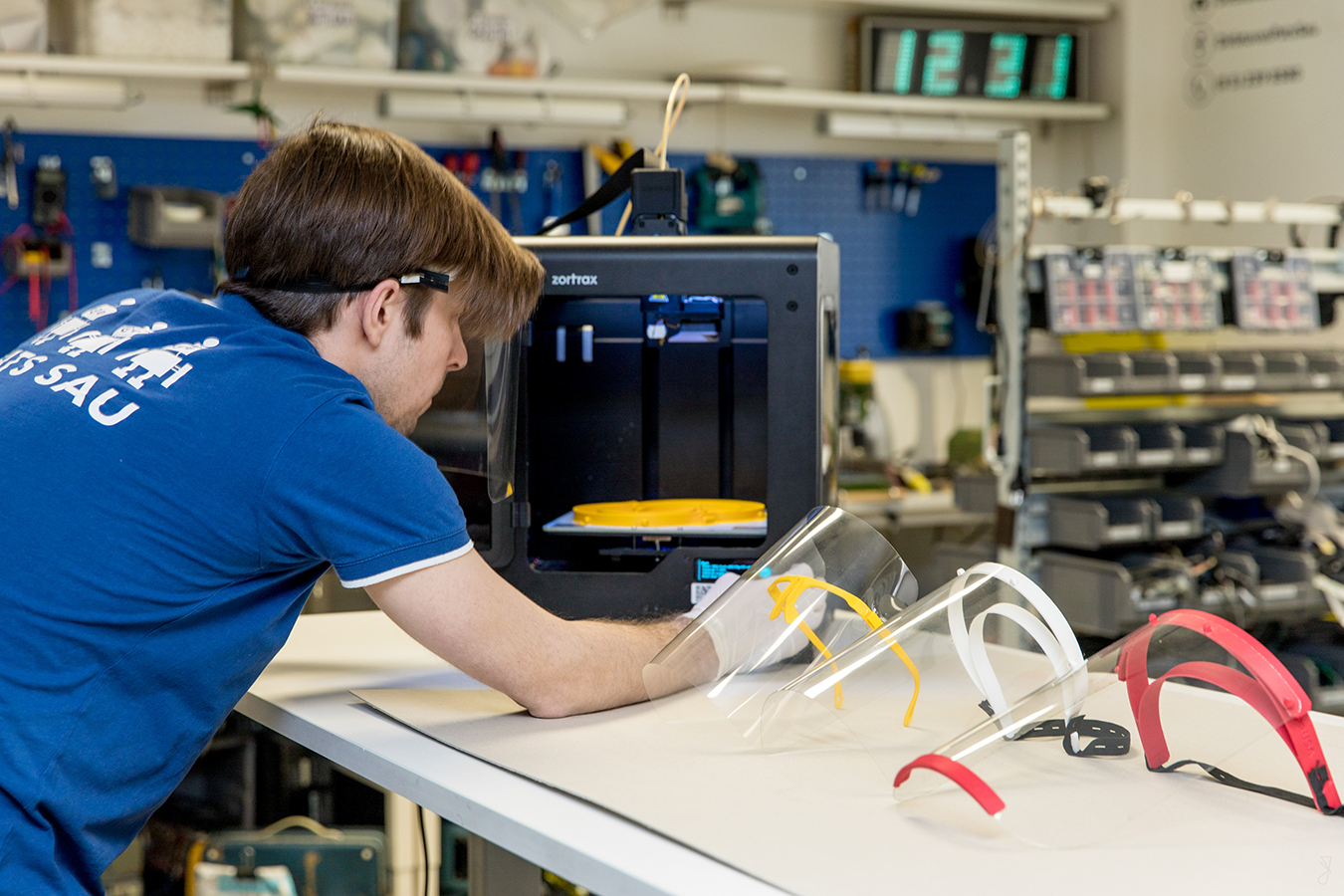
After the quarantine has been declared, component parts of protective face shields for medical professionals were being produced at the National Library by using a 3D printer. Photo by Vygaudas Juozaitis.
In order to manage the epidemiological situation in Lithuania, the National Public Health Centre turned to the public for help in working with people in self-isolation and/or with people who had contact with people with Covid-19. The National Library of Lithuania also invited its staff to contribute to this initiative. The volunteers, after receiving special training, called people and interviewed them according to the questionnaire of the National Public Health Centre and entered the data into a monitoring system. Although the workload of volunteers was high, it is particularly important to realise that such important organisations were in a critical situation during the pandemic and that, as far as possible, we, as citizens, must contribute and assist as much as we can.
Recommendations for Lithuanian libraries
The National Library of Lithuania, as a national centre of library competency, has taken on institutional leadership. We have prepared recommendations to help Lithuania’s library staff to adapt to work conditions during the quarantine and then to properly implement the stages of lifting the quarantine, in accordance with the requirements of the law and to create appropriate conditions to provide services in libraries. In these recommendations, we established requirements for ensuring the protection of employees and library visitors as well as procedures for customer service under soften quarantine, procedures for the use of documents, public communication requirements, development of electronic content and services, implementation of distance education and budget allocation. By using them, we aim to provide useful information and recommendations to help people meet the new challenges. The main target audiences for these recommendations are library managers and responsible professionals who have implemented the necessary measures in their own institutions. The libraries have implemented the recommendations considering the specifics and peculiarities of the activities carried out, as well as the epidemiological situation regarding the risk of the spread of the coronavirus in the region.
Public education projects
Since 1997, the National Library of Lithuania has been implementing large-scale ‘umbrella’-type projects by combining libraries and other memory institutions and contributing to the digital transformation of institutions, the digital inclusion of the Lithuanian population, an increase in employment, the development of critical thinking and the reduction of social exclusion. This became especially relevant during the quarantine, when most people’s lives moved into a virtual space.
Over the last 15 years, the National Library, together with its partner, the Ministry of Culture of the Republic of Lithuania, has attracted more than €32 million to all regions of Lithuania under the programme ‘Global Libraries’ (B. and M. Gates Foundation). Projects of great importance like ‘Libraries for Innovation’ and ‘Libraries for Innovation 2’ have been implemented. The problem of physical access to computers and the internet has been solved practically in the whole of the country (both in urban and rural areas). Currently, the system of public libraries concentrates and operates the most powerful forces in Lithuania, helping the population to overcome the digital divide and to assimilate and start using digital sources and e-services.
The experience gained has led to the situation that during the European Union funding period, the National Library is coordinating three investment projects (European Regional Development Fund) totalling more than €23 million. The implementation of these projects will help ensure the modernisation of the Lithuanian Integrated Library Information System (LIBIS) and Virtual Electronic Heritage System (VEPS) managed by the National Library, the creation of new services and the renewal of the Library’s public internet access infrastructure and supplement the most modern technical equipment required for robotics, engineering and creation. The National Library is also a partner of the ‘YIVO Vilnius Project’, which aims to create the largest digital library of Jewish historical memories in Eastern Europe.
Currently, the Lithuania’s Digital Development Programme for 2021–2030 is being planned on the national level. Experts from the National Library are participating in digital literacy and digitised heritage working groups as well as representing cultural institutions in thematic working groups on artificial intelligence and data analytics. The main goal is to increase the resources available to libraries for increasing the digital inclusion of the population, to reduce social exclusion, ensure quality lifelong learning, formulate critical thinking, promote citizenship and so on. The National Library provided conceptual suggestions on how the already digitised or digital born cultural heritage could be more widely used for education, science, the creative industries and tourism development purposes. Also for how it could be used by the State, scientific and business institutions for decision-making or development of new services, analysis of economic and social phenomena or for making public or policy-making decisions. The importance of these projects has been particularly evident in the quarantine conditions because it showed the importance of looking to the future and being able to adapt to a sudden change in reality. There are new projects awaiting. One of them is related to strengthening the role of the National Library as the leader in developing competencies of cultural professionals.
Reliable and innovative institution
We successfully cooperate with, and are partners with the most important State institutions, advanced start-ups, specialists in creative industries, non-governmental organisations and the most solid international institutions. This allows us to constantly feel the pulse of Lithuania and the world. The synergy of the library community and its partners in joint projects increasingly consolidates the National Library as a modern, reliable and innovative institution. We are constantly dreaming, forecasting, experimenting and looking for different solutions such as the new e-service created in our Library. An e-service is a tool for the labelling of digital works, designed to further develop the legitimate market for intellectual property or the application of new business strategies in the public sector or solutions to adapt to quarantine conditions. In this dynamic and ever-changing world, the library cannot be just an island of peace, it must also be able to move quickly (see Figure 2).

As it could not exhibit an original document from New York at the exhibition devoted to Vilna Gaon because of quarantine restrictions, the National Library applied technological innovations (holograms) to introduce an exceptional document to visitors. The Minister of Culture dr. Mindaugas Kvietkauskas and the Head of Judaica Centre dr. Lara Lempertiene visiting the exhibition. Photo by Vygaudas Juozaitis.
The quarantine declared because of the coronavirus has only shown us how important social responsibility is and how well libraries and librarians are able to adapt to this rapidly changing world. We are constantly monitoring and analysing the global challenges of the near future, reading the signs of our culture and environment, anticipating the development trends of libraries and contributing to ‘Global Vision’ of the International Federation of Library Associations and Institutions (IFLA) aimed at creating a strong shared library space for a literate, informed and active society. We have also been rewarded
We have also been granted a reward by competent authorities for civic participation in making protective tools. Our activities during the quarantine period have been evaluated by the Lithuanian Trade Union of Service Industries, which recommended us as one of the most socially responsible institutions of the public sector.
Instead of conclusion
For our Library, as a national library, the quarantine that was declared because of Covid-19 was not an unbearable blow. It is true that the challenges have been considerable, but we have handled them well. Some say that after quarantine, ‘life must return to normal’; I would rather think that libraries should not even try to go back to normal. It would be much more meaningful to learn from the lessons of the crisis and to act with full force once we have improved and adapted to the changed reality, the new virtual reality. Libraries should re-examine their services and the provision of those services and adapt them to the new conditions. Also they should think about the digitisation of content, services and activities, the big data dimensions and formulate new project initiatives to address the challenges society is currently facing. I think that in Lithuania this role is perfectly performed by the National Library working hand in hand with technology and a rapidly transforming society, and at the same time we are giving the direction to all Lithuanian libraries and even libraries abroad.