




Abstract
The Indonesian constitution provides for welfare and education. To achieve these constitutional mandates, the Indonesian government passed several laws as the foundation for lifelong education, including the Library Act of 2007 and the National Repository Act of 2018. These Acts are the main legal foundation for the National Library of Indonesia (NLI) to create public policies in library service development across Indonesia. This study seeks to understand these laws through Natural Language Processing (NLP) and Latent Dirichlet allocation (LDA) Topic Modelling. Using these methods, we uncovered the major themes of these legal mandates for library services. Our research revealed five topics for each law. We then analyzed the NLI budgets from 2021 to 2023 to see how the key legal mandates were implemented. We found greater implementation of the 2007 Act than the 2018 Act. Our study offers new methods for library law and policy research.
Keywords
Introduction
Library service is a complicated issue since it involves many concerns, not only user needs but also library administrator and professional responsibilities. Throughout the world, librarians are guided by association standards and librarianship research. In some nations, they are also guided by law. Laws governing library responsibilities and services can provide legal certainty to users and library professionals. The legal aspect of library services involves not only the individual patron-librarian interaction but also the needs of diverse users, librarian colleagues, library organizations, and the entire society (Mbofung and Popoola, 2014). A legal mandate for library services can empower library administrators to better serve library users and other stakeholders. Legal mandates can direct library procedures to ensure intellectual freedom, equal access, privacy, and compliance with other laws. Where legislatures have passed library laws, libraries must integrate those legal mandates as essential community resources.
Several countries have adopted library laws. The United Kingdom established the Public Libraries and Museums Act in 1964 to guarantee comprehensive and efficient library services (Woodhouse and Zayed, 2021). In China, state and local governments have library ordinances that dictate construction standards, management credentials, and more (Yi, 2013). In Singapore, the Ministry of Information and the Arts has managed billions of dollars of government investment in libraries as part of a “learning nation” or “intelligent island” mandate (Mittermaier, 2007; Ryan et al., 2023a). Libraries have also become a place to provide open access legal materials and government data (Burke, 2015; DeLuca, 2020). Legal mandates have increased access to various information resources, including in Indonesia.
To ensure long life and prosperity for the Indonesian people, the Indonesian government established a legal mandate for library services more than 15 years ago. The Library Act of 2007 [Act No. 43] bestowed to the National Library of Indonesia (NLI) the significant duty of establishing a comprehensive national framework for library services. According to the initial provision of Indonesia’s 2007 Library Act, and similar to the United Kingdom’s 1964 Library Act, the public was entitled to access services and make full use of library facilities in an efficient manner. Indonesia’s 2007 Library Act also guaranteed that people who have disabilities and/or physical, emotional, mental, intellectual, social and/or disorders have the right to obtain library services tailored to their respective abilities and limitations. A decade later, Indonesia revised the National Repository Act of 1990 with a new National Repository Act of 2018, which focused on accommodating not only the print Indonesian collection but also Indonesian digital collections (Perpustakaan Nasional Republik Indonesia, 2020b). Together, the laws required a great deal of digital work, including digitization and metadata creation. But the laws were more complicated than this, and library leaders have been challenged to understand and implement them. This research seeks to uncover buried trends and priorities in these laws through computerized text analysis.
Text analysis has emerged as a novel technique for extracting and analyzing legal texts (Ryan et al., 2023b; Vogel et al., 2018). In modern globalized society, where work and other activities can be governed by multiple jurisdictions’ laws, legal text analysis has become a major concern. In addition, data scientists are measuring the advancement of their natural language processing (NLP) techniques, in part, via the lens of specialized languages, in this case legal language (Nazarenko and Wyner, 2017). In sum, the public wants better tools for legal analysis and data scientists want to hone NLP tools for difficult domains and documents, including laws. Our study seeks to contribute to both sets of goals.
The objective of this study is to unpack the hidden trends and meanings in Indonesian library laws through a series of NLP tests and applications. Due to the interconnected layers of linguistic analysis, ranging from character strings (for the identification of jurisdictions, for instance) through broad mandates or legal arguments, achieving better text analysis is particularly difficult and crucial in the context of legal writings. This study will attempt to investigate the wording of library legal mandates to address the following question: RQ1: What are the major themes of legal mandates in library services in Indonesia?
After answering that question, we will explore recent National Library of Indonesia budgets to answer a policy question: RQ2: How did the National Library of Indonesia implement the library laws via its budgets?
To answer these questions, our study uses topic modeling, a powerful tool for identifying hidden patterns and themes in textual data. Topic modeling enables flexible document analysis based on actual content rather than predefined categories, as described below. This text analysis enabled us to pull back the curtains of Indonesian law and policy to learn what was happening beneath the surface of complex documents.
Literature review
Our study features the unique country of Indonesia, focuses on an era within Indonesia’s rich legal and cultural history, spotlights a renowned national library system, and demonstrates the utility of a novel set of analytical research techniques. We begin with an overview of relevant national laws.
Indonesian legal mandates for library services
The National Library of Indonesia (NLI) is one of Indonesia’s highest institutions of library and bibliographic affairs. The NLI is charged with several responsibilities. The library’s first obligation is to serve as the center for all library development agencies; this responsibility was established through the Library Act of 2007 (Act No. 43). This legal mandate made the NLI the central regulator of all types of libraries in Indonesia (Salahudin et al., 2021). The NLI also became the chief literacy agency, tasked with stimulating all types of libraries across Indonesia to nurture reading habits and information literacy. The Library Act impacted the growth of the library establishment. In 2007, the nation had approximately 120,000 libraries, mostly school libraries (National Library of Indonesia, 2009). Based on 2019 NLI strategic planning data, Indonesia now has approximately 165,000 libraries across the country (Ali, 2020). Thus, The Indonesian Library Act 2007 had a great impact on library development in Indonesia. The law, and its literacy-for-all mandate, is partly responsible for the launch of more than 40,000 new libraries.
The Library Act was quickly followed by the Public Information Act of 2008 (Act No. 14), which articulated a human right to obtain data, particularly public and government data. After that, the National Repository Act of 2018 (Act No. 13) made the NLI the central portal of open access material. The Repository Act gave libraries a legal mandate to gather all the national publications, those produced by Indonesians or concerning Indonesia, even if they were published or recorded abroad. The Act required authors to submit their printed or recorded works to the National Library and/or local or regional libraries, or the agency designated by the National Library of Indonesia (Perpustakaan Nasional Republik Indonesia, 2020a). Because of the National Repository Act, the NLI has added nearly four million general collections documents to its collection (National Library of Indonesia, 2017; National Library of Indonesia, 2023).
These legal mandates have changed the environment for how library services are provided to the community. The legal mandates have become the foundation for the NLI to have greater role than other national libraries in the world. National, comprehensive collections mandates are not the law in most countries. Notable exceptions include the U.S. Library of Congress and the British Library, two of the biggest national libraries in the world, which also have a legal duty to maintain national physical and digital repositories (British Library, 2017; Library of Congress, 2019). The NLI is not only maintaining a national repository but also has a duty to coach and develop all types of libraries in Indonesia, from major scholarly institutions to village school libraries.
The legal mandates on Indonesian libraries exist to ensure that Indonesians have access to information and knowledge, to protect cultural heritage, and to better themselves through education, research, and lifelong learning. The laws have promoted the formation and growth of libraries at multiple levels, including national, provincial, district/city, and village (Ali, 2020). The laws also require libraries to be open to the public and to provide free and equal services to all patrons. Lawmakers intended that libraries would gather, organize, and transmit information and knowledge in diverse formats, such as books, journals, multimedia materials, and electronic resources. The National Library of Indonesia is principally responsible for implementing these library services and activities. Local legislation and policies can also influence the management and administration of libraries in various locations. Local governments can also contribute to library development in their region using the Library Act and Repository Act as their fundamental legal foundations (Håklev, 2010). These two Acts are the fundamental legal source for developing and maintaining library operations across Indonesia, including at the nation’s flagship institution: the National Library of Indonesia.
In sum, under the laws of Indonesia, libraries are obligated to provide access to digital and print materials, to contribute to cultural preservation, and to facilitate the literacy and education of the public. The laws have promoted library creation and expansion from rural villages to the capital. Today, the NLI oversees these diverse institutions and library services, with local laws and institutional policies adding nuance to national strategy and directions.
The text analysis for national policy in library
Computerized text analysis has become one of the trending topics in sophisticated document analysis techniques. Currently, there are many ways to measure texts, including human (or hand) coding, human-led computer-assisted analysis (supervised learning), and totally automated computerized analysis (unsupervised learning), each of which has benefits and drawbacks (Ryan et al., 2023c). The approach chosen must always be determined by the research topic and the theory or ideas being tested. As with all quantitative and qualitative research methods, researchers must select the text analysis methods that fit their questions and goals.
In this study, the researchers selected one of several well-established and fully automated text analysis methods (Merchant and Pande, 2018). The method, Latent Dirichlet allocation (LDA), assumes that documents are comprised of topical clusters and that those topical clusters are comprised of words and word stems (Behpour et al., 2021). Tong and Zhang (2016) used LDA to explore legal texts related to how Used Nuclear Fuel (UNF) management has evolved over time. Their data was derived from the opening statements of witnesses at 140 Congressional hearings held between 1975 and 2012 about UNF (Tong and Zhang, 2016). Though these speeches concern legal topics and contain legal terms, they are textually shorter and less technical than most legal documents. More recently, a team of Brazilian researchers explored various LDA techniques for dense and highly-technical court judgments (Sabo et al., 2022). They discovered that all four of their LDA techniques—Hierarchical, Lingo, K-Means and Affinity Propagation–revealed patterns in the court documents, but that Hierarchical clustering was particularly suitable to the features of Brazilian court opinions (Sabo et al., 2022).
Library laws and library policies are differently structured and written than formal court opinions. Laws tend to follow predictable patterns that enable attorneys and other readers to determine the duties or obligations they require, the benefits they confer, and other legal mandates they contain (Ryan et al., 2023b). By contrast, library policies have been criticized for their unclear construction and poor instruction. This context informed Zheng et al.’s strategy for analyzing China’s library policies (2022). The researchers used LDA topic modelling to mine and quantitatively analyze library policies in the eastern, central, and western areas of China from 2011 to 2020. The results showed that: (1) Policy texts in the eastern region accounted for more than half of all policies; (2) Keywords included culture, openness, and information in the eastern region, numbers, resources, and reading in the central region, and students, teaching, and learning in the western region; (3) Cross-cutting themes included library government affairs, library digital resources, and library premises (Zheng et al., 2022). The researchers advised that government departments should promote library development in the future by developing regulations and norms under China’s Library Law, maintaining a dynamic balance between supply and demand, and expanding exchanges and collaboration between east, middle, and west libraries (Zheng et al., 2022). As these studies demonstrate, text analysis using natural language processing can bolster insights into both library laws and library policies.
Methodology
This section details the data sources, tools, and analyses used to answer our research questions and achieve our objectives.
Data sources
The first data sources were the Library Act of 2007 and National Repository Act of 2018. The documents were extracted from the official English translation from the Ministry of Law and Human Rights, Republic of Indonesia. The secondary data came from Open Government Data of the National Library of Indonesia, which publicly archives legal documents such as executive orders, congressional hearings, and other supporting documents. In this second part, we analyzed narrative text and allocations in the 2021–2023 National Library of Indonesia budgets.
Tools and data analysis
The first phase of data analysis involved processing the manuscripts of the Library Act of 2007 and Repository Act of 2018 using Natural Language Processing (NLP) tools. We used google Colab and employed several libraries in Python to process the data, including textblob, spaCy, and wordcloud. Colab enables programmers to record and execute their Python code. TextBlob is a free, open-source Python library that tags words as nouns, verbs, phrases, and more. SpaCy is a named entity recognition (NER) module that recognizes people, organizations, government agencies, and other entity words. Scholars have successfully used spaCy to identify entities within laws (Ryan et al., 2023b). Wordcloud is a free generator of weighted word pictures.
After processing the legal manuscripts, we used LDA Topic modelling to find semantic meanings among topics in the legal manuscripts. Tong and Zhang (2016) explained that LDA Topic modelling is a generative tool that, via the use of probabilistic text modeling, makes it feasible to make observations that are connected to a section of text inside a document. The rationale behind using topic modeling as our method is that topic modelling offers a powerful and flexible approach to uncovering patterns and themes within textual data, providing advantages in terms of adaptability, efficiency, and depth of analysis as compared to traditional methods such as hand coding. Topic modeling is a natural language processing tool used for information retrieval. One application of topic modeling is to summarize and rank the most important subjects in a document (Mimno et al., 2011). Topic modelling treats each document as a combination of subjects, and each topic is further represented as a distribution of words from a vocabulary.
Document analysis was also used to explore our second research question on National Library of Indonesia implementation of legal mandates. The budget data in this phase represented the higher-level strategy tier that set direction for policy formulation from within the organization, and the operational tier of policy implementation concerned with procedure and process. We performed thematic analysis of budget documents based on the findings from the first phase of data analysis. That is, we first found trends in the laws and then explored their presence or absence in budget documents.
Findings
This section offers a comprehensive exploration of the result derived from our in-depth analysis, and explains our key findings for the research questions. RQ1: What are the major themes of legal mandates for library services in Indonesia?
In this section, we present the topics retrieved from the laws. Using the English version of the Library Act of 2007 and National Repository Act of 2018 from the official translations, we employed the LDA model to generate descriptors and categories or sets of words. After this, each set was given a unique tag, and each tag was subsequently classified into five dimensions of topics. Topics were then grouped into themes. These themes are represented in Figure 1. Topic modelling thematic word cloud (the left cloud is the library act of 2007 and the right cloud is the repository act of 2018).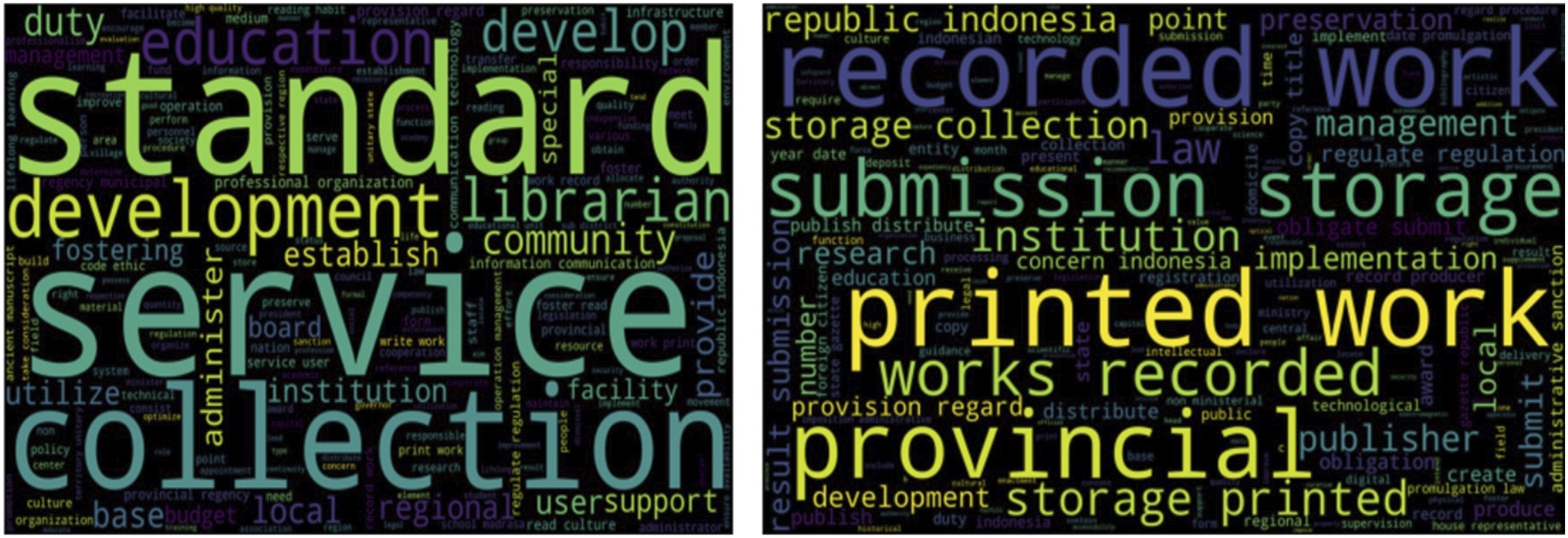
Semantic comparison corpus among library acts.

The table above offers a semantic comparison between Indonesia’s two main library acts. As mentioned by Jacobs and Tschötschel (2019) a semantic comparison corpus is a compilation of texts or documents that have been tagged or labeled with semantic information. The main idea to semantic comparison is to evaluate and compare the contextual meaning of texts. Our semantic comparison suggests, for instance, that collection development and management—of print books, repository materials, and more—was important to Indonesian legislators across a decade span. We also notice a focus on human resources in both laws; the 2007 law emphasizes the development of human resources whereas the 2018 law acknowledges that repositories must be actively managed by humans. These top-level themes did not include open government data or born-digital resources, which have become more of a national focus in the past 5 years (see Purwanto et al., 2020a, 2020b). RQ2: How did the Indonesian government implement the library laws via its budgets?
Percentage of budget for library act 2007.
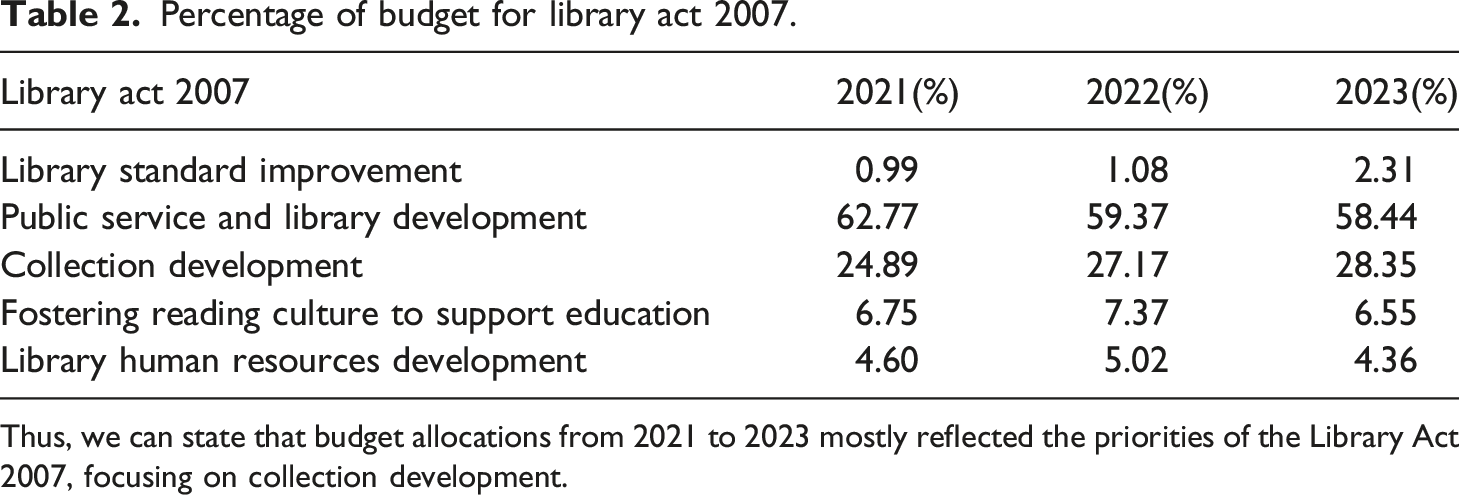
Thus, we can state that budget allocations from 2021 to 2023 mostly reflected the priorities of the Library Act 2007, focusing on collection development.
Still, the library law mandates were reflected in notable growth in certain budget areas during the 3 years studied. We begin by comparing the budgets to the Library Act of 2007. Library Standard Improvement was one of the priorities of the 2007 Act and was also a priority budget area. From 2021 to 2023 spending on Library Standard Improvement more than doubled. Collection Development was also a priority of the 2007 Act and related spending increased from 2021 to 2023. In 2021, Collection Development accounted for nearly one-quarter of the budget; by 2023, it was above 28%. Collection Development focused on the Indonesian collection, repatriation of ancient manuscripts, and digital collections (electronic resources, e-journals, and e-books).
Fostering Reading Culture and Library Human Resource Development both slightly increased from 2021 to 2022 and then slightly dipped in 2023 but remained largely stable. Fostering a reading culture to support education in Indonesia is a vital initiative undertaken by the National Library to promote the habit of reading among Indonesians, enhance the literacy skills of younger and older readers, and provide access to diverse educational resources (Nurhasanah and Najib, 2023). Library Human Resources Development is an important focus area for National Library of Indonesia personnel because it focuses on enhancing their skills, knowledge, and professionalism. This is particularly important in rural village libraries, where training programs, workshops, and capacity-building initiatives have not always been available (Mannan and Anugrah, 2020).
The most surprising finding was that Public Service and Library Development funding declined consistently from 2021 to 2023. Public Service and Library Development was one of the high-priority mandates of the Library Act 2007. The implementation of the program includes promoting the library as a maker space and meeting place through social inclusion. A social inclusion-focused library aims to create broader and more inclusive access for all members of society, including those with special needs, marginalized individuals, and vulnerable populations (Mahdi et al., 2020). It involves providing services, programs, and resources that promote equitable participation in reading, learning, and knowledge sharing opportunities for diverse patrons. The idea is that by supporting social inclusion, the library becomes a welcoming center for everyone, regardless of their backgrounds, abilities, or social status (Pratiwi and Heriyanto, 2022). The declining budget for these services could be a holdover from the pandemic. Regardless of its cause, it was the one budget trend that ran contrary to the Library Act of 2007.
Percentage budget for national repository act 2018.
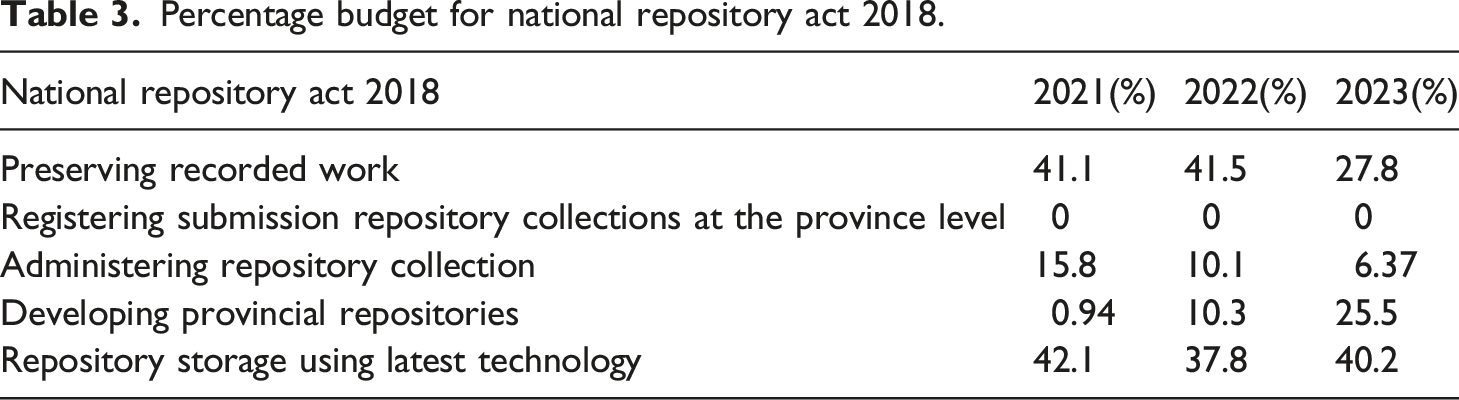
At the same time, the library spent a great deal on Preserving Recorded Work in 2021 and 2022 and far less in 2023. The same pattern was true for Administering the Repository Collection. These findings could suggest that the National Library of Indonesia was more focused on physical spaces, hardware, and software in 2023 than it was on personnel-heavy work such as physical preservation and day-to-day management of national repositories.
We observed no spending on Registering Submission Repository Collections at the Province Level. This is likely because the NLI is not responsible for this part of the 2018 Act because of regional autonomy in Indonesia. That is, this part of the 2018 Act is a local government responsibility. In sum, the 2021-2023 budgets showed NLI’sconsiderable efforts to guarantee the accessibility and longevity of valuable resources for future generations to investigate and gain knowledge from. However, hardware and spaces were prioritized during this period and the 2018 Act was less holistically implemented than the 2007 Act.
Discussion
This study offers a window into The National Library of Indonesia’s focus, policies, and strategies. These insights are both important and timely, as the NLI is an integral part of the Indonesian government and implementer of library laws. In recent years, some observers have criticized the Indonesian government’s record on education and literacy (Miller and McKenna, 2016). Based on our findings, it can be inferred that the NLI is focused on helping the national government improve education and literacy. In our document analysis, the implementation of the Library Act was more of a priority than the National Repository Act. This makes sense if the most important issues for the country are education and literacy rather than cultural preservation. Modern language processing techniques helped us arrive at this understanding.
The natural language processing techniques used in this study, particularly LDA Topic Modeling, offer an effective and flexible method to reveal patterns and themes within textual data, including legal documents and public policies. As Mimno et al. (2011) observed, topic modeling can provide advantages over traditional methods in terms of adaptability, efficiency, and depth of analysis. The topic modelling in this study performed well enough to provide insights and findings regarding the Indonesian government’s goals and NLI’s focus. Our research process and findings extend beyond Indonesia to other nations with strong national libraries.
National libraries play a crucial role in preserving cultural heritage, facilitating access to information, and supporting education and research within a country. To ensure their effectiveness and relevance, national libraries need to determine their areas of focus. First, national libraries should prioritize the development of comprehensive and diverse collections of various formats, including print, digital, and audiovisual materials (O’Reilly, 2019). Diverse collections enable national libraries to meet the evolving information needs of users and the long-term role of the nation in preserving cultural and intellectual heritage. Second, national libraries must focus on enhancing digital access and preservation capabilities (Besser, 2018). This includes developing strong digital infrastructure and effective metadata management strategies and ensuring the long-term preservation of digital resources. Third, national libraries should prioritize user-centered services for diverse communities (Dawson, 2018). This involves providing personalized assistance, user-friendly interfaces, and innovative programs and services that foster patron engagement and participation. Fourth, national libraries should actively engage in collaborations and partnerships with other libraries, cultural institutions, and stakeholders (Keller, 2018). By leveraging collective expertise and resources, national libraries can enhance resource-sharing, expand access to materials, and foster collaborative projects.
This study contributes to knowledge of library laws, library policies, and policy analytics. The methods used in this study are novel and have direct ramifications for understanding the legal aspects of library development policies using natural language processing through topic modelling. Topic modelling is able to discern themes from legal documents for comparison to library documents. As mentioned by Isoaho et al. (2021), policy analytics using topic modeling could provide better insights into how documents interact with each other, and also provide sharper insights into discourse and representation in the context of library communicative acts such as budgets. In short, topic modelling methods can offer clear and distinct insights regarding legal and public policies in libraries.
The largest limitation of this study related to data provided by the Indonesian authorities, especially budget and other numerical data, particularly at the local level. We were not able to effectively analyze how local governments are registering submissions for repository collections at the province level, for instance, because this data is not readily available to the public. Open government in Indonesia is currently rated at three stars (Widodo et al., 2020). That means that some data is unavailable and even available national government data is published using various formats (Widodo et al., 2020). Berners-lee et al. (2001) noted that open data should be in non-proprietary formats and also provide contextual information to link among future data. Additionally, much of our data corpus lacked descriptive information regarding other data involved in the implementation of library laws in Indonesia, such as local data. Law and public policy is essential to developing the National Library as the center of national heritage preservation (Dawson, 2018). However, this study cannot assess how law and public policy play out at the local government level, where governments have a specific level of autonomy.
Conclusion and future directions
The National Library of Indonesia plays a critical role in providing library services for a diverse cross-section of Indonesians, as national lawmakers have long recognized. This study is a first step in assessing the legal aspects of information policy in this national library. The study also reveals that the Indonesian Library Act of 2007 and Repository Act of 2018 are outstanding legal documents that actually translate to general policies and budget allocations for library development in Indonesia. The study also shows the different priorities within these two laws. The Library Act is focused on public library development. Meanwhile, the National Repository Act is focused on technology. These different orientations can cause libraries to make tough choices in budgeting, policymaking, and service delivery.
One major limitation of this study is that it only uses document analysis and not other methods such as interviewing, to gather and explore law and library data. Future studies should incorporate human subjects methods to more fully examine how the laws are implemented, particularly by local governments in Indonesia. Through surveys, interviews, or focus groups, researchers could discover nuances in the development of library laws and their implementation. Additional directions for such research include how other library legal mandates have impacted library development or other variables such as the economy, welfare, and other social outcomes.
Despite the strength of Indonesia’s current library laws, a future library legal mandate is imperative to secure the continued existence and development of libraries as essential institutions in society. Such a law should guarantee access to information, preserve cultural heritage, foster lifelong learning, and support research and innovation. To ensure its effectiveness, the law should address sustainable funding, transparent governance, diverse collections, and technological integration. By implementing a comprehensive legal framework, Indonesia could empower its libraries to better serve as vibrant hubs of knowledge, enriching the lives of citizens and contributing to the nation’s progress.
Footnotes
Declaration of conflicting interests
The author(s) declared no potential conflicts of interest with respect to the research, authorship, and/or publication of this article.
Funding
The author(s) received no financial support for the research, authorship, and/or publication of this article.
