Abstract

Conference Overview
Evolution
The International Conference on Spatial Structures has been organised and held on five previous occasions by the Spatial Structures Research Centre of the University of Surrey in 1966, 1975, 1984, 1993 and 2002, and in 2011 in collaboration with the International Association for Bridge and Structural Engineering (IABSE) and International Association for Shell and Spatial Structures (IASS).
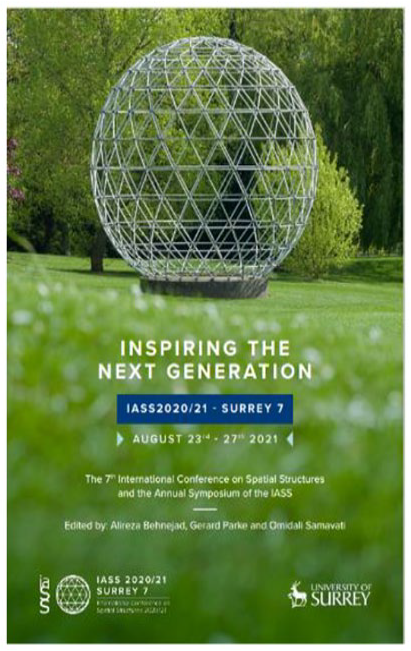
The seventh conference was hosted by the University of Surrey from the UK during 23rd – 27th August 2021; it was combined with the 2020 annual symposium of the IASS. The conference was named IASS 2020/21 – Surrey 7 and its strapline was “Inspiring the next generation”.
The planning and delivery of the conference had a long history: beginning in January 2016, and latterly very heavily affected by the worldwide Covid 19 pandemic emerging during late 2019/early 2020. The original planned dates were 24th – 28th August 2020, but as the impact of the pandemic became more profound, the mode of delivery evolved from fully in-person (designated as S0 mode of delivery), through hybrid in-person/virtual (S1) to eventually becoming fully virtual (S2) throughout the revised dates during August 2021.
Under these circumstances, achievement required a highly professional, flexible, and agile Executive Group (EG) planning for and working on an entirely novel delivery model. The team was partly drawn from the conference corporate Organising, Scientific and Industrial Committees and comprised representatives from the Surrey University Department of Civil and Environmental Engineering, Procurement, Events team, Faculty and Research Communications and Marketing teams; along with outside contractors providing wider support and specialist technical services. The internationalism of the conference participants (see Figure 1) and the virtual delivery model presented the EG with unique challenges.
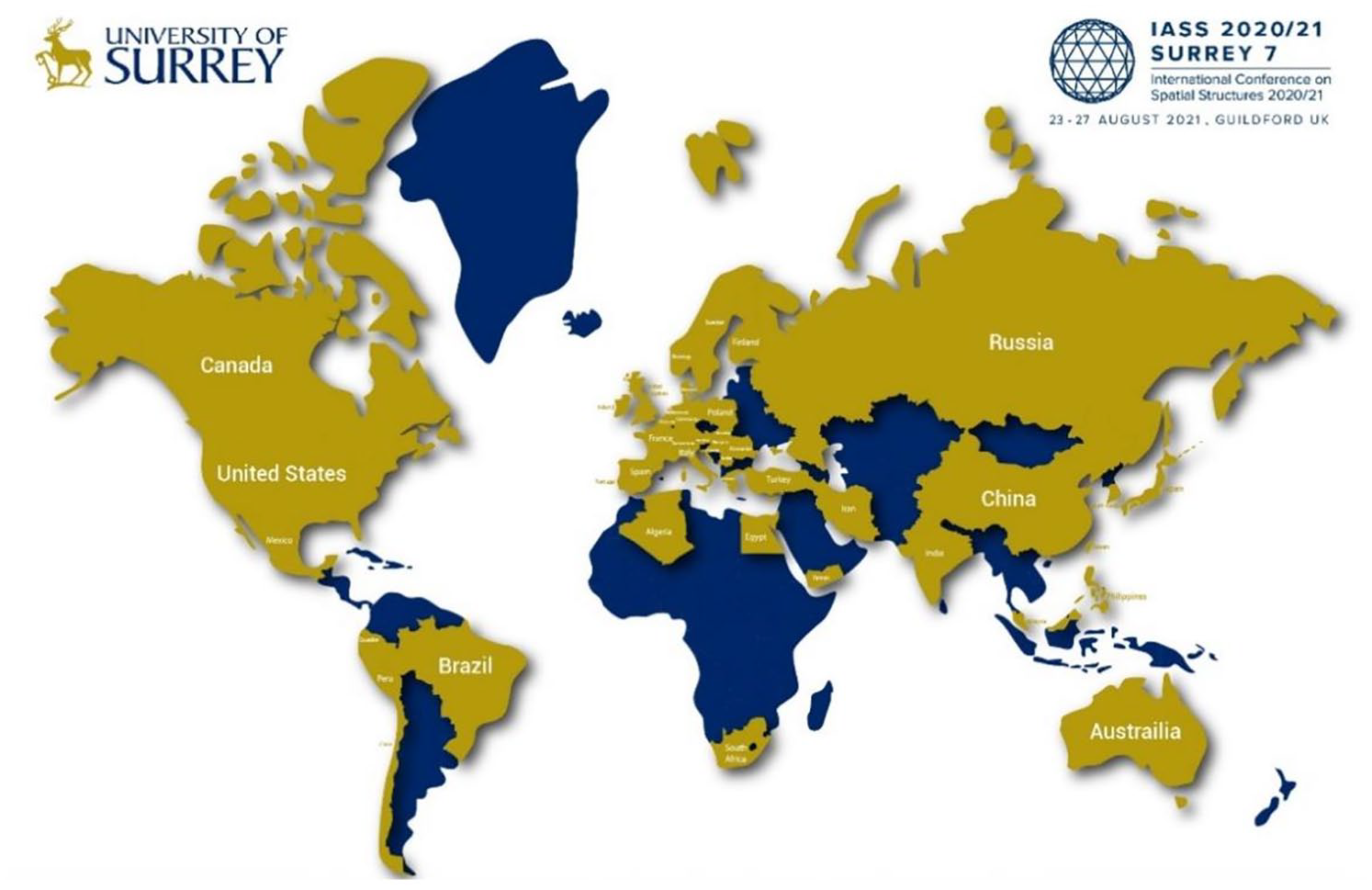
Countries of origin of conference authors.
Programme
The overall conference programme accommodated as best as possible the time differences between the UK and the countries of the participants. This comprised midday (UK time) plenary sessions, sandwiched between parallel technical sessions during which papers were presented. Paper authors were asked to supply a pre-recorded video of their presentation, to be broadcast on the conference platform during the technical sessions. In the case of plenary sessions, presenters were allowed to opt for a pre-recorded video, or to present “live”. In all cases live Q&A was a feature.
Delivery
Delivery of the conference was through MS Teams meetings for plenary sessions and Zoom meetings for the parallel technical sessions. There were also Zoom meetings for accompanying persons to provide some social interactions given the mode of delivery of the conference. A Slack workspace was provided as the main delegate-wide communication and networking mode outside of the parallel technical and plenary sessions. Additional Chat (Zoom) rooms provided opportunities for conference delegates with special technical or other interests to meet away from the main events. All of these were integrated within the conference platform, which comprised a web-based microsite that gave delegates remote view and Q&A access to the plenary and parallel technical sessions, and provided conference information including abstracts, and sponsor, keynote speaker and author data.
Attendance
A total of 473 delegates registered for the conference, drawn from 43 countries (see Figure 1). Countries providing the largest delegations were: United Kingdom 15.9%; United States 14.7%; Japan 11.9%, China 10.7%, and Germany 9.9%. Student representation (excluding those who had free registrations) was 144, representing at least 30% of the delegates. A composite, made up from some of the conference participants’ portrait photographs is shown in Figure 2.

Composite of some of the conference participants’ portrait photographs.
Technical Content
Originally, 468 abstracts involving 1061 authors were received and reviewed by members of the Scientific Committee. In the end, after a full review process, 329 full papers were accepted (including 46 Hangai prize applications), involving 763 authors, representing a total of 44 countries (see Figure 2). Countries providing the largest representations of paper authors were: China 13.6%; United States 13.4%; Germany 13.1%; Japan 11.9%; and United Kingdom 8.8%.
The papers were grouped into themes, based on common technical characteristics of the accepted papers. The themes had to be married to the constraints of the timings of the parallel technical sessions, as well as a limit of five papers per parallel session, along with accommodating (where at all possible) the time differences between presenters’ countries and the UK. There was a total of 78 (each of 5 x 15-minute duration) parallel technical sessions, distributed between the five days of the conference, in eight blocks of up to five parallel sessions. During the conference, excluding session chairs and presenters, there was one session that had a peak audience of 64; the median, mean and mode peak audiences were 22, 24 and 20, respectively.
Professor Sigrid Adriaenssens, as part of her summing up on Day 5 of the conference, observed that Hangai prize winners (see below) showed that the future generation will be bringing impactful and transformative work to the field of spatial structures. She took inspiration from technical content, including: auxetic materials, bi-stability, graphical approaches, adaptability, optimization, kirigami and ice as a building material! There was also a great blend of cutting edge methods from other fields, such as: machine learning, robotics, complementary historical and traditional technologies and principles.
Plenary Sessions
There were 10 plenary sessions of 75-minute durations, which took place between the parallel technical sessions on each of the five days of the conference. The themes of the plenary sessions included: opening and closing addresses; awards announcements and conferrals; various general interest features; keynote speaker presentations and presentations made by Hangai prize winners from 2020 and 2021. The details of some plenary sessions are given below.
Platform Usage
With regard to platform usage during the conference, cumulative views exceeded 1,000 on day 1, with views around 400 on days 2 to 5. In terms of the number of times individual delegates logged onto the conference platform, there was a minimum of one and a maximum of 87; the median, mean and mode values were 12, 14 and 5, respectively. It was reported that delegates from 67 countries used the platform. The key figures for Slack take-up and usage were: 373 members; 1982 messages sent, representing an average of 5.3 messages per workspace member; with 109 public channels. Peak Slack usage occurred around the 27th of August with approximately 330 members active. The majority of discourse took place within the public channels of Slack.
Awards Conferred during the Conference
Pioneers’ Awards
It has been a tradition of the Spatial Structures Research Centre of the University of Surrey to recognise and honour those who have made significant contributions in the field of spatial structures. This is done through a special award called the
John Abel. As a Professor at Cornell University from 1974 to 2004, John Abel’s research was focused on the development of numerical approaches to problems in structural engineering, primarily in the field of spatial structures and frequently with pioneering applications of emerging interactive computer graphics to visualize behaviour and design. Between 1980 and 2000, he supervised twenty Ph.D. dissertations that entailed research on reinforced concrete cooling towers; timber framed domes; the dynamics and stability of shells and frames; shape finding and the design of cable-reinforced membranes; nonlinear stress analysis and fracture analysis of shells; and nonlinear dynamics and control of spatial structures. These works resulted in over 200 technical papers and reports. Professor Abel joined the IASS in 1972, was elected to the IASS Executive Council in 1985 and served as Vice President 1991–2006, President 2006–2012, Editor-in-Chief of the Journal of the IASS 1996–2007, and Chair of the Website Committee 2005–present. He was Chair of the Scientific Committee for the IASS-ASCE International Symposium in Atlanta 1994 and was General Chair and host of the 6th IASS-IACM Conference on Computation of Shell and Spatial Structures in Ithaca (NY) 2008; and he co-edited the proceedings of each. John also produced and co-authored the IASS 50th Jubilee Book, Fifty Years of Progress for Shell & Spatial Structures, 2011. He was honoured with the IASS Torroja Medal in 2013.
Sigrid Adriaenssens. Sigrid’s research interest lies in the mechanical interaction between flexible, semiflexible and rigid surface systems and static and dynamic loading and the advancement of shape generation approaches based on analytical formulations, numerical form finding, optimization, fluid/structure interaction models and machine-learning techniques. This research has focused on the optimization of the design and behaviour of membranes, shells (both continuous and lattice) subjected to earthquake, storm surge and environmental loading, and more recently robotic construction constraints. In 2021, she was named Fellow of the Structural Engineering Institute of the American Society of Civil Engineers (ASCE) ‘for her seminal contributions to the understanding of the mechanics of large-scale shells and membranes through the development of methods for form-finding, analysis, and optimization. . .’ and she received the 2018 George Winter Award (ASCE) for her work at the intersection of engineering and the arts. Today she (co)chairs the ASCE Esthetics [sic.] in Design Committee as well as the Concrete Shell Roofs Working Group (International Association of Shell and Spatial Structures). She directs the Form Finding Lab at Princeton University and teaches classes on (non-)linear mechanics of solids and slender structures, structural design and the integration of engineering and the arts.
William Baker. Bill is a structural engineering consulting partner at SOM. He works to extend the profession of structural engineering through research and creating design approaches that lead to more efficient structures. Bill has led the structural engineering design of many structures including the world’s tallest manmade structure, the Burj Khalifa. He is a Member of the National Academy of Engineering and an International Fellow of the Royal Academy of Engineering. He has received honorary doctorates from the University of Stuttgart, Heriot-Watt University, the Illinois Institute of Technology and the University of Missouri. His awards include the Gold Medal from the IStructE, the ASCE Outstanding Projects and Leaders Lifetime Award for Design; the Gustav Magnel Gold Medal from the University of Ghent; the Fazlur Rahman Khan Medal from the CTBUH; the Fritz Leonhardt Preis; and the Torroja Medal from the IASS. He has been interested in geometry and lightweight structures since he was a student. In recent years, he has focused on adapting fundamental engineering mechanics to the design of structures. This includes the creation of visually based design tools for light-weight structures and applications of Maxwell’s Load Path Theorem, discrete Michell Trusses, graphic statics for topology optimization, Airy stress functions for the design of grid-shells and maximizing states of self-stress for 2D structural layouts.
Olivier Baverel. Olivier is a professor at the Ecole des Ponts ParisTech and professor at the Grenoble School of Architecture. He is a researcher at the Navier and GSA laboratories and co-editor in chief of the International Journal of Space Structures. His research focuses on the rationalization of structures with complex geometry in order to reduce their cost and their environmental impact. He believes that geometry is a fundamental knowledge for the structural engineers. For instance, Voss surface allows the generation of structures with geodesic lines and flat quadrangular panels that give a structure easily buildable with simple planks. Olivier has developed innovative construction systems, such as gridshells with Glass Fibre Reinforced Polymer that were used for the construction of Creteil Ephemeral Cathedral in 2013. He developed Nexorades structures in his thesis and moved further with the concept of Shell-Nexarode where the flat bracing panel makes the nexorade behave as shell. Olivier has published 148 scientific papers and is a member of the executive council of the IASS.
Michael Cook. Mike began his career working at Ove Arup with Ted Happold and Frei Otto, testing models of the Mannheim timber lattice grid-shell. Graduating from Cambridge in 1977, he worked at the University of Bath on a PhD titled ‘The Design of Air-supported Structures to Resist Wind Loading’. Between 1976 and 1994, Mike worked for Buro Happold in Bath on many diverse membrane structures in the UK, US and Asia. In 1985, he was Resident Engineer for the Hong Kong Cultural Centre roof – a lattice-shell formed by casting concrete around a catenary cable-net. From 1994 he ran Buro Happold’s London office and became Project Director on a series of notable spatial structures, in collaboration with Foster+Partners. These included: The Great Court roof at the British Museum, London; The Sage Centre roof in Gateshead, UK; the roof for the Smithsonian Gallery of American Art in Washington DC; The Pyramid of Peace and Reconciliation, and The Khan Shatyr, both in Astana, Kazakhstan. In 2019, he initiated the Engineers’ Declaration of Climate Emergency in the UK, and he leads the Institution of Structural Engineer’s Climate Emergency Task Group. He is Professor of Creative Design in the Department of Civil Engineering at Imperial College, a Fellow of the Royal Academy of Engineering, a Gold Medallist of the Institution of Structural Engineers, and has an Honorary Doctorate of Engineering from the University of Bath.
Ken’ichi Kawaguchi. Ken’ichi is a professor in the Institute of Industrial Science, the University of Tokyo. He graduated from Waseda University in 1985 and finished his PhD at the University of Tokyo in 1991 with a thesis on the theory of kinematically indeterminate structures. During his PhD he had been deeply involved in development and design of a tension truss dome, which was completed also in 1991. In the same year he published a book, in Japanese, including a part of his thesis and generalized inverse theory, with Professor Yasuhiko Hangai. Since his PhD, he has been involved with both theoretical work and practice. One of the examples of his theoretical works is folding analysis of space frames, which was presented in the conference of ‘Space Structure 4’ in 1993. He also designed and constructed typical tensegrity structure, White Rhino I in 2001, in which tensegrity frames are serving as structural elements to support a membrane roof. This development was reported in ‘Space Structure 5’ in 2002. He developed a new type of seismic base-isolation systems for houses. He also developed new guidelines for safety measures against accidental fall of suspended ceilings published from AIJ. He did the fundamental structural design for a new faculty building of engineering in the University of Tokyo, and also designed another tensegrity structure White Rhino II in 2017. All these achievements are based on his three-dimensional approach to structural engineering. He is currently a vice-president of IASS and a chair of WG6, working group on tension and membrane structures. He is also one of the founders of the IASS Hangai Prize.
Jan Knippers. Jan is a consulting structural engineer and, since 2000, Head of the Institute for Building Structures and Structural Design (ITKE) at the University of Stuttgart. His interest is in innovative and resource-efficient structures at the intersection of research and development and practice. He co-developed a robotic winding process for fibre composite systems that enables novel lightweight building systems as used in the Fibre Pavilion at the Bundesgartenschau 2019 in Heilbronn and the Maison Fibre at the Biennale Architettura 2021 in Venice. Another of Jan’s interests is advanced timber structures for segmental shells or multi-storey buildings. In addition to this, he designed the Central Axis for EXPO 2010 in Shanghai, one of the largest membrane structures of the world, and the compliant façade for the Thematic Pavilion at EXPO 2012 in Yeosu, South Korea. Jan published his works in several books and numerous scientific publications. From 2014 to 2019 Jan Knippers was coordinator of the research centre TRR141 ‘Biological Design and Integrative Structures’ a collaboration between the Universities of Stuttgart, Tübingen and Freiburg. Since 2019 he is Deputy Director of the Cluster of Excellence ‘Integrative Computational Design and Construction’ and Vice-Rector for Research at the University of Stuttgart.
Carlos Lázaro. Carlos is an Associate Professor in Structural Mechanics of the School of Civil Engineering at the Universitat Politecnica de Valencia, Spain. He has combined his experience as a professional structural engineer and his research activity in the field of lightweight and flexible structures, concrete technology, and computational mechanics to carry out designs of outstanding spatial structures and bridges. He is currently president of the IASS and has coordinated the technical activities of the twelve active IASS working groups. The hypar shell roof at Oceanographic in Valencia (2000) was his first well-known project: the realization of Felix Candela’s last shell using fibre-reinforced concrete. Within his firm CMD Ingenieros (2006-2014) co-founded with A. Domingo, he had a major role in the design of spatial structures such as the Pantadome roof of the arena at X tiva (2007), the 90 m span dome of the Parliament building in Kutaisi, Georgia (2013) (both in collaboration with M. Kawaguchi), a patented movable structure for a solar tracker, and the 130m high Alphabetic tower in Batumi, Georgia (2013). He is leading and participating in research and technology transfer projects on bending-active lightweight footbridges (using GFRP and UHPFRC), optimisation of composite bridges, design of Hyperloop viaducts, and vibration mitigation in long-span bridges.
Matthys Levy. Matthys is author of Building Eden, a novel; Why the Wind Blows: a History of Weather and Global Warming and co-author of Why Buildings Fall Down; Structural Design in Architecture; Why the Earth Quakes, Earthquakes, Volcanoes & Tsunamis and Engineering the City. He was born in Switzerland and holds degrees from the City College of New York and Columbia University. He served in the US Army Corps of Engineers in Korea. He is a member of the National Academy of Engineers and the recipient of numerous awards and honours and holds patents on Triangulated Roof Structures. He is a lecturer on structures, building failures, the consequences of climate change and the use of a hands-on approach to teach youngsters about science and mathematics in the built environment. He has served as a forensic engineer for the collapse of the World Trade Towers as well as for various other cases. Levy was a founding principal of WAI, Consulting Engineers and served as structural design engineer for hundreds of building and bridge projects. Among them are numerous concrete shell and spatial structures such as La Concha in Puerto Rico; the Javits Convention Center in New York with its stepped space frame roof; the Georgia Dome in Atlanta and the La Plata Stadium in Argentina, which feature his cable and fabric patented Tenstar Dome as well as smaller shell and space frame roofs in other parts of the world. His most recent project is a 100m long triangulated canopy supported on three columns for the World War II Museum in New Orleans.
Massimo Maffeis. Massimo was born in a small town in Northern Italy. After his studies in Engineering at the University of Trento, he founded Maffeis Engineering in 2000. Now based in Solagna (province of Vicenza), Massimo manages and follows up on the structural design works undertaken by the Firm. His strong educational background complemented with an intuitive approach have enabled him to deal with many types of structures. He has specialized in the analysis and design of spatial and cable structures, buildings, airports’ long-span roofs, bridges. Massimo has gathered a wide technical experience in sports complexes and stadia, starting from the conceptual stage up to the final detailed design phase, as well as the follow-up on-site construction. Massimo’s built works also include retractable roofs and moving mechanical systems. The focus of his experience lies in spatial and tensile structures for which he developed in-house form-finding state-of-the-art procedures and software. He is also skilled in developing innovative erection and installation methodologies, particularly for long-span steel and façade structures. A further area of development is the parametric design approach, of which Massimo is a strong advocate. His commitment and passion contributed to the diffusion of innovative structures into the panorama of the contemporary construction industry.
Marijke Mollaert. Marijke started her professional activities in the Civil Engineering Department of the Vrije Universiteit Brussel (VUB) in 1978. A few years later she moved to the Architectural Engineering Department, where the focus lies in the synergy between architecture and engineering. Her PhD. thesis, The Computer Aided Design of Tension Compression Structures (VUB 1984), initiated a deep interest and expertise in Spatial Structures in general and Form-active Structures specifically. In 1993, Marijke was appointed as professor at the Architectural Engineering Department and has since then taught structural design and form-active structures. Over the years, she has focused on various research objectives: to better characterize the materials, to underline the need for inter-disciplinary design, to refine the methods of form finding and analysis, to assure good detailing, to document qualitative projects, to have an eye on the integration in the landscape and to consider the limitations with respect to the very thin skin and the temporary use. Recently, environmental performance was added as a research topic. When Marijke initiated the European-Commission-funded thematic network TensiNet in 2001, it was intended to build up a network representing multi-disciplinary industries, like weavers, coaters, producers, manufacturers, engineering and architecture offices, to be able to exchange the specific domain knowledge and to improve the overall quality of tensile surface structures. This work continues today within the TensiNet Association. Marijke is currently convener of CEN-TC250 Working Group 5 Membrane Structures. This working group developed the Technical Specifications for the design of Membrane Structures, in preparation of a specific Eurocode part.
Juan Gerardo Oliva Salinas. Juan Gerardo is an architect from UNAM and a Doktor-Ingenieur from the University of Stuttgart, Germany. Professor Frei Otto was one of the tutors of his doctoral dissertation, where he published in 1982 the geometrical properties of translation surfaces applied to the form-finding of grid shells. For the first time, he proved that four symmetric nodes are coplanar; therefore, each mesh constitutes a planar quadrilateral. Since 1996, he has been in charge of the Lightweight Structures Laboratory at the Faculty of Architecture of the UNAM. Some of his most distinctive projects in Mexico are the grid-shell for the Federal Electoral Tribunal, the tent construction for the historical building ‘Palacio de Minería’, and the tent construction for the Government Palace in Oaxaca, Mexico. He has been an invited Professor at different universities in Mexico and elsewhere: the Technical University of Aachen in Germany; the University of Mendoza in Argentina, the University of Loja in Ecuador; Istmo University in Guatemala, and Yildiz Technical University in Istanbul, Turkey. In 2007 he received the National University Award in Architecture and Design, and in 2009 Mexico City’s Government Engineering Award. In 2014 he was nominated as the Best Researcher in Anthropic Sciences at the University of Aguascalientes, Mexico. He is currently Vice President of the IASS, and President of the Structural Engineers World Congress-Group Mexico.
Mike Schlaich. The main activities of Mike in the field of structural and civil engineering are lightweight structures and solar energy production. He is following his credo not as ‘l’art pour l’art’. In teaching, research and with his projects at schlaich bergermann partners he rather strives for saving resources by minimized use of materials and for producing clean, economic and renewable energy to improve everyone’s quality of life while at the same time contributing to what in German is called ‘Baukultur’. To him, in order to be successful, the built environment should not only arrive at environmental friendliness and low energy consumption during construction and use but ultimately lead to more beauty. He is, therefore, also actively working with artists, like the American, Christo with whom he is presently collaborating on the wrapping of the Arc de Triomphe in Paris. The results of this thinking are numerous lightweight spacial structures all over the world with renowned architects, and a wide range of solar thermal power plants which help to counteract climate change. At the university, together with a strong team of doctoral students, he lays the scientific and research base for such endeavours. His work was honoured by the memberships in two German Academies.
Brian Smith. Brian Smith spent the majority of his career with Flint & Neill, becoming a Partner from 1977 until 1997, when he was appointed a Consultant to the firm up to the end of 2020. Throughout his time with the firm, Brian has been responsible for the design and assessment of a wide range of long span bridges, tall towers, masts, chimneys and shell and other spatial structures in countries throughout the world. Of particular interest was his first shell design in 1964 for two novel structures constructed with sprayed concrete – possibly its first use as a structural material. Several noted shell structures were designed by the firm including university buildings in Cambridge and Birmingham and, more widely known, the Bahai Temple in Delhi. In the field of bridges, he has been responsible for the assessment and/or design of strengthening of major bridges including the Severn suspension bridge, The Wye and Erskine cable stayed bridges, the Lantau Crossing bridges in Hong Kong and the Westgate Bridge in Melbourne. In the field of towers and masts, he led the firm’s teams for clients such as the BBC, ITA (now Arqiva), BT as well as Electricity Supply Boards. Brian has been extensively involved in British, European and international Codes and Standards on Masts and Towers and on Wind Loading.
Chris Williams. Chris joined Ted Happold’s group at Arup in 1972, and was part of Ian Liddell’s team working on Frei Otto’s Multihalle Mannheim. His work was mainly on the interpretation of structural model test results, and computer analysis using a program written by Tezcan and Ovunc running on a Univac1108 computer. When Ted Happold left Arup in 1976 to form Buro Happold and to become a professor at Bath University, Chris joined him at the University. In the late 1990s he worked with Buro Happold and Foster + Partners on the roof over the Great Court of the British Museum. His work was mainly on the definition of the roof geometry for which he wrote the software. He now works with PhD students in the Department of Architecture & Civil Engineering, Chalmers University in Gothenburg, Sweden. He combines work on some exceptional projects with teaching undergraduate and postgraduate students.
Yi Min (Mike) Xie. Mike Xie is currently an Australian Laureate Fellow and a Distinguished Professor at RMIT University in Melbourne, Australia, where he directs the Centre for Innovative Structures and Materials. His team pioneered the evolutionary structural optimisation (ESO) and bi-directional evolutionary structural optimisation (BESO) methods, which have been used by thousands of engineers and architects around the world to design novel structures including several landmark buildings. His research impact in the field of structural optimisation was recognised in 2017 by the AGM Michell Medal and the Clunies Ross Innovation Award. In 2019, he was recognised in the Queen’s Birthday Honours List and appointed a Member of the Order of Australia. In 2020, he was awarded the Victoria Prize for Science and Innovation. Mike is a Fellow of the Australian Academy of Technology and Engineering. He is one of the most highly cited researchers in his field, with over 20,000 citations. He has collaborated with a wide range of local and international companies, including Arup and Boeing. In 2020, the topological optimisation software, Ameba, developed by Mike’s team, was recognised by Digital FUTURES World as ‘The Most Influential Digital Tool of the Year’.
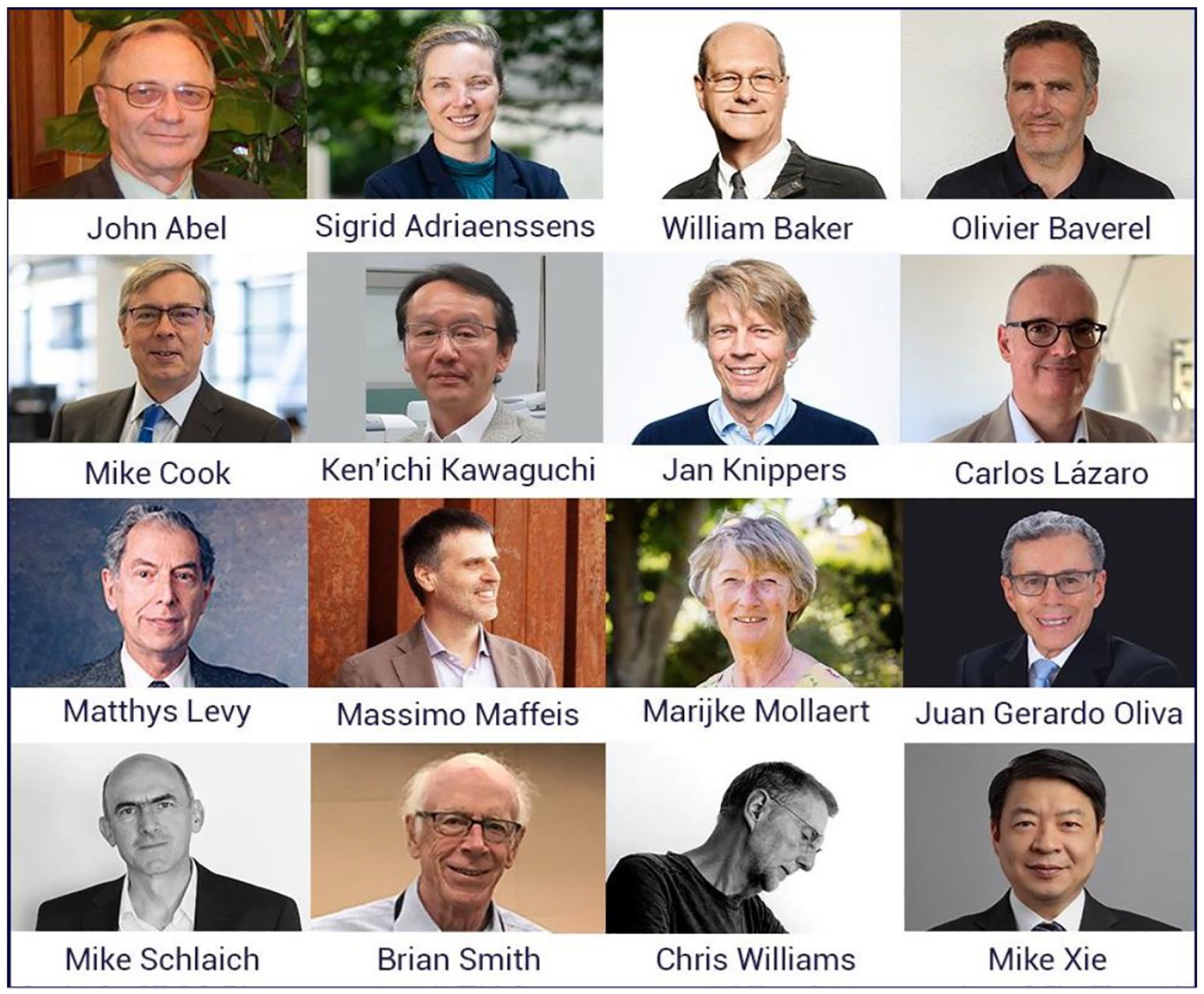
Pioneers’ Award winners for 2020/21 conference.
Awards Made by the IASS
Awards made by the IASS were conferred by Professor Ken’ichi Kawaguchi during the first plenary session of Day 1 of the conference; the awards comprised the following.
The
IASS
2019 and 2020 recipients of IASS honorary membership.

The
IASS Tsuboi prize winners.

The
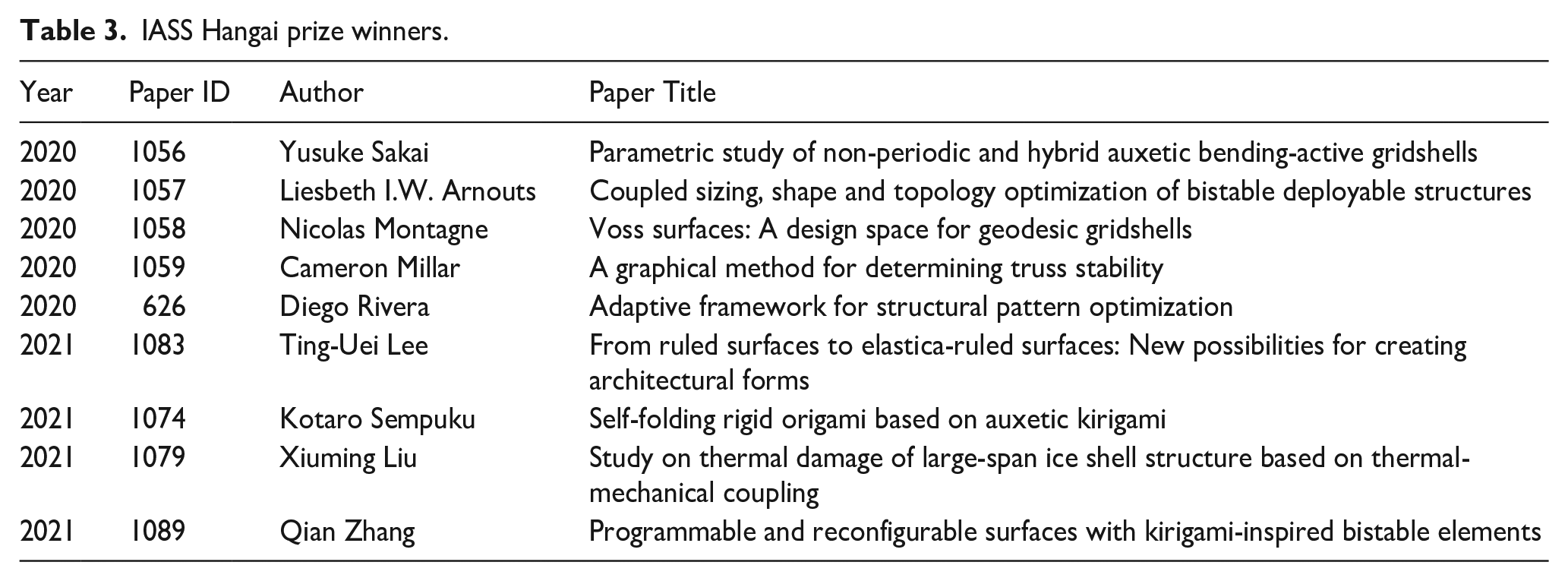
IASS Hangai prize winners.
Features
There were a number of features held during the plenary sessions. These included the following.
Internationalism in Higher Education
On Day 1, Professor Amelia Hadfield and Dr. Symon Lygo-Baker (both from the University of Surrey) spoke on the role of internationalisation in higher education. Professor Hadfield, who is Head of Department of Politics, Director of the Centre for Britain and Europe and Chair in European and International Relations, as well as being Dean International in the International Engagement Office, spoke particularly about the DAD project, run by the Spatial Structures Research Centre of the University of Surrey and its success in engaging internationally with other universities in Mexico, Iran, Brazil and Malaysia, as well as gaining sponsorship from the Nohmura Foundation of Japan. Dr Lygo-Baker, who is a Senior Lecturer in Higher Education in the Surrey Institute of Education, talked about the opportunities and challenges associated with internationalisation in higher education, particularly the interrelationship between how people learn and how they are taught. Central to his discussion was what he termed the consistency problem: it comes to the fore too much and constrains the ability to adapt to the diversity that internationalisation offers.
In Memoriam - Mamoru Kawaguchi
An In Memoriam session was held for the late Mamoru Kawaguchi on Day 2. This involved a panel of distinguished colleagues and friends of Professor Kawaguchi, including: Alireza Behnejad (Chair), John Chilton, Shiro Kato, Carlos Lázaro, Tien T Lan, John Abel, Olga Popovic Larsen and R Sundaram, who talked about Professor Kawaguchi and different aspects of his professional life. The presentations were based on the content of a special issue of the International Journal of Space Structures, Vol. 35, Number 1-2, March-June 2020: The Legend of Mamoru Kawaguchi. The individual presentations included: his formative years (John Chilton), advances in space structures – the Yoyogi Stadium (Shiro Kato), structural and architectural aspects of his works (Carlos Lázaro), his works in China (Tien T Lan), his work in association with the IASS and his presidencies (John Abel), his personal inspiration (Olga Popovic Larsen) and his work in India (R Sundaram).
Panel discussion – Net Zero; How to Get There
This panel discussion was held on Day 3. The panel comprised Samar Malek (Chair), Michael Cook, who talked about how will we get to net zero – how can we make the biggest difference in the light of the fact that we face a climate emergency; David Collings, who in his professional life has been measuring carbon for about 20 years, and his key message was to use less material, reducing the carbon in big projects and optimising across the whole of projects; Corentin Fivet, talked about the life-cycle aspects of design, including end of life and future service life of a structure and its components, along with their re-use; and Olivier Baverel, who focussed on aspects such as the lack of understanding of the challenges of climate change and the reluctance for people to change their habits, and reinforced life cycle aspects. A discussion between the participants followed the individual presentations, building on particular themes identified, such as: education, life cycle, urgency of the problem, the power of the designer to influence, everyone can all do something to contribute personally and professionally to net zero.
Art Gallery; Photography and Fashion
These two presentations were given on Day 4: Professor Terri Meyer Boake from the University of Waterloo, who teaches and researches architecturally exposed structural steelwork and Maryam Dastmalchian, who is a textile and fashion designer inspired by spatial structures and architectural structures.
Terri discussed spatial structures and the importance of photography, emphasizing the role of images in the teaching of architecture to show the details of a structure, illustrating her talk with many photographs of iconic constructions that include the finished, fabrication and erection/construction views (site visits).
Maryam’s talk centred on “architecture for the body”, a 2018 project that embodied traditional Iranian architecture and using it as a basis for creating divine beauty by means of a circle, creating patterns through repetition, rotation and evolution, as well as parametric design in architecture being used in fashion design.
Keynote Speakers
There were 8 keynote speakers who gave 30-minute lectures at the start of the morning plenary sessions of Days 2, 3, 4 and 5, and the start of the afternoon plenary sessions of Days 1, 2, 3 and 4 of the conference. The speakers were as follows:
Sigrid Adriaenssens’ (Princeton – USA) talk was entitled “Extreme structures: geometry and efficiency”. Sigrid’s premises were that by 2050, 70% of the world’s population will live in cities but urban infrastructure continues to be built in the massive tradition in which strength is pursued through material mass. Sigrid and her colleagues have focused research on structural systems that derive their performance from their curved shape, dictated by the flow of forces, resulting in structures that can be extremely thin, cost-effective, and have a smaller carbon footprint. During her talk, she outlined how she has discovered, studied, designed and built large-scale structural surfaces that can efficiently carry extreme loading, self-assemble, adjust their stiffnesses, elastically shift from one shape to another, or amplify motion.

Ian Firth (COWI – UK) talked about “Can we do better?” and drew upon his role as one of the world’s leading bridge designers and being a well-known advocate of elegance in bridge design. He has used his experienced in the management and direction of bridge design and construction projects worldwide, and has also been responsible for the design, analysis and assessment of stadia and other complex structures. He has been advisor to jury panels for bridge design competitions and is a regular speaker on the subject of bridges.
Massimo Maffeis’ (Maffeis Engineering – Italy) talk was entitled “20 years in design and construction of special steel structures – case studies” and covered a broad range of built projects where the design and construction presented special challenges due to the unique geometrical shapes of the buildings, particular structural behaviours, and where special erection methodologies were employed. These included the Khalifa Stadium, originally built in 1976 and recently renovated for the Qatar 2022 FIFA World Cup; the Stade Roland Garros retractable roof, in Paris; the Museum of The Future in the UAE; and the new Al Janoub Stadium, also for the Qatar 2022 FIFA World Cup.
Marijke Mollaert’s (Vrije Universiteit – Belgium) talk was entitled “The beauty, structural quality, and sustainability of tensile surface structures”. It centred around the fact that the form finding of tensile surface structures inherently implements natural shapes, equilibrium of forces, lightness, and flexibility. Once well-designed and built, the artefact fits in its environment. Despite the ephemeral character of tensile surface structures, each structure must, during its lifetime, be safe like any other building. Although often still neglected for tensile surface structures, the ecological performance and end-of-life scenarios should also be verified.
Sergio Pellegrino’s (Caltech – USA) talk: “Packaging and deployment of ultralight structures for solar arrays” outlined the role of the solar array to go beyond powering a spacecraft that operate near earth, which has motivated research on new and radically different structural concepts for very large, ultralight solar arrays. Sergio described how, together with his students and collaborators, he has been developing a structural concept for square solar arrays that are scalable from 10 to 100 meters. The inspiration for the concept came from solar sails consisting of flexible, lighter photovoltaic films attached to four diagonal, deployable booms.
Boris Reyher’s (sbp – Germany) talk was entitled “Inspiring a future of sustainable engineering”. The talk covered the effects of climate change on the roles and social responsibilities of structural engineers: the necessities of conserving natural resources and minimizing embodied carbon dioxide, driving the industry towards greater structural efficiency and sustainability; dealing with the predicted severe disruptions and shifts in the way engineers design, procure, build and operate buildings in the near future; the necessity to conceive and construct optimized and highly efficient structures; adequate usage of materials according to their properties and finding optimized structural form.
Ulrik Støttrup-Andersen’s (Rambøll – Denmark) talk was entitled “Good Education and Traditions from the Vikings is the Basis for Success on Special Steel Structures”; it extolled the virtues of the Danish education system and traditions from the Vikings as the basis for Denmark’s success in special steel structures. Ulrik cited expertise in tall masts and towers, and offshore wind energy where Denmark has been a market leader with Danish engineers designing more than 80% of all offshore wind turbine foundations. With its many islands and long history of bridges, Danish engineers are at the forefront of long span steel bridges: for example, the little and great belt bridges, with at their times, the “longest” free spans. Other records are held by Danish engineers: K10000, the largest tower crane in the world and the København Opera House, with one of the longest free cantilever roofs in the world.

Chris Williams’ (Chalmers University of Technology – Sweden) talk was entitled “How shells carry load” and dealt with the fundamentals of shell structure behaviours. It dealt with the enduring question of now that we have computer programs, and structural analysis can be done by almost anyone, it is difficult to decide how much knowledge is required to design a shell. Despite the freedom that the availability of computer software affords, some understanding of how shells work can help in the initial design of shells and understanding what to do if a computer analysis suggests that a shell is not very efficient. Chris discussed particularly a hemispherical shell, a hyperbolic paraboloid shell and a gridshell subject to point loads and posited that we really ought to be able to say something meaningful about how these structures carry loads without using a computer program.
Public Engagement
Movers and Shakers
The Movers and Shakers (M&S) concept was introduced by the Spatial Structures Research Centre of the University of Surrey with the objective of promoting the conference through public engagement using influential and world-renowned individuals in the field of spatial structures. This was done by producing of a series of e magazines, and videos and clips.
The high-quality periodical e-magazine “Spatial Structures; Movers and Shakers“, celebrates the life, work and achievements of world-leading individuals and organisations in the field of spatial structures, commending their outstanding contributions to research and education, as well as those in design, fabrication and construction. The e-magazines have been made available publicly through the University of Surrey library and, by the end of the conference, there have been 1,732 file downloads of six magazines.
The M&S videos are approximately 30-minute-long interviews with the world-leading individuals. By the end of the conference, a total of 30 have been produced and made publicly available on the Spatial Structures 2021 YouTube channel. There are also 112 short duration video “interview clips”, with distinguished individuals talking about a particular technical topic. By the end of the conference, a total of 64,173 views of the M&S videos and video clips have been made. Figure 4 shows the geographical range of the countries of origin of the movers and shakers interviewees.
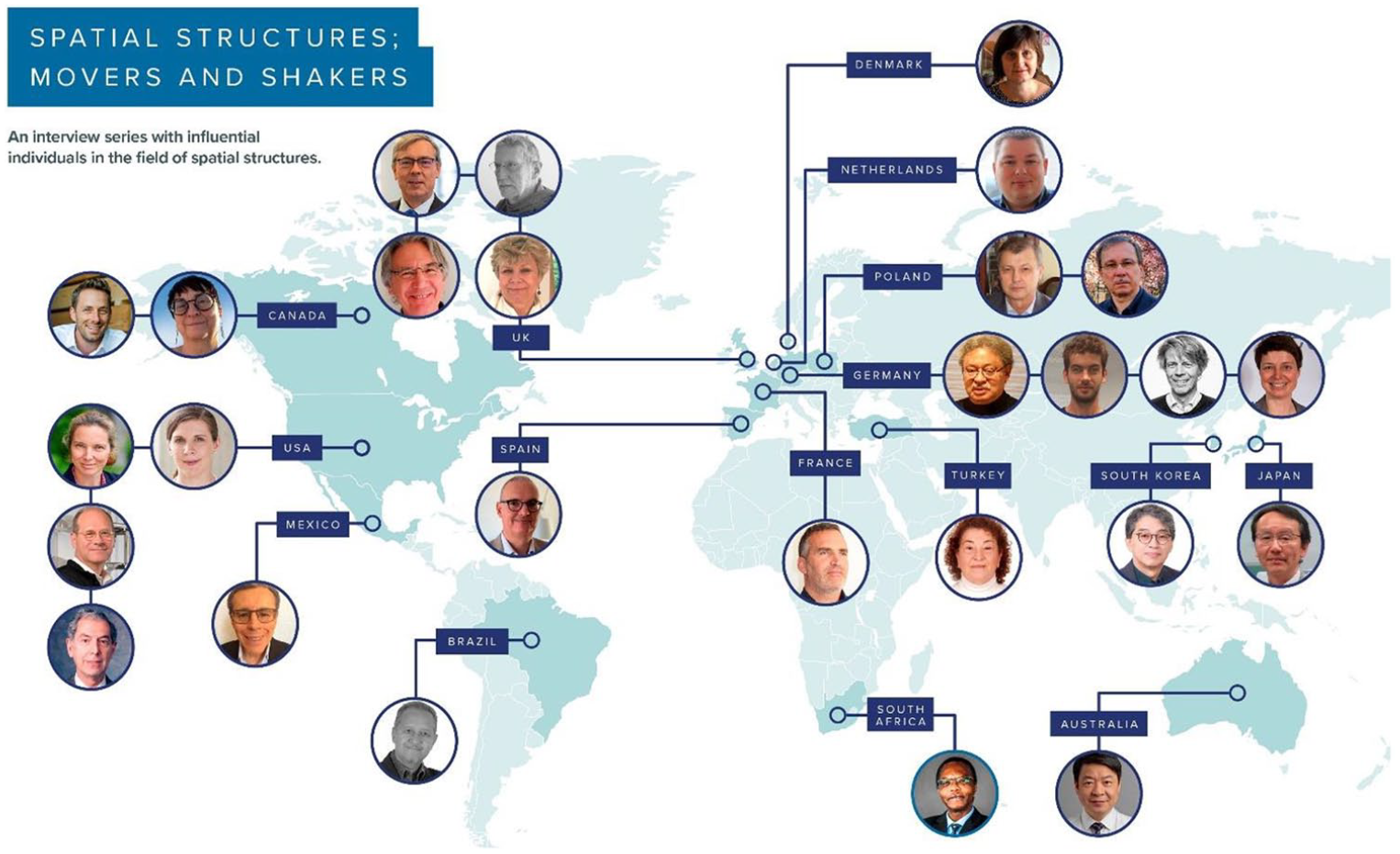
Countries of origin of spatial structures; movers and shakers interviewees.
Social and Professional Media
The conference had powerful and well-maintained presences on a range of social and professional media, including: Linkedin; Instagram; YouTube (for M&S videos and video clips, see above); Facebook, Twitter and Bilibili. Linkedin was the most popular media platform by number of followers (~2,450).
Delegate Feedback
In terms of delegate feedback on the conference, scores from a structured questionnaire to rate the conference ranged between 74% and 84%, with an overall score of 79%. 90.3% would be somewhat likely or very likely to attend a future IASS-Surrey conference and 76% would be somewhat likely or very likely to attend a virtual conference again in the future. Respondents cited “presentations” most often in answer to “What did you like about the conference?”.
There were overall positive remarks on the quality and organisation of the conference, but with the underlying understandable disappointment with the inability to provide the normal human interaction of a face-to-face conference. Additional delegate feedback from unsolicited emails was entirely positive on the organisation and successful delivery of the conference, despite the difficult conditions under which it took place.
Outcomes
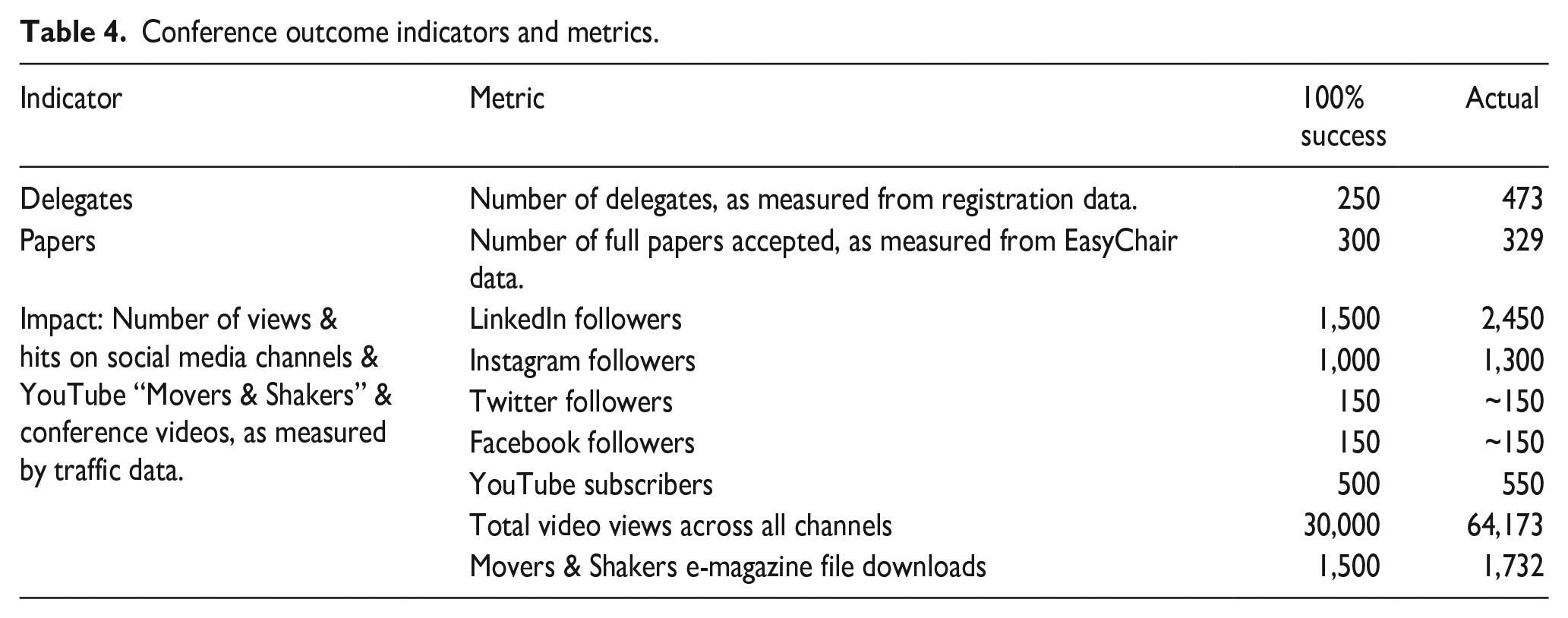
With regard to outcomes, the overwhelming majority of indicators and measurement metrics set in June 2021, to judge the success of the conference, were exceeded; two were equalled, as shown in Table 4.
Conference outcome indicators and metrics.
The manner in which the conference planning and delivery evolved also suggested new ways to deliver conferences for the future with the aim of increasing the level of engagement that would be possible from an only in-person conference. Planning for S0, S1 and S2 modes, and successful delivery of S2, provides a good blueprint of how an in-person/virtual hybrid conference of the sort envisaged to increase participation could be achieved. In future conferences, parallel technical sessions could be made available free online before a conference commences, be more spread out over time, and perhaps with session timings geared towards the time zones of presenters; the plenary sessions, technical tours and social events could be confined to a self-contained 2 to 3 day in-person event.
Outputs
The abstract and programme book has had approaching 900 downloads in the month following the conference.
The conference proceedings are to be published in early 2022.
Sponsors
The conference is grateful to the organisations that sponsored the conference, namely: