



Abstract

I. Setting the Scene – E&U/IIED and Global Policy Frameworks
In 2017, Environment and Urbanization’s October issue focused on the urbanization of humanitarian crises. This was the first issue of the journal dedicated to emergency contexts, and drew partially on a recently concluded Urban Crises Learning Partnership led by IIED that had explored humanitarian responses in towns and cities. Dodman and Archer’s editorial in that issue(1) reflected on the outcomes of two major summits the previous year – the World Humanitarian Summit and Habitat III – at which networks of urbanists had encouraged humanitarian actors to engage with the specificity of urban contexts in their responses to disasters within cities, as well as to large movements of people into cities fleeing conflicts or extreme weather events. Dodman and Archer concluded on the need for a more developmental approach to urban crises, encouraging humanitarian actors to engage with urban systems and institutions, and with the potential long-term impacts of their emergency interventions on the urban fabric.
Many of the papers in the 2017 special issue considered the role of humanitarian actors in responding to disasters. Just one of the papers looked at displaced people: an article by Monteith and Lwasa (2017) on internally displaced people (IDPs) in Kampala.(2) The current issue focuses on forced displacement into and within towns and cities. But Dodman and Archer’s argument on the need for a developmental response still applies and is perhaps particularly relevant in situations of protracted displacement – where large groups of people have been displaced for more than five years. Urban refugees and IDPs in protracted displacement are no longer experiencing an emergency or crisis. As such, their needs and aspirations go far beyond basic human survival, to encompass longer-term goals for a meaningful and dignified life while in exile. This is the context for most of the research showcased in this current issue.
Here we use the term “urban displaced” to encompass both refugees and IDPs living in towns and cities. It is important to acknowledge the distinctions between them: refugees have crossed a border for fear of persecution, conflict or violence, and their rights are defined under international refugee law and conventions, and/or national statutes. IDPs have been forced to move but remain within their country of origin, and are thus citizens, but may still require special protections, particularly if the government is a party to the conflict that triggered their displacement.(3) In practice, refugees and IDPs often share experiences of marginalization and exclusion when settling in urban areas.
This special issue draws on a recently completed IIED-led research collaboration, Out of Camp or Out of Sight? Protracted Displacement in an Urban World (PDUW), a comparative, mixed-methods study that ran from 2020 to 2024.(4) Many of the authors featured here were involved with the project in a research or advisory capacity. PDUW responded, in part, to the increasing concern among UN member states on the growing number of refugees and IDPs globally, and the inability of humanitarian assistance to keep pace with need. As reported in Dodman and Archer’s editorial, in 2016 the UN Refugee Agency (UNHCR) published estimates that 65.6 million people were living in situations of forced displacement globally. This was already higher than at the end of the Second World War, but is now far surpassed by current figures (117 million according to the UN Refugee Agency’s 2023 Global Trends report(5)). In September 2016, President Obama convened a Leaders’ Summit on Refugees, and set in train a process that eventually led to the UN’s affirmation of the 2018 Global Compact on Refugees (GCR).(6)
The GCR has four pillars: (i) ease the pressure on host countries; (ii) expand access to third-country solutions (i.e. resettlement); (iii) support conditions in countries of origin for return in safety and dignity; and (iv) enhance refugee self-reliance. Self-reliance has been defined by UNHCR as the “social and economic ability of an individual, a household or a community to meet its essential needs in a sustainable manner and with dignity”.(7) However, beneath this ostensibly shared definition, the concept is often left partially elaborated and it is rarely challenged.(8) Self-reliance is also notoriously difficult to measure – one methodology, developed by the Refugee Self-Reliance Initiative,(9) is briefly described in the dialogue between McAteer and Leeson in this issue.(10)
The issue of self-reliance has particular relevance for the urban displaced. In many contexts, refugees and IDPs living in cities who do not receive assistance from international actors or the host government are believed to be self-reliant. There is an assumption that those who move to towns and cities are innately more able to support themselves, with the weakest and most vulnerable remaining in camps.(11) However, as noted by Easton-Calabria and Omata, living without external support does not necessarily equate to the achievement of self-reliance.(12) They argue that self-reliance is promoted in humanitarian response as a “remedy for dependency and protracted displacement”, based on a neoliberal approach that promotes refugees’ individual responsibility to support themselves. For Crawford et al.(13) “the fact that some groups may have not received much or any assistance over a long period of time [. . .] should not be equated with those people having achieved satisfactory self-reliance and sustainable livelihoods”. Indeed, many urban displaced people are highly vulnerable and experience poverty and food insecurity.(14)
a. Setting the scene – Protracted Displacement in an Urban World (PDUW)
These debates around self-reliance informed the design of the PDUW project. It set out to fill a number of evidence gaps on the experience of displaced people living in towns and cities in Jordan, Kenya, Ethiopia and Afghanistan, with a specific focus on well-being and livelihoods as core components of self-reliance. It also compared findings from these urban areas with those from a camp in the same country: the first study to do this systematically and at scale. With the intention of producing a nuanced picture of the experiences of refugees and IDPs living in camps and cities, PDUW used participatory methods to develop a detailed well-being metric based on bodily, economic, political, social and psychosocial well-being.(15) Economic assets were similarly assessed through a livelihoods assets index, and the application of the Displacement Economies Framework, which was developed for the PDUW project and is discussed by Brown, Mackie, García Amado, Barratt and Kriščiūnaitė for this special issue. In addition, the study had a participatory component, drawing representatives of municipal authorities, service providers, NGOs and refugee-led organizations into regular conversations about the capabilities and potential of the urban displaced, and the barriers they face in achieving rights and meeting basic needs in the city.(16)
PDUW demonstrated a wide variety of outcomes for refugees and IDPs in cities. While some are clearly “doing well” across a range of indicators, there are clusters of extremely vulnerable households. They are surviving in the city, but far from thriving, and while living without humanitarian assistance are not “self-reliant” in terms of the definition above.(17) In camps, refugees are under a “care and maintenance” regime funded by the international community.(18) Despite this support, PDUW found them to be generally worse off than their urban counterparts, particularly in terms of economic and bodily well-being.(19) The difference between urban and camp counterparts was more stark in Kenya and Ethiopia than in Jordan, where the Syrian refugee population in our study had been comparatively well-funded.(20) These findings counter the myth that camps serve as a safety net for vulnerable refugees. Refugees in camps routinely go hungry and there are serious concerns with healthcare provision, particularly maternal health. Economies in camps, such as they exist, are artificially sustained by the presence of international NGOs and the UN.
The lack of assistance for urban refugees and IDPs is intimately bound up with a lack of recognition of their right to be in the city, as discussed by Earle in this special issue. Until the change in perspective signalled by UNHCR’s Urban Policy of 2009, the agency had discouraged displaced people from settling in towns and cities.(21) (22) As Crisp notes in his insider account of the development of the policy,(23) urban refugees had been considered a “problem” – or, as Verdirame and Pobjoy more bluntly put it: “an urban-based refugee was a tolerated exception at best, a deviant at worst”.(24) The 2009 policy is, in some ways, an about-face, in that it recognizes the presence of refugees in urban areas – a fact hard to ignore given that UNHCR’s own statistics suggest that urban refugees now account for 60 per cent of the global refugee population (with around 20 per cent in camps and 20 per cent self-settled in rural areas).(25)
However, the introduction of the urban policy has done little to change the situation in refugee-hosting cities – according to Muggah and Abdenur, it has been unevenly implemented and “not fully accepted”.(26) Critically, the urban policy maintains camps as a programming and spending priority, and it states that assistance will only be given to refugees in urban areas that “have a demonstrable need to be in that location”. While not entirely of UNHCR’s making, the idea that refugees should only be in a town or city for a very particular reason (e.g. medical treatment) only serves to entrench the attitude that urban refugees are “out of place”. The pervasiveness of this attitude, at worst, translates into routine harassment by the police and other local officials, particularly for those working informally, accompanied by fear of arrest and forced removal to a camp.
A critical finding from the PDUW study is the need for refugees and IDPs to have agency to challenge these perceptions, change the narrative and shape their own futures. This requires evidence that goes far beyond the needs assessment frameworks designed for emergencies, and that incorporates the perspectives of refugees and IDPs themselves. The findings from the PDUW project were brought into discussion forums with municipal authorities in each study city, which included representatives from refugee groups, civil society, governments, donors and humanitarians. These discussions highlighted the limited understanding among city officials of the status of refugees and other displaced populations, their needs, capacities and contributions. But the message from the research – that refugees and IDPs bring assets and skills to their new settings, and that there is a potential to marry humanitarian and development funds to achieve longer-term development objectives in towns and cities – is beginning to take hold. Researchers saw a growing recognition among municipal actors of both their responsibilities and the potential dividends of hosting the urban displaced. This is taking shape as we write – Nairobi county is currently drafting its first urban refugee strategy.
II. Framing an “Urban First” Strategy – Moving to a “World without Camps”
An ongoing conversation among the PDUW research team has centred on the future of refugee and IDP camps. This is a particularly important question, given the very poor situation of refugees and IDPs in camps in the study, and the intractability of the wars and political situations that contributed to their flight. Between an economically unsustainable and confined existence in a refugee camp and the large-scale abandonment of urban refugees and IDPs, can we find a middle ground? More precisely, can we imagine a world in which the default response to a displacement crisis is to house people in existing towns and cities rather than provide emergency accommodation in camps? What would this “urban first” strategy, and a world without camps, look like? Which actors would be involved, and how would towns and cities be supported to absorb additional populations?
An “urban first” strategy requires a fundamental realignment of response to forced displacement in cities, both a radical reformulation of international policy on urban refugees and IDPs, and investment in local initiatives to design and pilot new approaches to the social and economic inclusion of displaced people. The strategy proposes towns and cities as the primary places for most displaced people to be and it requires a proactive approach. This approach goes beyond the adoption of urban policies setting out an institutional response to those already there; it proposes practical preparations for those still to arrive. An “urban first” strategy thus requires a systematic shift from a humanitarian to a developmental way of working, involving local governments as key actors in responding to displacement and recognizing the often-protracted nature of urban displacement.
a. Principles of an “urban first” strategy
Drawing on the papers in this issue, and on debates with PDUW consortium members and other partners,(27) we identify five core principles that underpin the “urban first” strategy discussed below. Critical to the debate is an understanding of the needs of individual refugees and IDPs, and of their agency and collective contribution, which is rarely harnessed. The ideal would be for refugees to build collectives to amplify their voice and negotiate rights, but in practice the activities of refugee organizations (and to a lesser extent IDP groups) are severely constrained and often treated as a security threat. Many refugee organizations therefore focus on neutral territory such as providing mutual aid and welfare or information to their communities. PDUW, with its philosophy of participatory planning and the co-production of knowledge, partly addressed this challenge through establishing the discussion forums noted above to create nascent reform coalitions(28) which have informed ideas on the “urban first” strategy.
The following sections outline the five principles of an “urban first” strategy, and the contribution of the special issue papers to their framing. This discussion then moves on to the implications for practice through a localization agenda, and operational challenges.
i) Importance of a rights-based approach, and the right to live in cities
A key principle for an “urban first” strategy, which emerges from several papers in this special issue, is the imperative for a rights-based approach to displacement, including the right of refugees and IDPs to live in cities. The idea draws on the Lefevbrian concept of the right to the city, which extends the benefits of urban living to all inhabitants.(29) The idea expands on the statement in the 2009 UNHCR urban policy(30) which considers urban areas as a “legitimate place for refugees to enjoy their rights”, which has been only partially actioned, to argue that urban areas should be the first location of choice for hosting displaced people. This is because of the relative freedoms and opportunities these areas provide, the potential for aid to have wider benefits for host communities and because most displaced people desire to live outside camps.
Recent scholarship on forcibly displaced people outside camps has emphasized that most live with restricted rights and limited support, navigating the city, often informally, to access housing, livelihoods and community. As Nuñez-Ferrera, Aubrey and Earle(31) have argued in a submission to the UN’s High-Level Panel on Internal Displacement, and elsewhere,(32) in a proactive urban response to displacement, local governments, service providers and society must provide an enabling environment for their newest residents. Furthermore, refugee/IDP rights should be portable, so that the right of residency is not confined to a specific locality, the right to work is not tied to a specific employer, and aid is not place-specific. Two papers in this issue explicitly address the lack of rights in displacement.
The first paper, by Lucy Earle, challenges the attitude, long held by international agencies, that sees refugees in cities as “out of place”, arguing that the humanitarian model of supporting refugees in camps impacts negatively on those in cities. She calls for the recognition of the right to the city for displaced people, and for a complete repudiation of the care and maintenance approach to refugee support which, when countries pursue an encampment policy, has resulted in a “shadow” of the camp in the city(33) and a “camp-logic” of control.(34) Drawing on refugee voices from the PDUW study, she finds that many refugees face insurmountable practical challenges in meeting the legal requirements for living outside camps, forcing them either to live irregularly in the city, or to remain trapped in camps against their will. The “myth” of the camp promoted by donors as a safety net for refugees reflects a failure by policymakers in the UN to modernize the refugee response. Earle argues instead for new imaginings of inclusive cities, where displaced people are legitimate urban residents with progressive rights to shelter, livelihoods and services. Ultimately, upholding their right to freedom of movement, as established in international law, and providing some assistance beyond camps, would allow refugees to make choices about where to settle – in rural areas, small towns or large cities.
The second paper is a debate between Boel McAteer and Kellie Leeson, who apply a rights-based perspective to the concept of self-reliance – Leeson from her perspective as founding member of the Refugee Self-Reliance Initiative (RSRI), and McAteer as a researcher on PDUW. The RSRI was created to build a more holistic understanding of the resources refugee households need in order to gain stability and dignity in displacement. In the paper they develop the concept of self-reliance beyond its narrow focus on basic income and labour market inclusion, arguing the contradiction that, to leave camps, refugees often have to prove they are self-reliant, but the isolation of some urban refugees undermines their potential self-reliance. As Leeson notes, for urban refugees, in addition to the income earned, work is seen as empowering and self-fulfilling. They argue that urban refugees need help to navigate the real challenges they face, such as accessing a bank account, getting children into school, applying for ID documents or other certification or avoiding police harassment. Self-reliance programming, they suggest, should include both holistic and more targeted case management based on need, language support and client follow-up to help refugees get back on their feet. They thus argue for a much more nuanced view of self-reliance, which must be twinned with efforts to enable refugees to access the full spectrum of their rights.
ii) Economic inclusion in contexts of protracted displacement
In protracted crises, the issue of the right to work quickly comes to the fore; economic inclusion is thus the next “urban first” principle. Economic inclusion is also important in the self-reliance agenda, but debates on self-reliance tend to under-emphasize the assets that displaced people can bring to their new settings and the collective contribution of their enterprise to urban economic development. Refugee communities are often linked by networks bound by nationality, kinship, ethnicity, religion or language, linking with host communities of similar origin and diaspora groups abroad, which can form a basis for trade.
Data from the PDUW study confirm McAteer and Leeson’s findings that most urban refugees want the right to work and freedom to open a business – pride in supporting family and identity gained through work are both important for the well-being of displaced people.(35) However, without full rights to work, many displaced people are forced into informal employment, subject to exploitation, low pay, extortion and police harassment. A 2022 study in 51 countries, covering 87 per cent of the refugee population, found that over half of all refugees faced significant restrictions on rights to work, because either they had no work permit, or permits were restricted to a specific employer or sector,(36) forcing many into informal and unprotected work. Refugees and IDPs, like the urban poor, must employ political acumen or operate surreptitiously to avoid the traps of informal work.(37) Although the increase in low-paid workers which may result can sometimes have impacts on labour markets and wages, informal economic enterprise can also help in conflict recovery.(38)
In this issue Alison Brown and colleagues argue that the right to economic inclusion should be a fundamental component of displacement response. The unencumbered right to work is crucial for urban refugees and IDPs, many of whom receive almost no humanitarian support. Equally important, but rarely acknowledged in refugee policy, is the right to start a business, as self-employment is sometimes the only way for refugees and IDPs to earn an income. Research has shown that displaced people build on mutual support and transnational networks to create distinct and dynamic “displacement economies”, yet the cumulative impact of these complex economic networks is poorly understood by policymakers. Using large-scale datasets from the PDUW study, the authors develop and test a new model, the Displacement Economies Framework, which demonstrates the importance of social networks and innovations in business partnerships in displaced people’s enterprise. This approach can demonstrate the collective economic impact of displacement economies and shift the narrative from assumptions about the burden imposed by refugees and IDPs to explorations of their positive economic impacts. Finally, the authors recommend that urban protracted displacement is now so widespread that it deserves recognition as a distinct state of refugeehood, built around complex, interlinked and fragile economies, but with the potential to flourish.
iii) Recognizing the primacy of local government in displacement response
In most displacement situations, local government’s role is key, our third “urban first” principle. Although the response to those fleeing war, violence or persecution must be determined by the speed and scale of displacement, ideally local government should lead the response with financial and technical support where necessary. In a sudden large-scale crisis, early assistance from humanitarian actors may be required, but where people’s exile is long-term, displacement must be considered a development issue rather than a humanitarian crisis. Local governments already provide a wide range of services to their residents, including health, education, housing and basic services, and can reach dispersed communities in need, such as the urban displaced. Providing refugees and IDPs with separate services misses opportunities to use relief funds to strengthen local service provision for all. A city-led response to displacement means channelling donor funds directly to local governments, thus enabling them to develop local refugee/IDP policy, embed displacement issues into long-term strategic planning, and initiate collaboration between government and civil society. Additional support to local governments affected by displacement can help them cope with their crisis-affected population as well as other vulnerable citizens.
However, major barriers exist to enabling local governments to lead on displacement response. First, refugees and IDP affairs are often a state responsibility and city governments have little say in refugee policy, especially where security issues predominate over humanitarian response. Second, city governments often have limited powers to set agendas and staff have little awareness of the status or needs of refugees and IDPs. Service providers, police and other officials all need to understand the rights of displaced people, to ensure that they receive their entitlements. Third, displaced people often live in informal settlements where municipal management is poor, but aid agencies are out of their comfort zone in working with partners with a political agenda such as informal power brokers and gatekeepers.(39) Finally, most international donors and the UN have a primary relationship with central government and cannot directly fund city governments, while intragovernmental fiscal transfers to local governments impacted by displacement may be complicated by party politics and/or capacity constraints.
Despite these challenges, local governments are finding ways to innovate and manage displacement, as two practice-based papers in this issue show: the first describing a donor-led initiative with secondary cities hosting refugees in the Horn of Africa, and the second highlighting how, in pre-2022 Ukraine, decentralization of powers to local government promoted innovations in IDPs response. Caroline Wanjiku Kihato and Loren B Landau examine a three-year programme to build a network including seven refugee-hosting cities in Ethiopia, Uganda, Somaliland and Kenya, supported by Cities Alliance, and using their advisory role to provide insights. Exploring the frontstage/backstage dichotomy(40) adopted by network members, the authors explore how municipalities use a frontstage approach to “visibilize” refugees to attract donor funding, but “invisibilize” refugees in their development strategies to avoid controversy over their presence. Backstage networking helped network members navigate migrant inclusion amid contexts in which refugees are viewed as burdensome and encroaching on limited resources. Melissa Weihmayer explores innovations in local government response to displacement in Ukraine, differentiating between initiatives benefiting the entire population and those aimed specifically at IDPs. She draws on her humanitarian work in Ukraine’s Luhansk oblast with IDPs displaced from Crimea and elsewhere before the 2022 invasion, to examine how decentralization gave local government more leeway to promote IDP visibility and integration. The initiatives included reforms that enabled IDPs to vote in local elections, collaborative data collection, and the institutionalization of IDP councils to foster civic engagement and give IDPs voice.
iv) Recognizing the agency of refugees, IDPs and hosts
Whether men or women, refugees and IDPs use agency to survive. Recognition of that agency is our fourth “urban first” principle. Agency is usually defined as the ability to take action(41) and may be individual or collective. Although often constrained by structures of hostile regulation, ethnic discrimination or ongoing insecurity, the agency of refugees and IDPs has distinct characteristics, having been built on hope in the face of protracted uncertainty. Agency is also achieved collectively, both through collectives which support and advocate for refugees and IDPs, and as displaced people pursue similar paths in the struggle for improved lives, for example to access shelter, education or employment. In the realms of informality, agency represents a continuum of individual acts that collectively transform cities; social networks that facilitate access to income-related resources; and organizations advocating for common objectives.(42) Thus, even where individuals are constrained, agency can be collectively expressed.
Two papers in this issue explore the agency of displaced people, both refugees and IDPs. Patricia García Amado, Alison Brown and Peter Mackie consider individual agency. Using PDUW evidence on Eritrean refugees in Addis Ababa, they build on Brun’s concept of “agency-in-waiting” for urban refugees facing protracted displacement. The authors argue that, although protracted displacement is now the experience of millions of refugees, in urban settings relatively little is known about their agency to navigate restricted urban environments or transform their settings. They use a case study in Addis Ababa of Eritrean refugees from Tigrinya communities, many of whom fled indefinite forced conscription in Eritrea. The authors explore the concept of “waiting”, indicating how strategies of routine endurance, preparedness for unknown futures, and active defiance, give refugees the agency to manage the transience of protracted displacement, and envision different pathways to self-fulfilment. The refugees’ ultimate goal was to have a life with respect, rights and a future. The findings illustrate how urban refugees use their agency to challenge a limited right to work or tackle the unfulfilled wait for resettlement to achieve their ultimate goal of establishing a full life.
In an example of collective agency, Patience Adzande (to follow) explores how urban IDPs in Makurdi, central Nigeria, started an informal market, and gradually consolidated this through self-organization and improved relations with the authorities. She challenges dominant perspectives of IDPs as helpless victims in need of aid, exploring how the IDPs used collective self-reliance and agency to create livelihoods in the market. In 2014, the community set up a cluster of roadside stalls which expanded to a makeshift informal market, selling second-hand clothes, food and other items. To avoid repeated harassment from “area boys” (local gangs), traders set up a market committee which coordinates the market, and traders, though unofficial, are now paying taxes. The author distinguishes between IDPs who chose to move to Makurdi, who were more able to adapt, and those who went there as a last resort, who lacked the skills for urban jobs. The author argues that, beyond the usual provisions of food, shelter and cash transfers, displaced people should be supported by a more coordinated approach that leverages the capabilities and agency of urban IDPs to achieve more lasting results.
v) Adopting a spatial lens
The final “urban first” principle is the need to adopt a spatial lens in forced displacement response in cities. Both humanitarian and development actors are increasingly adopting a spatial approach in urban displacement response. UN-Habitat advocates city-wide urban profiling in humanitarian response(43) to assess the spatial distribution and needs of displaced communities across the city and focus resources in localities where the most vulnerable congregate and where services are most strained, benefiting both refugees and IDPs, and hosts. Area-based approaches, which take a multi-stakeholder, multi-sectoral approach in a defined geographic area,(44) are relatively new to humanitarian response and are applied mainly in the context of disasters(45) but have a long track record in urban settlement upgrading and neighbourhood planning. However, spatial programming requires new ways of working for humanitarian actors – for example, an ability to work at multiple spatial scales within the city, a longer-term perspective than funding normally allows, and participatory approaches that include all the residents in an area.(46) A report by the Global Shelter Cluster’s Urban Working Group, based on 30 case studies of area-based interventions, concluded that they work best when the population is stable and local authorities are credible partners.(47) Parker and Maynard(48) argue that the success of area-based approaches depends entirely on the context, programme design and delivery.
A second approach is to focus on key spaces and their role both as convening places for refugees and IDPs, and in displaced people’s remaking of the city – Bayat’s “quiet encroachment of the ordinary”.(49) In this issue, Dolf te Lintelo and his research team(50) report on a major new study, following work on a 2018 paper(51) which argues for a spatial lens to support dispersed urban refugee populations, based on an understanding of public space, home space and work space occupied by refugees. The new study draws on a systematic literature review, to reflect on Yiftachel’s conceptualization of “displaceability”(52) and how diversly displaced migrants in global South cities use urban public space for placemaking. Placemaking, they argue, entails the process of acting in and on space to imbue it with meaning and value and that, for migrants, public space can assume especially critical importance for the pursuit of well-being. The review demonstrates how displaced people imaginatively use public spaces for livelihoods, shelter, leisure, homemaking and identity, conviviality and political mobilization to anchor themselves in cities. However, migrants’ placemaking is constrained by multi-layered regulations, public discourse and design that restricts how spaces can be used, as well as their own practices of (in)visibility. The authors argue for much more research on displacement and placemaking, to counter increased privatization and regulation of space, and highlight the need for mediation to enable migrants’ use of public space.
A second paper explores how one local government, Greater Amman Municipality (GAM) in Jordan, is already using place-based interventions to stretch constrained resources to support Amman’s large refugee population. Drawing on discussions at the PDUW participatory forums in Amman, Yamen Al-Betawi explores how, although GAM has no formal role in refugee policy, the authority nevertheless initiated a series of small-scale spatial interventions – or “tactical urbanism” – to promote refugee inclusion. Despite Jordan’s shift around 2014 from an initial open-door policy welcoming Syrian refugees to increasing control and encampment,(53) nearly four out of five Syrian refugees live in urban areas. GAM has relative legal and financial autonomy from central government, giving it flexibility to address urban planning issues. Although GAM has traditionally adopted restrictive masterplans and avoided temporary solutions, the challenges of the new refugee arrivals, COVID-19 and budget constraints have ushered in a more flexible approach. Several of the new initiatives are creating new urban spaces through temporary interventions with long-term impacts, such as green infrastructure projects, urban micro-forests and a children’s climate academy and park. Despite the lack of strategic coordination, or reliance on a humanitarian lens, this spatial approach provides an agile and pragmatic response for both local and refugee populations.
b. Localizing the “urban first” agenda
Many factors will influence the implementation of an “urban first” strategy, which must be tailored to both city context and the refugee population. At town and city scale important factors include: the urban poverty profile; the extent of informal settlements and the informal economy; and the city government’s financing, capacity and political freedom from central control. Also important is whether national and local policies towards refugees are broadly supportive (as in Kampala(54)) or restrictive (as in Addis Ababa after the Tigray war(55)); the extent of public and press freedoms and whether associations and NGO action are tolerated or encouraged; and issues of security and fragility, including outbreaks of local violence, militia action and xenophobia towards incomers.
An understanding of the displaced population is also needed, including documented and undocumented refugees, asylum seekers and IDPs. How large is this population within the city, and was their arrival a sudden-onset emergency or slow increase – the latter making provision easier?(56) How ethnically and linguistically diverse are the newcomers, and do any groups share language and culture with host communities? In Nairobi, Somali Kenyans and Somali refugees have joined the vibrant economy of Eastleigh.(57) What assets, skills and diaspora links do the refugee population bring, and what vulnerabilities due to the trauma of past experience? For example, urban refugee women are particularly vulnerable to gender-based violence, yet rarely report rape or other abuses.
Each community and refugee population will be different, but we suggest here some pointers towards localizing the five principles of an “urban first” strategy (Table 1 see over). Several documents from UNHCR and UN-Habitat have informed the pointers,(58) but none fully meets the requirements of an “urban first” strategy, as they either take too narrow a perspective of the type of response needed, or assume a fairly sophisticated urban response capacity which many local governments do not possess.
Localizing agenda for an “urban first” strategy.
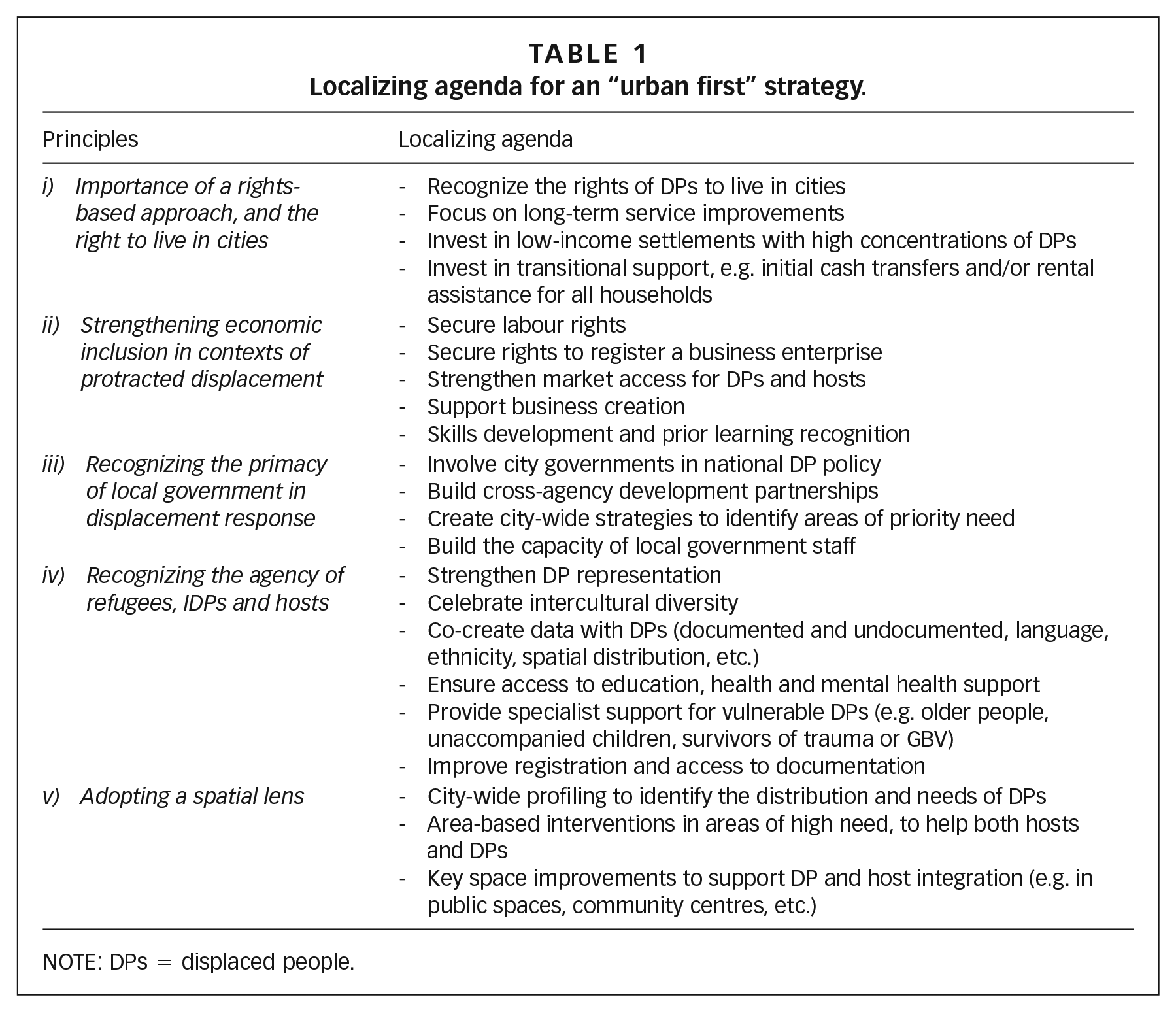
Note: DPs = displaced people.
c. Challenges of an “urban first” strategy
We also note the many challenges in implementing an “urban first” agenda, including the absence of reliable data on a population that often wishes to remain hidden, and policy abdication or absence of city government in fragile contexts, as three papers in this issue discuss (see below).
A key problem for both humanitarian and development responses is the lack of accurate estimates of the scale and distribution of urban displacement. The documentation of refugees and IDPs can help, but is no panacea to understanding who is where in the city. Many displaced people in cities keep a low profile and avoid registration, enumeration and profiling,(59) particularly undocumented or irregular refugees, and IDPs who lack an identity card. Challenges in data collection include the lack of a clear definition of urban boundaries, the dynamic nature of displacement, and lack of longitudinal data after the emergency phase of crises. Organizations such as the Internal Displacement Monitoring Centre (IDMC) are now using alternative data sources such as mobile phone and satellite data to build an evidence base on IDPs.(60) Work by IIED in other contexts has demonstrated the power of community-driven data which leave no-one behind, and the significant potential to integrate questions on migration into informal settlement enumerations.(61)
Two submissions on Lebanon in this issue 62 show how that government’s “zero-camp” policy and abdication of support for Syrian refugees left them in perpetually insecure housing. Hannah Sender examines the private rental sector in the Biqa’ Valley, and the financial and social arrangements which underpin rentals for forced migrants. Drawing on interviews with young refugees, she explores how municipal inaction on housing quality, rental contracts and evictions, and societal obligations, combine to perpetuate gendered and xenophobic forms of dispossession. Many migrants in Lebanon rent apartment rooms or space in repurposed factories and garages, and the rest live in informal tented camps. Municipalities are supposed to oversee rental standards but have limited enforcement powers. Sometimes rental is agreed in exchange for farm labour negotiated by a shaweesh, a migrant labour organizer who may also administer camps. The obligations trap migrants into extractive agreements which they cannot exit. Sender argues that displacement response in cities should avoid perpetuating reliance on an inequitable private rental sector. Maureen Abi-Ghanem examines the self-settlement of Syrian migrants in two higher-income neighbourhoods of Beirut, where they often live with no legal rental contract, in overcrowded accommodation – in concierge rooms, basements, roof-top huts, dilapidated buildings or multi-family apartments. Legal insecurity, high inflation and exploitative social networks leave Syrian migrants with inadequate housing and insecure tenure, in fear of eviction, as the result of broader government failures to secure affordable housing.
In fragile cities, the more extreme challenge is the absence of formal government. In Christopher Ward’s paper on Haiti, a governance void in the capital Port-au-Prince has left the city to the mercy of gangs and local powerbrokers. In this context the donor paradigm of durable solutions has been inadequate to support IDPs. Ward focuses on Canaan, a large informal settlement that emerged in Port-au-Prince after Haiti’s 2010 earthquake. Recently Canaan has been engulfed in the catastrophic violence gripping Port-au-Prince, which has further displaced tens of thousands of its residents. The city is now a no-go area for state intervention. At neighbourhood level, endemic violence stems from leadership struggles, rent-seeking and gang warfare. Ward argues that in the context of extreme state and urban fragility, the international aid system is poorly positioned to achieve incremental development goals, let alone “durable solutions” to displacement. Centralized donor control of projects in Haiti and short-term aid and development funding have contributed to intervention failures, and the agency and capacity of disaster-affected populations have been overlooked. Ward argues that urban IDPs should not be treated as a humanitarian caseload, but as fully-fledged urban citizens with rights to urban services and to benefit from urban life. He sees recovery as long-term, even generational, arguing that protracted urban displacement is a development and governance challenge more than a humanitarian issue, and that development institutions should be more humble about aid’s ability to address the causes and consequences of internal displacement.
III. Conclusion
Many of the papers of this special issue emphasize the need for a rights-based approach in urban displacement response, recognizing cities as legitimate places for refugees and IDPs to live in and stressing their need for progressive social and economic inclusion. The papers explore the experiences of the urban displaced and challenge the laissez-faire approach to self-reliance with little ongoing support for displaced people. They explore the ways displaced people face the bleak challenges of protracted displacement, responding with agency and enterprise to transform local economies and open space. A common theme in several papers is the need for municipal-led responses to urban displacement. This body of research suggests that there are fundamental new initiatives which challenge the camp-based model of international and state-led humanitarian assistance, to enable local and grounded initiatives to form the basis of an urban response strategy. Thus, an “urban first” approach profoundly alters the framework of international humanitarian assistance, in favour of rights-based approaches, a developmental agenda and local initiatives to support displaced people in cities.
Feedback: FROM THE ENVIRONMENT AND URBANIZATION EDITORS
There are two Feedback papers in this issue – an integrative literature review on African wetlands and a book symposium on Hou Li’s rich account of an “Oil City” in China.
The literature review by Lewis Abedi Asante, Beverly Akomea Bonsu and Ilse Helbrecht explores and synthesizes work on African wetlands in the context of rapid urban growth with a view to generating new perspectives. The authors propose that the Northern concept of “ecological gentrification” be reconceptualized in Africa as “wetland gentrification” to better reflect the realities of the situation, and to shed light on Africa’s urban development and displacement. A central feature of this trend is the very common dual governance arrangement whereby traditional chiefs and family heads share power with municipal authorities. In the context of urban land scarcity, these customary authorities can sell off fragile wetlands at attractive prices to property developers, thus contributing to the threat of seasonal flooding and the consequent displacement of many, primarily poor, urban households. By bridging the literatures on wetland encroachment and ecological gentrification, usually researched quite separately, this paper extends the reach of both fields, filling a knowledge gap and addressing the need to re-theorize cities by drawing on Southern realities.
The symposium on Hou Li’s book, Building for Oil (2021), which includes a framing introduction by Franklin Obeng-Odoom, features four essays on different aspects of the book by interdisciplinary scholars, and a closing reflection by Hou. The book, which combines economic, political and social history with personal narratives, explores the development of the oil field city of Daqing in China in the 1960s and 1970s, a pivotal era of modernization under Mao Zedong. Obeng-Odoom explains the “fiendishly difficult mission” Hou undertakes. Jing Zhang focuses on the book’s account of China’s staggering growth over a short period. Stephen Hauser explores the very local dimensions of this achievement and the hardships endured by committed workers. Joe Collins considers the fascinating interplay of structure and agency in the building of this paradigmatic city; and Yan Zhang looks at the ideological significance of Daqing and the ethos of the “Daqing spirit”. While also offering critiques, all four reviewers, along with Obeng-Odoom, praise the book’s extraordinarily rich and nuanced contribution to accounts about a controversial period in China’s history.