




Abstract
The objective of this study was to investigate women’s willingness to experiment with new condoms and lubricants, in order to inform condom promotion in a city with high rates of poverty and HIV. One hundred and seventy-three women (85.9% Black) sexually transmitted infection clinic attendees in Jackson, Mississippi, United States completed a questionnaire assessing willingness to experiment with condoms and lubricants and sexual pleasure and lubrication in relation to last condom use. Most women were willing to: (1) experiment with new types of condoms and lubricants to increase their sexual pleasure, (2) touch/handle these products in the absence of a partner, and (3) suggest experimenting with new condoms and lubricants to a sex partner. Previous positive sexual experiences with lubricant during condom use predicted willingness. The role women may play in male condom use should not be underestimated. Clinicians may benefit women by encouraging them to try new types of condoms and lubricants to find products consistent with sexual pleasure.
Keywords
Introduction
In the United States, other than men who have sex with men (MSM), Black women experience the greatest rate of HIV acquisition, with their odds of infection being 16 times greater compared to white women and five times greater compared to Hispanic women.1,2 The epidemic among Black women is particularly concentrated in the southern U.S. 3 Because rates of sexually transmitted infections (STIs) are correspondingly high among Black women in the southern U.S., 2 condom use is a necessity for those at risk of HIV/STI acquisition. Most research on condom use in women has focused on gender power dynamics and female negotiation or insistence on condom use, and on women’s motivations that may interfere with condom use.4–6 However, ample evidence suggests that women commonly experience pleasure-related issues with condom use.7–13 For example, in a study of women on ‘condom turn-offs,’ 39.6% reported that condoms decreased sensations during sex. 10 Other studies have documented women’s concerns about condoms leading to decreased sensation, interruption of the sexual moment, and increased vaginal dryness.11–13 Additionally, evidence suggests that condom use can decrease women’s sexual arousal and can cause vaginal irritation or pain.9,11,14–16 Further, studies suggest that inadequate lubrication during condom use is problematic for women.9,10,17
Two points related to condom use and women’s sexual pleasure are critical. First, women’s sexual pleasure is a central part of their lives and thus should be a legitimate focal point of clinic encounters. The World Health Organization defines sexual health as a ‘complete state of physical, emotional, mental and social well-being in relations to sexuality; not merely the absence of disease, dysfunction, or infirmity.’ 18 Thus, sexual health includes pleasurable and safe sexual experiences. Second, issues related to pleasure and condom use may lead to decreased likelihood of condom use. In a study of more than 5000 heterosexual men and women, 29% of the women agreed or strongly agreed that condoms decreased their arousal, and these women were more likely to report unprotected sex in the past year compared with those who disagreed. 19 A U.S.-based, nationally-representative study found that young women’s pleasure-related attitudes about condoms were the most powerful predictor of condom use. 20
One possible approach to improving young women’s pleasure-related attitudes about condoms is to encourage their experimentation with new types of condoms (especially those that are prelubricated with variety of lubricants) and various lubricants (particularly newer brands of premium lubricants). Two studies, one with men who had sex with women 21 and the other with MSM 22 successfully encouraged men’s self-practice with condoms and lubricants as a method of enhancing comfort and pleasure during condom-protected sex. Possibly, this same approach could be used with women. Unfortunately, however, even sex-positive behavioral intervention designed for women have not actively promoted self-practice with condoms.23–28 The potential acceptability of asking women to engage in self-practice with condoms is somewhat supported by studies that encouraged women to experiment with lubricants for penile–vaginal sex.29,30 Thus, the overarching goal of this exploratory study was to determine whether women attending STI clinics are willing to engage in self-practice with condoms, as well as lubricants.
Accordingly, the purpose of the study was to explore women’s engagement in self-practice behaviors with new condoms and lubricants. Distinct from willingness to negotiate condom use with males, this self-practice is focused on women’s self-exploration of safer sex products. This self-practice may be important relative to increasing their sexual pleasure during condom-protected sex (which may, in turn, promote more consistent condom use). A secondary purpose was to examine previous condom and lubricant use experiences as possible correlates of women’s willingness to experiment. Finally, we examined the relationships between previous experiences of condom use and pleasure with those regarding lubrication during condom use and pleasure. Given the disproportionate HIV burden experienced by Black women, the clinic selected for this exploratory study was one serving predominately Black women.
Methods
Study sample
A sample of 173 women was recruited from an STI clinic located in Jackson, MS. At the time of recruitment (November 2015 through February 2016), this city was the ‘epicenter’ of the HIV epidemic in MS and had the highest prevalence rate of HIV in the U.S. 1 The city ranked fourth in the nation relative to AIDS-related deaths among women. 1 Moreover, a 2016 study ranked the city as having the highest prevalence of HIV among MSM in the U.S., thereby posing inflated risk to women having sex with men who are also involved in sexual networks of MSM. 31 Mississippi has the highest poverty rate in the nation 32 and, from 2010 through 2012, 20.9% reported food insecurity, making MS also the highest in the country for this very specific measure of poverty. 33
Eligibility criteria were (1) female clinic patient, (2) age 18 years or older, (3) engaged in penile–vaginal sex within the past three months, and (4) ability to read and speak English. A research assistant approached potentially eligible women in the waiting room of a publicly funded STI clinic serving the needs of low-income women residing in three contiguous counties. The assistant also assessed eligibility of women interested in volunteering, and if eligible invited them to complete an anonymous survey. The exploratory nature of this study meant also that is was not funded, thus staff time was minimized by not requiring record keeping of all potentially eligible women during the data collection period. Further, women were not compensated for their time if they did volunteer. All study procedures were approved by the internal review board at the University of Mississippi. Of the 173 women, three were excluded due to extensive missing data, leaving a final sample of 170.
Study procedures
Women were provided with a single sheet of paper containing a 19-item questionnaire printed on the front and back. Response options were closed and women were instructed to answer by simply checking one option for each item. Because of the novelty of the research question, preexisting scale measures were not available and thus the research team created the needed measures.
Measures
The questionnaire began with the following statement: The clinic is looking for new ways to help protect women from getting sexually transmitted infections. The use of condoms can be very beneficial; however, some women enjoy condom use more than others. We are doing a survey to find out more about condoms and sexual pleasure as well as lubricating condoms to possibly enhance sexual pleasure.
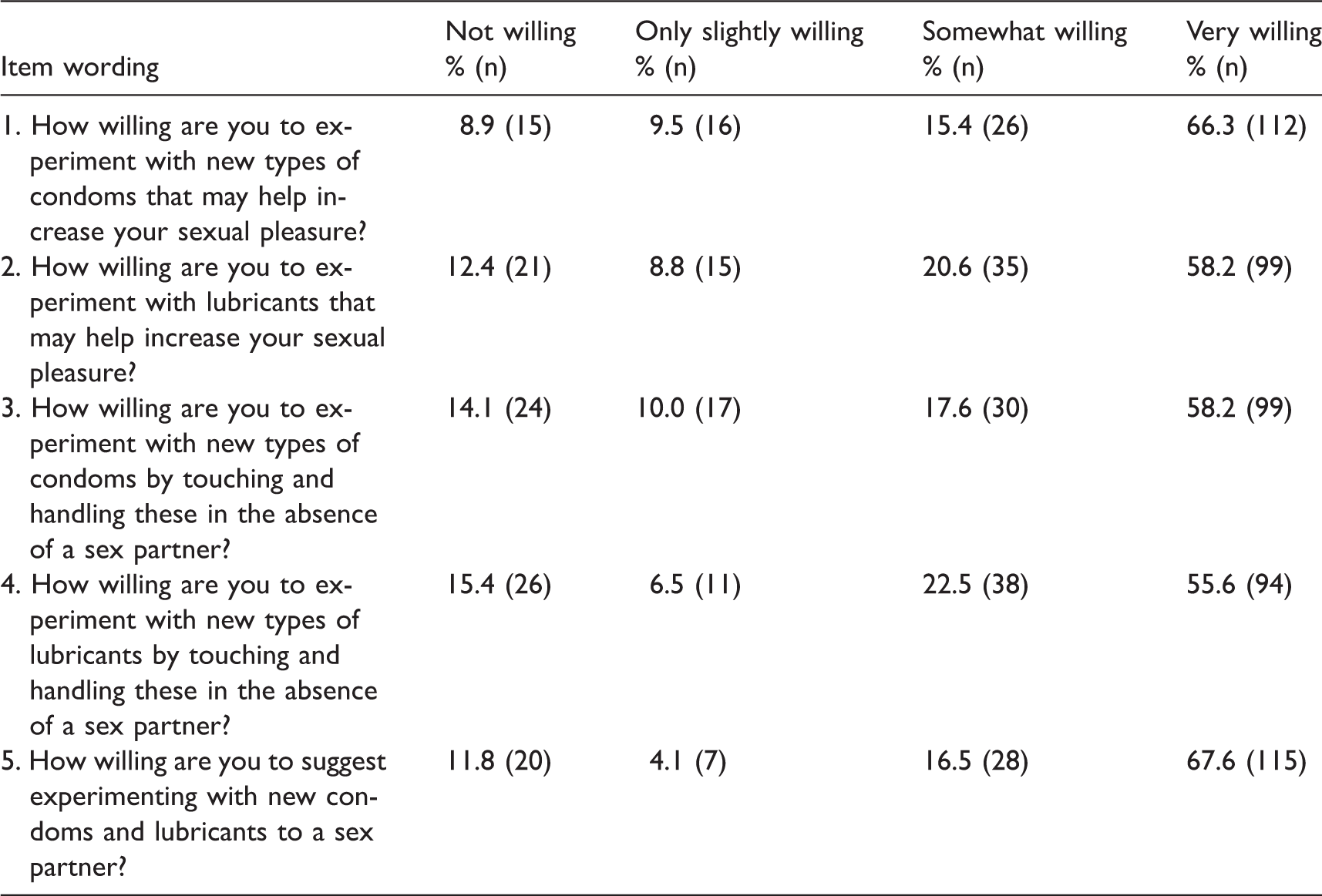
Willingness Scale. The outcome measure, ‘Willingness’ to experiment with condoms and lubricants, was assessed by a 5-item scale (see Table 1 for items). The items for this scale were the last presented and were preceded by the following ‘The next set of questions asks you about your comfort level in trying out new condoms and lubricants.’ Response options were coded ranging from 1 ‘not willing’ to 4 ‘very willing.’ The interitem reliability of this scale was excellent (Cronbach’s alpha=.88). Potential correlates of Willingness included two scales and four single-item measures.
Descriptive statistics for willingness items.
Condom and Pleasure Scale. The opening statement of the questionnaire was followed by the six items used for this scale assessing the effect of condom use on the woman’s sexual pleasure. The items, prefaced by the stem ‘The last time you had sex using a condom, to what degree did using a condom:’ were (1) ‘reduce your sexual arousal (i.e., “wetness” of your vagina)?’; (2) ‘cause you any physical discomfort during sex?’; (3) ‘decrease your sexual desire/passion?’; (4) ‘decrease your sexual pleasure?’; (5) ‘decrease your chances of having a satisfying orgasm?’; and (6) ‘decrease your emotional closeness to him?’ Each had response options ranging from 1 (indicating a great deal) to 4 (indicating no effect). Interitem reliability was excellent (Cronbach’s alpha=.84).
Lubrication and Enjoyment Scale. The items comprising this scale and the Lubrication Items (see below) were prefaced by the following statement: ‘For the next set of questions please think about the last time you used a condom that was either pre-lubricated or you (or your partner) added lubricant after it was on his penis.’ Each of the four items started with ‘Did the lubrication…’ followed by (1) ‘make sex more comfortable?’, (2) ‘increase your sexual desire/passion?’, (3) ‘increase your overall sexual pleasure?’, and (4) ‘help you have a satisfying orgasm?’ The four response options ranged from 1 (indicating no positive effect) to 4 (indicating lubrication enhanced enjoyment a great deal). Interitem reliability was excellent (Cronbach’s alpha=.89).
Lubrication Items. Table 4 contains the exact wording of the four lubricant items. Each had yes/no response options.
Data analysis
Cronbach’s alpha was used to assess interitem reliability for scale scores. Scales scores were calculated as means of the items and these were examined for normality. Women’s willingness to experiment with new condoms and lubricants was assessed in two ways: (1) by examining the distribution of responses for each of the willingness items, and (2) by examining the distribution of Willingness Scale scores. The distribution of the Willingness Scale had a strong positive skew. Thirty-nine percent (39.3%) of the women indicated responses of ‘1’ for each item (meaning they were ‘perfectly willing’ (PW) to experiment with condoms and lubricants). Therefore, we transformed this nonnormal distribution by dichotomizing it to compare those who were PW to those who were less than PW (<PW).
A number of methods were used to evaluate potential correlates of willingness. The Condoms and Pleasure Scale and the Lubrication and Enjoyment Scale deviated somewhat from normal, although to a lesser degree than the Willingness Scale. Therefore, PW/<PW group differences on these variables were tested using Mann–Whitney U as well as t-tests. The consistency in results across these two types of tests of group differences indicated that the deviation from normality was not so extreme as to preclude the use of parametric statistics. Therefore, results were reported from the t-tests. Age was assessed using the Independent Groups t-test. Chi square tests were used to analyze the association of categorical variables (i.e. four lubrication items and race) with being PW (PW versus <PW). Next, logistic regression using a forward Wald stepwise entry method was constructed to predict PW; significant and marginally significant correlates were entered as predictors and age and race were used as covariates.
Finally, we examined the relationships between previous experiences of condom use and lubrication experiences. Pearson correlation was used to assess the association between scores on the Condoms and Pleasure Scale and the Lubrication and Enjoyment Scale. Independent Groups t-tests were used to examine the relationship between scores on the Condoms and Pleasure Scale and the ‘yes’ versus ‘no’ answers provided to the four items that assessed lubrication practices. Statistical significance for all tests was defined by an alpha of .05. Analyses were conducted using SPSS (version 22.0).
Results
Mean age of the sample was 27.16 years (sd=8.57, median=24, range 18–63). Most women identified as Black/African American (85.9%), with 4.7% identifying as White and the remainder not indicating a racial identity. Table 1 shows the distribution on answers to each of the items comprising the Willingness Scale. Examining each item found the majority of women (55–68%) were very willing to experiment with condoms and lubricants that might increase their sexual pleasure, to do so by touching and handling condoms and lubricants in the absence of a sex partner, and to suggest experimenting with condoms and lubricants to a sex partner. Less than 16% indicated they were not willing to engage in these behaviors. The mean score on the Willingness Scale was 3.28 (sd=.87, median=3.60), with a range of 1 (PW to experiment (PW), 39.3% of the sample) to 4 (not at all willing to experiment, 3.6%). Sixty-one percent (60.7%) were in the <PW group (less than PW group).
The mean score on the Condom and Pleasure Scale was 2.90 (sd=.83, median=3.00), with scores of 1 indicating that condoms greatly decreased pleasure and 4 indicating no decrease. For the Lubrication and Enjoyment Scale, the mean score was 2.29 (sd=.99, median=2.25), with scores of 1 indicating that lubrication during condom use did not increase their enjoyment and 4 indicating lubrication greatly increased enjoyment.
Table 2 displays the observed bivariate associations between the correlates assessed at a continuous level and the dichotomized measure of willingness. As shown, of these, only the Lubrication and Enjoyment Scale scores differed by willingness. Those in the PW group had higher scores than the <PW group, indicating that they were more likely to report that lubrication during last condom use enhanced their enjoyment.
Bivariate associations between willingness to experiment with condoms/lubricants and continuous correlates.
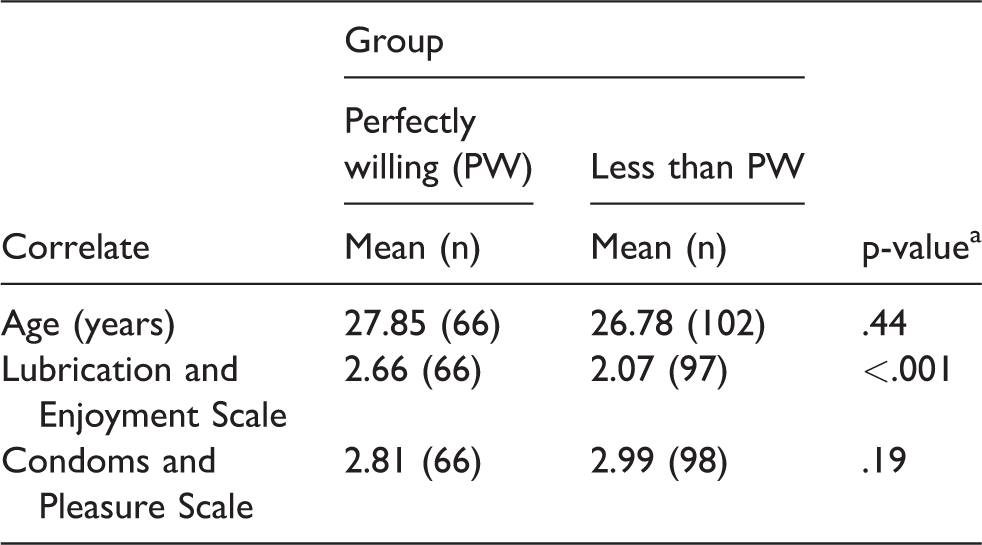
aAssessed with t-tests.
Table 3 displays the observed bivariate associations between the categorical measures and Willingness. As shown, only one comparison attained significance. Those reporting that condoms dried out during sex were more likely to be in the PW group than those who did not report this condom use problem. Two other items attained marginal significance: whether the amount of lubrication was enough to last until sex ended and whether the amount of lubrication was enough to ‘keep you sexually satisfied.’ Those answering ‘no’ were more likely to be in the PW group than those who answered ‘yes.’
Bivariate associations between willingness to experiment with condoms/lubricants and selected dichotomous correlates.
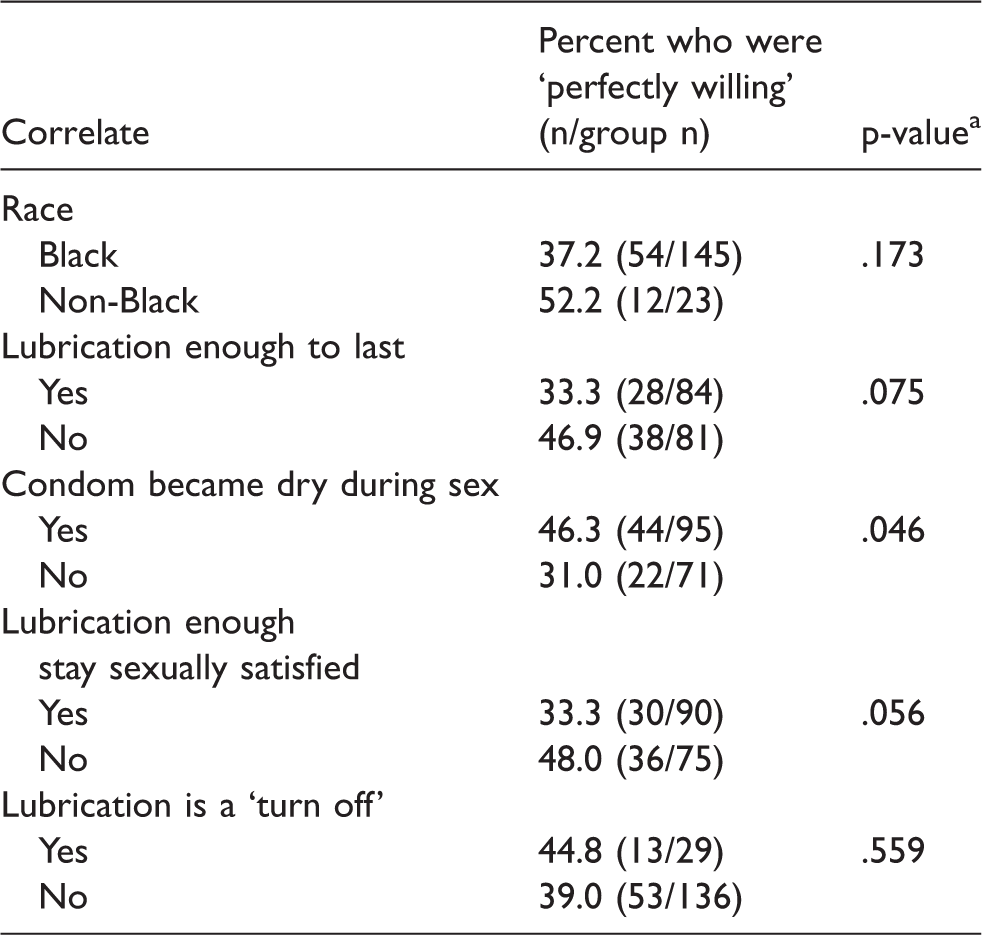
aBased on Chi square tests comparing the percentages of the PW and <PW group who answered yes and no for each item.
Bivariate associations of lubrication items and scores on the Condom and Pleasure Scale.
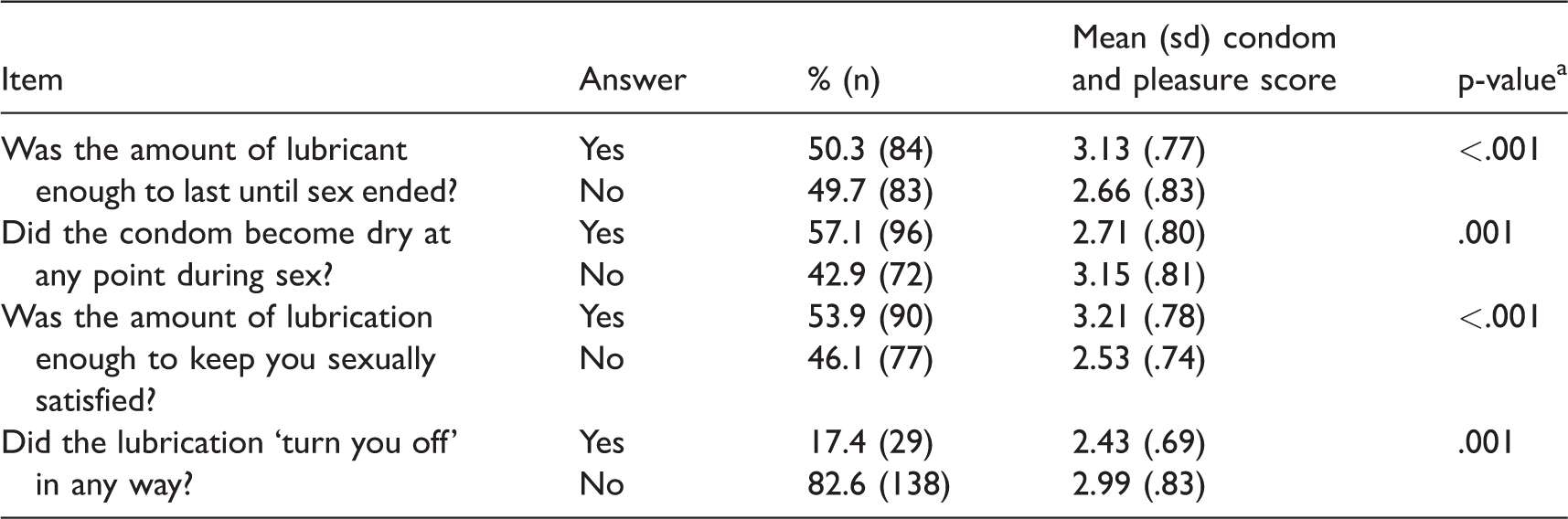
aBased on t-tests for each item comparing mean Condom and Pleasure Scores for ‘yes’ versus ‘no’ groups.
A logistic regression model using a forward Wald stepwise entry method was constructed for PW/<PW as the dependent variable using the two significant correlates (i.e. Lubrication and Enjoyment score, whether condom dried out), the two marginally significant correlates (i.e. lubrication lasted and lubrication was enough items) as well as age and race as covariates. Only one of these six variables attained multivariate significance as predictor of perfect willingness. The Lubrication and Enjoyment Scale yielded an adjusted odds ratio of 1.99 (95% CI=1.40–2.84, p<.001), indicating that for every one unit increase in this scale (meaning that lubrication was reported as more enhancing of enjoyment) there was a 99% increase in the odds of women being PW to experiment with new condoms and lubricants. Using the continuous measure of willingness, the correlation between the scores on the Lubricant and Enjoyment Scale and the Willingness Scale was .37 using Spearman’s rho (p<.001).
Additional analyses were performed examining the relationship of the Condom and Pleasure Scale with the Lubrication and Enjoyment Scale and the four lubricant items. The two scales were not significantly correlated. As can be seen in Table 4, all four of the lubricant items were significantly related to the Condom and Pleasure Scale. Specifically, lower scale scores (indicating that condoms interfered with sexual pleasure) were found for women who reported that the amount of lubricant was not enough to last until sex ended, the condom became dry before sex was over, amount of lubrication was not enough to maintain sexual satisfaction, or that the lubrication ‘turned them off.’
Discussion
The women in this sample were willing (many very willing) to experiment with condoms and lubricants that might increase their sexual pleasure. Specifically, the majority of women in the sample, regardless of age or race, were prepared to: (1) experiment with new types of condoms and lubricants that increase their sexual pleasure, (2) touch and handle these products in the absence of a partner, and (3) suggest experimenting with new condoms and lubricants to a sex partner. More than one of every three women (39.3%) responded that they were ‘very willing’ on each of the five willingness items (categorized as PW). Being PW to experiment with condom and lubricant use was predicted by previous experience with lubrication during condom use and the degree to which women reported that lubrication enhanced their sexual enjoyment. Specifically, multivariate analysis demonstrated that greater likelihood of being PW to experiment with condoms and lubricants was associated with higher scores on the Lubrication and Enjoyment Scale indicating that lubrication during last condom use enhanced the sexual experience in terms of comfort, desire/passion, sexual pleasure, and satisfying orgasm. Comparing continuous measures, there was a significant positive correlation between Lubrication and Enjoyment Scale scores and Willingness Scale scores. These findings demonstrate that the more positive women’s previous experience was with lubrication enhancing sexual enjoyment during condom use, the more willing they were to experiment with and touch and handle new types of condoms and lubricants on their own and with a sex partner to enhance sexual pleasure. These findings suggest the possibility that women are interested in trying new condoms and lubricants and that lubrication may be an important aspect of making condom use more consistent with women’s sexual pleasure.
Of particular interest, 67.6% of women were ‘very willing’ to suggest experimenting with new condoms and lubricants to a sex partner. The importance of this finding is that women may not need encouragement, ‘coaching,’ or enhanced self-efficacy to instigate the use of condoms and lubricants with their male partners. Indeed, many women may have adequate relational power and sexual agency to work with their male partners to improve their use of condoms and lubricants. This perspective is quite different from past research focusing on women who may lack the needed agency and power4–6 to affect condom use. One perspective does not preclude the other. Some women in some contexts may lack the power and agency to negotiate use of male condoms effectively. But the view of condom use as ‘male controlled’ and of women as relatively powerless to influence male condom use27,28 obscures the potential for women to affect use of male condoms positively. These findings suggest the possibility that women (1) care about their sexual pleasure as a factor in condom use, (2) are eager to learn about condoms and lubricants to enhance their sexual pleasure during condom use, and (3) are willing to engage their male sexual partners in trying different condoms and lubricants. Because this exploratory study represents women in only one clinic of a southern U.S. city, subsequent studies of women in other clinical settings are needed to determine the stability of these findings across samples.
Another commonly cited barrier to condom use for women is that condoms may interfere with a sense of emotional closeness to male partners. The majority (59.2%) of women in our sample reported that condom use did not decrease their emotional sense of closeness to their partner ‘at all’ and only 13.6% said it decreased this a great deal. These findings suggest that it is important not to assume that women experience decrements in emotional closeness with condom use.
Taken together our findings suggest that there may be an underutilized opportunity to involve women more fully in condom use promotion. Women engaging in sex with men can and should become well versed in the wide array of options for both condoms and lubricants. Women may actively preselect their choice of condoms and lubricants for a particular sex partner, thus optimizing her pleasure and his. This focus on the pleasure-related aspects of condom and lubricant use may, in turn, facilitate and empower women’s negotiation of condom use.
Of importance, lubrication-related experiences also correlated with women’s sexual pleasure during sex protected by condoms (as measured by Lubrication and Enjoyment Scale). Also women who reported negative lubrication experiences during last condom use (insufficient lubrication, condom becoming dry, or lubrication ‘turned them off’) reported that condom use interfered with their sexual pleasure. Thus, interventions designed to enhance women’s use of adequate and long-lasting lubricants that are compatible with male latex condoms may be a valuable approach to reducing epidemics of HIV and other STIs. These findings also have implications for observational research studies as erroneous conclusions about women not liking condom use may be made when the reality instead is that inadequate lubrication during condom use is the issue.
Given the extreme level of the HIV epidemic in the U.S. south, especially for Black women,1–3 forgoing condom use in the pursuit of sexual pleasure is not a safe or acceptable option. Instead, learning to make condom use compatible with sexual pleasure is perhaps a reality that comes with the advanced HIV epidemic in the south. These data speak to the desire of at-risk women to have condom use become a compatible and satisfying aspect of their overall sexual experiences with male partners. Thus, the study findings support and extend previous research regarding the role of sexual pleasure in condom use promotion programs designed for women.
The experience of having adequate lubrication was associated with deriving pleasure from sex protected by condoms. Interestingly, unlike the Lubrication and Enjoyment Scale, the Condom and Pleasure scale was not associated with willingness to experiment with condoms and lubricants. Women may be satisfied with condom use per se and only feel that improvements in their sex lives may be fostered from learning and practicing new methods of introducing lubrication into condom-protected sex. This aspect of condom use deserves more attention and condom promotion efforts, especially those directed toward women, may benefit from more discussion of adding lubricant during condom use and the variety of condom-compatible lubricants that women may want to try.
Findings can be used to help inform the design of behavioral interventions for women attending STI clinics. This is important because developing novel methods of promoting condom use to women at risk of HIV acquisition remains as a ‘frontline’ effort in reducing HIV incidence. This is true even in the era of preexposure prophylaxis (PrEP) because guidelines for PrEP recommend adjunctive counseling to promote condom use. 34 Novel behavioral interventions to promote condom use to women are also vital given that the U.S. Centers for Disease Control currently recommends condom use for both pregnant and nonpregnant heterosexual couples in light of the potential for sexual transmission of Zika virus when male partners may be infected or in areas with Zika. 35
Limitations
First, it is imperative to note that this study assessed women’s willingness to suggest/introduce condom use to their male partners; this is much different than their actual ability to do so in a successful manner. Clearly, willingness is only one factor in a larger equation of condom use. Further, the findings are limited by the use of a convenience sample and the inherent limitations of cross-sectional study. Also, it is acknowledged that findings pertain to women attending an STI clinic; thus generalization to women not attending clinics is precluded. Finally, it is important to note that the study did not quantify how much women care about the loss or gain of sexual pleasure and it did not assess the degree of eagerness/priority to learn about condoms/lubricants. Given the bivariate associations revealed by this exploratory study, a more extensive study should be conducted that includes a thorough assessment of theory-based constructs that may serve as covariates for more definitive analyses.
Conclusion
It is important not to underestimate the role women may play in male condom use. Findings suggest the possibility that Black women attending publicly funded STI clinics in the southern U.S. may be willing to engage in self-practice, or partnered practice, with condoms and lubricants. Adequate and lasting lubrication may be an especially critical factor to enhance pleasure during condom-protected sex and to experimenting with new types of condoms. Thus, clinicians may possibly benefit female patients by encouraging them to consider experimenting with a variety of condoms and lubricants, alone or with sex partners. This suggestion from clinicians should be made in the context of women’s personal relationship factors. For example, women who may be in abusive relationships will have very different counseling needs than those in healthy relationships. Clinicians may want to simply ask, ‘does your partner get involved in talking with you about condom use?’ Women’s response to this question can then be used to guide the remainder of time used for counseling. Prompting women to experiment with condoms/lubricants can be achieved, in part, by providing women with a selection of multiple condoms prelubricated with a variety of lubricants as well as providing an equally broad variety of premium lubricants that can be added to condoms both before and during sex. Our findings suggest that women in high HIV-seroprevalence areas will be likely to embrace the concept of self-practice with condoms/lubricants and that only a small percentage may reject this idea.
Footnotes
Declaration of conflicting interests
The authors declared no potential conflicts of interest with respect to the research, authorship, and/or publication of this article.
Funding
The authors disclosed receipt of the following financial support for the research, authorship, and/or publication of this article: Funding was provided by an endowment to the second author.